
The aim of this page is to systematically explore the history and circumstances of M2117 .S325 1842 in the MSU Libraries’ Murray and Hong Special Collections.
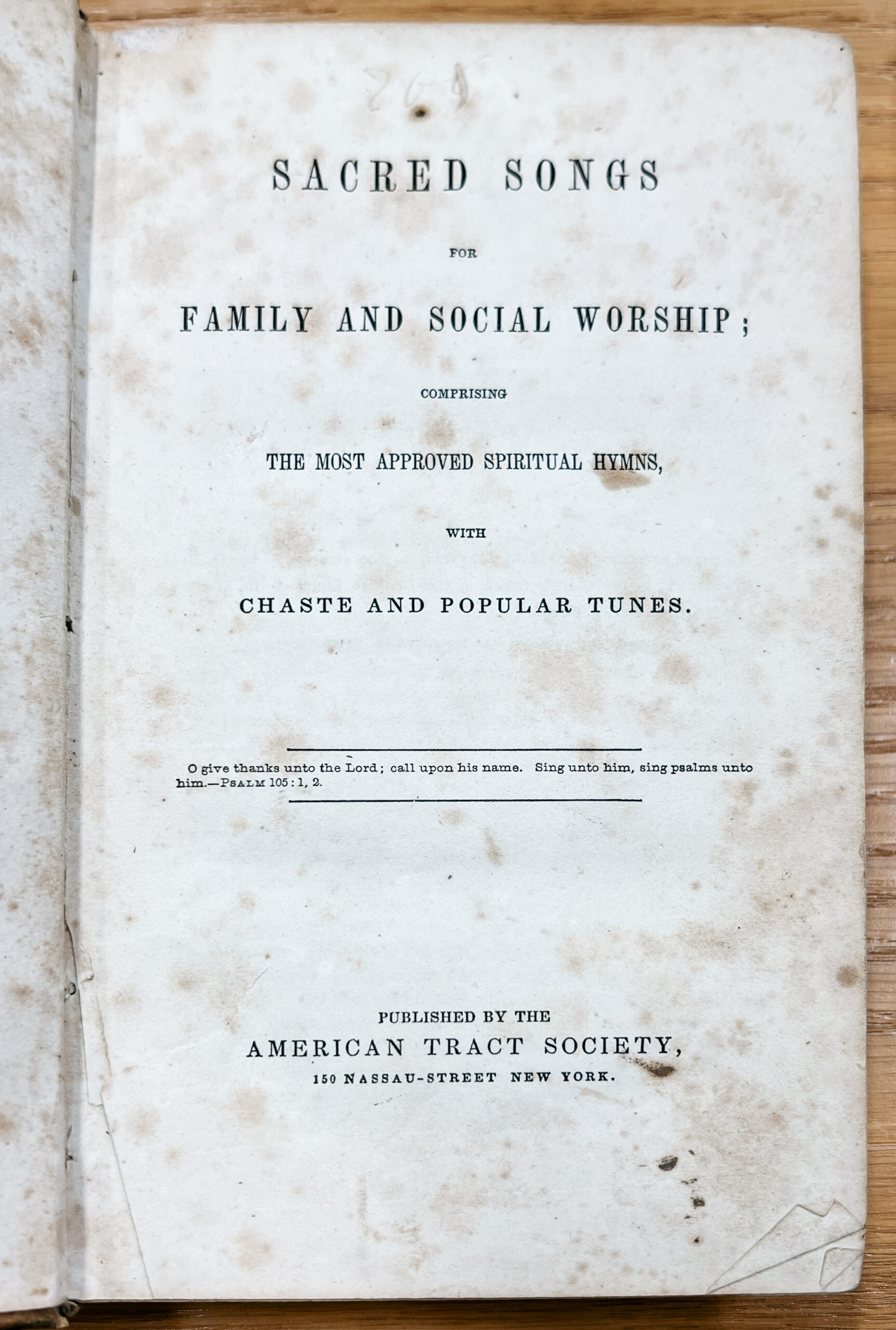
The title page of this item provides the customary bibliographic information for reference. Of particular note is the addition of a Biblical epigraph betwixt the title and colophon. Psalm 105 is a popular choice for Christian texts whose authors have the penchant to rhapsodise at length about giving praise and worship to God. Theologically speaking, this epigraph does, indeed, align itself with the nature of this book as a hymnal.
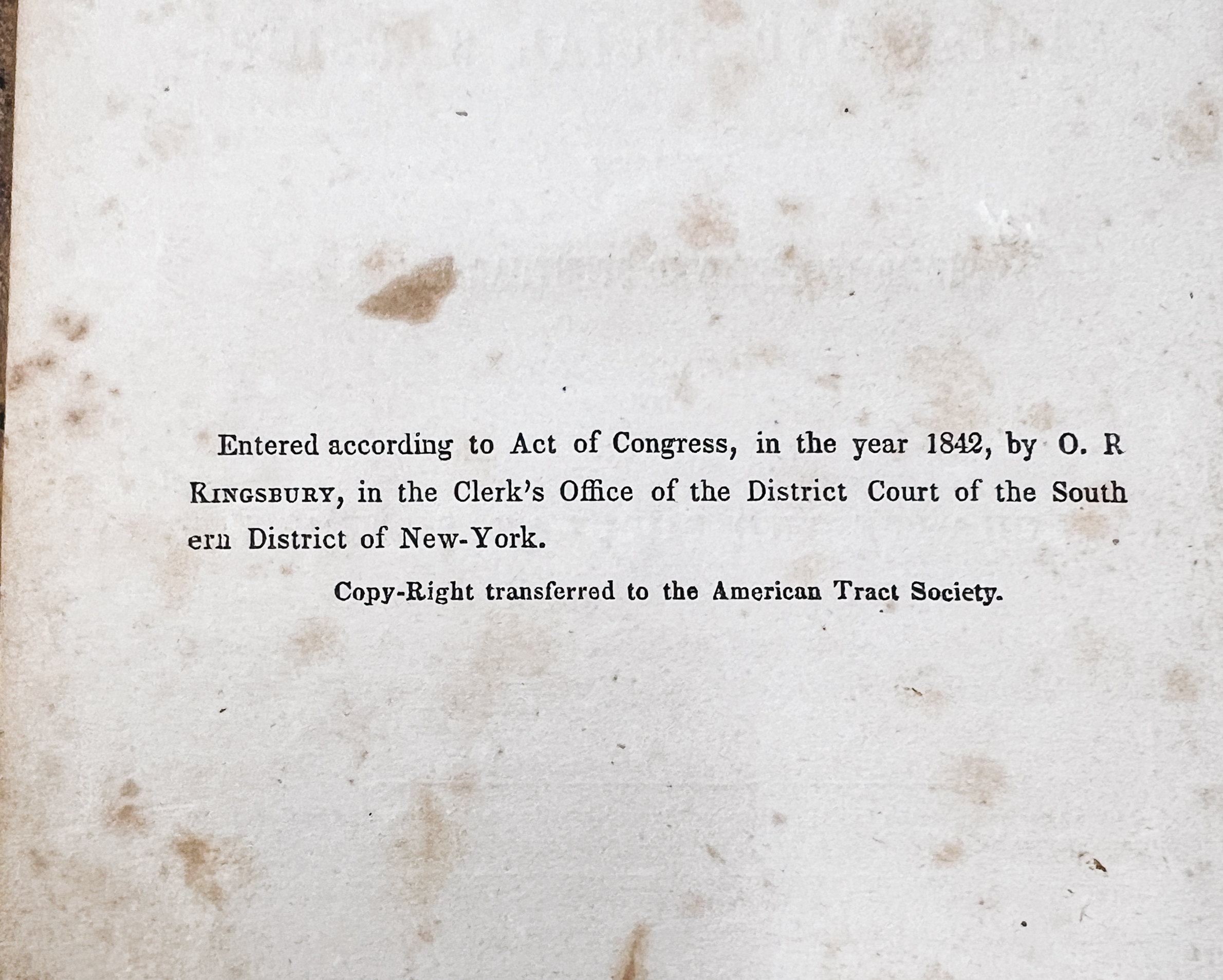
While a simple colophon appears on the title page—stating the publisher and origin—a traditionally complete colophon may be found on the reverse side of the title page. The book was published in 1842 in New York City and this event precipitated a transfer of copyright to the publisher, the American Tract Society.
Material Description
Binding
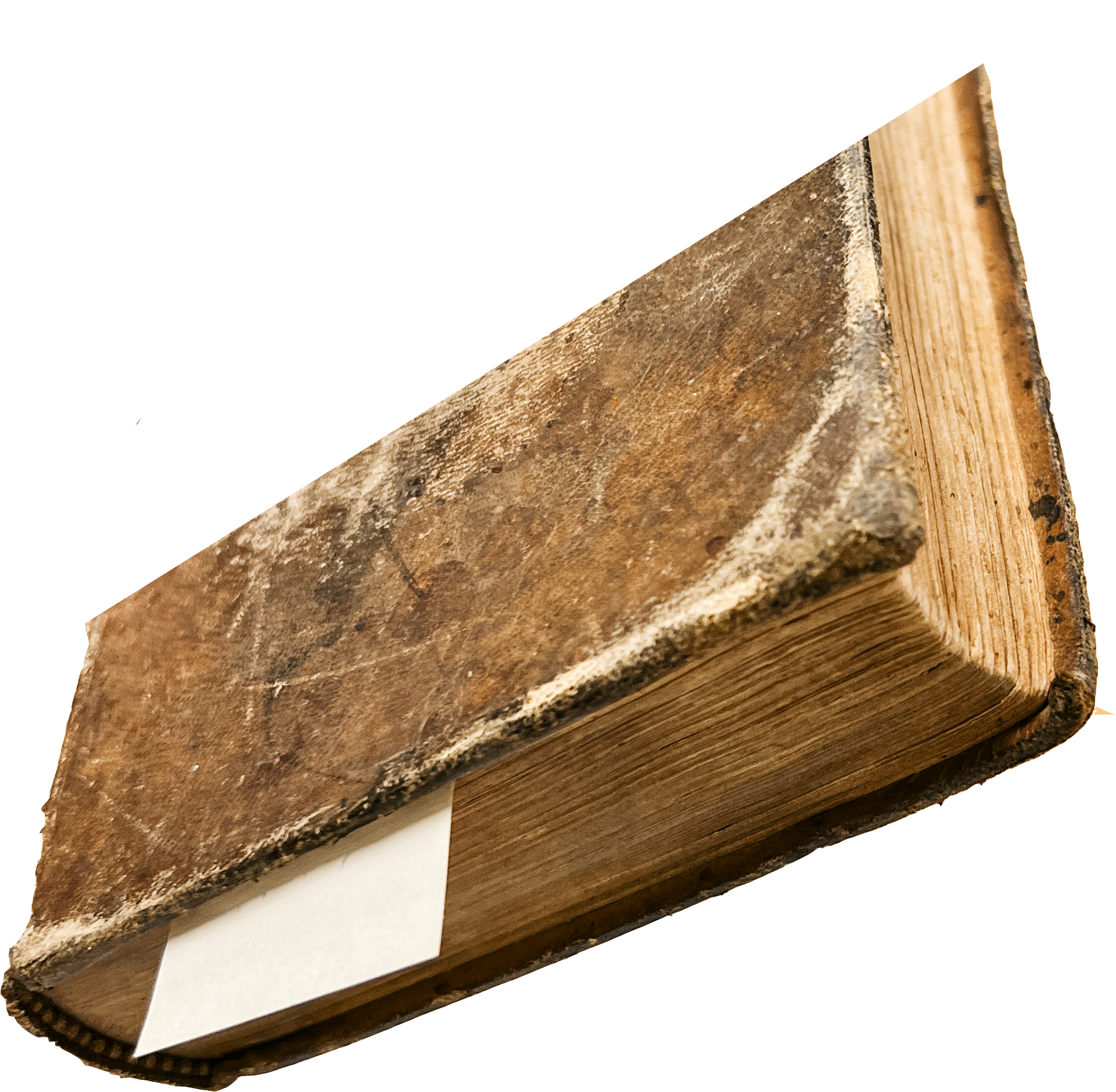
Given its softness of touch and tight, regular grain, it is reasonable to suppose that the binding is sheepskin. This educated guess is further supported by an existing record of sale for a copy of the same edition, wherein the seller describes “Brown sheepskin leather binding with black leather title label on the spine.” The binding is original and complete in this first edition.
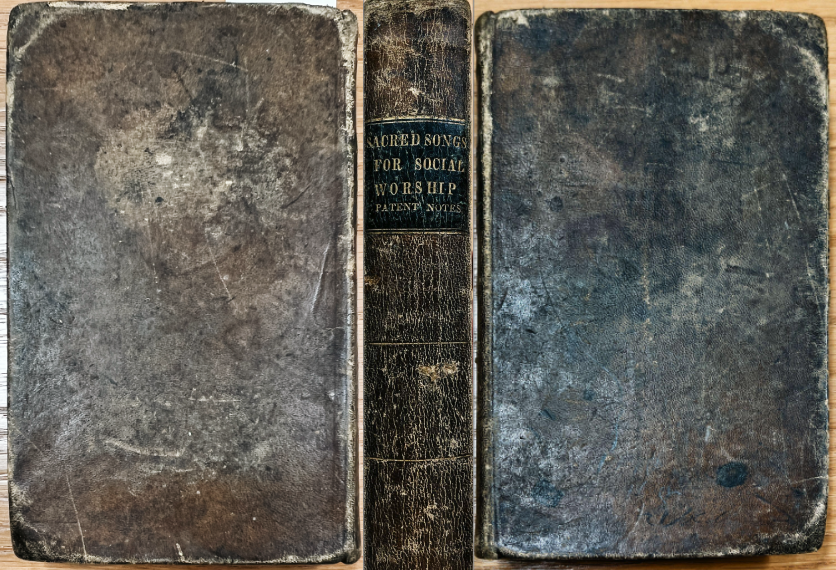
There is significant corner bumping to both end boards, resulting in severe page warping.
Pages
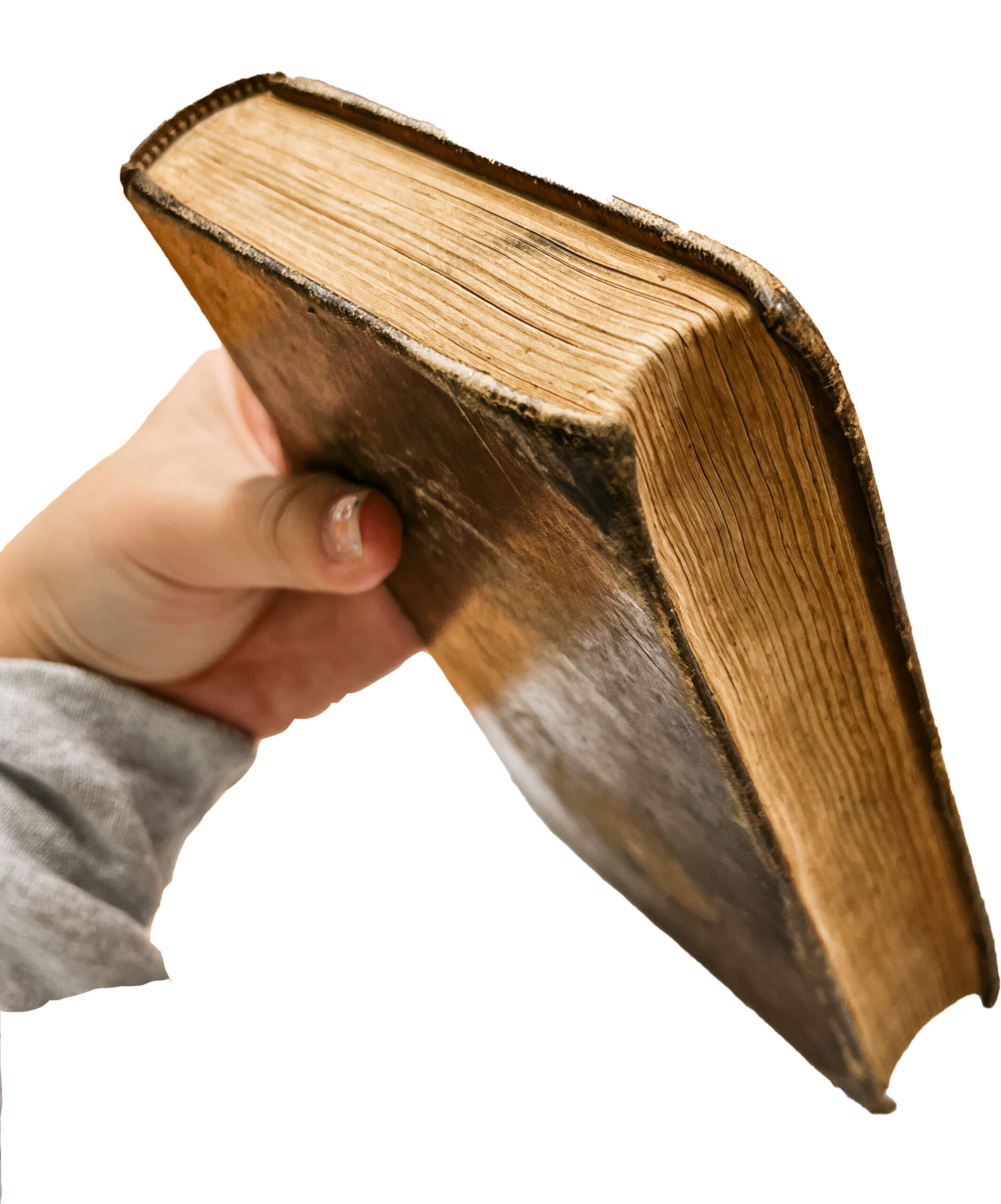
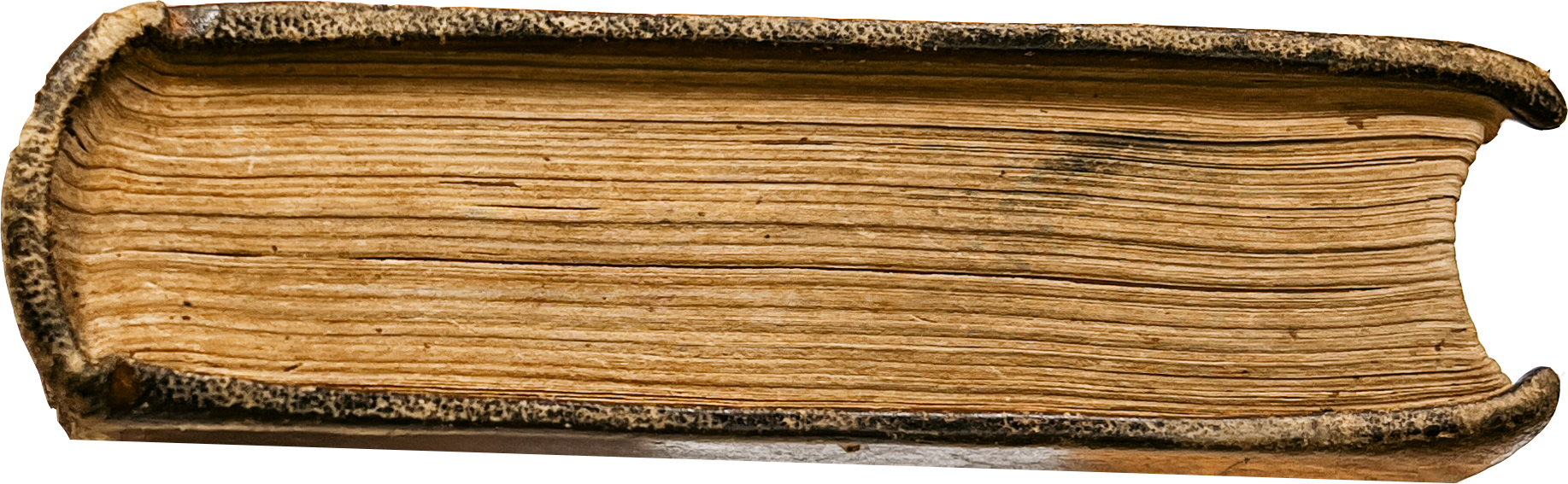
There are 343 pages with music (not including the end leaves).
Other information
According to WorldCat, there are 150 holdings of Sacred Songs worldwide.
OCLC 1157192092; LCCN 45044475.
Contents
Shape Note Singing
The astute observer will notice that the musical scores in Sacred Songs feature notation that differs distinctly from standard musical notation. This unique style uses noteheads with distinctive shapes. Each shape corresponds to a unique pitch in the given key. In any given key, there is the corresponding scale of 8 notes and each note is assigned a name (those knowledgable of music will recognise this as the solfège). Regardless of the key, the names for each pitch of the scale remain unchanged. Here it must be noted that shape note music does not typically follow the seven-shape system. Based on the number of distinct noteheads used, Sacred Songs follows the tradition of the foundational shape note hymn, Sacred Harp, by using the four-shape system.
(It is with the deepest and most sincere regret that here, one is forced to reference the unfortunate scene of children frolicking through the Alps, singing a ridiculous ditty about drops of golden sun and needles pulling thread, and all while being enabled by a highly irresponsible and deplorable excuse of a governess. However, one can cheer oneself up with the thought of how difficult it would have been for Maria to compose a ditty about the truncated solfège….)
Historically, shape note music was most commonly seen in New England and, later, in the South. The function of shape note music was that it bypassed the need for musical literacy and, therefore, was accessible to the common folk of America during the long 19th century. It was (and remains to the present day) a profoundly communal worship practice, most often at church or a large gathering in a home, and with the four parts (Soprano, Alto, Tenor, Bass) facing each other in a square.
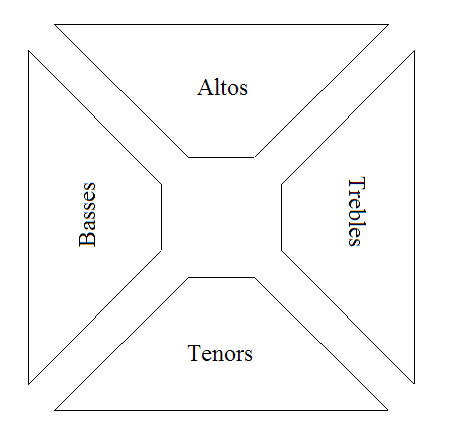
The modern reader may compare the SATB parts in Sacred Songs with the music found in more formal hymnals, where a much higher degree of technical vocal ability is required of congregants. In contrast, the composition in shape note psalters (and in modern reformulations of old hymns) is much more conducive to the hearty participation of common congregations.
The American Tract Society
The American Tract Society (ATS) was founded in 1826 with the express purpose of printing and distributing Christian texts. Prior to the ATS, the only widely circulated Christian literature was the Bible. Inspired by similarly-styled “tract societies,” ATS began distributing large quantities of cheaply produced literature, first with tracts and pamphlets, but quickly expanding to books (and thus the unfortunate genre of popular Christian literature took hold…).
In its first year, ATS printed nearly 700,000 tracts, and by 1850 was publishing over five million.
Landmarks Preservation Commission, June 15, 1999; Designation List 306 LP-2038
The ATS members chose the “wicked” place of New York City to establish their headquarters, reasoning that it was an excellent place to begin their mission of proselytising (something about “preaching to the choir,” but who gives a toss). Quickly gaining traction (ha, ha), the ATS decided to build a building that is apparently quite famous for historic reasons; it was one of the tallest buildings in the city at the time and is flanked by the buildings of the New York Times and the New York Tribune.
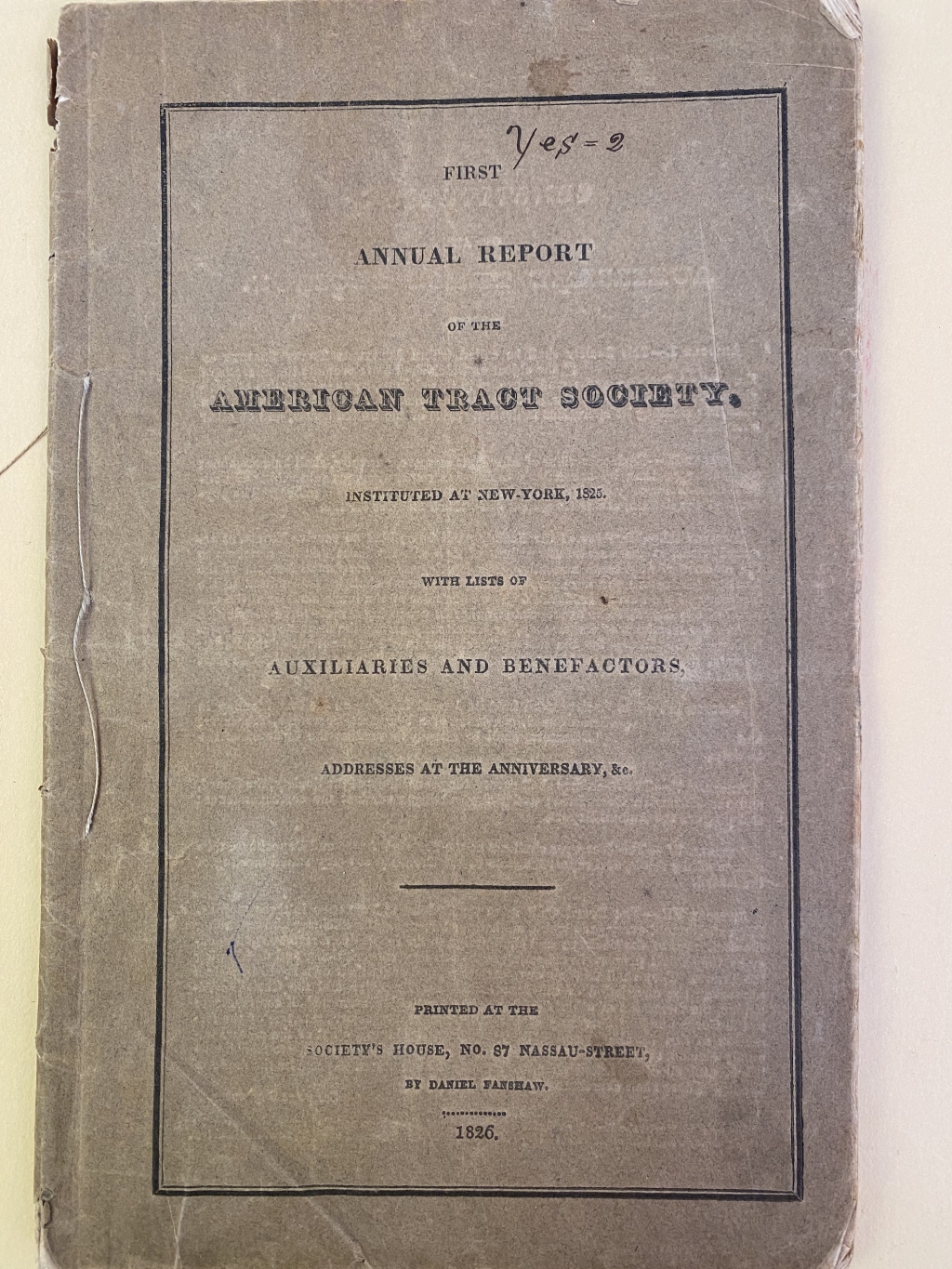

One will observe that, while with strong flavours of Puritanism, the ATS was a fairly ecumenical organisation as it catered to a variety of Christian sects with a desire to appeal to a large audience. Hence the motivation behind publishing and distributing volumes like Sacred Songs.
Oliver Richmond Kingsbury
While the call slip for Sacred Songs lists O.R. Kingsbury as the author, this is a bit of a mischaracterisation. Per the complete colophon on the reverse of the title page, Kingsbury was merely responsible for submitting the appropriate documentation for Sacred Songs to the district clerk. Looking elsewhere, the volume is typically attributed to either the ATS or Thomas Hastings, the primary musical hand that assembled the contents.
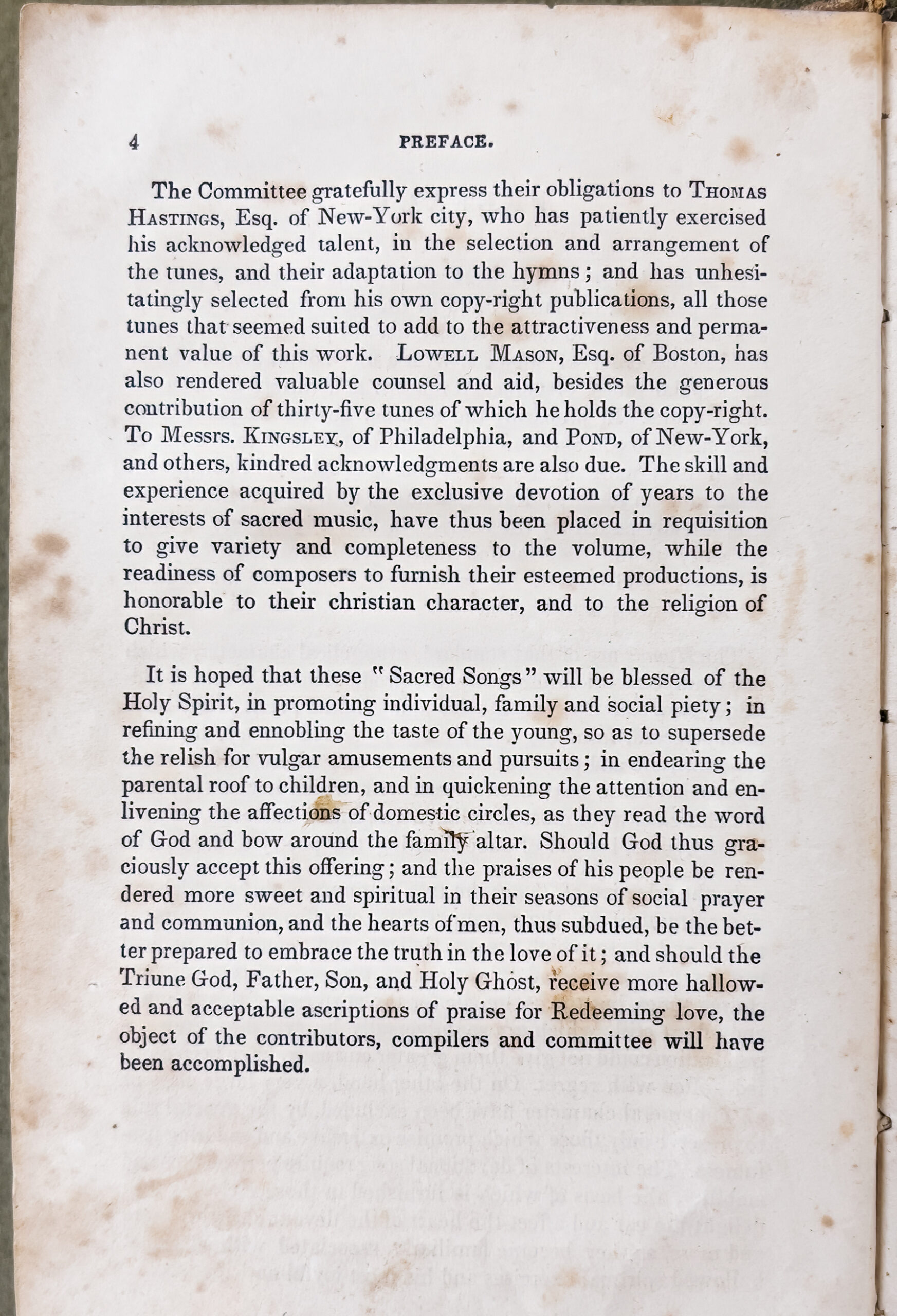
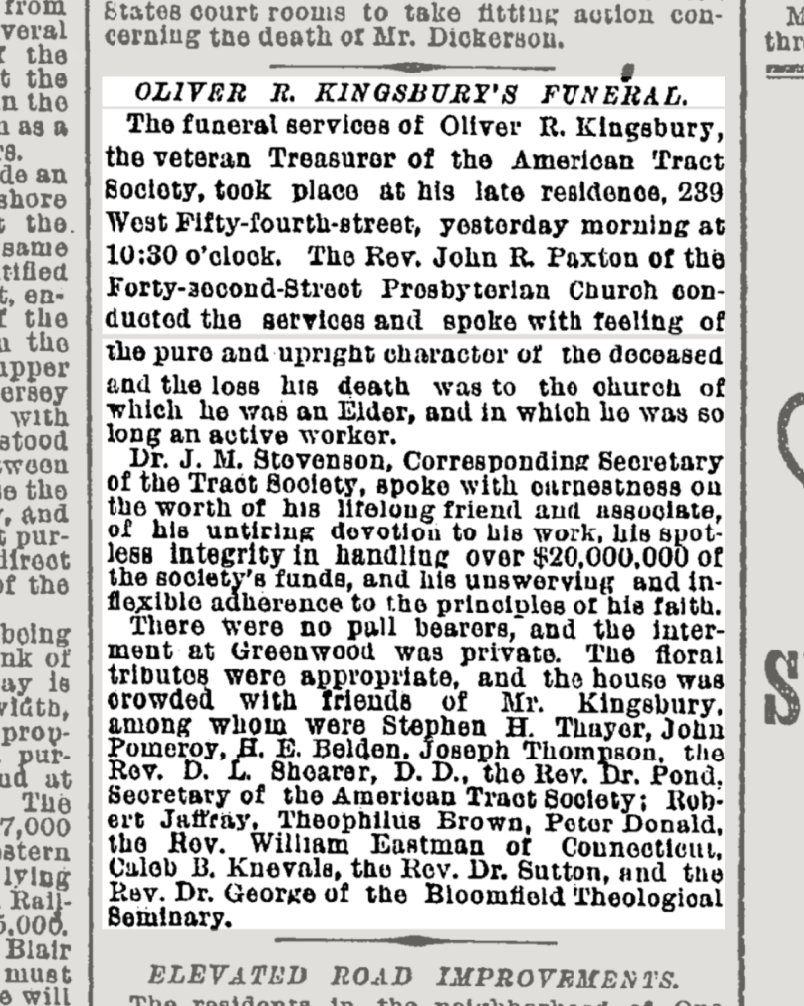
That said, Kingsbury was still a key figure in the early years of the ATS. Born in 1809 in Massachusetts, O.R. Kingsbury’s tenure at the American Tract Society spanned approximately 68 years. Many of these years were spent as the organisation’s financial steward, though it is not entirely clear whether this was his position at the time of Sacred Songs‘ publication.
Markings
There are a number of readily apparent instances where people have written inside Sacred Songs. These markings can be divided into two categories, discussed below.
The Shedd Family
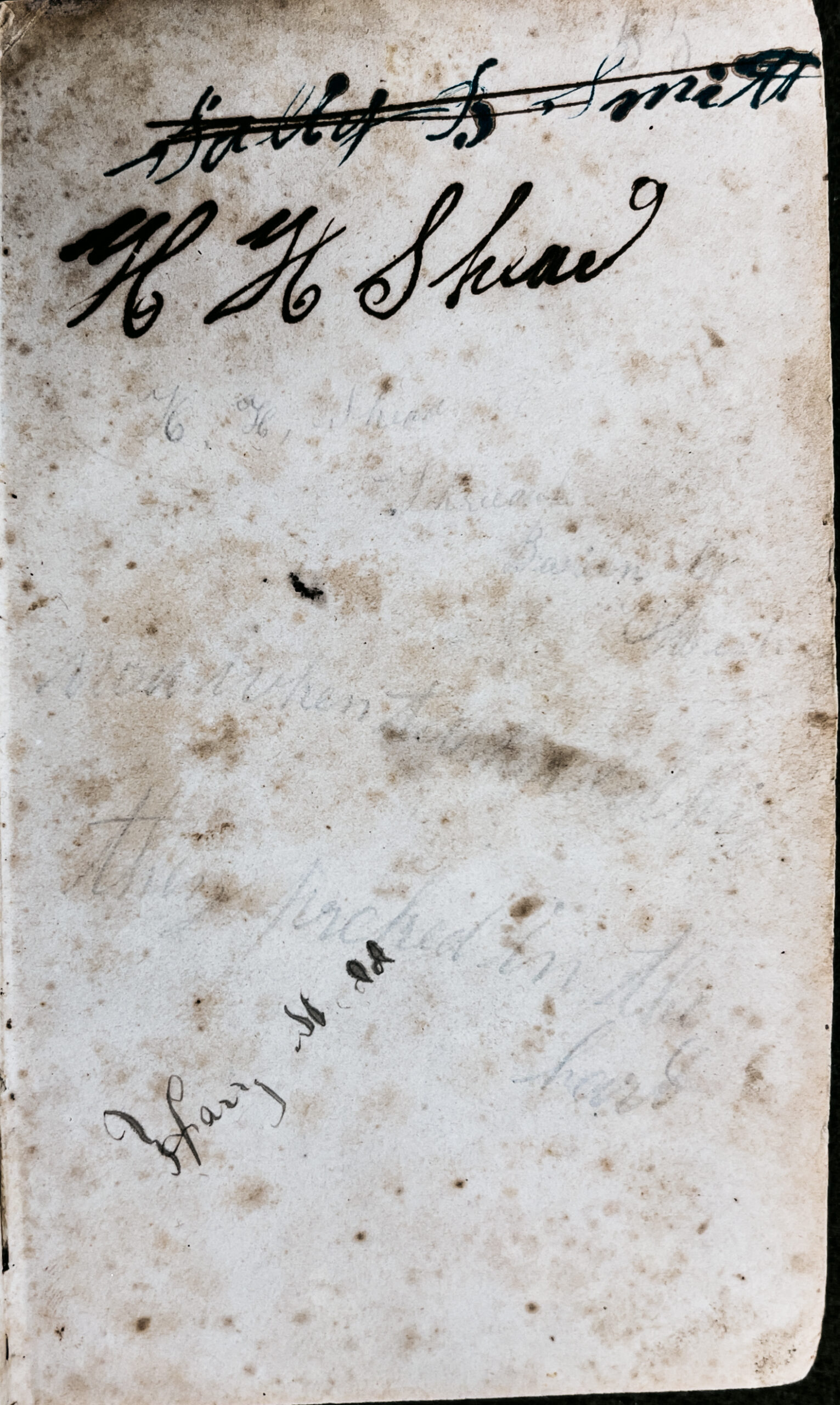
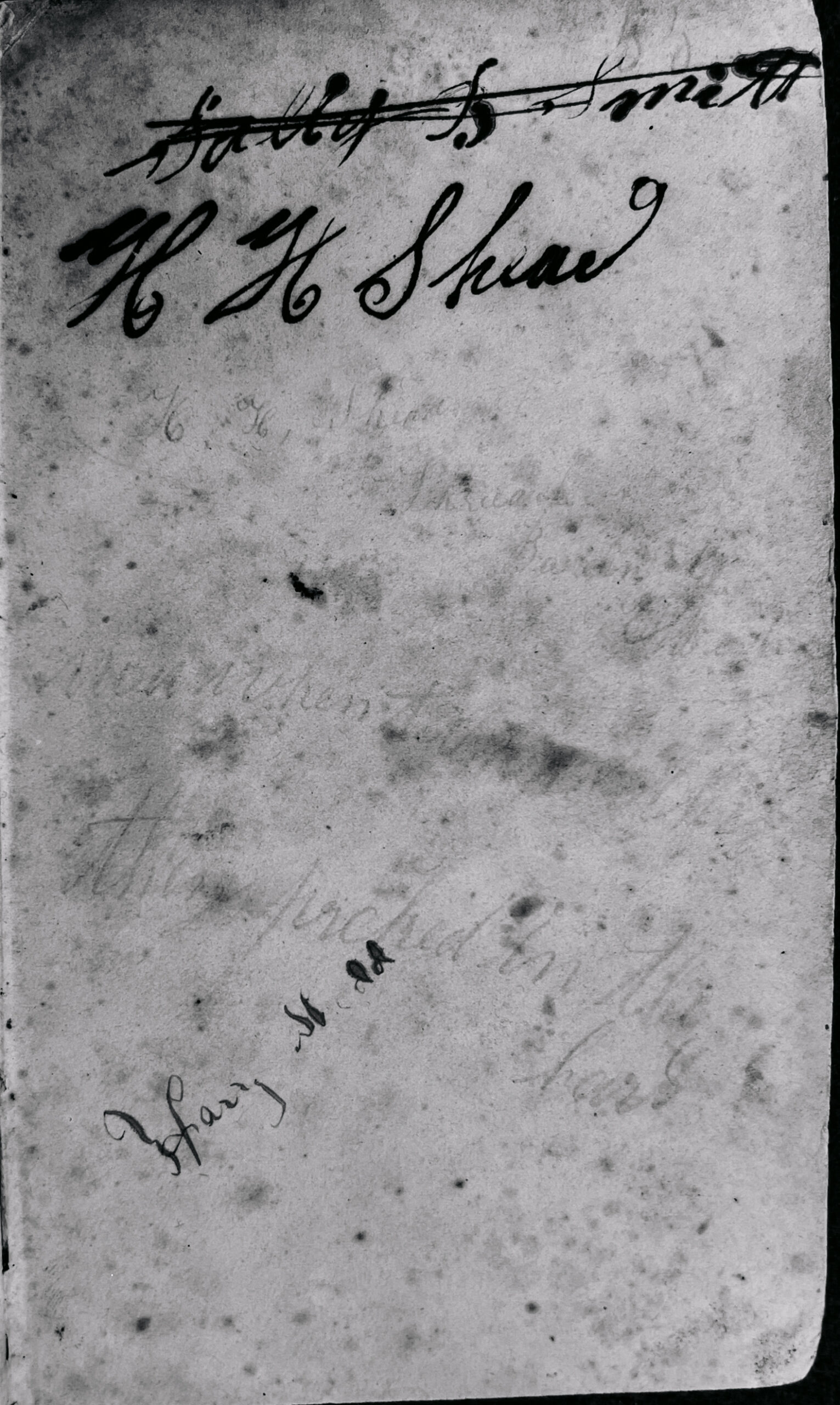
The inscription that appears first is the name of Sally B. Smith in blue ink. On first inspection, the last name appears as though it could be “Smitt,” but for reasons discussed below, it is meant to be read as “Smith.”

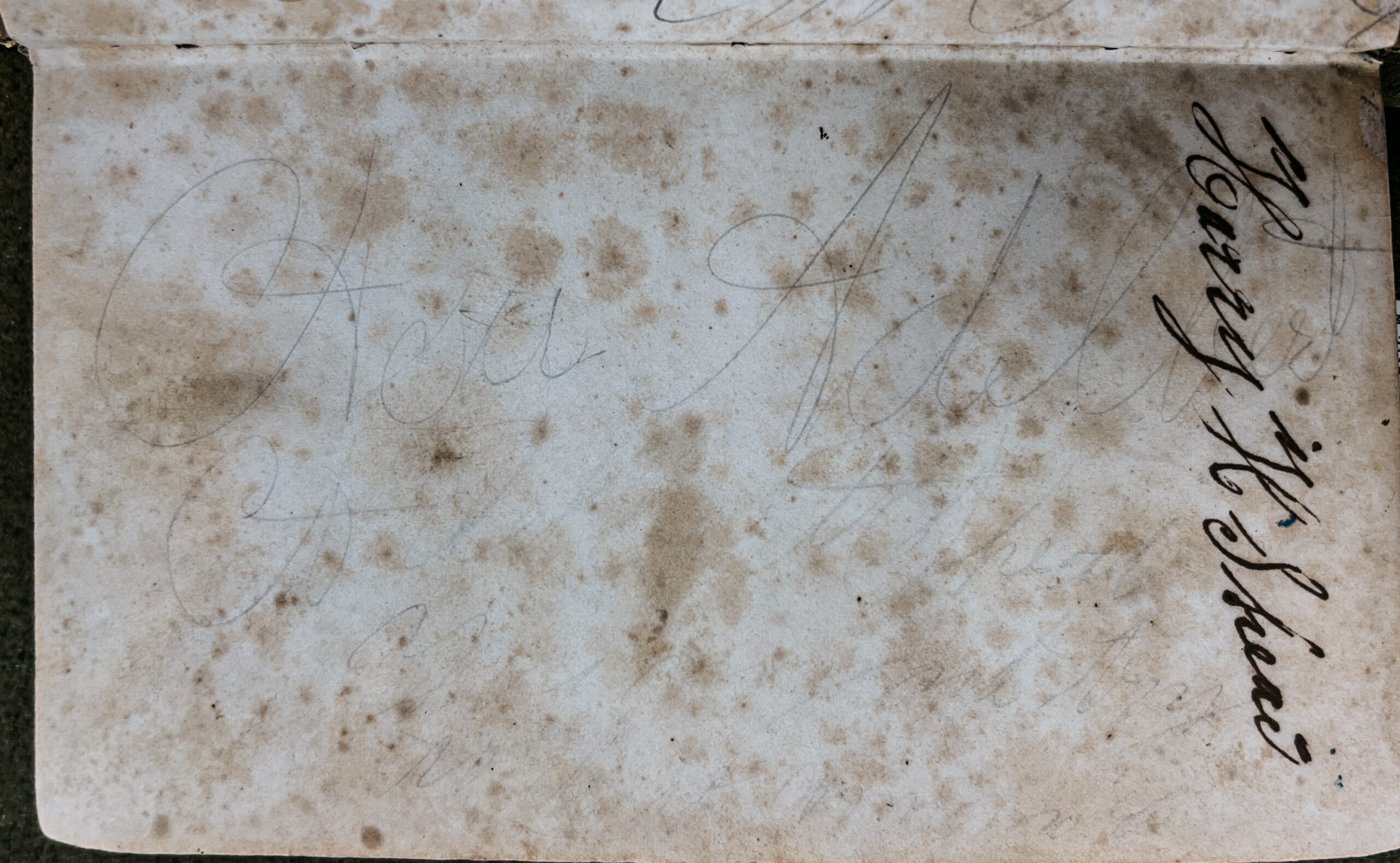
This inscription was struck out by the subsequent owner of the book, Harry H Shedd, who then proceeded to inscribe his own name multiple times throughout the book, appearing to practice his signature.
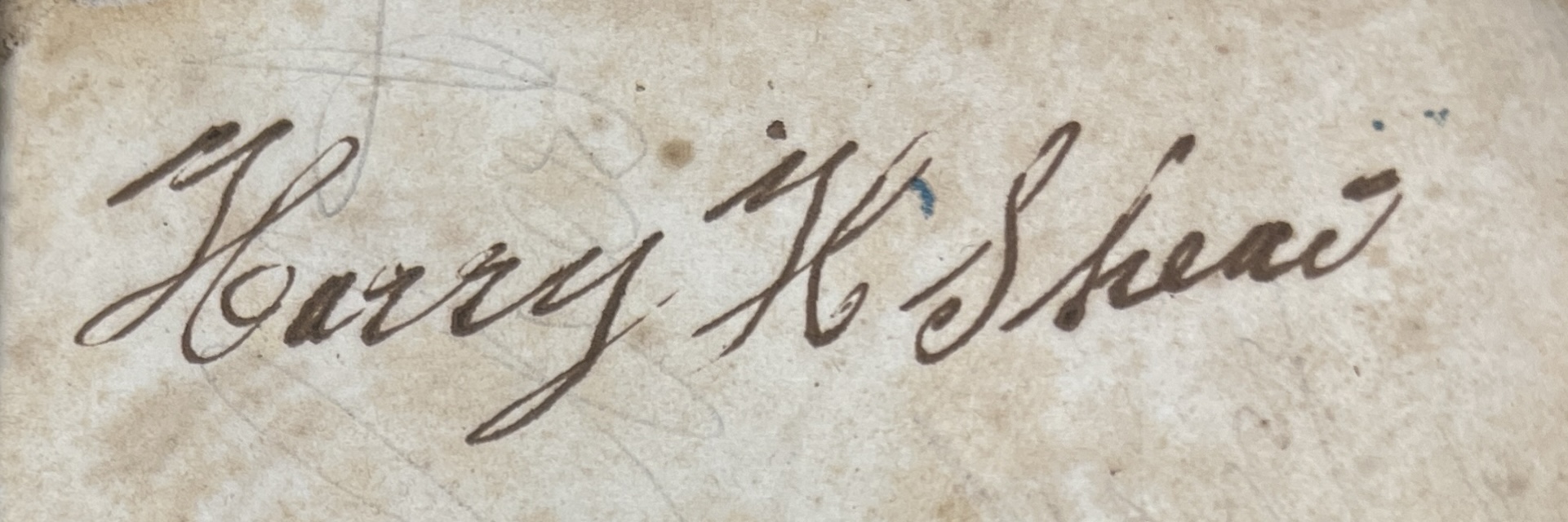
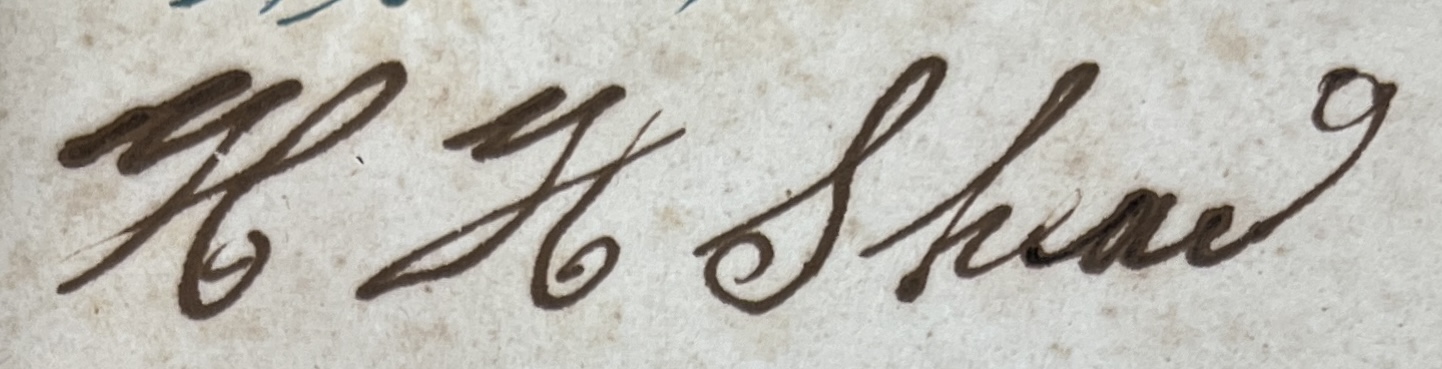
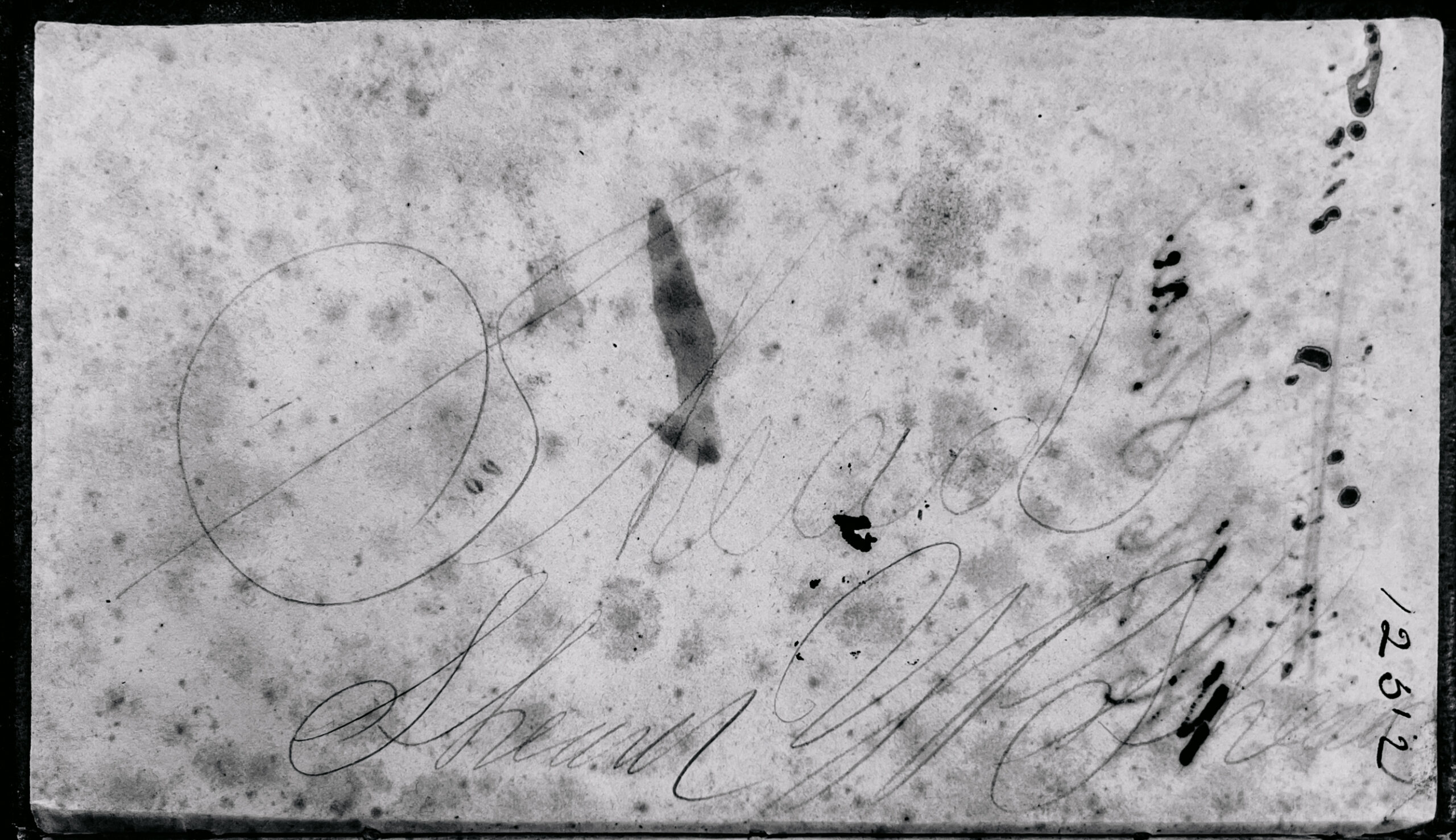
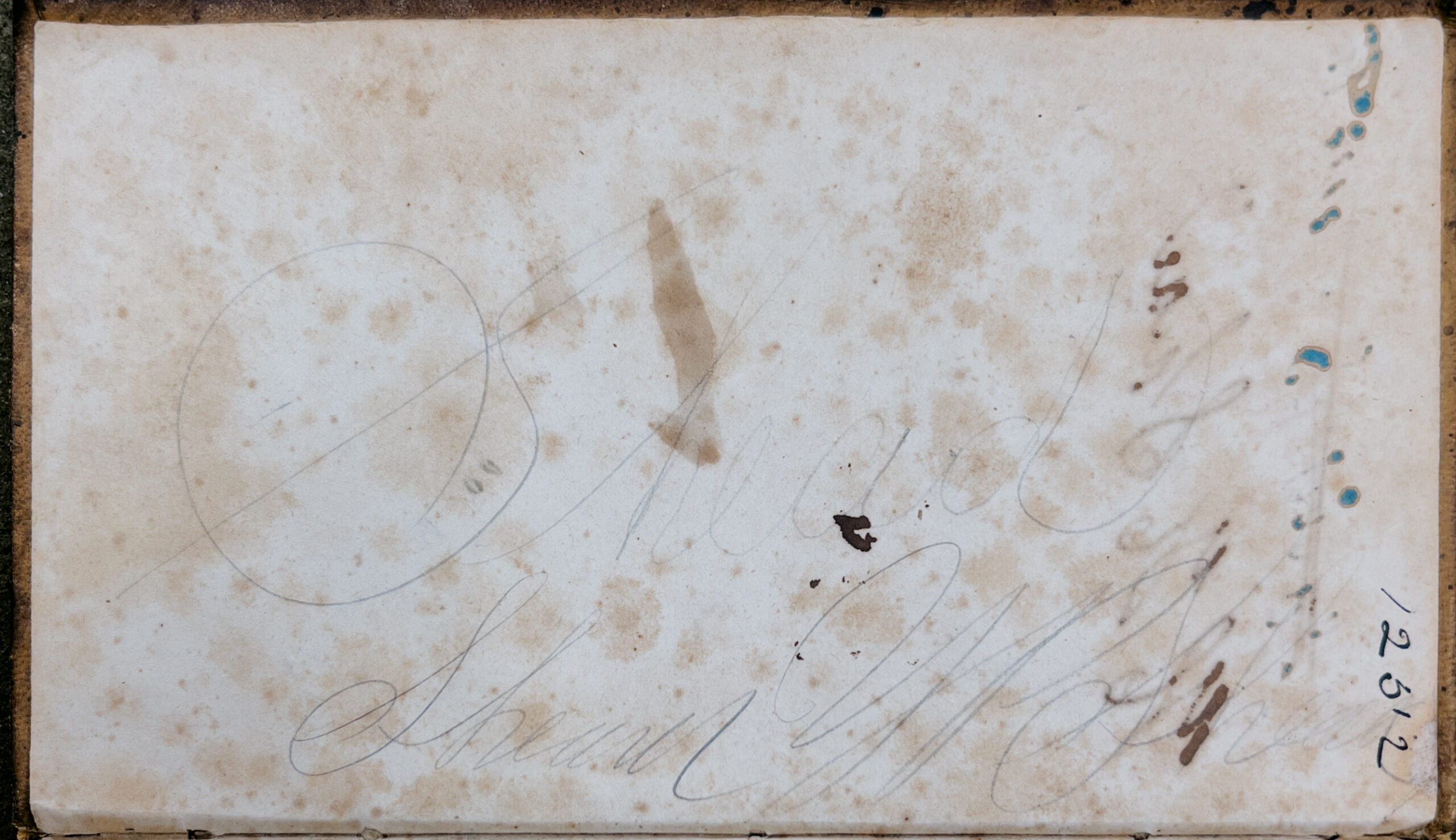
Of particular interest is the writing on the posterior pastedown.
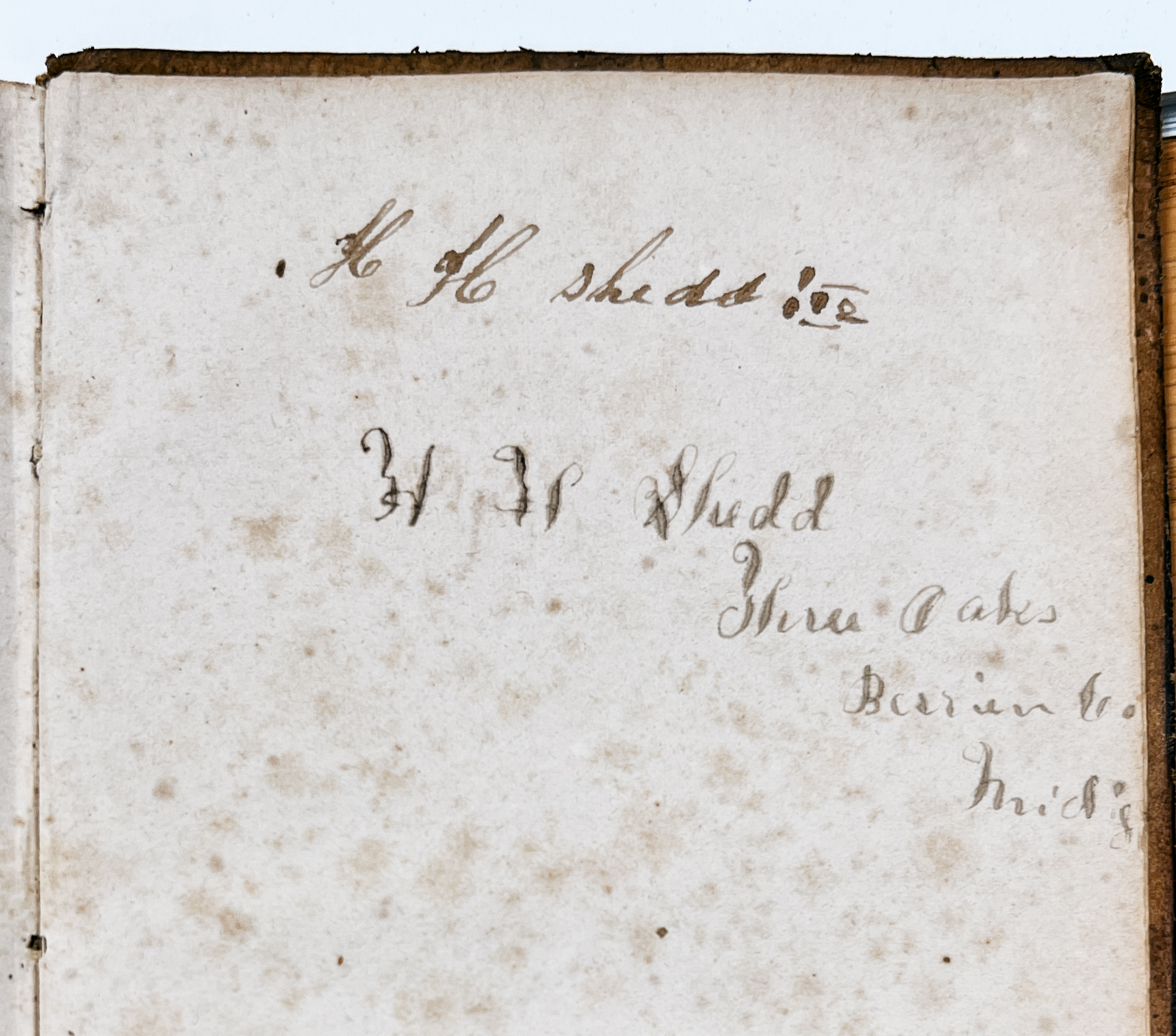
In addition to Harry H Shedd’s name, there is additional writing that was deciphered with the kind assistance of Messrs. Boehmer and Lundeen. Mr. Shedd inscribed this pastedown with his location: Three Oaks, Berrien, Michigan. And, while there are many Harry H Shedds in census records, the addition of knowing his location allows one to pinpoint the precise Harry H Shedd in question.
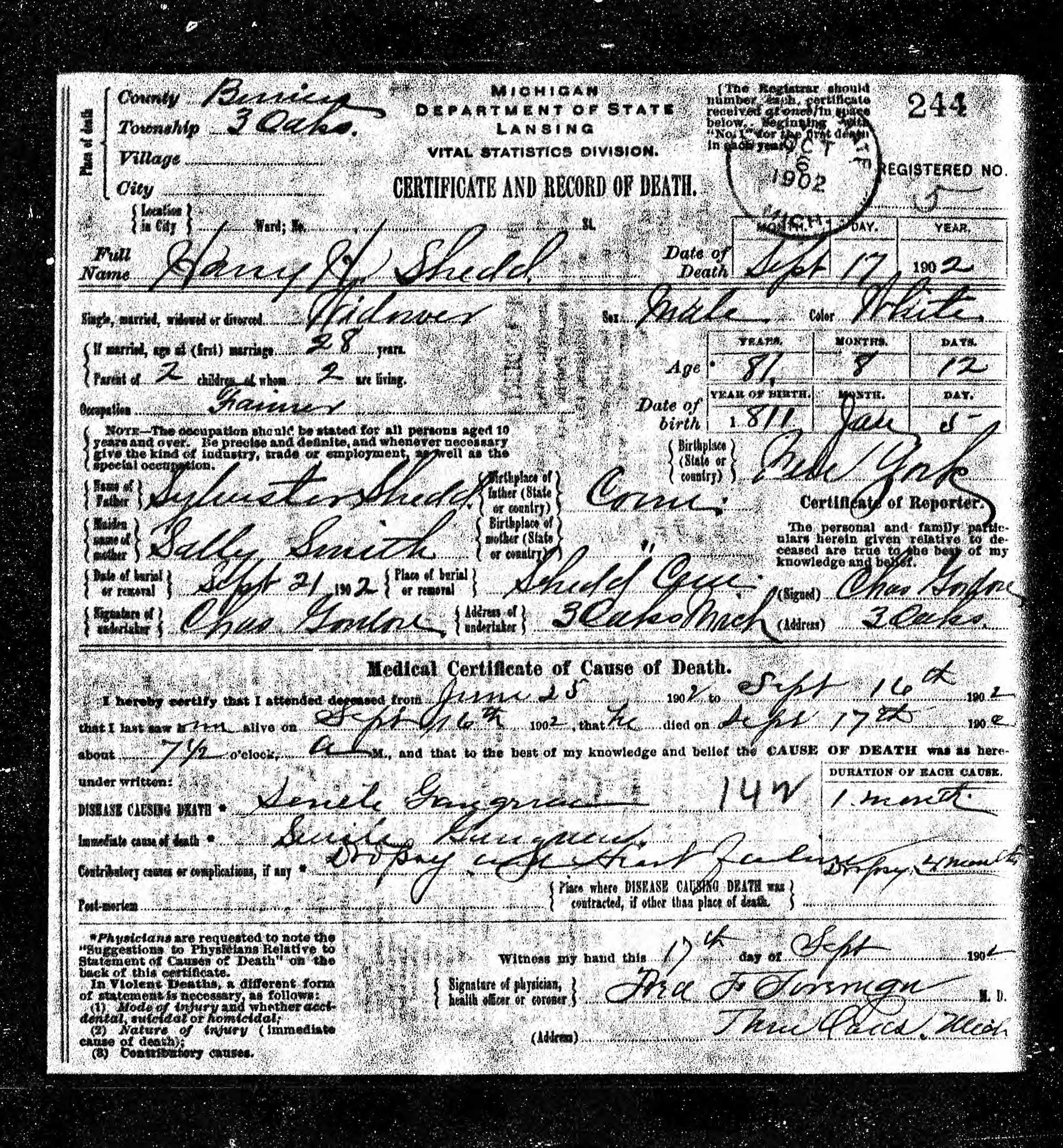
Per the death certificate pictured above, one sees that Mr. Shedd was born in New York. This agrees with other crowd-sourced records saying that he was born in Camillus, a town just west of Syracuse. However, while the death certificate records Harry Shedd’s year of birth as 1811, this conflicts with other reports. In particular, there are census records for Three Oaks from the years 1870 and 1880 that, with a little basic arithmetic, place Mr. Shedd’s year of birth at 1822, not 1811. The year of 1822 also appears in crowd-sourced records. One wonders how a coroner would have made such an egregious error in recording a subject’s year of birth.
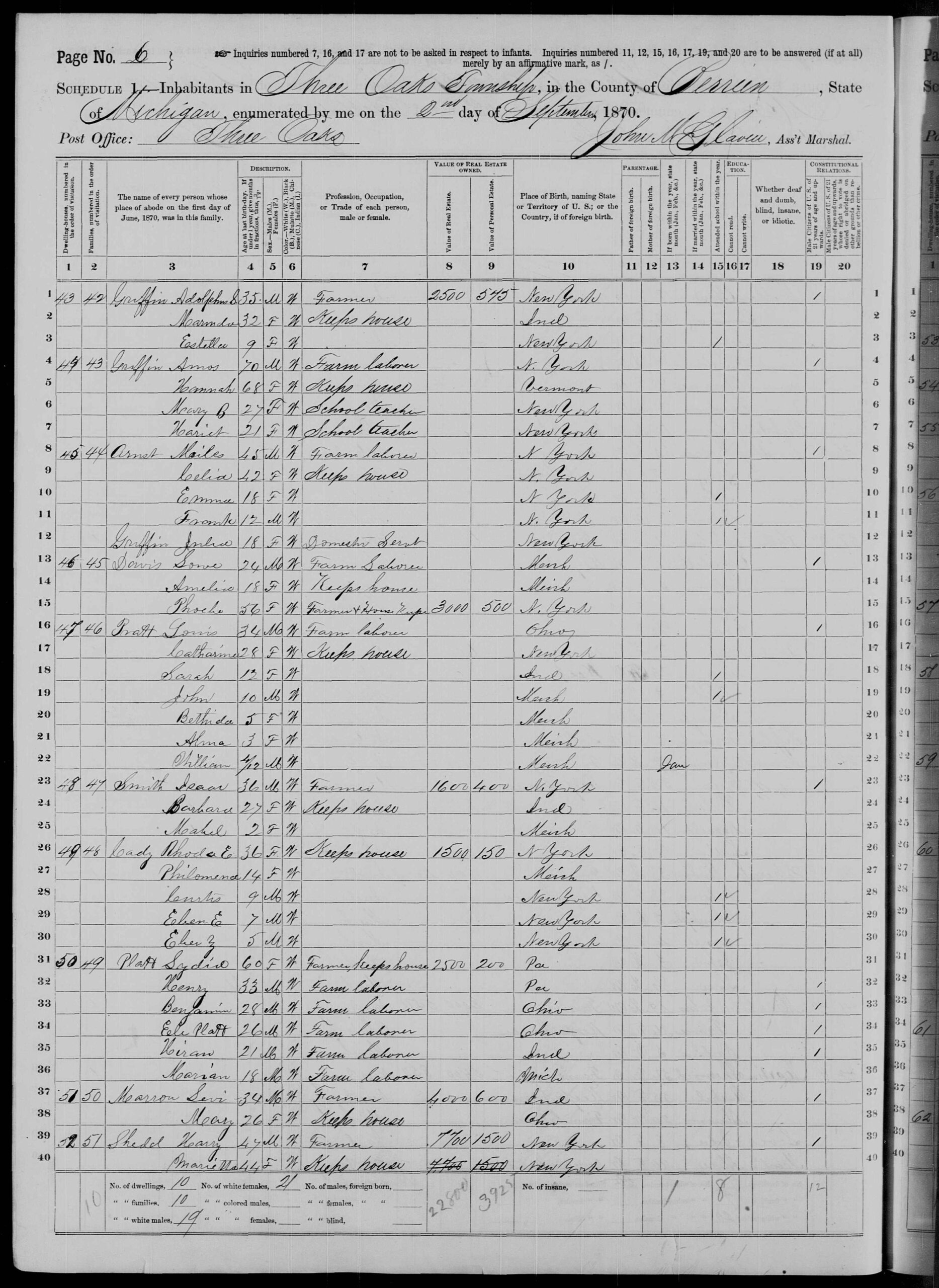
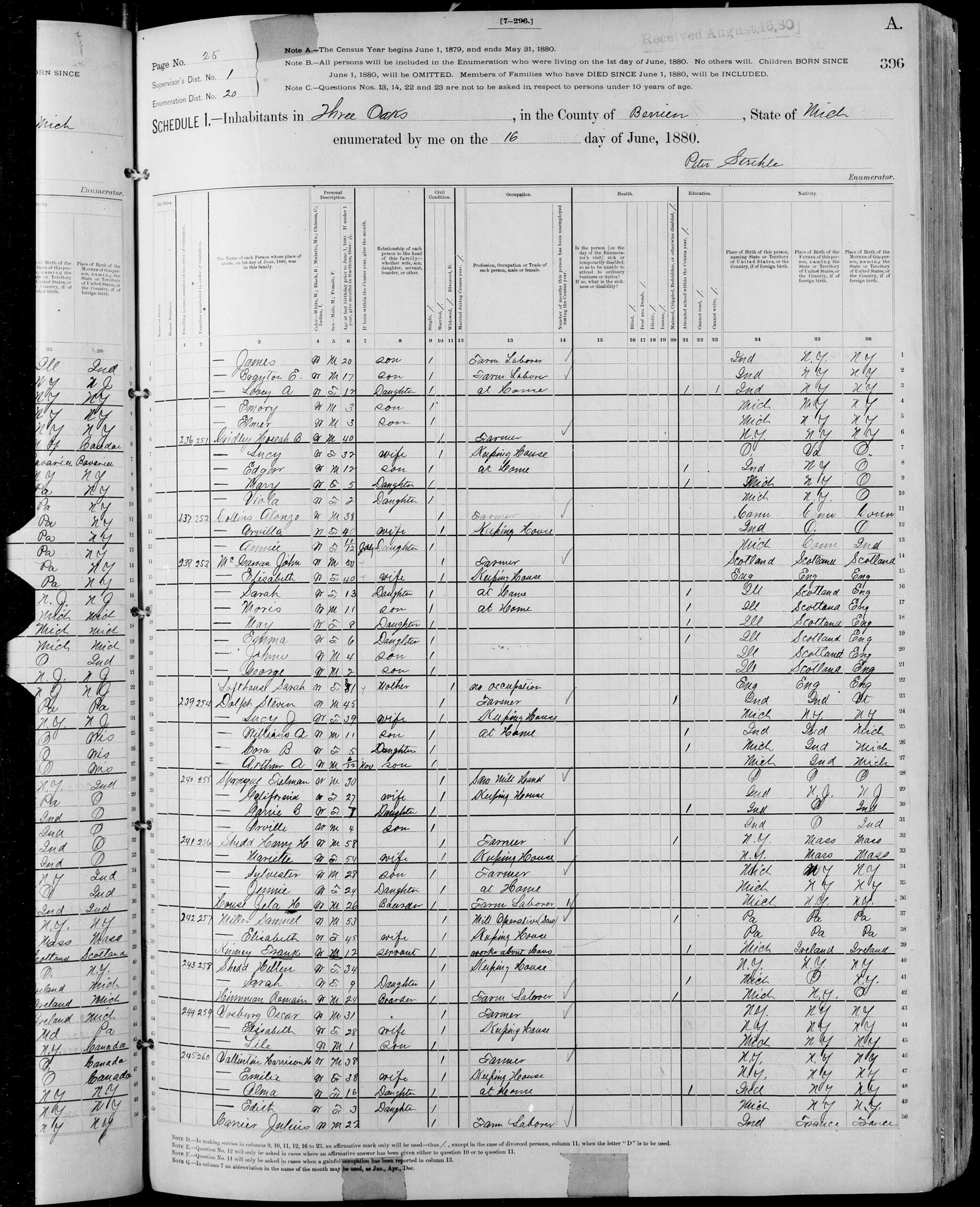
Also evidenced in the records for Harry Shedd are the names of his parents, Sylvester and Sally. As previously mentioned, the first ownership mark in Sacred Songs is a Sally B. Smith—presumably Harry Shedd’s mother. Appropriate documentation is scarce, but in large part because of the information in Shedd’s biography (discussed below), one can ascertain that Sylvester and Sally were born in New England in the years 1786 and 1790, respectively; made their way to Camillus, New York by the time their fifth child, Harry, was born; moved to Ohio for two years when Harry was in his early teens; and then settled in Three Oaks, Michigan by the year 1836.
Turning one’s attention to the Shedd family in Three Oaks, it is delightful to discover that Harry H Shedd was featured in Portrait and biographical record of Berrien and Cass counties, Michigan, an 1893 publication that highlighted prominent community members in places like Three Oaks. Mr. Shedd’s entry in the aforementioned text provides invaluable information that assists in filling the gaps in his history. After arriving in Three Oaks at the age of 14, Mr. Shedd began working in agriculture and eventually established himself as a successful farmer who, in the words of his biographical portrait, “Won his upward way to a position of usefulness and influence.”
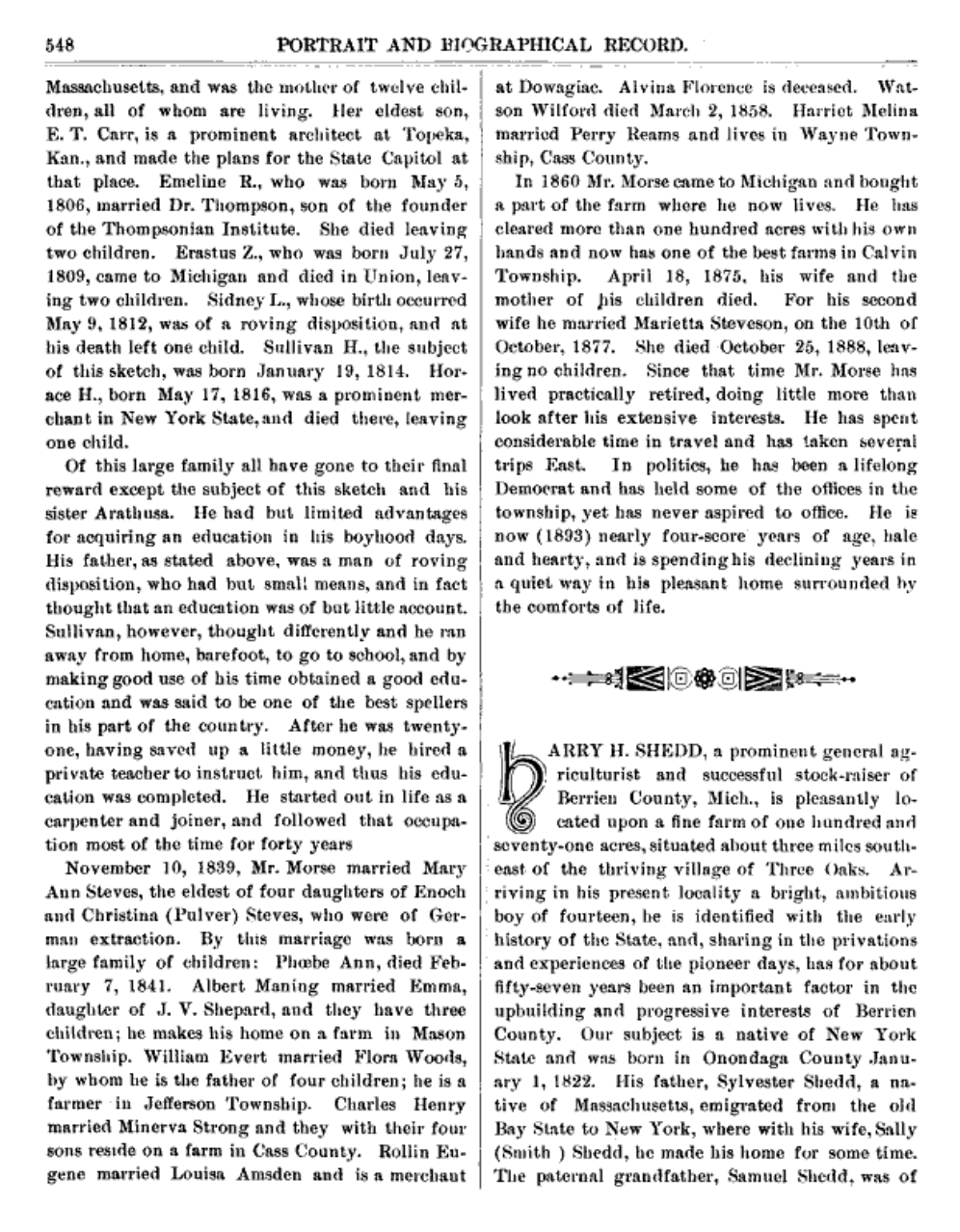
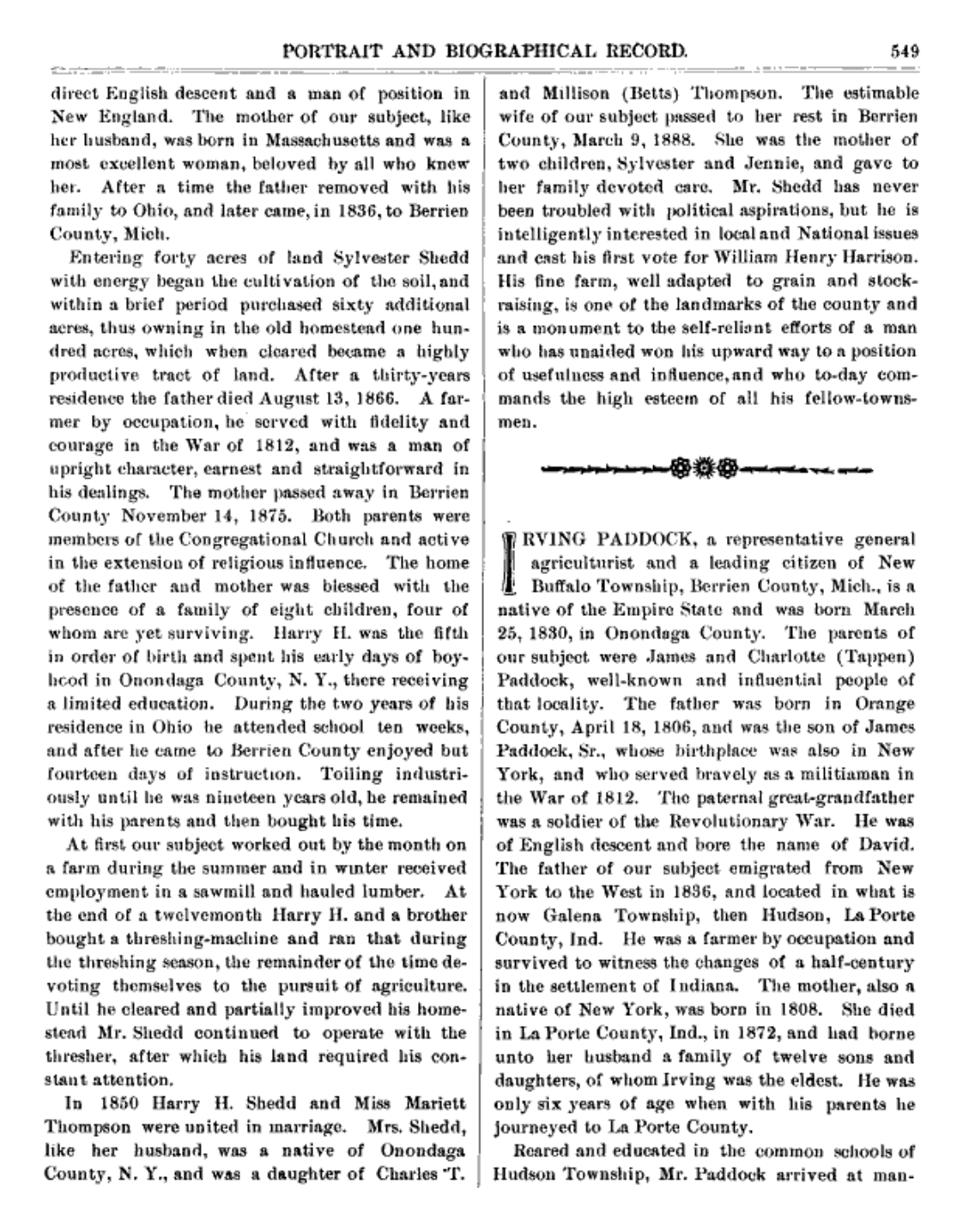
Harry Shedd married a Mariett Thompson (who also happened to be born in the same county of New York as Harry) in 1850. They had two children, Sylvester and Jennie. It is from Sylvester and Jennie that Sacred Songs entered institutional collections, as demonstrated by a later bookplate on page 224 of the volume.
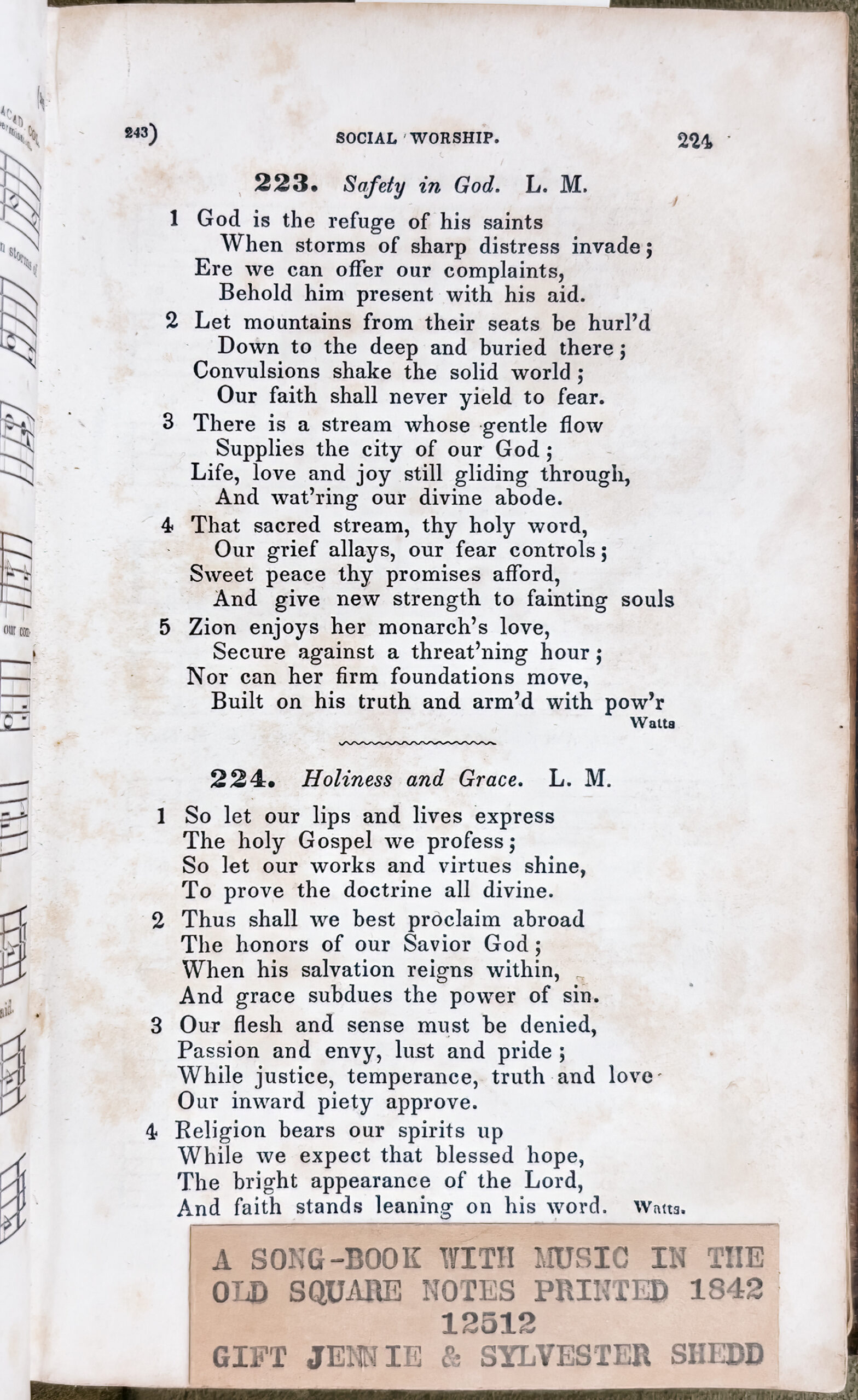
The bookplate commemorates the donation by Sylvester and Jennie Shedd to the Chamberlain-Warren Museum. Now defunct, the Chamberlain-Warren Museum operated from 1916 to 1952 as the regional history museum for Three Oaks. The number on the bookplate catalogues the book’s number in the Chamberlain-Warren collection. This catalogue number is also inscribed on the anterior pastedown.
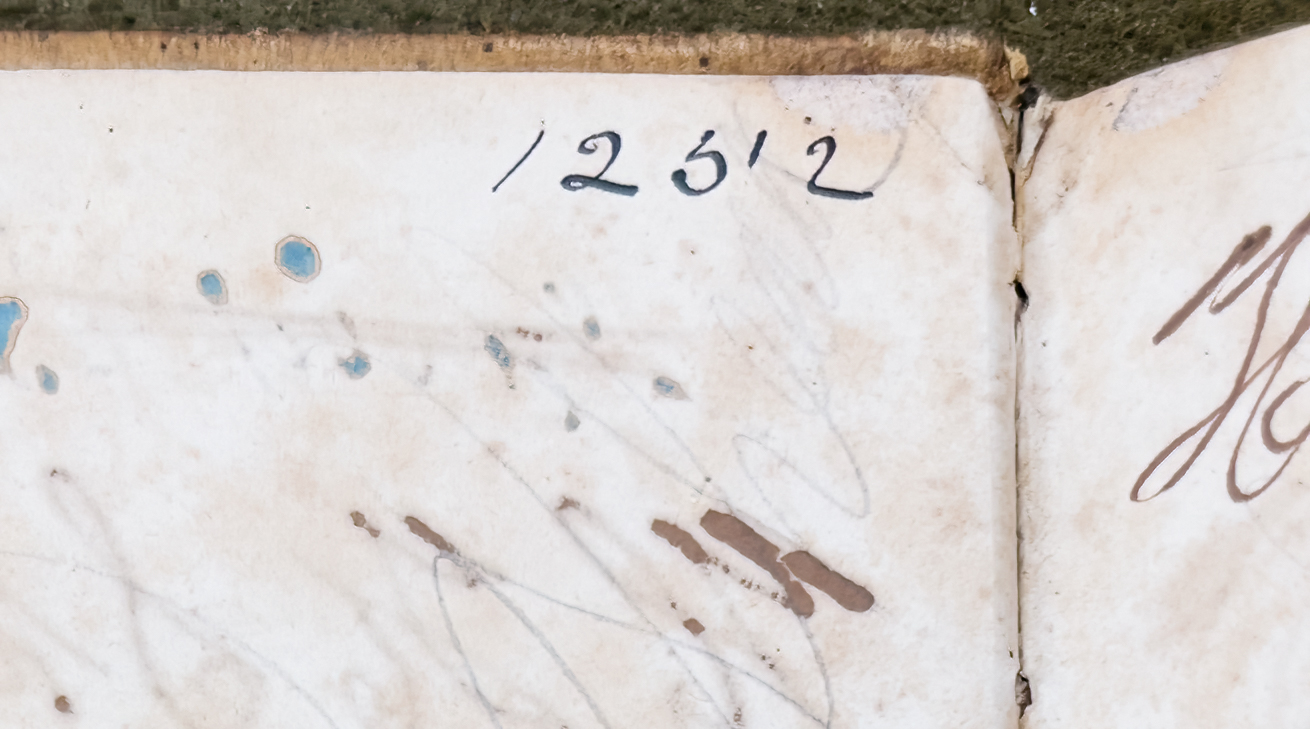
Upon the dissolution of the Chamberlain-Warren Museum in 1952, Michigan State University obtained the volume.
Pencil
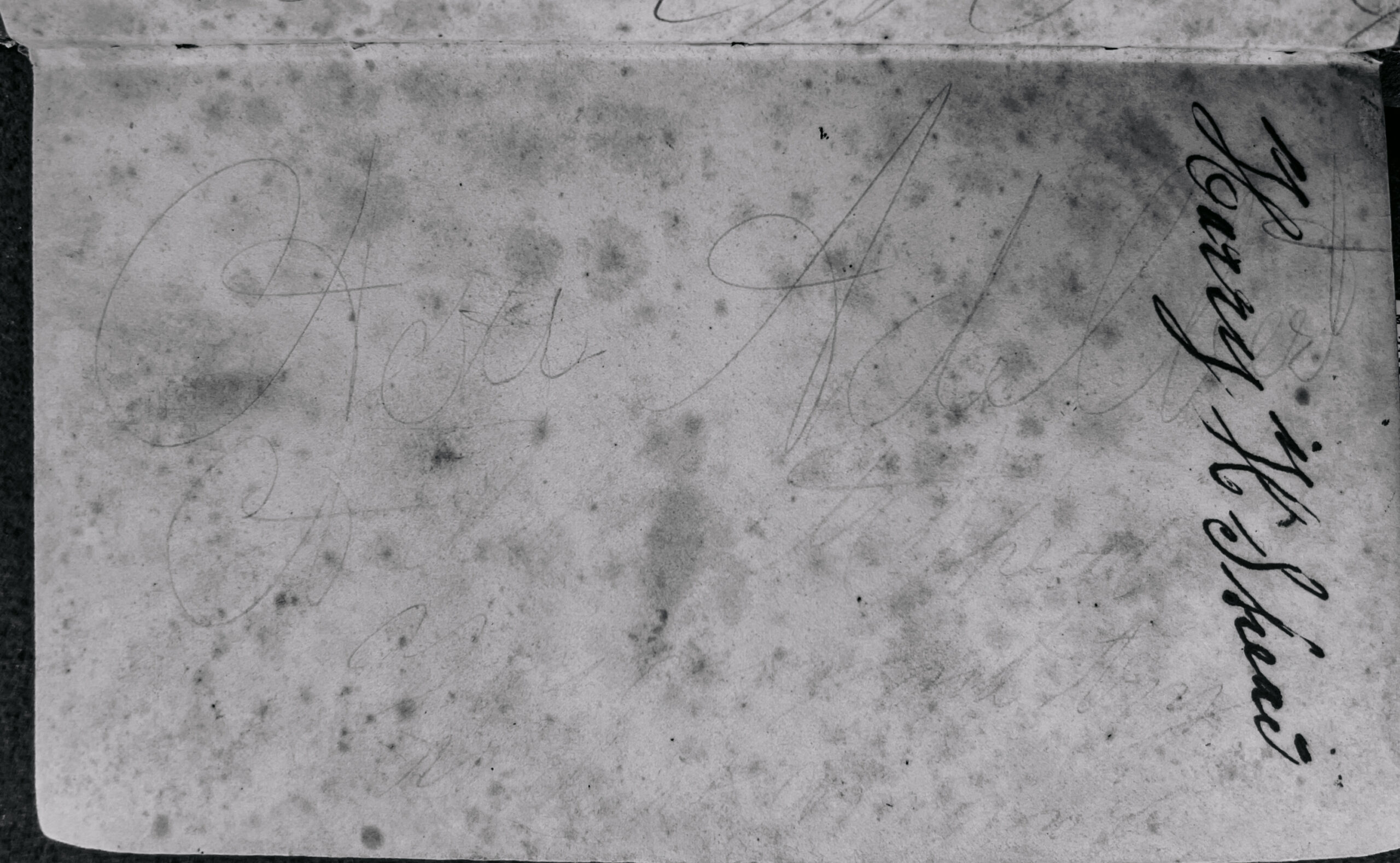
These are the most abundant but, unfortunately, also the most difficult to decipher due to the errant nature of pencil scribbles.
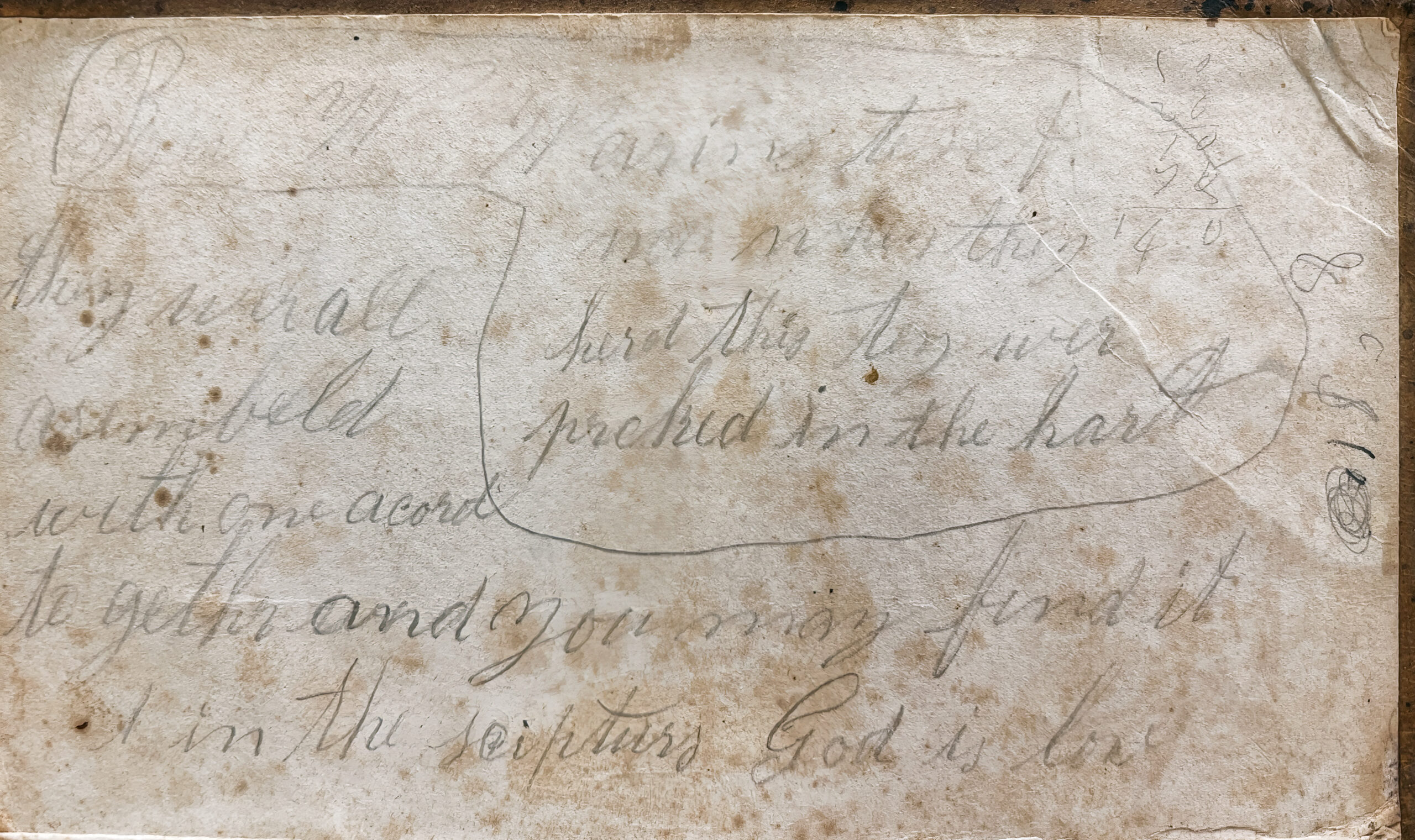
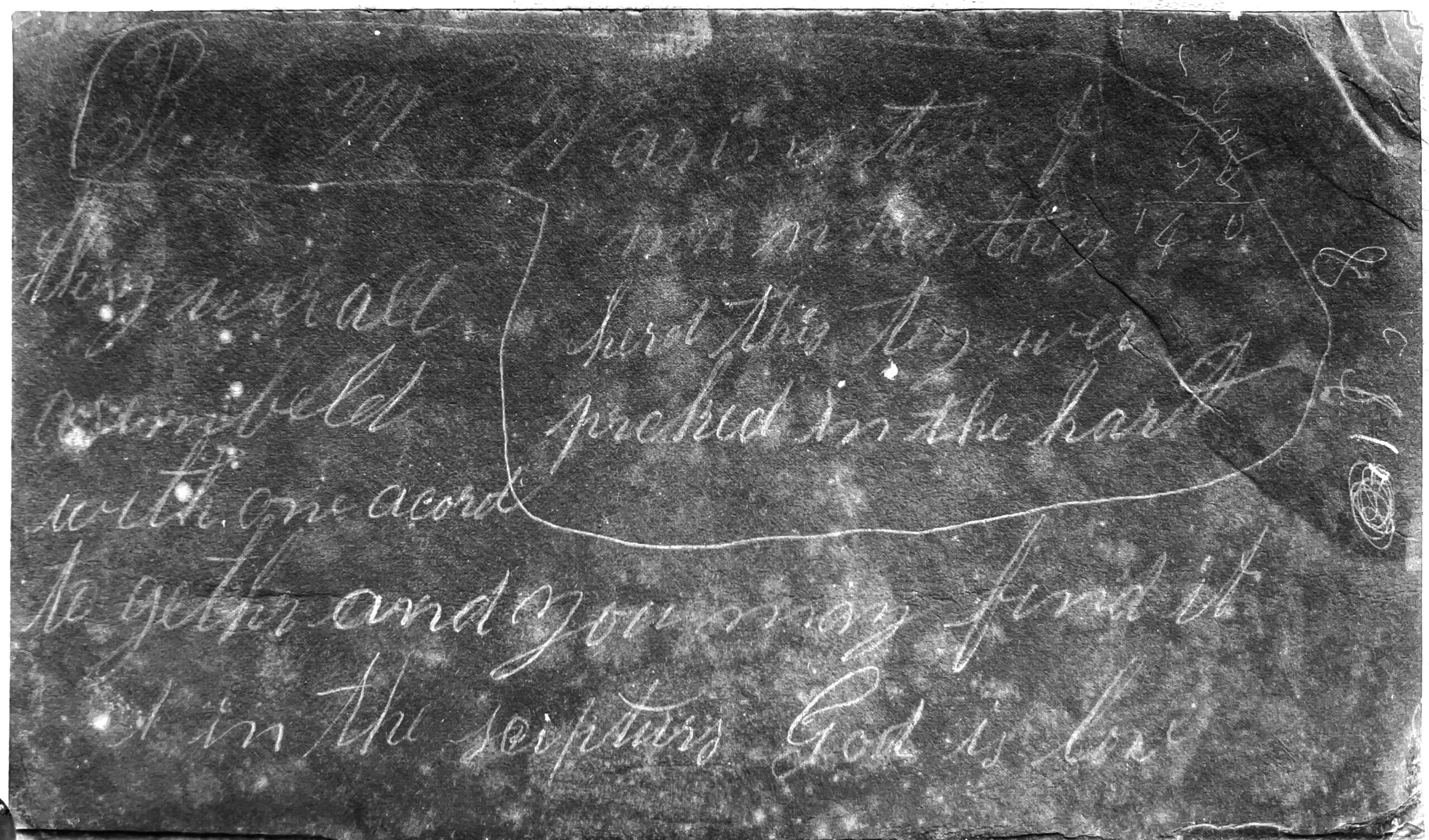
Portions are illegible, but it appears to be the theological ruminations of someone, presumably either Sally Smith or Harry Shedd.
As previously mentioned, the pencil hand throughout these pages is largely indiscernable due to the discolouration of the paper and the faded nature of the marks. However, most of the inscribing, both in ink and pencil, appear to be Harry Shedd practicing his signature.
The Newspaper Clipping
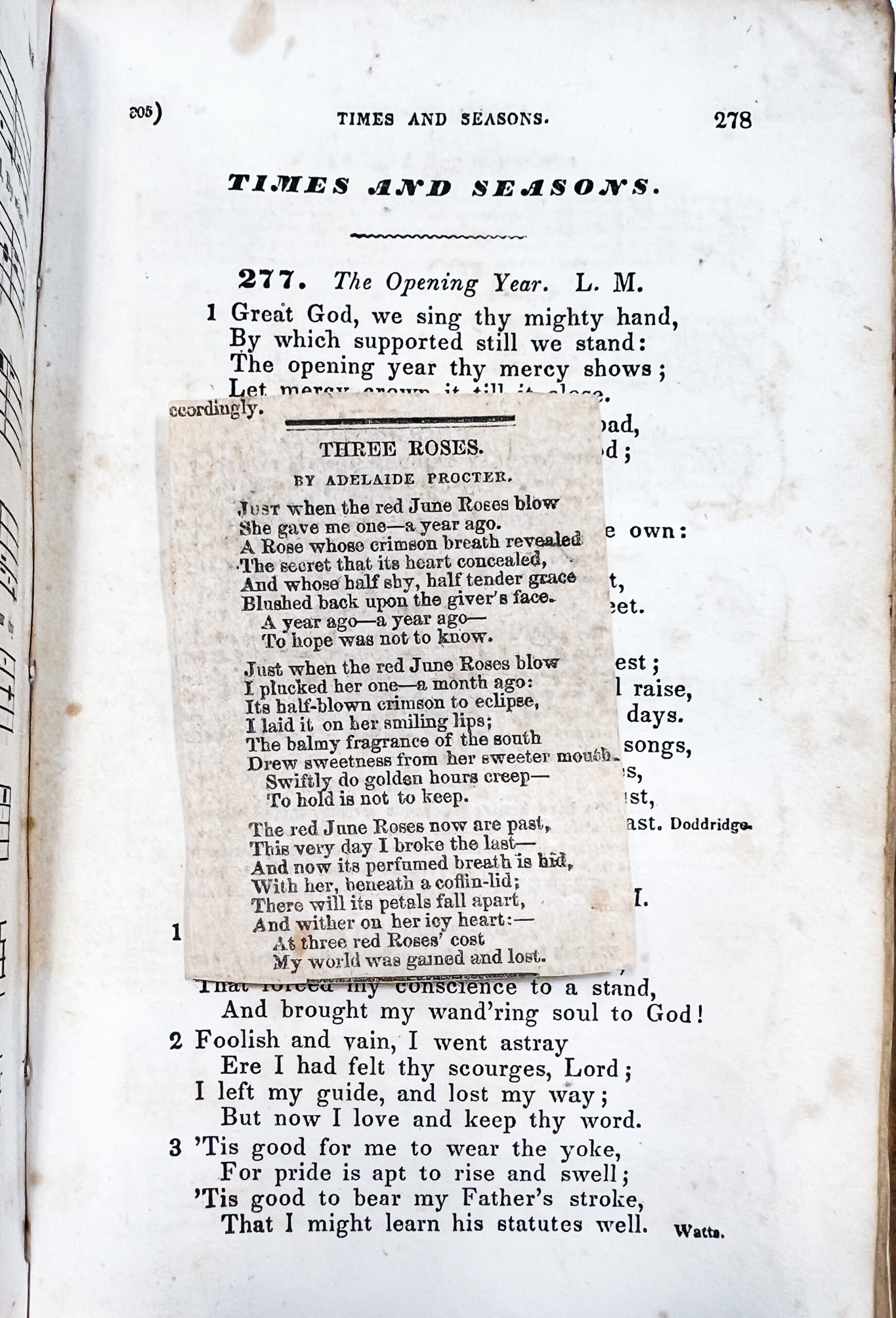
On p. 278, there is a newspaper clipping that appears to have been stored in the book for quite some time. The clipping captures the poem, “Three Roses,” by Adelaide Procter.
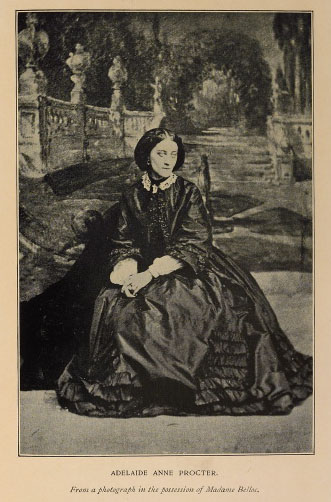
Adelaide Anne Procter
Adelaide Procter was a 19th century British poet and feminist with a fascinating history in her own right. Procter grew up in a literary household where her family frequently entertained the likes of Charles Dickens and Elizabeth Gaskell. At the ripe old age of 18, Procter saw her first publication as a poet in Heath’s Book of Beauty in 1843.
Converting to Catholicism in her 20’s, Procter became an active supporter of contemporary social justice movements, most notably for female sex workers. Procter was also a founding member of the Society for Promoting the Employment of Women, one of the earliest groups created by and for women. Critics have rhapsodised at length about how Procter’s altruism is reflected throughout her later poetry.
Procter enjoyed a successful career until her untimely death at the age of 38 in 1864; she was said to be Queen Victoria’s favourite poet and second only to Alfred Tennyson in popularity. While Procter has largely been forgotten or ignored by modern scholars, she has become an obscure, queer, feminist icon of sorts. For example, “Queering A.A. Procter.” Procter is also featured in an entry on the popular online blog, the queer bible. Additionally, there is ample room for a queer interpretation of “Three Roses” (or, really, more like a welcome mat as someone hands you a hot cuppa and asks you to stay a while).
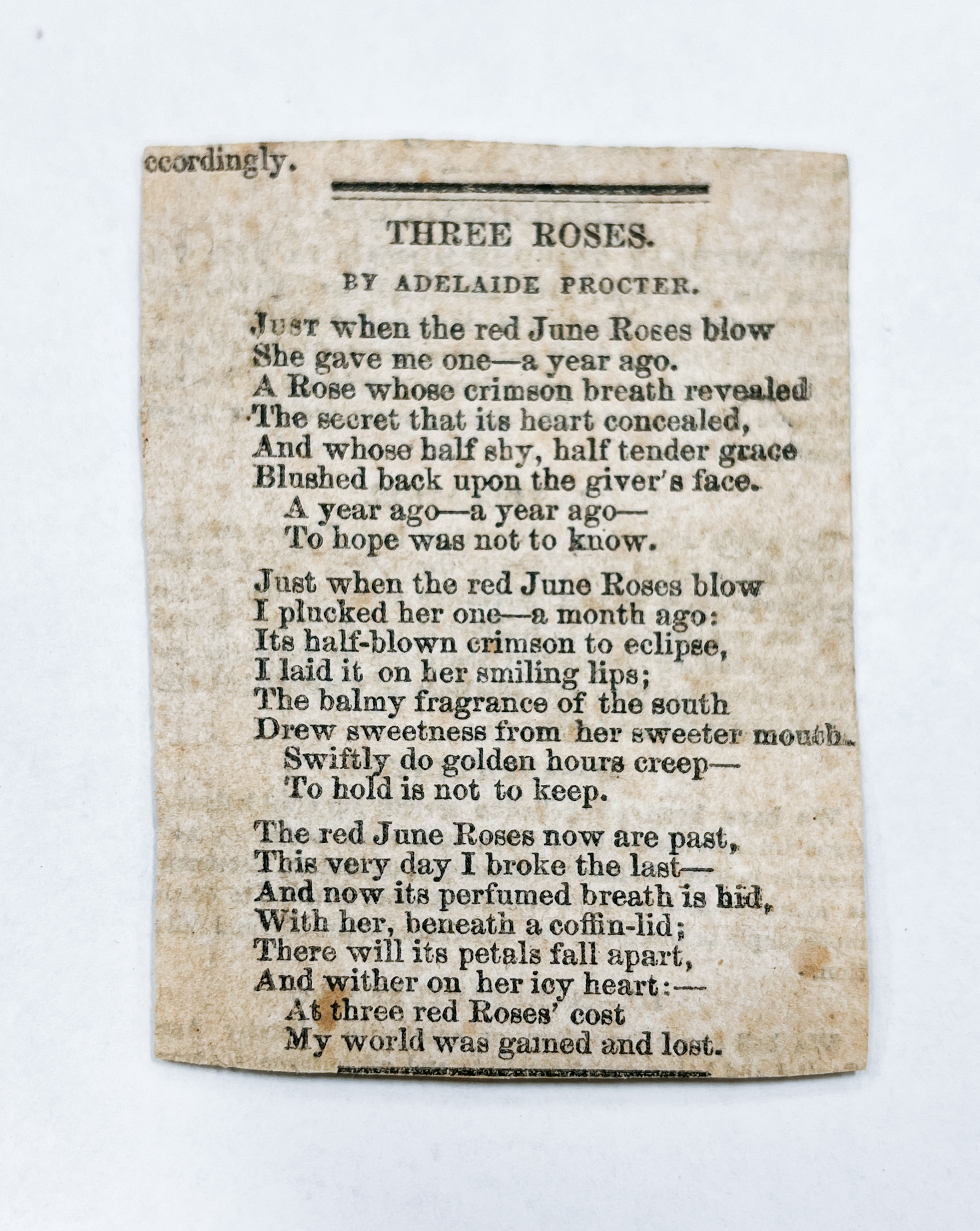
“The Three Roses” was first published in 1861, appearing in a collection of Procter’s poetry, Legends and Lyrics, Second Series. The subsequent timing of the poem’s publication in American newspapers provides excellent insight into the circumstances of how the clipping made its way into the pages of this particular copy of Sacred Songs.
New-York Semi-weekly Tribune
The fun thing about newspaper clippings is that there’s always a reverse side with its own story to tell; “Three Roses” is no different. The reverse contents of this clipping help complete the puzzle for identifying the time and place this excerpt was first clipped.
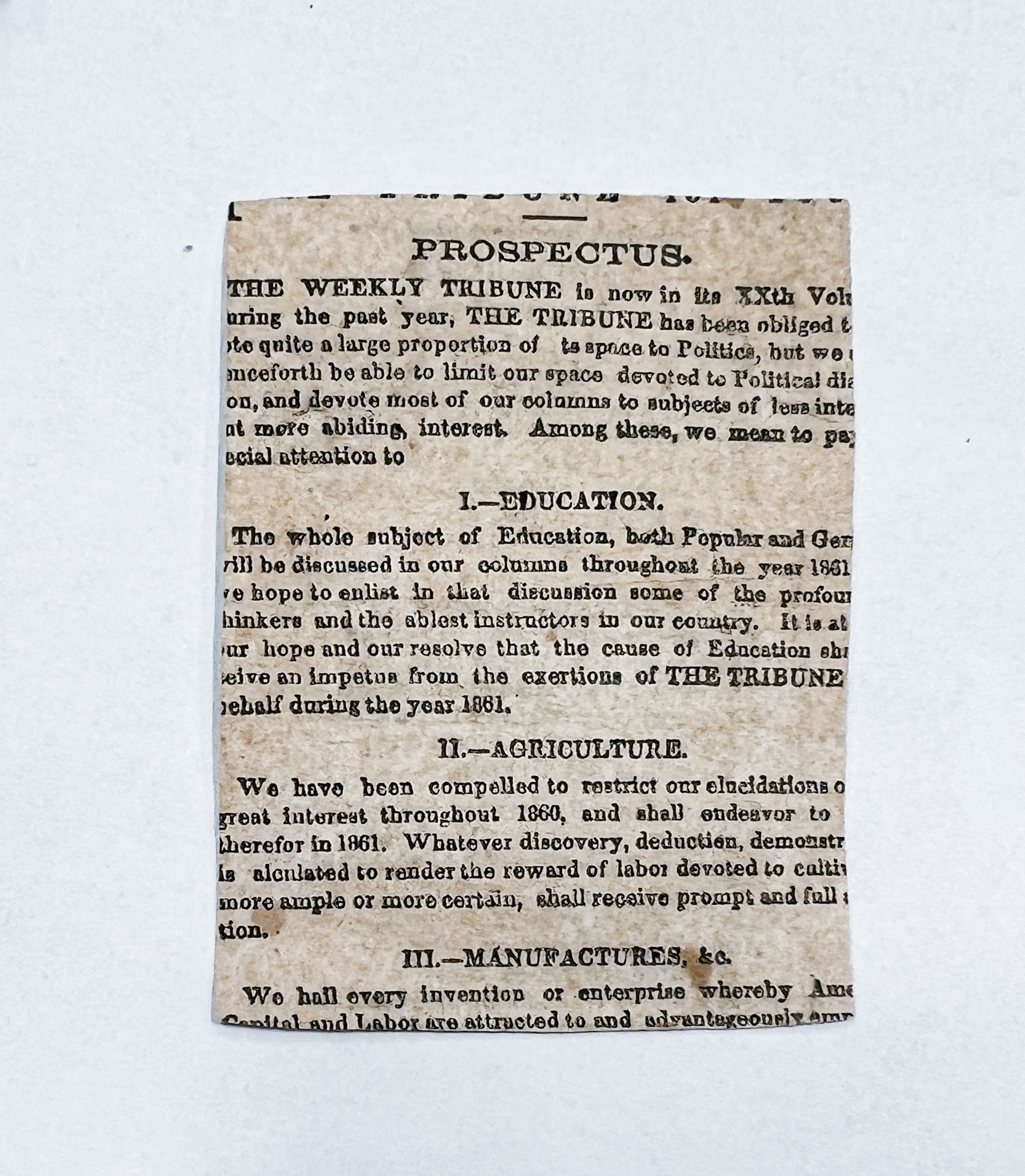
A cursory review tells us that the newspaper in question seems to refer to itself as “The Weekly Tribune” or just “The Tribune.” This “Prospectus” section seems to concern the organisation of the newspaper’s contents and changes being made between the years 1860 and 1861. Armed with this information, one is prepared for the wild goose chase of trying to sift through archival scans of old American newspapers.
OCR for old newspapers is pretty atrocious, so one must have realistic expectations for the search engines that can purportedly search through hundreds of thousands of old newspaper scans. However, the “throw things and see what sticks” strategy is a favoured tactic for a reason. A selection of unique search terms yielded a surprising number of useful results.
Search terms: adelaide procter; three roses; blushed back upon the giver's face; the weekly tribune is now in its xxth volume; the red june roses blow; adelaide proctor
| SOURCE | DATE | RELEVANT CONTENTS | COMMENTARY |
| New-York Semi-weekly Tribune | 01.04.1861 | Tribune for 1861; Prospectus | Matches typesetting |
| New-York Semi-weekly Tribune | 02.12.1861 | Tribune for 1861; Prospectus | Matches typesetting |
| Providence Evening Press | 02.16.1861 | “Three Roses” by Adelaide Ann Proctor | Poem appearance; alt spelling |
| New-York Semi-weekly Tribune | 02.19.1861 | ”Three Roses” by Adelaide Procter | Poem appearance; matches typesetting |
| New-York Semi-weekly Tribune | 03.09.1861 | ”Three Roses” by Adelaide Procter | Poem appearance; matches typesetting |
| National Anti-Slavery Standard | 03.09.1861 | “Three Roses” by Adelaide Proctor | Poem appearance; alt spelling |
| The Dubuque Herald | 04.10.1861 | “Three Roses” by Adelaide Ann[n/a?] Proctor | Poem appearance; alt spelling |
| New-York Semi-weekly Tribune | 04.30.1861 | Tribune for 1861; Prospectus | Matches typesetting |
| New-York Semi-weekly Tribune | 04.30.1861 | Miscellaneous; ”The Silver Cord” by S. Brooks | Literary work on prospectus leaf |
| New-York Semi-weekly Tribune | 04.30.1861 | “Over the Mountain” by Adelaide Procter | Recurrence of poet |
| New-York Semi-weekly Tribune | 04.26.1861 | Tribune for 1861; Prospectus | Matches typesetting |
| Sunday Mercury | 07.12.1863 | “Three Roses” by Adelaide D. Proctor | Poem appearance; alt spelling |
| The Missouri Republican | 03.28.1869 | “Three Roses” | Poem appearance; no author |
| Lewiston Evening Journal | 06.05.1869 | “Three Roses” | Poem appearance; no author |
| The Plaindealer | 11.25.1876 | “Three Roses” | Poem appearance; no author |
The New-York Semi-weekly Tribune is the focus of our attention because it features Procter’s poetry while also including the same “Prospectus” contents as the clipping. One is compelled to ask, though, how a semi-weekly publication can talk about a weekly publication. According to the record in the Directory of U.S. Newspapers in American Libraries via the Library of Congress, the New-York Semi-weekly Tribune (1845–1866) was the part-time counterpart of the New-York Weekly Tribune (1841–1866). As its title suggests, the newspaper was published in New York City and was supposedly one of the most widely-circulated city newspapers in the 1850s.
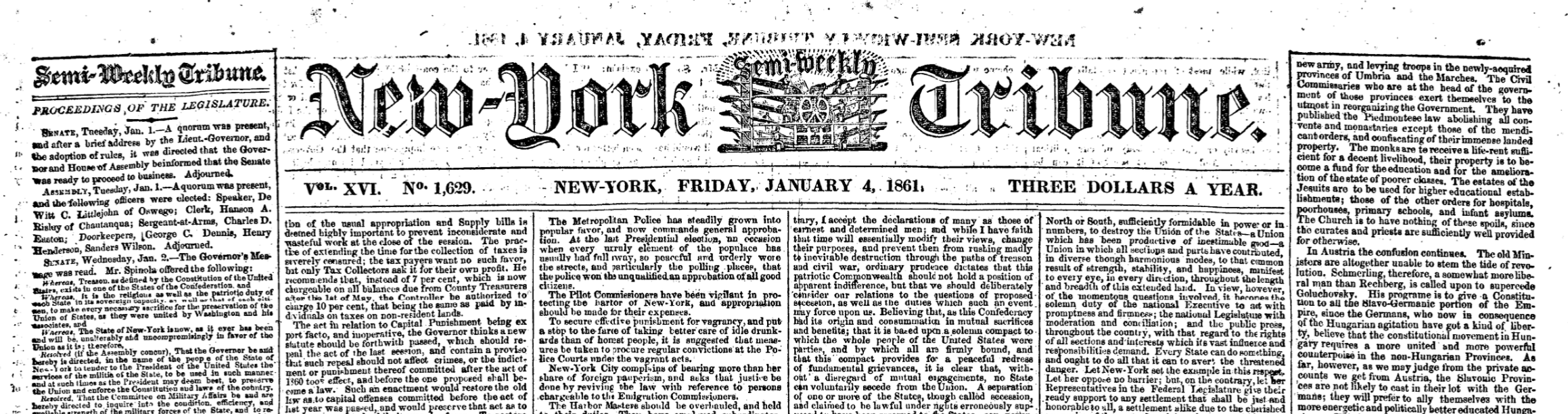
“Matches typesetting” refers to the fact that the regular Tribune set the “Prospectus” contents differently than the semi-weekly Tribune, the latter of which matches the setting in the clipping. This allows us to narrow our search down even further to this particular subset of the overall Tribune publication. And, lo and behold, “Three Roses” by Adelaide Procter appears in the semi-weekly Tribune in the months of February and March 1861. Furthermore, another Procter poem appears in April of the same year, indicating that she was a recurring choice for the newspaper’s editors.
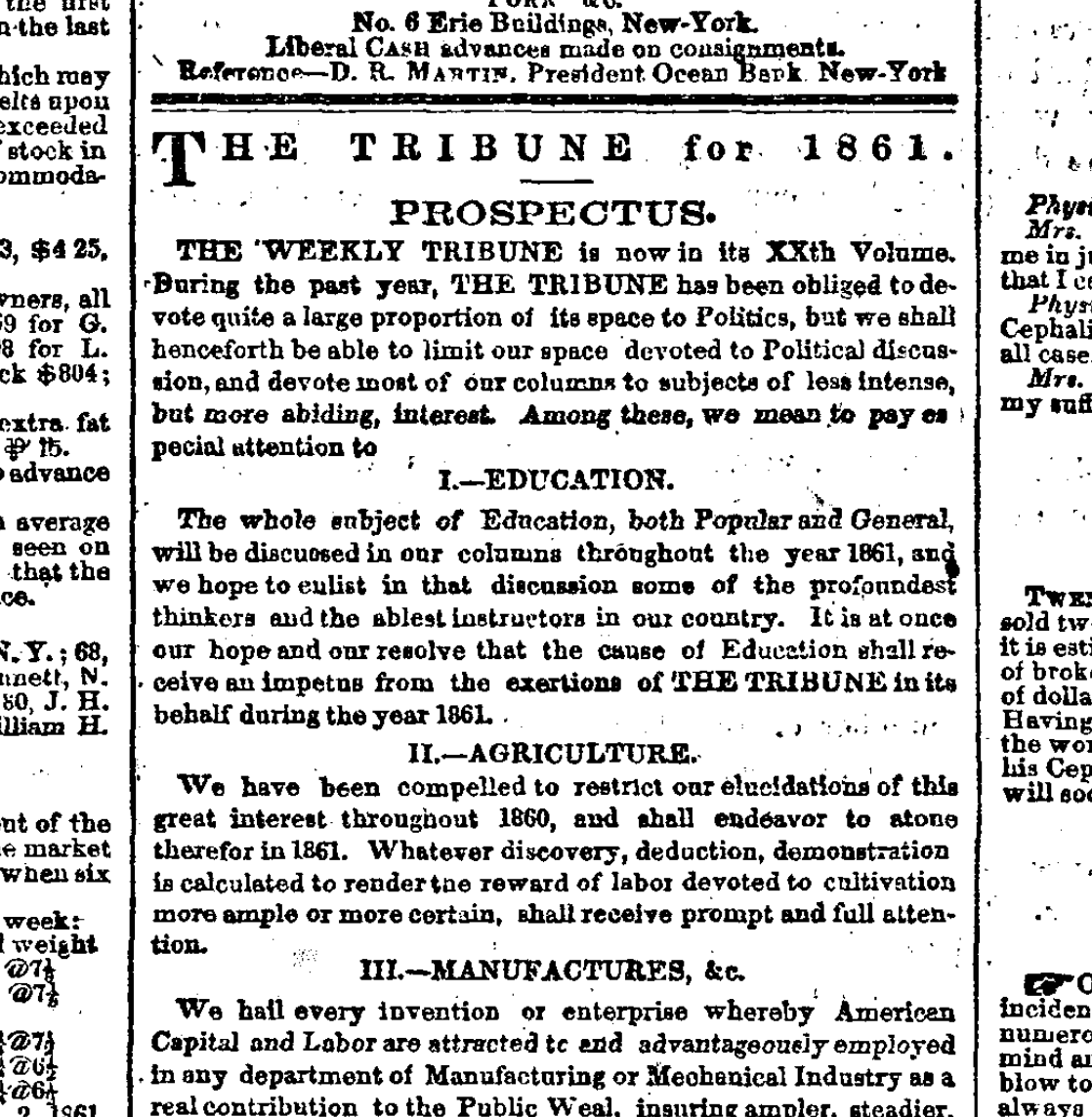
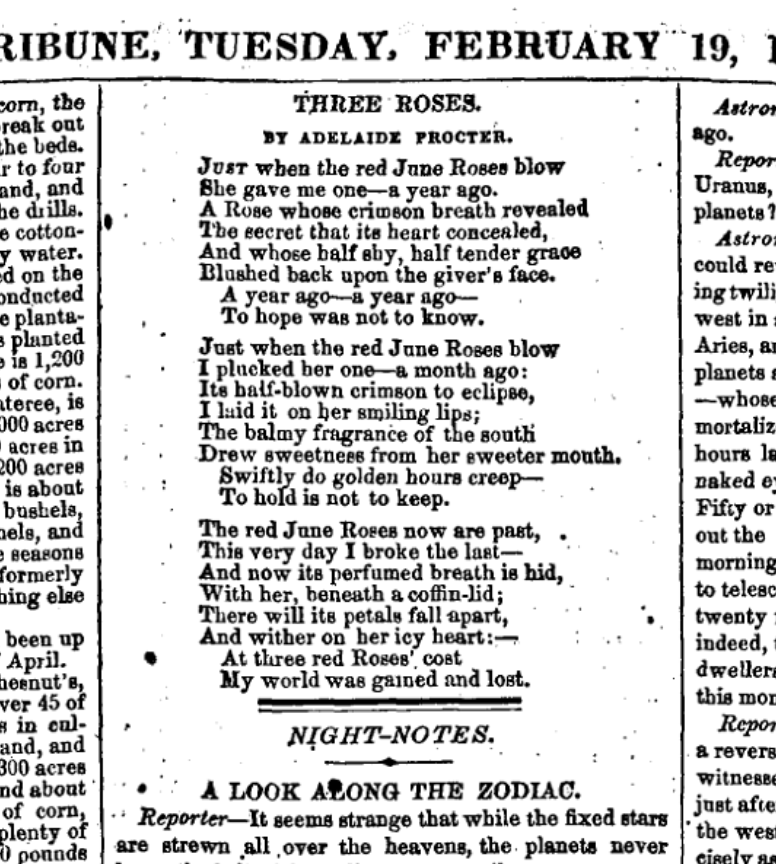
No exact match was found—that is, with “Three Roses” on one page with the “Prospectus” in the same position on the reverse side of the same leaf. However, it’s plausible that such a precedent existed, given the appearance of another literary text, “The Silver Cord” by S. Brooks, on the reverse side of the same leaf as the “Prospectus.”
One will observe that there are other non-Tribune records of “Three Roses,” thus attesting to the poem’s popularity in the given time frame (even appearing in the National Anti-Slavery Standard, presumably due to Procter’s advocacy for such movements). In particular, note the various alternative spellings of the poet’s name. While the Scripps National Spelling Bee did not come about until 1925, one wonders how newspapers could err so dramatically from the formal name of a well-known and well-published poet. Similarly, less than a decade after the poem’s initial publication, it still appeared in American newspapers, but without any mention of the poem’s author.
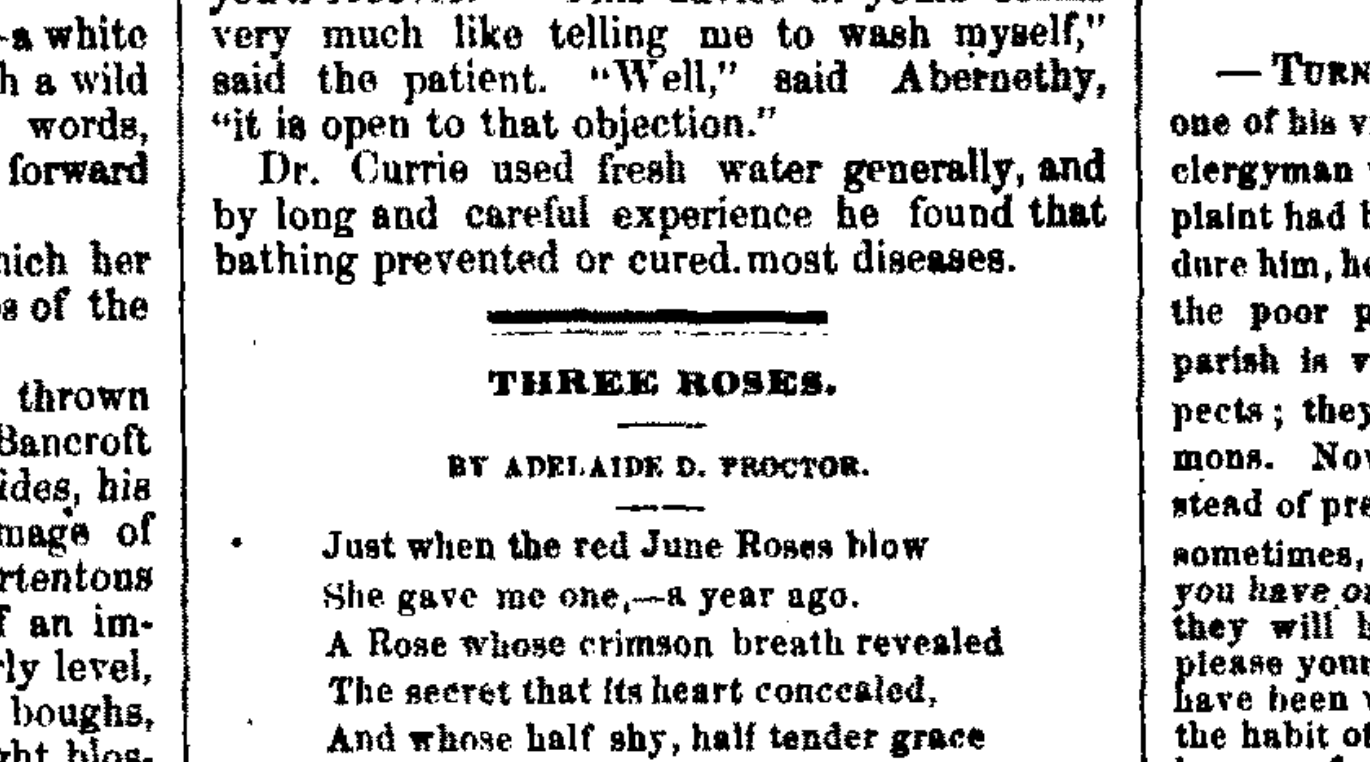
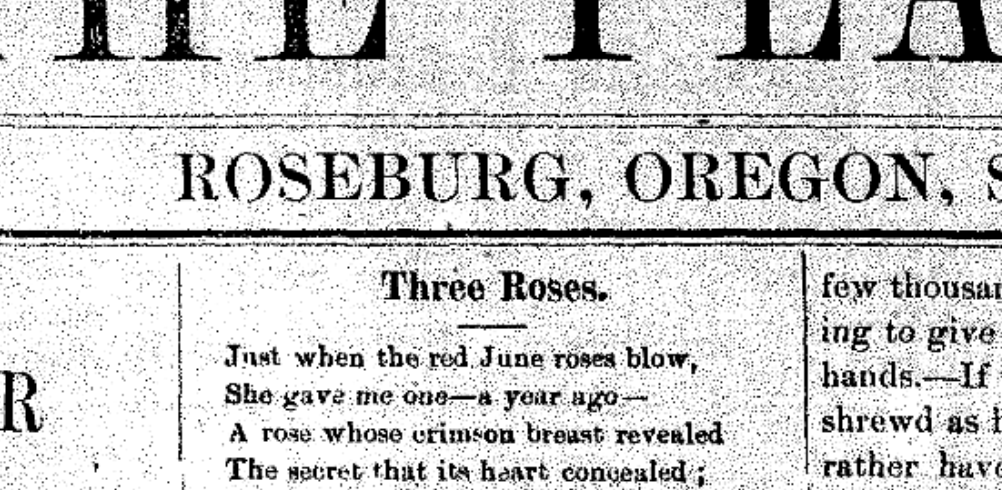
Returning to the broader perspective of the material book, we find ourselves with some new facts that are also fairly accurate. Namely, that someone who read New-York Semi-weekly Tribune in the earlier part of the year 1861 encountered “Three Roses” by Adelaide Procter. Here we can speculate as to whether it was Sally Smith or Harry Shedd; while the family had settled in Three Oaks they presumably kept ties with New York, as that’s where Harry Shedd was born as well as his wife. At any rate, the person liked the poem so much that they cut it out of the newspaper and placed it into Sacred Songs for safe keeping.
Conclusion etc.
While seemingly mundane and uninspiring on first blush, Sacred Songs has proven to be a fascinating journey of provenance and, gratifyingly, of the rare kind where an essentially complete history can be reconstructed from its clues.
Anna Jeffries // FS23 // History 475
