
TABLE OF CONTENTS
I. Bibliographic Information & Physical Description
II. Note on Content
III. Significance of the Sermons: Early Modern Portuguese Print Culture
IV. Provenance Information
     i. Provenance Pt. 1: The Convent of Santa Cruz de Bussaco
     (Buçaco)
     ii. Provenance Pt. 2: Francisco António Rodrigues de Gusmão
     iii. Provenance Pt. 3: The Auction of Rodrigues de Gusmão's
     Library
V. List of Consulted Sources and References
I. Bibliographic Information & Physical Description
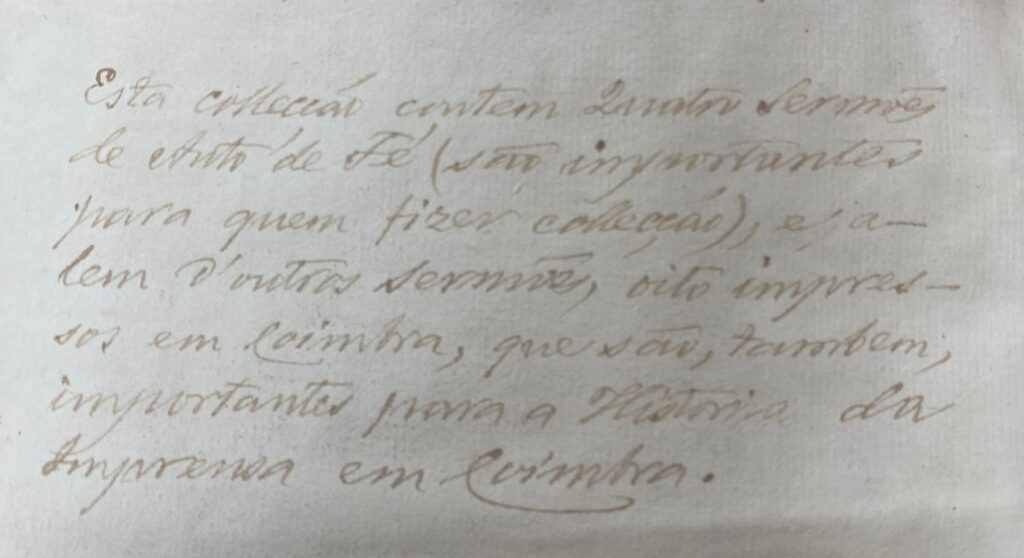
“Esta collecção contem quatro sermões de Auto de Fé (são importantes para quem fizer collecção), e alem d’ outros sermões, oito impressos em Coimbra, que são também importantes para a História da Imprensa em Coimbra.”
Trans.: This collection contains four Auto de Fé sermons (which are important for whoever makes the collection) and additionally other sermons, eight [of which are] printed in Coimbra, which are also important for the history of printing in Coimbra.
Transcription and translation of the inscription written in the volume next to the title page of the first sermon of the collection.
As stated in the inscription above, this is not a single, contiguous volume but a collective volume containing a total of sixteen sermons. The sermons generally date back to the 17th century, while some of them were printed in 18th century – the earliest of them being printed in 1648 and the most recent of them being printed in 1720. The basic bibliographic information on the volume as well as its physical description are provided below:
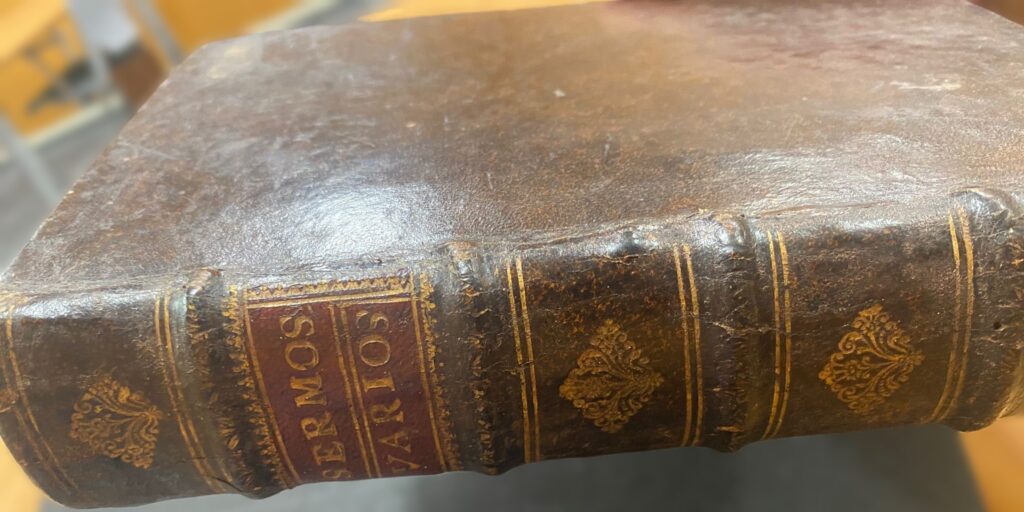
Collective Title: Sermões Varios
Authors: Various; see below
MSU Library Call Number: XX BX1756.O55 S47 1691
Physical Description: the volume consists of sixteen early modern Portuguese sermons (dating back to between the mid-17th and early-18th centuries; four of which are Inquisitorial auto da fé sermons) bound together – the technical term for a bounded collection such as this is a sammelband;1 gilt bands and patterns, as well as gilded title on spine of book; several remains of removed leaves in beginning, middle, and end of volume (the image below that shows the title page of the Sermon on Saint Sebastian clearly shows the remnants of those removed leaves); print quality varied – some sermons are clearly decipherable while other sermons are blurry (namely the Sermon of the Tears of Magdalen, which is the second to last in the collective volume)
As stated, this volume is a compilation of sixteen different sermons (once again, the potential reason for the discrepancy between this total and the total number mentioned in the beginning inscription is detailed in Footnote #1). The information for each individual sermon (namely the clerical individual to which the oral delivery of each sermon is attributed—which will be referenced with the phrase “delivered by,” the individual the sermon is being addressed to [if such information present], the printer, print date, location, and links to the sermon in online catalogues [if present]—other information particular to specific sermons are marked with an asterisk) is as follows:2
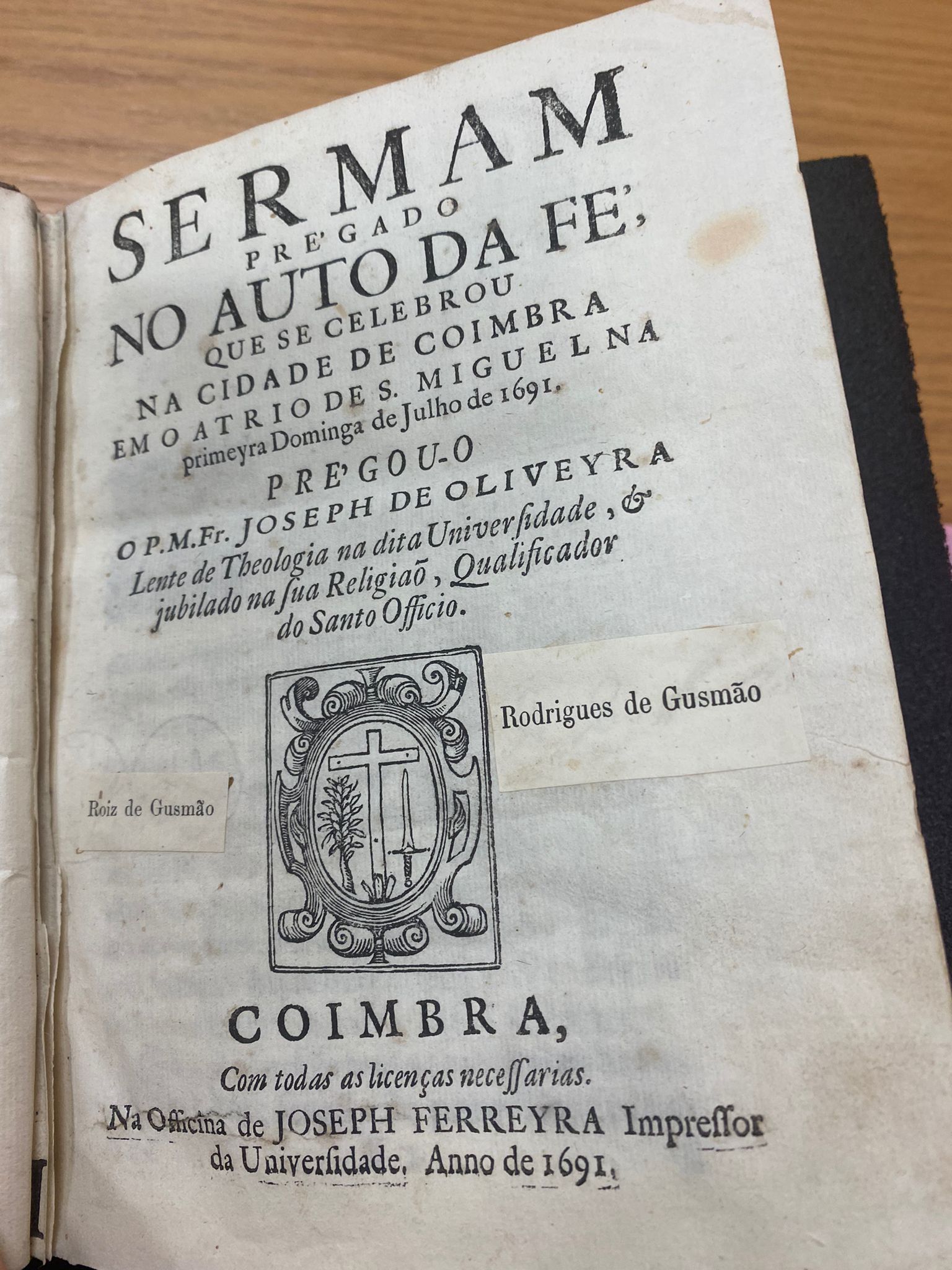
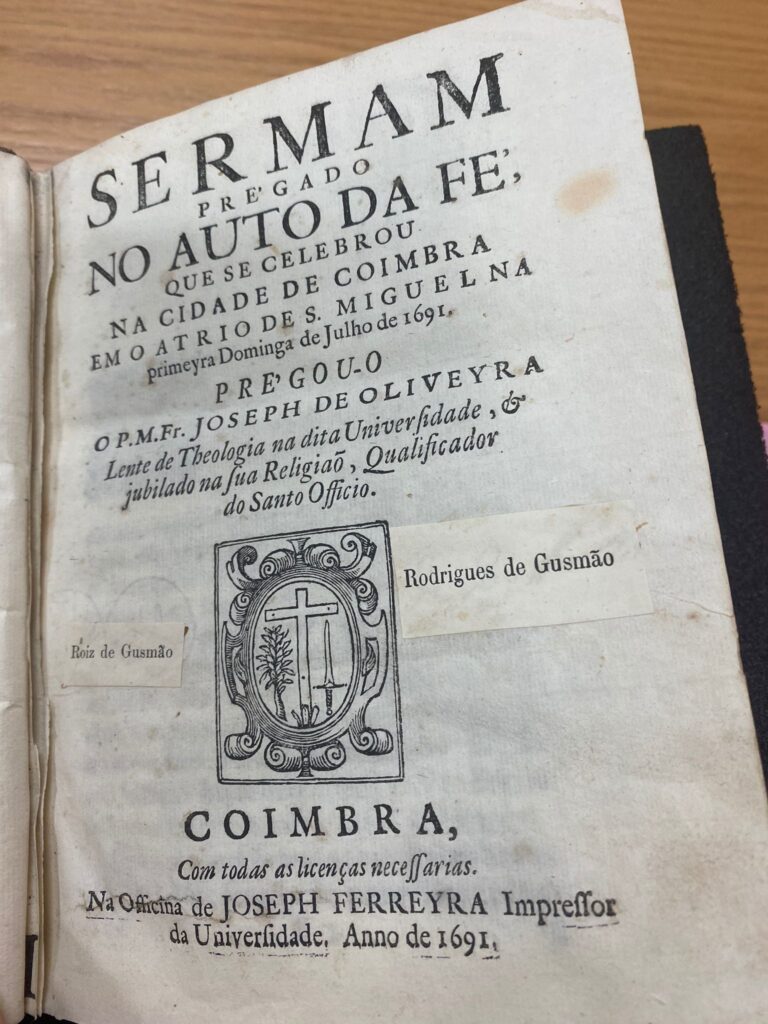
Sermam Prégado no Auto da Fé, que se celebrou na cidade de Coimbra em o Atrio de S. [São] Miguel na primeyra Dominga de Julho de 1691 [*]
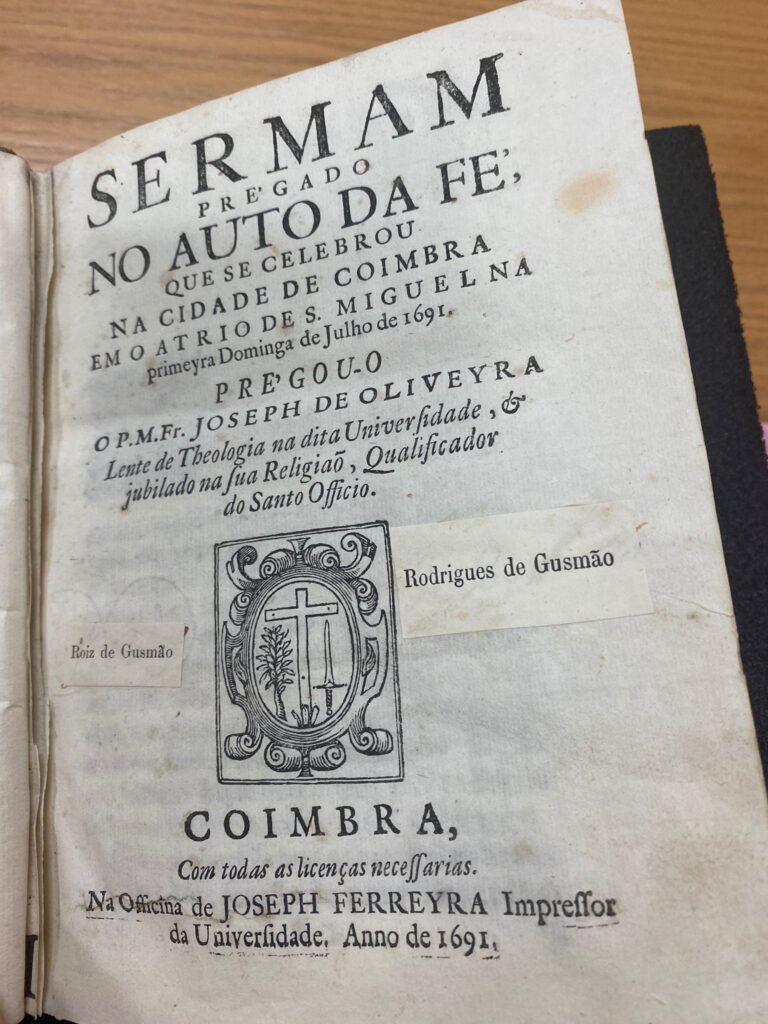
- Delivered by: Joseph (José) de Oliveyra (Oliveira)
- Printer: Joseph (José) Ferreyra (Ferreira; printer for the University of Coimbra)
- Print Location and Date: Coimbra, 1691
- Link: https://catalogo.bnportugal.gov.pt/ipac20/ipac.jsp?session=17004B31OG923.9569&profile=bn&source=~!bnp&view=subscriptionsummary&uri=full=3100024~!1278154~!1&ri=2&aspect=subtab11&menu=search&ipp=20&spp=20&staffonly=&term=sermam+pregado+no+auto+da+fe&index=.GW&uindex=&aspect=subtab11&menu=search&ri=2
Exhortação Dogmatica a Perfidia Judayca Feytaaos Reos penitenciados no Auto publico da Fé, que se celebrou na praça do Rocio junto aos paços da Inquisição desta Cidade de Lisboa em 9 de Julho de 1713 [*]
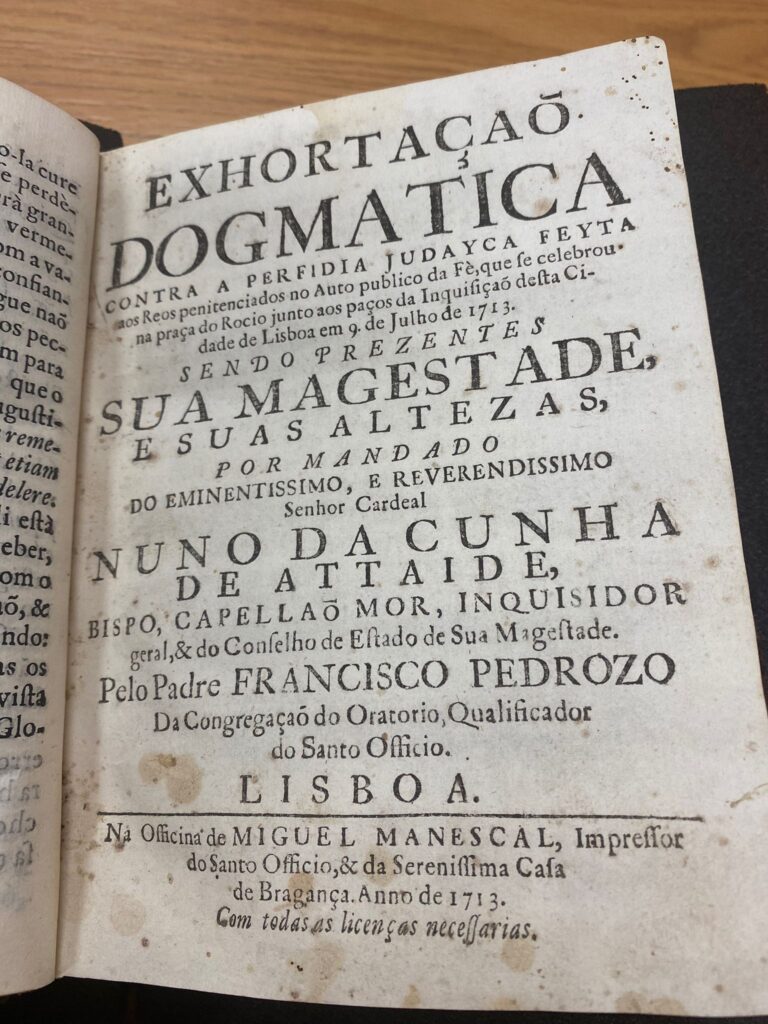
- Delivered by: Francisco Pedrozo/Pedroso
- Addressed to: Nuno da Cunha de Attaide/Ataíde3
- Printer: Miguel Manescal (printer for the Holy Office and the Royal House of Bragança/Braganza)
- Print Location and Date: Lisbon, 1713
- Link: https://catalogo.bnportugal.gov.pt/ipac20/ipac.jsp?session=17004B31OG923.9569&menu=search&aspect=subtab11&npp=20&ipp=20&spp=20&profile=bn&ri=3&source=%7E%21bnp&index=.GW&term=exhortacao+dogmatica&x=0&y=0&aspect=subtab11
Sermam no acto publico da fé que se celebrou na praça do rocio desta corte em Domingo 14 de Outubro de 1714 [*]
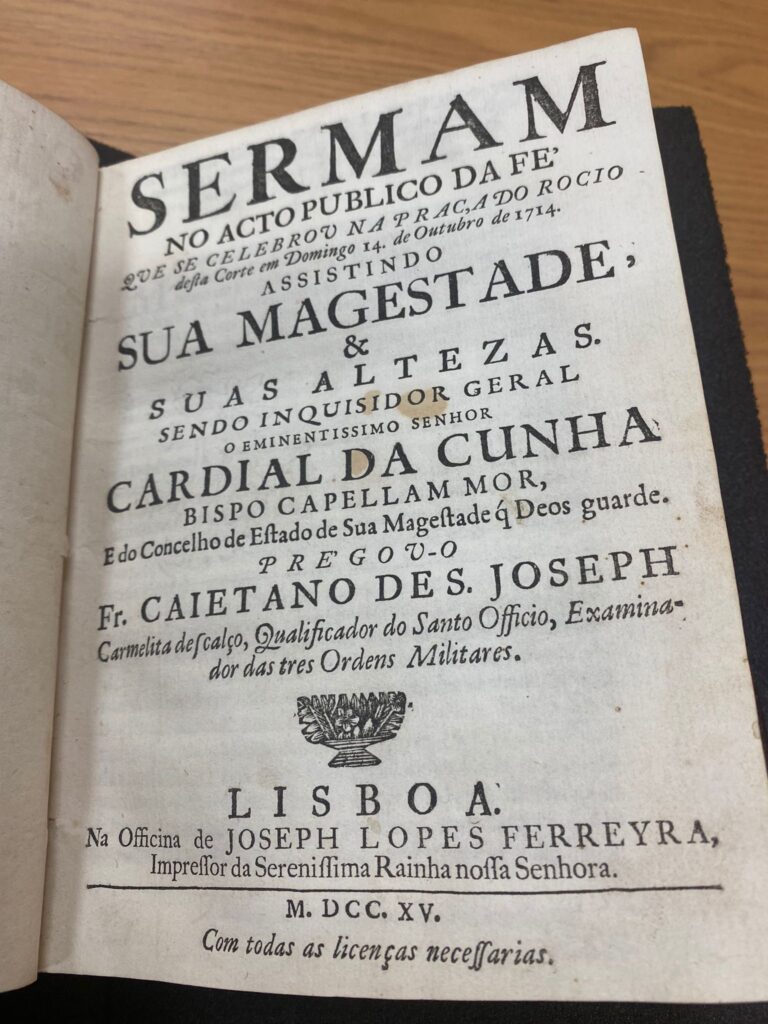
- Delivered by: Caietano de S[ão] Joseph
- Addressed to: Nuno da Cunha Ataíde (addressed as Cardinal da Cunha)
- Printer: Joseph (José) Lopes Ferreyra (Ferreira; printer for the Queen)4
- Print Location and Date: Lisbon, 1715
- Link: https://catalogo.bnportugal.gov.pt/ipac20/ipac.jsp?session=17004B31OG923.9569&menu=search&aspect=subtab11&npp=20&ipp=20&spp=20&profile=bn&ri=4&source=%7E%21bnp&index=.GW&term=sermam+no+acto+publico&x=0&y=0&aspect=subtab11
Sermão do acto publico da fee que se celebrou no pateo de São Miguel da Cidade de Coimbra em sette de Julho de 1720 [*]
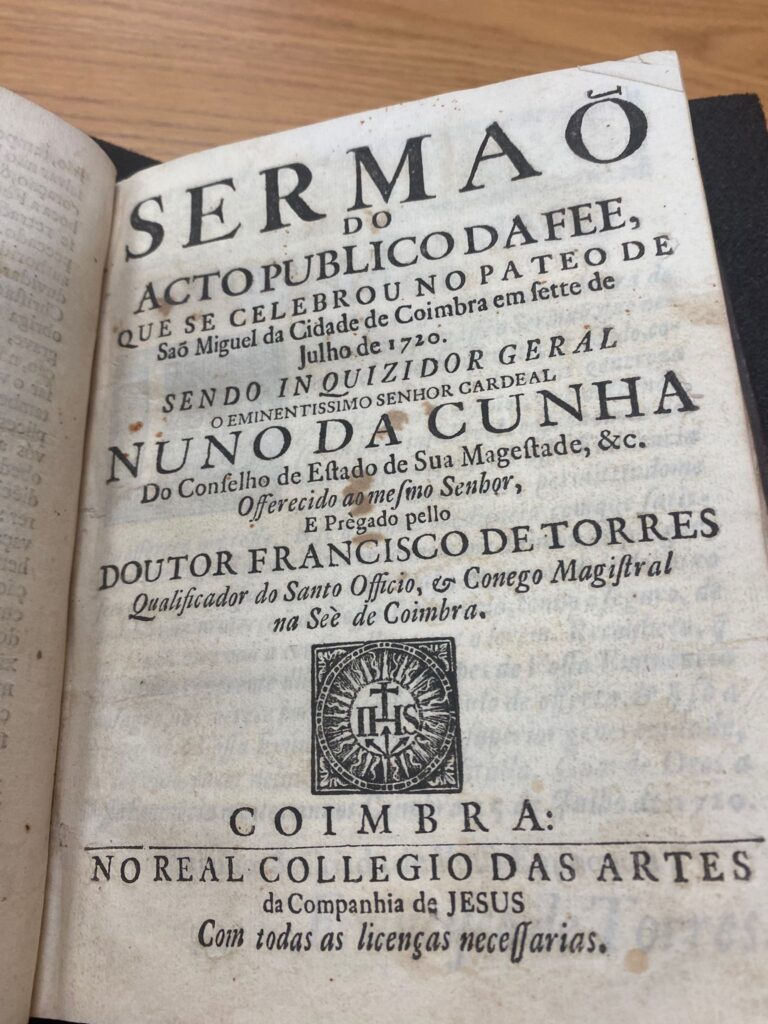
- Delivered by: Francisco de Torres
- Addressed to: Nuno da Cunha Ataíde (addressed as Nuno da Cunha)
- Printer: Royal Jesuit College of the Arts (Real Collegio das Artes da Companhia de JESUS)
- Print Location and Date: Coimbra, 17205
- Link: https://catalogo.bnportugal.gov.pt/ipac20/ipac.jsp?session=17004B31OG923.9569&menu=search&aspect=subtab11&npp=20&ipp=20&spp=20&profile=bn&ri=6&source=%7E%21bnp&index=.GW&term=Serm%C3%A3o+do+acto+publico+da+fee+que+se+celebrou+no+pateo+de+S%C3%A3o+Miguel+da+Cidade+de+Coimbra+em+sette+de+Julho+de+1720&x=12&y=13&aspect=subtab11
Sermam Historico e Panegyrico do P. Antonio Vieyra da Companhia de Iesv
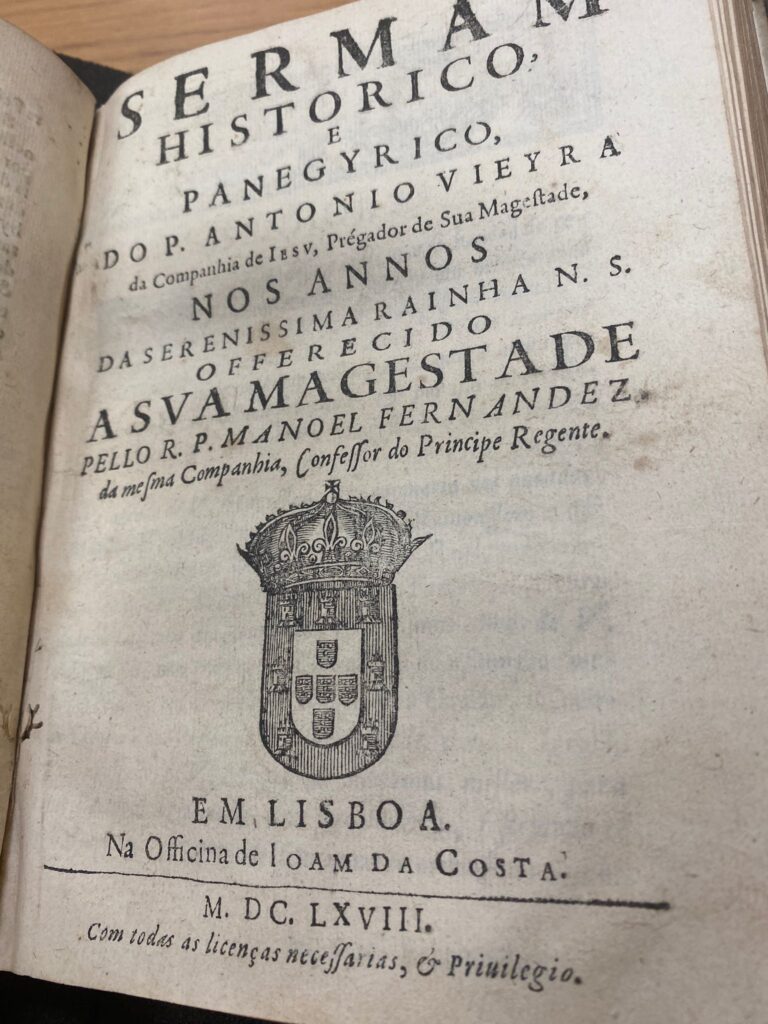
- Delivered by: Antonio Vieyra (Vieira)
- Addressed to: Queen of Portugal (Maria Francisca of Savoy), by Manoel Fernandez/Fernandes (a Jesuit priest)6
- Printer: Ioam (João) da Costa
- Print Location and Date: Lisbon, 1668
- Link: https://catalogo.bnportugal.gov.pt/ipac20/ipac.jsp?session=17004B31OG923.9569&profile=bn&source=~!bnp&view=subscriptionsummary&uri=full=3100024~!637850~!0&ri=10&aspect=subtab11&menu=search&ipp=20&spp=20&staffonly=&term=Sermam+Historico+e+Panegyrico&index=.GW&uindex=&aspect=subtab11&menu=search&ri=10
Sermam do Glorioso Martyr Sam Sebastiam pregado na Capella Real, aos 20 de Janeiro do Anno de 1670
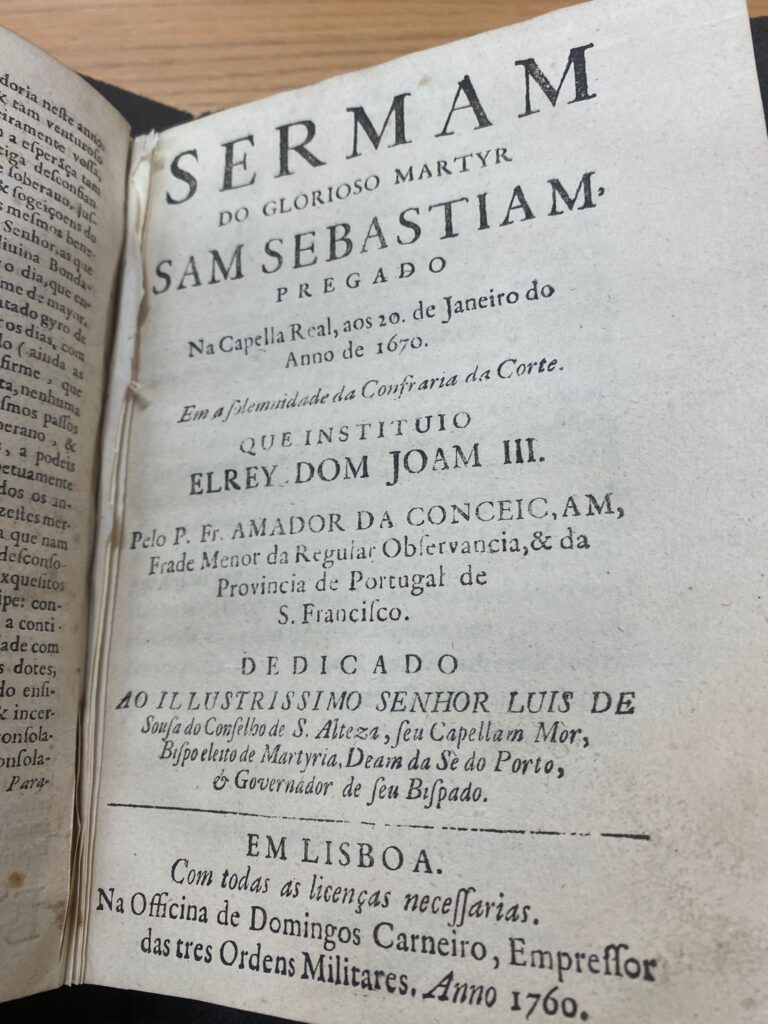
- Delivered by: Amador da Conceiçam (Conceição)
- Addressed to: Luis de Sousa
- Printer: Domingos Carneiro (printer for the Three Military Orders)7
- Print Location and Date: Lisbon, 16708
- Link: https://catalogo.bnportugal.gov.pt/ipac20/ipac.jsp?session=17004B31OG923.9569&profile=bn&source=~!bnp&view=subscriptionsummary&uri=full=3100024~!1061671~!0&ri=12&aspect=subtab11&menu=search&ipp=20&spp=20&staffonly=&term=Sermam+do+Glorioso+Martyr+Sam+Sebastiam+pregado+na+Capella+Real&index=.GW&uindex=&aspect=subtab11&menu=search&ri=12
Sermão de São Ioseph que Pregou no Mosteyro da Madre de Deos de Monchique na Profissão de Sua Irmãa a Madre Soror Luiza Clara de Aracaeli
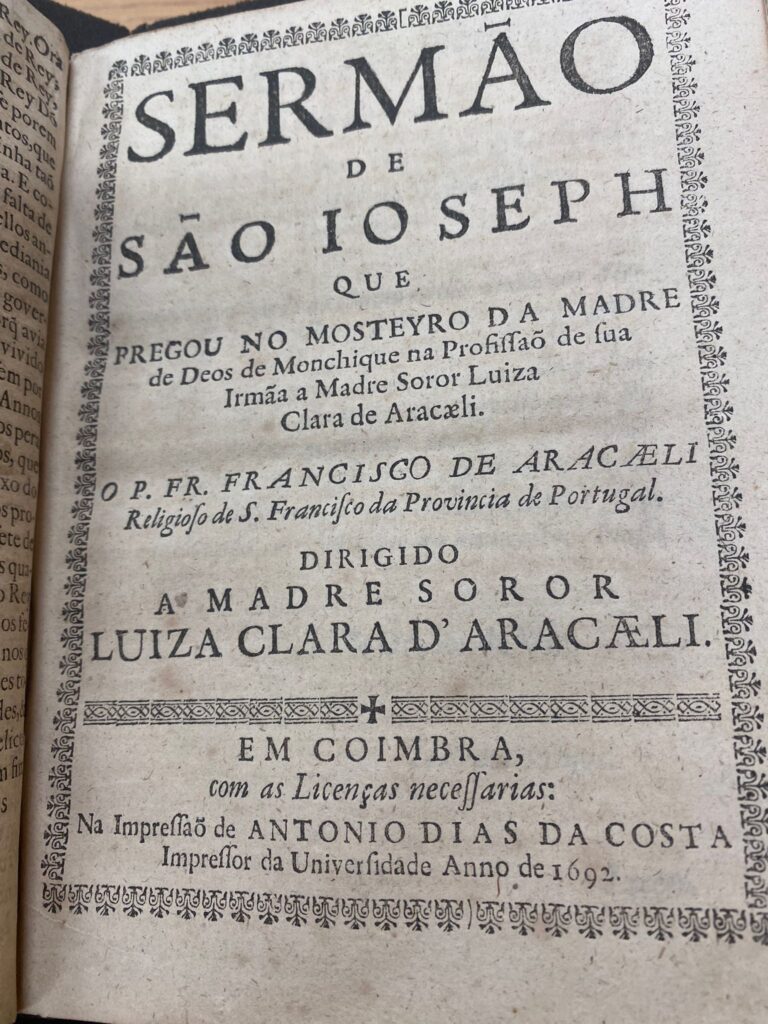
- Delivered by: Francisco de Aracaeli (Franciscan Priest)9
- Addressed to: Luiza Clara de Aracaeli
- Printer: Antonio Dias da Costa (printer for the University of Coimbra)
- Print Location and Date: Coimbra, 1692
Sermon on St. Joseph and a Passage on Matthew
- This text does not have a title page that contains bibliographic information
Sermam de S. Joam Bautista pregado Na Igreja de Santo Estavão d’Alfama em 4 de Agosto de 1680
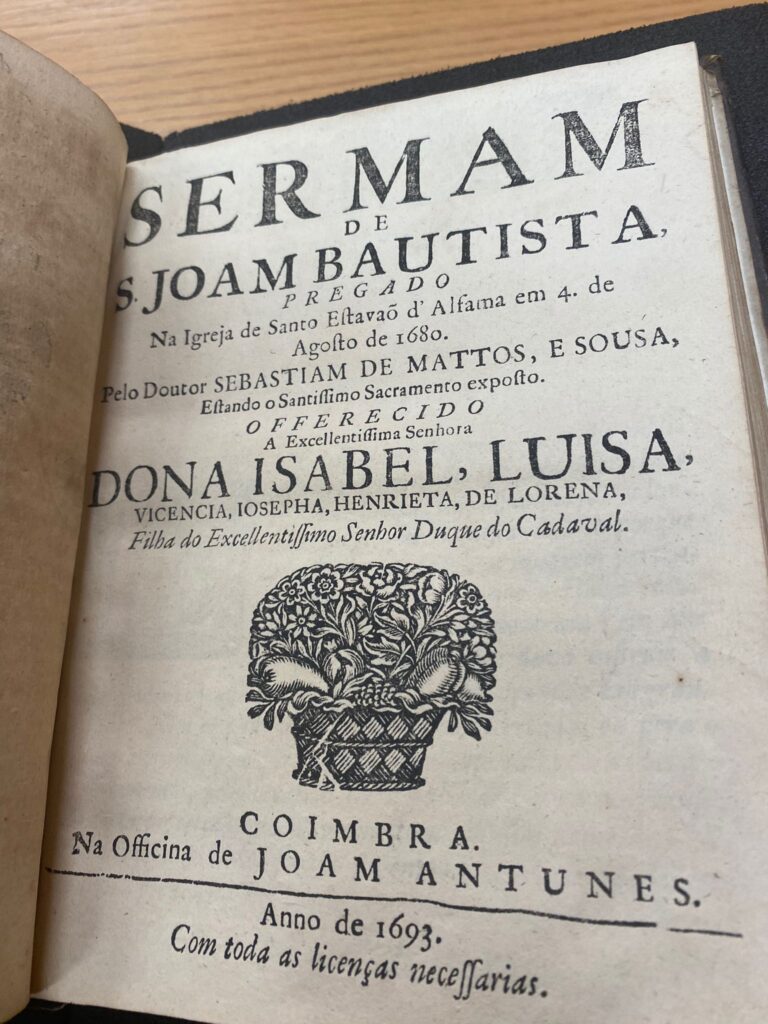
- Delivered by Sebastiam (Sebastião) de Mattos e Sousa
- Addressed to Isabel Luisa Vicencia Iosepha Henrieta de Lorena10
- Printer: Joam (João) Antunes
- Print Location and Date: Coimbra, 1693
- Link: https://catalogo.bnportugal.gov.pt/ipac20/ipac.jsp?session=17004B31OG923.9569&profile=bn&source=~!bnp&view=subscriptionsummary&uri=full=3100024~!1587640~!0&ri=19&aspect=subtab11&menu=search&ipp=20&spp=20&staffonly=&term=Sermam+de+S.+Joam+Bautista&index=.GW&uindex=&aspect=subtab11&menu=search&ri=19
Sermão da Rainha Sancta pregado no Real Mosteiro de Sancta Clara de Coimbra no Anno de 679
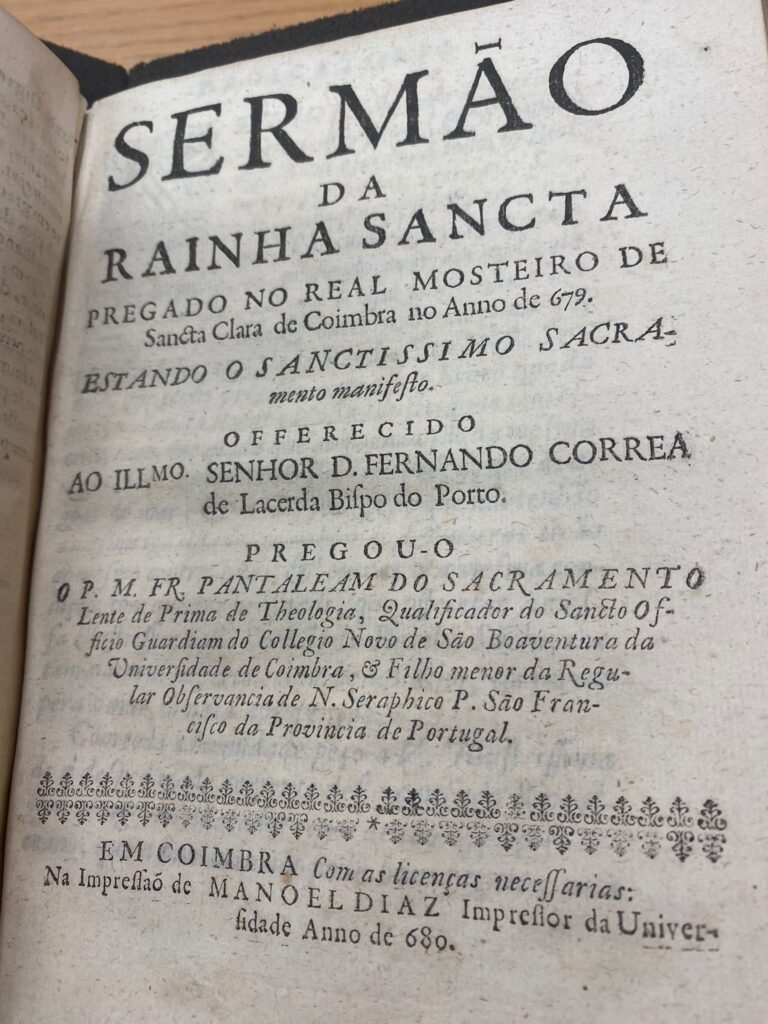
- Delivered by Pantaleam (Pantaleão) do Sacramento
- Addressed to: Fernando Correa de Lacerda (Bishop of Porto)
- Printer: Manoel Diaz/Dias (printer for the University of Coimbra)
- Print Location and Date: Coimbra, 1680
- Link: https://catalogo.bnportugal.gov.pt/ipac20/ipac.jsp?session=17004B31OG923.9569&profile=bn&source=~!bnp&view=subscriptionsummary&uri=full=3100024~!1272568~!1&ri=21&aspect=subtab11&menu=search&ipp=20&spp=20&staffonly=&term=Serm%C3%A3o+da+Rainha+Sancta&index=.GW&uindex=&aspect=subtab11&menu=search&ri=21
Sermão da Canonização de S. Paschoal Baylon Pregado em a Tarde do Segundo dia do Solemne Triduo, que celebrou o Convento de São Francisco do Porto em 4 de Agosto de 1691
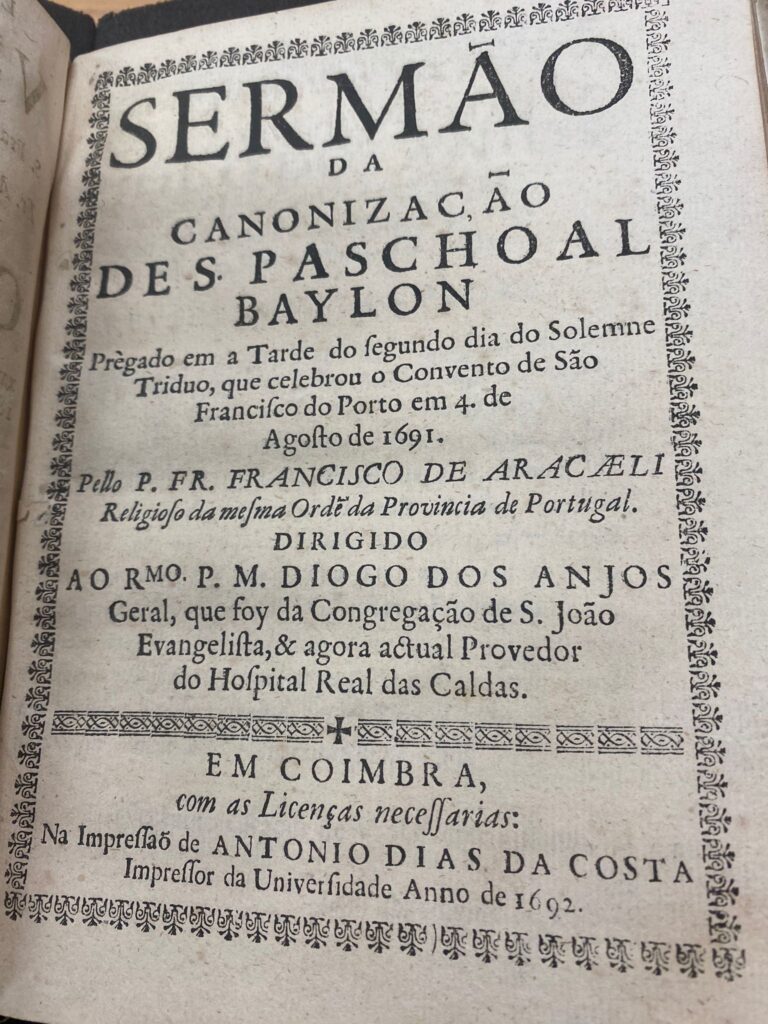
- Delivered by Francisco de Aracaeli
- *Directed by: Diogo dos Anjos
- Printer: Antonio Dias da Costa (printer for the University of Coimbra)
- Print Location and Date: Coimbra, 1692
- Link: https://catalogo.bnportugal.gov.pt/ipac20/ipac.jsp?session=17004B31OG923.9569&menu=search&aspect=subtab11&npp=20&ipp=20&spp=20&profile=bn&ri=22&source=%7E%21bnp&index=.GW&term=Serm%C3%A3o+da+Canoniza%C3%A7%C3%A3o+de+S.+Paschoal+Baylon&x=0&y=0&aspect=subtab11
Sermam do Dia de Cinza que pregou o p. Antonio de Saa
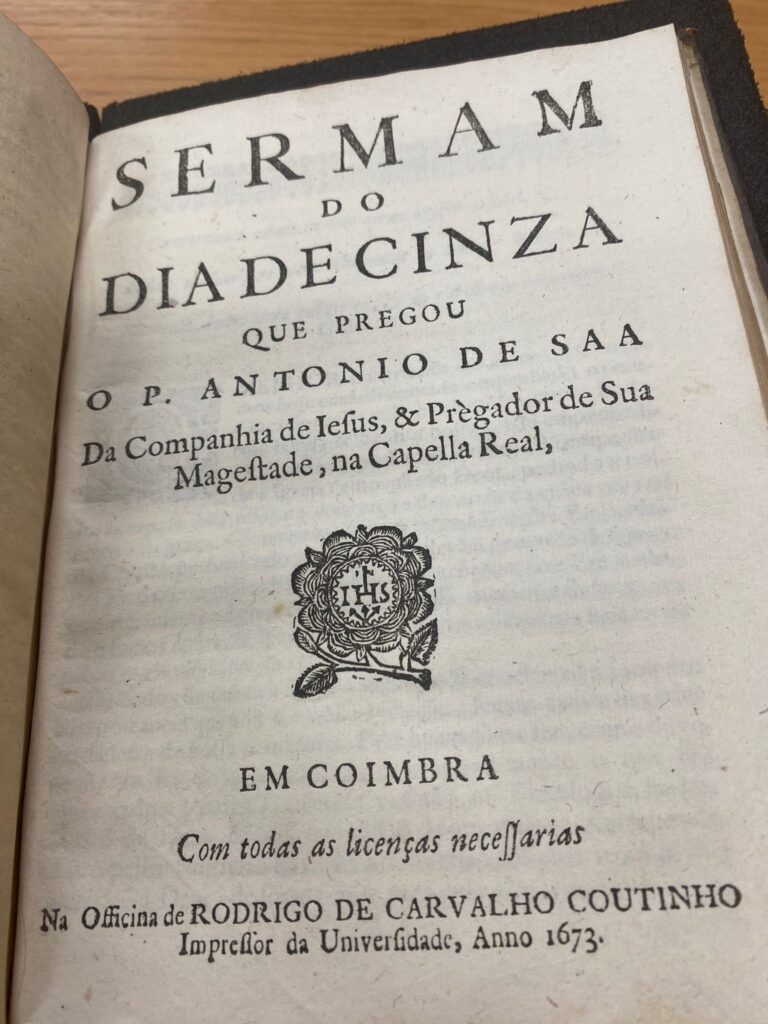
- Delivered by: Antonio de Saa (Sá; Jesuit priest)
- Printer: Rodrigo de Carvalho Coutinho (printer for the University of Coimbra)
- Print Location and Date: Coimbra, 1673
- Link: https://catalogo.bnportugal.gov.pt/ipac20/ipac.jsp?session=17004B31OG923.9569&profile=bn&source=~!bnp&view=subscriptionsummary&uri=full=3100024~!1648952~!1&ri=26&aspect=subtab11&menu=search&ipp=20&spp=20&staffonly=&term=Sermam+do+Dia+de+Cinza+&index=.GW&uindex=&aspect=subtab11&menu=search&ri=26
Sermão na primeira sesta feira da Quaresma que pregou o R. P. Antonio de Saa da Companhia de Jesvs na Freguezia de S. Julião anno de 1674
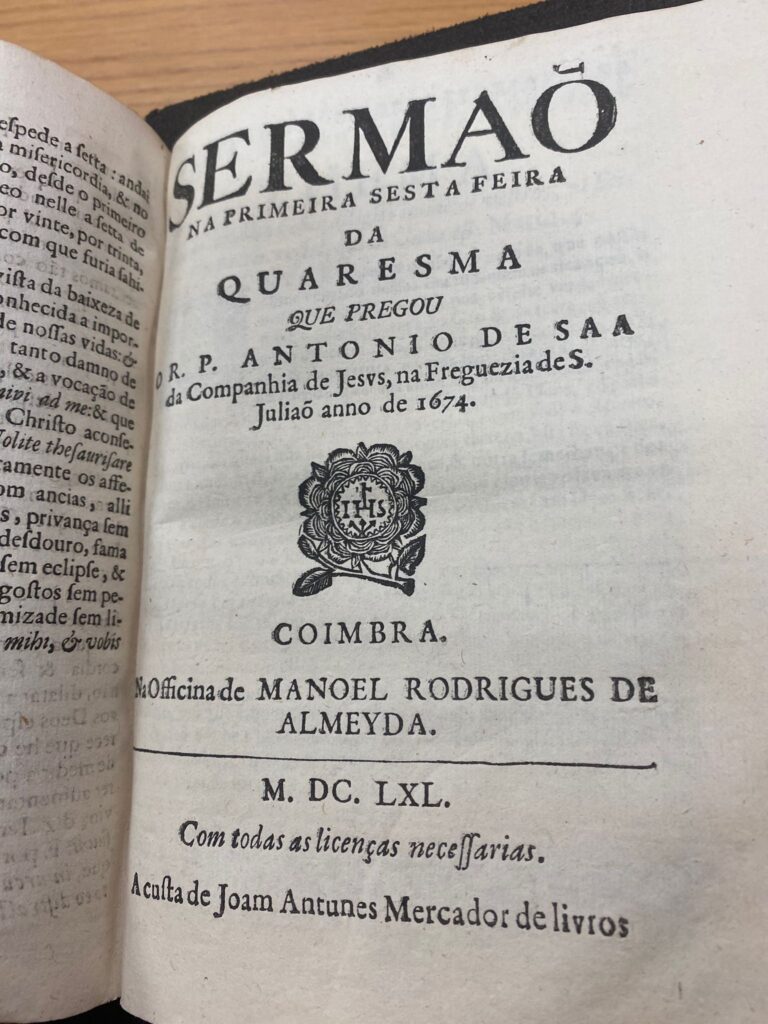
- Delivered by: Antonio de Saa (Sá)
- Printer: Manoel Rodrigues de Almeyda (Almeida)
- *Bookseller: Joam (João) Antunes
- Print Location and Date: Coimbra, 167411
- Link: https://catalogo.bnportugal.gov.pt/ipac20/ipac.jsp?session=17004B31OG923.9569&profile=bn&source=~!bnp&view=subscriptionsummary&uri=full=3100024~!1648986~!1&ri=28&aspect=subtab11&menu=search&ipp=20&spp=20&staffonly=&term=Serm%C3%A3o+na+primeira+sesta+feira+da+Quaresma&index=.GW&uindex=&aspect=subtab11&menu=search&ri=28
Sermam de terceira quarta feira da Quaresma pregado na capella real anno de 1651
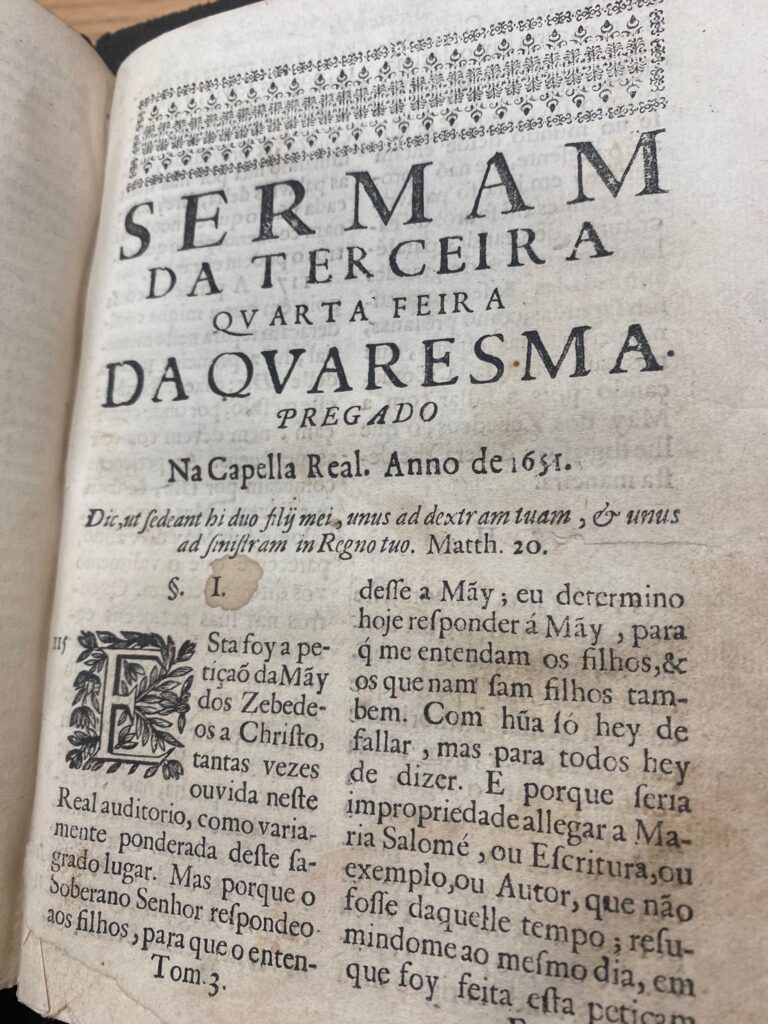
- This sermon has no title page with bibliographic information – though historian João Francisco Marques identifies this sermon as being part of António Vieira’s series of sermons.12
Sermão da Lagrimas da Magdalena feyto pello Fr. Manoel de S. Joseph
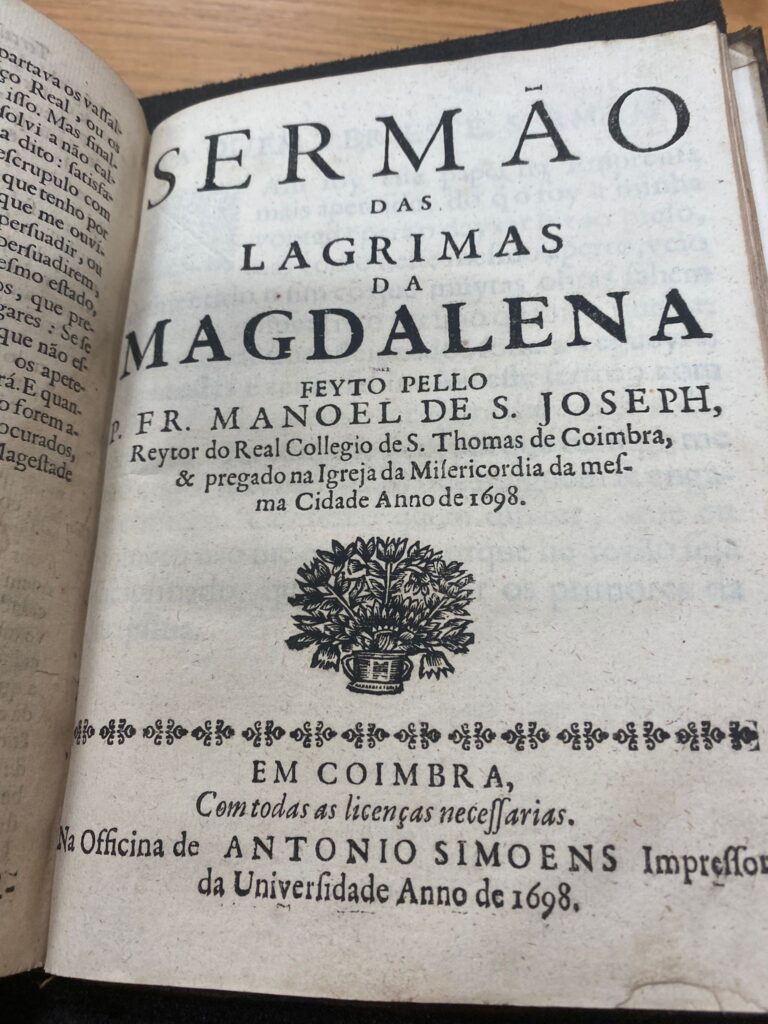
- Delivered by: Manoel de S[ão] Joseph (rector at the Royal College of S. Thomas of Coimbra)
- Printer: Antonio Simoens (printer for the University of Coimbra)
- Print Location and Date: Coimbra, 1698
- Link: https://catalogo.bnportugal.gov.pt/ipac20/ipac.jsp?session=17004B31OG923.9569&profile=bn&source=~!bnp&view=subscriptionsummary&uri=full=3100024~!1278049~!1&ri=32&aspect=subtab11&menu=search&ipp=20&spp=20&staffonly=&term=Serm%C3%A3o+da+Lagrimas+da+Magdalena+&index=.GW&uindex=&aspect=subtab11&menu=search&ri=32
Sermam de S. Agustinho pregado na sua igreja e convento de s. Vicente de Fóra em Lisboa, Anno de 1648
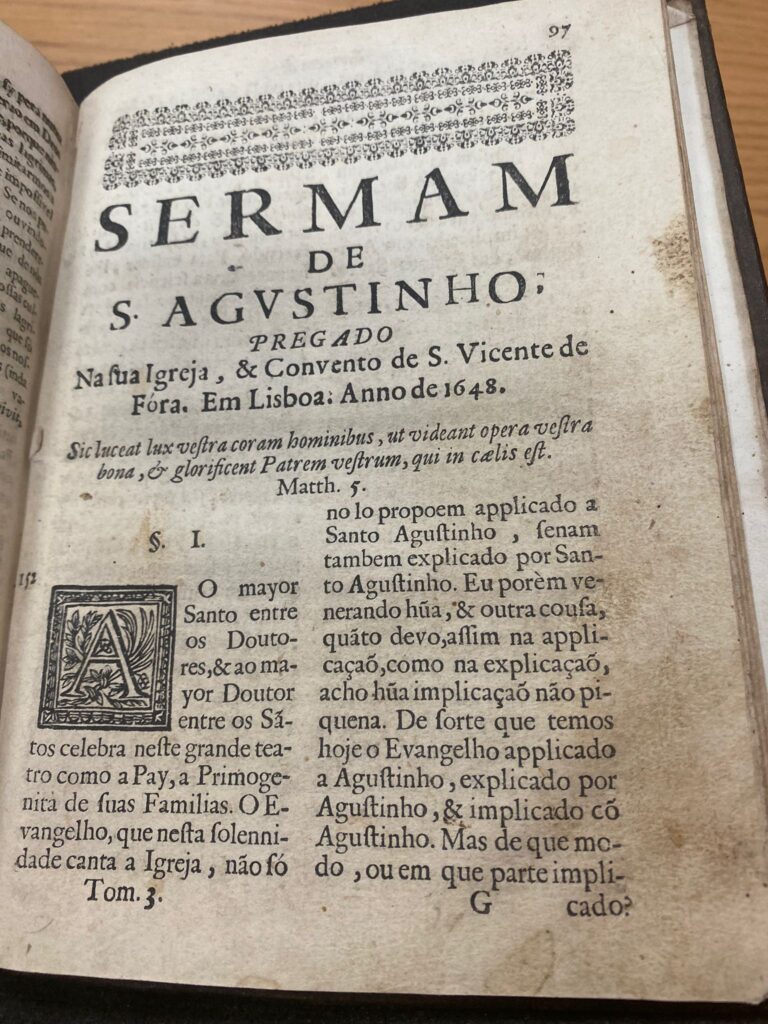
- No bibliographic information besides the date of the sermon – João Francisco Marques identifies this as belonging to António Vieira’s sermons.13
II. Note on Content
The sermons of this volume deal with a diverse array of spiritual subjects, from the commemoration of important holy dates within the Catholic canon such as Ash Wednesday (Sermam do Dia de Cinza; Sermon of Ash Wednesday [Dia de Cinza literally translating to “Day of Ash”]) and Lent (Sermam de terceira quarta feira da Quaresma; Sermon of the Third Wednesday of Lent) to paying homage to important religious figures such as Saint Augustine (Sermam de S. Agustinho) and Paschal Baylón (Sermão da Canonização de S. Paschoal Baylon).14 At the crux of these sermons is biblical exegesis by the various religious authorities who are delivering these sermons, forwarding their critical analyses of the scripture to support the spiritual arguments being made in each sermon.
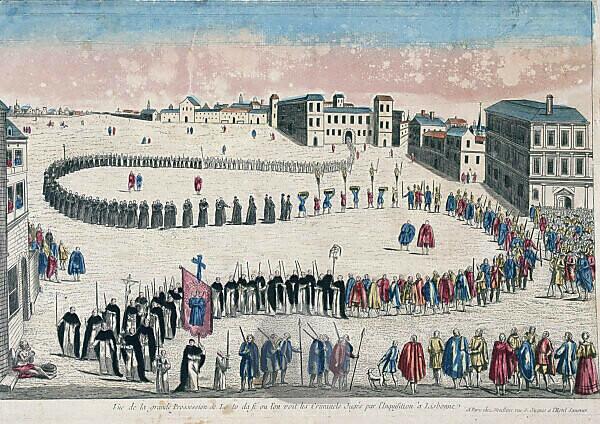
With respect to content, the four auto de fé sermons jump out in that they demonstrate a great deal of uniformity. The primary intent of these sermons, which were preached to those denounced to the Portuguese Inquisition for the spiritual crime of Judaizing – a charge typically levied to converted Christians of Jewish origin who allegedly continued to adhere to the Mosaic Law in private, was to communicate the supposed deficiencies of the Jewish faith. In doing so, the deliverers of the four sermons all rely on strands of anti-Jewish argumentation prevalent during this period. Perhaps the most prominent example comes in the form of constant references to the spiritual blindness of Jews (the words use to invoke that trope are cego and cegueira, or “blind” and “blindness” in Portuguese). The trope of spiritual blindness is often stated in conjunction with the messianic belief in Judaism (communicated with the word esperança [hope]), pointing out that the Jews are too “spiritually blind” to understand that Jesus Christ is the messiah that they have been, and continue to search for. Another prevalent trope – also going hand in hand with the previous two – is that of Ecclesia and Synagoga, or personifications of the Church (Ecclesia) and the Synagogue (Synagoga).15 The blindfold and the drooping gaze of the latter particularly reflect the notion of spiritual blindness. As the statues representing this trope were readily visible at churches, this invocation would have been a poignant message that would have resonated even with some of the lay audience present at the autos de fé that may not have been familiar with the scripture.
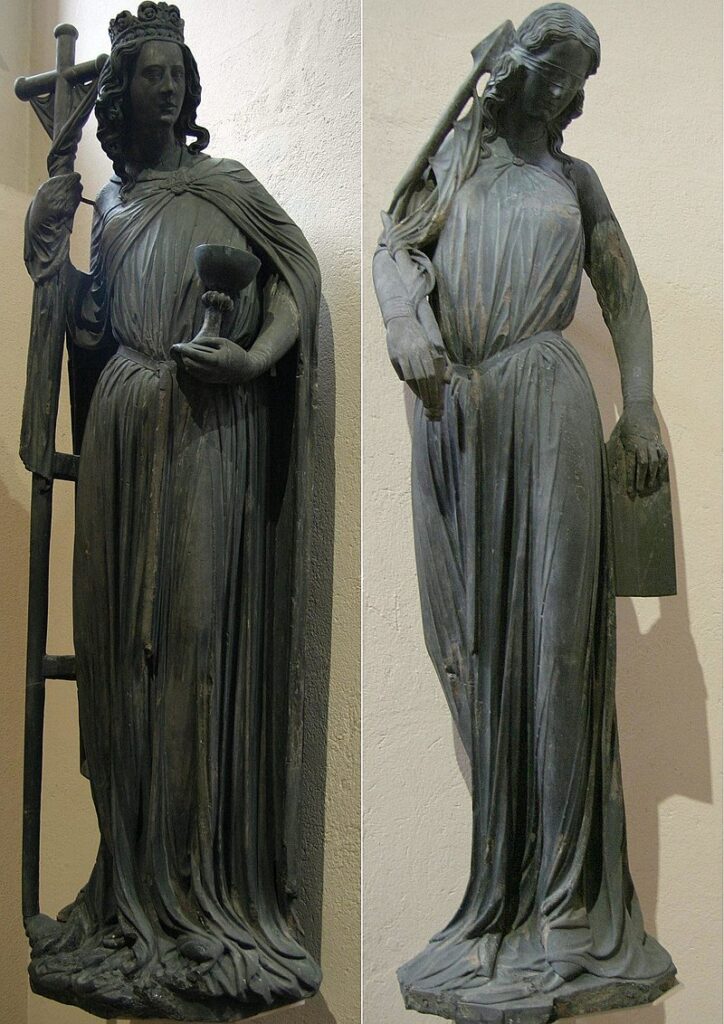
All in all, the sermons listed in this compilatory volume provide valuable insight into the intellectual currents and the climate of religiosity in early modern Portugal. For one, the sermons display the kinds of scriptural exegesis taking place during this period, alluding to which spiritual messages were being communicated to the Portuguese during the mid-to-late 17th and early 18th centuries. The sermons also give ample information regarding prominent ecclesiastical and secular authorities during this time, from things that are specifically mentioned in the title pages such as the fact that Nuno da Cunha held the position of Inquisitor-General for the Holy Office to histories that are more so implied such as the political circumstances surrounding Pedro II’s ascension to the monarchy.
Regarding the auto de fé sermons in particular, they point to the presence of clandestine practitioners of Judaism despite their nominal conversion to Christianity being a significant source of religious anxiety among the early modern Portuguese. Edward Glaser, a literary scholar who studied many of the auto de fé sermons, notes that there are more than seventy known to be printed at this time (Glaser’s article on the subject is close to seventy years old, and more sermons could have been unearthed since then), suggesting a climate of intense religiosity predicated on the discovery and suppression of crypto-Jewish heretics.16
III. Significance of the Sermons: Early Modern Portuguese Print Culture
In addition to insights on early modern Portuguese religiosity, survey of the printers named in the title pages of the sermons reveals much regarding print culture in Portugal from the mid-17th to the early-18th centuries. This is very much in line with what the author of the inscription had to say of the compiled volume, as the sermons were not only “valuable for those collecting [early modern Portuguese sermons]” but also highly useful for those studying the print culture of Portugal – particularly in Coimbra where the majority of the sermons were published.
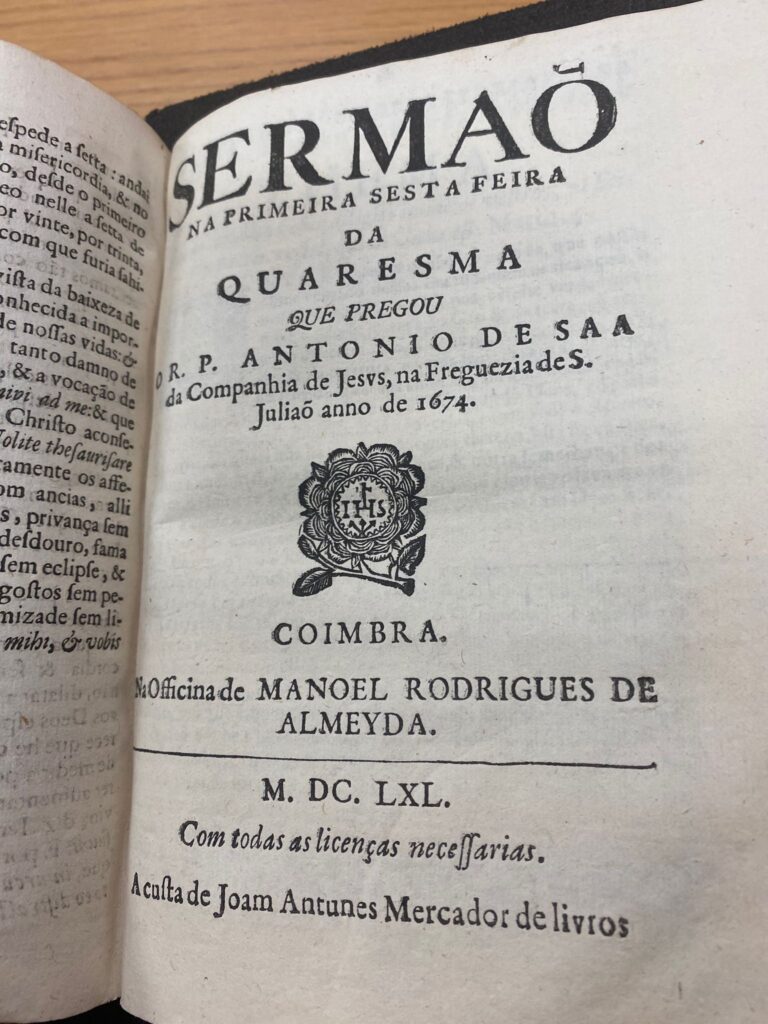
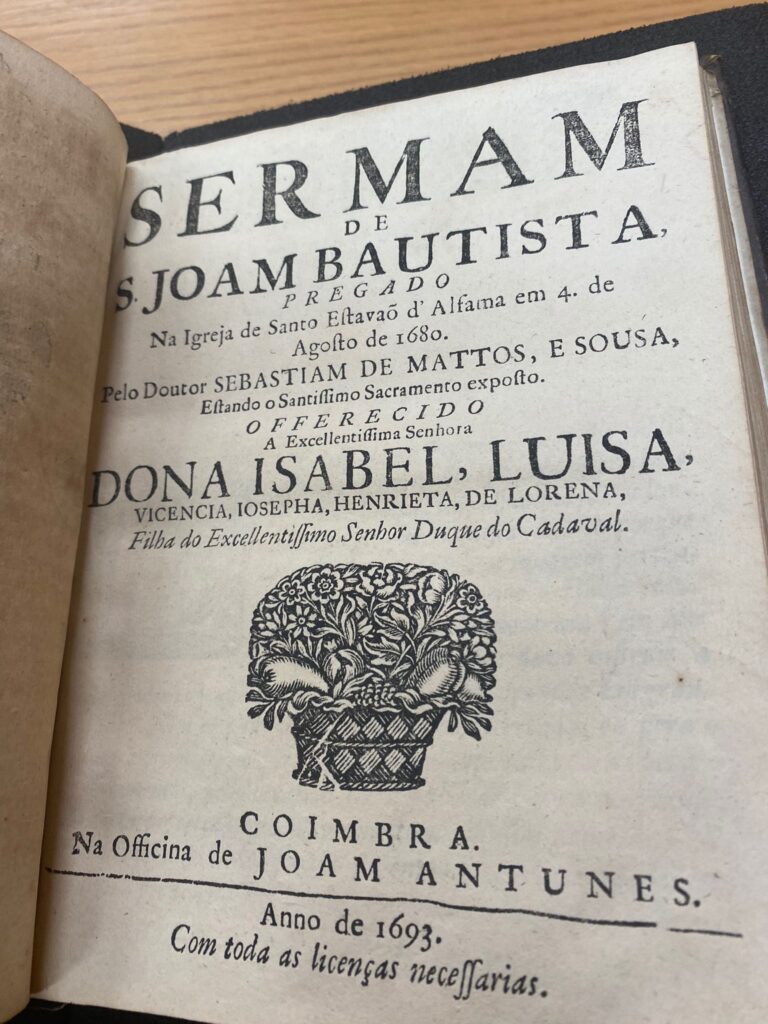
The images above feature the same name twice: that of Joam (João) Antunes. In the sermon on the left (António de Sá’s), Antunes is listed as a bookseller; in the sermon on the right (Sebastião de Mattos e Sousa), he is listed as a printer. Though one may be wary of instantaneously equivalizing these two individuals given that João Antunes is not necessarily the most unique combination of Portuguese names, a register of printers associated with the city of Coimbra (and particularly its university) found in 19th century historian Joaquim Martins de Carvalho denotes that Antunes the bookseller and Antunes the printer are one and the same.17
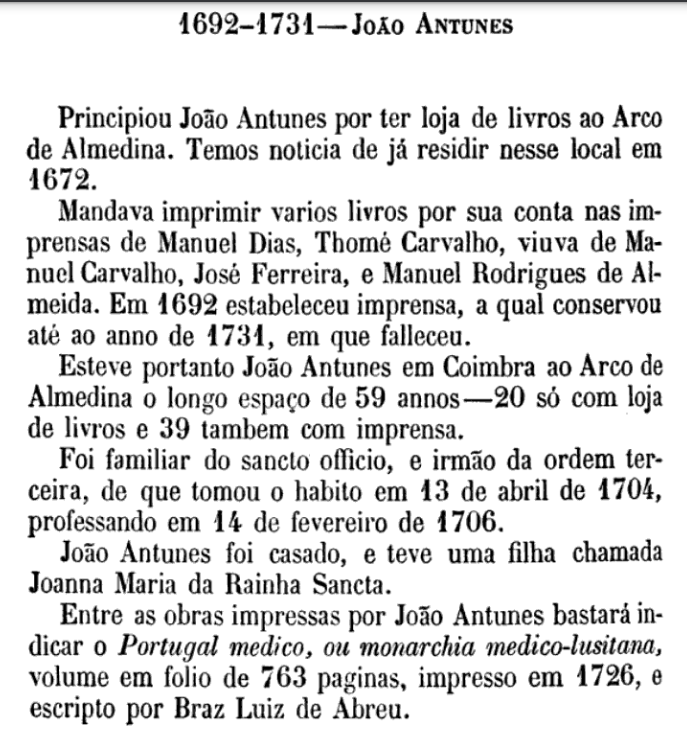
From this excerpt, Antunes started out by opening his own book shop at the Arco de Almedina in the city of Coimbra (“Principiou João Antunes por ter loja de livros ao Arco de Almedina“), likely since 1672 when his residence in that section of Coimbra became first documented. Antunes then went on to establish his own press in 1692 (“Em 1692 estableceu imprensa”). With this information, Carvalho confirming that Antunes was both a bookseller and later a printer – the dates making sense given the information printed on the two sermons listed above, as the sermon that lists him as a bookseller dates back to some time shortly after 1674 (not certain due to the typographical error on the Roman numerals) and the one that identifies him as a printer dates back to 1693, shortly after his print shop opened.
Two other notable observations emerge from this piece of text. For one, Carvalho notes that Antunes collaborated extensively with other printers, predominantly associated with the university, in Coimbra, some of whom are names we find in the title pages of the other sermons in the collective volume (Manuel Dias/Manoel Diaz – Sermão da Rainha Sancta; José Ferreira/Joseph Ferreyra – Sermam pregado no auto da fé). The transactions that Antunes had with the printers of the University of Coimbra provides some insight into how networks of printers and booksellers would have operated in the city during early modern times. Second, Carvalho additionally identifies Antunes as a familiar of the Holy Office (“Foi familiar do Santo Officio”), or a lay collaborator of the Portuguese Inquisition. The fact that an individual involved in the publication and distribution of printed sources closely collaborated with the Inquisition suggests that the Holy Office played a direct role in the dissemination of information alongside their more widely known role in censorship.19
IV. Provenance Information
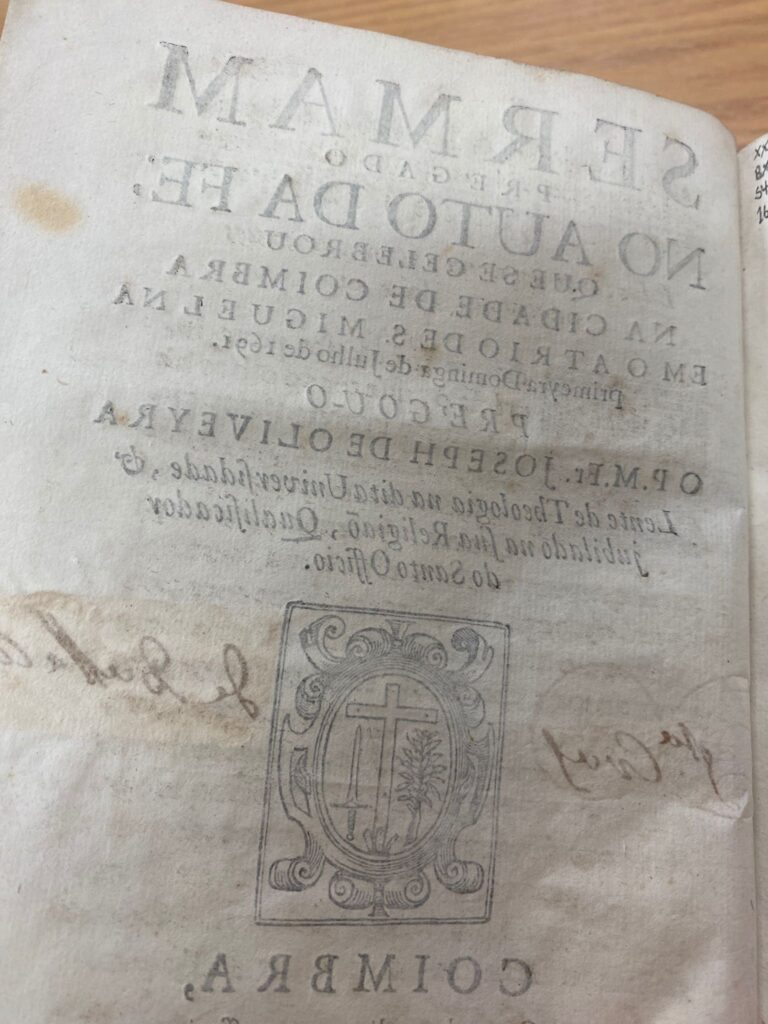
Preliminary Provenance Information: brief, written description of the bound volume on page before the title page of first sermon; two slips of paper with Rodrigues de Gusmão and Roiz de Gusmão (refers to the same individual; Roiz is shortened form of Rodrigues in Portuguese) pasted over an inscription that says Sta Cruz do Bussaco (Santa Cruz do Buçaco); several instances of marginalia ranging from note inscriptions, scribbles, and pagination (Vieira's Sermam Historico e Pangyrico is paginated on the top corners of the leaves)
The Two Productive Leads
Other Leads, Less Productive in Terms of Provenance
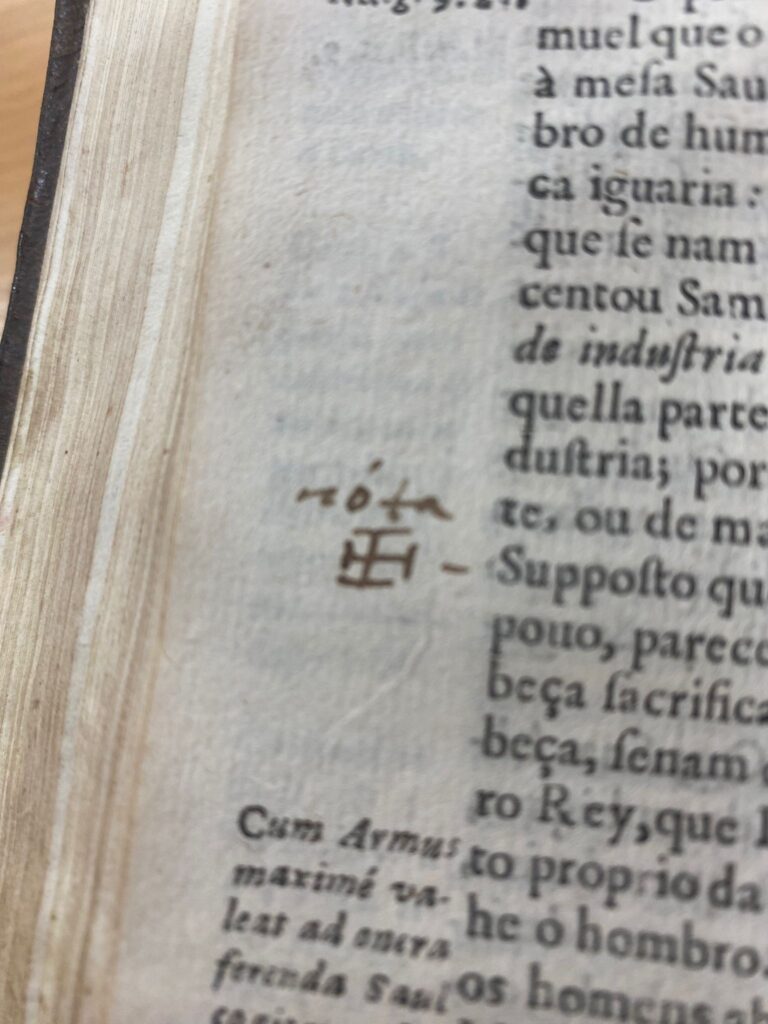
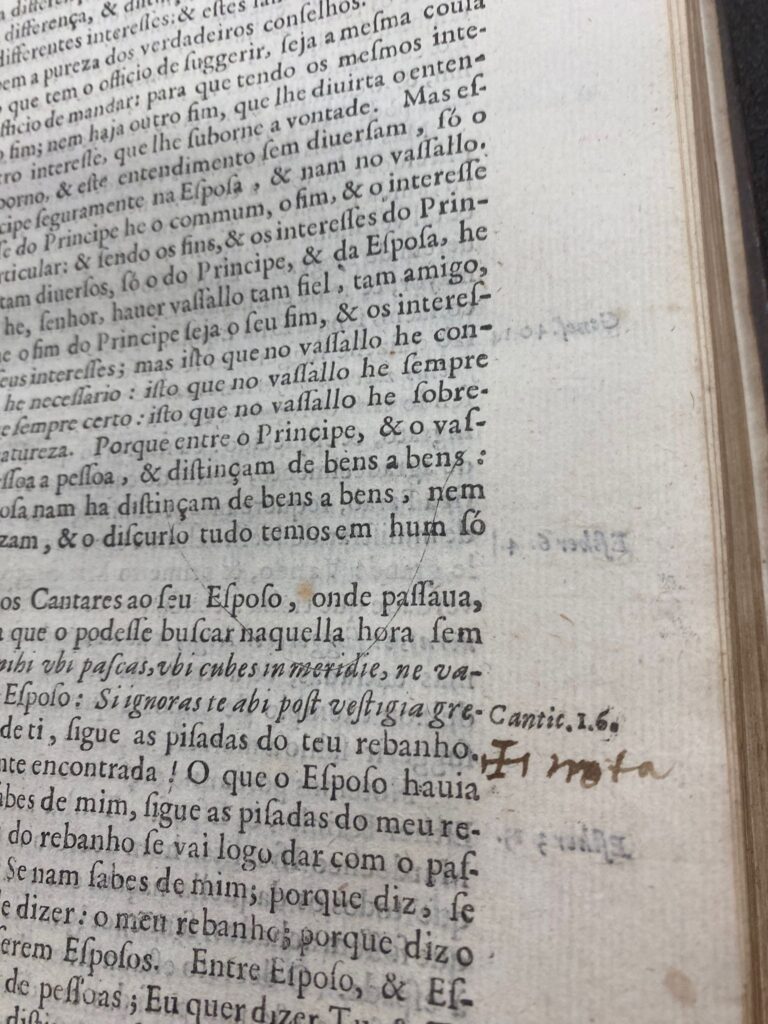
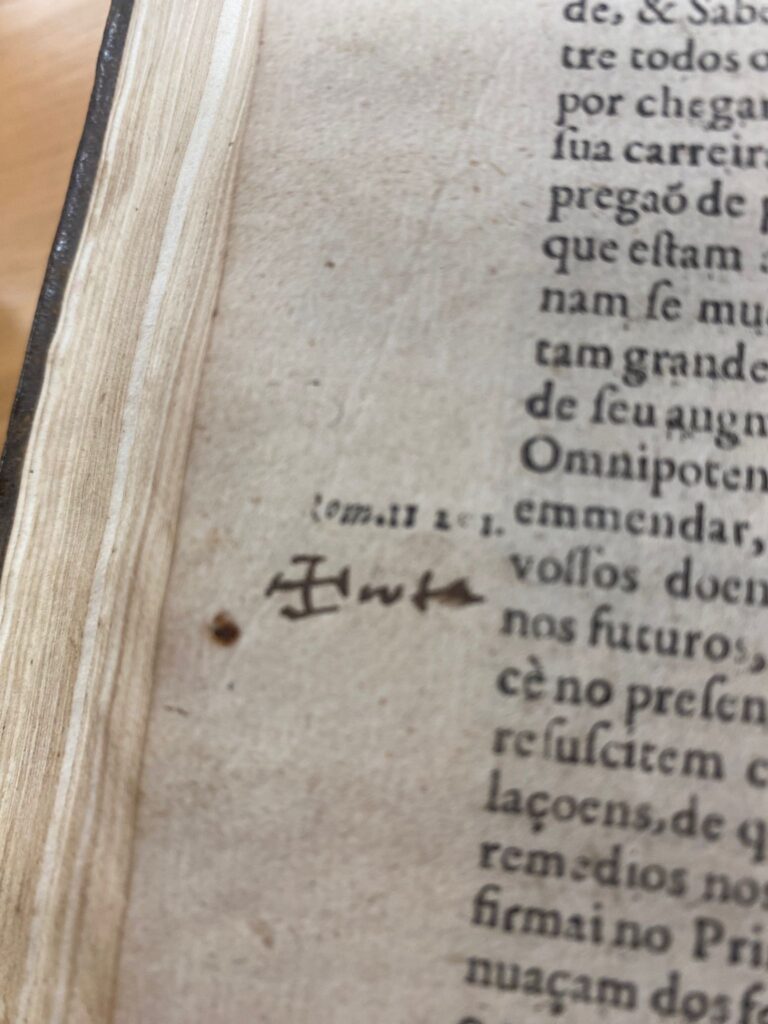
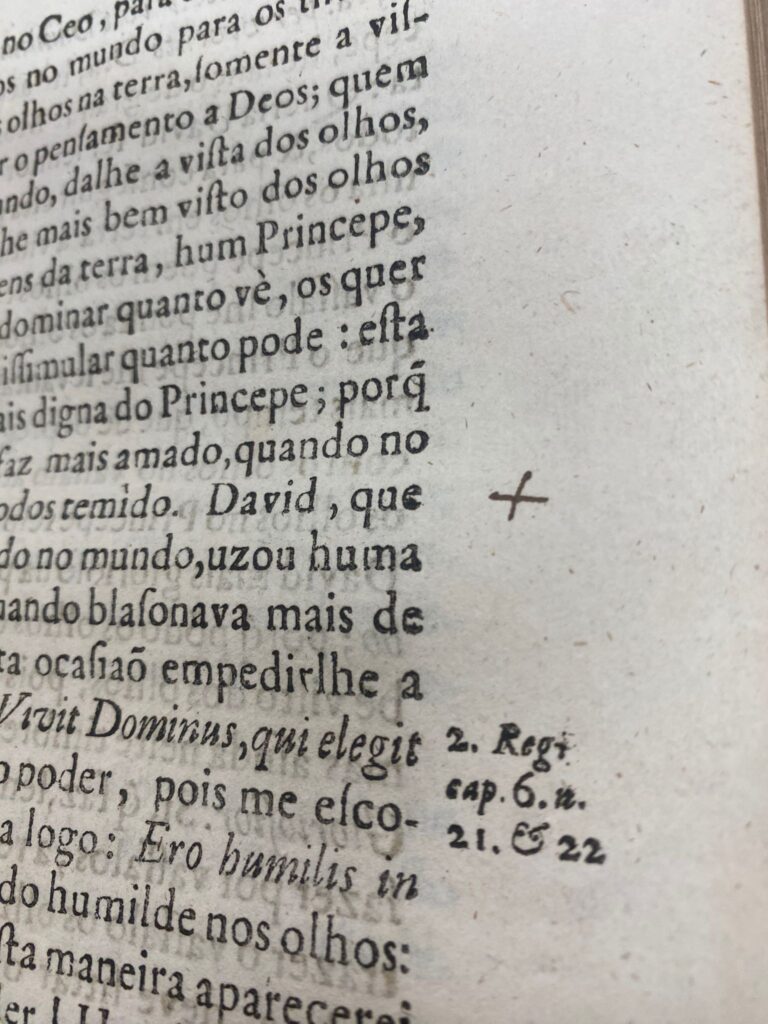
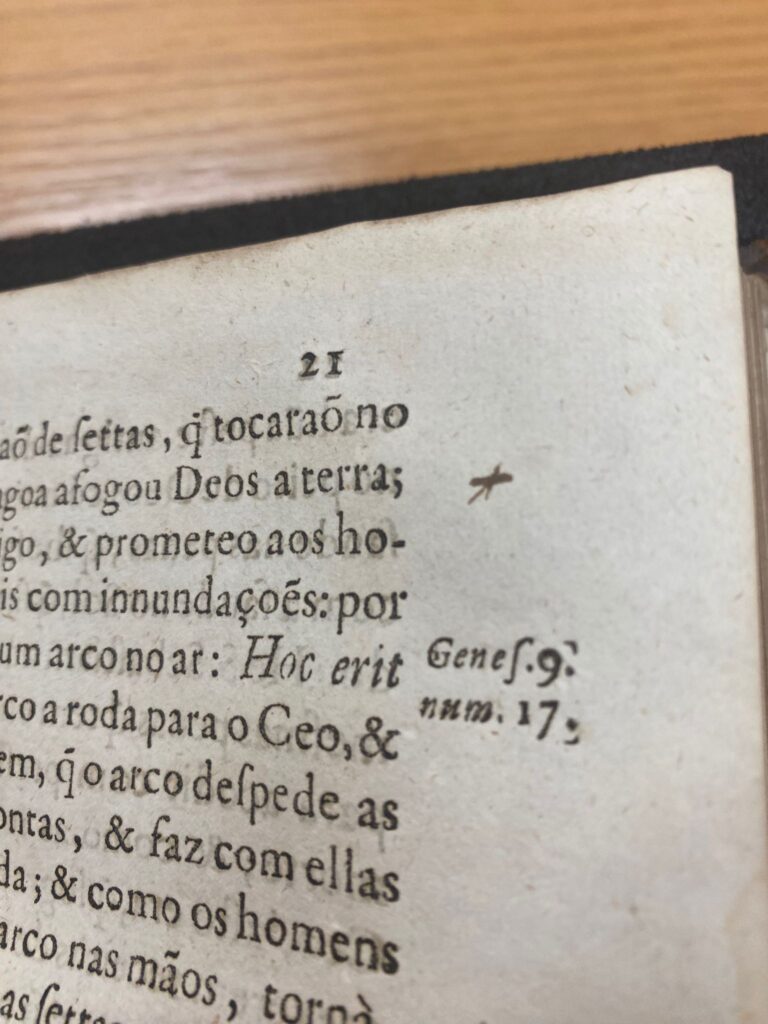
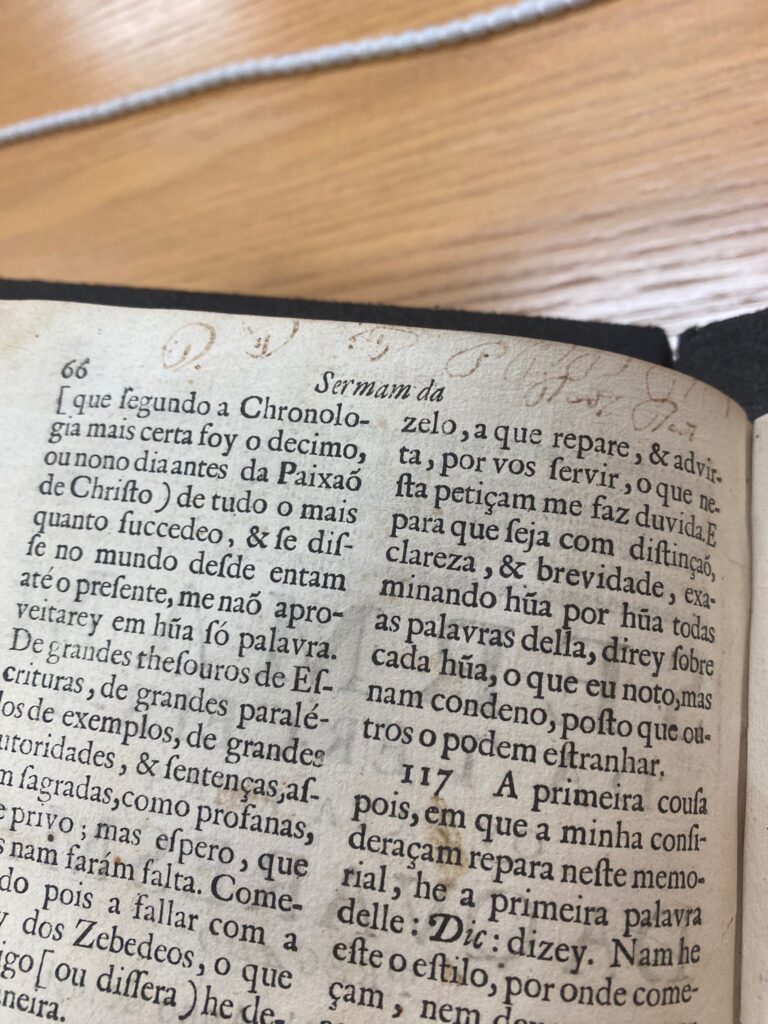
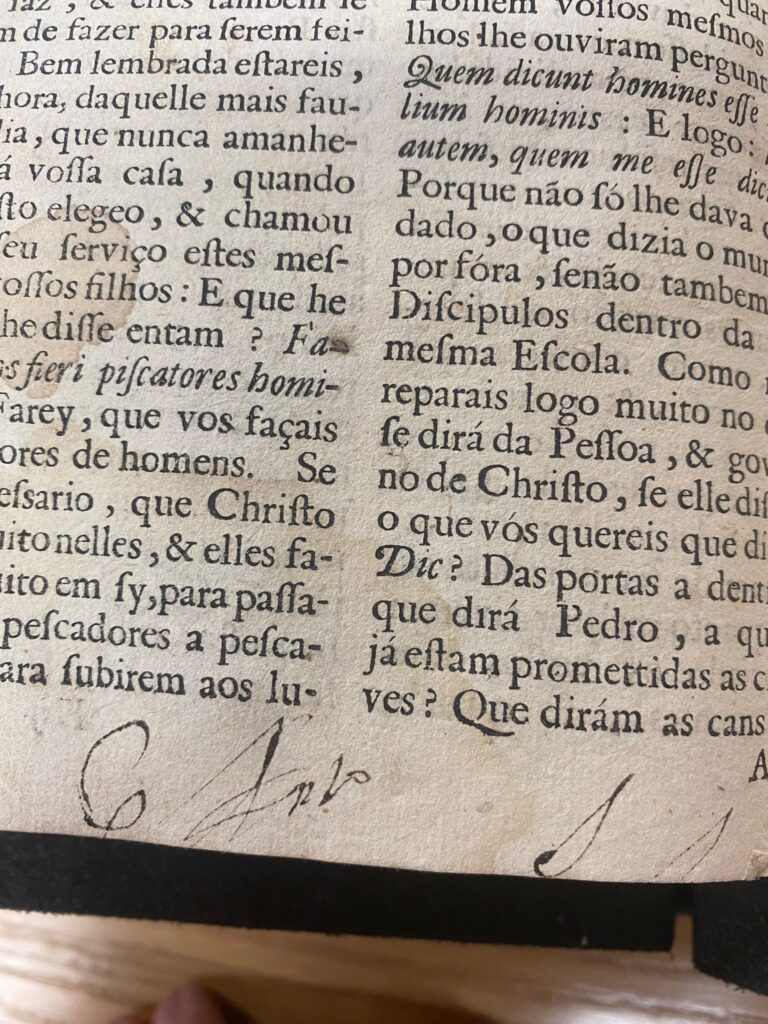
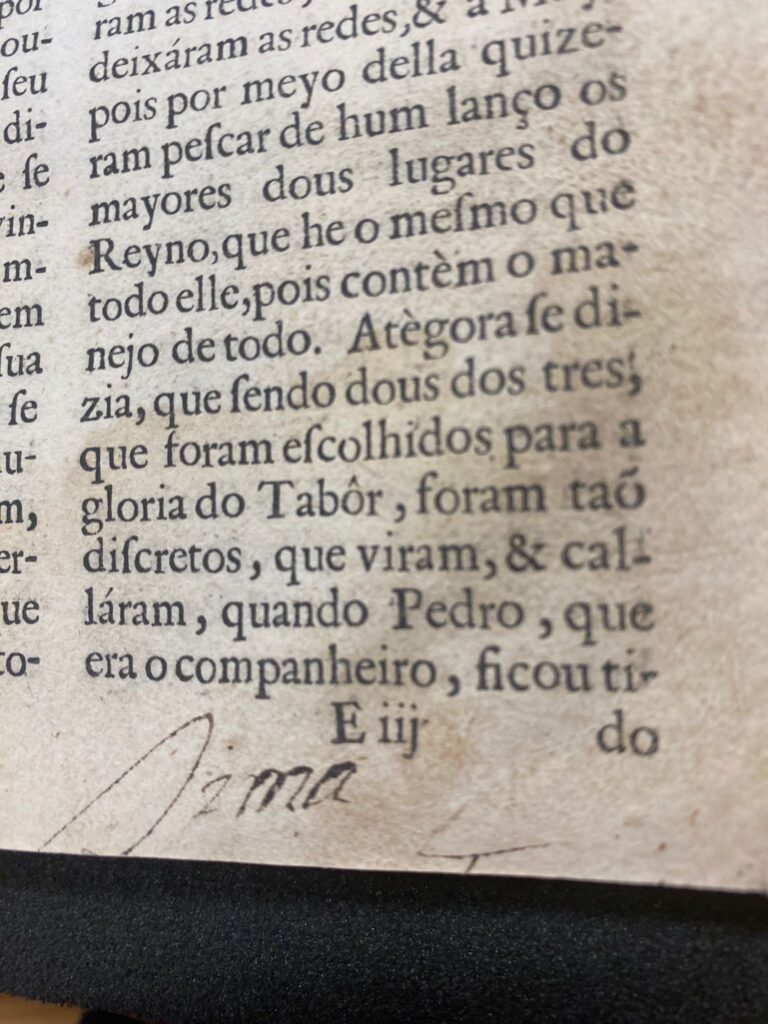
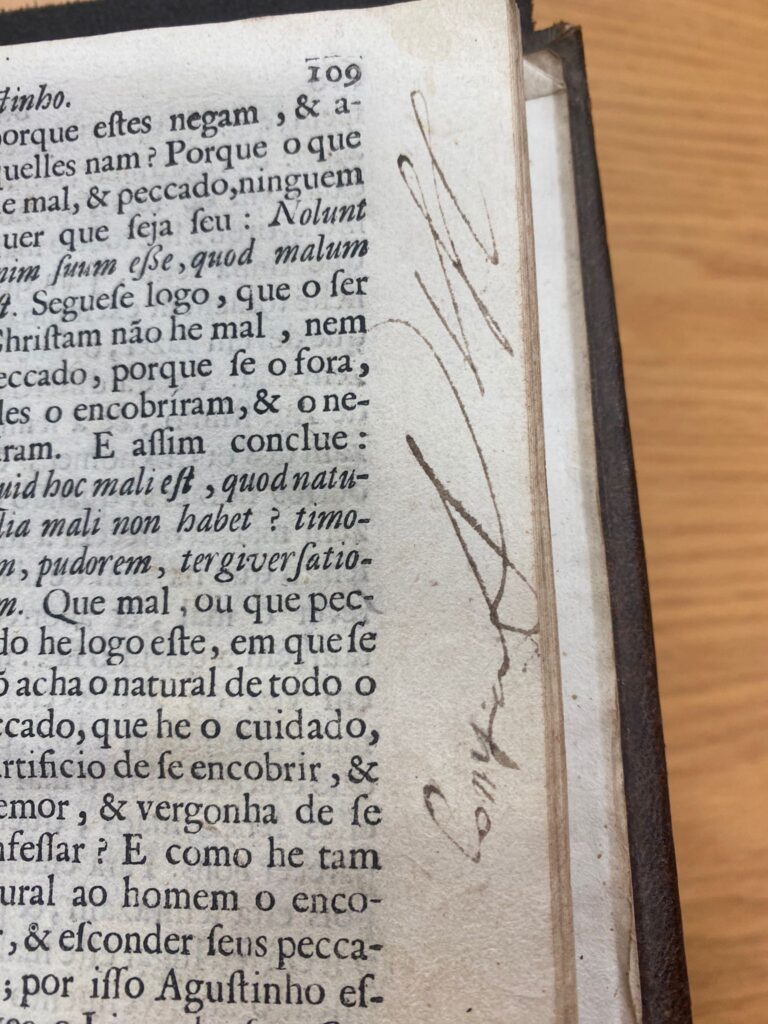
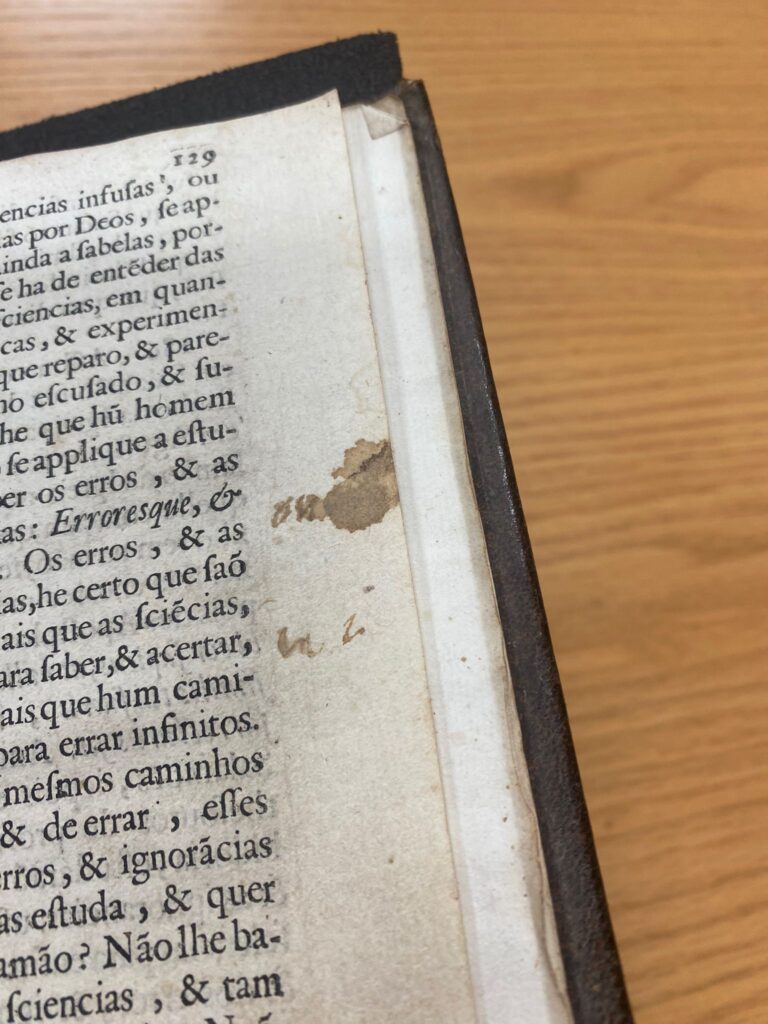
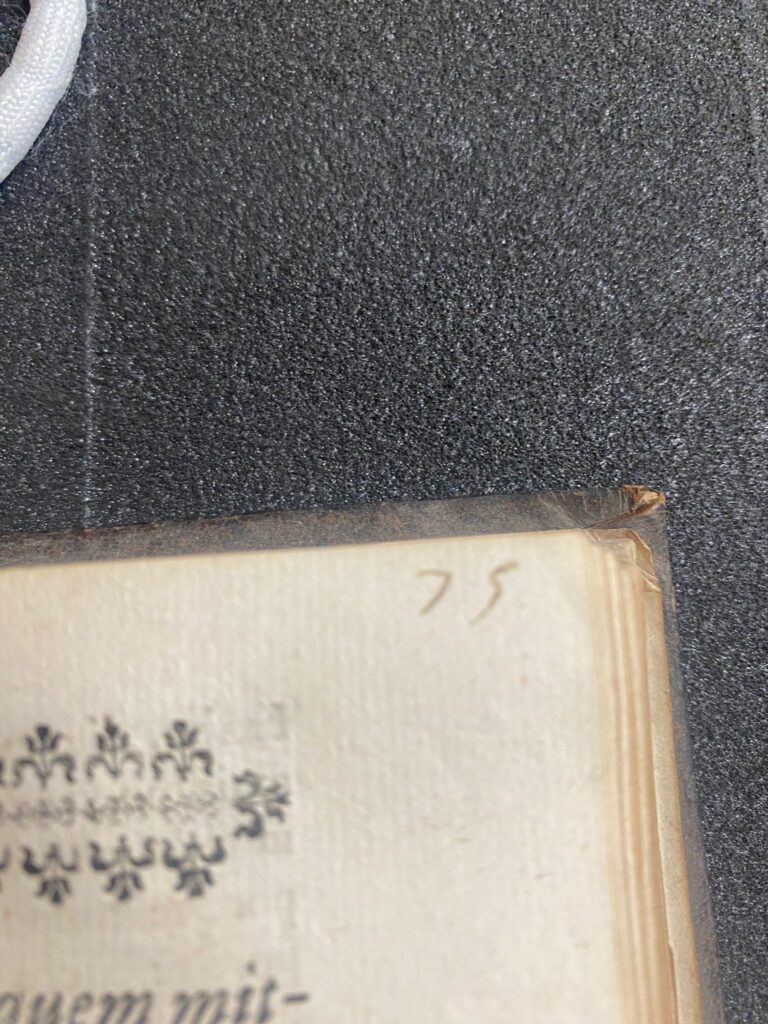
The two most productive leads with respect to provenance information found in this book are the paper slips with Rodrigues de Gusmão/Roiz de Gusmão – in conjunction with the inscription that provides an overview of the compiled volume’s content, and the inscription over which the slips were pasted that reads Sta Cruz de Bussaco (Santa Cruz de Buçaco). As seen in the pictures above, there are instances of marginalia yet they do not seem to provide potential leads regarding ownership. Inquiring into those two leads brought about this potential provenance narrative:
Following the initial printing and circulation of these sermons, Catholic religious institutions such as the Santa Cruz de Buçaco would have housed them as testament to their religious devotion. With the dissolution of monasteries by the Portuguese government in 1834, the site of Santa Cruz de Buçaco is passed over to the General Administration of the Kingdom’s Forests, and the convent’s material possessions likely came into the agency’s possession as well. 20 Francisco António Rodrigues de Gusmão, as an individual living during this period and having a keen interest in the bibliographical history of Portugal and its print culture (particularly at the site of his alma mater, Coimbra) decides to collect the sermons he would have procured from the agency (and auctions given that other monasteries were put to auction with the 1834 dissolution) and compiles it into the volume. The compiled volume is in turn sold with a plethora of other beloning to Rodrigues de Gusmão’s personal library at an auction in 1998 organized by Pedro de Azevedo. The new owner of the book either sells or donates – though the former seems more likely given the presence of sellers of Portuguese-language rare books such as Richard C. Ramer, who acquired a significant number of Rodrigues de Gusmão’s inventory- the volume to Michigan State University’s Special Collections.
The details regarding the three highly probable, if not confirmed nodes of ownership will be presented in the subsections below.
Provenance Pt. 1: The Convent of Santa Cruz de Bussaco (Buçaco)
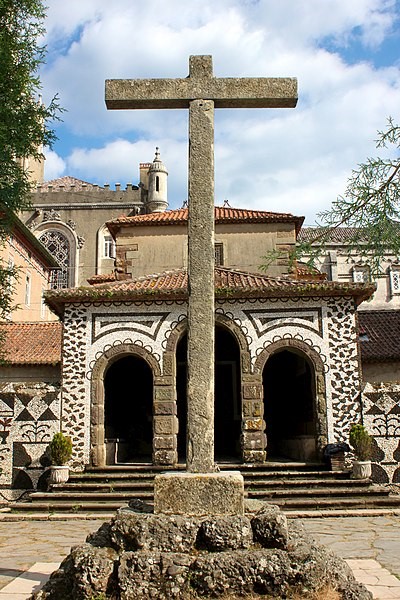
The convent of Santa Cruz de Buçaco was the site where the very first sermon in this compiled volume – José de Oliveira’s Sermam Prégado no Auto da Fé, que se celebrou na cidade de Coimbra em o Atrio de São Miguel na primeyra Dominga de Julho de 1691 – was stored. Santa Cruz de Buçaco presumably housed the sermon some time between after the publication of the sermon and the 1834 dissolution of monasteries in Portugal / subsequent acquisition by the likely compilator Fransico António Rodrigues de Gusmão. A reconstruction the history of this religious institution and analyzing the convent’s significance would illuminate why printed sermons such as Oliveira’s would have been kept.
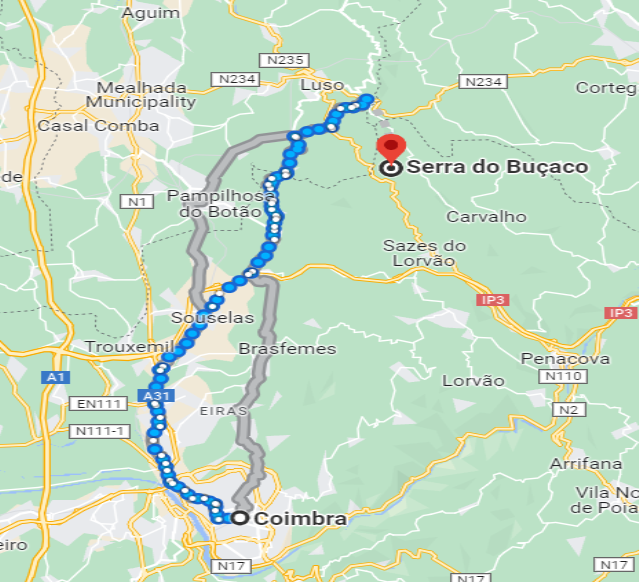
The convent stood (and its remaining site continues to stand) in the Serra do Buçaco, a mountain range that is approximately twenty-five kilometers away from Coimbra. Also worth noting is the fact that the region surrounding the mountains came under the jurisdiction of the Bishop of Coimbra 1094, and well into the early modern period in Portugal.21 The combination of geographic proximity and common religious authority figure presiding over both locales likely facilitated the convent’s access to religious texts that were being printed in Coimbra. The construction of the monastery itself began when the Discalced Carmelite order in Portugal purchased the land from the bishop in 1628.22 On May 3rd, 1639, the church finally became consecrated and celebrated its first mass.23
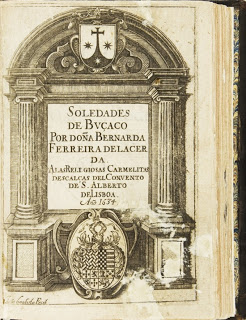
The Discalced Carmelites – who had been co-founded by Teresa of Ávila and John of the Cross, two Spanish religious figures who would both go on to be canonized as saints by the Catholic Church – sought to make Santa Cruz de Buçaco a spiritual “desert,” or an enclosed space of wilderness that replicated the region surrounding Mt. Carmel, the place where the original Carmelite order was born.24 Having done so since the end of the 16th century, the Discalced Carmelites sought to stray away from the archetype of the urban monastery in hopes to distance themselves from civilization’s vices and be closer with God in a natural environment.25 The richest contemporary description of the complex comes from the poems of Bernarda Ferreira de Lacerda, a highly renowned female poet in 17th century Iberia – so much so that the famous Spanish playwright Lope de Vega dubbed her “La décima musa (the tenth muse).”26 Lacerda’s collection of poems, the Soledades de Buçaco (Solitude of Buçaco), vividly captures the lush green and wildlife teeming in the “desert” of Buçaco, consequently illustrating how captivating the landscape of the convent would have been to contemporary audiences.
Considering all of this, the convent of Santa Cruz de Buçaco makes sense as a possible destination for sermons such as Oliveira’s. The convent was near and under the clerical jurisdiction of the city in which the sermon was printed, had the ambiance and display of religiosity that captivated the minds of famous contemporary observers, and housed a monastic order whose founder had been recently canonized. The evidence suggests that the spiritual desert of Buçaco was the culmination of strategic environmental engineering by the Discalced Carmelite order to bring its priests as close to the divine as possible. Consequently, collecting printed sermons would have been considered hand-in-hand with such efforts and another step towards being one with the Almighty. Furthermore, the isolated location of the convent would have meant that attending sermons – which were likely to be done in towns and cities – would have been challenging for its inhabitants. Housing printed sermons, therefore, would have provided the opportunity for the order to perform such acts of public piety without having to journey all the way to the nearest urban center.
Provenance Pt. 2: Francisco António Rodrigues de Gusmão
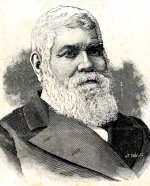
The printed slips saying Rodrigues de Gusmão/Roiz de Gusmão pasted over the inscription of Santa Cruz de Buçaco in all likelihood refer to a physician and bibliographer by the name of Francisco António Rodrigues de Gusmão (b. January 6th, 1815 – d. February 22nd, 1888). It is also highly probable that Rodrigues de Gusmão is also the person who procured the sermons – directly from the monasteries that had closed down in 1834, by auction, or through government contacts – and bound them together in the physical copy housed by Michigan State University’s Special Collections. Though there is no direct piece of evidence that states Rodrigues de Gusmão was the one responsible for the binding of Sermões Varios, similarly bound collections of pamphlets belonging to his personal collection (many of which are listed on Richard C. Ramer’s catalog – refer to Special List 427 and 466 on his website) insinuate that he would have been the one to carry out such a task.28
Born in the district of Carvalhal in the district of Viseu, Rodrigues de Gusmão matriculated in the University of Coimbra’s department of Philosphy and Math on October 14th, 1835.29 He would leave Coimbra in 1844 with a degree – presumably an advanced one given the nine-year time span between his matriculation and graduation – in medicine and surgery. It is precisely his education in Coimbra’s university that likely factored into his lifelong passion for studying his nation’s, and specifically the city of his alma mater’s literary past. A chapter on Rodrigues de Gusmão written by Pedro Marques states that the then-student of the university took a keen interest in the city’s history and monuments, even going on to writing about them for the Revista Universal Lisbonense.30 Given such interests, what is stated in the inscribed description of the compiled volume about assessing the history of printing in Coimbra would have undoubtedly been something that interested Rodrigues de Gusmão.
Rodrigues de Gusmão’s primary occupation following his educational stint in Coimbra seems to have been a physician, as he practiced medicine in the town of Portalegre and authored several treatises on the subject as well.31 However, the Viseu-native continued his commitment to the study of his nation’s past as he carried out important works for Portugal’s bibliographical history. Rodrigues de Gusmão’s involvement in the collection and study of Portuguese books is best evidenced by his extensive collaboration with Inocêncio (also cited as Innocêncio) Francisco da Silva (b. September 28th, 1810 – d. June 27th, 1876), the author of the first nine volumes of the influential Diccionario Bibliographico Portuguez (the Portuguese Bibliographical Dictionary).32 The extensive correspondence between the two remains in the form of letters – 157 of them were acquired and sold by bookseller Richard C. Ramer, which reveal that Rodrigues de Gusmão played a significant role in securing patrons for Silva’s work as well as discussed the finer points of bibliography with him.33 All of this reveals Rodrigues de Gusmão continued to remain motivated in his quest to uncover his nation’s history, thus lending further credence to the idea that he collected and compiled Sermões Varios.
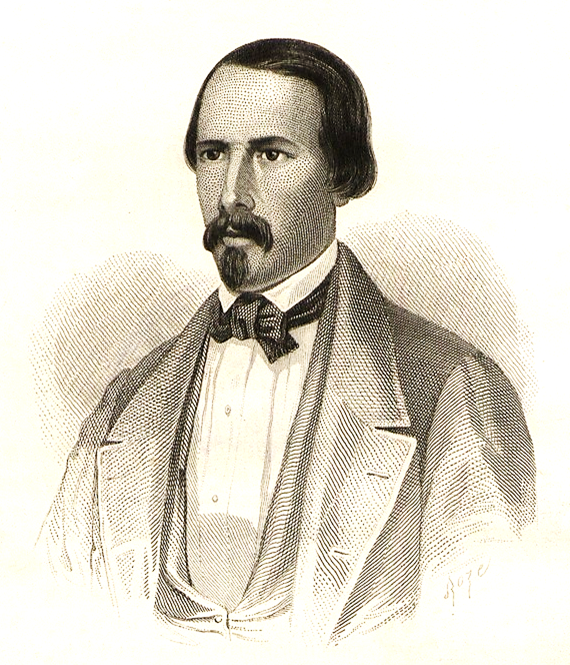
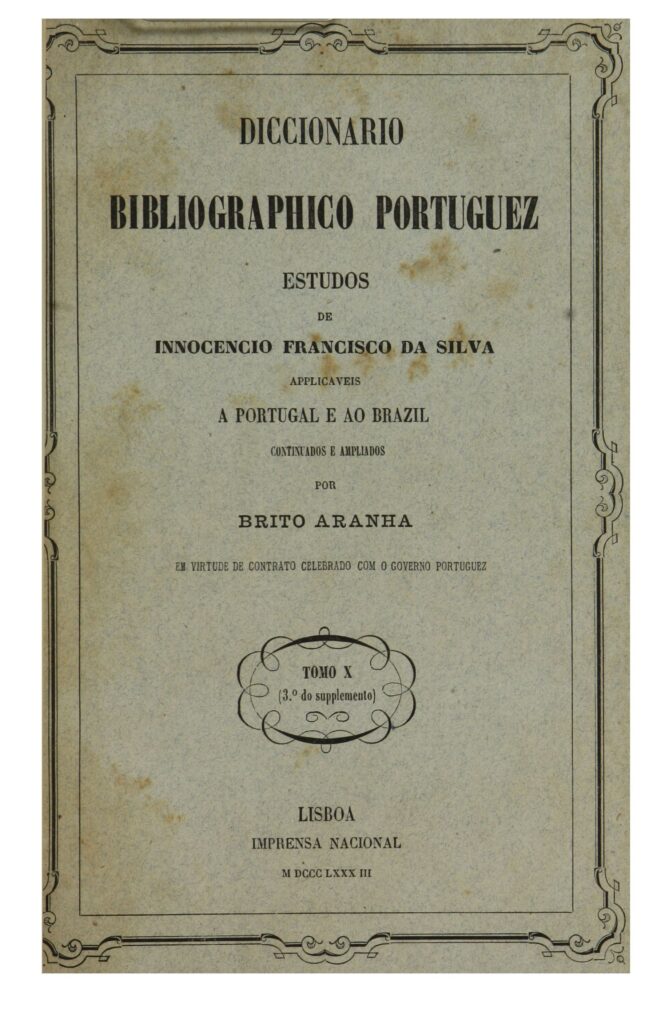
Alongside his education in Portugal’s oldest university and his professional experience directly engaging with bibliographical history, the milieu of the 19th century European – and by extension – Portuguese world inhabited by Rodrigues de Gusmão could have inspired his decision to collect and compile the sermons. Rodrigues de Gusmão’s Europe was one dominated by the currents of Romantic Nationalism. Various currents of independence movements that would become the foundation for modern-day nation states swept across Europe (notably the Greeks and the Philhellenic sentiments that it inspired), which in turn inspired epic poems of national folklore and heroes of days gone by. Portugal certainly was not an exception to this trend, as evidenced by some of the works produced by intellectual contemporaries of Rodrigues de Gusmão, with some of the most notable examples being poet and politician Almeida Garrett and historian Alexandre Herculano.34 The considerations of Portugal’s national character which occupied the minds of his contemporaries would have significantly affected an educated man such as Rodrigues de Gusmão. The collection and binding of Sermões Varios are exactly works that would be commissioned by someone greatly inspired by the intellectual currents of one’s time, such as Rodrigues de Gusmão.
Provenance Pt. 3: The Auction of Rodrigues de Gusmão’s Library
Being ever the avid bibliophile, Francisco António Rodrigues de Gusmão amassed quite a substantial book collection over his years. The ownership and maintenance of Rodrigues de Gusmão’s personal library following his death in 1888 is unknown. Based on the fact that his letters (later acquired by bookseller Richard C. Ramer) had a note written on them by his son, who shared the same name as his father (F.A. Rodrigues de Gusmão [filho/son]), one could presume it was the younger Rodrigues de Gusmão who inherited his father’s books including Sermões Varios.35 A social media post from a page documenting figures of Portalegre additionally states that the younger Rodrigues de Gusmão followed his father’s footsteps in being educated in Coimbra and becoming a physician in his own right back in Portalegre, thus increasing the likelihood that he tended after his father’s library.36
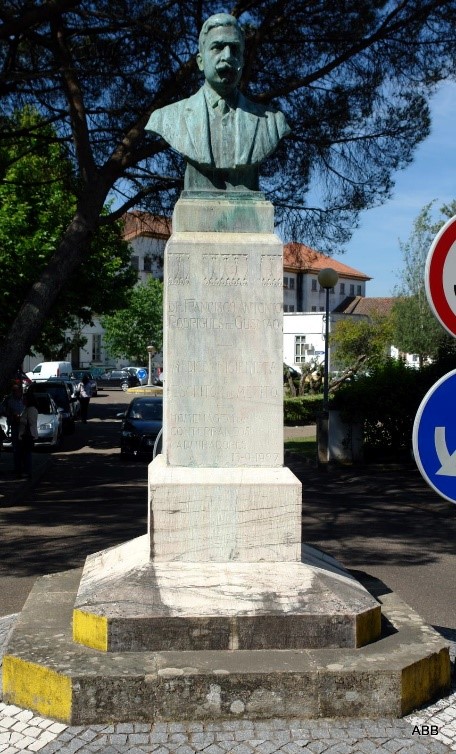
Yet the potential ownership of the collection following the younger Rodrigues de Gusmão’s passing remains even more uncertain. It is not until April 1st and 2nd of 1998 when the older Rodrigues de Gusmão’s books emerge in an auction alongside those of another physician from a later generation named Mário Tomás da Costa Roque (b. 1932 – d. 1983).37 The auction was organized by Pedro de Azevedo, with a total of 1,320 books from both collections. Richard C. Ramer, a rare bookseller who specializes in Portuguese-language books, appears to have bought a considerable portion of Rodrigues de Gusmão’s texts, yet not Sermões Varios. A catalog of the auction had been made and would likely provide the information as to where the compilation of sermons would have ended up prior to its journey to Michigan State, yet the catalog is unfortunately unavailable via web.38 The best educated guess would be that an antiquarian bookseller much like Ramer acquired Sermões Varios at an auction, and the item was later purchased by the university’s Special Collections.

V. List of Consulted Sources and References
Textual Sources
- Carvalho, Joaquim Martins de. Apontamentos para a História Contemporanea. Coimbra: Coimbra University Press, 1868.
- Glaser, Edward. “Invitation to Intolerance: A study of Portuguese sermons preached at autos-da-fé.” Hebrew Union College Annual 27 (1956): 327-385.
- Glaser, Edward. “Portuguese Sermons at Autos-da-fé: Introduction and Bibliography.” Studies in Bibliography and Booklore 2. No. 2 (1955): 53-78, 96.
- Hegstorm, Valerie. “‘La décima musa portuguesa’ and Her Soledades de Buçaco: Gendered Landscape Poetry Dedicated to the Nuns of Santo Alberto.” Calíope: Journal of the Society for Renaissance and Baroque Hispanic Poetry 22. No. 2 (2017): 145-164.
- Marques, João Francisco. “A crítica de Vieira ao poder político na escolha de pessoas e concessão de mercês.” Revista de História 08 (1988): 215-246.
- Marques, João Francisco. “A crítica sócio-política de Vieira na parénese quaresmal dos sermões dos pretendentes.” Revista Lusófona de Ciéncia das Religiões Vol. 7, no. 13/14 (2008): 77-92.
- Marques, João Francisco. “Santo Agostinho na parenética portuguesa seiscentista.” Didaskalia XXVI (1996): 195-224.
- Marques, Pedro. “Francisco António Rodrigues de Gusmão: A Arqueologia, a Epigrafia e o Patrimonio.” Chapter in Arqueologia em Portugal: 2017 – Estado da Questão. Edited by José Morais Arnaud and Andrea Martins. Lisbon: Associação dos Arqueólogos Portugueses, 2017. 63-73.
- Pepys, Samuel. The Portugal history, or, A relation of the troubles that happened in the court of Portugal in the years 1667 and 1668 in which is to be seen that great transaction of the renunciation of the crown by Alphonso the Sixth, the dissolution of his marriage with the Princess Maria Frances Isabella of Savoy : the marriage of the same princess to the Prince Don Pedro, regent of the realm of Portugal, and the reasons alledged at Rome for the dispensation thereof. London: Richard Tonson, 1677.
- Ramer, Richard C. “Special List 427: Six Miscellaneous Volumes with Fifty-seven Titles Offered in Four Lots.” September 20, 2021.
- Ramer, Richard C. “Special List 466: Decorated Papers.” December 1, 2022.
Web Sources & Links
- Biblioteca de Francisco António Rodrigues de Gusmão e Mário Tomás da Costa Roque. https://books.google.com/books/about/Biblioteca_de_Francisco_Ant%C3%B3nio_Rodrigu.html?id=2J3szgEACAAJ.
- Biblioteca de Francisco António Rodrigues de Gusmão e Mário Tomás da Costa Roque. https://ccbibliotecas.azores.gov.pt/cgi-bin/koha/opac-detail.pl?biblionumber=623165&query_desc=su%3ABibliotecas.
- Catalogue of the Biblioteca Nacional de Portugal (National Library of Portugal). https://catalogo.bnportugal.gov.pt/ipac20/ipac.jsp?profile=bn.
- “Desert of the Discalced Carmelites and Built Ensemble of the Palace-Hotel in Bussaco.” UNESCO World Heritage Convention (hereon UNESCO WHC). https://whc.unesco.org/en/tentativelists/6227/.
- “Dr. Francisco António Rodrigues de Gusmão: Médico e Escritor.” Facebook. Caras de Portalegre. https://www.facebook.com/carasdeportalegre/posts/1620493758186970/.
- “Francisco António Rodrigues de Gusmão.” Geneall. https://geneall.net/es/name/32007/francisco-antonio-rodrigues-de-gusmao/.
- “Franciscus de Aracoeli.” Franciscan Authors, 13th – 18th Century: A Catalogue in Progress. Edited by Maarten van der Heijden and Bert Roest, http://users.bart.nl/~roestb/franciscan/franautf.htm#FranciscusdeAracoeli.
- “Inquisitio.” Hesburgh Libraries Rare Books & Special Collections. https://inquisition.library.nd.edu/.
- “Joaquim Martins de Carvalho.” Dicionário de Historiadores Portugueses. https://dichp.bnportugal.gov.pt/historiadores/historiadores_martins_carvalho.htm.
- “Narrative and dramatic literature: Portuguese.” Encyclopedia of Romantic Nationalism in Europe. Edited by Joep Leerssen. https://ernie.uva.nl/viewer.p/21/56/object/122-160136.
- “Sermoens do P. Antonio Vieira (Volume 3).” University of São Paulo Library. https://digital.bbm.usp.br/handle/bbm/4562?locale=en.
- Staniforth, Oswald. “St. Pascal Baylon.” The Catholic Encyclopedia. Vol. 11 (New York: Robert Appleton Company, 1911). http://www.newadvent.org/cathen/11512a.htm.
By Zachary K. Cho, HST475, Fall 2023
- An explanation for the term can be found on a rare books glossary from the University of Missouri: https://library.missouri.edu/specialcollections/exhibits/show/glossary/page10#:~:text=Sammelband%3A%20A%20set%20of%20disparate,Ages%20and%20early%20modern%20period ↩︎
- The four auto da fé sermons are marked with an asterisk [*], and the names of individuals have been written in modernized Portuguese whenever possible. ↩︎
- Commonly referred to as Cardinal da Cunha; then Inquisitor General of Portugal and key advisor to King D. João V. ↩︎
- Though sharing the same first and last name, Joseph Lopes Ferreyra (José Lopes Ferreira) was likely a different person from the aforementioned Joseph Ferreyra (José Ferreira), owing to not only their different affiliations but also that the latter appears to have been active until the onset of the 18th century. ↩︎
- Exact date not mentioned on cover but given that the license to print was secured on September 12th of that year, one could presume the actual publishing of the sermon came shortly after. ↩︎
- Referring to Maria Francisca of Savoy, who was queen to Afonso VI before annulling the marriage and married Pedro, Afonso’s younger brother and then-Duke of Beja who would become the prince regent and later king of Portugal as Pedro II. The circumstances surrounding Afonso VI’s loss of power to Pedro II are outlined in contemporary English observer’s Samuel Pepys’s account of the event. See Samuel Pepys, The Portugal history, or, A relation of the troubles that happened in the court of Portugal in the years 1667 and 1668 in which is to be seen that great transaction of the renunciation of the crown by Alphonso the Sixth, the dissolution of his marriage with the Princess Maria Frances Isabella of Savoy : the marriage of the same princess to the Prince Don Pedro, regent of the realm of Portugal, and the reasons alledged at Rome for the dispensation thereof (London: Richard Tonson, 1677). ↩︎
- Three Military Orders of Portugal being the Military Order of Christ, the Military Order of Aviz, and the Military Order of St. James/Santiago. ↩︎
- Typographical Error; publication date listed as 1760, which contradicts what is found on other copies of the same sermon – most notably the one housed by the National Library of Portugal. See https://permalinkbnd.bnportugal.gov.pt/records/item/83571-sermam-do-glorioso-martyr-sam-sebastiam-pregado-na-capella-real-aos-20-de-janeiro-do-anno-de-1670?offset=5438. ↩︎
- Basic information on Francisco de Aracaeli can be found here: http://users.bart.nl/~roestb/franciscan/franautf.htm#FranciscusdeAracoeli. ↩︎
- Referring to Isabel Henriqueta de Lorena (b. 1672 – d. 1699), daughter of the first Duke of Cadaval, Nuno Álvares Pereira de Melo. Isabel married Rodrigo Anes de Sá Almeida e Meneses, 1st Marquis of Abrantes, who would go on to have a successful diplomatic career as Portugal’s ambassador to the Holy See. ↩︎
- Typographic error with the Roman numerals (“M. DC. LXL.”) ↩︎
- The title of the sermon appears in the citations of Portuguese priest and historian João Francisco Marques’ articles as belonging to a collection of sermons by António Vieira. See João Francisco Marques, “A crítica de Vieira ao poder político na escolha de pessoas e concessão de mercês,” Revista de História 08 (1988): 222, and Marques, “A crítica sócio-política de Vieira na parénese quaresmal dos sermões dos pretendentes,” Revista Lusófona de Ciéncia das Religiões Vol. 7, no. 13/14 (2008): 80. ↩︎
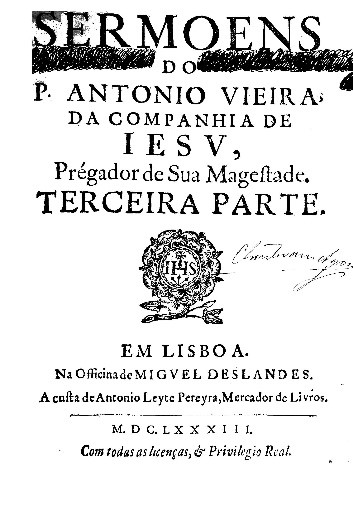
- Yet another article belonging to João Francisco Marques as well as the University of São Paulo’s online catalog notes that this sermon was included in the third volume of António Vieira’s collection of sermons, published in Lisbon by Miguel Deslandes and distributed by the bookseller Antonio Leyte Pereyra in 1683. USP’s catalog additionally makes mention that the date of the sermon is likely erroneous given Vieira’s diplomatic missions to France and the Netherlands from 1647 to 1648, with him only returning at the end of 1648 and most definitely after the feast day of Saint Augustine – which the sermon commemorates. See João Francisco Marques, “Santo Agostinho na parenética portuguesa seiscentista,” Didaskalia XXVI (1996): 206 and https://digital.bbm.usp.br/handle/bbm/4562?locale=en. The collection of sermons published by Deslandes is shown in the following picture (sourced from the USP catalog):
↩︎ - Paschoal Baylon (Paschal Baylón) was a 16th century Spanish Franciscan priest who was canonized as a saint in 1690 by Pope Alexander VIII, which the sermon mentioned commemorates. See Oswald Staniforth, “St. Pascal Baylon,” The Catholic Encyclopedia, Vol. 11 (New York: Robert Appleton Company, 1911), http://www.newadvent.org/cathen/11512a.htm. ↩︎
- The physical depiction of Synagoga is that of a young woman with a strip of cloth covering her eyes, once again a reference to the common anti-Jewish trope of spiritual blindness. ↩︎
- Edward Glaser, “Portuguese Sermons at Autos-da-fé,” Studies in Bibliography and Booklore 2, no. 2 (1955): 53. A valuable overview of the Inquisition and the print sources left behind by the institution can be seen on the University of Notre Dame’s library website titled Inquisitio. See “Inquisitio,” Hesburgh Libraries Rare Books & Special Collections, https://inquisition.library.nd.edu/. ↩︎
- Carvalho’s biography can be found on the University of Lisbon’s online dictionary of Portuguese historians. See “Joaquim Martins de Carvalho,” Dicionário de Historiadores Portugueses, https://dichp.bnportugal.gov.pt/historiadores/historiadores_martins_carvalho.htm. ↩︎
- Joaquim Martins de Carvalho, Apontamentos para a História Contemporanea/Notes on Contemporary History (Coimbra: Coimbra University Press, 1868), 302. ↩︎
- The Holy Office’s role in censorship is attested to by none other than the title pages of the sermons in the collective volume, with many of which containing the phrase “com todas as licenças necessarias (with all the necessary licenses).” This means that the Inquisition looked over the sermons for any inaccuracies or potential heresies and sanctioned the printing and circulation of the material. ↩︎
- The dissolution of monasteries in Portugal and its effect on the convent of Santa Cruz de Buçaco is explained on UNESCO World Heritage Convention’s history and description of the site surrounding the monastery. See “Desert of the Discalced Carmelites and Built Ensemble of the Palace-Hotel in Bussaco,” UNESCO World Heritage Convention (hereon UNESCO WHC), https://whc.unesco.org/en/tentativelists/6227/. ↩︎
- Valerie Hegstorm, “‘La décima musa portuguesa’ and Her Soledades de Buçaco: Gendered Landscape Poetry Dedicated to the Nuns of Santo Alberto,” Calíope: Journal of the Society for Renaissance and Baroque Hispanic Poetry 22, no. 2 (2017): 148. ↩︎
- Ibid., 149. ↩︎
- Ibid. ↩︎
- Mount Carmel is nearby the modern-day Israeli city of Haifa. It is also worth noting that Theresa of Ávila had been canonized shortly prior to the start of the monastery’s construction, in the year of 1620. The canonization of their founder would have given the Discalced Carmelites considerable sway in the ecclesiastical world. See Ibid., 148. ↩︎
- Ibid. ↩︎
- Ibid., 146. ↩︎
- “Francisco António Rodrigues de Gusmão,” Geneall, https://geneall.net/es/name/32007/francisco-antonio-rodrigues-de-gusmao/. ↩︎
- Richard C. Ramer, “Special List 427: Six Miscellaneous Volumes with Fifty-seven Titles Offered in Four Lots,” and Ramer, “Special List 466: Decorated Papers.” ↩︎
- Pedro Marques, “Francisco António Rodrigues de Gusmão: A Arqueologia, a Epigrafia e o Patrimonio,” in Arqueologia em Portugal: 2017 – Estado da Questão, ed. José Morais Arnaud and Andrea Martins (Lisbon: Associação dos Arqueólogos Portugueses, 2017), 63. ↩︎
- “No período de tempo em que esteve nesta cidade a estudar, interessou-se também pela sua história e monumentos, iniciando as publicações na Revista Universal Lisbonense, nos anos de 1841-1842.” See Ibid. ↩︎
- Ibid. ↩︎
- Richard C. Ramer, “Special List 466: Decorated Papers,” December 1, 2022, 81-82. ↩︎
- Ibid., 82. ↩︎
- “Narrative and dramatic literature: Portuguese,” Encyclopedia of Romantic Nationalism in Europe, ed. Joep Leerssen, https://ernie.uva.nl/viewer.p/21/56/object/122-160136. ↩︎
- Ramer, “Special List 466,” 82. ↩︎
- “Dr. Francisco António Rodrigues de Gusmão: Médico e Escritor,” Facebook, Caras de Portalegre, https://www.facebook.com/carasdeportalegre/posts/1620493758186970/. ↩︎
- Ramer, “Special List 466,” 51. ↩︎
- Google Books has the catalog’s information but does not have an available e-book. A search of various library catalogs returned one public library in the Azores that has the catalog in its holdings, yet that is also not available online. Refer to the following links: https://books.google.com/books/about/Biblioteca_de_Francisco_Ant%C3%B3nio_Rodrigu.html?id=2J3szgEACAAJ, https://ccbibliotecas.azores.gov.pt/cgi-bin/koha/opac-detail.pl?biblionumber=623165&query_desc=su%3ABibliotecas. ↩︎
