
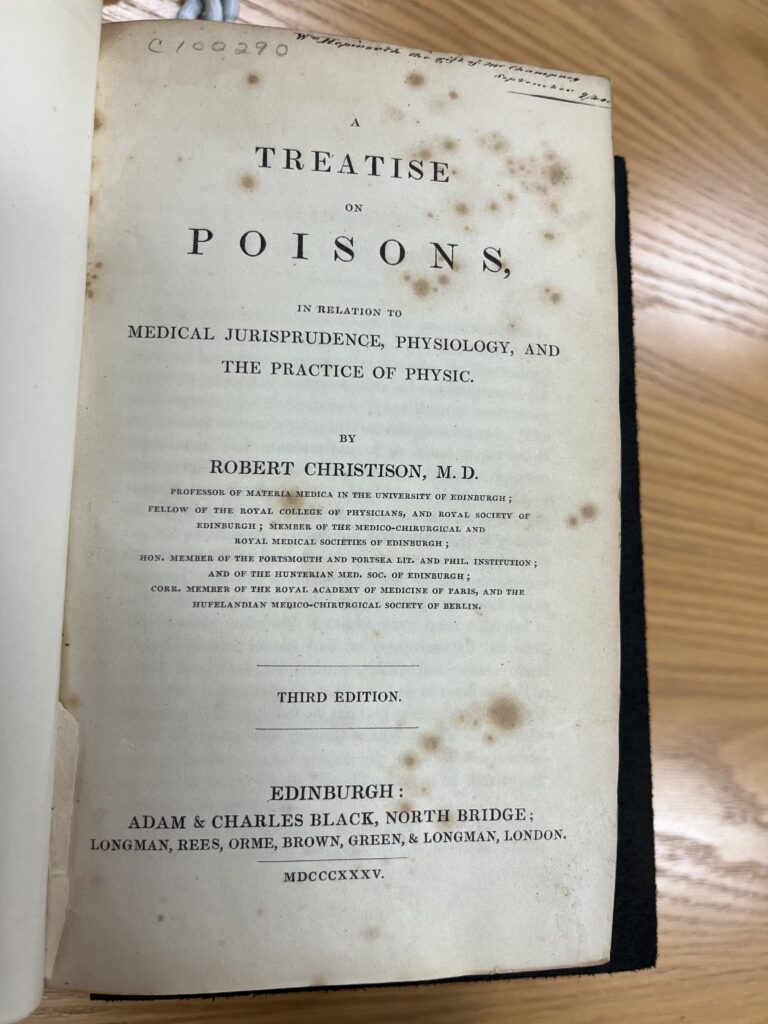
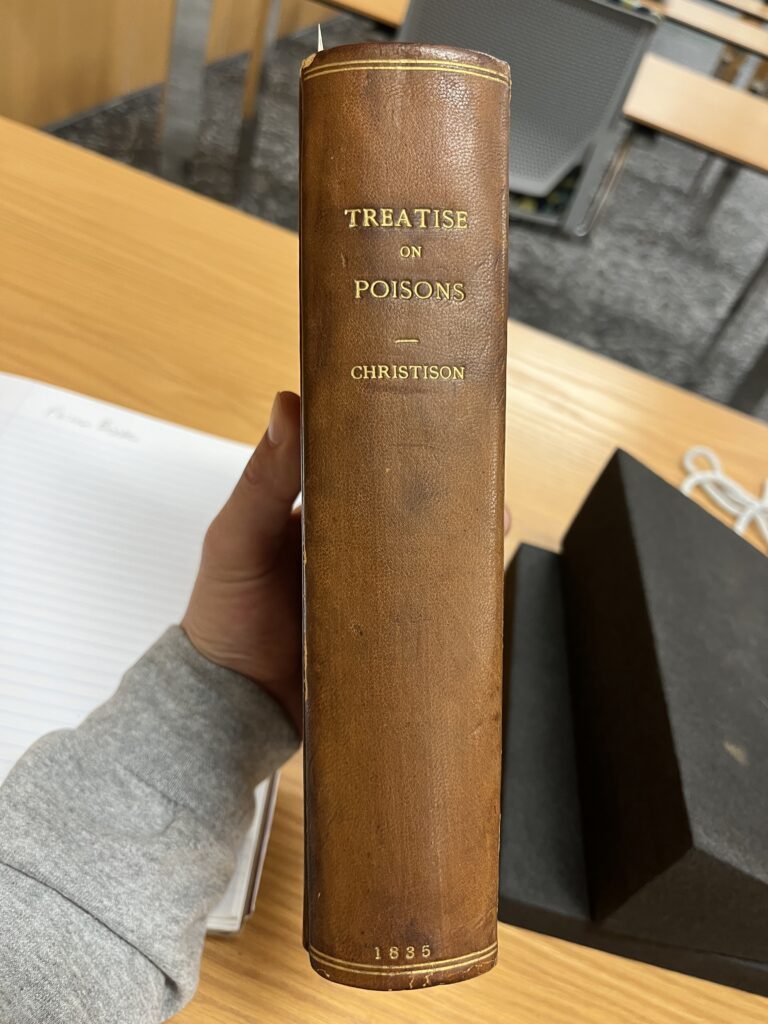
A Treatise of Poisons is a work presenting the medical jurisprudence, physiology, and practice of physics in relation to poisons. The book goes over various aspects of poisons, their effects on the human body, and there detection and treatment.
RA1211 .C56
Physical Description
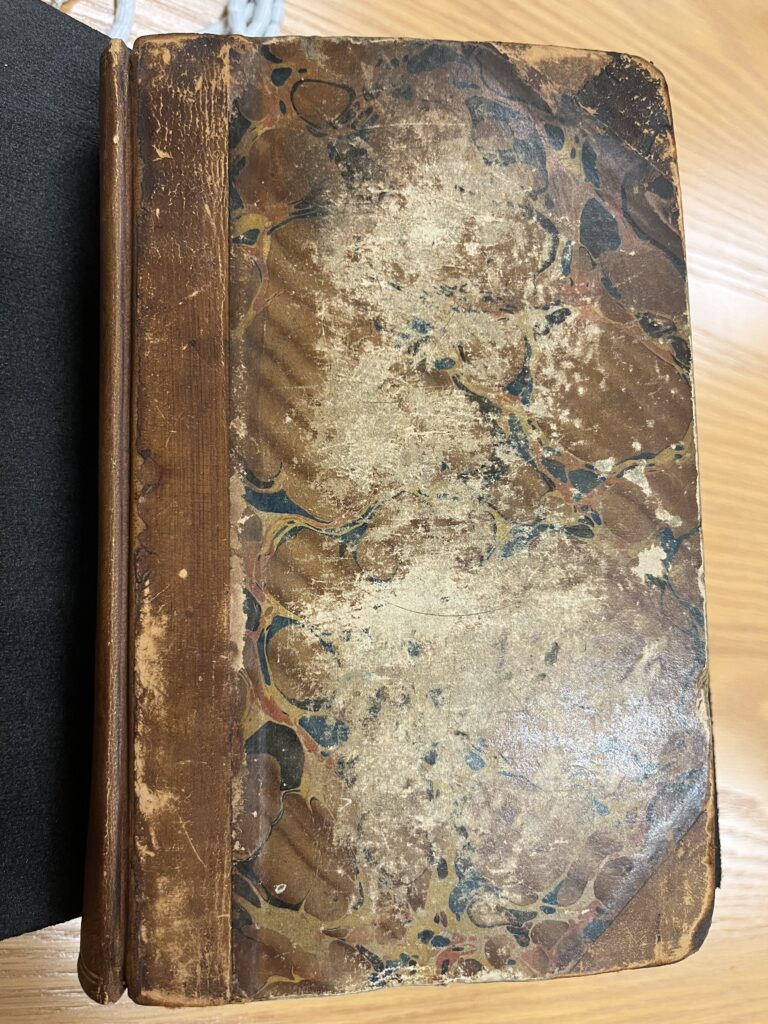
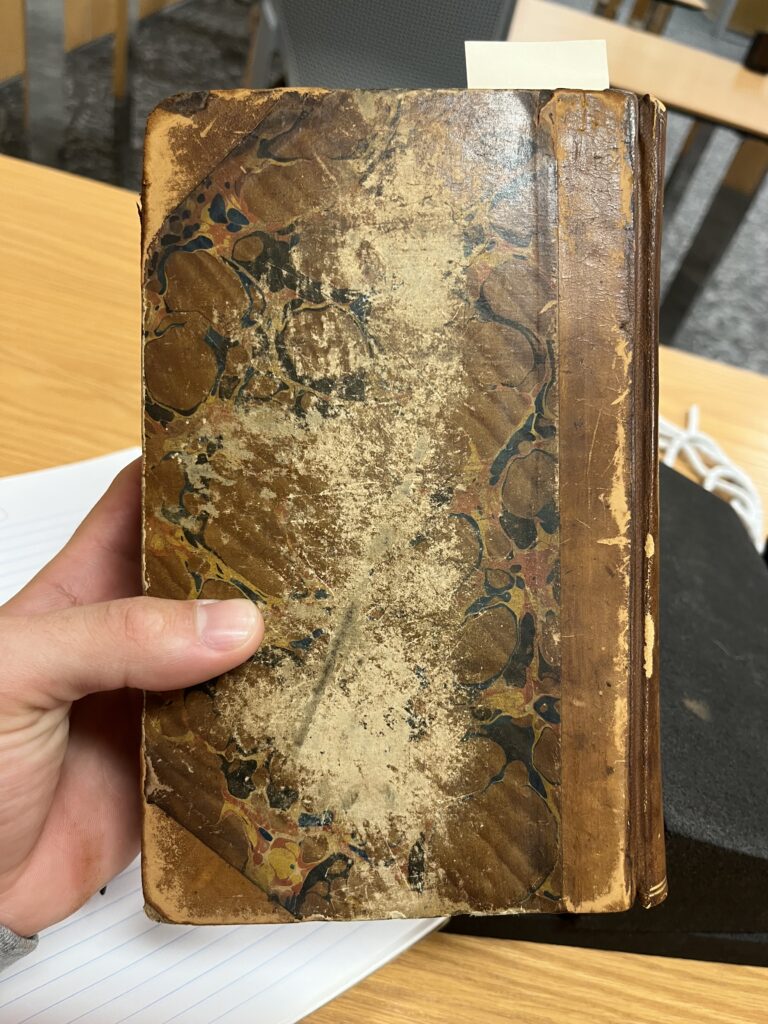
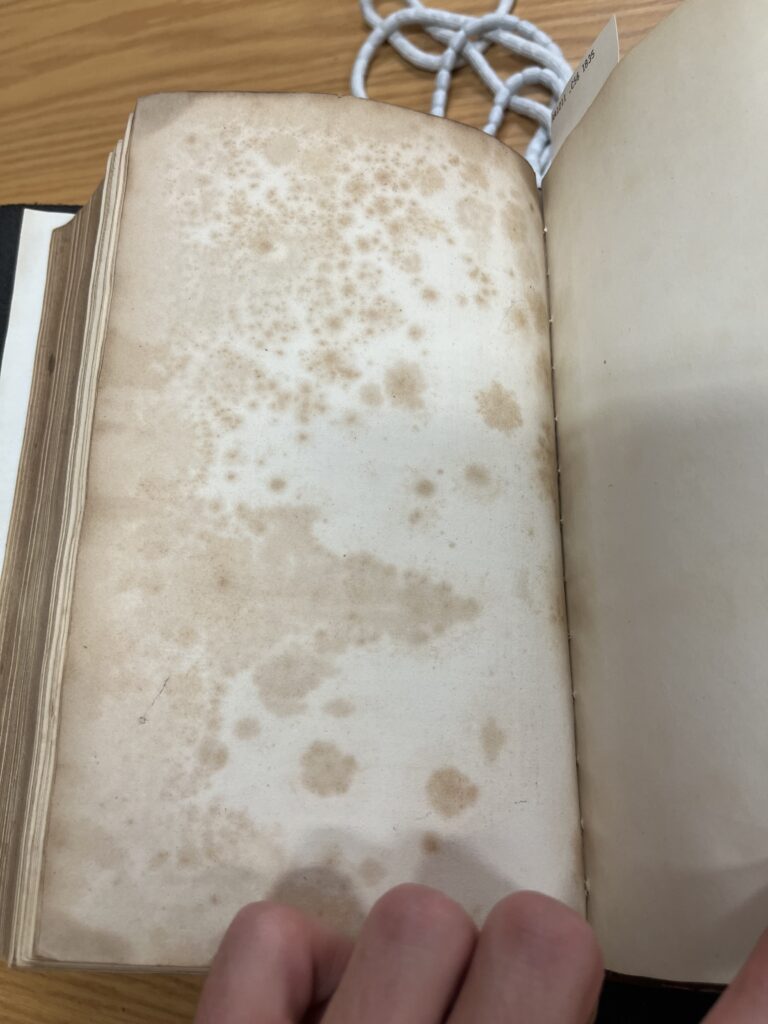
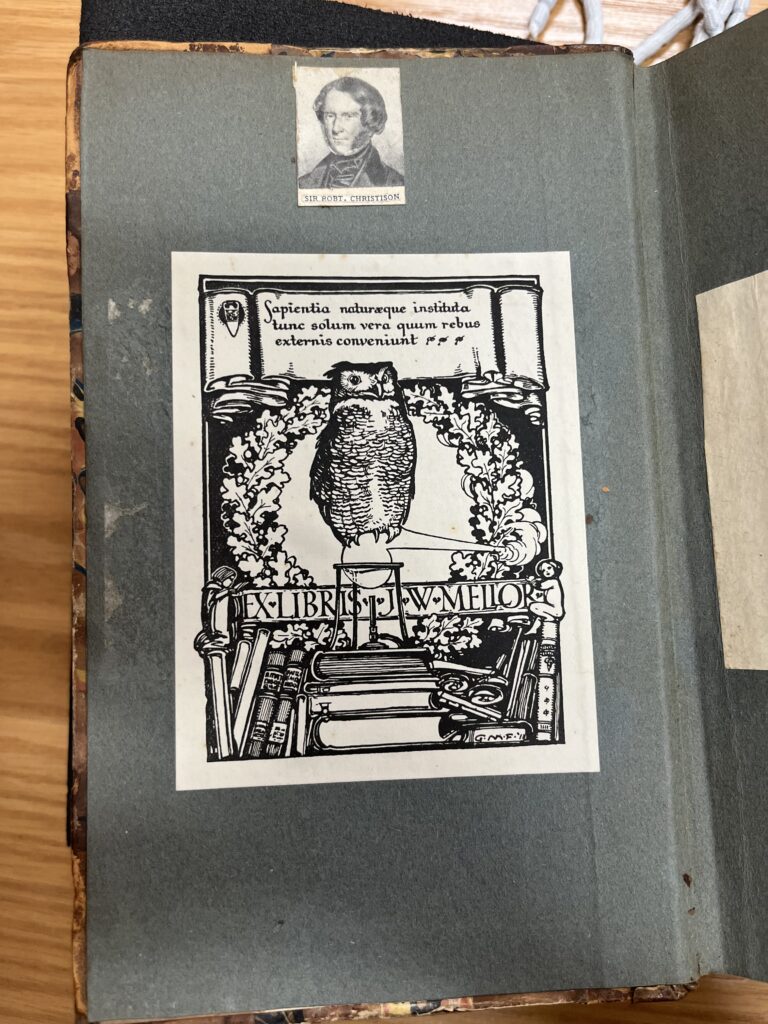
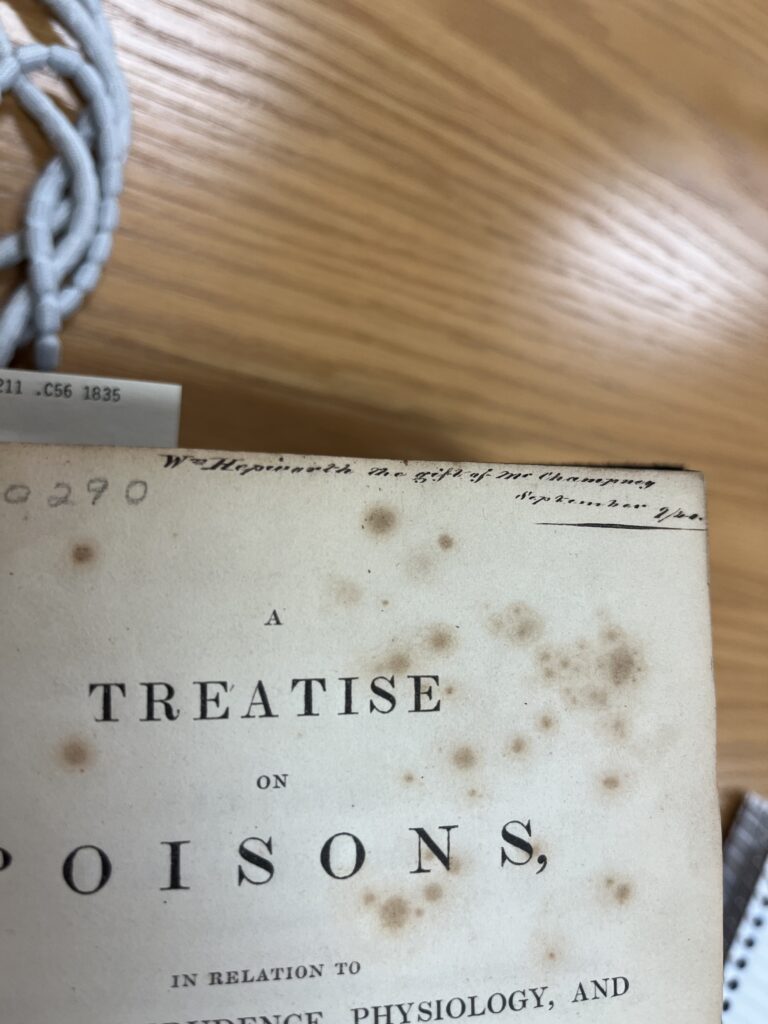
The book itself is in very good condition, the binding appears to have been replaced because it is in much better condition than the cover which has some scratches. Although the cover is scuffed and obviously has been used thoroughly, it does not have any tears or pieces coming off. The paper is still doing a good job hanging on to the binding it does not appear to be separating at all. The pages themselves are in decent condition, there are no rips or tears in the pages. There is some mold/stains on most of the pages but they do not prevent the text from being legible. The inside of the front cover contains a picture of the author as well as a library crest belonging to J.W. Mellor, and another belonging to William Hardcastle. There are some underlined parts of text throughout the book as well as very minimal writing along either the top or bottom of some pages. Including but not limited to pg. viii and on the title page. Some pages with underlined text include pg. 2,5,17.
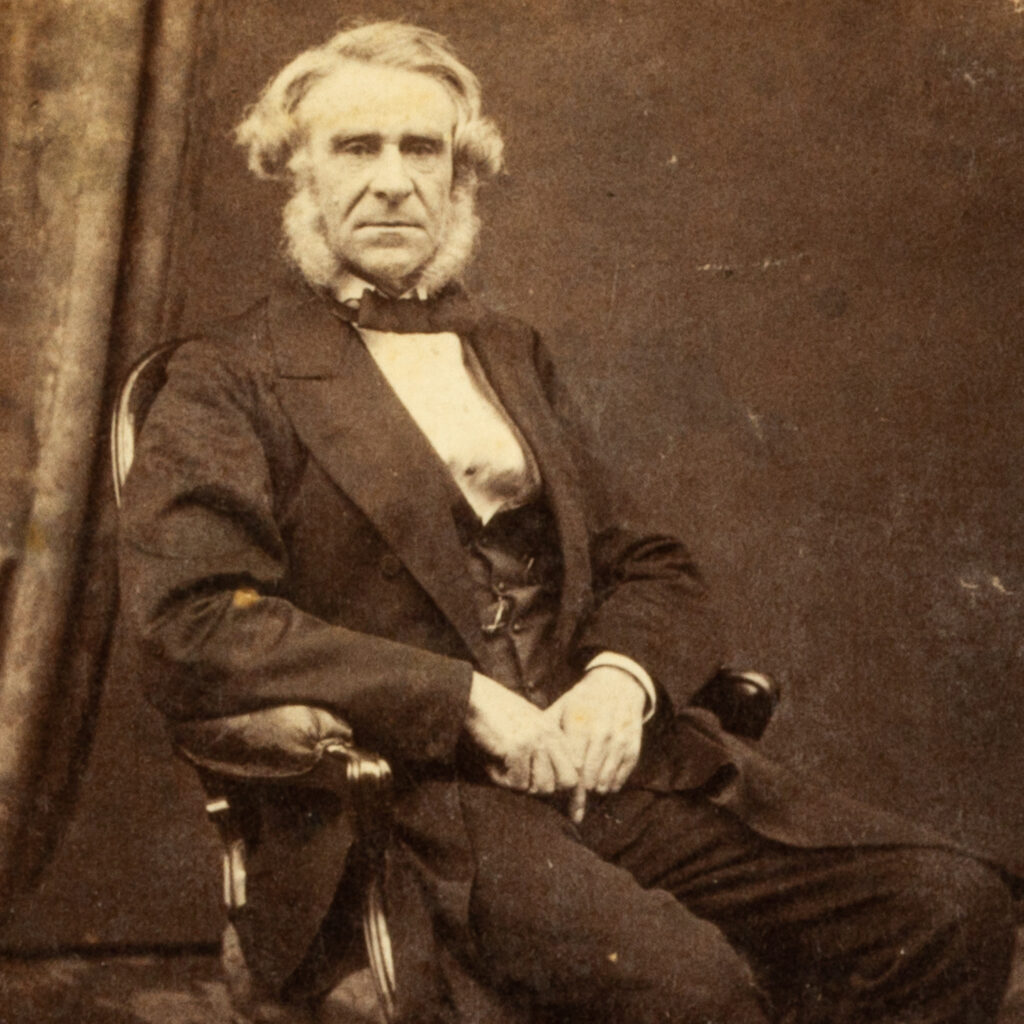
Author: Robert Christison
Born in Edinburgh, Scotland-Lived from (1797-1882)
After graduating medical school in 1819, he studied under two surgeons in London by the names of John Abernethy and William Lawrence. It was when he visited Paris where he would learn analytical chemistry which would aid him in his career. The University of Edinburgh has a bust of him in their school
Published a wide range of books: Granular Degeneration of the Kidneys (1839), Commentary on the Pharmacopoeias of Great Britain (1842), and A Treatise on Poisons in Relation to Medical Jurisprudence, Physiology, and the Practice of Physic (Edinburgh: A. & C. Black, 1845), which contains a description of glassware essential for a toxicologist.
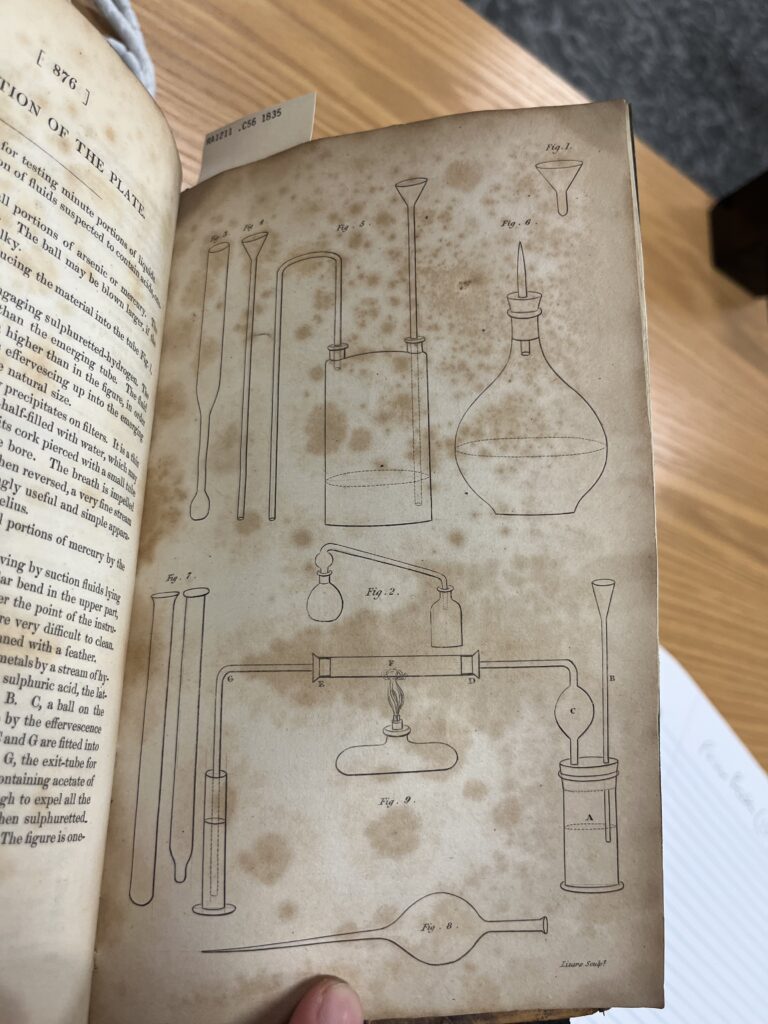
Professor of Materia Medica at the University of Edinburgh in Scotland. He was a Scottish physician known mostly for his publishing of the Treatise of Poisons and the first person to describe renal anaemia. Robert Christison had quite an impressive resume. He was a member of the Royal College of Physicians and the Royal Society of Edinburgh, Hunterian Med. Soc. of Edinburgh, Royal Academy of Medicine of Paris. Not only did he accomplish all of these positions but this book was also a large contribution to the overall understanding of toxicology in the 19th century.
Provenance
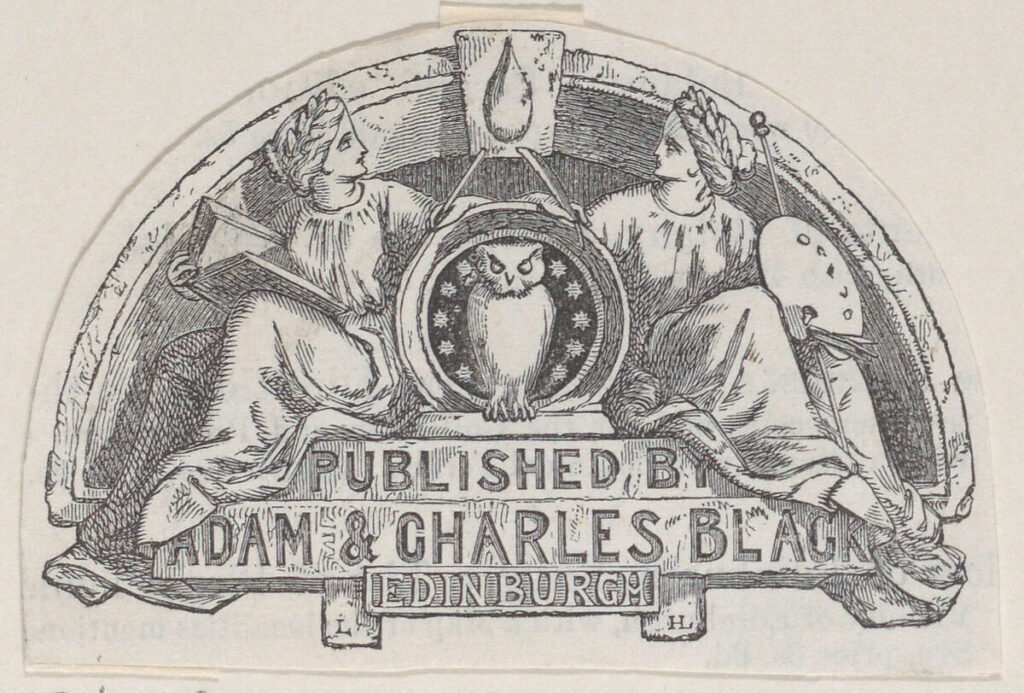
Publisher: Adam & Charles Black
Prominent 19th-century Scottish publishers. They were established in 1807 and became well-known for their high-quality and well-illustrated publications. They did particularly well in the fields of travel, natural history, and reference books. They had a guide called “Black’s Guides”, which did very well because of its detailed travel information and maps. They played a very important role in 19th-century publishing, contributing to the spreading of knowledge and culture.
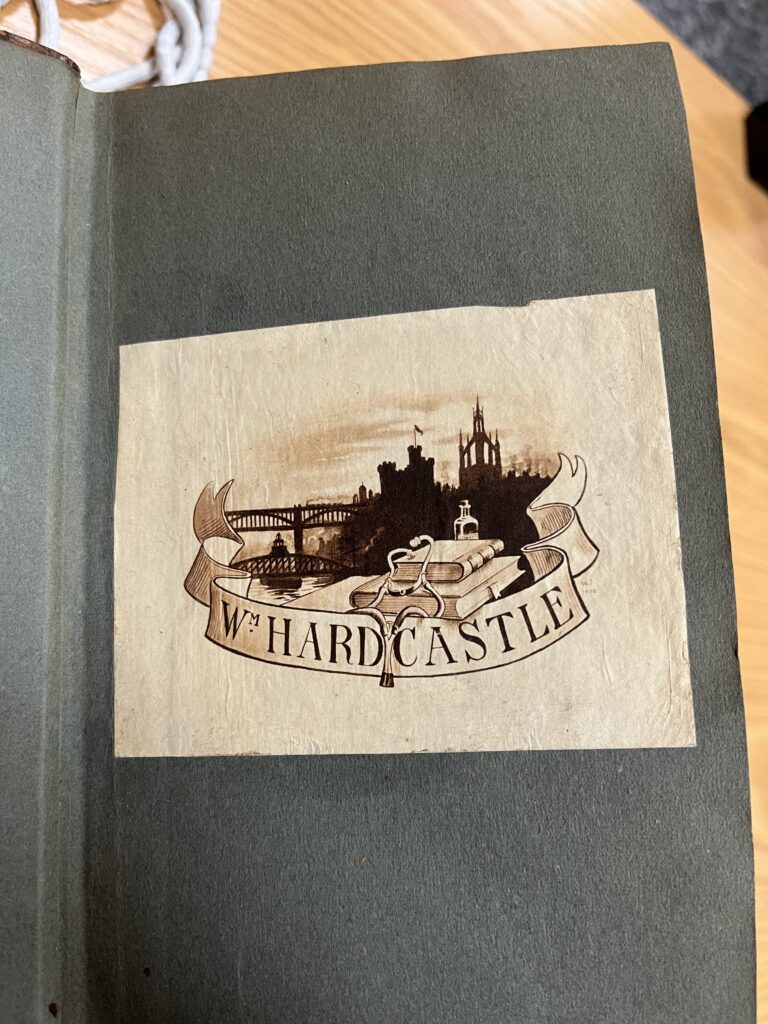
William Hardcastle Book Plate: Lived (1794-1860) in Newcastle, England, and had a famous apprentice by the name of John Snow. A leading member in the research and development of anesthesia. His father John was a Cobbler, and his mom, Mary. No information about him was recorded further until he became an apprentice of Stephenson Clark, a surgeon in Micklegate, York. He was a young and talented apothecary completing his medical education in London and later became a member of the Royal College of Surgeons. William is thought to have joined his practice in 1808 at the age of 14.
JW Mellor Bookplate– Born in 1869 Joseph Mellor was a renowned chemist who attempted by himself to create a large comprehensive work on chemistry called A Comprehensive Treatise on Inorganic and Theoretical Chemistry. This work is said to have over 15,000 pages. Joseph studied at the University of Otago in New Zealand, there he would win a scholarship to be able to study and research at the Owens College in Manchester. During the first world war he did some important work involving ceramics in the steel industry aiding the war effort, and went on to become a member Royal Society for work related to ceramics. His peers would sometimes refer to him as the Peter Pan of Ceramics because he is said to have a childish humor to him.
Latin translation: Wisdom and the institutions of nature are then true only when they agree with external things
Mr. Champney Note- No information found
William Hepworth Note- Lived (1821-1879) and was an English historian/traveler from Manchester. (The last known owner and note indicate that William Hepworth was given the book as a gift in 1840 by a Mr. Champney)
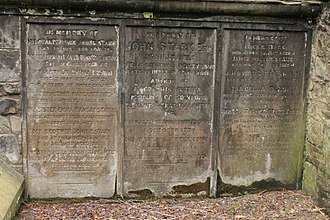
Printer: John Stark
Born on October 14, 1779, in Blyth’s Muir in Peeblesshire. Son of James Stark and his wife Elizabeth Lawson. He moved to Edinburgh in 1803 where he was educated. In 1805 he set up a print shop at the Netherbow Port on the Royal Mile in Edinburgh. In 1810 he was living at a house near here on the Royal Mile. He moved to a few other places in his life and settled in Brown Square around 1820 to 1825. In 1826 he was elected a Fellow of the Royal Society of Edinburgh, serving as assistant curator to the Society’s museum from 1829 to 1849.
John Stark passed at his son’s house, 21 Rutland Square, on Christmas Eve December 24, 1849. Buried nearby in St Cuthbert’s Churchyard. The grave lies on the outer north wall of the church.
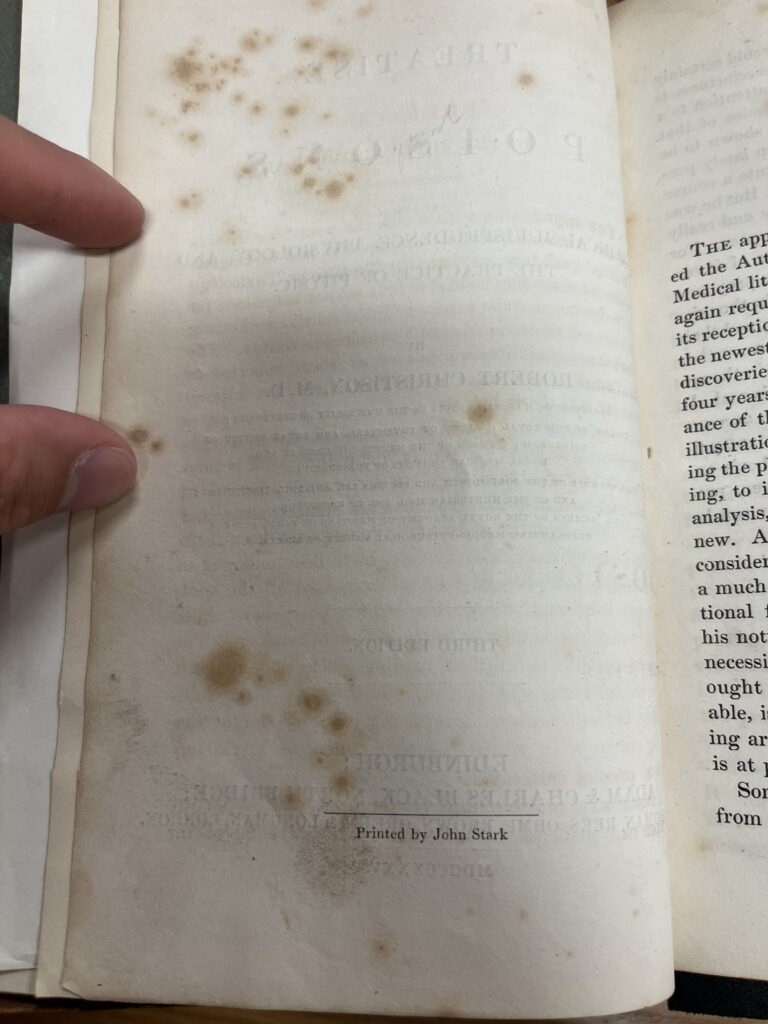
This particular copy was published in (1835) indicated by the binding and Roman numerals on the title page . It was originally published in Edinburgh in 1829. The book has some writing on the title page: W. Hepinworth the gift of Mr. Champney September 1840
Appears to be a gift given to W. Hepworth, but no data was found about Mr. Champney. However, it can be assumed that William Hepworth was some sort of medical or university student who received this book as a gift. The underlined text in the book indicates that it was most likely used for school purposes.
Sources
2023, Author Mark William Dixon, and Name. “William Hepworth Dixon (1821-1879)Victorian Writer and Traveller: An Adopted Child of St. John’s Wood.” St John’s Wood Memories, www.stjohnswoodmemories.org.uk/content/new-contributions/william-hepworth-dixon-1821-1879victorian-writer-and-traveller-an-adopted-child-of-st-johns-wood. Accessed 16 Nov. 2023.
“A. & C. Black Publishers Ltd.. Archive.” Collections Special Collections, collections.reading.ac.uk/special-collections/collections/a-c-black-publishers-ltd-archive/. Accessed 16 Nov. 2023.
Christison, Robert. “A Treatise on Poisons :: In Relation to Medical Jurisprudence, Physiology, and the Practice of Physic /: By Robert Christison.” Berkeley Law, Printed for Adam Black, 1 Jan. 1970, lawcat.berkeley.edu/record/83025?ln=en.
“Christison.” Toxipedia, www.asmalldoseoftoxicology.org/christison. Accessed 16 Nov. 2023.
Matrix. “The John Snow Archive and Research Companion.” The John Snow Archive and Research Companion, Michigan State University, johnsnow.matrix.msu.edu/work.php?id=15-78-FF. Accessed 16 Nov. 2023.
https://www.metmuseum.org/art/collection/search/821212
James McCullen
Dr. Brockey
HST 475
Fall Semester 2023
