

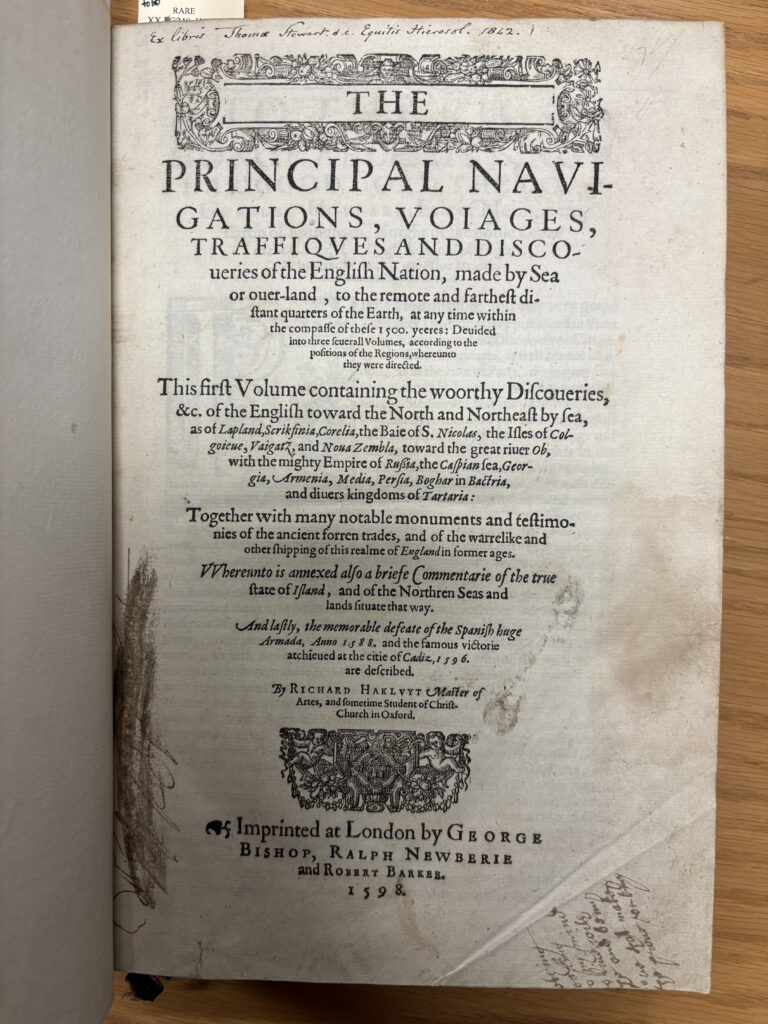
Full Title: The principal nauigations voiages, traffiques and discoueries of the English nation, made by sea or ouer-land, to the remote and farthest distant quarters of the earth, at any time within the compasse of these 1500 yeeres : deuided into three seuerall volumes, according to the positions of the regions, whereunto they were directed : this first volume containing the woorthy discoueries, &c. of the English toward the north and northeast by sea, as of Lapland, Scrikfinia, Corelia, the Baie of S. Nicolas, the Isles of Colgoieue, Vaigatz, and Noua Zembla, toward the great riuer Ob, with the mighty empire of Russia, the Caspian Sea, Georgia, Armenia, Media, Persia, Boghar in Bactria, and diuers kingdoms of Tartaria : together with many notable monuments and testimonies of the ancient forren trades, and of the warrelike and other shipping of this realme of England in former ages : whereunto is annexed also a briefe commentarie of the true state of Island, and of the northern seas and lands situate that way, and lastly, the memorable defeate of the Spanish huge Armada, anno 1588, and the famous victorie atchieued at the citie of Cadiz, 1596, are described / by Richard Hakluyt, master of artes, and sometime student of Christ-Church in Oxford.he principal nauigations voiages, traffiques and discoueries of the English nation, made by sea or ouer-land, to the remote and farthest distant quarters of the earth, at any time within the compasse of these 1500 yeeres
Publishing Information
Publishers: George Bishop (1540–1611), Ralph Newberie (1535-1608), and Robert Barker (died 1645).
Place of Publication: London, England
Year of Publication: 1598
Compiler/Author: Richard Hakluyt (1552–1616)
MSU Call number: XX folio G240 .H144 1598
Book Contents
Robert Barker, one of the printers of this book and named on the bottom of the title page, was a very well-known printer. He later went on and is most known for printing the King James Bible in 1611. His father, Christopher Barker, was a printer to Queen Elizabeth I, and they worked in publishing together. After his death, Robert Barker then took over and became the “Printer for Her Majesty the Queen”.
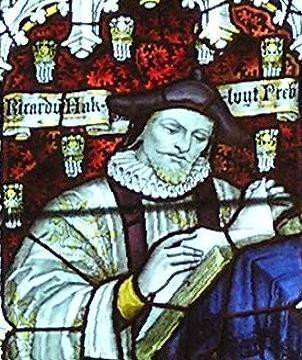
This book is the first of three volumes detailing many voyages around the world. Richard Hakluyt (1552-1616), the compiler of all of these voyages, was a famed editor, geographer, and Anglican minister. He is best known for being one of the strongest voices of his time in promoting English colonization across North America. After studying at Christ Church, Oxford, he became the first lecturer on modern geography. He is most well-known for writing The principal nauigations, as it provides some of the most detailed information about early English voyages to North America of its time.
This first Volume contains navigations around numerous countries and bodies of water, including but not limited to the North and Northeastern Sea, Russia, the Caspian Sea, Georgia, Armenia, Persia, etc.
This volume is part of a second and expanded edition, with the title page in volume I rarely dated (1598) and including the reference to “the famous victorie atchieued at the citie of Cadiz”, with the “Voyage to Cadiz” section (pp. 607-61g) which was suppressed by Elizabeth I after the disgrace of the Earl of Essex in 1599. Versions printed after that year would not have included this information.
Physical State
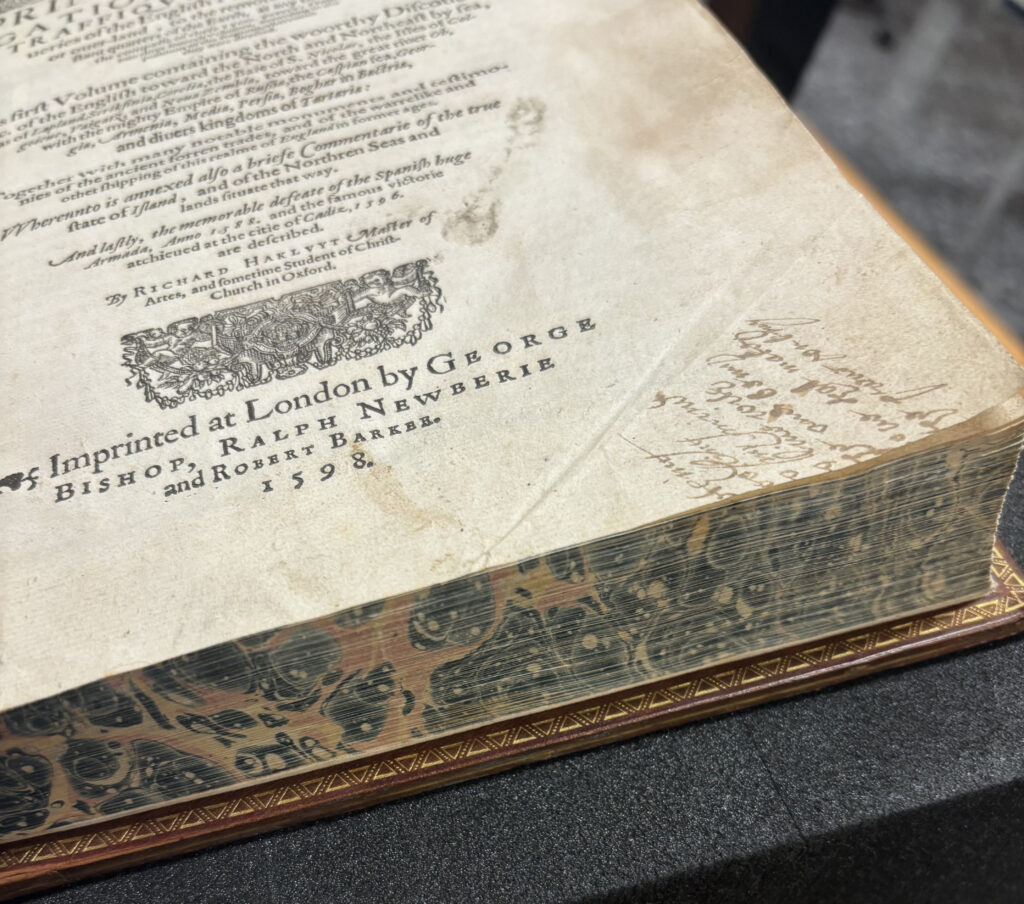
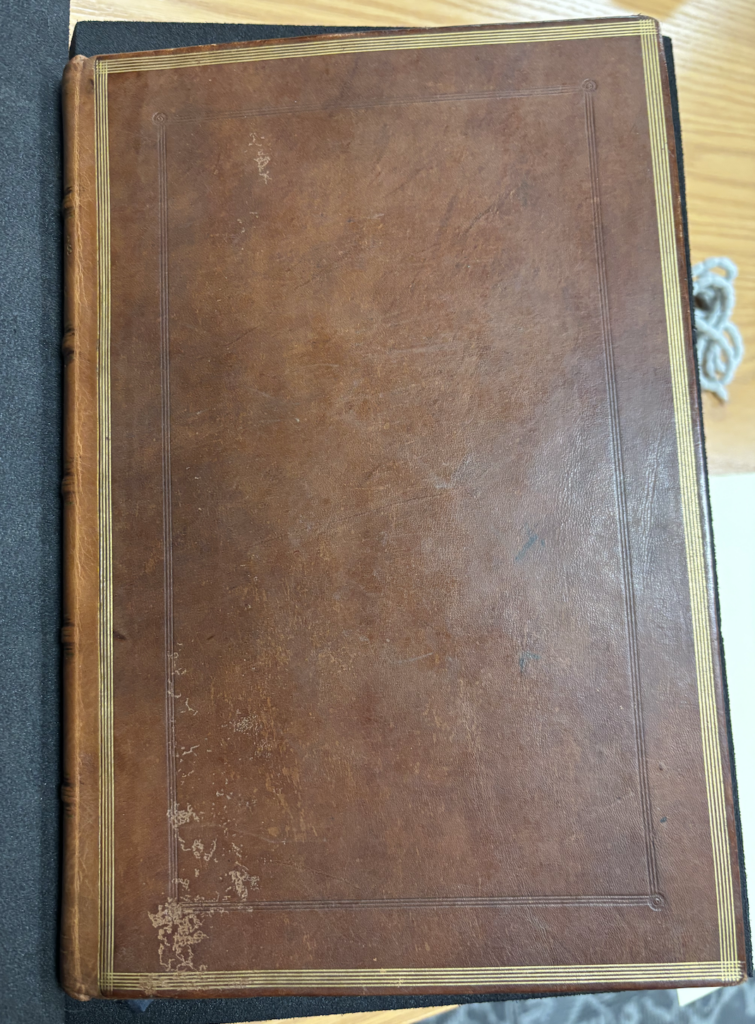
The book binding is an early-19th-century European leatherbound book that has been professionally rebacked and received new endpapers. The cover has a gold gilted fillet frame. On the inside edge of the covers, there are gold gilted turn-ins. The edges are also marbled and have been discolored over time. The front cover has some scuffs on the leather as well. Inside, there are woodcut vignettes on the title page and located throughout the rest of the book.
Provenance
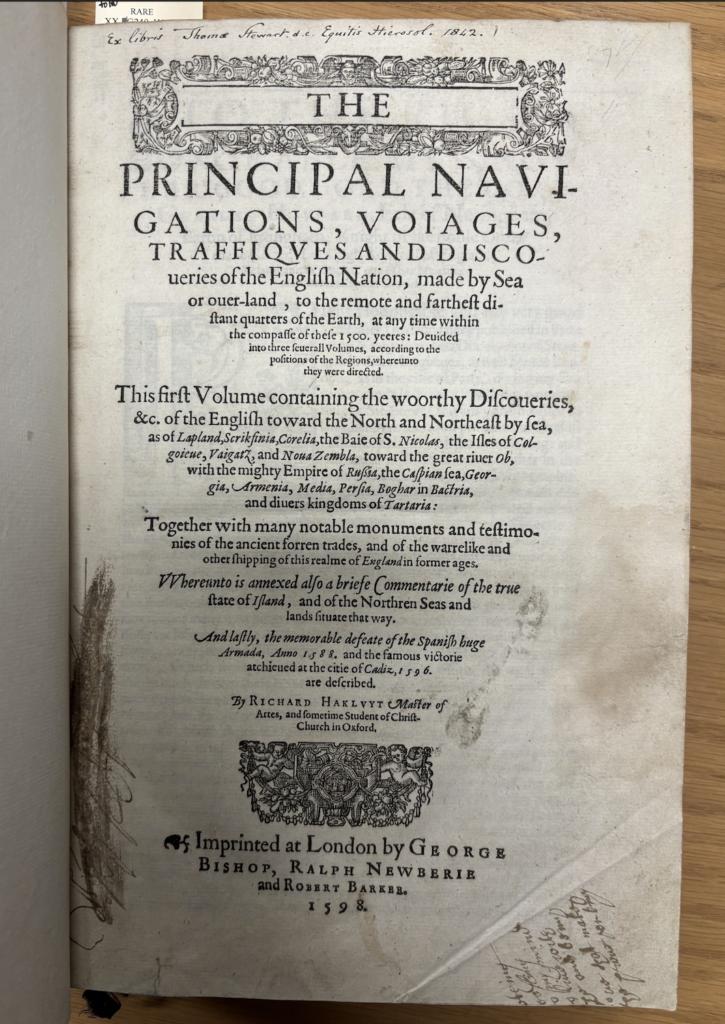
There are four notable points of provenance, with three (as shown) located on the front endpaper title page. There is one signature on the top, one crossed off on the left, and one fragmented section of writing on the bottom right. Additionally, there is one book seller’s pencil marking located on the front pastedown. These pieces of provenance indicate multiple signs of ownership; yet only two of these provenances have pointed to viable information about ownership history.
Crossed-Off Signature
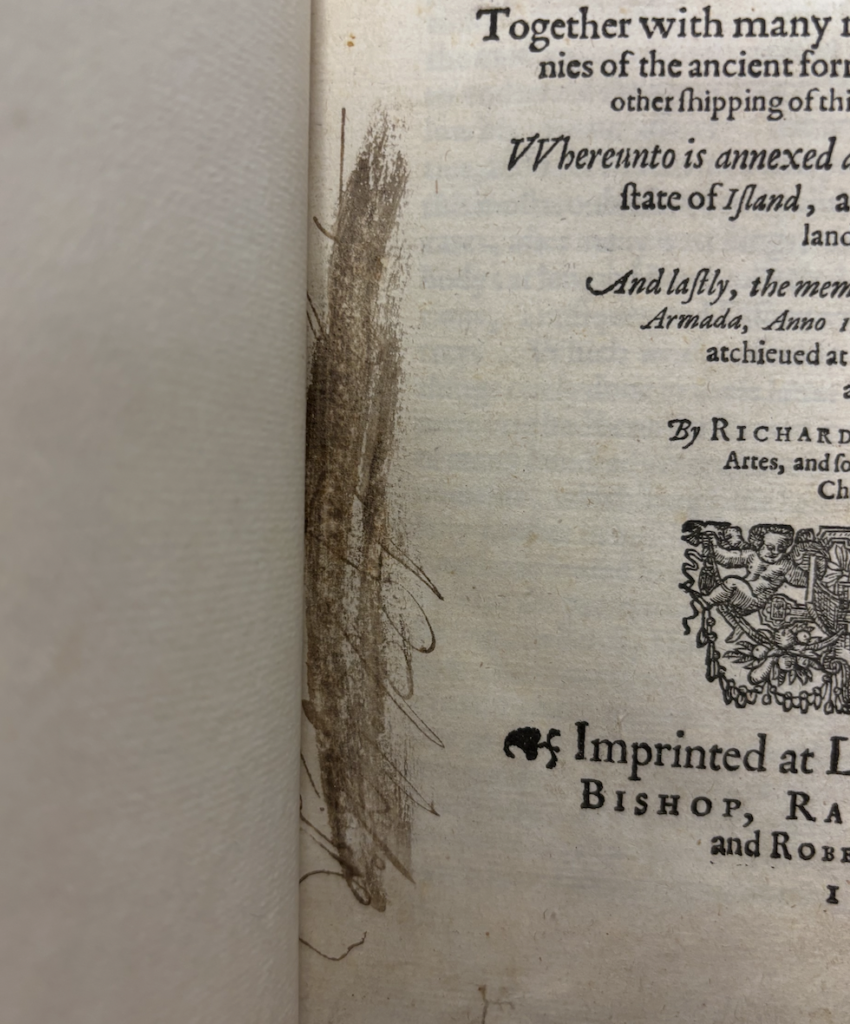
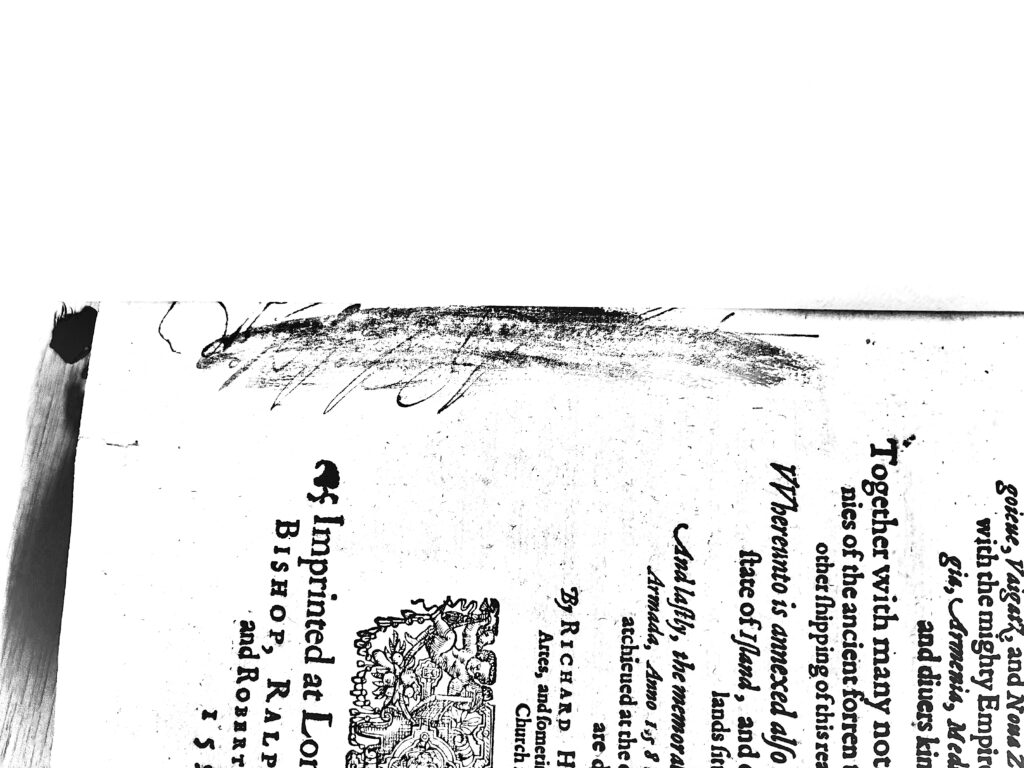
There is one signature located on the left side of the front endpaper that is completely illegible due to it being crossed out. Even with multiple attempts to edit saturation on images and flashlight use, no further information was deduced on the potential name, making this a dead end in terms of provenance research.
Poem?
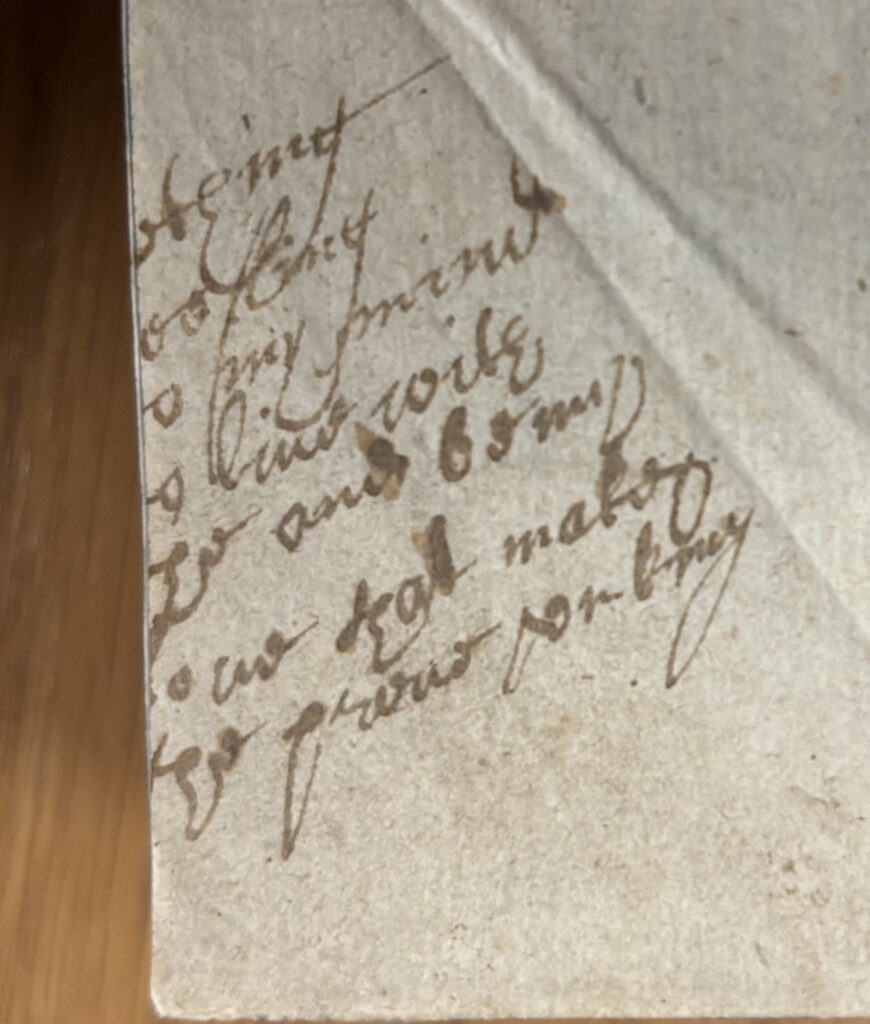
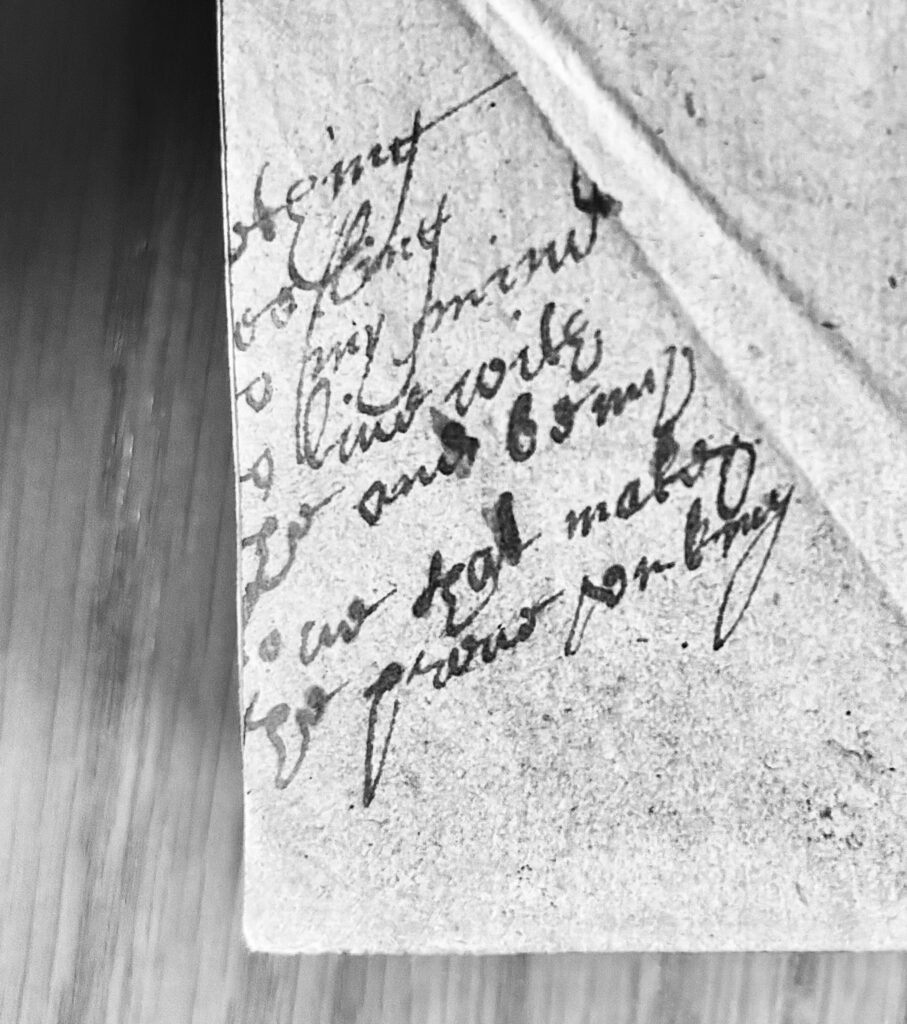
On the bottom right corner of the front endpaper, there is an oddly angled and partially cut-off section of writing. Only a few words can be deduced, including “my mind/wife/makes.” No additional information or word matchups have resulted from searching, leading to no further information on ownership history.
Thomas Stewart

Thomas Stewart is the most legible signature and note of provenance within the book, with his signature “Ex Libris Thomas Stewart d.c. Equitis Hierosol. 1842.” located on the entire top of the front endpaper. This signature also exists in the second volume of the set. Upon searching the entire signature, another book matching the exact handwriting and ownership title was being listed for sale by Sotheby’s, titled Manuzio, Orthographiae ratio, published in 1566. However, instead of 1842, this signature was ended “Rome. 1837.” This book is a Latin orthography that was a guide for scholars and printers to standardize Latin spelling.
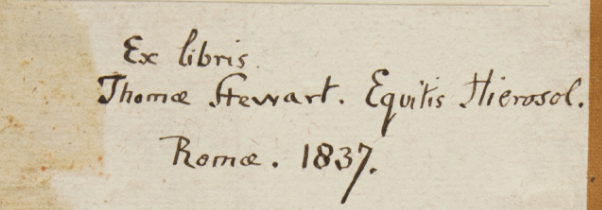
This match indicates that Thomas Stewart owned a much larger library and had experience in traveling the world, specifically visiting Rome. His interest in older book collecting and travel could point to clear reasons why someone would have an interest in purchasing The principal nauigations.
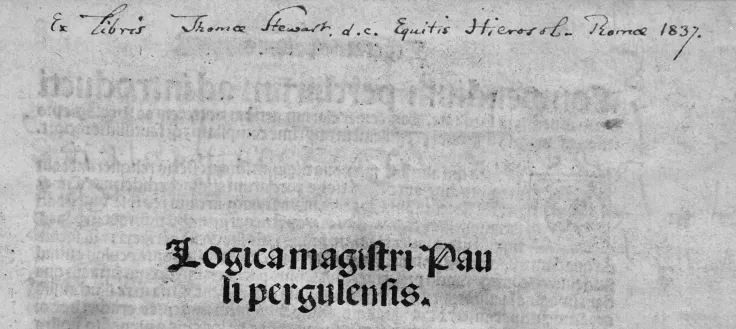
Another signature of Thomas Stewart, dated Rome 1837 on the title page, was located on a text titled Logica magistri Pauli Pergulensis. This text focuses on logic, which was a type of philosophy that focused on deductive reasoning, organized into theses. Another logic text by the same author (Paulus Pergulensis, ca. 1451), titled Logica magistri Pauli Pergulensis, was dated with this same signature, although there is no available image. This type of information gives deeper insight into the type of academic Thomas Stewart was, and what types of content he interacted with and cared to sign. Specifically, it shows his interest in older academic works and research.
Cross-referencing of the birth and death dates listed on these websites and a letter addressing the book following MSU’s purchase of The principal nauigations, enough information was available to conclude that Thomas Stewart was alive from 1803 to 1846 and was from Little Dunkeld, Perth, Scotland. He had also graduated from Christ Church in Oxford, as Richard Hakluyt had, which may be another reason he purchased this book.
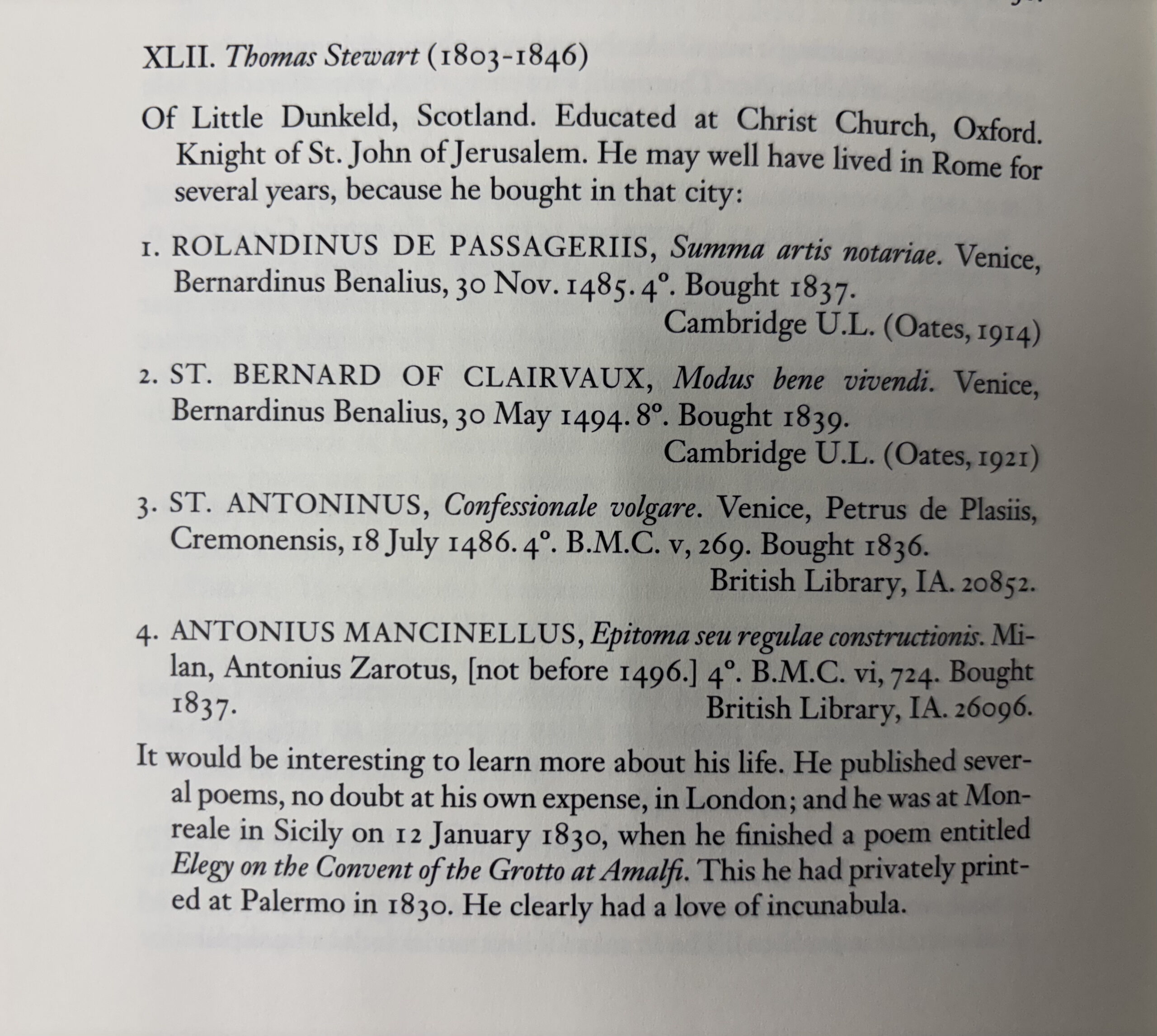
Thomas Stewart also appeared in a book titled Bookbindings & other bibliophily: essays in honour of Anthony Hobson, edited by Dennis E. Rhodes. In the chapter titled “British and Irish Book-Collectors in Italy, 1467-1850,” he is mentioned in a passage detailing many of the book purchases he made while in Italy, not including his logic texts. While these titles didn’t have much available information, there was an additional comment that led to much more about Thomas Stewart and his life. In this passage, he is credited with publishing several poems, one of which he titled Elegy on the Convent of the Grotto at Amalfi, and had published in Italy, which is a 24-page work. However, it is also mentioned that he had published multiple works before this, which were soon able to be pieced together.
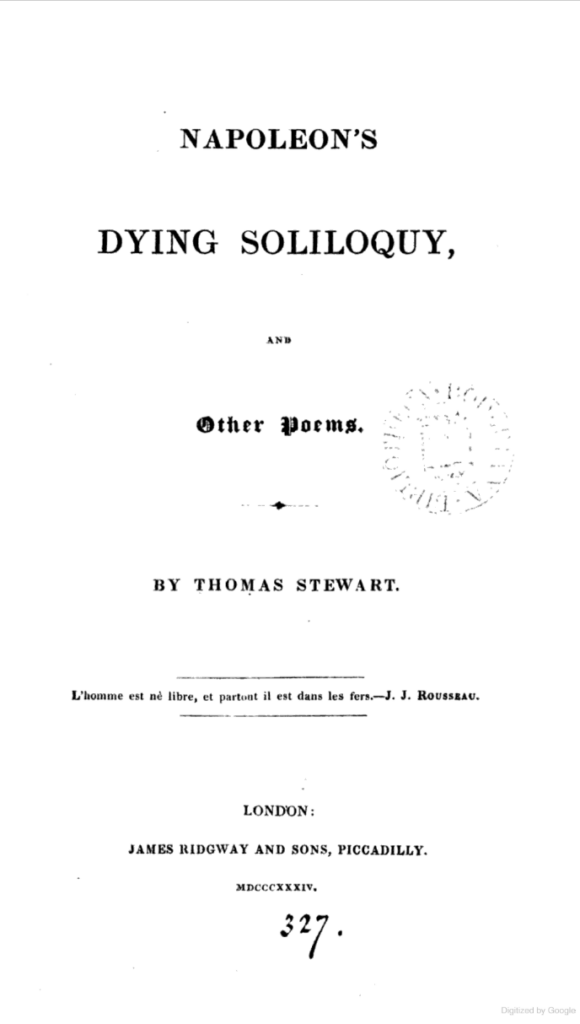
On looking up Elegy on the Convent of the Grotto at Amalfi, another text titled Napoleon’s Dying Soliloquy and other poems was also connected to Thomas Stewart, labeled a collection of poetry published in 1834 by the British poet Thomas Stewart. Upon searching, a digitized copy was available that was published in London by James Ridgeway and Sons. The original copy is labelled to come from Oxford University, with all signs pointing to the fact that this is the very same Thomas Stewart who likely published his own works in London. However, the authorship online labelled him “Thomas Stewart (of Naples).” With his clearly long history of traveling to and from Italy throughout his life, it would make sense that he was mislabelled as being “Of Naples,” and would also explain why it wasn’t easily connected to him. It is also clear that his documented love for academia and book collecting pushed him to publish his own literary works as well.
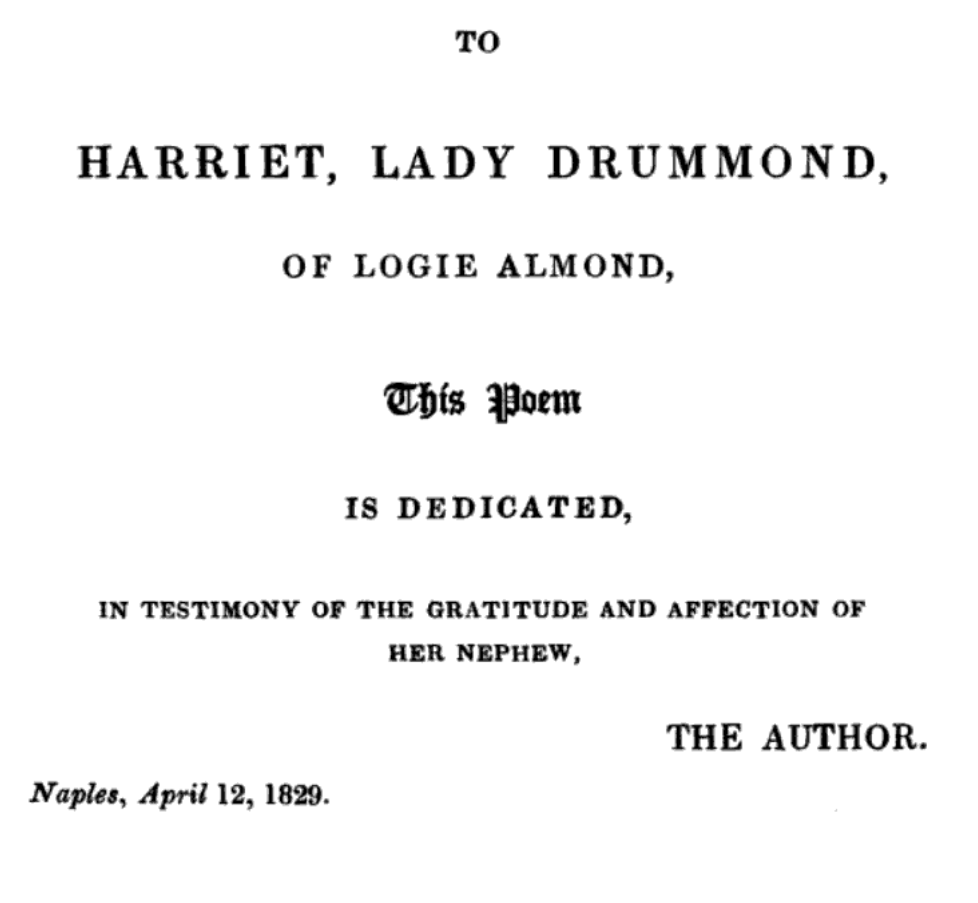
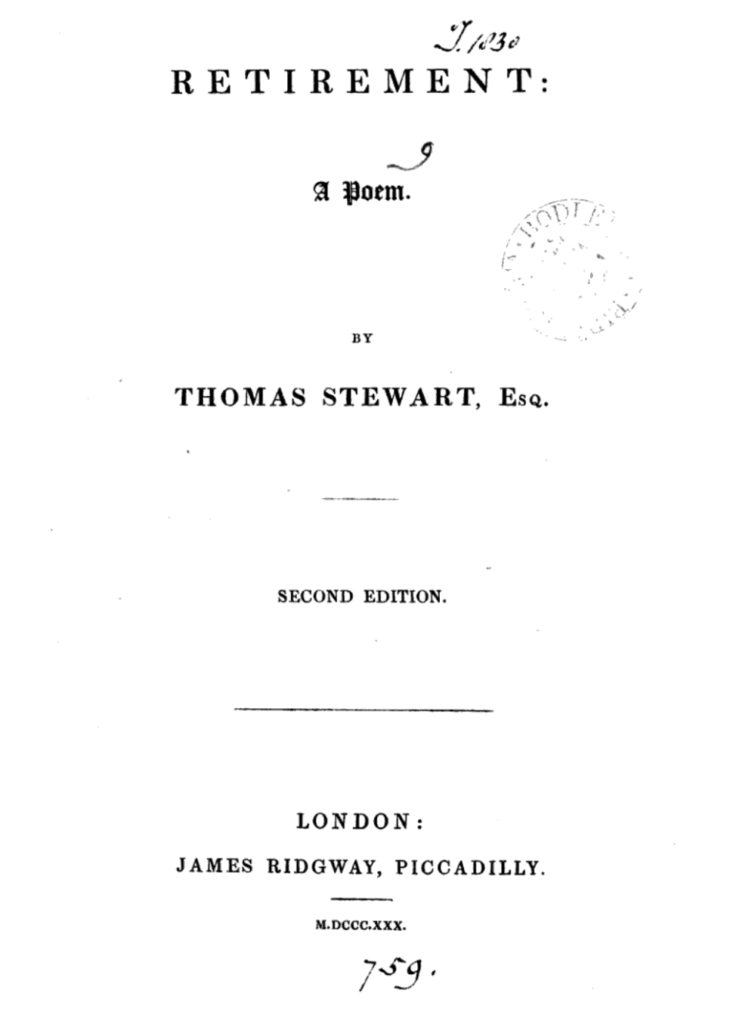
Upon searching other works by “Thomas Stewart (Of Naples),” two additional works were found, both published in London (Piccadilly) by James Ridgeway and Sons. The first one, titled Retirement: A Poem, was published in 1830, making Thomas 27 years old. In his dedication page, he names his aunt Harriet, Lady Drummond of Logie Almond. Harriet Anne Drummond (1795-1865) was the wife of Sir William Drummond of Logiealmond. She was known as the namesake for the planned village of Harrietfield in Perthshire, Scotland, established in the early 1820s by her husband on his estate. In the bottom left of the dedication, he dates his writing to Naples, April 12, 1829, with this label and dedication connecting this publication both to Scotland and to Italy. In this way, the book can be attributed to belonging to the very same Thomas Stewart, who was born in Perthshire, Scotland, and traveled to Italy very frequently. It also gives credit to the first work as being fully connected. This is likely one of his earliest published works, if not the earliest.
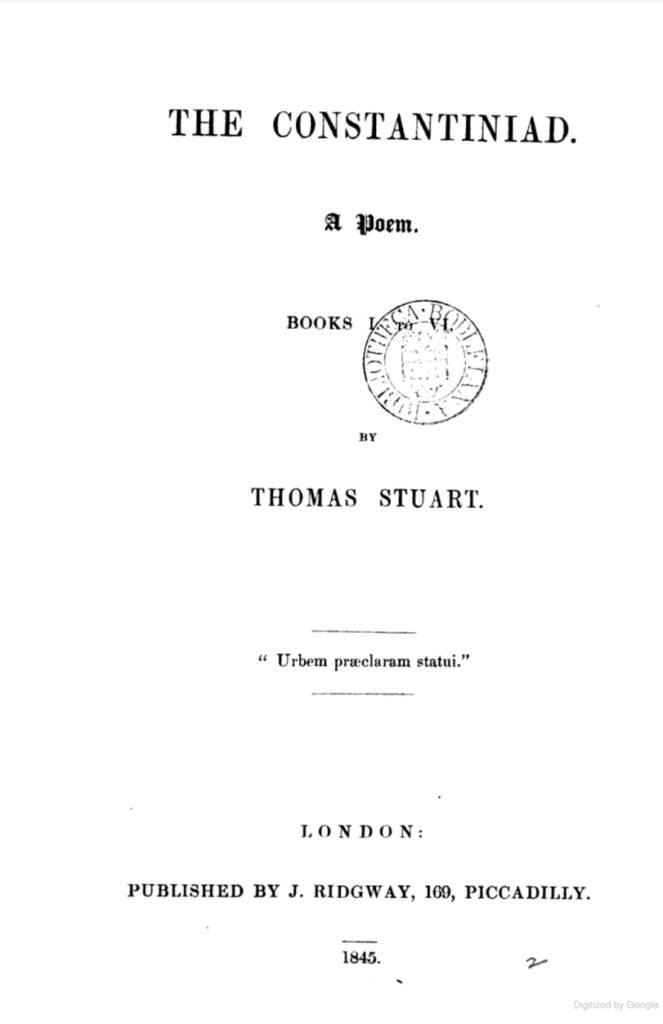
The last connected publication to “Thomas Stewart (Of Naples)” that was published in London (Piccadilly) by James Ridgeway and Sons was titled The Constantiniad: A Poem. This is most likely the last published work of Thomas Stewart, as he died in 1846, and this text was published in 1845. His name on the title page is different, labelling him “Thomas Stuart”, likely a spelling variation he used throughout his life, which may have also made it difficult to track down additional sources. However, with all of these published works and the tracked purchase history of books across Italy, it is clear that Thomas Stewart has a deep passion for writing, learning, and collecting incunabula.
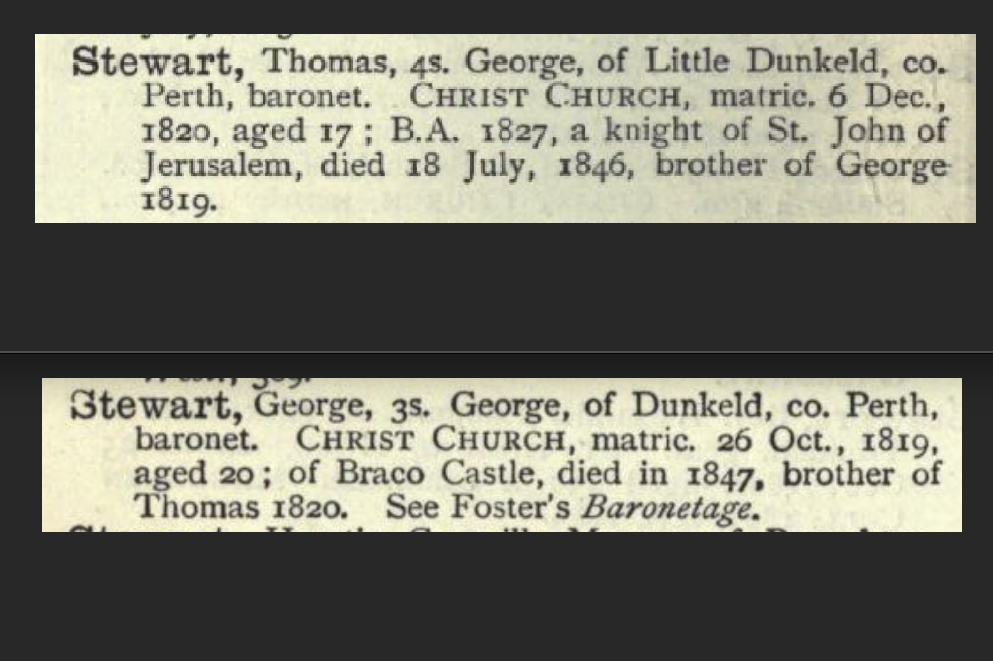
On searching for graduation records from Christ Church in Oxford, one record titled Alumni oxonienses: the members of the University of Oxford, 1715-1886; their parentage, birthplace and year of birth, with a record of their degrees. Being the matriculation register of the University, aligned with all other known information about Thomas Stewart. By listing him as a knight of St. John of Jerusalem in the early 1800s, his history at Christ Church was confirmed. It also provides more information, stating he had a brother named George and was a baronet. He was enrolled (matric) in university at age 17 on December 6, 1820. His exact death date is listed as July 18th, 1846. His brother was also listed as an enrolled student at Christ Church in 1819, at age 20. His title as baronet is a holder of a British hereditary title of honor, ranking below a baron but above a knight.
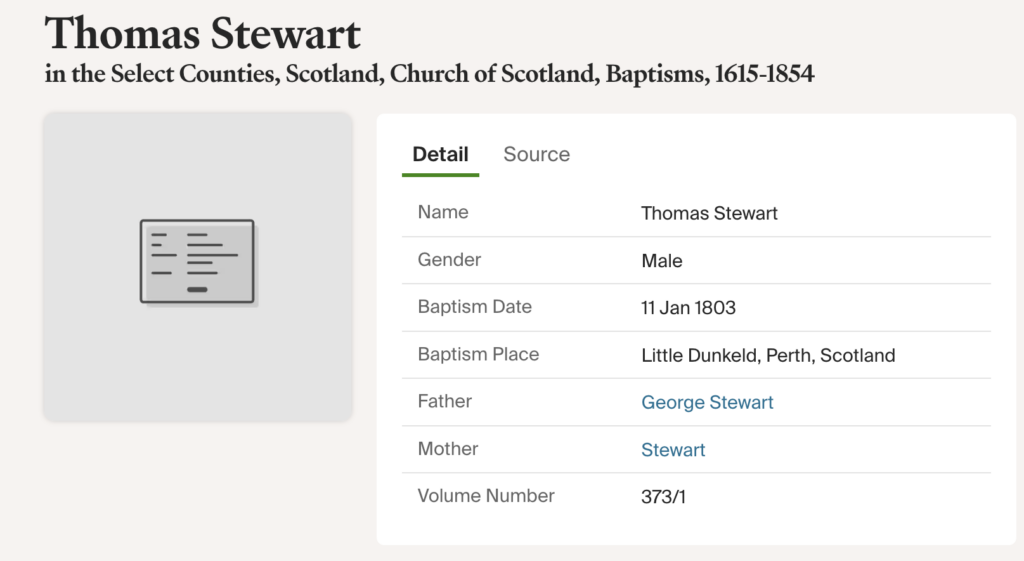
In labelling his books “Equitis Hierosol” (translating to “Knight of Jerusalem), Thomas Stewart also appears to have been a member of the Order of the Holy Sepulchre of Jerusalem. This baptism registry from Little Dunkeld, Scotland, also matches with previous information known about Stewart, making this a potential record of his baptism. It also gives more confirmation about his father’s name, George Stewart, which is where his middle name and brother’s name most likely were passed down from.
The Equestrian Order of the Holy Sepulchre of Jerusalem – Eastern Lieutenancy is described as “an order of chivalry under papal protection entrusted with an important mission from the Holy Father: to serve as witnesses to the Christian faith and protectors of the church and the living Christian communities in the biblical lands of the Middle East”. This derives from times when crusader knights traveled to religious sacred sites, protecting Christian pilgrims.
Online Listing
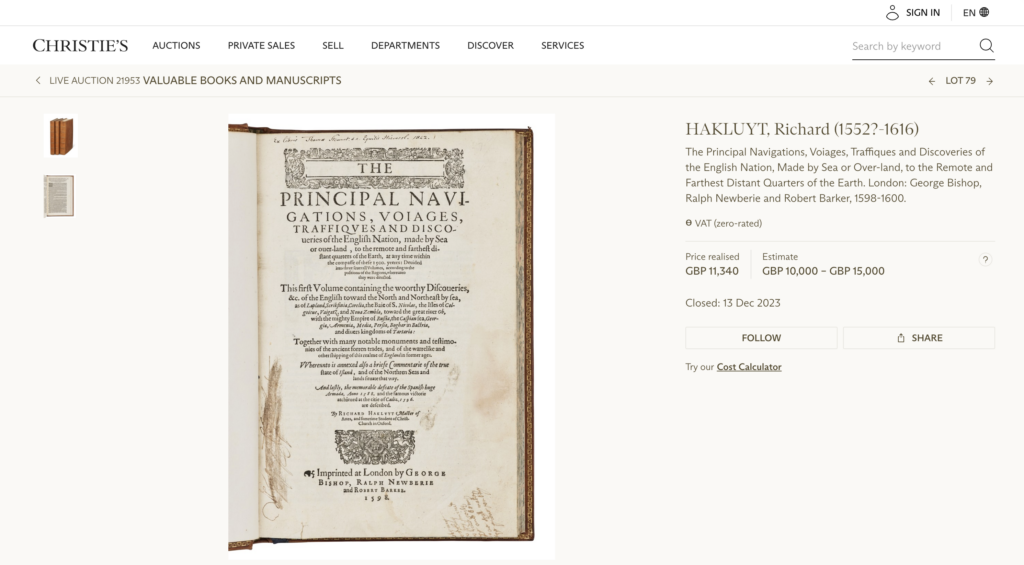
The principal nauigations along with the other two volumes in this set were previously sold online by Christie’s Auction House, a British auction house founded in 1766 by James Christie. Its main building is located on King Street, St James’s in London. As shown in the image, this title page reflects the same provenance as that of MSU’s copy. This sale was closed on December 13, 2025, and the set of 3 volumes was sold for 11,340 pounds.
Purchased by MSU
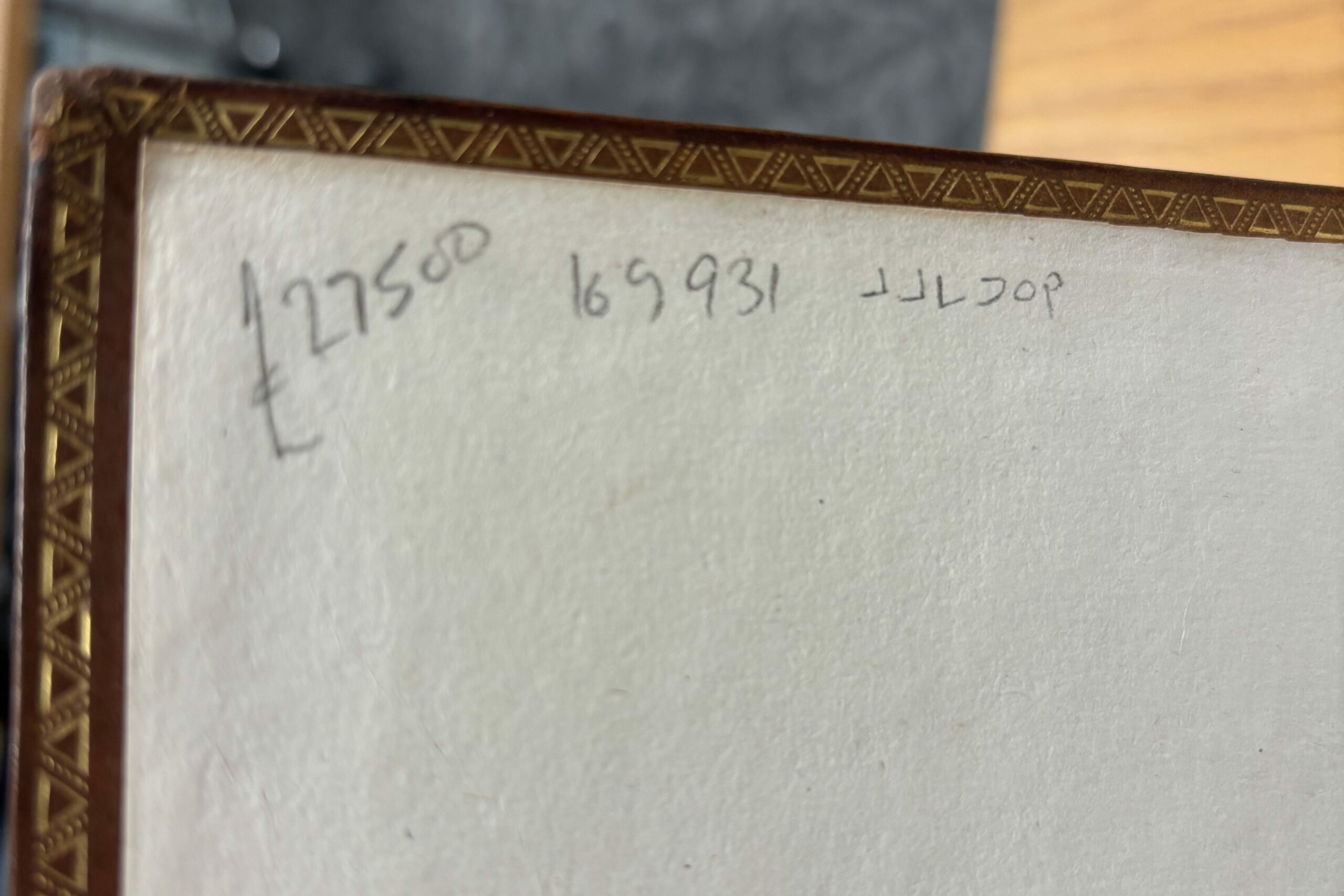
It can be assumed that the 3 volumes were then purchased by Peter Harrington of London, a well-known rare bookseller (founded 1969). This book, as part of a set of three volumes, was purchased by MSU on February 13, 2024, from Peter Harrington. Included with the purchase was a note detailing important information, specifically on provenance and the historical importance of the three volumes, which aided in research on Thomas Stewart and the contents of The principal nauigations. As indicated by the pencil markings on the pastedown (shown below), the set sold for 27,500 pounds.
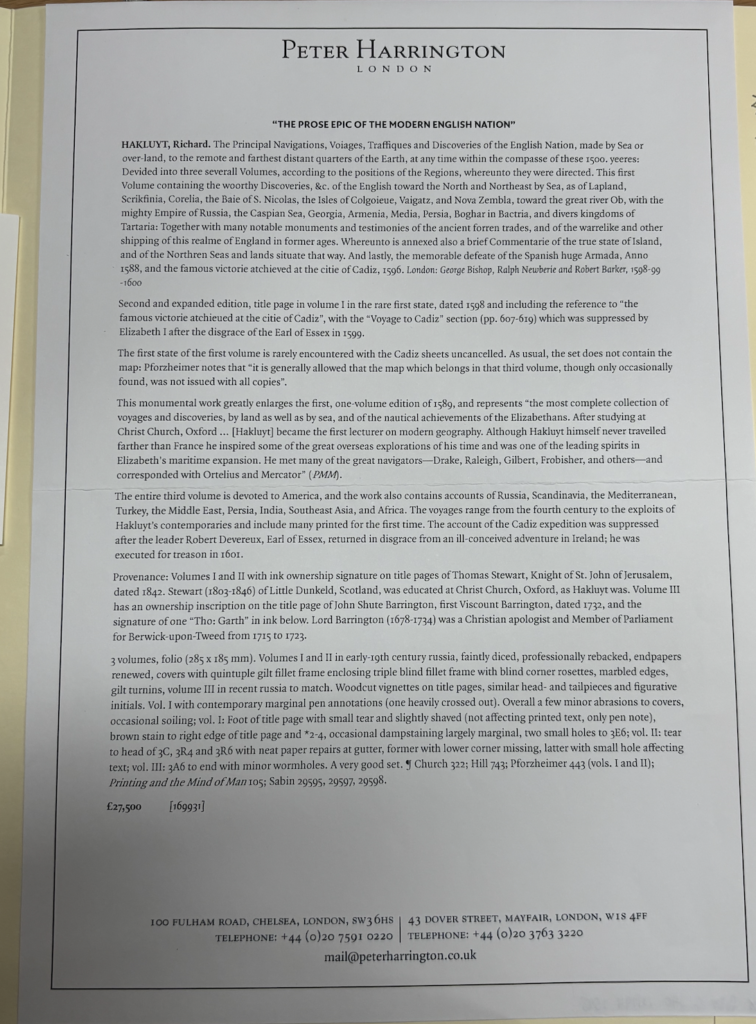
Harrington, in regards to provenance, states, “Volumes I and II with ink ownership signature on title pages of Thomas Stewart, Knight of St. John of Jerusalem, dated 1842. Stewart (1803-1846) of Little Dunkeld, Scotland, was educated at Christ Church, Oxford, as Hakluyt was.” This information became a key piece in narrowing down the provenance information and uncovering information regarding Thomas Stewart.
Bibliography
“Baronet | History, Requirements & Privileges.” Britannica. Accessed April 3, 2026. https://www.britannica.com/topic/baronet.
“Discover Your Family Story.” MyHeritage. Accessed March 25, 2026. https://www.myheritage.com/.
“Drummond, William (?1770-1828), of Logie Almond, Perth.” History of Parliament Online. Accessed April 5, 2026. https://www.historyofparliamentonline.org/volume/1790-1820/member/drummond-william-1770-1828.
“Earl of Essex.” Heritage History – Products. Accessed March 27, 2026. https://www.heritage-history.com/index.php?c=resources&s=char-dir&f=essex.
“Elegy on the Convent of the Grotto at Amalfi. [by T. S.] by Thomas Stewart 9781241013172.” Booksplease. Accessed April 5, 2026. https://booksplea.se/elegy-on-the-convent-of-the-grotto-at-amalfi-by-t-s-by-thomas-stewart-9781241013172/.
“Family Tree, Genealogy & Family History Records.” Ancestry. Accessed March 23, 2026. https://www.ancestry.com/.
Foster, University of Oxford; “Alumni Oxonienses: The Members of the University of Oxford, 1715-1886; Their Parentage, Birthplace and Year of Birth, with a Record of Their Degrees. Being the Matriculation Register of the University : University of Oxford : Free Download, Borrow, and Streaming.” Internet Archive, January 1, 1888. https://archive.org/details/alumnioxonienses04univuoft/page/1354/mode/2up.
Gray, James. “Nine Incunabula Printed in Italy 1476-1500.” jamesgray2, February 6, 2020. https://jamesgray2.me/2020/02/05/nine-incunabula-printed-in-italy-1476-1500-2/.
Gray, James. “The Printed Copies Are in the Mail ! Fascicule XII July MMXIII (500 Year Old Books).” jamesgray2, August 6, 2018. https://jamesgray2.me/2018/08/06/the-printed-copies-are-in-the-mail-fascicule-xii-july-mmxiii-500-year-old-books/.
“Harriet Anne Drummond (1795 – 1865).” WikiTree, April 13, 2025. https://www.wikitree.com/wiki/Drummond-5431.
“History of Logic – Rationalism, Empiricism, Symbolic Logic.” Britannica. Accessed April 3, 2026. https://www.britannica.com/topic/history-of-logic/The-18th-and-19th-centuries.
“History of the Rite.” The Scottish Rite of Freemasonry. Accessed March 25, 2026. https://scottishrite.org/about/history/.
“Manuzio, Orthographiae Ratio, Venice, [Paolo Manuzio], 1566, Late Sixteenth-Century French Red Morocco, Stewart-Hope-Scott Copy.” Sotheby’s. Accessed March 23, 2026. https://www.sothebys.com/en/buy/auction/2024/bibliotheca-brookeriana-a-renaissance-library-the-aldine-collection-d-m/manuzio-orthographiae-ratio-venice-paolo-manuzio-2.
“Order of the Holy Sepulchre of Jerusalem.” A Brief History. Accessed March 24, 2026. https://www.vatican.va/roman_curia/institutions_connected/oessh/en/cenni_storici_en.html.
Peter Harrington Rare Books. Accessed March 24, 2026. https://www.peterharrington.co.uk/.
“Record Details.” FreeCEN. Accessed March 23, 2026. https://www.freecen.org.uk/search_records/59045f0ee9379091b10e06e2/thomas-stewart-1841-perthshire-rattray-1803-?locale=en.
Rhodes, Dennis E., ed. Bookbindings & Other Bibliography: Essays in honour of Anthony Hobson. Verona: Valdonega, 1994.
“The Principal Navigations, Voiages, Traffiques and Discoveries of the English Nation, Made by Sea or over-Land, to the Remote and Farthest Distant Quarters of the Earth. London: George Bishop, Ralph Newberie and Robert Barker, 1598-1600.” Christie’s. Accessed April 3, 2026. https://www.christies.com/en/lot/lot-6463285?ldp_breadcrumb=back.
“Richard Hakluyt (1552–1616).” Encyclopedia Virginia, August 26, 2024. https://encyclopediavirginia.org/entries/hakluyt-richard-1552-1616/.
“Richard Hakluyt | Biography, Significance, & Facts | Britannica.” Britannica. Accessed April 3, 2026. https://www.britannica.com/biography/Richard-Hakluyt.
“Robert Barker.” Datchet history. Accessed March 24, 2026. https://datchethistory.org.uk/datchet-people/robert-barker/.
Stewart, Thomas. “Napoleon’s Dying Solioquy, and Other Poems.” Google Books. Accessed April 6, 2026. https://www.google.com/books/edition/Napoleon_s_dying_solioquy_and_other_poem/Olv4P–gPQcC?hl=en&gbpv=1.
Stewart, Thomas. “Retirement: A Poem.” Google Books. Accessed April 6, 2026. https://books.google.com/books?id=_uyuua-Cd04C&printsec=frontcover&source=gbs_ge_summary_r&cad=0#v=onepage&q&f=true.
Stewart, Thomas. “The CONSTANTINIAD. A Poem. Books I. to VI.” Google Books. Accessed April 6, 2026. https://www.google.com/books/edition/The_Constantiniad_A_poem_Books_i_to_vi/mCdcAAAAQAAJ?hl=en&gbpv=1.
“Welcome.” The Equestrian Order of the Holy Sepulchure of Jerusalem. Accessed April 3, 2026. https://eohsjeastern.org/.
Adora Gjoni, HST 475, Spring 2026
Special thanks to Tad Boehmer for providing helpful resources to track down information.
