
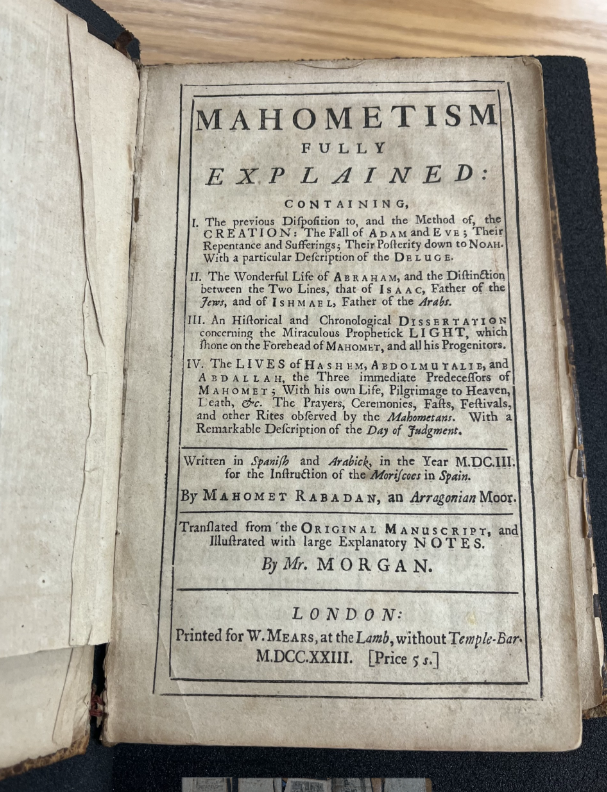
Authorship and Translation
Original Author
Discorso de la luz y descendencia y linaje claro de nuestro caudillo y bien aventurado anabi Muhamed [English Translation: Discourse of Light—the Origin and Translucent Genealogy of Our Leader and Blessed Prophet Muhammad ] was written by Mahomet Rabadan [fl. 1603] in 1603. The two volumes were originally written in both Spanish and Arabic, and translated into English, French, and Aragonese by various authors. Rabadan was a morisco of Aragonese descent; meaning he was from a Muslim community within Spain that was forcibly converted to Christianity by the Spanish, but continued to practice Islamic traditions regardless. Rabadan presumably lived most of his life in his home village of Rueda, Spain, where he wrote poetry informed by his identity. A hallmark of Rabadan’s writings was the interweaving of Spanish and Arabic to create a unique prose that was very difficult to fully grasp unless both languages were known by the reader.
Translator and Author of Mahometism Fully Explained
English historian and translator John Morgan [fl. 1700-1739] purchased the 2-volume series written by Rabadan in 1719, while living in the “Kingdom of Tunis” [Modern Day Tunisia]. Morgan spent approximately 23 years in Tunisia and the North African countries surrounding it, serving as chancellor to the British Consul Robert Cole in “Algiers” [Modern Day Algeria] for 8 of them. In 1720, Morgan returned to England and decided to translate Rabadan’s volumes into English for the education of other Englishmen on Islam; this became Mahometism Fully Explained, published in 1723. Morgan provided an important perspective to the English understanding of Islam as a religion. Having both lived experience in communites with high Muslim populations and fluent Arabic, Morgan was able to approach Islam from a considerably more nuanced standpoint than previous scholarship did; his predicessors and contemportaries essentially denounced it in favor of Christianity in their works. However, many details included by Rabadan, such as headings and entire paragraphs, were cut from Morgan’s final translation, indicating that Morgan likely had a bias despite his deeper knowledge of the subject matter. He may have been more concerned about changing the common, unfavorable narrative around Islam at the time to the point of somewhat unfaithfully translating Rabadan’s original work.
Contents of the Book
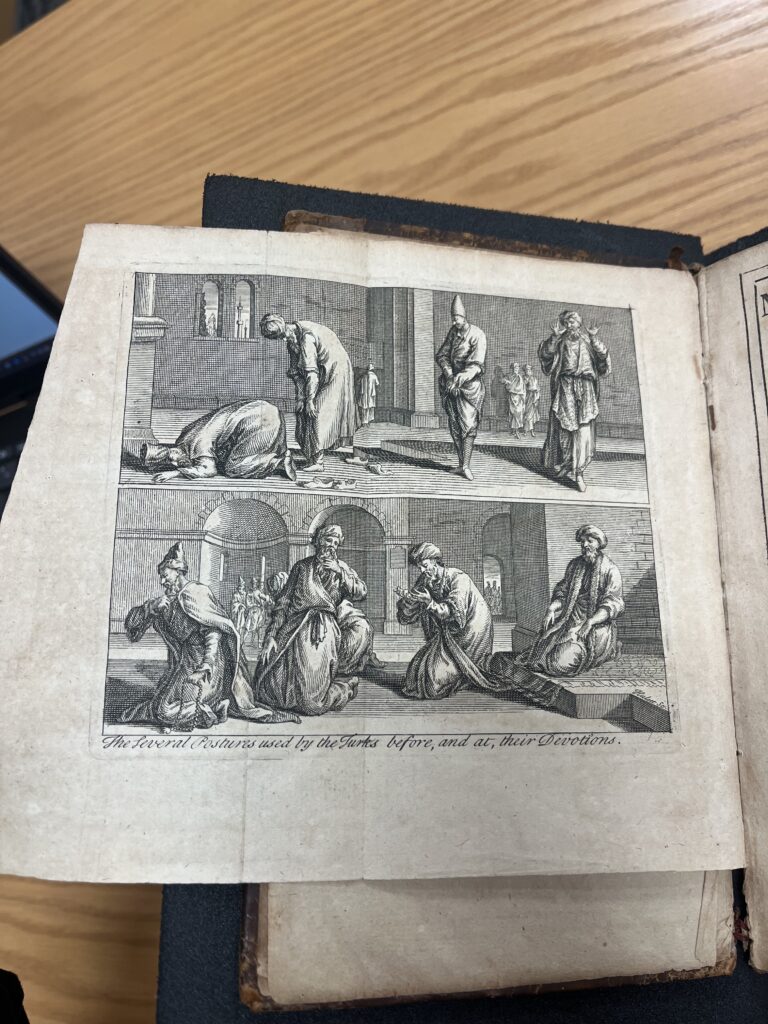
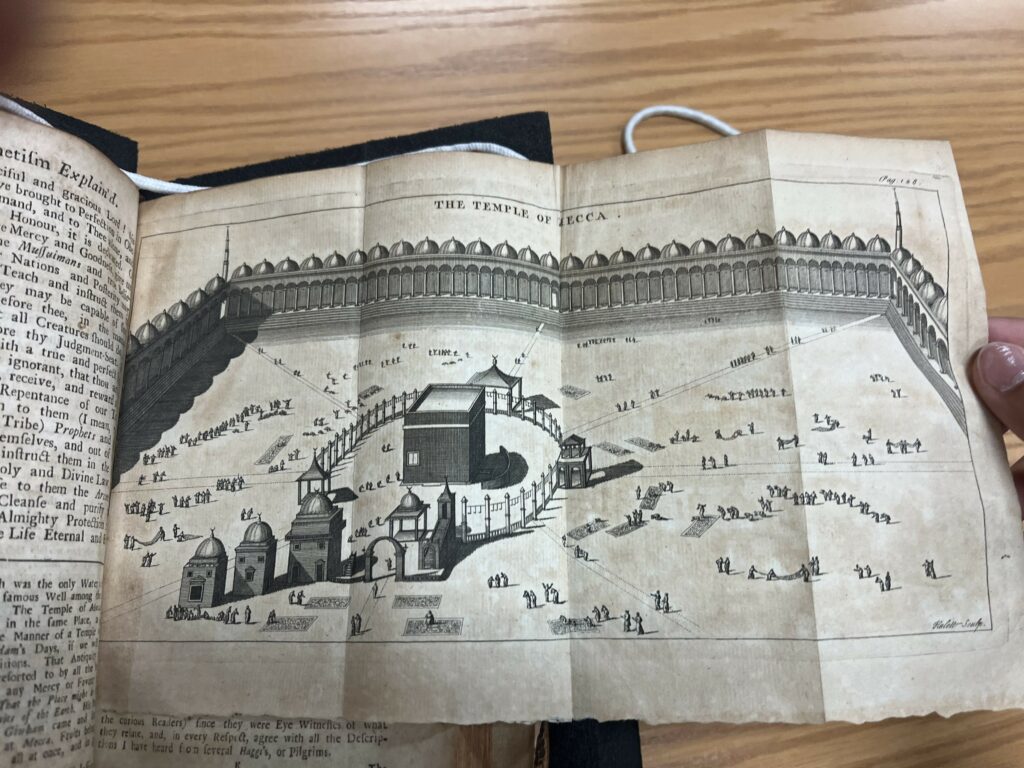
Mahometism Fully Explained translates the original books from Rabadan into English, with additional commentary from Morgan further contextualizing the topic of Islam for Englishmen who may not know or understand the religion; both in footnotes and a supplementary chapter added by Morgan. This additional commentary is accompanied by visual illustrations:
The first is a depiction of Muslim men praying, directly next to the title page:
The second is an illustration of the Great Mosque of Mecca on page 129, including the Kaaba in the center:
The third is a family tree of the Prophet Muhammed (Peace Be Upon Him) on page 257:
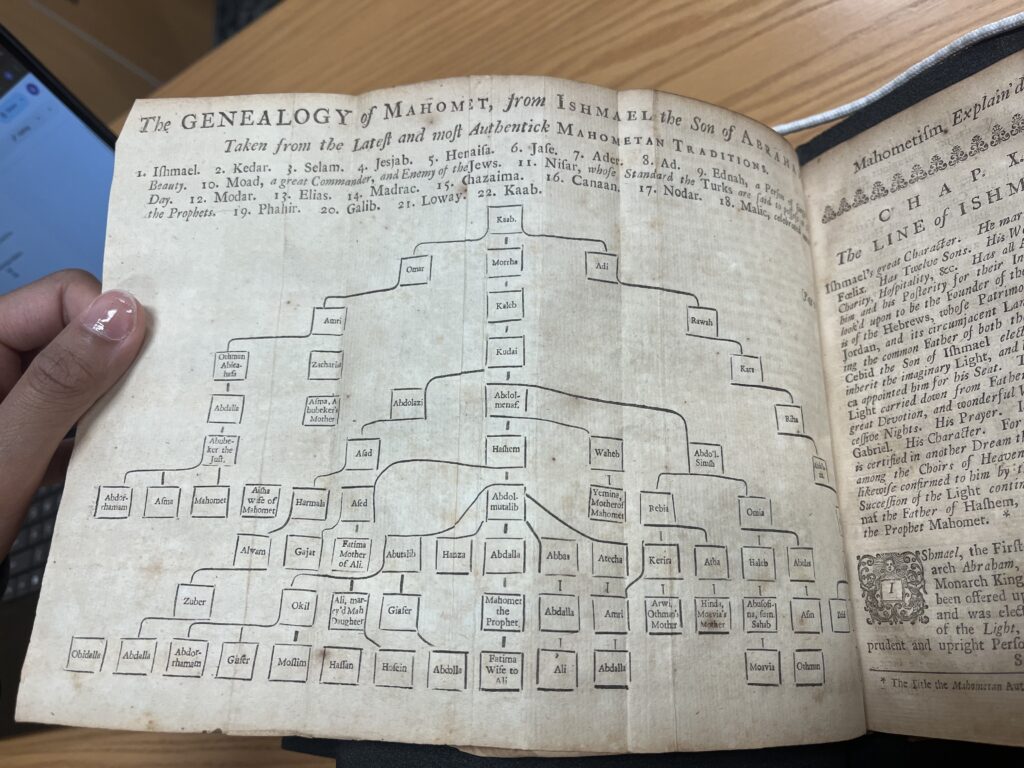
Through the original volumes, Rabadan likely intended to contribute to the literary tradition of the sira, or biographical poems that focused on the life and legacy of the Prophet Muhammad (Peace Be Upon Him). Similar to other siras written before, Rabadan starts by detailing the life of the first human and continues from there into the ancestry of the Prophet Muhammad (Peace Be Upon Him). However, volume I ends midway through this ancestral line. A few parables involving Abraham, a notable figure in Islam, are included towards the end of the book.
Letters
The beginning of the book reproduces letters corresponding with two individuals about the creation of the book. The first in print is an inquiry from Morgan to the “Right Honorable Edward Lord Harley”, sent May 20th, 1723, asking if the Lord Harley would like a copy of Mahometism Fully Explained. Lord Edward Harley [1689-1741] was the second Earl of Oxford and Mortimer, and the Baron of Wigmore, London. He almost certainly purchased this book, as much of his life was spent developing the vast collection of manuscripts started by his father, Robert Harley [1661-1724]. This collection was eventually known as the Harleian/Harleyian Library, and it held more than 20,000 items in several languages. It was purchased by the British Museum in 1753 for £10,000.
The second is from Morgan to Reverend Humphery Prideaux, D.D., Dean of Norwich, sent in August 12, 1722*; requesting that Rev. Prideaux to proofread the draft of Morgan’s translation. Rev. Prideaux [1648-1724] was highly regarded for his work The True Nature of Imposture Fully Display’d in the Life of Mahomet, published 1697. Morgan’s translation takes a comparatively neutral tone on Islam compared to Rev. Prideaux’s work, which is very disapproving of the religion. If Rev. Prideeaux had been able to edit Mahometism Fully Explained, the tone of Morgan’s commentary may have skewed more critically of the content he was translating.
The final letter is from Thomas Church, Rev. Humphery’s sickbed amanuensis, written August 18, 1722, explaining that the reverend has become too ill to read but wishes him luck with his book. Something notable is that Morgan comments on the third letter on the same page, wishing the unfortunate Rev. Prideaux good health and thanking him for the response despite the circumstances. This may be because of his profession; as a translator, he understands the inherent value of provenance when it comes to books and manuscripts.
*While I have written 1722, in the book it is documented as 1723. I believe this is a printing error, as the response to this letter comes in 1722.
Condition of the Book
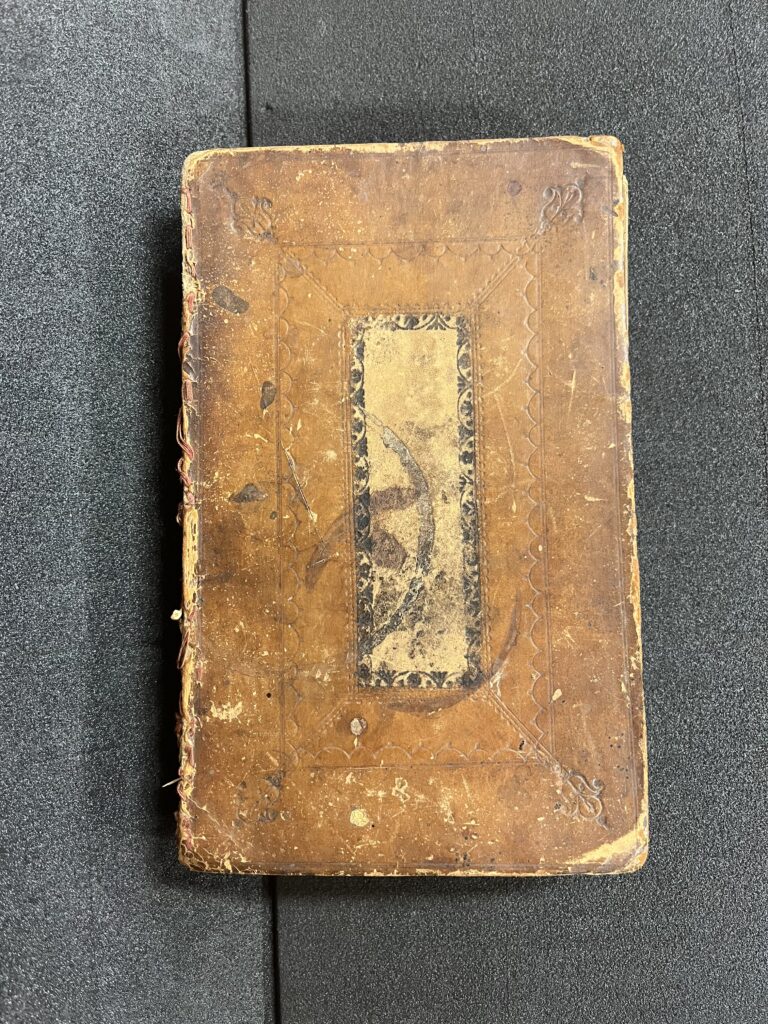
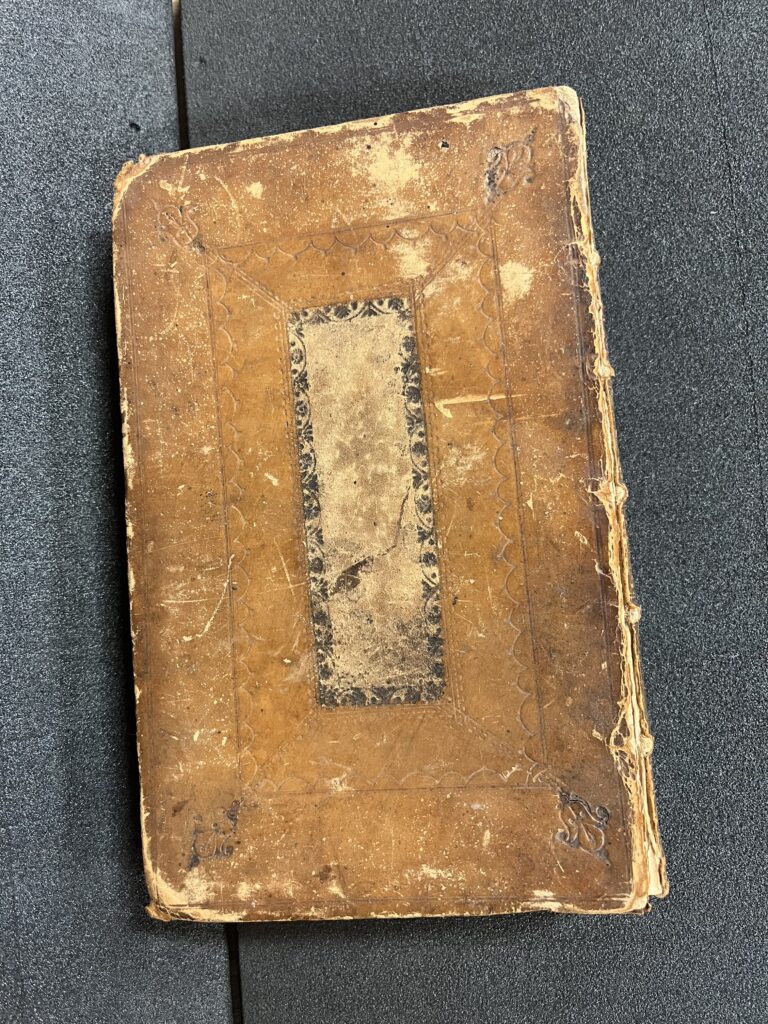
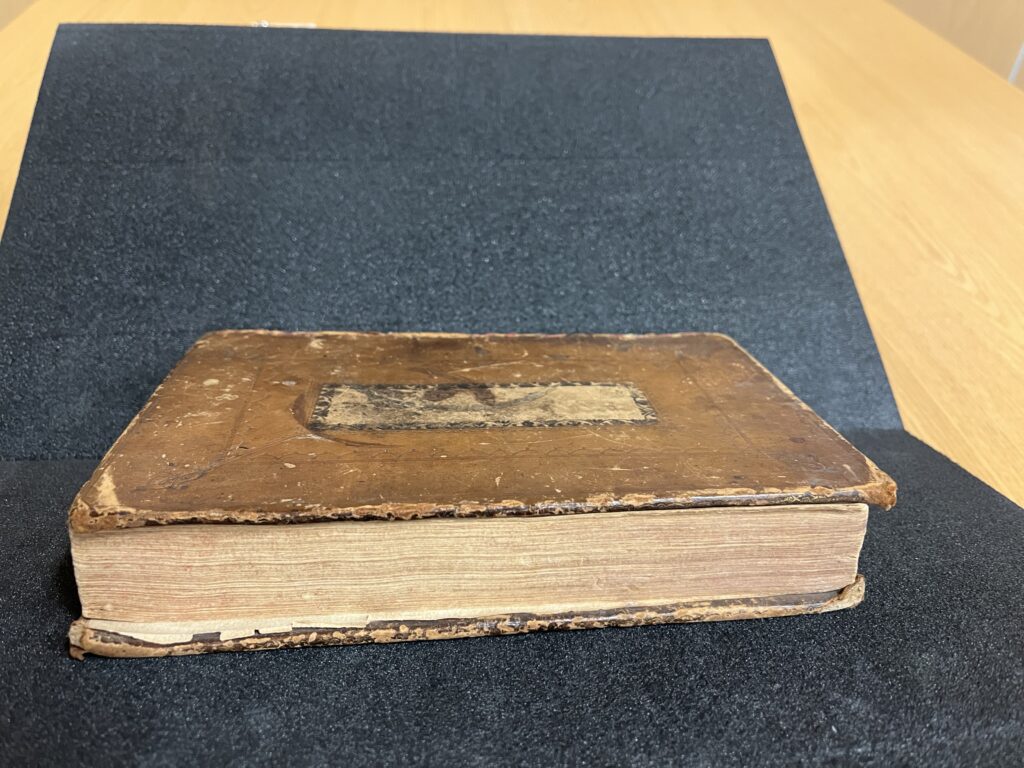
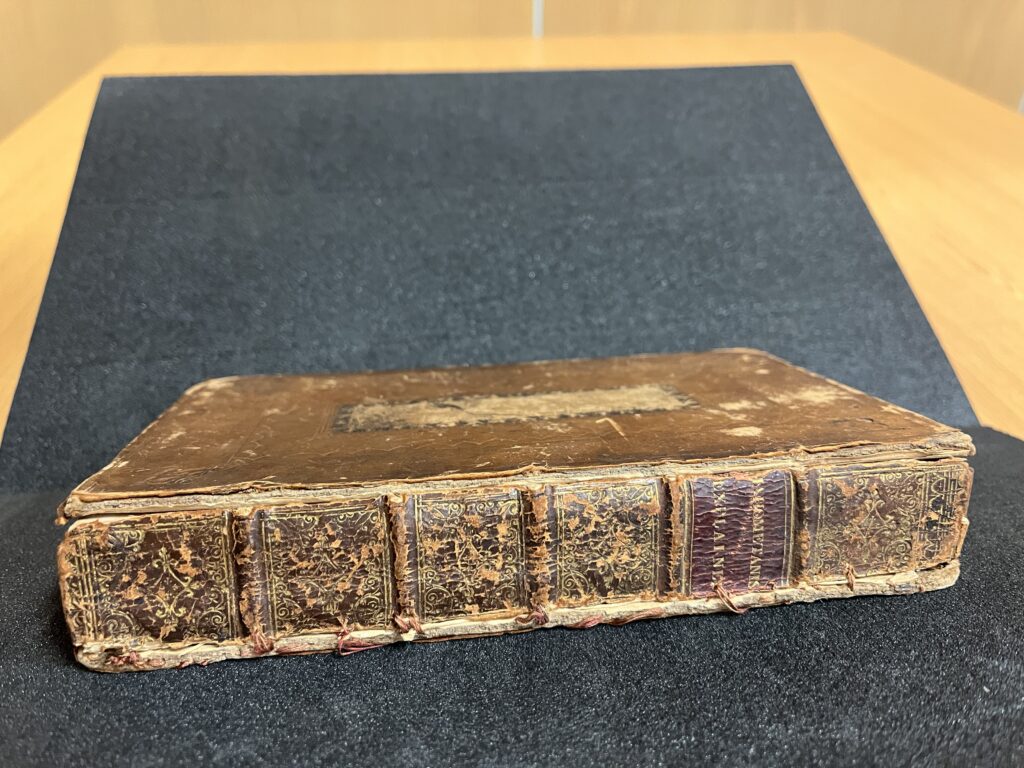
The book is in poor condition. It has managed to remain in its original binding, though. The front and back covers are falling off, some pages throughout the book are falling out, and the binding is loose. The red thread holding the cover together is visible. The pages are heavily foxed and speckled. It is still in its original binding, with tooled brown leather covering it; the spine has gilded lettering, but the accompanying design on it has faded significantly. There are two faint rings on the front cover, as if someone had placed a hot drink on them and the combined heat and pressure left permanent indents.
Provenance
Bookseller
The book was originally printed in 1723 for bookseller William Mears [fl. 1713-1758] and sold from the Lamb Without Temple-Bar shop in London. It was sold for 5s.
Richard Bagshaw
The first owner of this book was most likely Richard Bagshaw, as shown by a bookplate on the front pastedown of the book:
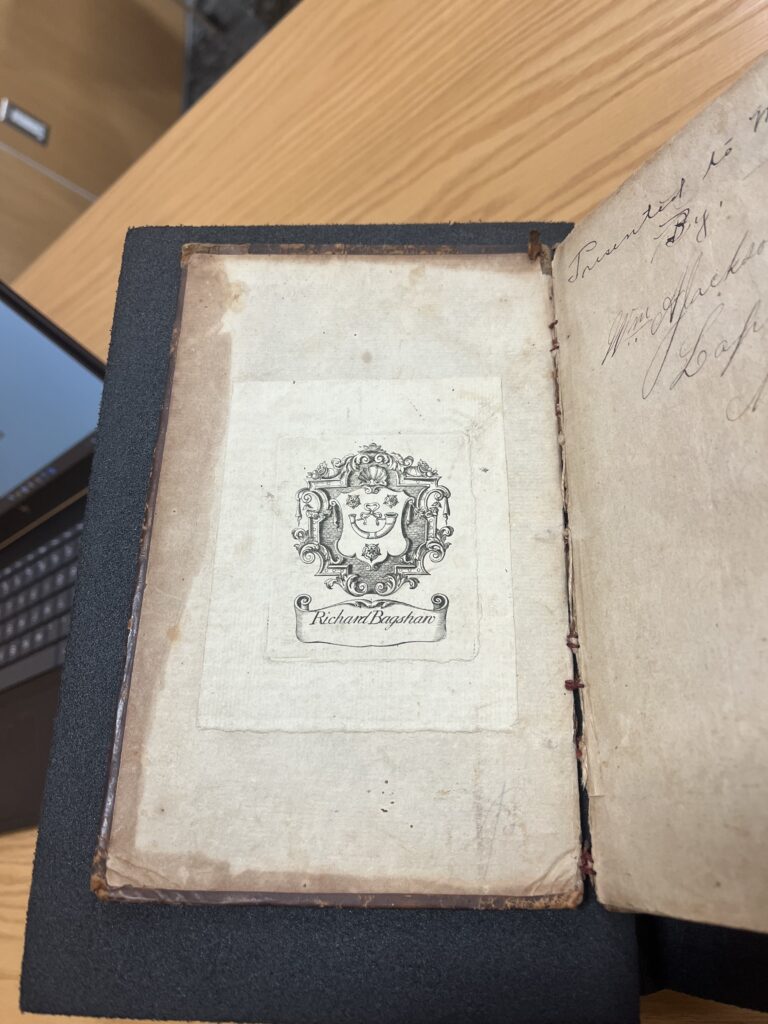
Bagshaw was born February 25, 1675 in Wormhill Hall, Buxton, Derbyshire, England. He had approximately 5 siblings. Bagshaw married Elizabeth Gill on August 31, 1699, and had at least 6 children together. He inherited the Bagshaw Family estates and wealth in 1728, and managed it until his death in 1750. The size of the Bagshaw library is unknown, but it’s likely he acquired the book out of curiosity about Islam. From 1685 – 1750, there was a notable shift in English attitudes surrounding Islam; the religion began to be examined with an open mind rather than aggression by scholars.
William Jackson & M.R. Keiser
On the final endpages of the book, there is a note that reads:
“William Jackson
Went into Staffordshire
September 16 1836”
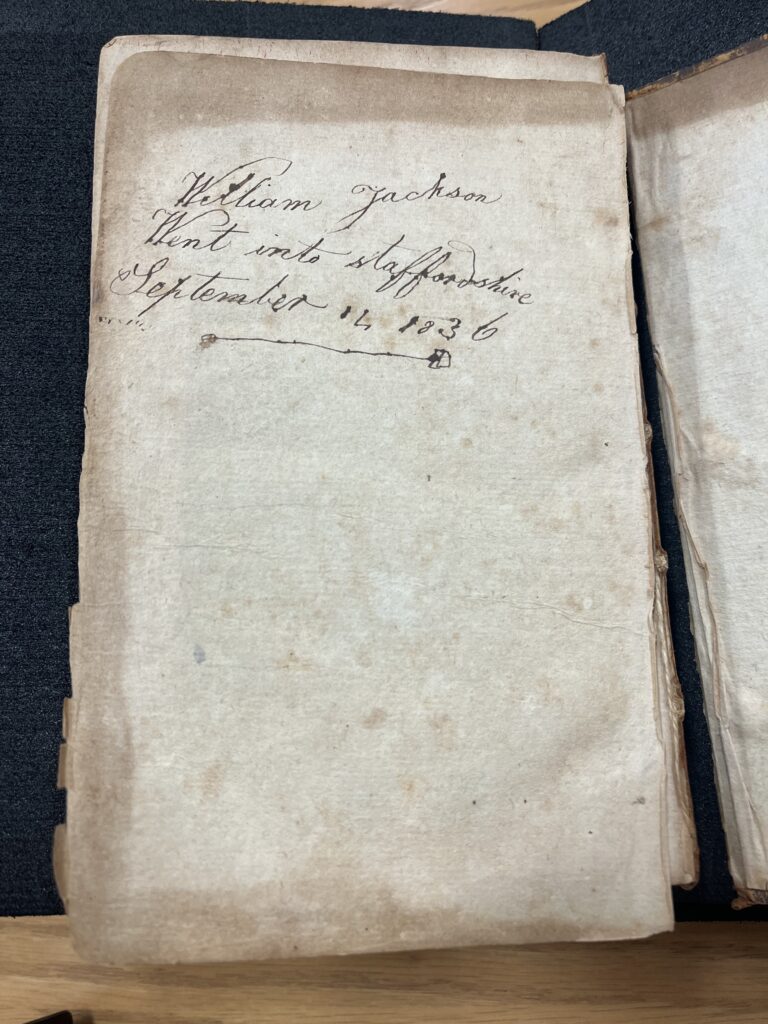
Presumably, the next owner of this book was William A. Jackson. He was born October 21 (of either 1816 or 1817) in Nottinghamshire, England, and worked as a physician for most of his life. Considering Derbyshire, where Bagshaw lived, is the northeast region of Staffordshire, it is very likely that Jackson bought or received this book on a trip deeper into the English Midlands. He was likely documenting the date of when he acquired the book through this note. Jackson came to the United States in either 1837 or 1838 to aid in the Patriot War as a surgeon. He settled in Cicero, Onondaga, New York by 1850, and married his only wife, Amelia Jackson, in 1846. By 1860, Jackson had moved to Lapeer, Michigan, and possibly served as mayor for a few years. Jackson had three sons, though one passed during his lifetime. He passed June 4, 1890 and was buried in Mt. Hope Cemetery in Lapeer, the same year.
On the front endpages of the book, there is a note that states:
“Presented to M.R. Keiser
By
Will A. Jackson.
Lapeer,
Mich.”
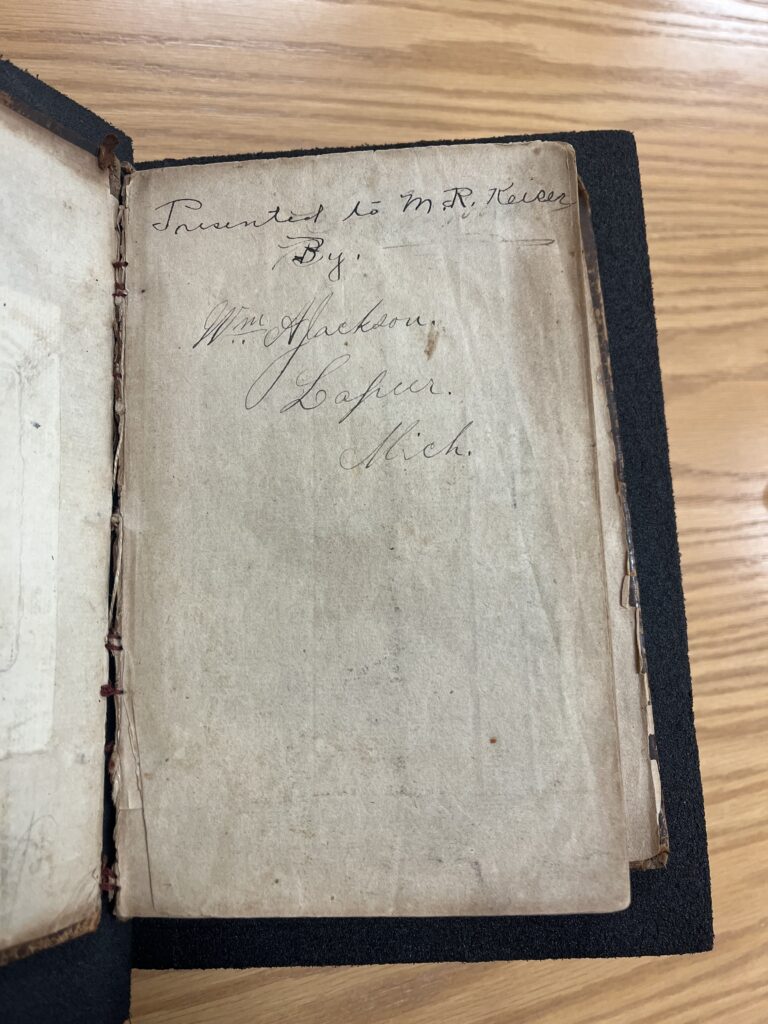
My best estimate is that the initials stand for “Mary Rose”, as a Mary Rose Keiser is recorded as living in Lapeer from 1870-1947. Considering she and Jackson lived in the same community for large parts of their lives, it’s entirely possible their families interacted; she would have been around the same age as his children. She was born in New York to Swiss immigrant parents in approximately 1859 (sources vary). By 1870, the Keiser family had moved to Lapeer, Michigan. Mary and at least her 2 of her 6 siblings remained there for the rest of their lives. Mary worked as a dressmaker and never married; her brother Joseph, a furniture salesman, and her sister Minnie lived in one house together. Mary passed and was buried at Mt. Hope Cemetery in Lapeer in 1947.
Leaves of Grass
The last known owner of this book is Leaves of Grass Bookshop in Ann Arbor, whom Michigan State University bought it from in 2018. It appears to still be open today, though there is not much online activity from the store.
Michigan State University
Both volumes of Mahometism Fully Explained are currently in the MSU Special Collections catalog under the call number: XX BP160 .R313 1723; this project only covers the first volume.
Thanks
Thanks to Tad Boehmer and all others who contributed to the research on Mahometism Fully Explained !
Created by Abigail Brooks for HST 475 SS26, taught by Dr. Liam Brockey.
Citations
“Books Printed for, and Sold by William Mears at the Lamb without Temple-Bar .” Vanderbilt University Jean and Alexander Heard Libraries. Accessed March 26, 2026. https://catalog.library.vanderbilt.edu/discovery/fulldisplay/alma991029778979703276/01VAN_INST:vanui.
Britannica Editors. “Morisco.” Encyclopedia Britannica, November 1, 2013. https://www.britannica.com/topic/Morisco.
Britannica Editors. “Great Mosque of Mecca.” Encyclopedia Britannica, October 13, 2025. https://www.britannica.com/topic/Great-Mosque-of-Mecca.
Contributors to Wikimedia projects. “Dictionary of National Biography, 1885-1900/Morgan, J.” Wikisource, the free online library, December 28, 2020. https://en.wikisource.org/wiki/Dictionary_of_National_Biography,_1885-1900/Morgan, J.
David Pearson Book Owners Online, April 30, 2021. https://bookowners.online/Richard_Bagshaw_1675-1750.
Edward Harley, 2nd Earl of Oxford. Accessed March 28, 2026. https://www.westminster-abbey.org/abbey-commemorations/commemorations/edward-harley-2nd-earl-of-oxford.
“Edward Harley, 2nd Earl of Oxford and Earl of Mortimer – YCBA Collections Search.” Yale Center For British Art. Accessed March 27, 2026. https://collections.britishart.yale.edu/catalog/tms:26172.
FamilySearch Family Tree – Mary R Keiser, n.d. https://records.myheritagelibraryedition.com/research/record-40001-1194661734/mary-r-keiser-in-familysearch-family-tree.
FamilySearch.org. Accessed March 26, 2026. https://ancestors.familysearch.org/en/KCPY-GVM/richard-bagshaw-1675-1750.
“Harleian Library.” Wikipedia, October 12, 2025. https://en.wikipedia.org/wiki/Harleian_Library.
“Harley Manuscripts.” Wayback Machine, December 5, 2014. https://web.archive.org/web/20180830005052/http://www.bl.uk/reshelp/findhelprestype/manuscripts/harleymss/harleymss.html.
“Humphrey Prideaux.” Author info: Humphrey Prideaux – Christian Classics Ethereal Library. Accessed March 26, 2026. https://www.ccel.org/ccel/prideaux.
JONES, CLYVE. “THE HARLEY FAMILY AND THE HARLEY PAPERS.” The British Library Journal 15, no. 2 (1989): 123–33. http://www.jstor.org/stable/42554279.
Laramore, Trenton. “The Battle of Windsor.” Military History of the Upper Great Lakes, October 27, 2019. https://ss.sites.mtu.edu/mhugl/2019/10/27/the-battle-of-windsor/.
“Leaves of Grass Rare Books – Ann Arbor, MI.” Yelp. Accessed March 26, 2026. https://www.yelp.com/biz/leaves-of-grass-rare-books-ann-arbor.
Mary R Keiser in the 1930 United States Federal Census, n.d. https://www.ancestrylibrary.com/search/collections/6224/records/10519706?tid=&pid=&queryId=dae5e391-3d0f-4420-9fd1-835f31badb27&usePUBJs=true&_gl=1*vkcrka*_up*MQ..*_ga*OTA3MDY4OTg0LjE3NzQ1MjgzOTQ.*_ga_4QT8FMEX30*c2VkOTQ5ZDk1LWMxYTAtNDc5Ni04ZDU4LWM3YjVlNmE0MjAyZSRvMSRnMSR0MTc3NDUyODY1NCRqNjAkbDAkaDA.*_ga_LMK6K2LSJH*c2VkOTQ5ZDk1LWMxYTAtNDc5Ni04ZDU4LWM3YjVlNmE0MjAyZSRvMSRnMCR0MTc3NDUyODM5NCRqNjAkbDAkaDA.
Matar, Nabil. “Islam in Britain, 1689–1750: Journal of British Studies.” Cambridge Core, December 21, 2012. https://www.cambridge.org/core/journals/journal-of-british-studies/article/islam-in-britain-16891750/D9B26AB867EA54C2898569ACD36AFDC3.
MATAR, NABIL. “JOS.[EPH] MORGAN AND MOHAMED RABADAN: THE FIRST MUSLIM BIOGRAPHY OF THE PROPHET MUHAMMAD IN ENGLISH.” Journal of Islamic Studies 30, no. 2 (2019): 151–75. https://www.jstor.org/stable/26994778.
“Muhammad Rabadán.” Wikipedia, February 25, 2026. https://en.wikipedia.org/wiki/Muhammad_Rabad%C3%A1n.
“Prideaux, Humphrey, Dd.” McClintock and Strong Biblical Cyclopedia Online. Accessed April 8, 2026. https://www.biblicalcyclopedia.com/P/prideaux-humphrey-dd.html.
Prideaux, Humphrey. “The True Nature of Imposture Fully Display’d in the Life of Mahomet : With A Discourse Annex’d for the Vindication of Christianity from This Charge : Offered to the Consideration of the Deists of the Present Age : Prideaux, Humphrey, 1648-1724 : Free Download, Borrow, and Streaming.” Internet Archive. Accessed April 9, 2026. https://archive.org/details/39020024846894-thetruenatureof/page/n13/mode/2up.
The National Archives, n.d. https://discovery.nationalarchives.gov.uk/details/r/D3373447.
“The Patriot War.” SOM – State of Michigan. Accessed April 9, 2026. https://www.michigan.gov/dmva/about/history/military-events/highlights/the-patriot-war.
Rabadan, Mohamet. “‘Discurso de La Luz y Desçendençia y Linage Claro de Nuestro Caudillo y Bien Aventurado Anabi Mohamad.’” Gallica. Accessed April 8, 2026. https://gallica.bnf.fr/ark:/12148/btv1b100366680.
SemiColonWeb. “Joseph Morgan.” 18th Century Translators Dictionary. Accessed March 26, 2026. https://www.eutec-project.it/translators/en-joseph-morgan.
“Sira.” The Institute of Ismaili Studies. Accessed April 8, 2026. https://www.iis.ac.uk/glossary/sira/.
Spaulding, Sharon. “Mt. Hope Cemetery Page.” My Tombstone Transcription Projects, 2004. http://freepages.rootsweb.com/~crossloch/genealogy/Mt__Hope_Cemetery_page.html.
Staffordshire | England, history, geography, map, & facts | britannica. Accessed March 27, 2026. https://www.britannica.com/place/Staffordshire.
Stanley, H. E. J. “The Poetry of Mohamed Rabadan, Arragonese.” The Journal of the Royal Asiatic Society of Great Britain and Ireland 3, no. 1 (1867): 81–104. http://www.jstor.org/stable/44012762.
Thomson, Ann. Chapter 4 Joseph Morgan between England and Algiers. Accessed March 27, 2026. https://brill.com/edcollchap/book/9789004726864/BP000005.xml.
“William A Jackson.” FamilySearch.org. Accessed April 9, 2026. https://www.familysearch.org/en/tree/person/details/LVLW-5TN.
“William A Jackson.” FamilySearch.org. Accessed April 9, 2026. https://www.familysearch.org/ark:/61903/3:1:3QS7-99JK-NSK2?view=index&cc=2215693&lang=en&groupId=.
“William A. Jackson in the 1880 United States Federal Census.” ancestrylibrary. Accessed April 9, 2026. https://www.ancestrylibrary.com/search/collections/6742/records/31751093?_gl=1*1b5h5gf*_up*MQ..*_ga*MTY5Nzg5OTIxMS4xNzc1Nzk2OTMz*_ga_4QT8FMEX30*czUyMDRjYjBlLTFhMTEtNGYyZC05YWJhLTU0OWU0Zjk5Y2ZmNyRvMSRnMCR0MTc3NTc5NjkzMyRqNjAkbDAkaDA.*_ga_LMK6K2LSJH*czUyMDRjYjBlLTFhMTEtNGYyZC05YWJhLTU0OWU0Zjk5Y2ZmNyRvMSRnMCR0MTc3NTc5NjkzMyRqNjAkbDAkaDA.
