
A Story of Piracy and Cookery
Introduction
Piracy has long been a tool associated with shady, back-door booksellers and unreputable sellers. However, early in the days of American publishing, pirated texts (especially of texts from foreign authors) were widespread across the country (Balázs 2011). So widespread, in fact, that even reputable dealers were known to engage in copyright infringement, as indicated by the existence of my book. While basic copyright law was introduced to the country in 1790, its protections were limited to American authors for a period of only 14 years.
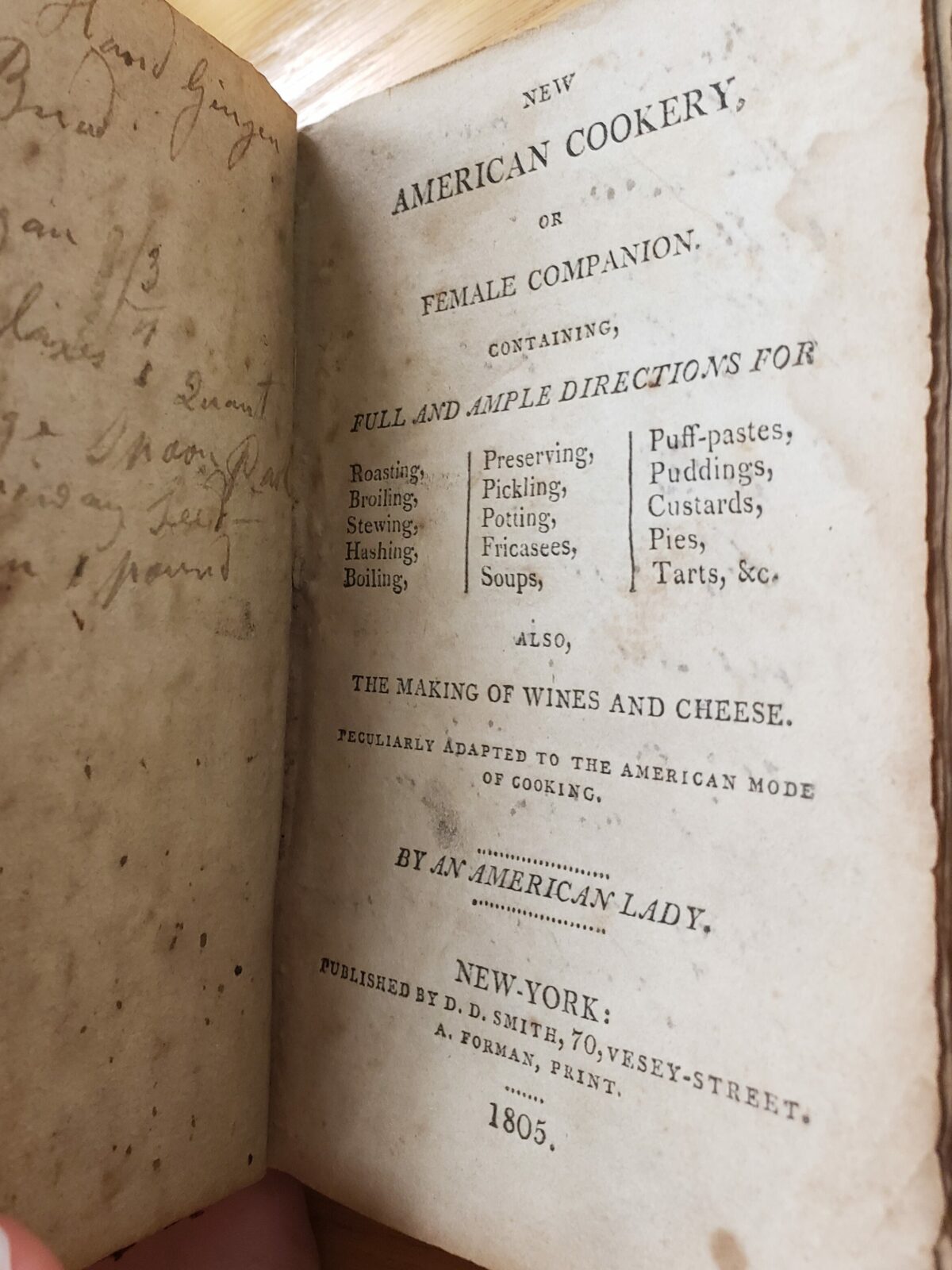
The book American Cookery, or, Female Companion (published 1805 by an unknown author) is one such example of pirated text. It is, however, especially unique in that it pirates from at least three other author’s works. As researched by the SWANN auction galleries in 2018, American Cookery contains ripped texts from the following works:
- Amelia Simmon’s American Cookery (1796), the first ever American cookbook
- Susannah Carter’s Frugal Housewife (1765), an English cookbook reprinted in America in 1772
- Unknown author, The Farmer’s Wife (1780), another English cookbook
Despite the book’s dubious beginnings (at least, in the eyes of the modern onlooker), it is clear the book itself was well-used, as indicated by the number of hand-written notes and potential cooking stains. While information on the prior owners of this book is scarce online, here I will be arguing that my copy of American Cookery was the personal book of a singular lady, Mary Striker Foster (or possibly, Foster Striker), who carried her book with her through marriage and childbirth.
Identification Information
- Author: Unknown, identified only as “An American Lady”
- Short Title: American Cookery
- Full Title: New American cookery, or, Female companion : containing, full and ample directions for roasting, broiling, stewing, hashing, boiling, preserving, pickling, potting, fricasees, soups, puff-pastes, puddings, custards, pies, tarts, & c : also the making of wines and cheese : peculiarly adapted to the American mode of cooking
- Publisher: Daniel D. Smith
- Date of Publication: 1805
- Location of Publishing: 70 Vesey-Street, Manhattan, New York City, New York
- Printer: Aaron Forman
- MSU Call Number: XX TX715 .N5114 1805
Printing and Publishing
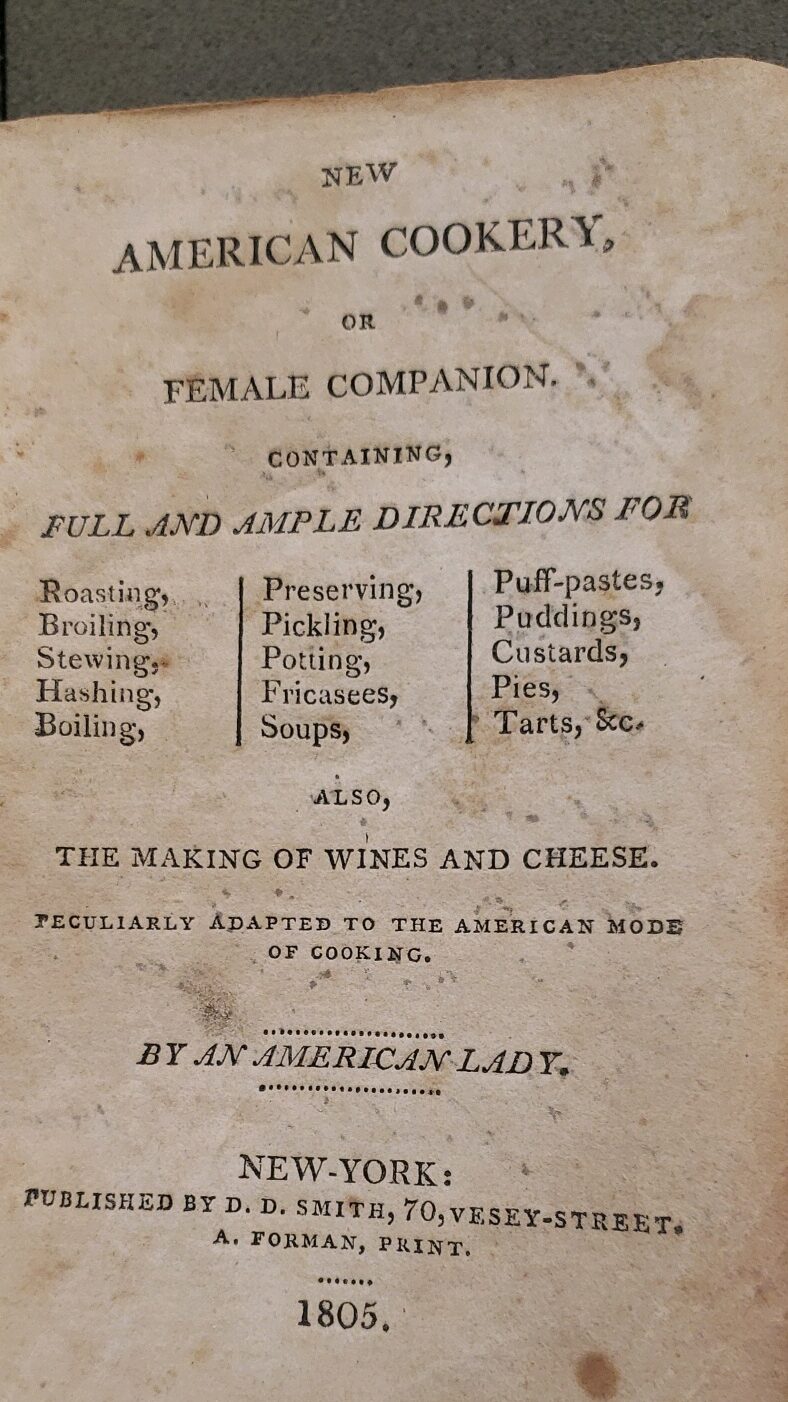
As with any book, the original owner would have been the printer. In my case, the printer-publisher happened to be a relatively short-lived duo, Daniel D. Smith and Aaron Forman (master printer, as indicated by Longworth, 1806). At the time of publishing, they were both stationed at 70 Vessey-Street, Manhattan, New York City, which is today home to a 14-story condo. Although there are multiple sources confirming the existence of the publisher, printer, and their store, little is known about their operation (McKay, 1943; Longworth et al, 1806; Longworth et al, 1816).
Physical Information
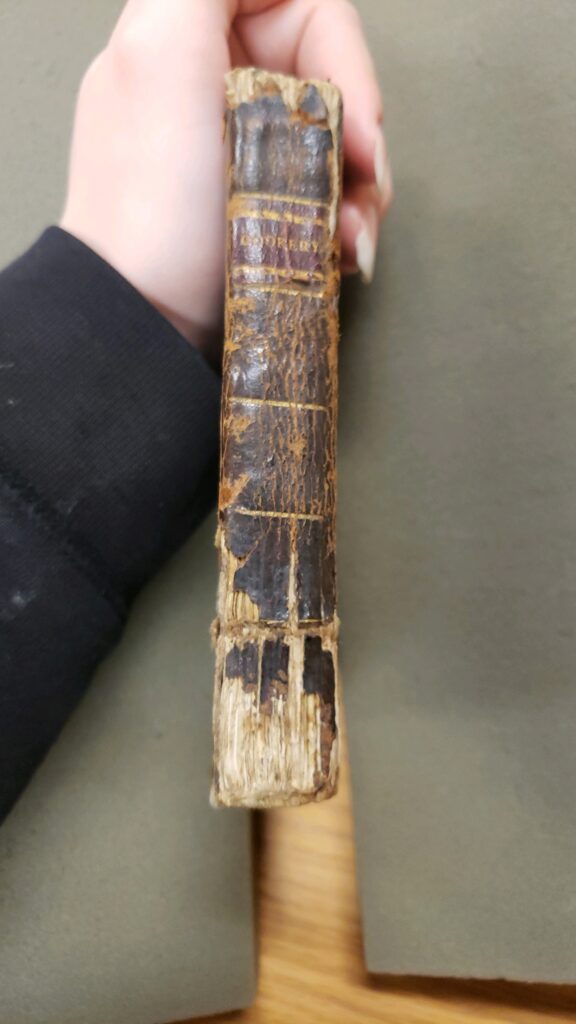
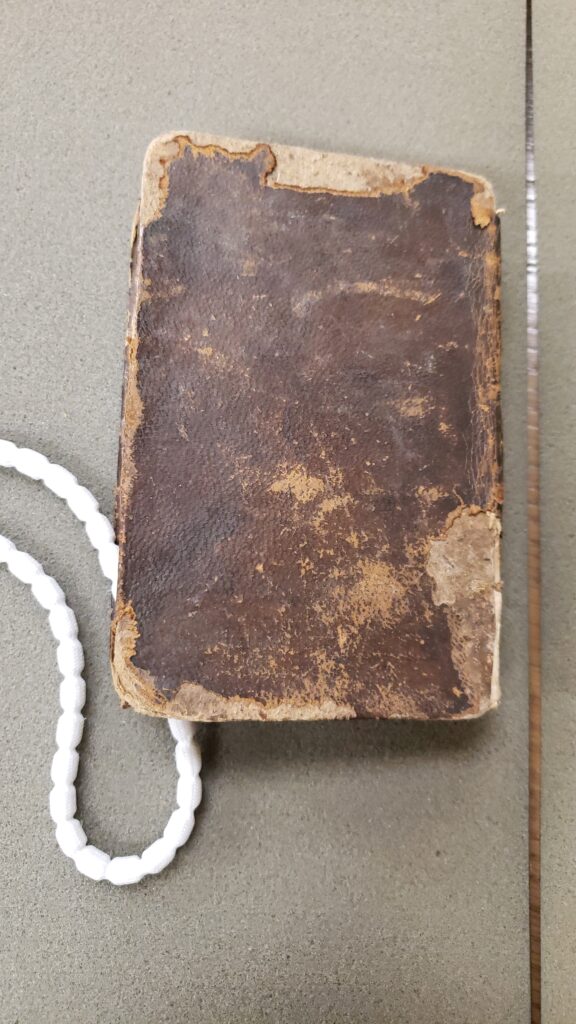
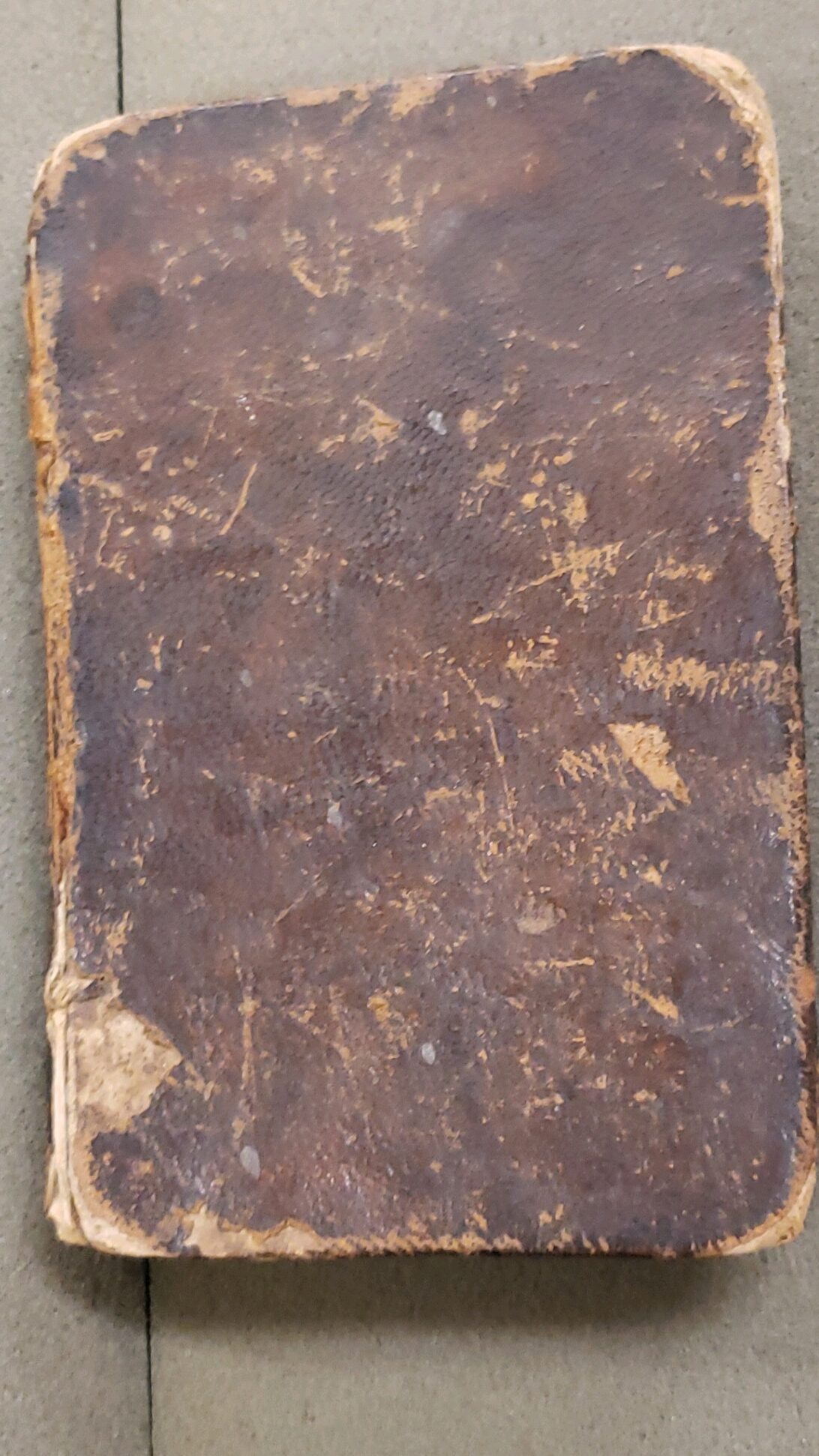
My edition of American Cookery is still bound in its original calfskin, although now in fairly poor condition. The spine includes a red leather label decorated with tooling and lettering in gilt. As mentioned on the MSU cataloguing page, the edges may have once been speckled blue, although the coloring has since faded significantly.
Although relatively plain and unassuming, there are four notable features of my book – the writings scattered without, a small pin tacked to the table of contents, a number of possibly cooking stains, and a small trading card.
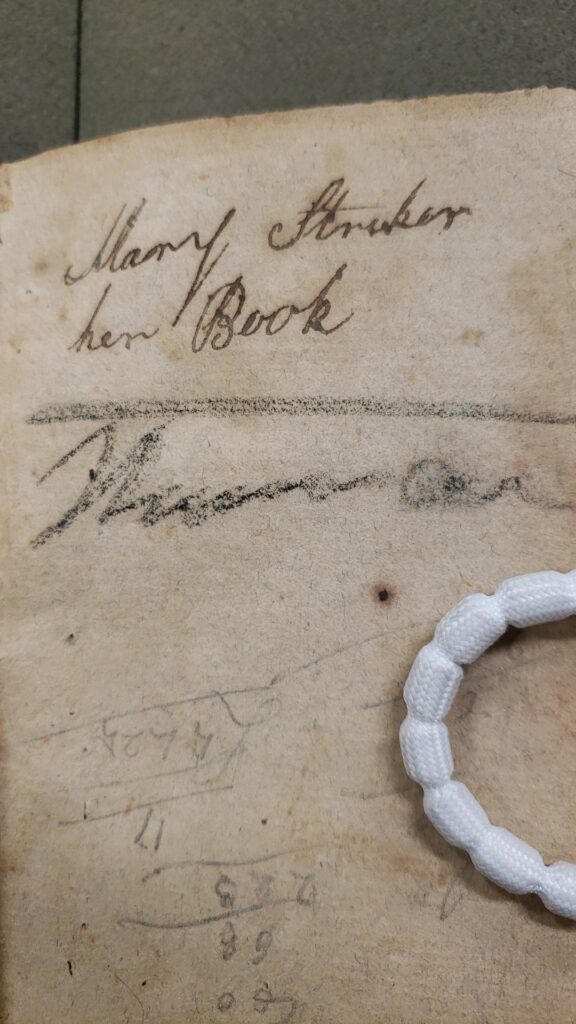
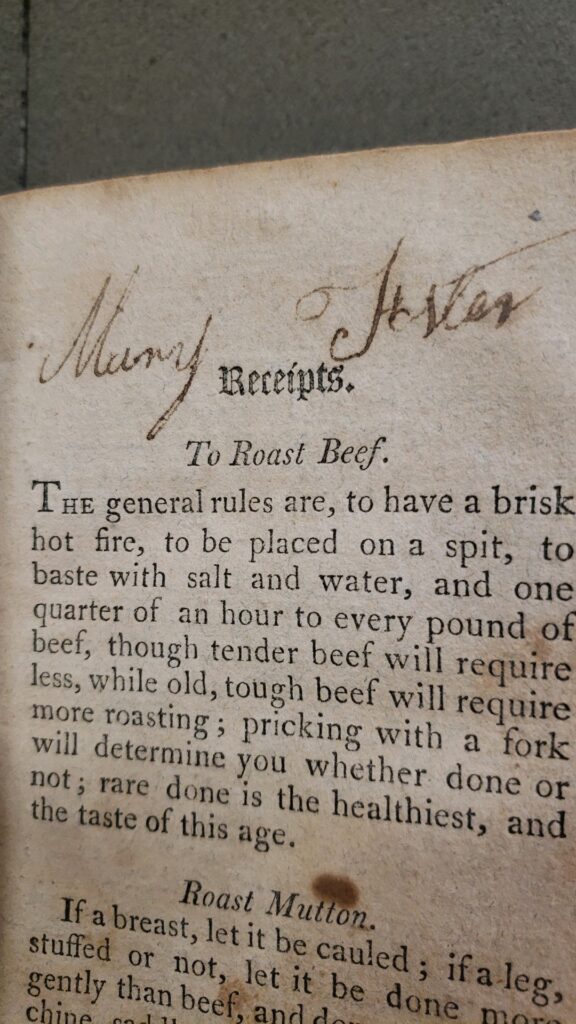
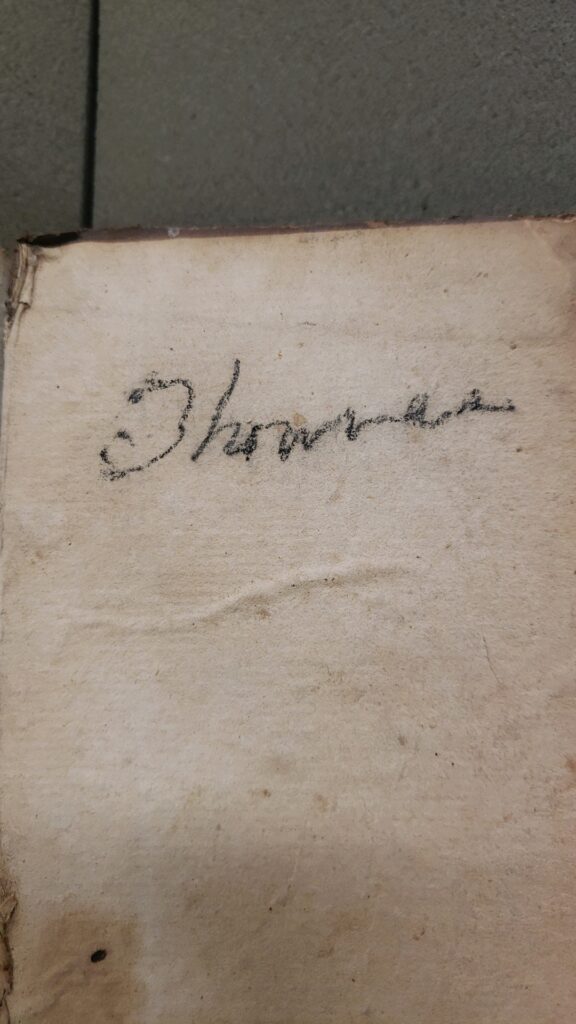
First, and most obviously, is the writing scattered throughout the book. The front free endleaf has written in it two names, Mary Striker and Thomas (possibly written by a child in black crayon). The first page of the introduction has another name, Mary Foster, which I interpret as being the same person as Striker, with one perhaps being a married name. The identical handwriting between the two names helps to support this assumption. The rear paste-down has Thomas written a second time.
There are additionally three recipes, which I have copied below as written.
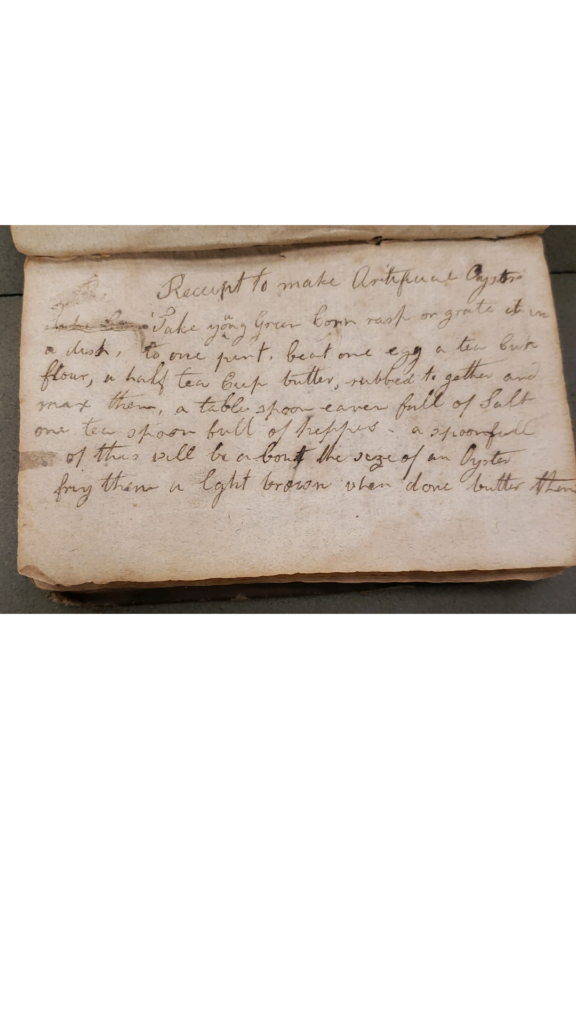
Receipt to make Artifical Oyster
Take young Green corn and grate it in a dish, to one part. Beat one egg, a tea cup flour, a half tea cup butter, rubbed together and mix them, a table spoon even full of salt one tea spoon full of peppers, a spoonfull of the this will be about the size of an Oyster Fry them a light brown when done butter them
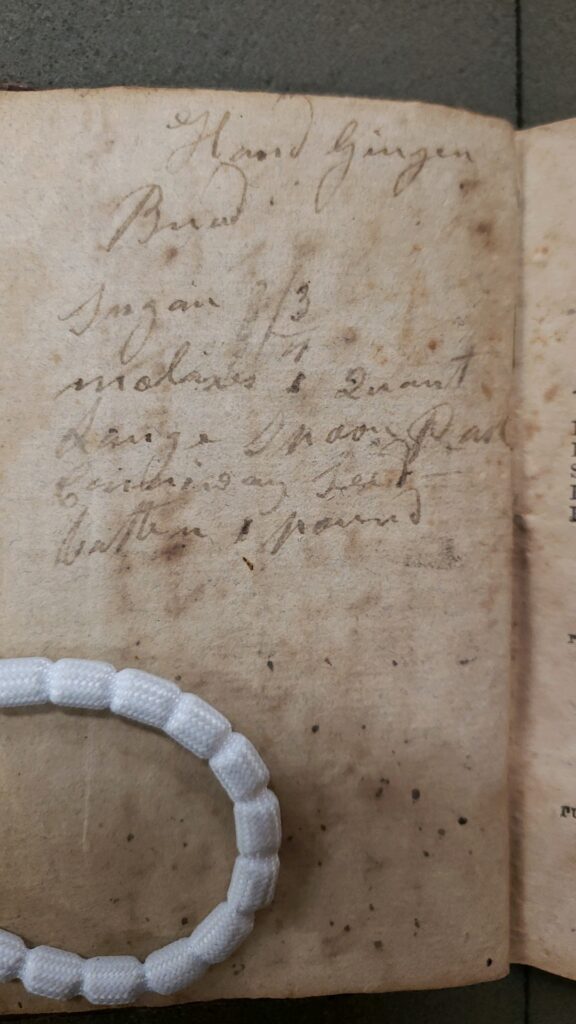
Hard Ginger Bread
Ginger 2/3
Molases quart
Sugar one part
Carraway seed
Butter pound
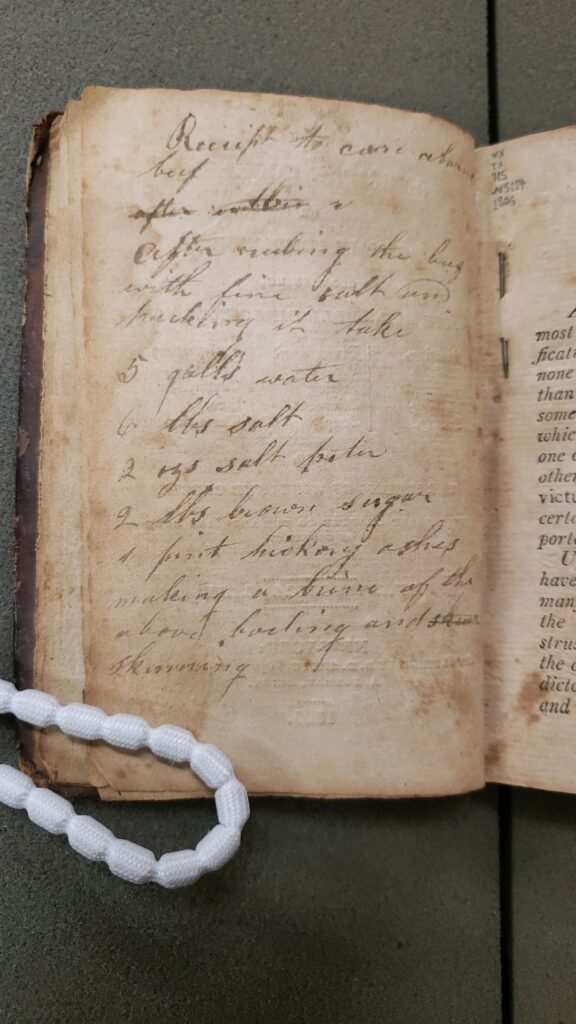
Recipe to cure barrel beef
After rubbing the beef with fine [illegible] and packing it, take
5 quarts water
6 lbs salt
2 ozs salt peter
2 lbs brown sugar
1 pint hickory ashes
Making a brine of the above, boiling and skinning.
The next noteworthy feature of my book is the pin, pushed through the table of contents.
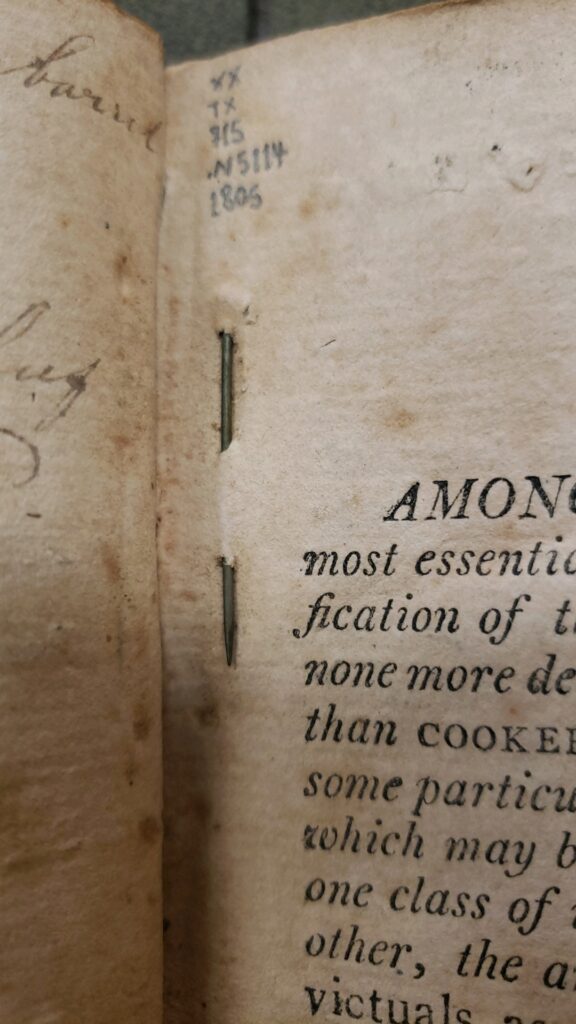
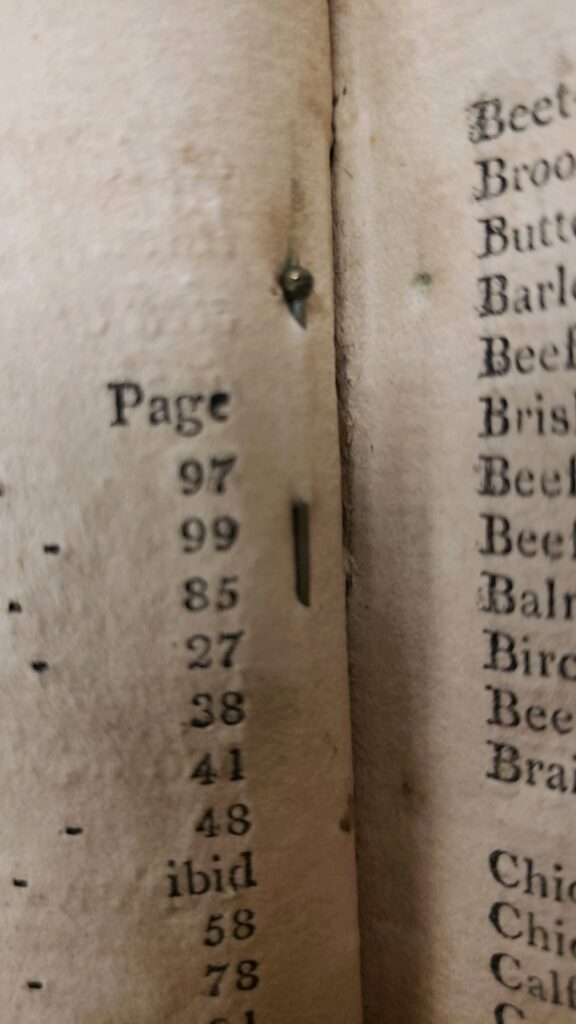
Although often overlooked (possibly due to their mysterious origins) is the history of book stains. While the stains in my book reveal little additional information, they do well to support the extensive use of the book. On select pages, stains and small remnants of potential food are scattered across the pages.
The final noteworthy feature of my book is the clipped chromolithograph depicting a girl watering roses, found inside the rear board. While little is known about this exact printing, it appears to have been a Victorian trading card, small collectables depicting popular garden and household scenes. This copy is of a girl watering roses.
- Original binding, heavily worn
- Light foxing
- Various stains across pages
- Visible binding stitches
- Straight pin through table of contents
- Small tears on pages
- Folding on page 179
The History of the Book
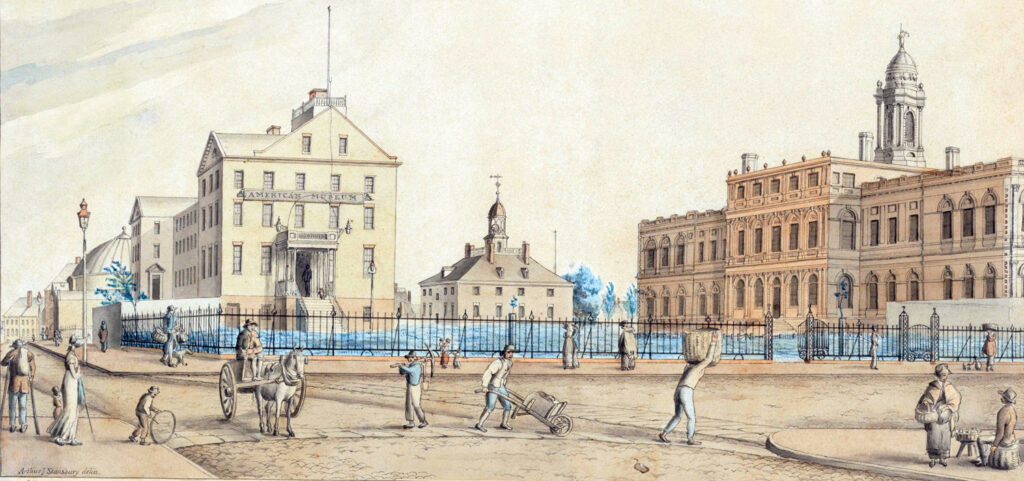
First printed in 1805 Manhattan by the master printer Aaron Forman and the publisher Daniel D. Smith, the book may have spent its early life enjoying the eastern coast of New York. At some point, the book made its way into the hands of a Mary Striker. While little is known about this woman, we can extrapolate a few key details about her life:
- Based on the gender associations of the name Mary, we can assume the owner was a woman. Owning a household cookbook was not unusual for literature women, and it was likely used to aid in cooking.
- She was a literature during a time when many women (and men) were not literate
- She enjoyed imitation oysters, hard ginger bread, and barrel-cured beef, as indicated by her recipe inserts.
- She may have lived in Massachusetts, as indicated by three factors:
- Presence of young corn in one of her recipes (artificial oysters)
- Presence of hickory ashes in another recipe (barrel-cured beef)
- The book showed up in 2021 in a Massachusetts book shop
- She may have married and changed her name
- She may have had a child named Thomas
It is also possible that the second name in the book, Mary Foster, belonged to the same woman. During the 19th century (and up until present day), women traditionally took the last name of their husband after marriage. As such, it was not uncommon for women to have two last names: their maiden name, and their married name.
Another name appears in the book twice – Thomas. Written in black crayon, the name may belong to a child or young relative of Mary.
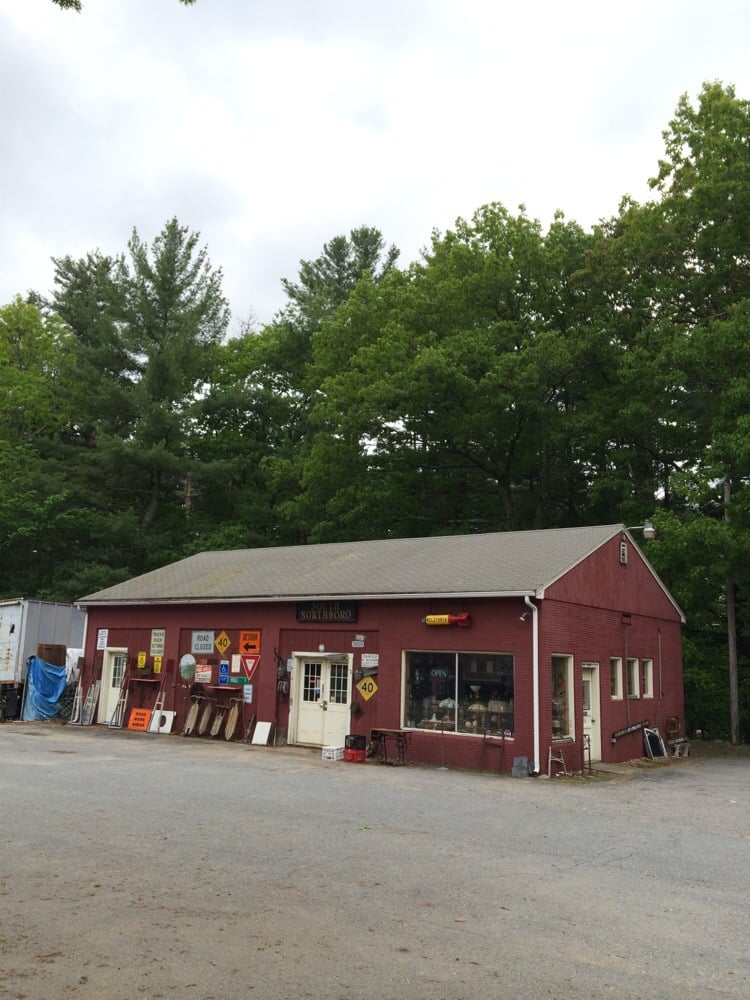
Although the book may have stayed within the family for some time, it eventually would have made its way to Gary’s Antiques and Lamp Restoration, sometime before 2021. On November 19, 2021, the book was sold to Nancy Hallock and/or Keith Arbour for $79 (possibly alongside other books). Almost exactly a year later, on November 14, 2022, the duo donated the book to MSU’s special collection in honor of the 81st birthday of Marilynn Brass.
Bibliography
Book Contents
Lowenstein, E. Bibliography of American cookery books, 1742-1860 (3rd ed.), 36. Link
Lincoln, W. Bibliography of American cookery books, 1742-1860, 36. Link
Catalogue Info
Unknown, [A. Woman]. New American cookery, or Female companion. AAS Catalog Record, ID 474974. link
Unknown, [A. Woman]. New American cookery, or Female companion. Women’s Print History Project, ID 16348. link
April 12, 2018 1:30 PM EDT. (FOOD AND DRINK.) [New American Cookery, or Female Companion . . . by an American Lady.]. SWANN Auction Galleries. New York, NY, US. link
Publishing and Printing
McKay, G. L. (1943). Register of artists, engravers, booksellers, bookbinders, printers & publishers in New York city, 1633-1820. Link
Longworth, T & D., Andrew Beers. (1806). Longworth’s American almanac : New-York register and city directory – 1806. link
Longworth, T. & D., Andrew Beers. (1816). Longworth’s American almanac : New-York register and city directory – 1816 Link
Book Piracy
Balázs, B. (2011). Coda: A Short History of Book Piracy. In J. Karaganis (Ed.) Media Piracy in Emerging Economies (pp. 399 – 413). Social Science Research Council. link
Author: Deanna Peterson
Class: HST 425 – History of the Book
Semester: Spring 2026
Special Thanks:
Liam Brockey, my professor
Tad Bohemer, a library professional
Andrew Lundeen, another library professional
and of course,
Brandon Humburg, my favorite person <3
