
Identification
Author: Alexander Ewing
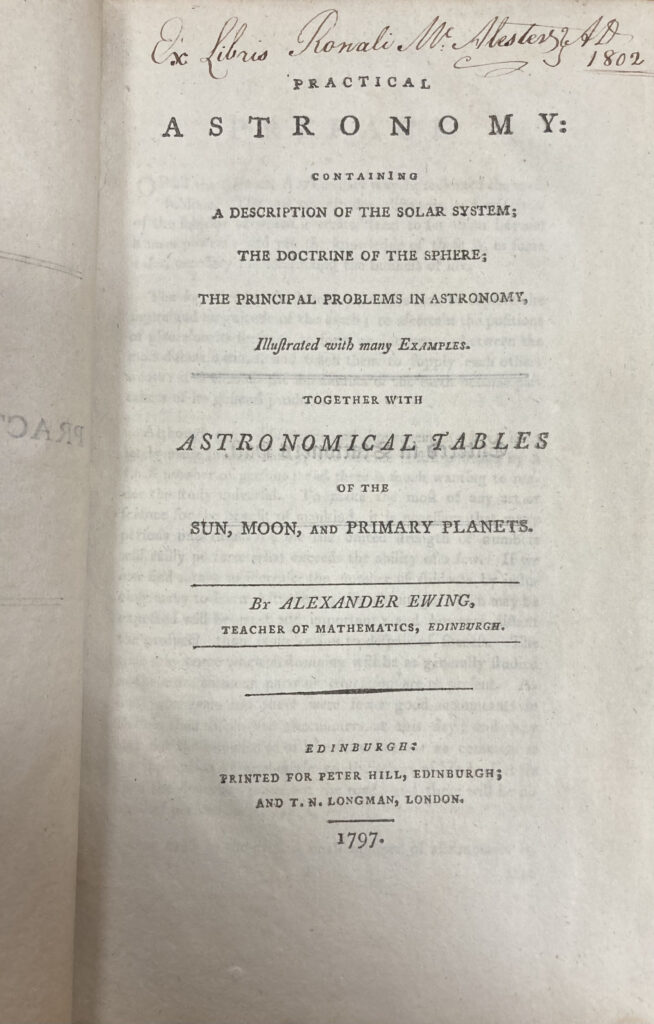
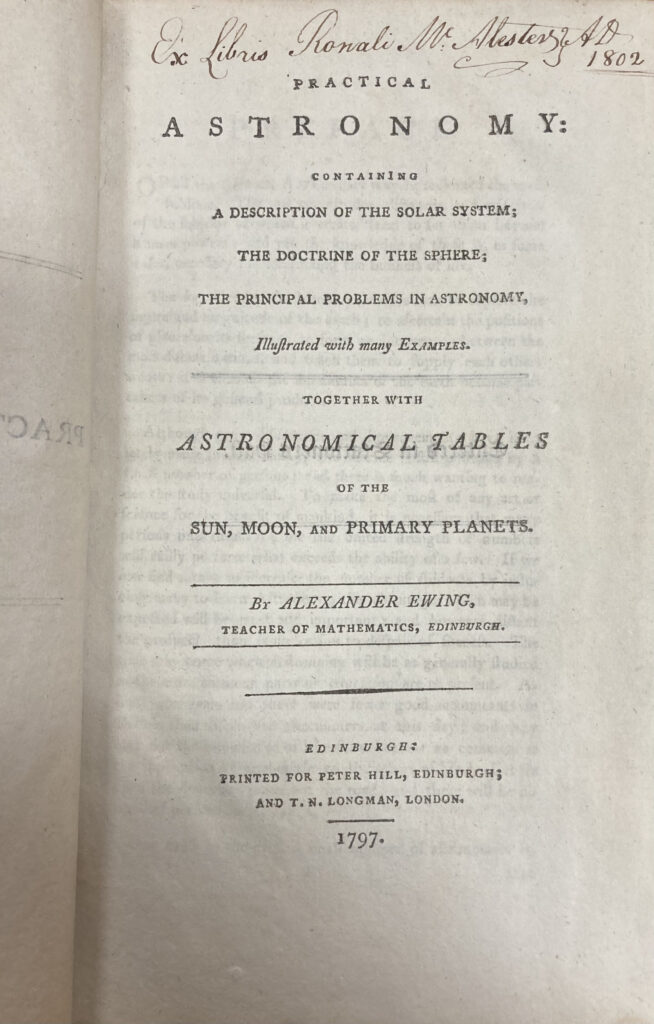
Title: Practical astronomy: containing a description of the solar system, the doctrine of the sphere, the principal problems in astronomy, illustrated with many examples: together with astronomical tables of the sun, moon, and primary planets
Shortened Titles: Practical Astronomy or Ewing’s Astronomy
Publishing Information: Edinburgh: Printed for P. Hill, Edinburgh, and T.N. Longman, London, 1797.
This particular copy was printed by Peter Hill in Edinburgh, Scotland in 1797.
MSU Library Call Number: XX QB145.E9 1797
ESTC Citation Number: T44121
Subject: Spherical astronomy – Early works to 1800.
Alexander Ewing’s Practical Astronomy
Alexander Ewing (unknown birth date – 1804) was a well recognized teacher of writing, mathematics, and book-keeping, especially known for his published math textbooks which covered a range of topics. Aside from his particular interest in math, he focused heavily on the geographical studies of surveying and navigation, in particular the utilization of globes and maps. Primarily known for his teachings, his book Practical Astronomy attempted to combine his studies of math and geography in order to predict astronomical locations of the sun, moon, and planets.
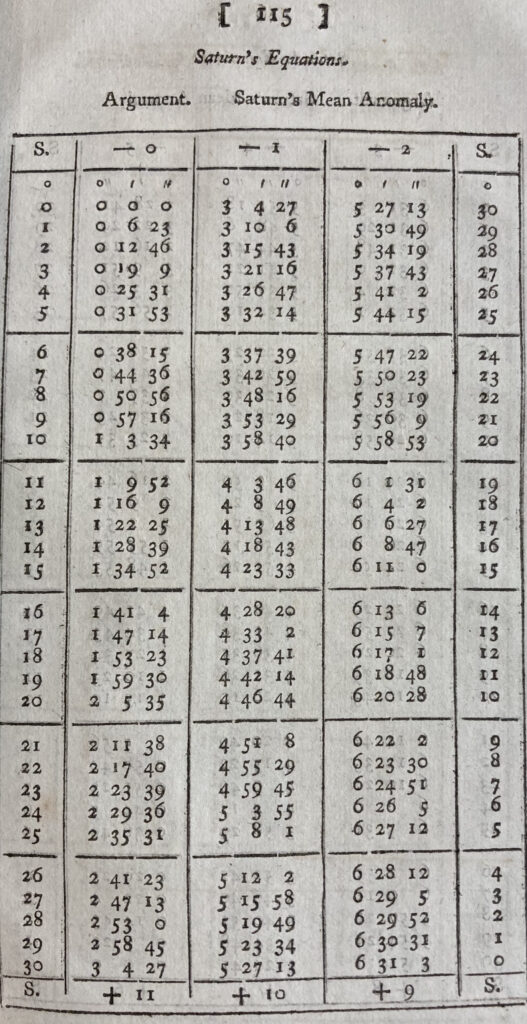
Ewing’s work Practical Astronomy serves as a study of spherical and practical astronomy, further identifying problems related to the theory, and the use of astronomical measuring instruments. Additionally, the book provides a detailed explanation of the laboratory theory that contributes to astronomical spectrographs. Furthermore, Ewing’s work illustrates 18th century understanding of the solar system, as well as measurements regarding the sun, moon, and planets. The book contains chapters detailing “The Doctrine of the Sphere,” “The Division of Time,” and “Practical Astronomy.” The book includes 143 tables throughout its text, as well as a folded leaf diagram which can be found before page 249, all of which illustrate measurements in regards to size and location of the sun, moons, and planets of our solar system.
Alexander Ewing’s Practical Astronomy illustrates 18th century understanding of the intersection of math and geography as it relates to astronomy. Ewing’s analysis of spherical and practical astronomy provides insight into the formation of a new scientific thought, as is depicted through the large number of detailed tables included within this book. Each table provides detailed measurements that enable the reader to predict location and movement in regards to various features of the universe. Ewing’s calculations, which provide a unique perspective into 18th century scientific thought, enable current historians and scientists to identify transitions over time in astronomical, mathematical, and geographical understanding.
The Book’s Physical State
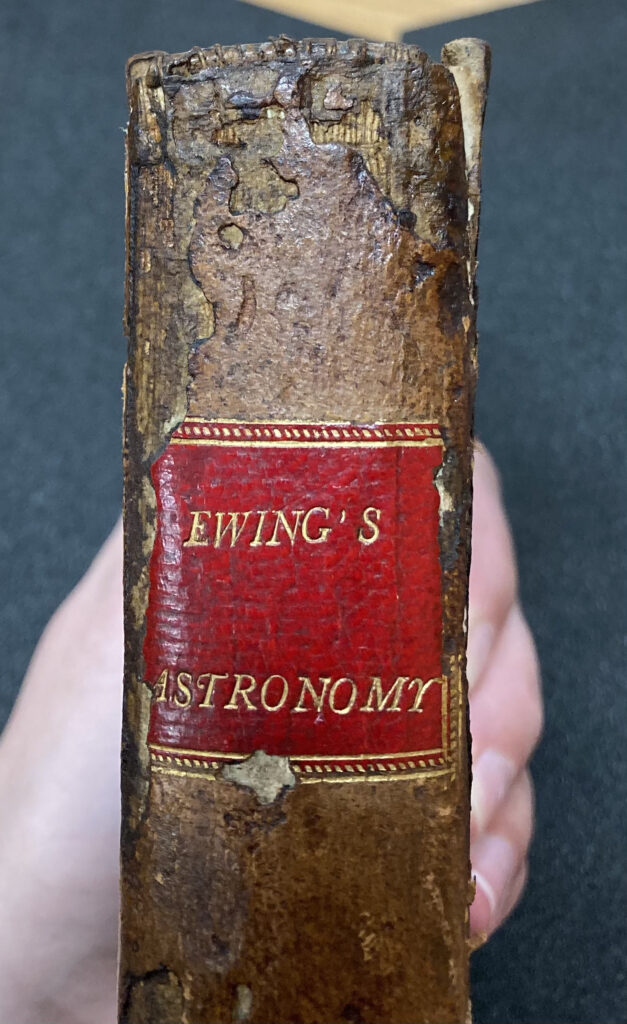
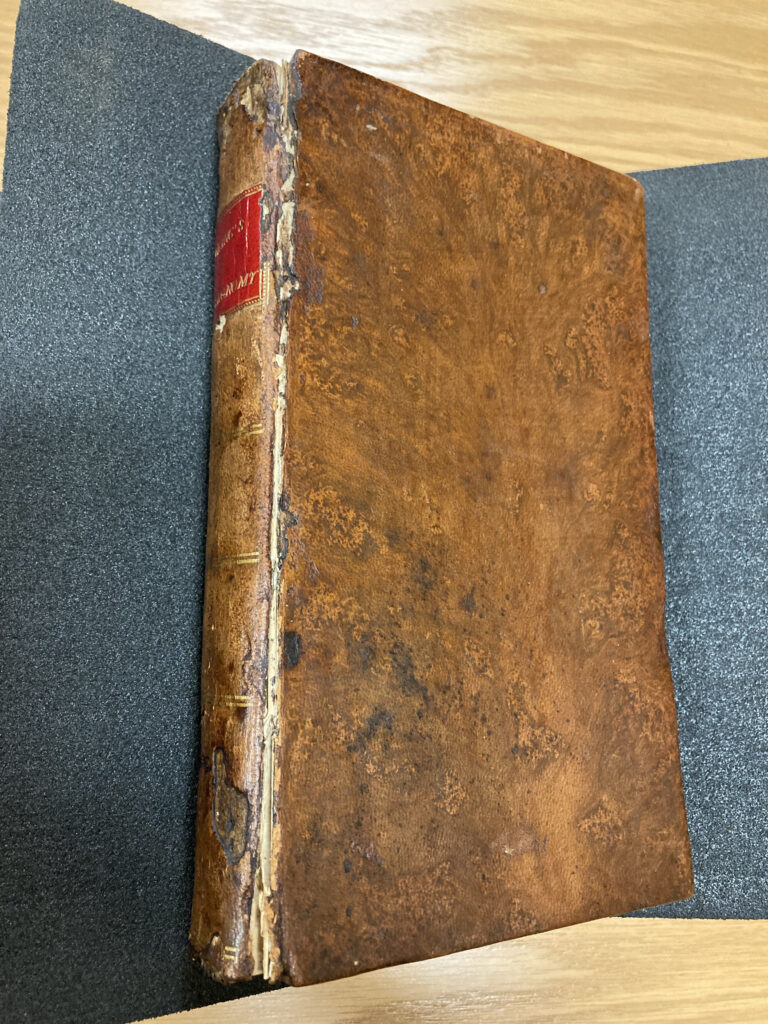
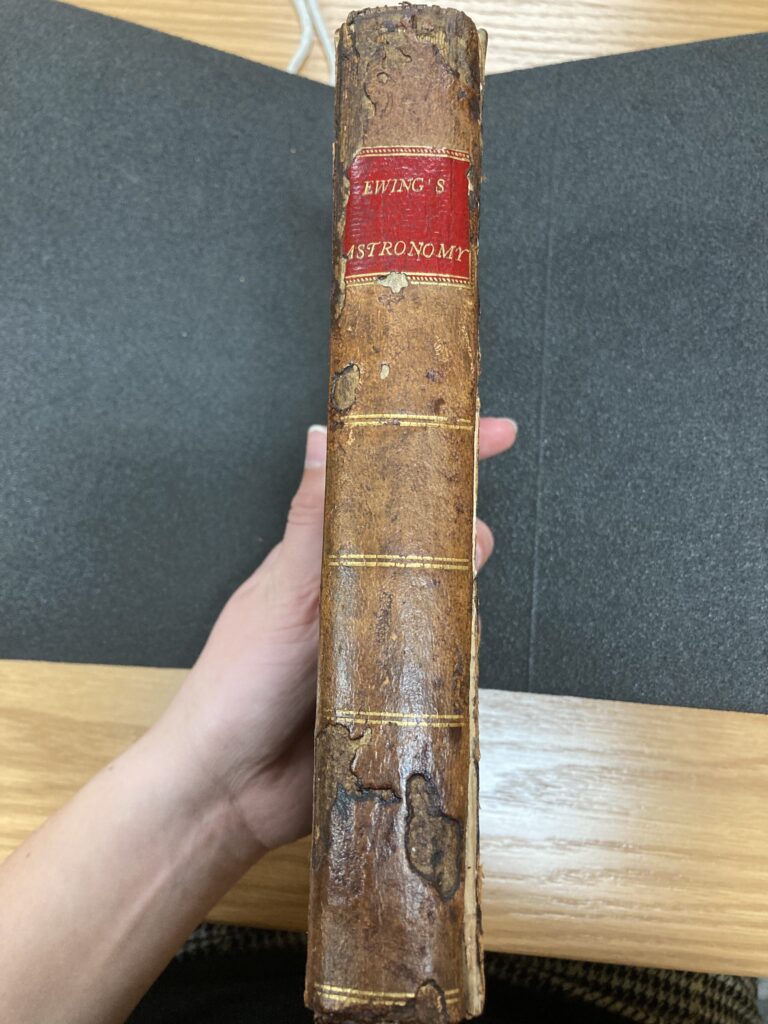
This book is bound with contemporary tree calf, with gilt tooling on the spine and a red leather label with gilt lettering detailing the title Ewing’s Astronomy.
The book still contains its original binding, which has sustained damage along the spine and cover, and is only loosely attached to the book’s leaves.
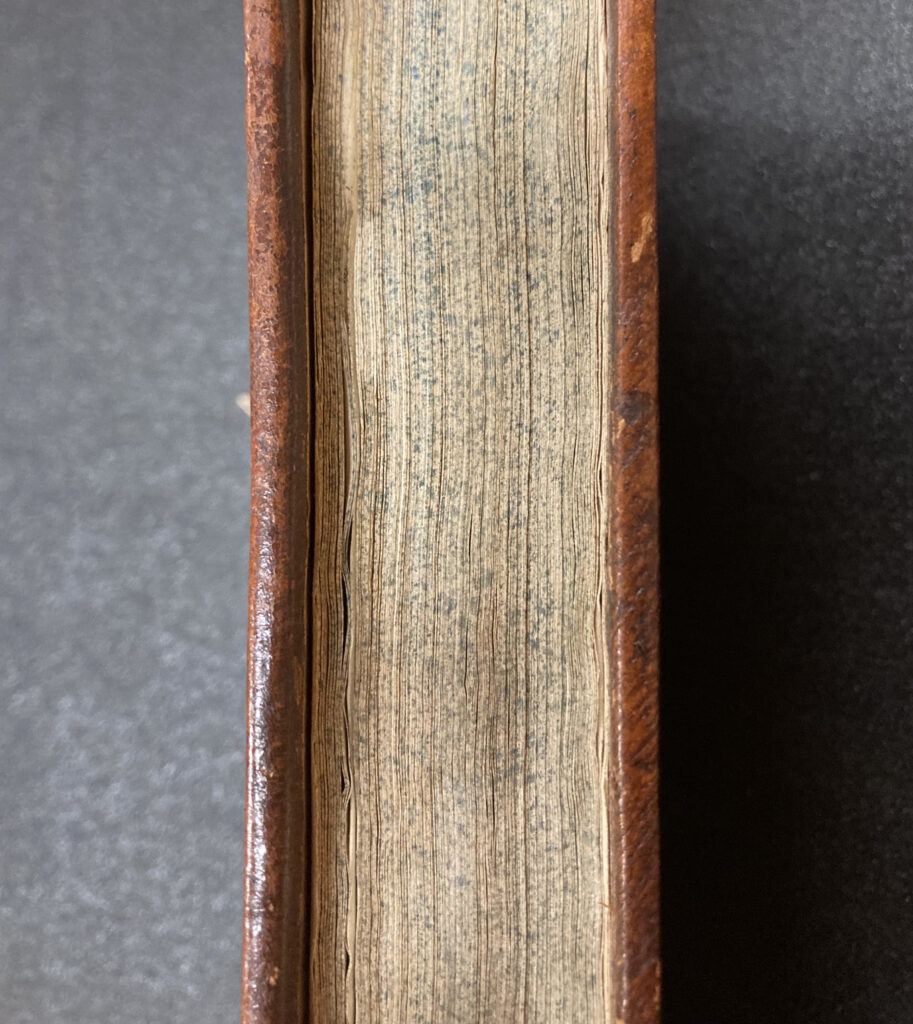
Blue sprinkling can also be found along the leaves’ edges. The pages are printed on wove paper in quarto format, and while most leaves’ edges have been trimmed, some are not.
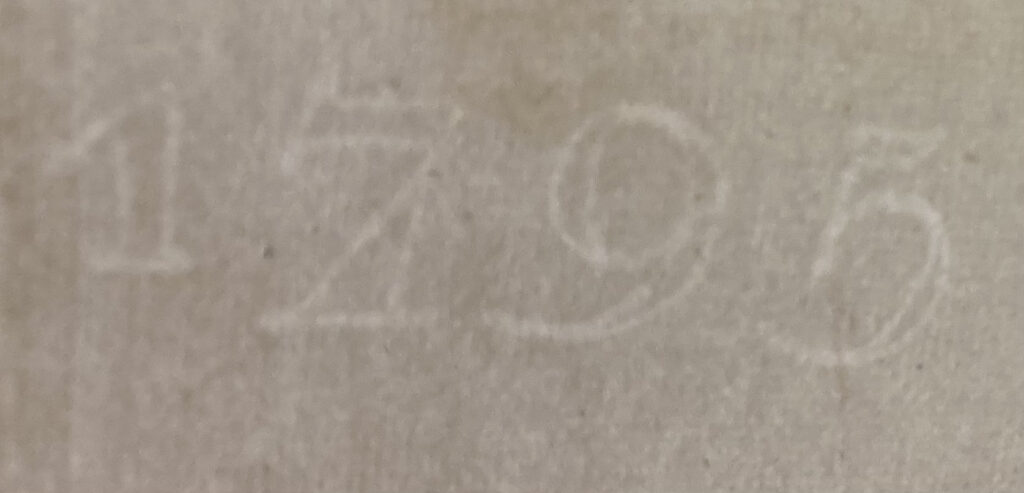
Additionally, a watermark containing the year “1795” can be found on either the bottom left or right corner of most leaves.
While examining this book, it is evident that the first third of the leaves have been heavily handled, while the remaining two thirds have not, thus indicating its use.
Regarding pagination, the book is as follows: 1 unnumbered page, followed by 3 numbered pages, 1 unnumbered, 2 numbered, 1 unnumbered, 247 numbered pages, followed by 1 unnumbered page, and 1 unnumbered folded leaf, 20 numbered pages, and 143 unnumbered pages. Additionally, this book contains a series of tables and one diagram, and has a page height of 20 centimeters.
Provenance Unique to this Copy
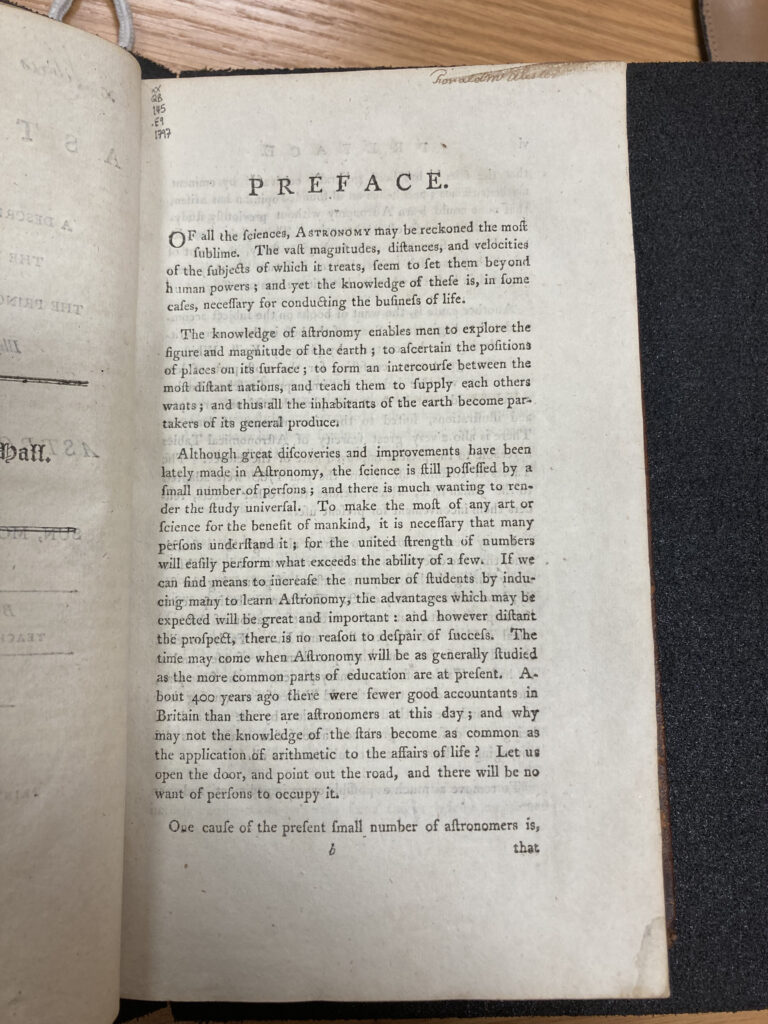
This copy was published in Edinburgh, Scotland by Printer Peter Hill in 1797. The next known location of this book was that it was owned by Ronald McAlester in 1802. No information as to where McAlester lived could be found, however it is assumed that as exemplified by his last name, it most likely remained in Scotland. McAlester writes his ownership mark “Ex Libris Ronald McAlester, AD 1802” meaning “In the Library of Ronald McAlester” on several pages of the book, including the front page, title page, and crossed out on the preface page and back cover of the book.
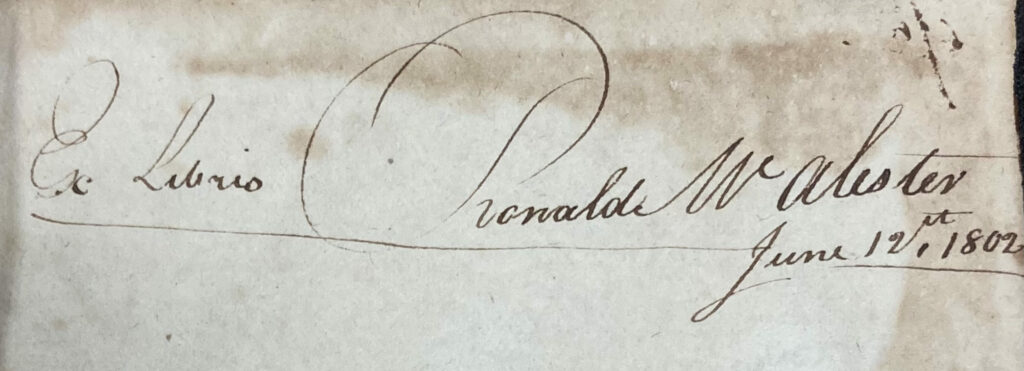
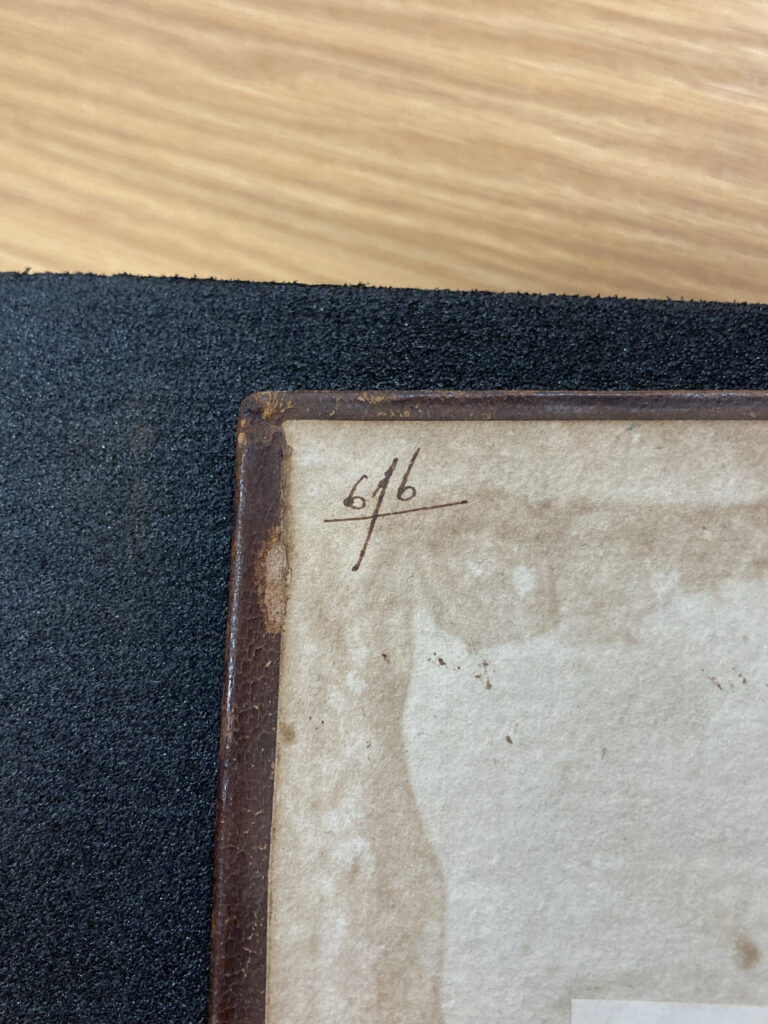
Additionally, on the inside of the front cover a notation indicating a price of six shillings six pence is written in the same hand, indicating McAlester purchased this specific copy in 1802 for six shillings six pence.
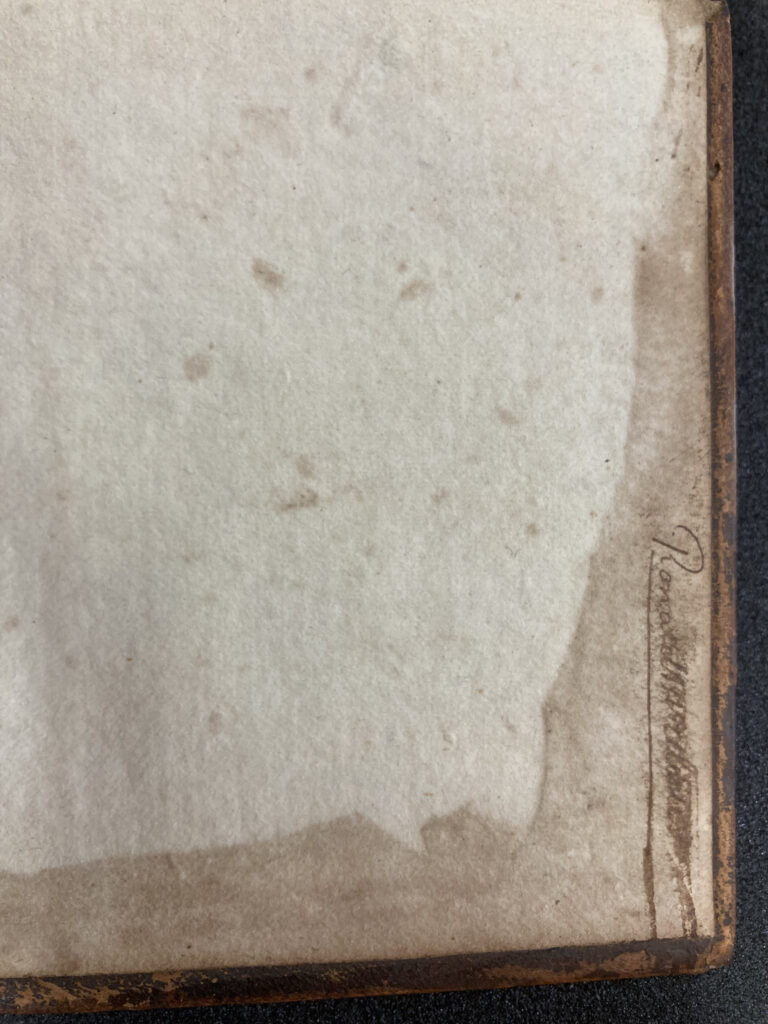
crossed out on inside of the
back cover of the book.
McAlester proceeded to make several annotations throughout the book.
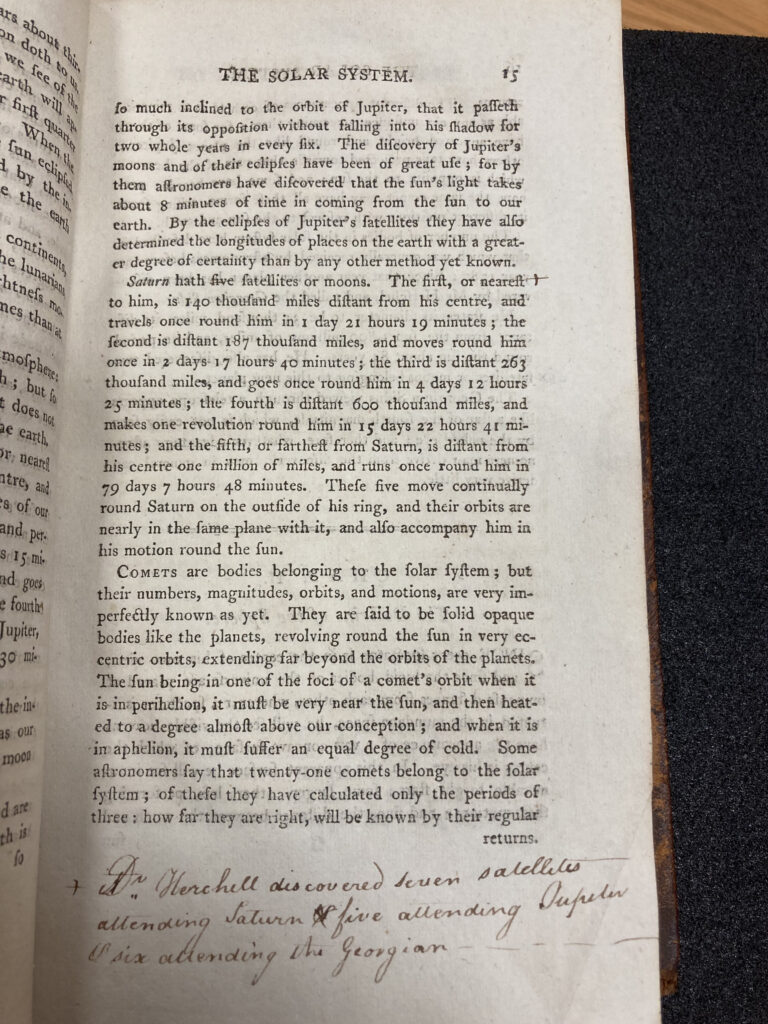
First, on page three he crossed out the word seventeen and wrote nineteen in the margin, however it appears McAlester also crossed out the nineteen in which he wrote.
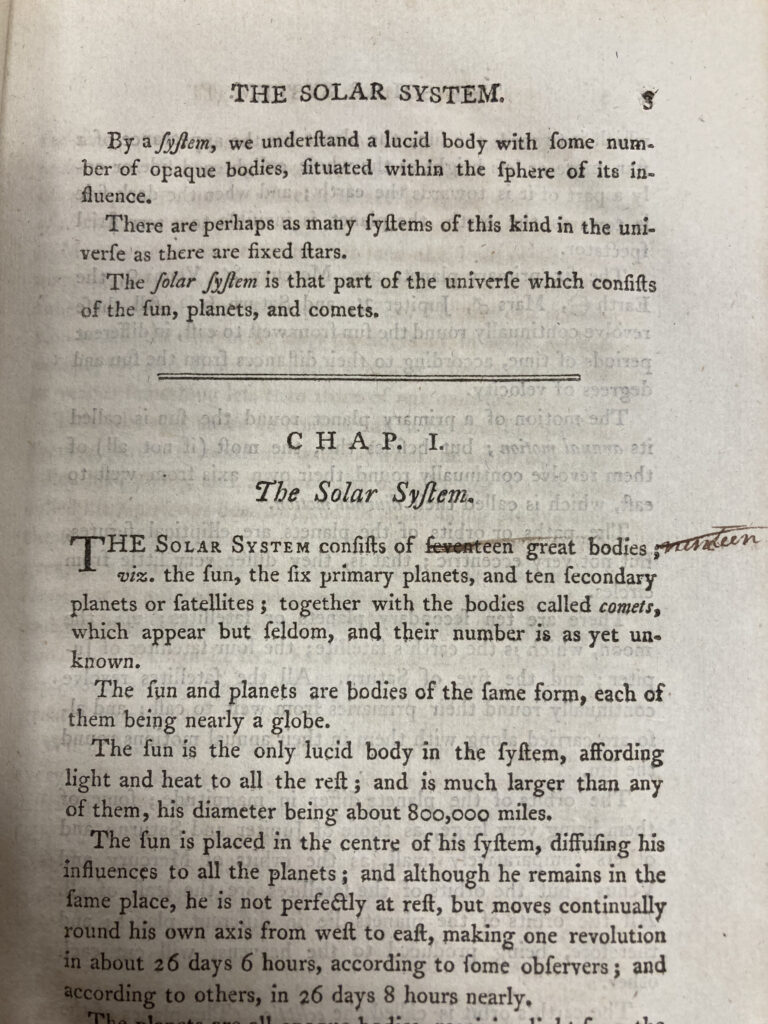
Second, on page fifteen McAlester corrects Ewing’s statement that Saturn only has five moons, by writing on the bottom of Image of McAlester’s correction the page “Dr. Herchell discovered seven satellites attending Saturn five attending Jupiter six attending the Georgian.” It is worth noting that Georgian is the planet that we now identify as Uranus.
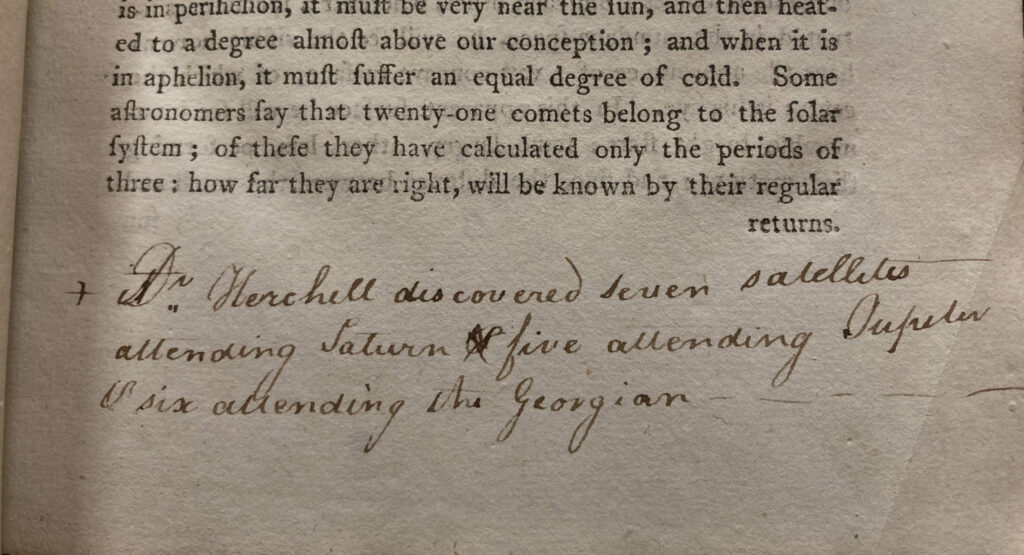
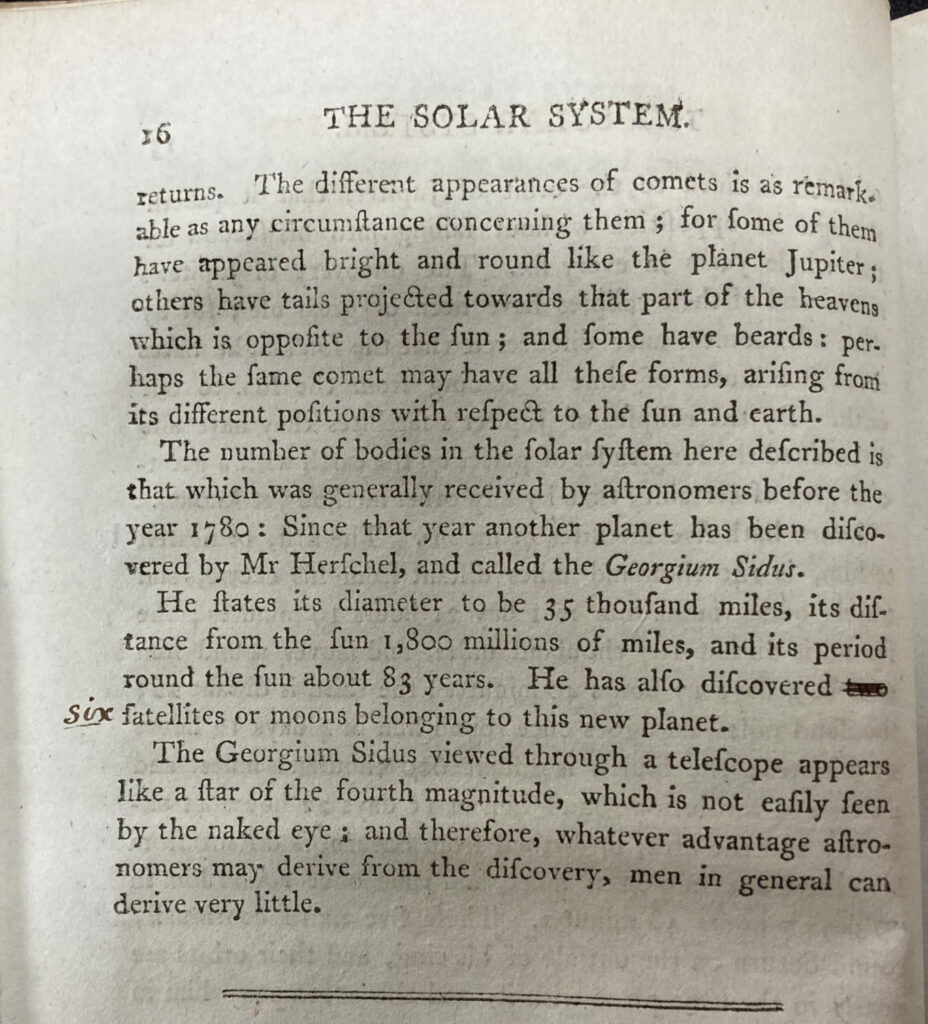
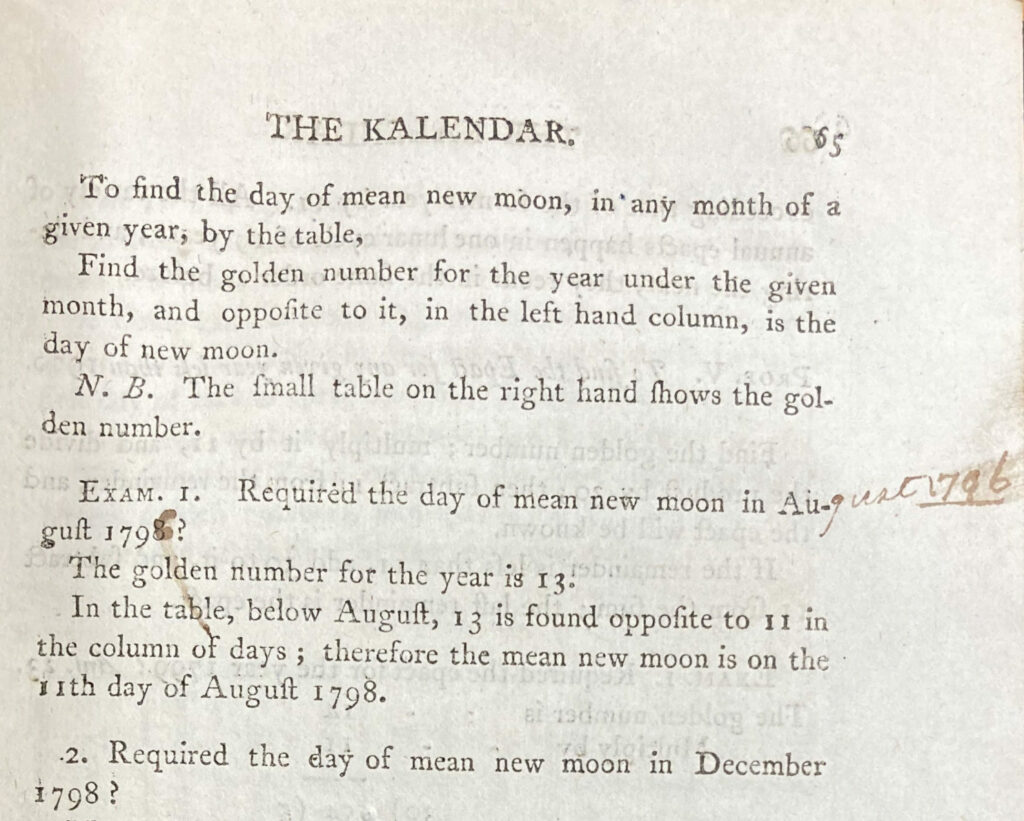
McAlester’s correction was in fact true, as English astronomer Dr. William Herschel discovered the seventh satellite of Saturn on September 17, 1789. Third, on page sixteen McAlester corrects Ewing’s statement that two satellites orbit Uranus by crossing out the two and writing in the margin six.
Finally, McAlester makes his final correction on page sixty-five where he crossed out the date August 1798 and writes August 1796 instead.
While documentation surrounding Ronald McAlester is limited, it is inferred that the book remained in Scotland for some time after its publication, however eventually, the book did make its way across the Atlantic to Pennsylvania. There is no information found within the book that indicates how or when the book made its way to the American continent, however it is known that this specific copy did reside in the Franklin Institute Library in Philadelphia, Pennsylvania. The book does contain an ownership bookplate detailing its holding as a book of the Institute’s library and Rare Book Collections, however upon reaching out to the current Institute they failed to provide any information regarding the book.
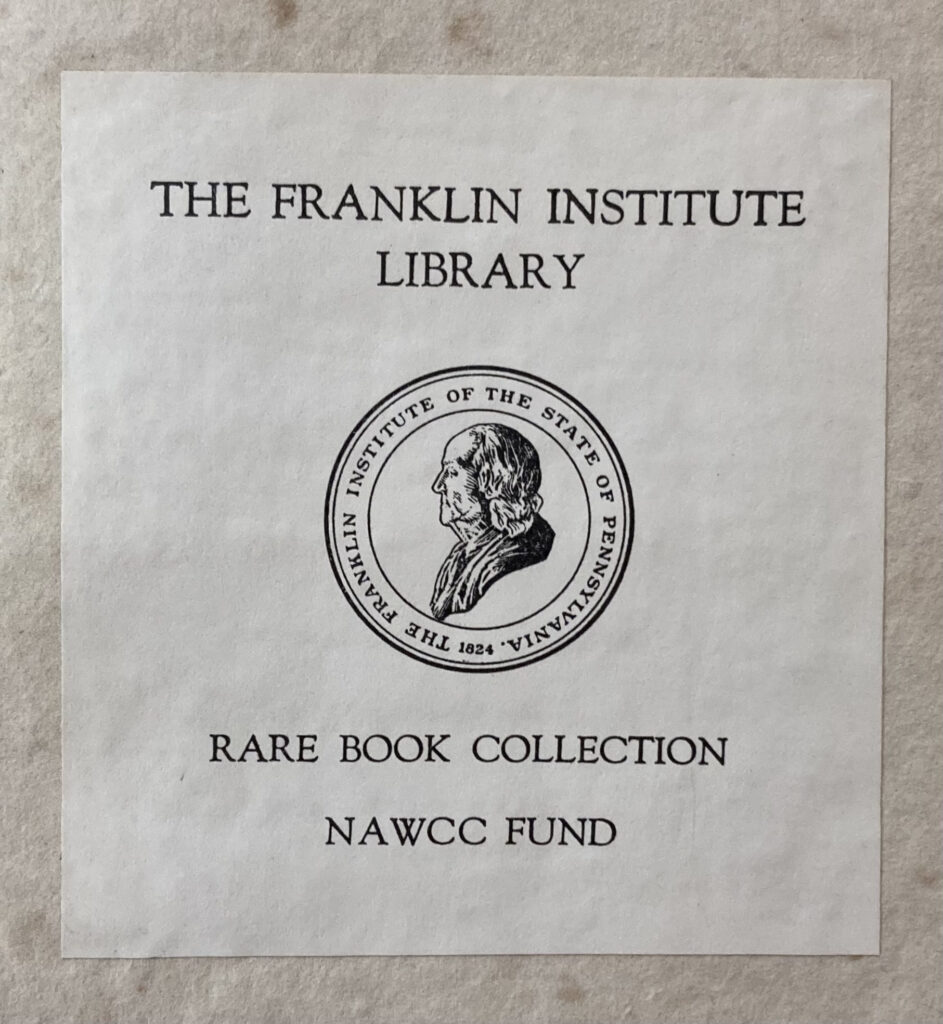
After extensive research regarding the Franklin Institute and its library, which seemed to completely vanish in the late 1900s, the evidence suggests that the library was intentionally discarded. The Institute’s library was originally formed in 1824 to collect books about science, this selection focusing on Astronomy aligned well to that objective. Over the course of 150 years the library grew to be quite extensive, however improper housing and maintenance put the books at direct risk. Over the course of 150 years, the library drifted away from the Institute’s original mission of preserving scientific material, and was therefore not sustained. In 1977, the library began to sell books unofficially for prices as low as $3 but kept no records logging what was being sold. In 1985 the Franklin Institute decided to disperse its library, and in 1986 the books began selling officially. After significant investigation, no record of the selling of this book was located, therefore the price at which it sold is also unknown. However, because there is no record of the official sale of this specific book, it is inferred that it was sold unofficially before 1986.
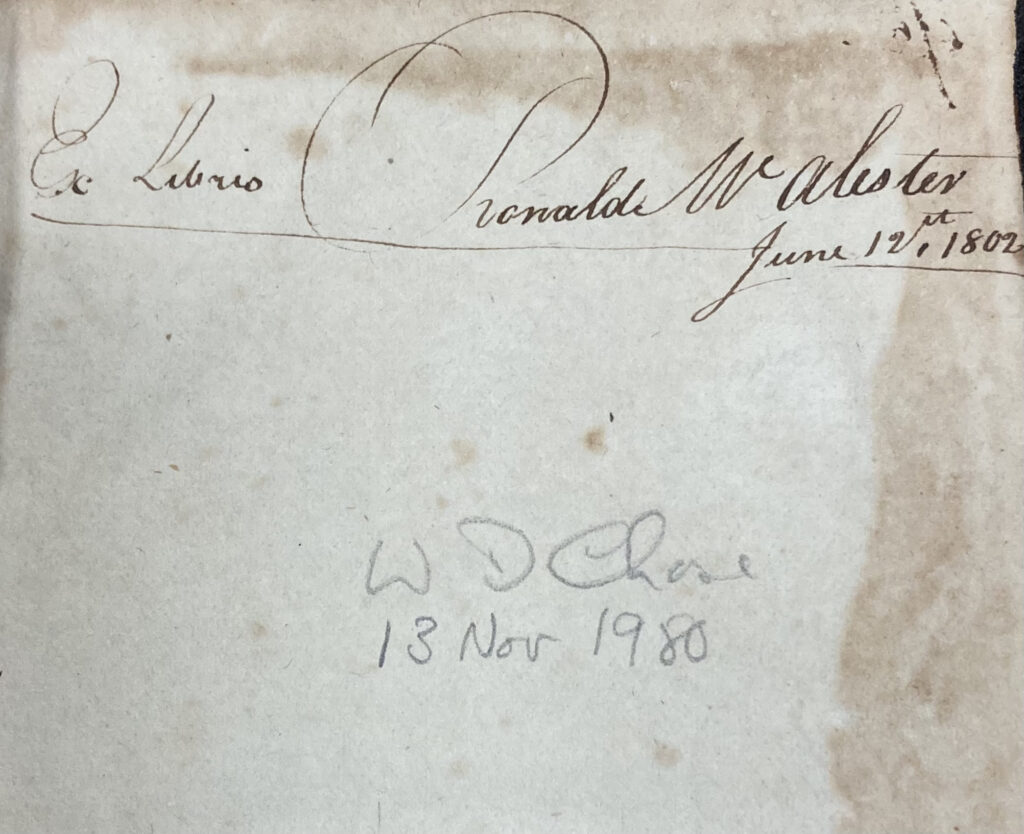
This book was in fact sold unofficially by the Franklin Institute because the next owner, William DeRoy Chase, purchased it in 1980. It is assumed that Chase purchased this copy directly from the Institute, however no record indicates this transaction. Chase makes one single note throughout the entire book on the inside of the front cover detailing “WD Chase 13 Nov 1980”, his name and the date it is assumed he added this specific copy to his personal collection.

William DeRoy Chase graduated from the University of Michigan with his Bachelors and Masters degrees in geography, pairing nicely with the interests of Practical Astronomy author Alexander Ewing. Chase also had an interest in Libraries and Archives, being very active in the Special Libraries Association as Editor and eventually President of its Newspaper Division.
Much like Ewing, Chase held many careers throughout his lifetime including serving as a professional geographer, teacher, journalist, librarian, editor, and publisher. Upon his marriage to his wife Helen Chase, the couple began their own antiquarian book collection in 1943, where they collected a wide variety of books and almanacs, this particular copy of Practical Astronomy being one of them. In 2016, William DeRoy and Helen Chase donated their entire collection to the Michigan State University Libraries, where this particular copy became a part of the much larger Michigan State University Special Collections where it resides today.
Bibliography
“Astronomical Discoveries of the Herschel Family – the Royal Society – Google Arts & Culture.” Google. Google. Accessed November 8, 2021. https://artsandculture.google.com/incognito/exhibit/astronomical- discoveries-of-the-herschel-family/GwKSW5pqakeYJQ.
Barke, Michael. “Book Review: Walks Around the Old Grain Ports of Northumberland: Alnmouth, Seahouses and Berwick.” The Journal of Transport History 17, no. 1 (03, 1996): 92-93. doi:http://dx.doi.org/10.1177/002252669601700123.
“Catalogue of the Books Belonging to the Library of the Franklin Institute.” Google Books. Google. Accessed November 8, 2021. https://books.google.com/books?id=Nj4RAAAAIAAJ&printsec=frontcover&source=gbs_ge_summary_r&cad=0#v=onepage&q&f=false.
“ESL: Engineering Societies Library.” Taylor & Francis. Accessed November 8, 2021. https://www.tandfonline.com/doi/abs/10.1300/J122v19n01_02.
“The Franklin Institute of the State of Pennsylvania for the Promotion of the Mechanic Arts.” Google Books. Google. Accessed November 8, 2021. https://books.google.com/books?hl=en&lr=&id=PZ9IAAAAMAAJ&oi=fnd&pg=PA1&dq=what%2Bhappened%2Bto%2Bthe%2Bfranklin%2Binstitute%2Blibrary&ots=Yv0eDQA4Pr&sig=BgzregMkVOb5sJI5cRnlvlkpvmA#v=onepage&q=library&f=false.
“Library Company of Philadelphia: 1987 Annual Report.” Google Books. Google. Accessed November 8, 2021. https://books.google.com/books? id=JvbjJWtT7gUC&pg=PA7&lpg=PA7&dq=selling%2Bof%2BBooks%2BBelonging%2Bto%2Bthe%2BLibrary%2Bof%2BThe%2BFranklin%2BInstitute&source=bl&ots=TPI4opZ19p&sig=ACfU3U2MPtHAYjL6_xhzf63D_60da18m4Q&hl=en&sa=X&ved=2ahUKEwjVmOm66vzzAhXaB80KHWr8Ba8Q6AF6BAgMEAM#v=onepage&q=rare%20book%20collection&f=false.
“Mission & History.” The Franklin Institute, January 22, 2020. https://www.fi.edu/about-us/mission-history.
“William D. and Helen M. Chase Collection.” MSU Libraries. Accessed November 8, 2021. https://lib.msu.edu/ebookplates/view/?id=1263.
“William DEROY Chase Obituary (1922- 2020) Ann Arbor News.” Legacy.com. Accessed November 8, 2021. https://obits.mlive.com/us/obituaries/annarbor/name/william-chase-obituary?id=8475957.
Article by Rebecca Yeomans-Stephenson, HST 475 Fall 2021
