
XX PR3763.W2 K7 1726
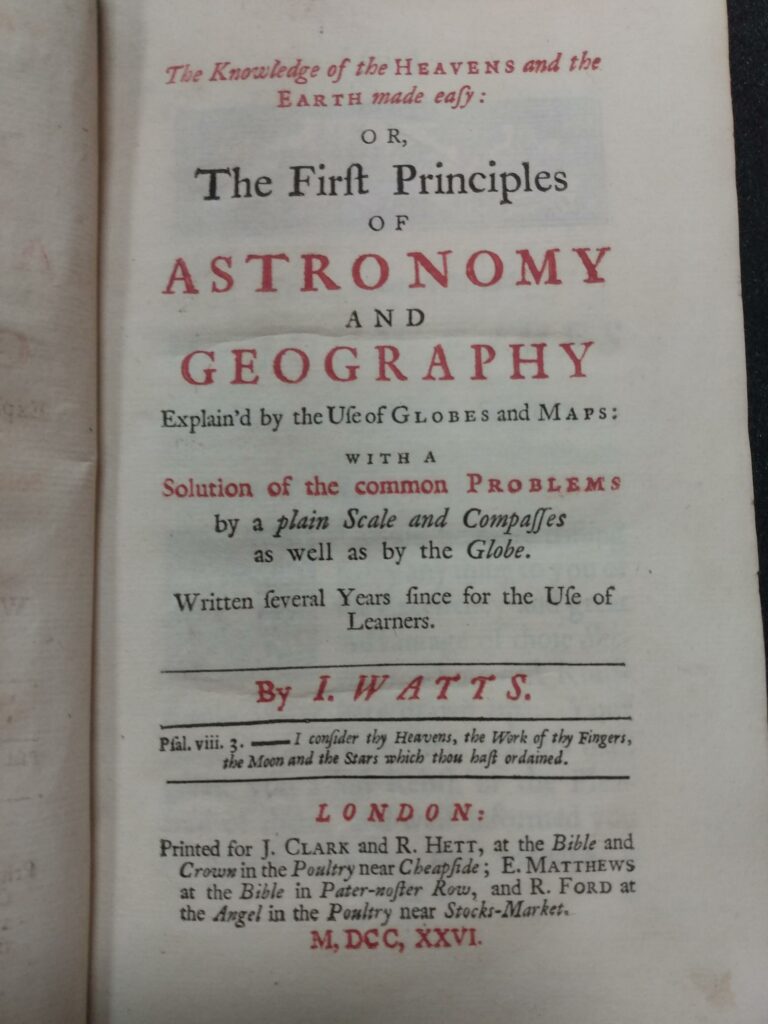
Our copy of Knowledge of the Heavens and Earth Made Easy… by Isaac Watts was published in 1726 in London and printed by J. Clark and R. Hett. This item’s lifetime has, by 2021, brought it into the hands of students at Michigan State University in East Lansing, Michigan. What can we figure out about this book’s journey from studying the artifact itself?
The Book’s Author: Isaac Watts
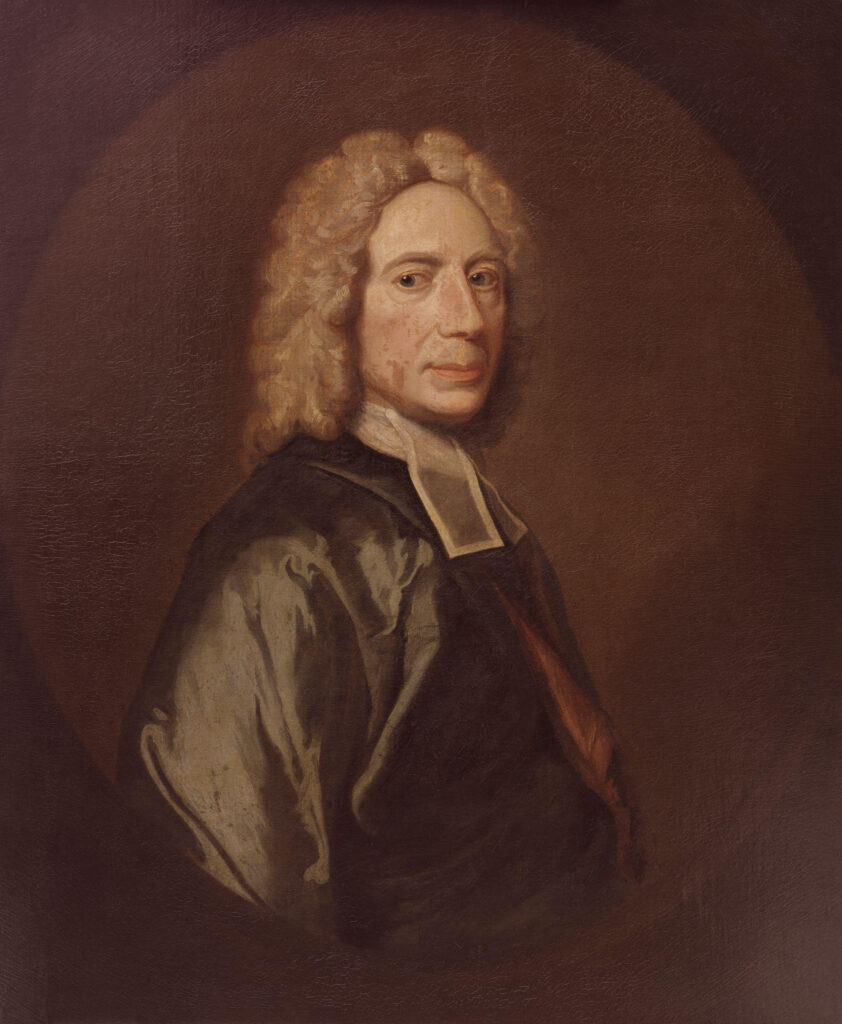
Isaac Watts was born in 1674, the first of eight children. He, like his father, was a devout Christian who took a keen interest in learning. According to historian David Fountain, when Watts was given money, “he would run to his mother crying, ‘A book, a book; buy me a book!””[1]. Education was important to him and he was inspired by the Enlightenment ideas of his day and he took an interest in philosophy, influenced by Locke and Descartes. At one point, he was a tutor. He also had a penchant for rhymes and verse, which would define his later legacy.
Watts and his father shared a name as well as a faith. Both were nonconformists. They did not belong to the Church of England, an offense that landed some, including Watts’ father, in jail. The offense could also carry the weight of a fine. This did not dissuade Watts from his faith. He would go on to become a minister at multiple congregations through the years and he is most famous for the large number of hymns he wrote.
Hymns have sometimes caused controversy as congregations used to primarily sing Psalms since hymns are of man’s creation and psalms are directly from the Bible. Watts’ hymns are still sang today.
The combination of reason and religion promoted by Watts can be seen in the psalm he decided to include on the title page of his book: “I consider thy Heavens, the Work of thy Fingers, the moon and the stars which thy hast ordained.” [Psalms 8:3]
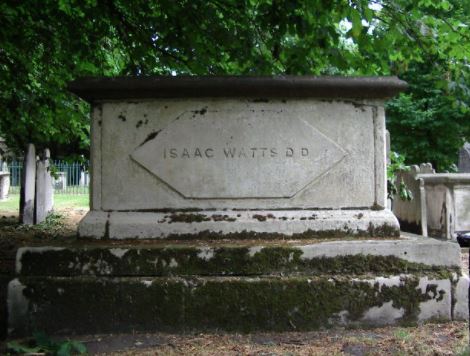
Sickness plagued Watts his whole life. He succumbed to illness at age 74 in 1748. He is buried in Bunhill Fields and there are several statues depicting him in England.
James Eames
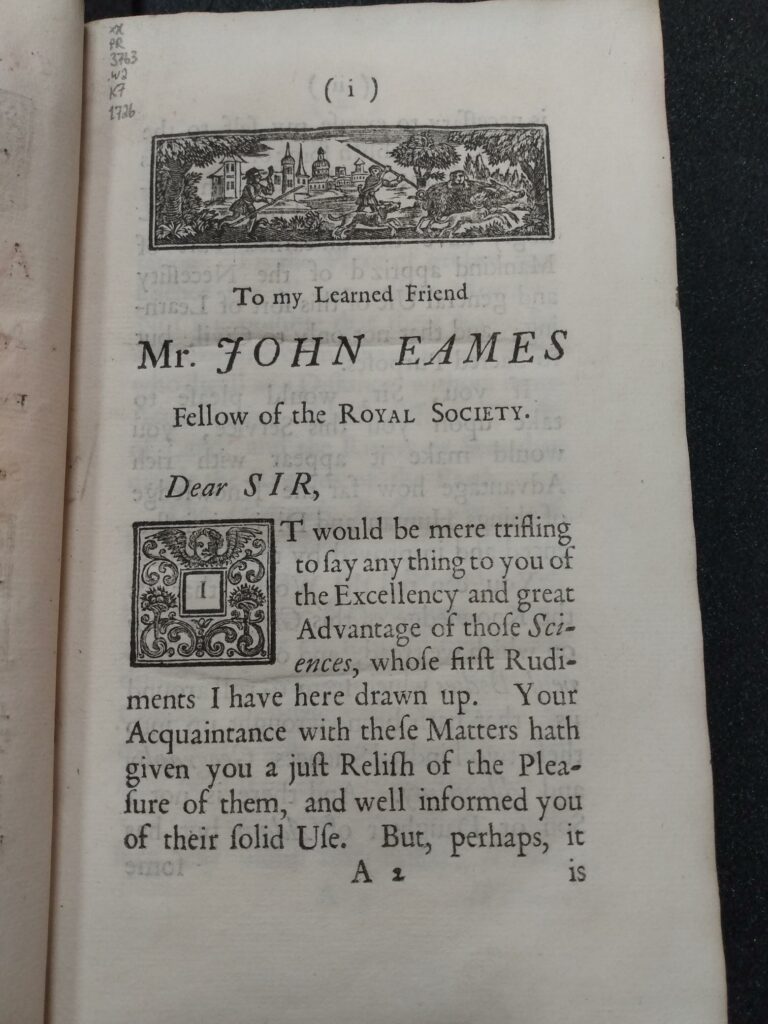
John Eames is less well-known. It appears that he edited Watts’ book and Watts includes this dedication to Eames at the start of his book. The dedication seems to indicate how highly he feels about Eames and about his knowledge of science. It is also a good way to secure support and funding. He was a fellow dissenter, that is he was also not part of the Church of England. Like Watts, Eames was also a tutor, well known for his knowledge in the natural sciences [8]. None of his own works or anything he wrote himself remain, but he did have a hand in editing this work and a few others. [Ibid]. According to Fountain, Eames was an “associate of Isaac Newton, and the best known scientist and science teacher among the Dissenters.”[1].
Physical Description
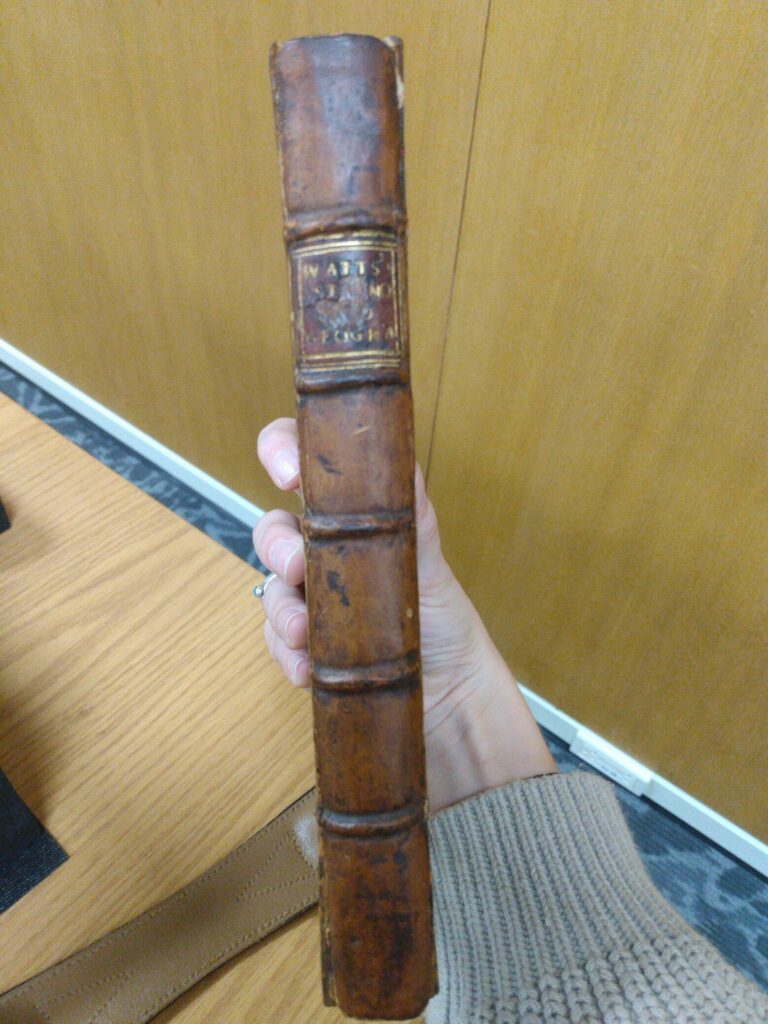
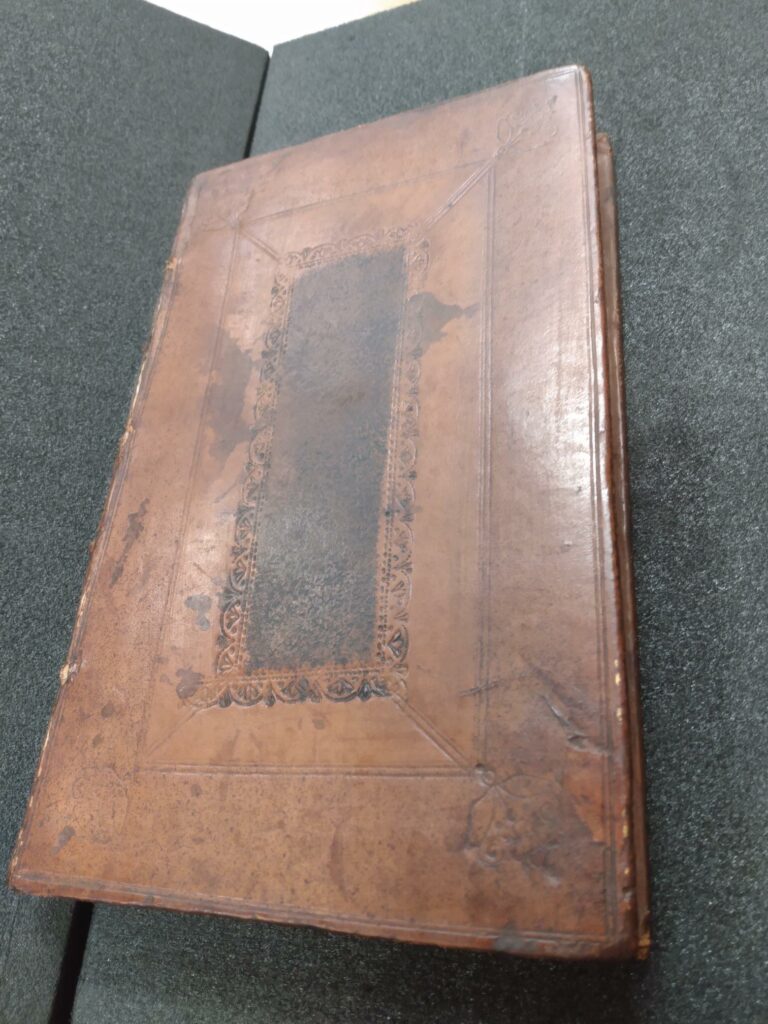
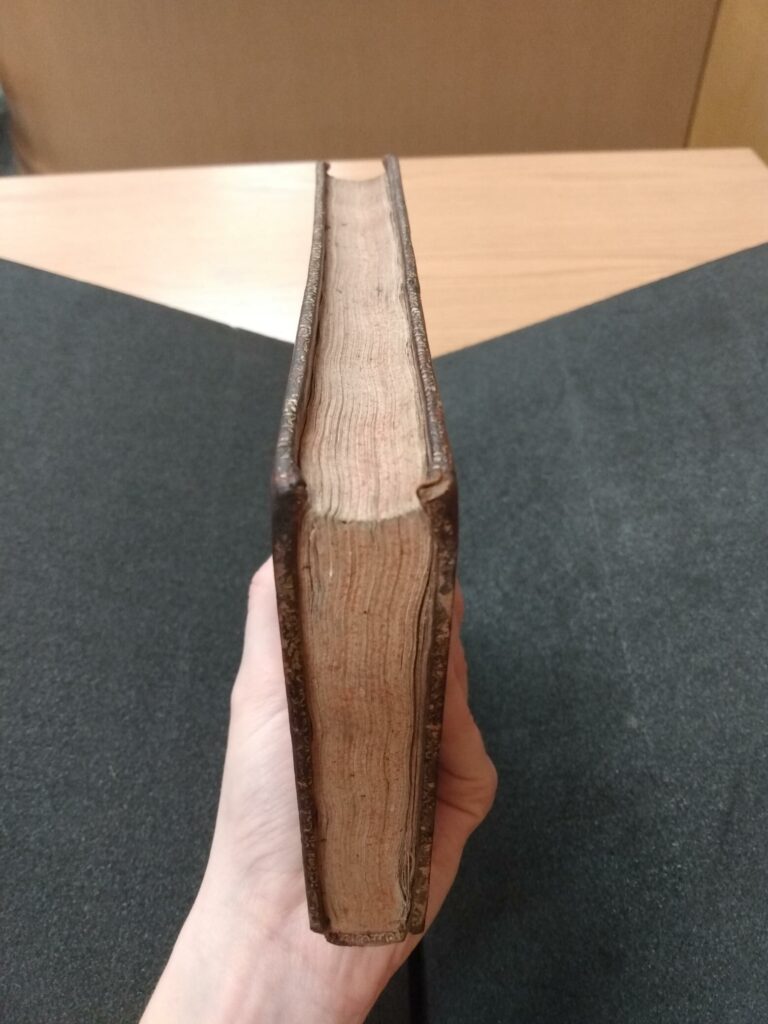
This copy of Watts’ book appears to be gently used and well taken care of. The boards of the book are leather bound with cambridge panels impressed into the front and with a floral design around the edges. The middle panel is darker than the outside panels. The spine has the title with gold gilted lettering and gold gilt surrounding it in a square. The spine has some wear at the top and bottom from where prospective readers have tipped it from the shelf. There are also false bands for aesthetic purposes on the spine. The fore-edge has red speckling.
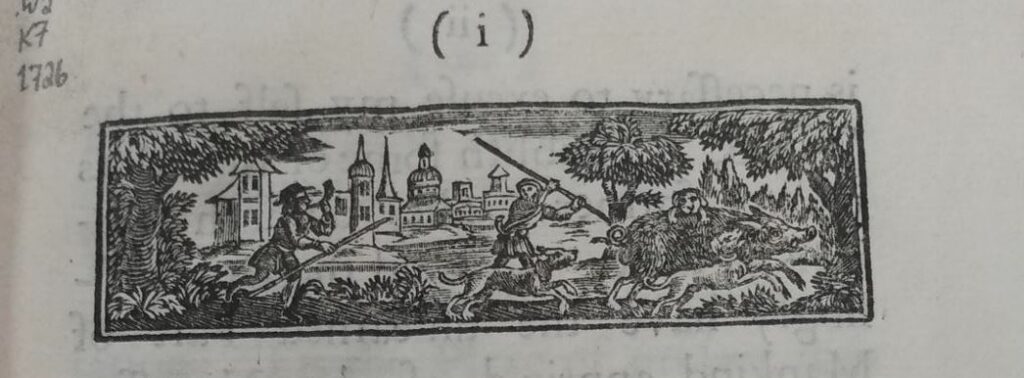
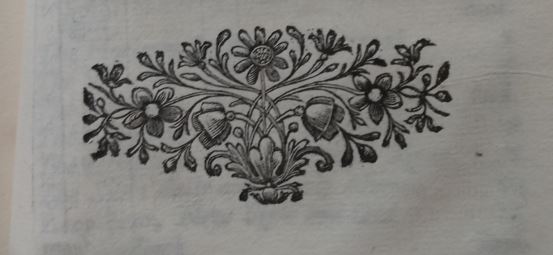
The book contains beautiful, intricate illustrations and initial letters on some pages. I believe these designs were made using woodblocks, but a more trained eye could tell if they were made using the intaligio method with engraving or etching. Either way, the designs are a gorgeous addition to the book.
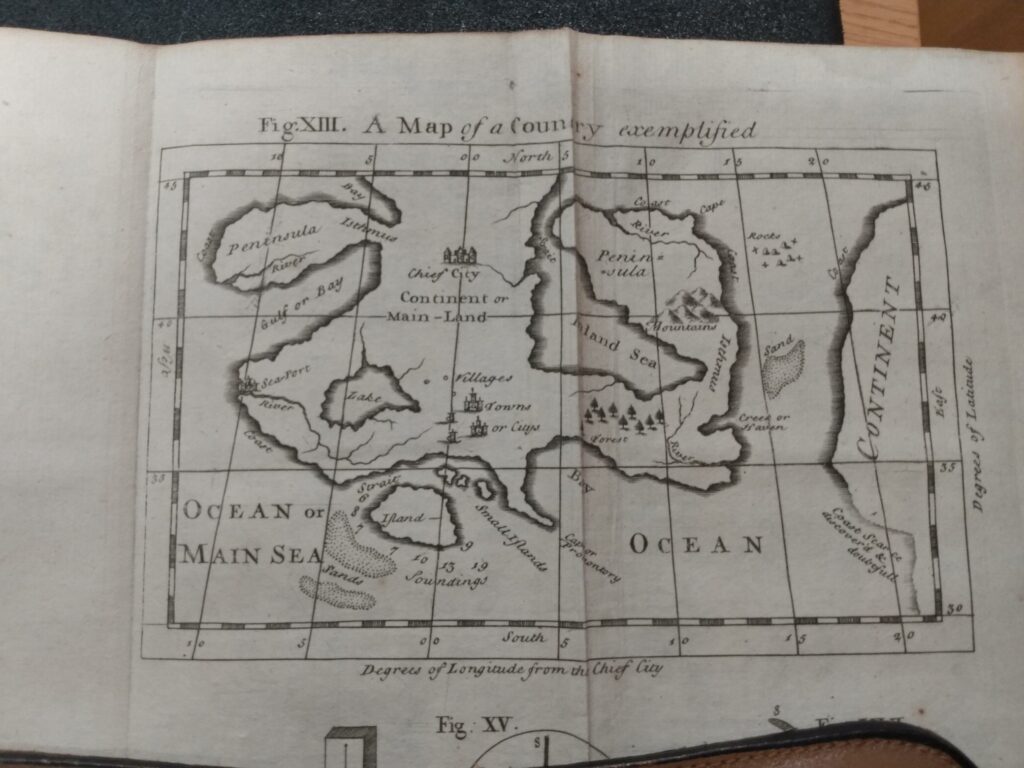
There’s rubrication, specifically on parts of the title page. There is also a table of contents in the back and maps and charts for the reader to study along with the printed information contained in the book as it relates to both astronomy and geography. These fold out from the back of the book. Additionally, the book is paginated, includes signatures at the bottom of the page, and one can see chain marks when holding the paper to the light.
Contents and Signficance
This book is a guide to learning and teaching astronomy and geography, as can be gathered from the book’s, possibly overly, descriptive title.
Watts writes, “You can tell the World, that ’tis the Knowledge of the Globe of Earth on which we tread, and of thofe Heavenly Bodies which feem to roll around us, that hath been wrought up into thefe two kindred Sciences, Georgraphy and Aftronomy.” [6]. This book is his way of explaining man’s place in the world and earth. He also emphasizes that this book should be a guide that is straightforward and clear for teaching purposes and was inspired by his interests as a young man.
For Watts, there is no disentangling man’s understanding of the physical world with his understanding of God and religion. Science seems to only strengthen his faith: “What amazing Glories difcover themfelves to our Sight? What Wonders of Wifdom are feen in the exact Regularity of their Revolutions?” [Ibid.]
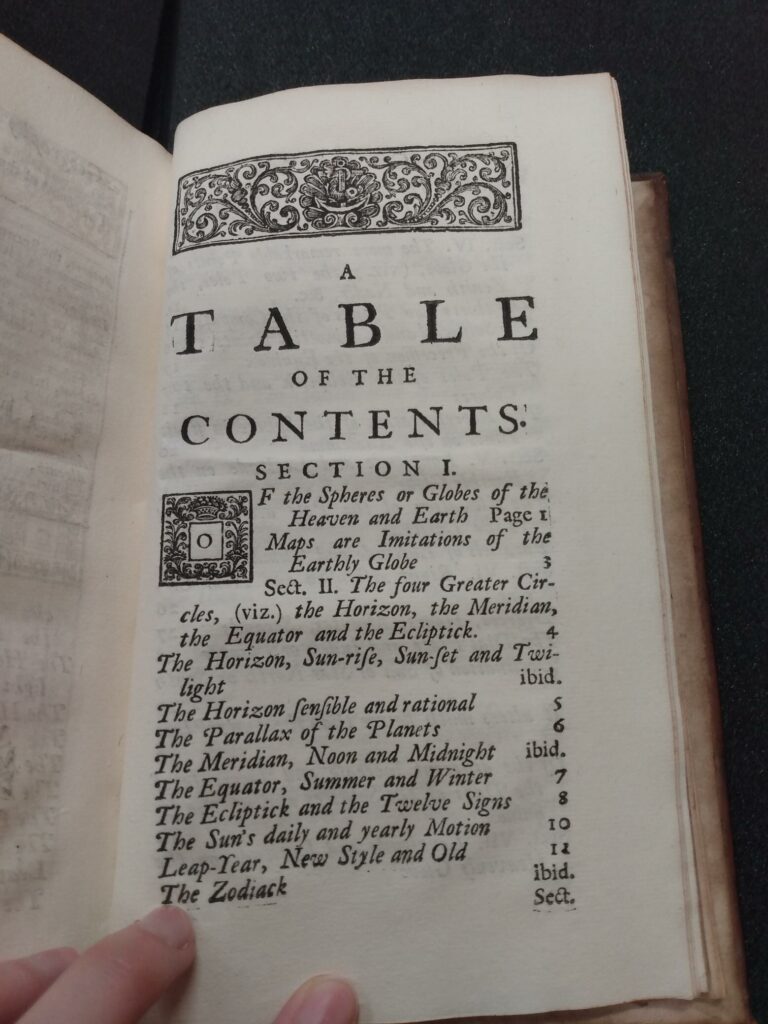
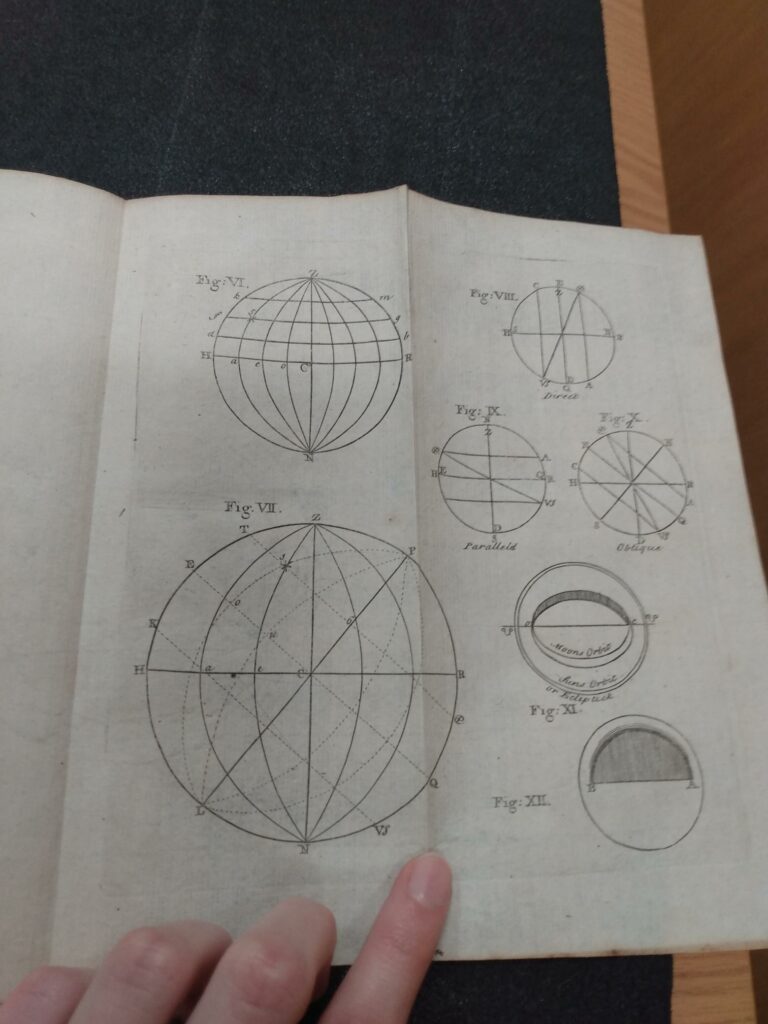
Fountain states that, “For its age and its avowed purpose of introducting the study of astronomy to beginners, it was an excellent text. The outstanding feature of the work is its clarity.” [1].
This book could be considered part of the material related to the Enlightenment. Fountain emphasizes the book’s, and Watts’ works generally, role in “the development of modern education.”[1]. Watts’ name carries a certain weight, and this book’s significance lies too with its tie to him.
Tracing Ownership: Gustavus Wynne Cook
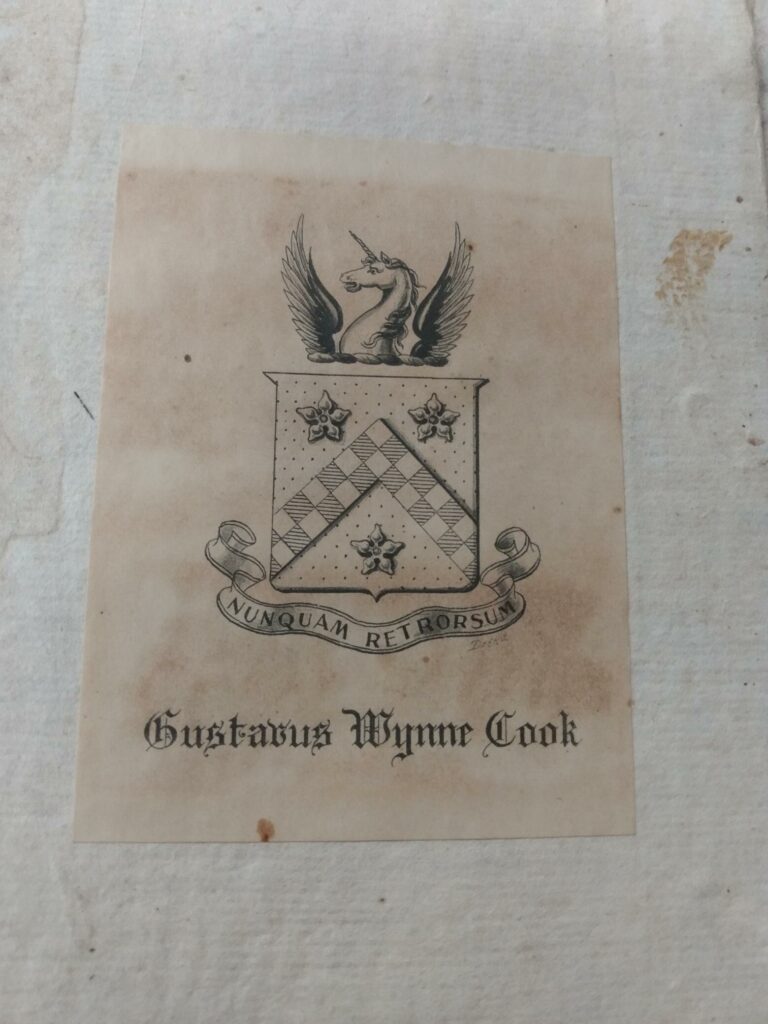
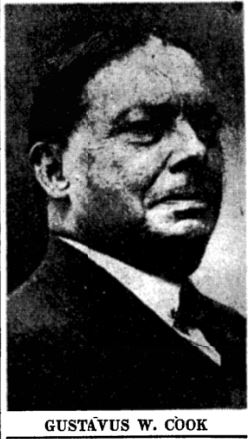
Gustavus Wynne Cook’s bookplate is in the front flyleaf of the book. This book plate indicates a certain level of wealth and prestige. His plate includes a strong pegasus as well as a phrase in latin that translates to “never backwards”
Cook was a well-to-do industrialist from Philidelphia. He was also an amateur astronomer, and was even featured as science’s number one amateur in a 1937 edition of Time Magazine [7]. His interest in astronomy, as well as the surplus of money and time he had, led to his building of an observatory at his home. According to the 1937 edition of Time, “…he has the world’s most elaborate private astronomical observatory. His 281⁄2-in. telescope, installed in 1932, is the most powerful possessed by an amateur.” [Ibid].
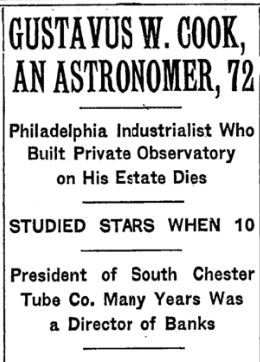
Cook died at age 72 and his obituary was featured in the New York Times [2]. As a rich, amateur astronomer, an old book on astronomy would be related to Cook’s interest. He would have considered himself, as he was called in the Time Magazine piece referenced already, a man of science. He could have considered this book to be a work by other great men of science. Additionally, there’s another indication in the book of ownership that is related to Cook. There’s a plate for the Franklin Institute Library in Philidelphia, PA that lists the book as a “bequest of Gustavus Wynne Cook.” We know that Cook was in that same area. According to a journal article from the Publications of the Astronomical Society of the Pacific, Cook also took courses at the Franklin Institute during his lifetime.[10]. He is also noted to be a rare book collector in the article, and it’s noted that “these were willed to the Franklin Institute.” [Ibid.]
Franklin Institute Library
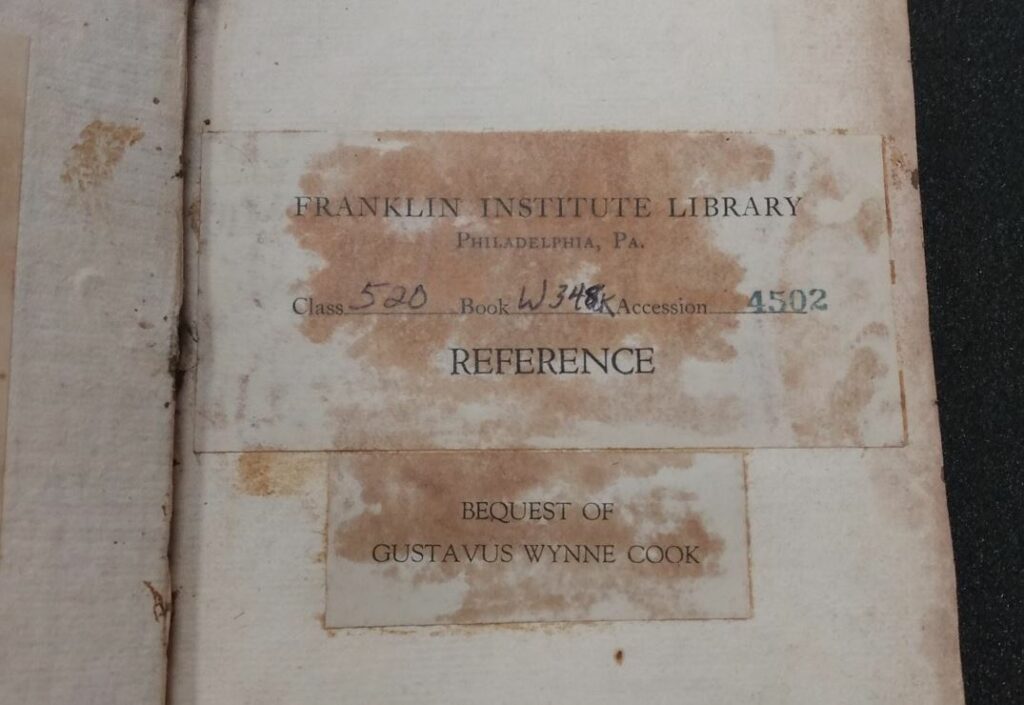
From Cook’s donation, the book went to the Franklin Institute in Philadelphia where it was listed as a reference book.
The Franklin Institute’s website describes themselves thus: “In the Spirit of inquiry and discovery embodied by Benjamin Franklin, the mission of the Franklin Institute is to inspire a passion for learning and technology.” It was founded in 1824 by William Keating and Samuel Merrick. The Institute took donations to create, but was able to raise the necessary $5.1 million. Cook, as a wealthy industrialist with an interest in science, may have been a donor himself.
“Within three years of its founding, that promotion took place through public lectures, a high school, a library, public exhibitions, and a research journal, and many of these endeavors remain core activities to this day.”[9] This library was the one that contained Watts’ book. The museum element to the Franklin Institute did not open until 1934, but it remains a popular attraction in Philadelphia today.
While the museum may be popular, the library itself no longer remains open. According to a 1987 annual report from the Library Company of Philiadelphia, “…today the Franklin Institute is a science museum for the general public, and its library, now of interst mainly to historians of technology, was irrelevant to its mission. The library was not well- maintained; the staff was not trained in administration of a rare-book library; the collection had already been targeted by book-thieves. Selling the collection was not only defensible, it was necessary.” They started selling books in 1977. [11].

W.D. Chase
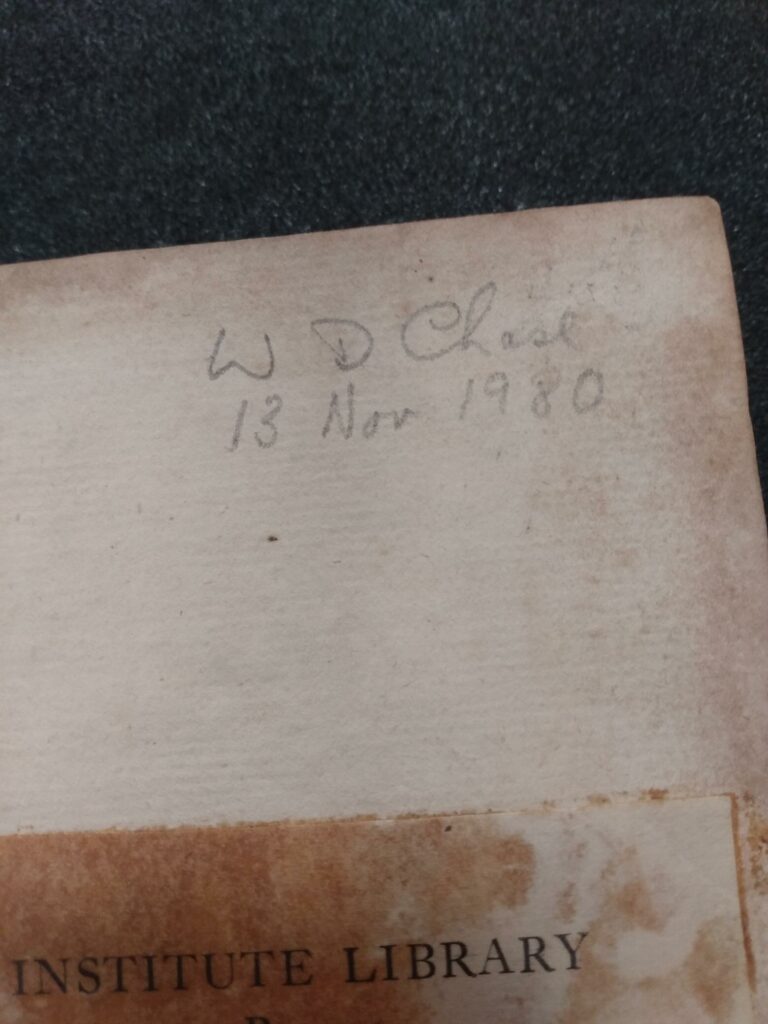

An inscription on the first flyleaf in the book is written in pencil and contains the name “W.D. Chase” and is followed b
William DeRoy Chase lived from 1922 until 2020. He had a bachelors and masters degree in geography and spent time as a librarian, involving himself as editor and president of their newspaper division. He served in some capacity during both WWII and Vietnam. He was also the assistant curator of books at one point at UM Clements Library. He worked in publishing as well [5].y a date: “November 13, 1980.”
Some people may be familiar with Chase inadvertently through Chase’s Calender of Events which he worked on publishing starting in 1957. It is a calender including ” presidential proclamations, religious holidays and important dates” as well as “significant historic events, important birthday and astronomical observations” and more [3].
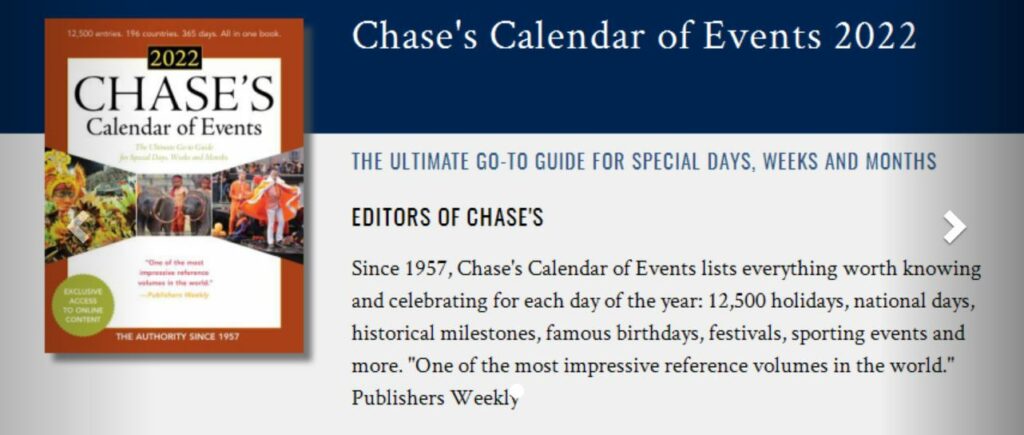
It would make sense for William D. Chase to own this book. He found dates to be important, and we know that W.D. Chase included the date in his inscription. The book is also about geography, a topic Chase would have known well. His experience as a librarian and curator contributes to the likelihood as well.
Further, William DeRoy Chase is listed as donor to Michigan State University’s library. His inscription in the book is dated around the same time that the Franklin Institute was selling off its library’s collections.
Other Signs of Provenance
Much of the provenance and signs of use in this book have been inscriptions from previous owners and book plates. There is not a lot of writing throughout the book, perhaps indicating that those who have read it closely have chosen instead to take notes somewhere other than within the book itself. It was in a library at one point, after all, and libraries don’t encourage patrons to write within their copies. It could mean that Gustavus Wynne Cook and W.D. Chase collected this book and did not spend much time actually reading it, preferring to see it decorating their book shelves. Cook did consider himself an amateur astronomer though so this was a book pertaining to his interest and, similarly, William D. Chase had degrees in geography and had experience in rare books as a librarian. It was also a book more than 100 years old during both men’s lifetimes so it may have been more of a book for their collections rather than for information as the information would certainly be outdated. We cannot be sure of the exact use of the book, much as we could speculate.
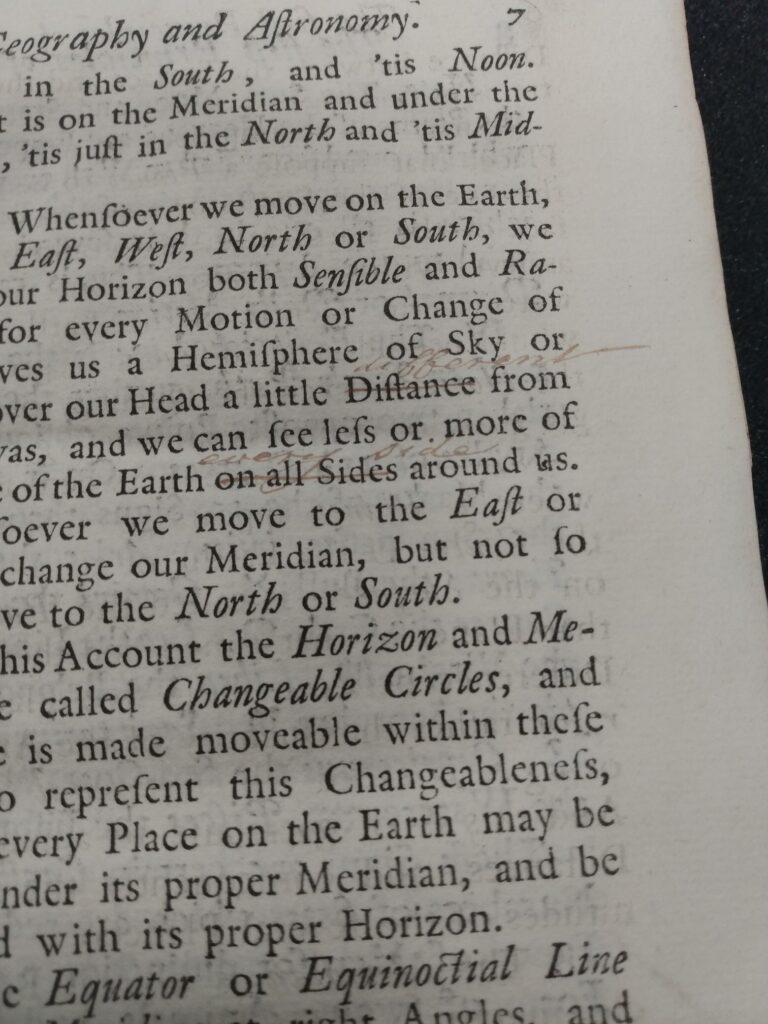
The lone example of marginalia is at the beginning of the book. There are words crossed out on page 7. The crossed out words are replaced with what the writer more than likely felt belonged there instead of the existing word or phrase. One gets the feeling that the reader, who hadn’t gotten very far yet and whose hand and corrections are not found past this point, may be reading the book with a critical and judgemental eye. They appear to be acting as an early example of the “grammar police.” This script is in yellow and looks to be old. It is not written in pencil, as W.D. Chase’s inscription was.
There are also several examples of where pages are creased, showing signs of use. The first example is a large crease, but the second example looks like where a reader could have been dog-earing a page to keep their spot for later.
The book’s LOC call number has been written by MSU’s library in pencil towards the front of the book as well.
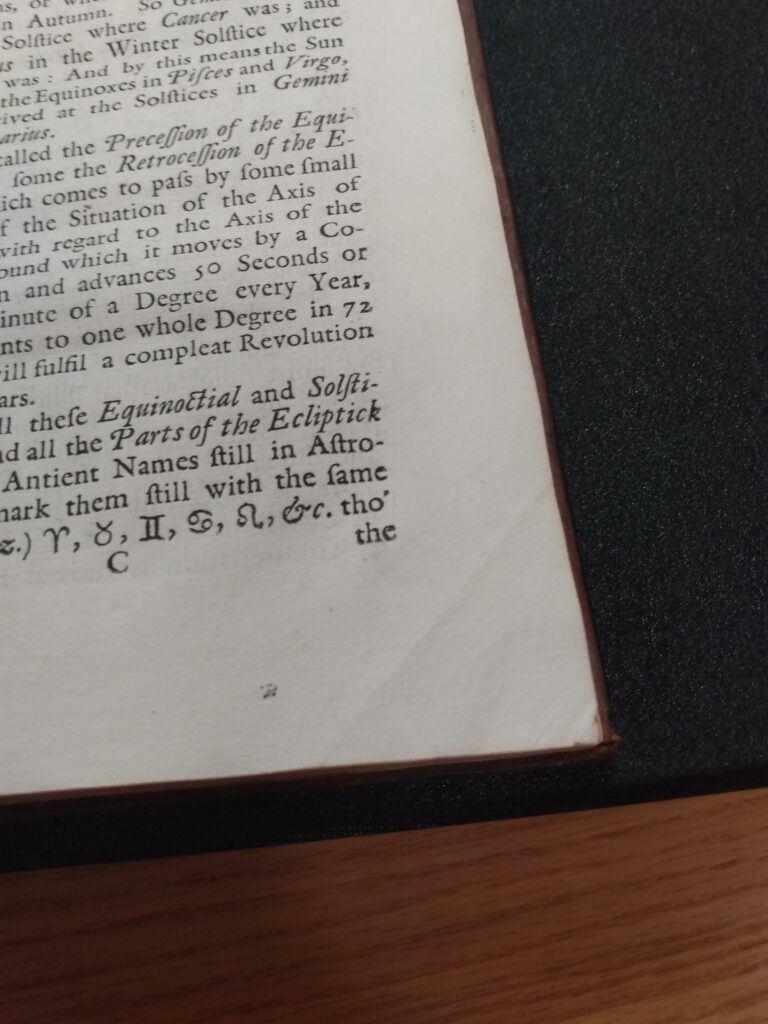
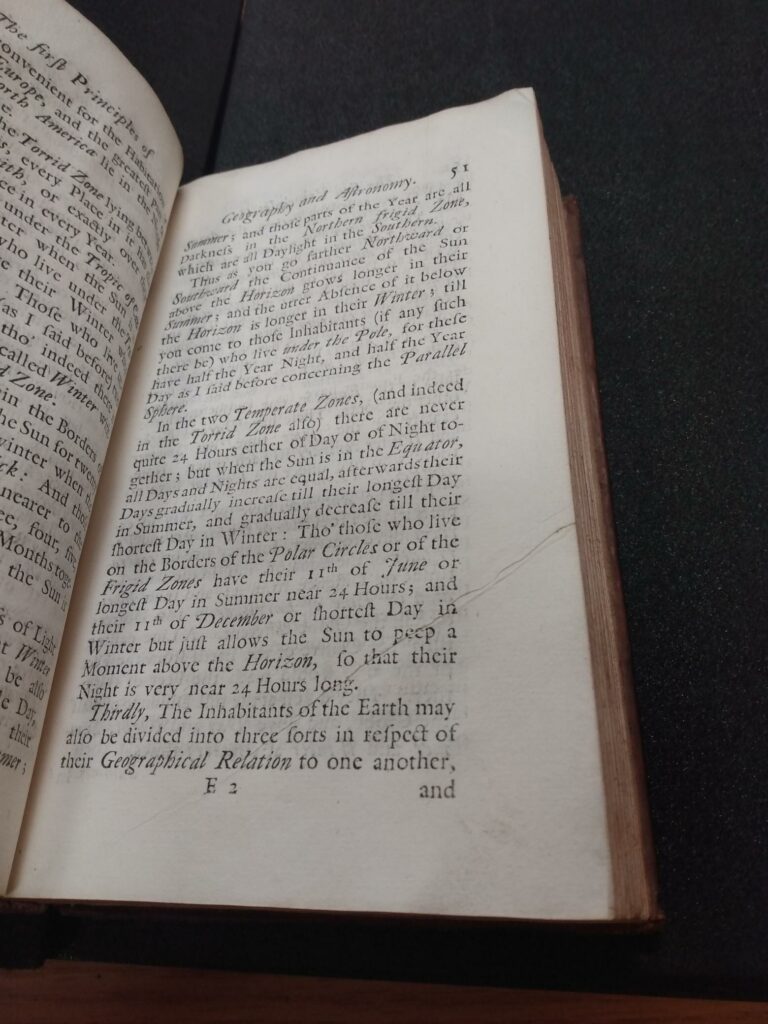
of wear
MSU Library Call Number
Conclusion
We can gather a lot of information from studying our copy of Isaac Watts’ The Knowledge of the Heavens and the Earth Made Easy… We know that this book was published in London in 1726 and that its journey took it in and out of many hands, including those of Philadelphia industrialist Gustavus Wynne Cook, patrons at the Franklin Institute’s library, and of William D. Chase. We can see that, while this book is in good shape and has a beautiful physical appearance, it has signs of use from over the years like creases and minimal writing within it.
Watts intended for this book to be a teaching guide. At one point, it was a very good and concise one. It was his goal to teach readers about the world that, he felt, God had beautifully and skillfully crafted for mortals to roam.
The book continued to serve as a teaching guide, but probably became admired as art in its own way and as a testament to the beauty and tradition of early print. There is not a lot of writing or signs of heavy use, so this book may have become more decorative than practical. We have been able to trace its ownership back through people and places that admired science.
This book’s path has brought it to the collection of rare books at Michigan State University’s Special Collections. While it’s part of MSU’s collection it will remain, as mentioned before, a teaching tool and testament to Enlightenment thought and the charm of traditional printing.
Sources:
[1] Fountain, David. Isaac Watts Remembered: 1674-1748. Great Britain: University Press, Oxford. 1978.
[2] Special to the New York Times. “Gustavus W. Cook, An Astronomer, 72” New York Times. June 5, 1940. https://timesmachine.nytimes.com/timesmachine/1940/06/05/11308782
3.html?pageNumber=25
[3] Miller, Janet. “Ann Arbor man, 90, founded catalogue of events for every day of the year.” The Ann Arbor News. April 2, 2012. http://www.annarbor.com/news/chasing-down-days-ann-arbor-founder-
of-chases-calendar-of-events-turns-90/
[4] Werner, Sarah. Studying Early Printed Books 1450-1800: A Practical Guide. Wiley Blackwell, 2019.
[5] “William DeRoy Chase, 1920-2020.” Ann Arbor News. MLive. March 13, 2020. https://obits.mlive.com/us/obituaries/annarbor/name/william-chase-obituary?id=8475957
[6] Watts, Isaac. The Knowledge of the Heavens and Earth Made Easy: or the First Principles of Astronomy and Geography Explain’d by the Use of Globes and Maps: with a Solution of the Common Problems by a Plain Scale and Compasses as well as the Globe. London: J. Clark and R. Hett. 1726.
[7] “Science: No 1. Amateur.” Time Magazine. February 1, 1937. http://content.time.com/time/subscriber/article/0,33009,788661,00.html
[8] Gordon, Alexander. “Eames, John.” Dictionary of National Biography: 1885-1900. Volume 16.
[9] https://www.fi.edu/about-us/mission-history
[10] Olivier, Charles P. “GUSTAVUS WYNNE COOK, 1867-1940.” Publications of the Astronomical Society of the Pacific 52, no. 308 (1940):
272-75. http://www.jstor.org/stable/40711188.
[11] Annual Report of the Library Company of Philadelphia: 1987. Philadelphia: The Library Company of Philadelphia, 1987. https://books.google.com/books?id=JvbjJWtT7gUC&pg=PA7&lpg=PA7&dq=selling%2Bof%2BBooks%2BBelonging%2Bto%2Bthe%2BLibrary%2Bof%2BThe%2BFranklin%2BInstitute&source=bl&ots=TPI4opZ19p&sig=ACfU3U2MPtHAYjL6_xhzf63D_6od a18m4Q&hl=en&sa=X&ved=2ahUKEwjVmOm66vzzAhXaB80KHWr8Ba8Q6AF6BAgMEAM#v=onepage&q&f=true
Created by Leah Welch for HST 475 in the fall of 2021
