
The Basics
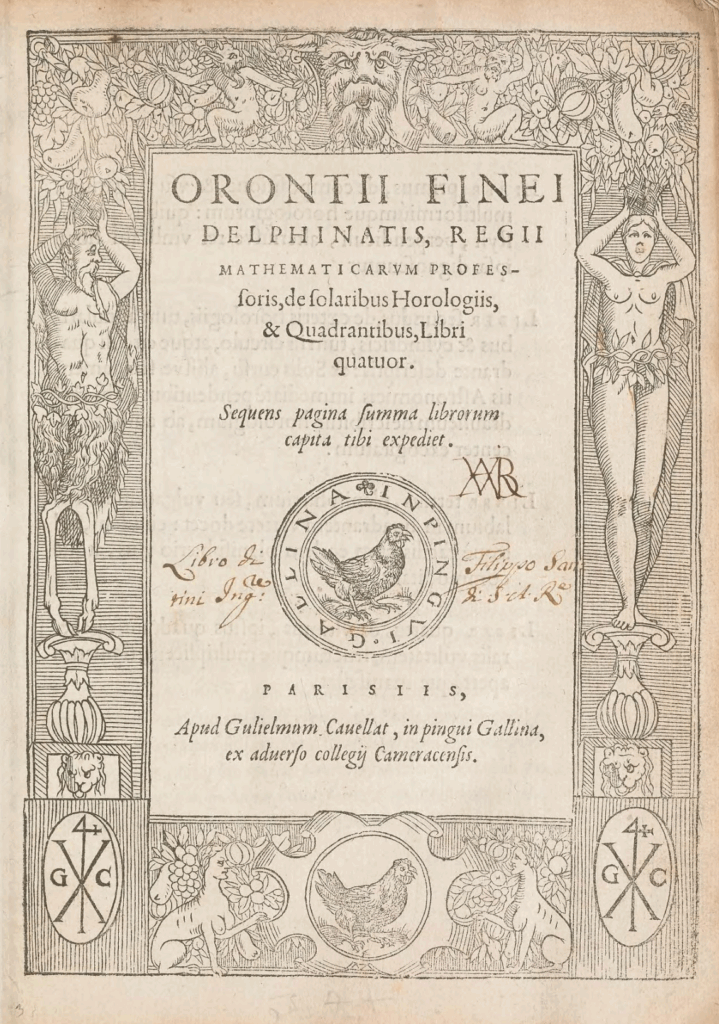
https://urldefense.com/v3/https://archive.org/details/orontiifineidel00fine/page/n7/mode/2up;!!HXCxUKc!nqobnXP62-Opf9AlmWGH2PraqYJ8rC5L- TSCdXyppLugLO5IJiqPcXsFeApDFnps$
Title (In Original Language): Orontii Finei Delphinatis, regii mathematicarvm professoris, De solaribus horologiis, & quadrantibus, libri quatuor. Sequens pagina summa librorum capita tibi expediet
Shortened Title: De solaribus horologiis
Title (Translated Into English): Oronce Finé of Dauphiné, Professor of Mathematics at the Collège Royal, On Solar Clocks and Quadrants in Four Books. The next page is the sum of these books which I bring forward to you.
Author: Oronce Finé
Publication: Published by bookseller/printer Guillaume Cavellat in Paris, 1560.
Language: Latin
Current Collection: The Dibner Library of the History of Science and Technology, Smithsonian Institution Libraries
Library of Congress Call Number: QB215.F3X
The Author

Oronce Finé was a sixteenth-century French mathematician and cartographer. Born in Briançon, France on December 20, 1494, Finé was educated at the College of Navarre, one of the colleges of the University of Paris, where he earned a degree in medicine in 1522. Fine’s father was a physician during a period of history in which astrology was considered a suitable mathematical discipline. Disagreements with the Catholic church, François I, or both led to Finé being imprisoned twice between 1518 and 1524.
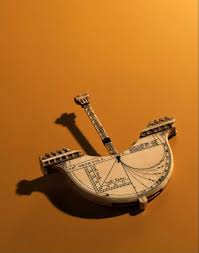
This did not stop him from creating an ivory sundial in 1524 that still exists to this day. In 1531, he was appointed as the Chair of Mathematics at Collège Royal. He was a professor there from that point until his death in 1555. Finé is remembered for his contributions to the fields of mathematics, cartography, astrology and other scientific disciplines. He made advancing approximations for the value of sundial pi with his final estimation being 245/78 (approximately 3.141025). He also made mathematical instruments, engravings for printers, maps of the world, sundials, and a great many other devices. Finé is recognized as playing an important role in the development of mathematics in sixteenth- century France. However, this is not so much for the advancements that he made in the field as it is the for the work he put into promoting mathematical teaching in France. As an educator and a writer of treatises, he taught mathematics to the generation which taught such scholars like Christopher Clavius (1538-1612) and René Descartes (1596-1650). Clavius was a member of the Vatican council that accepted the Gregorian Calendar and one of the most respected astronomers in Europe, whereas Descartes became the “father” of modern philosophy.
The Contents of the Book
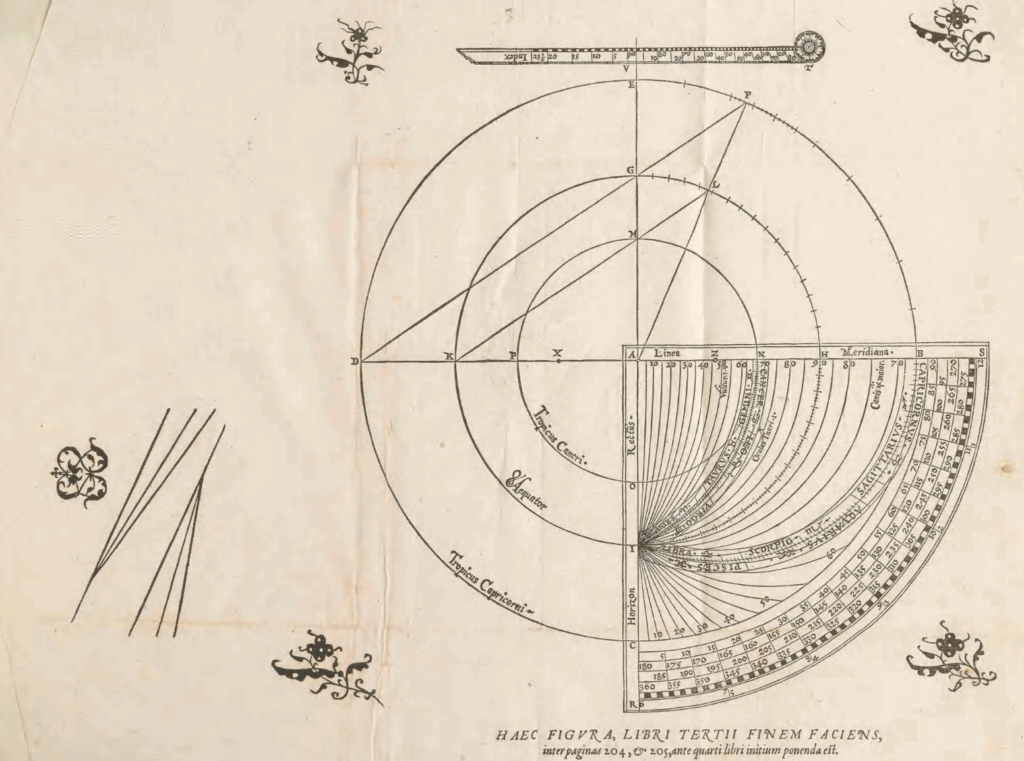
This book, De solaribus horologiis, takes some concepts and writing from Finé’s Protomathesis which was published in 1532. De solaribus horologils, published posthumously, talks extensively about sundials. He includes descriptions and steps for making both a Regiomontanus (1436-1476) dial and a ship-shaped dial with detailed diagrams inserted as well. Finé used medieval manuscripts as sources for these dials and then made corrections and advancements upon the theories surrounding them. One particularly interesting idea was the description of a portable sundial that could be used at more than one latitude and how it could be used to construct a nocturnal.
Although this does not have much to do with the main topic of sundials in this book, there were two rather thoughtful preludes to the main content of this book. First, in the “epistola”, there is an emotional dedication or letter in which what happened to Finé’schildren after his death is described. Secondly, in the section titled Typographus lectori, Guillaume Cavellat, the publisher, praises booksellers and printers while emphasizing how important the printing of scientific books is. He goes on to write about how expensive printing can be and how meticulous the work is. Finé’s family was in need of money, so his son Jean eventually had this introduction reprinted separately and sold.
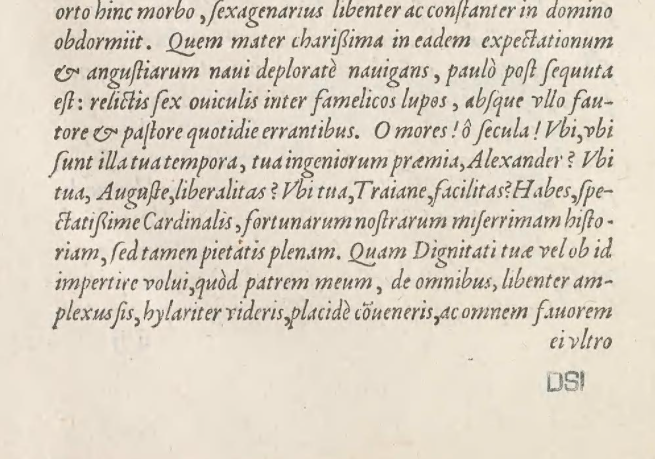
Excerpt from “Epistola”: “After three decades and more spent and devoted to restoring and explaining mathematics, not only by lecturing but also by writing. all this time waiting and begging for payment for his efforts and being mocked and put off with courtly pittances, all this time watching his family shrink and old age come upon him while the number of his published works continued to mount, having borne such indignity as unworthy, he died cheerfully and steadfastly in the Lord in his sixtieth year from a fatal disease. My beloved mother, who had sailed in the same deplorable ship of hopes and troubles, followed a short while after, leaving behind six little sheep to wander among starving wolves without a shepherd.”
There is also much to be said with regards to how the book was printed. Finé was a detailed artist who created his own diagrams and ornaments for both his books and the books of others. However, as this work was published after his death, his woodcuts and exact diagrams were not used in this piece, at least not entirely. Finé’s son, Jean Finé, improved the engravings for this book and Guillaume des Bordes created the new woodcuts needed. This edition features fifty-seven wood engravings in addition to many initials and a printer’s device (located on the title page and enlarged on the back of the final page) that were derived from wood engravings as well. Another neat piece of printing that is featured is a diagram on a large folded page at the end of the book.
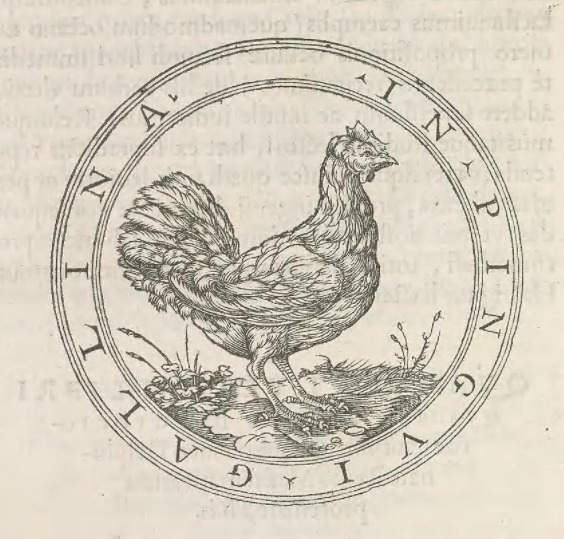
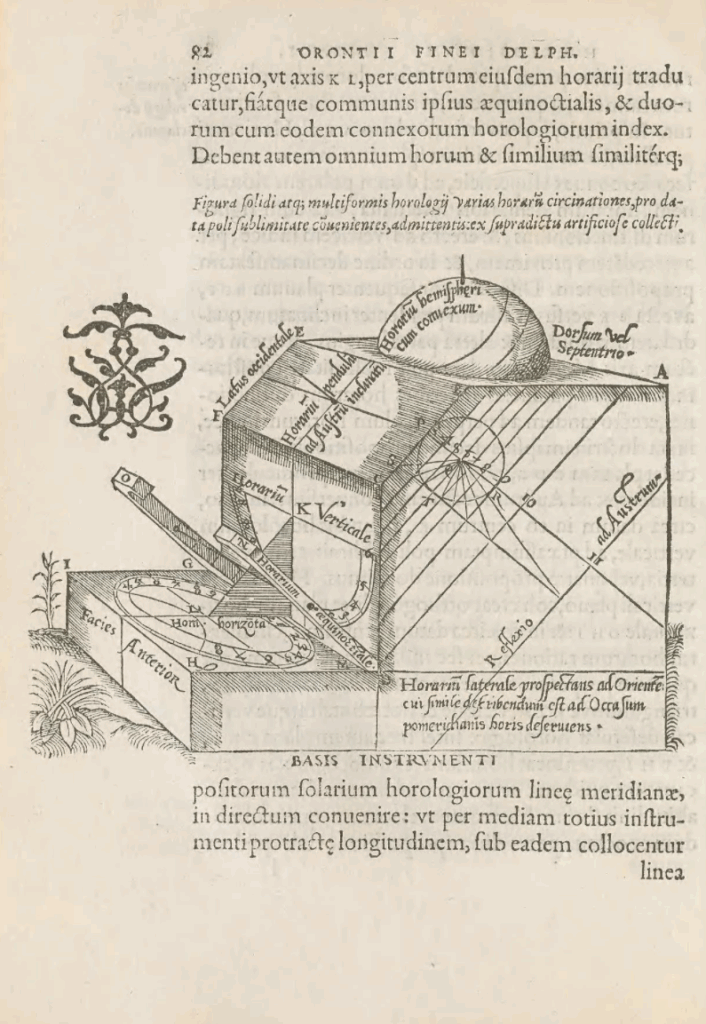
The title page (which can be seen in Figure 1), is heavily decorated. The title itself, along with the printer’s device and publishing information, is placed within an ornamented border. Decorated and zoo-anthropomorphic initials of varying sizes adorn the pages at the beginnings of chapters and sections of the book. These initials serve the purpose of breaking up the different areas of content within the text. Signature marks “a-E4” are also prevalent throughout the book in the bottom right of the right-side pages. There are 223 numbered pages with the numbering starting after the index and ending before the final page displaying the printer’s device.
The Physical State of the Copy
This copy of De solaribus horologiis is bound with a vellum cover. The cover is discolored and stained, but still appears to be largely intact when looking at the online resource. When looking at the inside cover, it is evident that the book was bound using another manuscript on the inside of the cover. I unfortunately could not deduce what manuscript this was exactly. A couple leaves of sheet music appear to have been involved in the binding process as well.
This is true with both the front and back covers. Aside from the discoloring, which appears to be from exposure to moisture, and somewhat poor looking covers (there are a couple tears/holes and some blemishes), the physical state of the book is in great condition. The pages containing the actual text of the book are in great condition, especially the further inward towards the middle of the book one goes. There has been no smearing of ink and the diagrams remain in pristine condition as well. There are some stains here and there throughout the text, but none take away from the text or hinder one’s ability to read it. There are a few areas with bits of handwriting or notes, only at the beginning and end of the book, but that will be talked about and focused on in the provenance section.
The Provenance
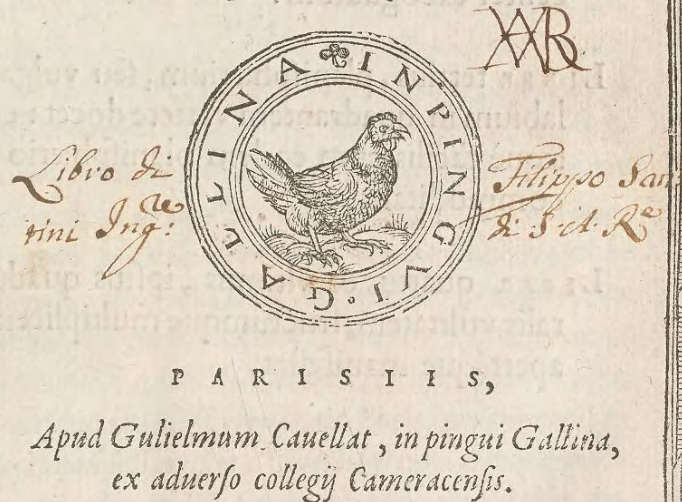
The first piece of ownership is visible on the title page. While some of it is illegible to me due to both the handwriting and the fact that it is written in French I was able to read some of it. The inscription reads “Libro di Filippo Santini…”. This translates into English as “The book of Filippo Santini”. As for the rest of the inscription and the letters in the top right of Figure 9 I am unsure as to what they mean. The letters in the top right are “AVBR” but I am unsure of what they mean. I tried to learn more about this Filippo Santini and was able to discover that he was the official engineer of the Grand Duke of Tuscany in the early 18th century.
The next piece of provenance can be found at the back of the book on one of the final pages. On the page after the fold-out diagram at the top of the page the inscription shown in Figure 10 is visible.
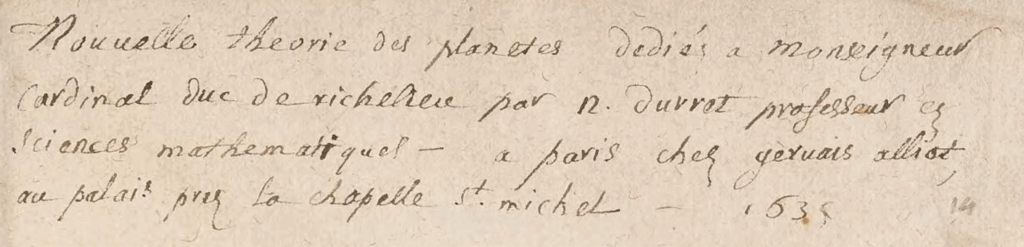
While difficult to read because of the age of the page and ink the handwriting and the fact that it is French I was able to translate and learn from some of this inscription. I will translate what I can and insert ellipses where I am unsure of the writing. The marginalia reads “Nouvelle theorie des planetes dedies a monsigneur cardinal duc de richelieu par…professor…sciences mathematiques-a paris chef…au palais prif la chapelle st. michel-1635”. I translated this into English as “New theory of planets dedicated to (or at) lord Cardinal Duke of Richelieu through…professor…sciences mathematics-at Paris chief…of the private palace the Chapet St. Michael-1635”. It is also possible that the word after “chief” could be “manager”. Given what I could decipher the handwriting dedicates a completely different book titled Nouvelle théorie des planètes o the Duke of Richelieu also known as Cardinal Richelieu by the author Noël Duret a professor of sciences and mathematics. The inscription then goes on to say that this unrelated book was sold outside Chapel St. Michael and possibly describes one of their appointments as “chief manager”. The inscription also states that this book was published in 1635. This inscription offers little incite into who exactly wrote this inscription or when just that they felt the need to write the title and details of Nouvelle théorie des planètes on a back page of this book.
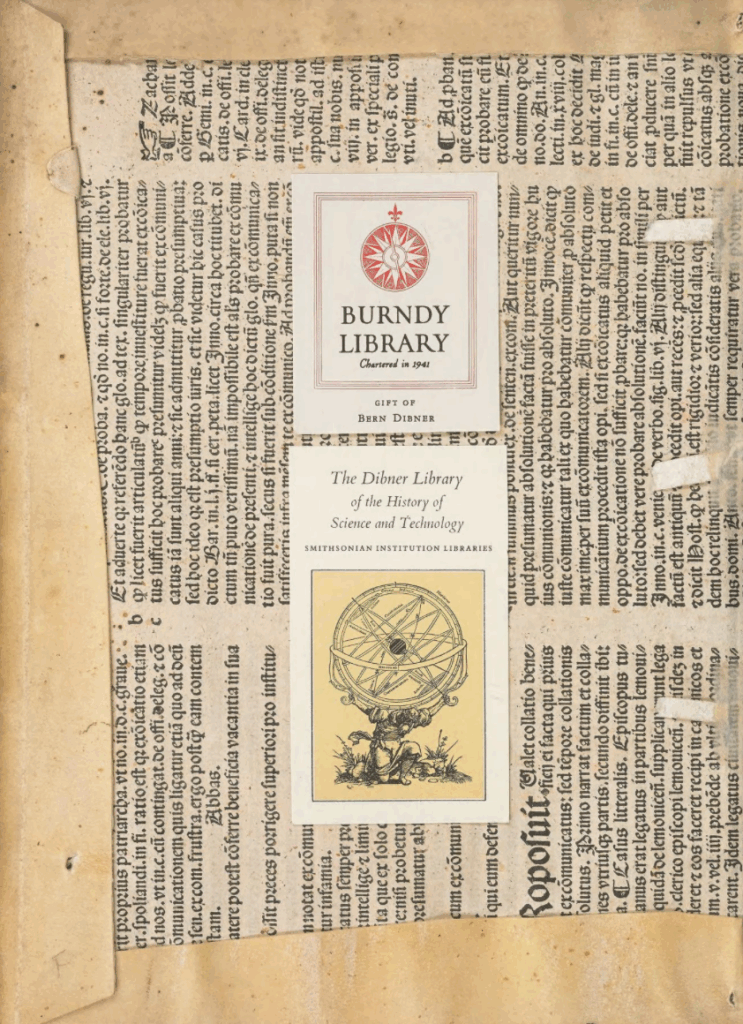
The most complete and certain pieces of provenance for this book can be found on the inside of the front cover. As can be seen in Figure 11 there are two bookplates on the inside of the front cover. The top bookplate says “Burndy Library. Chartered in 1941. Gift of Bern Dibner.” Bern Dibner (1897-1988) was an electrical engineer known for being a historian of science and technology. Dibner began travelling around Europe in 1936 and started buying his first reference books during this time period. Eventually it became a passion for him and he was acquiring thousands of books and works that dealt with the sciences or technology. By the mid-1960s his collection had eclipsed 40 000 volumes. He even acquired entire libraries of famous scientists such as Alessandro Volta and Louis Pasteur. It can be assumed that this copy De solaribus horologiis was acquired by Dibner sometime between the late 1930s and the 1960s. He then gifted it to his own library the Burndy Library. That brings us to the second bookplate which reads “The Dibner Library of the History of Science and Technology. Smithsonian Institution Libraries.” In the mid-1970s Dibner donated a quarter of the Burndy Library’s volumes to the Smithsonian. Shortly after this the Dibner Library of the History of Science and Technology was established and gave the Smithsonian its first rare book collection. It can then be assumed that this copy of De solaribus horologiis was likely donated to the Smithsonian’s new collection at this point as well. I attempted to look through the Smithsonian’s archival records of when it obtained its current possessions. Unfortunately the years of “circa 1930-1993” are lumped together on the Smithsonian website and gave no clear answer as to when this exact copy was acquired. Based on the information I was able to find I believe that my conclusion on the matter is likely what happened. Additionally there is a stamp of “DSI” at the bottom of one of the “Epistola” pages that is likely another mark of ownership that signifies “Dibner Smithsonian Institute”.
The final pieces of provenance are an assortment of numbers letters and a single illegible word that have been handwritten in pencil or ink.
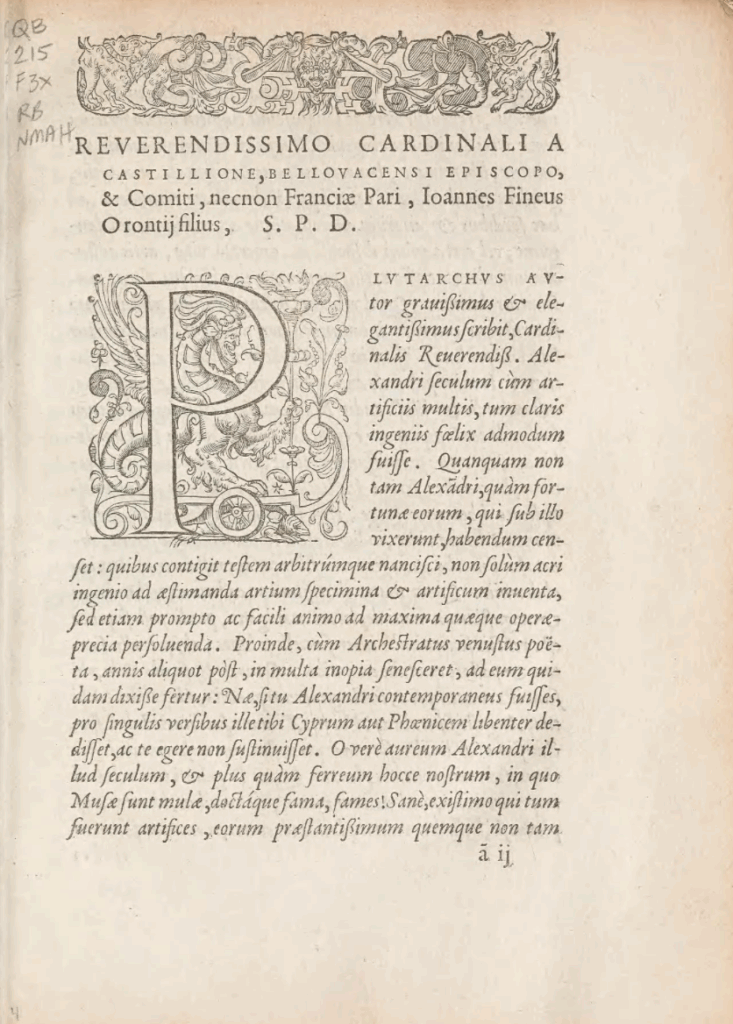
top left corner of image
with unknown meaning
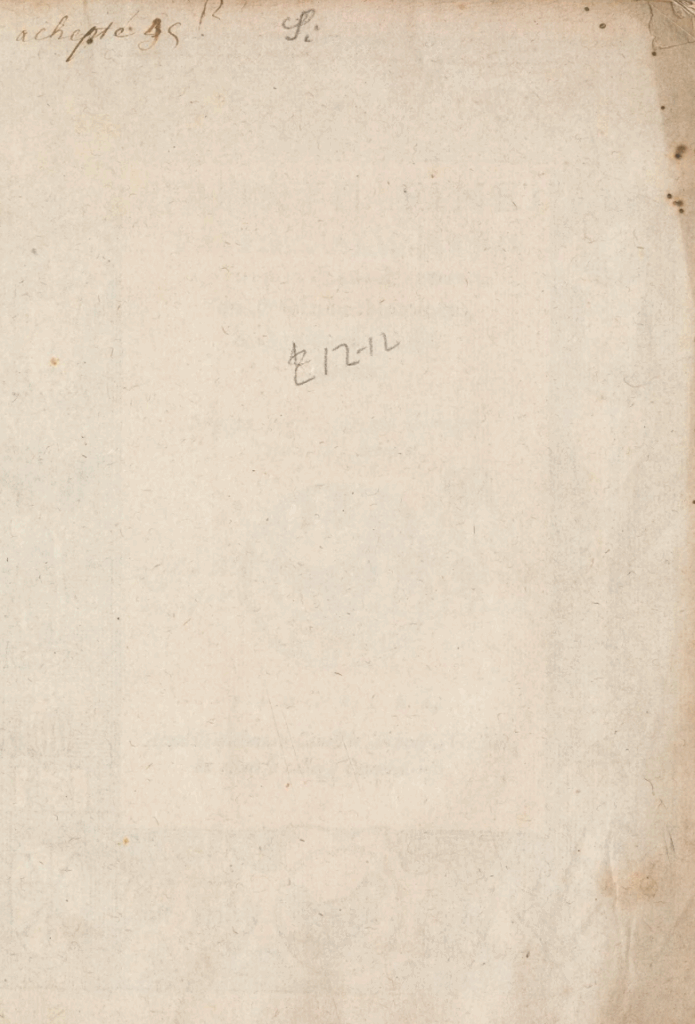
marginalia
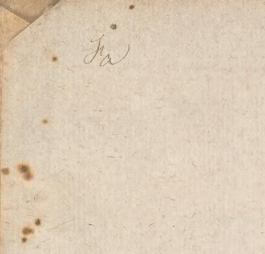
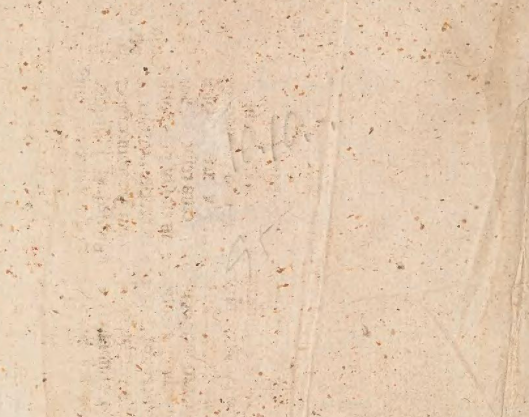
These images all display some numbers and letters on various different pages. It is likely that this book was assigned these number/letter codes by the different libraries and connections that it has been a part of over the years. However I cannot be sure as I am not knowledgeable enough in the library code systems that this book may have been a part of. They could also have been made by the publisher to differentiate copies of this book. If you look at Figure 7 there is also a number written in red ink on the front cover. Although I was glad to see these signs of ownership as I hoped they would help me piece together the provenance of this copy of De solaribus horologiis I was unable to use them to add much to what I have already compiled.
Summary of Provenance:
1560: This copy was published
Late 1600s?-mid 1700s: Owned by Fillipo Santini for some unknown amount of time during this period. (It is also possible that Santini owned it after Richelieu, but, due to the location of Santini’s signature and the
handwriting, I found it less likely)
Mid 1700s?-late 1700s?: owned by someone who made the inscription about the book Nouvelle théorie des planètes on one of the back pages.
1930s-1960s?: Acquired by Bern Dibner and gifted by him to his Burndy Library
mid-1970s: Acquired by The Dibner Library of the History of Science and Technology at the Smithsonian from the Burndy Library.
1970s-present: Located at the Dibner Library of the History of Science and Technology
Analysis
One of my biggest takeaways from this copy of De solaribus horologiis is that I have been very surprised with how few signs of ownership were found. Aside from the bits and pieces of marginalia that I deduced were identification codes for either the publisher or the libraries who have had a part of this book’s history, there are really only four signs of ownership. Those signs are each of the bookplates on the inside cover, the signature by Filippo Santini, and the inscription involving Cardinal Richelieu at the end of the book. Unfortunately, when a book is nearly five centuries old, this little information leaves a lot of puzzle pieces still missing with regards to the provenance of this copy. If someone knows more about this than I do, I would love to connect with them and learn more about where this book has been and whose hands it has passed between. In terms of the actual content of this book, I was limited as to how much I could actually get out of it due to it being written in Latin. However, from what I was able to translate or research about the contents, I was very intrigued by what I could learn about sixteenth-century sundials and their construction. What interested me even more was how detailed and intricate the diagrams experienced. The meticulous detail put into these carefully crafted engravings must have been most impressive. Although there was no rubrication or color in this copy, I still found myself increasingly drawn into this book by the diagrams and images on the pages. While the contents of this book may not be helpful or practical in today’s world, the glimpse into history that it provides us undoubtedly is. Regardless of how interested one is in sundials, much can be learned about history, both of this specific book and in general, through an in-depth analysis of this copy of De solaribus horologiis.
Sources
https://blog.lib.utah.edu/book-of-the-week-de-solaribus-horologiis/
http://galileo.rice.edu/Catalog/NewFiles/fine.html
https://mathshistory.st-andrews.ac.uk/Biographies/Fine/
https://link.springer.com/chapter/10.1007/978-3-030-30833-9_8
https://historical.ha.com/itm/books/science-and-technology/oronce-fine- orontius-finaeus-delphinatus-de-solaribus-horologiis-and-quadrantibus-libri-quatuor/a/6127-45188.s
https://library.si.edu/libraries/dibner-library-history-science-and-technology/history
Created by: Luke Hollenbaugh. Fall 2020. HST 475 @ MSU
