
“Observations on popular antiquities: including the whole of Mr. Bourne’s antiquitates vulgares, with addenda to every chapter of that work: as also, an appendix, containing such articles of the subject, as have been omitted by that author”
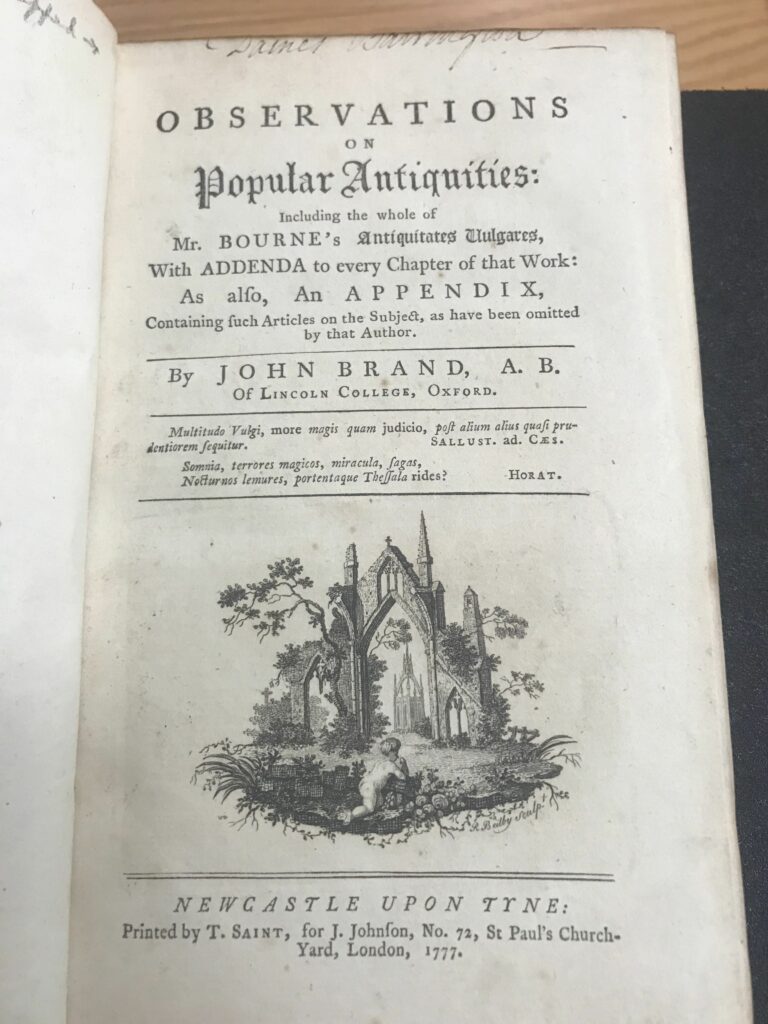
John Brand, A.B. – printed in St Paul’s Church-yard (London) by T. Saint in 1777 for J. Johnson.
MSU call #: DA110.B82 1777 c.2.
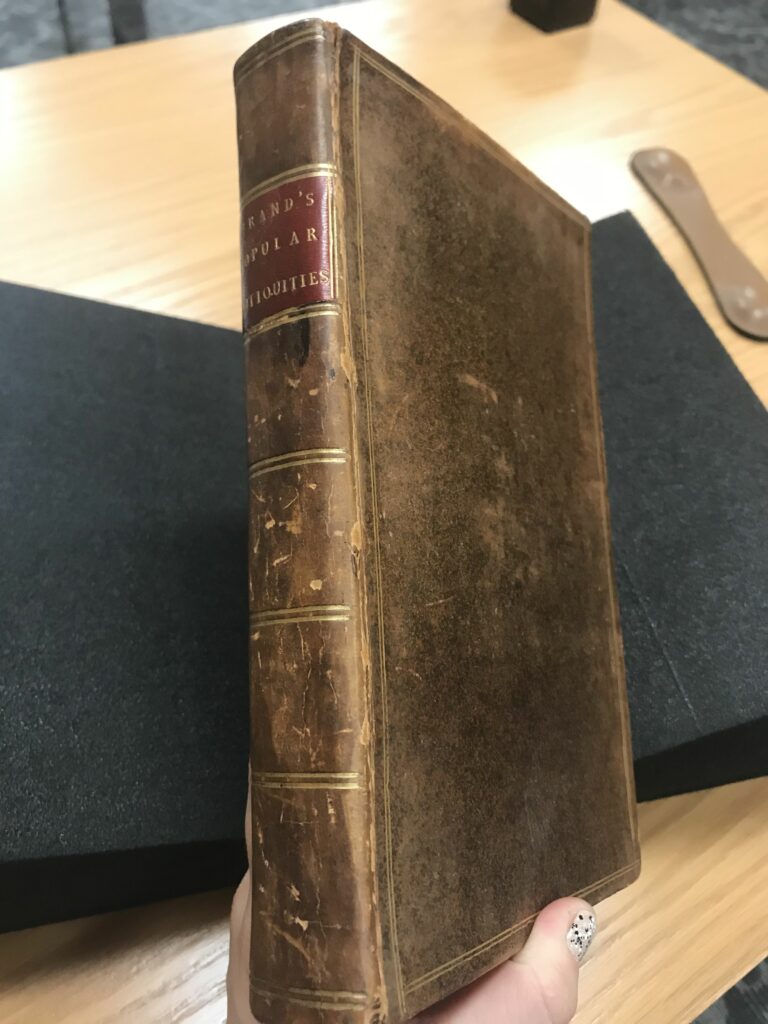
Overview of the book and its condition
- Leather covered board cover
- Inner papers have oily stain or water damage.
- Plate printed, roman type.
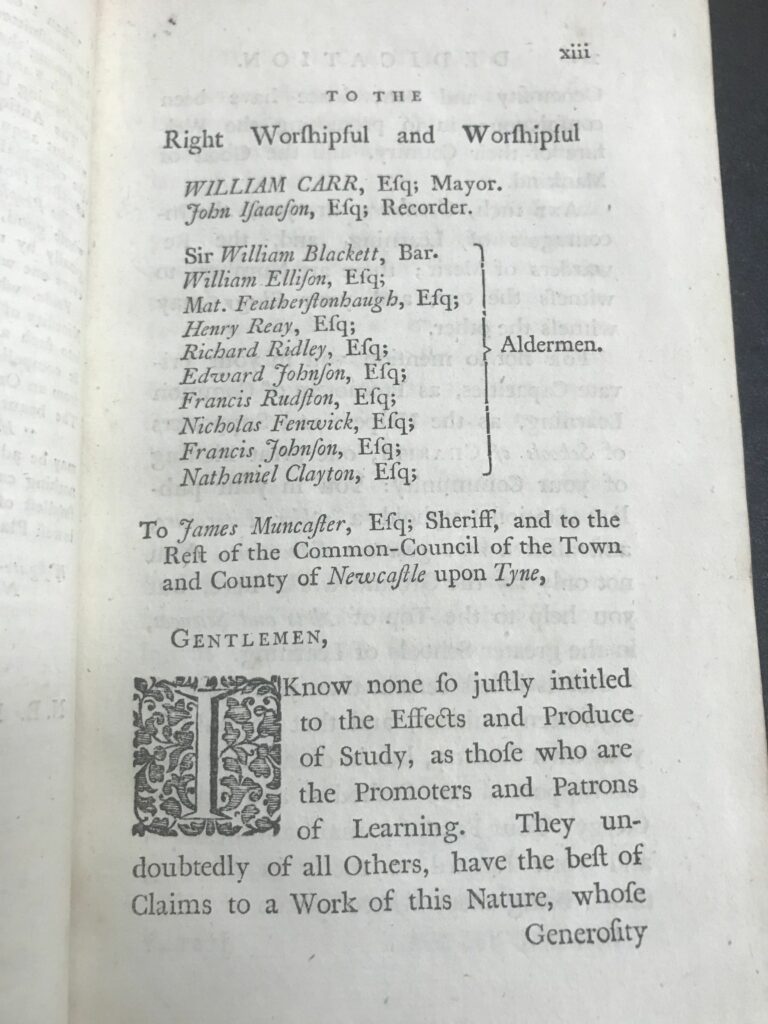
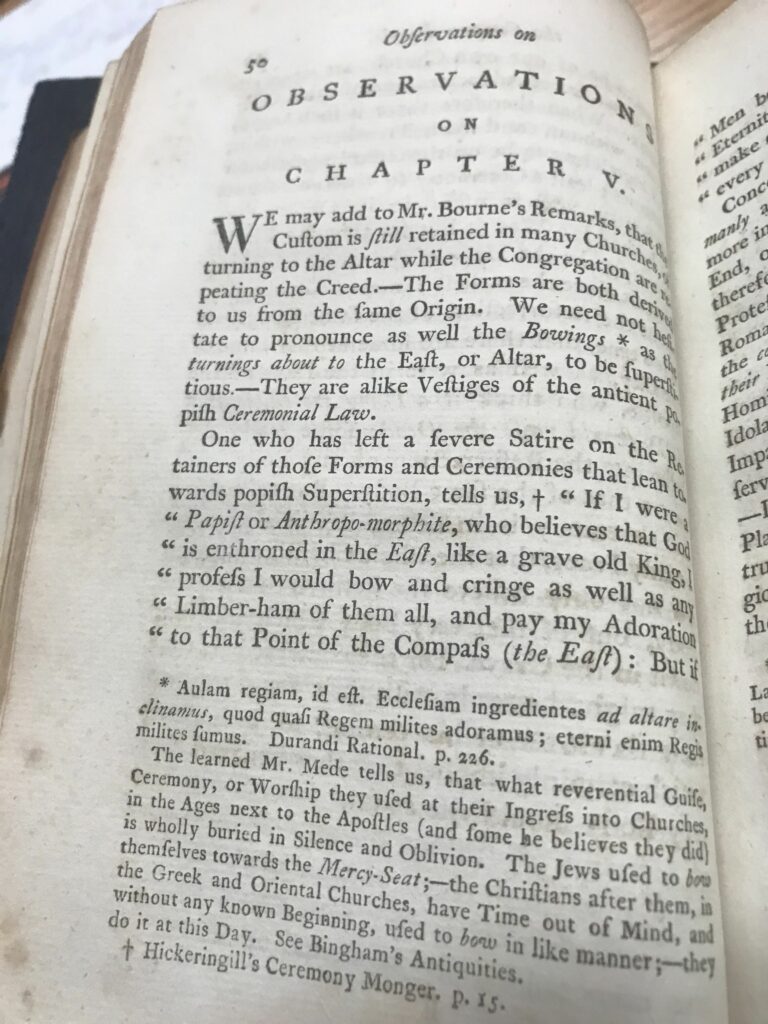
- There are some capital letters that are more ornate, they show a leafy
pattern. - Some oil spots on the inner pages.
- Black ink, no other colors or rubrication.
- No evidence of corrections or typesetting mistakes. Last 4 pages left
blank. - Includes an advertisement for other books, appendixes, index, errata, foreword, dedication, and preamble.
- Both Greek and Latin typefaces were used in addition to English.
The Author
John Brand (1744-1806) was an English antiquarian and writer, he published poetry, sermons, and commentary on antiquity publications. He graduated with a B.A. from Lincoln College, Oxford in 1775 after being previously ordained in Northumberland. His career culminated in becoming a domestic chaplain to the Duke of Northumberland and elected resident secretary of the Society of Antiquaries until his death.
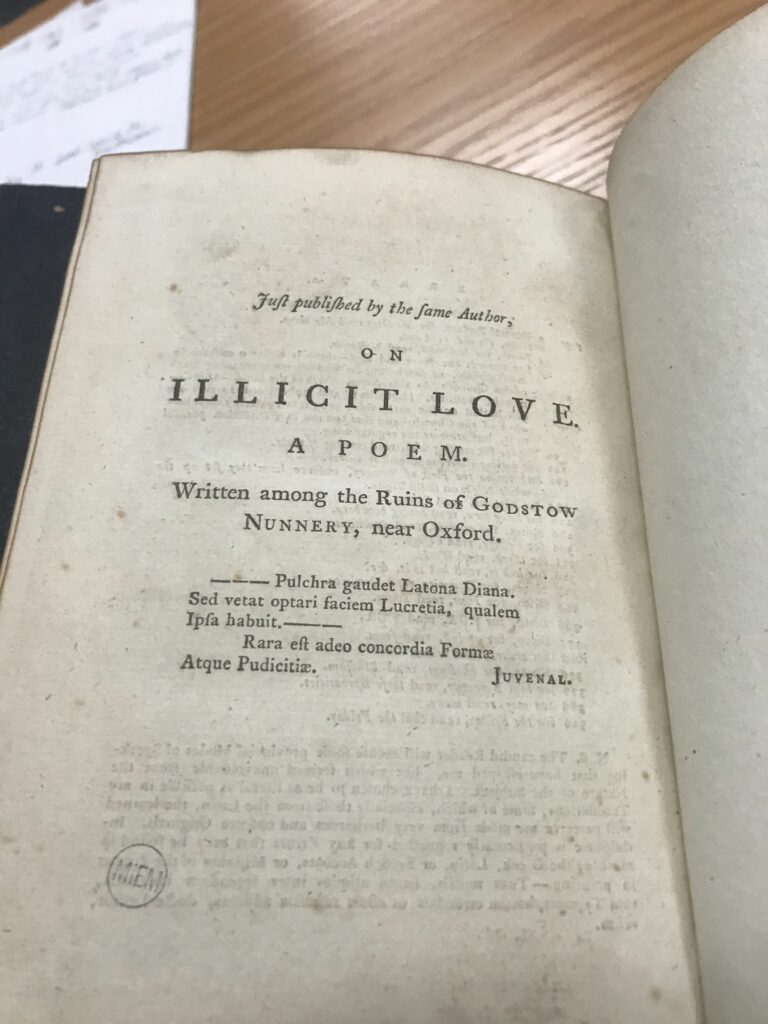
This book is a commentary on the writings and antiquities of historian Henry Bourne (1694-1733). Antiquities Vulgaris was his best-known publication and recounted English folk customs/artifacts and recommended them for abolishment due to their common nature. John Brand assesses Antiquities Vulgaris with a critical and dry tone, he adds in more information about later-discovered practices as well as appendixes and an index that were not included by the original author. Brand enjoyed correcting and adding to previous works, he published mainly papers but also a few books in this form.
Provenance of the text
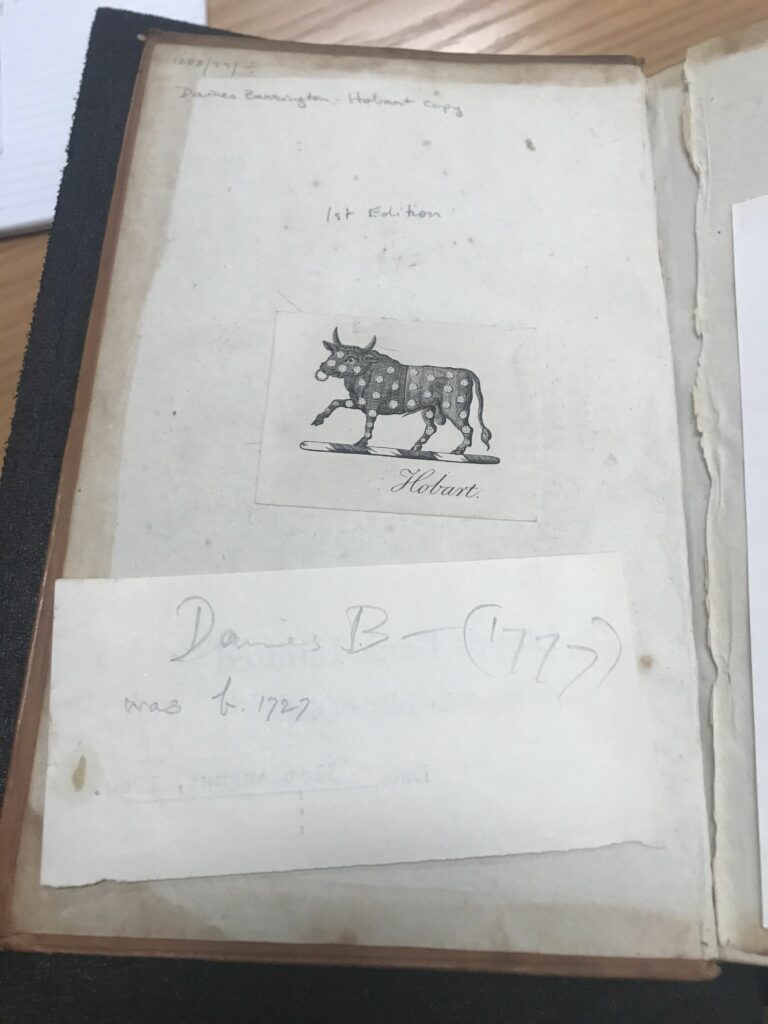
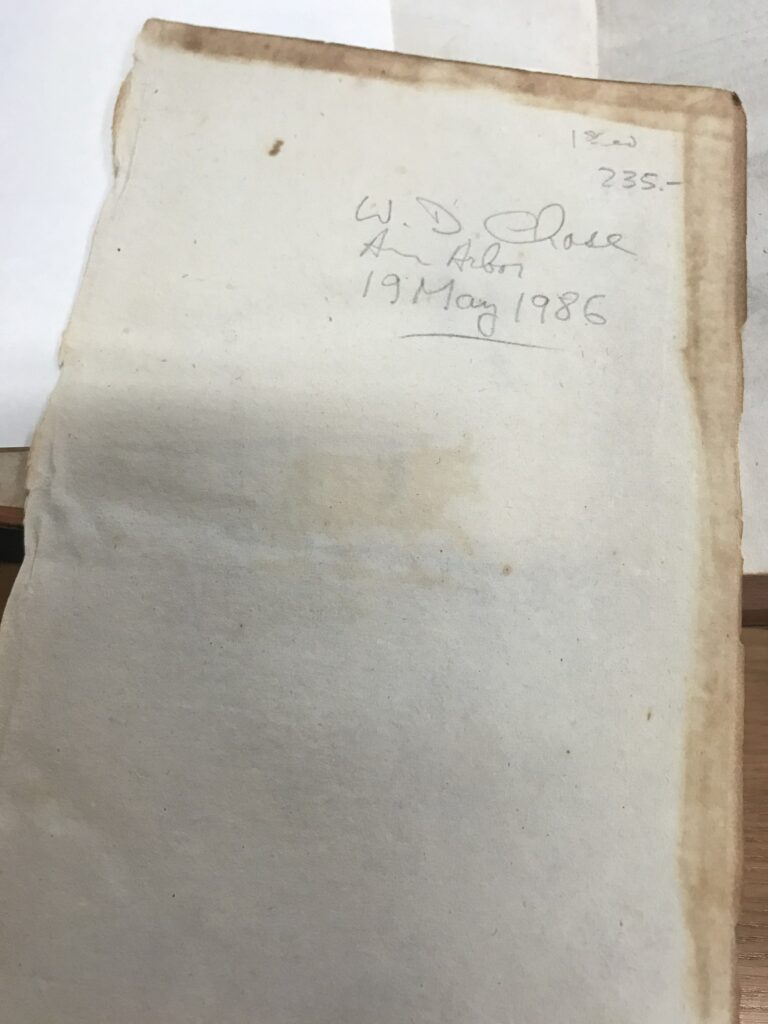
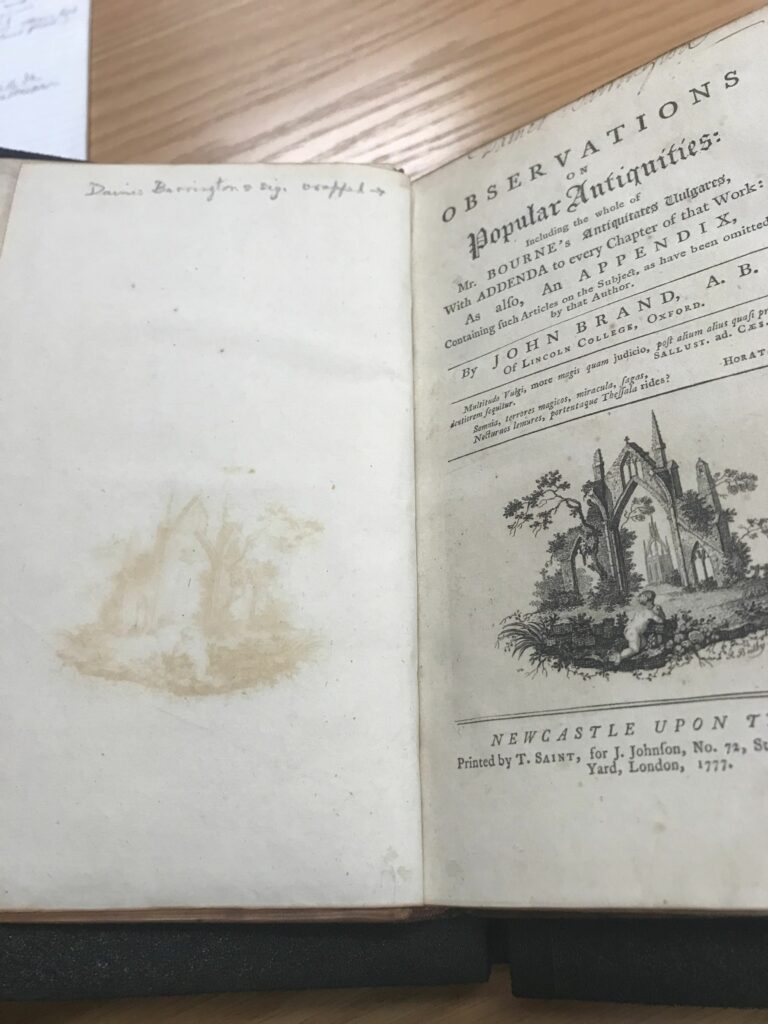
Hobart book plate in front shows a bull with spots. “1283/77/+ danes barrinton – Hobart copy” in pencil. Also W.D. Chase Ann Arbor 19 May 1986 and 1st ed 235.- on first page. That page is loose from wear.
Daines Barrington signed the title page in pen, though it looks like the book has since been cut down or re-bound. There is a pencil mark opposite to the title page that points out the signature. The ink from the illustration of a R. Beilby sculpture was imprinted on the opposite page below the pencil note about the signature, looking like a watermark but is only a mirrored in bleed. There are two pieces of paper in the front; one blank, one Lloyds Bank Limited card from Cambridge, with “Daines B – (1777) was b. 1727. written on the back.
Ownership:
Joseph Johnson (1738-1809) was a notable London bookseller and publisher. He was not truly successful until his shop in St. Paul’s Churchyard became firmly established (around 1770, after a fire destroyed his old shop) and by the end of the 1770’s he was the largest publisher in St. Paul’s. Post-1770, he began to publish revolutionary materials for the American and French revolutions (He was the first person to publish Benjamin Franklin’s collected political works in England) and became a hub for more radical publications. He also contributed to the children’s literature revolution by becoming one of the first houses publishing books aimed at children’s education. His career as a successful publisher ran out as the publishing revolution pushed out independent publishers around the turn of the century and his age made him neglectful of his businesses. But Johnson managed to publish more books in more fields than any other publisher of the time over the course of his career.
Daines Barrington (1727/28-1800) was an English lawyer, writer, antiquary and naturalist. He wrote on many natural science topics as well as historical events, and held various legal offices until his death.
Henry Hobart (1774-1846) was an ordained priest and son of the Earl of Buckinghamshire. His greatest success was his appointment as Dean of Windsor, which made him the spiritual head of the monarchy. He held the office until his death and served 4 monarchs in that time.
W.D. Chase (1922-2020) was a librarian in Ann Arbor, MI. He was an assistant curator at the U of M special collections and was active in the Special Libraries Association as Editor and later as president of its Newspaper Division. His signature has appeared in other provenance works for this class.
Note: This specific edition of the text was owned by W.D. Chase before coming to MSU which is interesting because U of M has a copy of this text that was printed by another printer for the author.
Analysis
My assessment of the book is that it is not particularly useful content-wise, but is valuable as evidence of print publishing in the late 1700’s. The cultural practices noted in the book are obfuscated by the religious lens of the time, so it’s hard to tell if the practices noted are actually good evidence of historical customs. It’s changed hands a few times times, but there are no edits to the text of the book or any provenance marks besides the front and back. There are no plate print errors that I could find, no margin notes or redactions. It’s in decent condition for its age, the only true damage being the staining and the ripped front page. The ownership of the book is the more interesting part because it was owned by people that are known to history. I think that the ownership of two copies in Ann Arbor is fascinating and the fact that they can be differentiated by their provenance shows how valuable the study is.
C Widmann, HST 475, 11/8/2020
