
Identification
Title: English-Men For my Money: Or, A Pleasant Comedy, called, A Woman will have her Will.
Author: William Haughton
Publisher: W. White (William White), dwelling in Cow-Lane
Place of Publication: London, England
Year of Publication: 1616
MSU Library Call Number: Online
Archive Call Number: 39999052949276
USTC: 3007348
https://archive.org/details/englishmenformym1616haug/mode/2up
Description
Physical State of the Book
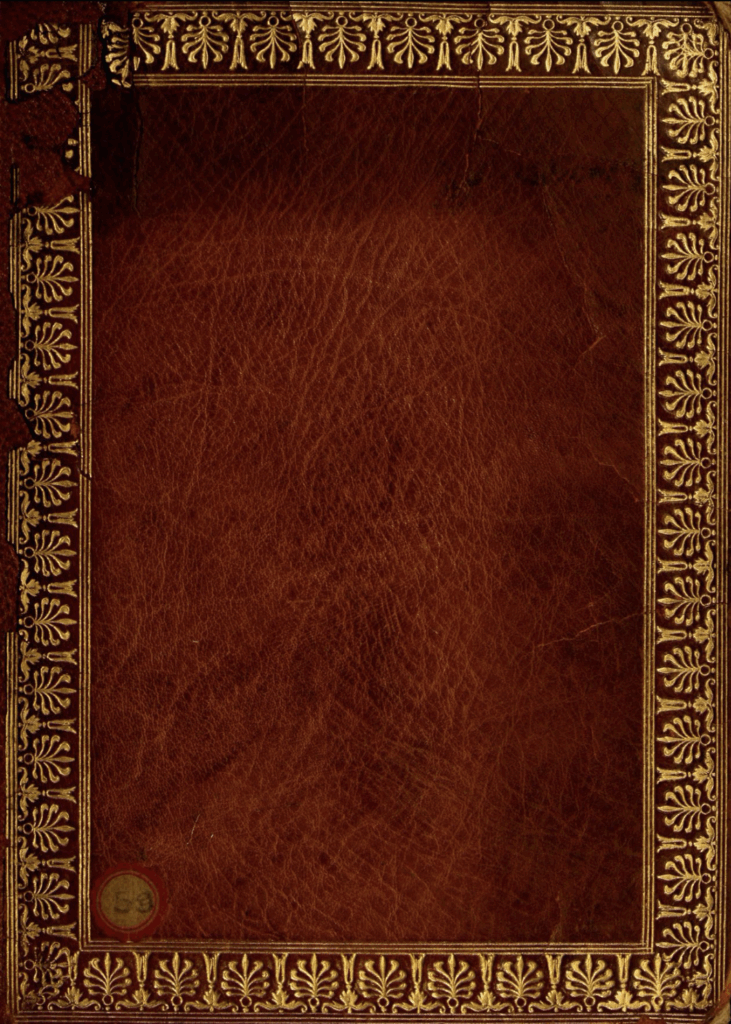
Book has worn edges and binding indicating signs of use but is in overall good condition. Ink is still black and legible, indicating a good printing method was used to create this book.
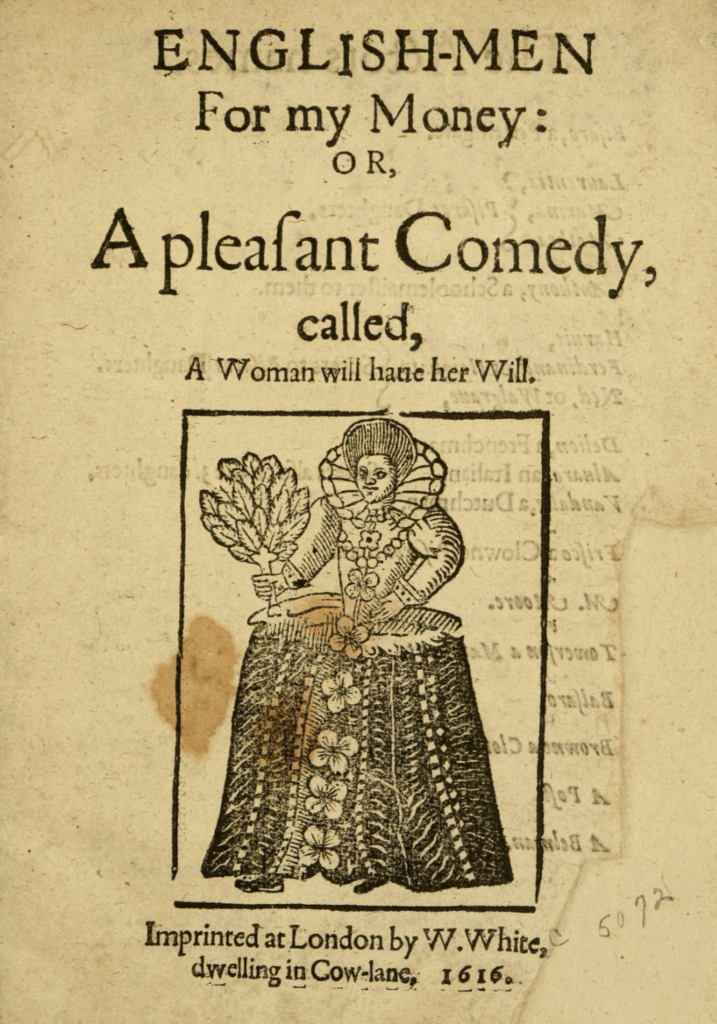
Title page has a large environmental marking that is present for three more pages. Woodcut printing of the title of play is in bold lettering above an image that presents an Elizabethan woman holding fan. Under the image the printer is listed as “Imprinted at London by W. White, dwelling in Cow-lane, 1616.”
Ink bleeding can be seen throughout the book and is prevalent on the title page, which makes reading the content difficult at times. There is no marginalia throughout the book. Twelve blank pages appear after the ending of the play’s content and hold no annotations.
Back-cover pastedown contains a Barton Library Bookplate and Boston Public Library classification label.
Content of the Book
English-Men For my Money: Or, A Pleasant Comedy, called, A Woman will have her Will is an Elizabethan era stage play. It is a comedy that also includes moments of verse.
The play is set within the contemporary merchant class of London. The Portuguese-born merchant and moneylender Pisaro has three half-English daughters, Laurentia, Marina, and Mathea. The play provides satirical commentary of the daughters choosing between two trios of suitors, one foreign and one domestic. The foreigners are Delion, a Frenchman, Alvaro, an Italian, and Vandal, a Dutchman. Pisaro favors the foreigners because of their wealth, but his daughters prefer their English suitors. Frisco the clown is used throughout the play to provide comedic relief for the audience. In the end, as the title indicates, the Englishmen win their brides.
Linguistic play, courtship scenes, disguises, and cross-dressing, provide for the perfect Elizabethan comedy. It also compares to Shakespeare’s play The Merchant of Venice, a comedy that follows the Venetian merchant Antonio as he tries to settle his debts.
Author
William Haughton was an English playwright in the age of English Renaissance theatre. His date of birth is unknown, but we know he died in London, England in 1605. What little is known about Haughton comes from Philip Henslowe, the proprietor of the Rose Theatre, and his writings. Henslowe’s papers refer to Haughton as Hawton, Hauton, Haughtoun, Haulton, Howghton, Horton, Harton, and Harvghton-a prime example of the flexibility of Elizabethan era English.
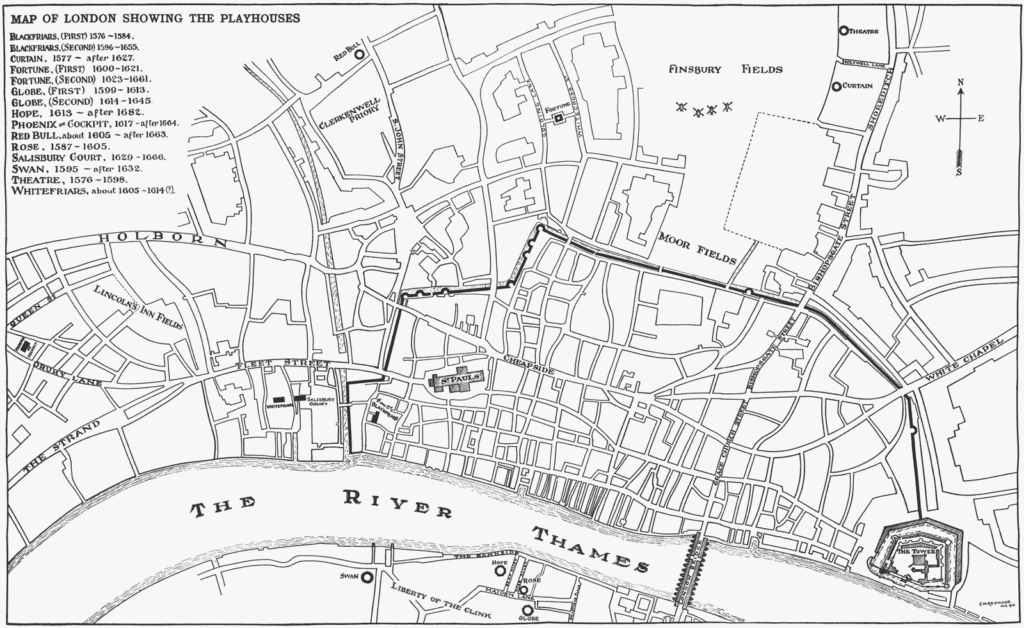
Haughton wrote all of his known work for Henslowe, which were made for production for the theatre groups Admiral’s Men and Worcester’s Men. While producing work solely for Henslowe, Haughton collaborated with other famous playwrights such as Thomas Dekker, Henry Chettle, and John Day. Most notably he contributed almost half the text of The Spanish Moor’s Tragedy, better known as Lust’s Dominion.
It is thought he may have obtained an M.A. from Oxford a year before his death because a William Haughton is recorded as doing so, but this is disputed by historians.
Although little is known about Haughton we still know that he was important to Elizabethan era theatre. English-Men For my Money: Or, A Pleasant Comedy, called, A Woman will have her Will is cited as the first city comedy, which is a comic drama characterized by its contemporary urban subject-matter and its portrayal, often satirical, of middle-class life and manners.
Provenance
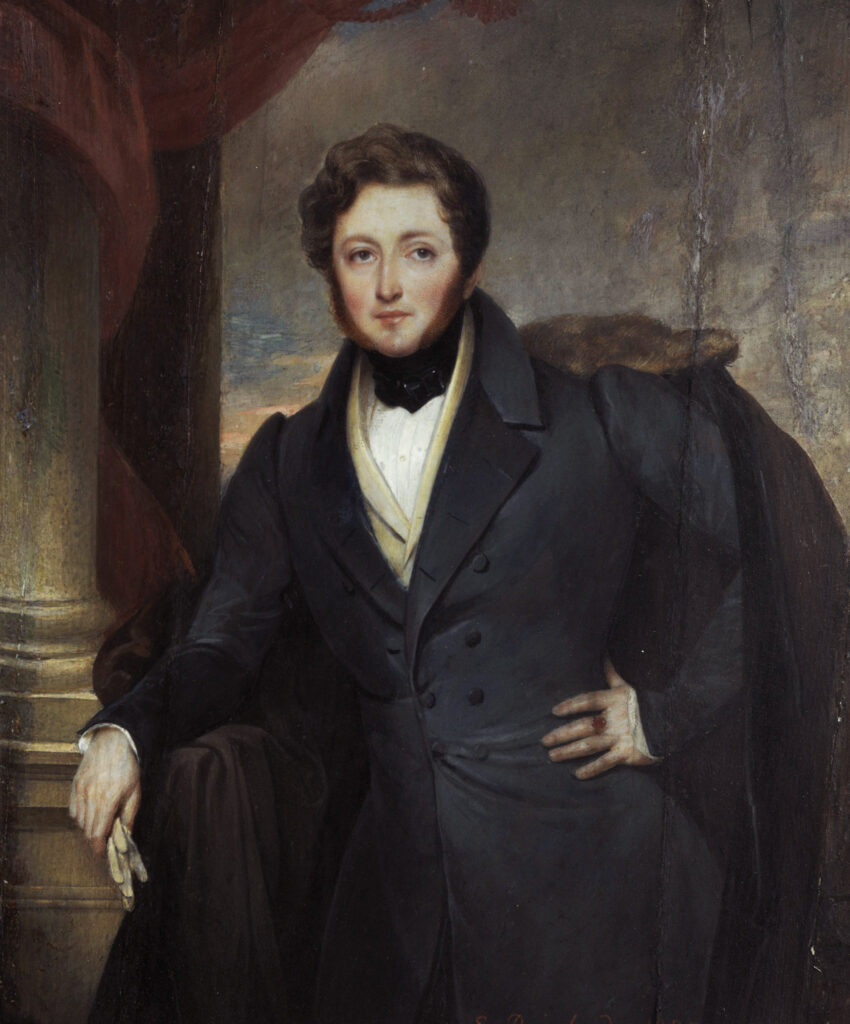
Thomas Pennant Barton was an American diplomat and bibliophile who is primarily remembered for collecting books by and relating to William Shakespeare and English drama between 1834 and 1869. Four years after his death, Barton’s collection was acquired by the Boston Public Library, where it has remained ever since.
While he was alive Barton also wrote extensive catalogues as well as An Elegie Upon the Death of the Noble and Vertuous Douglas Howard, which is a rework of the famous English poet, Edmund Spenser.
Barton’s primary collecting interest was in the works of William Shakespeare and, in particular, in the early quarto and folio editions of his plays and poems. Barton acquired many rare and early Shakespeare editions including 45 play quartos, nine of which were issued during Shakespeare’s lifetime, all four seventeenth-century folio editions, all nine of the Jaggard/Pavier quartos (False Folio), and several anthologies and poetic miscellanies containing Shakespeare’s poetry.
Barton’s collection has a large amount of Early Modern Period pieces, containing hundreds of quarto editions of English playbooks by playwrights including Christopher Marlowe, John Lyly, Thomas Kyd, Ben Jonson, Thomas Middleton, John Fletcher, and Thomas Heywood, among others. He also amassed substantial selections of French, Italian, Spanish, and German literature and belles-lettres.
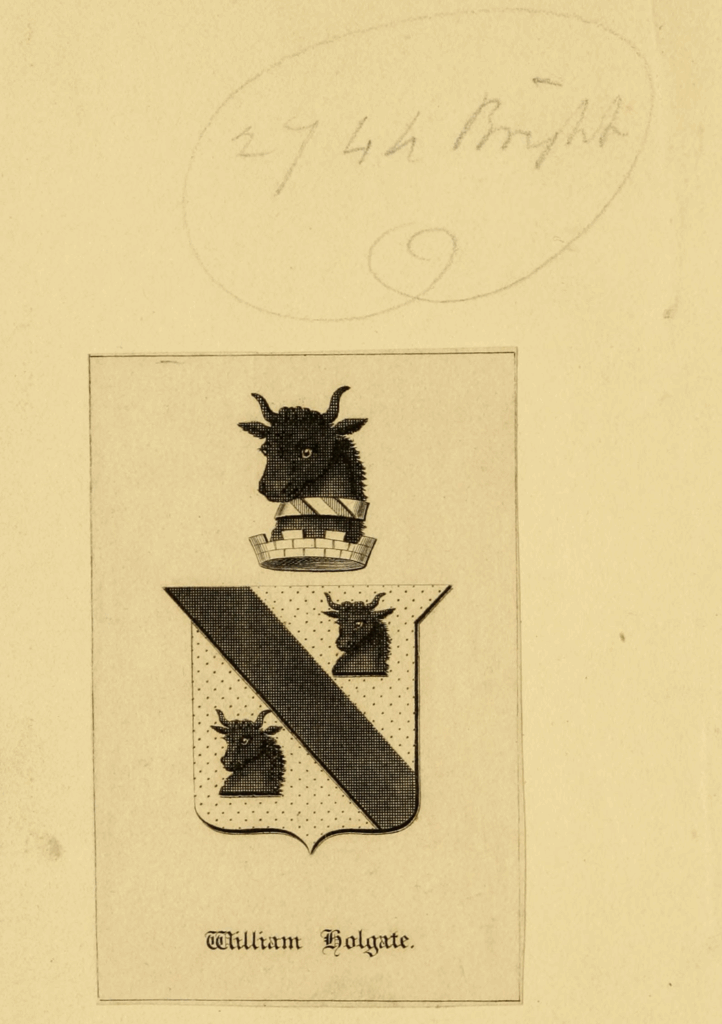
Front pastedown has a bookplate with three bulls and the name William Holgate, which looks to be a family insignia. Above the bookplate there appears to be a bookseller’s mark or code circled that reads 2 47 h and illegible writing in pencil.
The crest belongs to William Holgate Esq. of the General Post Office. He
lived in London and died in 1846. William Holgate owned an extensive collection of rare books that included works of Shakespeare and other early modern works. English-Men For my Money: Or, A Pleasant Comedy, called, A Woman will have her Will was purchased in the second day sale of William Holgate’s collections on June 9, 1846.
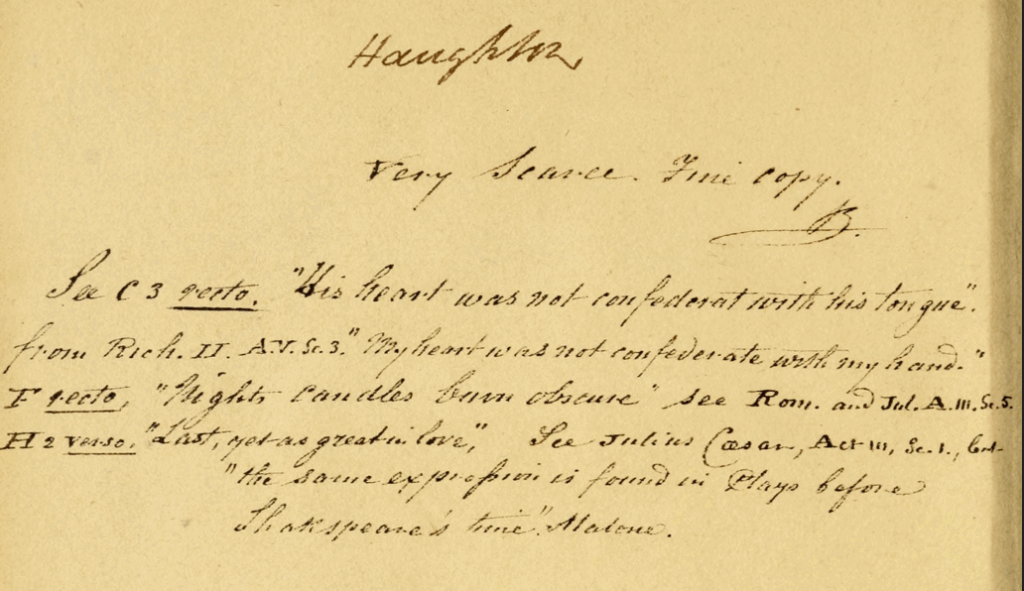
Before the title page is an ownership inscription and annotations made by the former owner, Thomas Pennant Barton, which contains echos of phrases from Shakespeare’s works comparing them to English-Men For my Money: Or, A Pleasant Comedy, called, A Woman will have her Will:
- Haughton
- Very Scarce. Fine Copy. Followed by cursive B. as a signature (last initial of former owner, Thomas Pennant Barton)
- See C 3 recto “His heart was not confederate with his tongue.”
- from Rich. II. A.V. See. 3. “My heart was not confederate with my head.”
- Frecto “Nights candles burn obscure” see Rom. and Jul. III. Sc. 5.
- H 2 verso “Last, yet-as great love,” See Julius Caesar as, Act-III, Sc. 1, (illegible)
- “the same exposition is found in plays before Shakespeare’s time.” Malone.
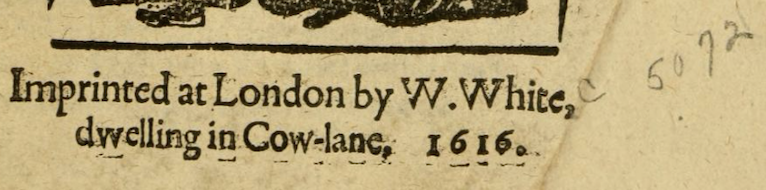
“Imprinted at London by W. White, dwelling in Cow-lane, 1616.” C5072 is inscribed on the right bottom corner of the page, another bookseller’s mark or code. 1616 is also the year Shakespeare died.
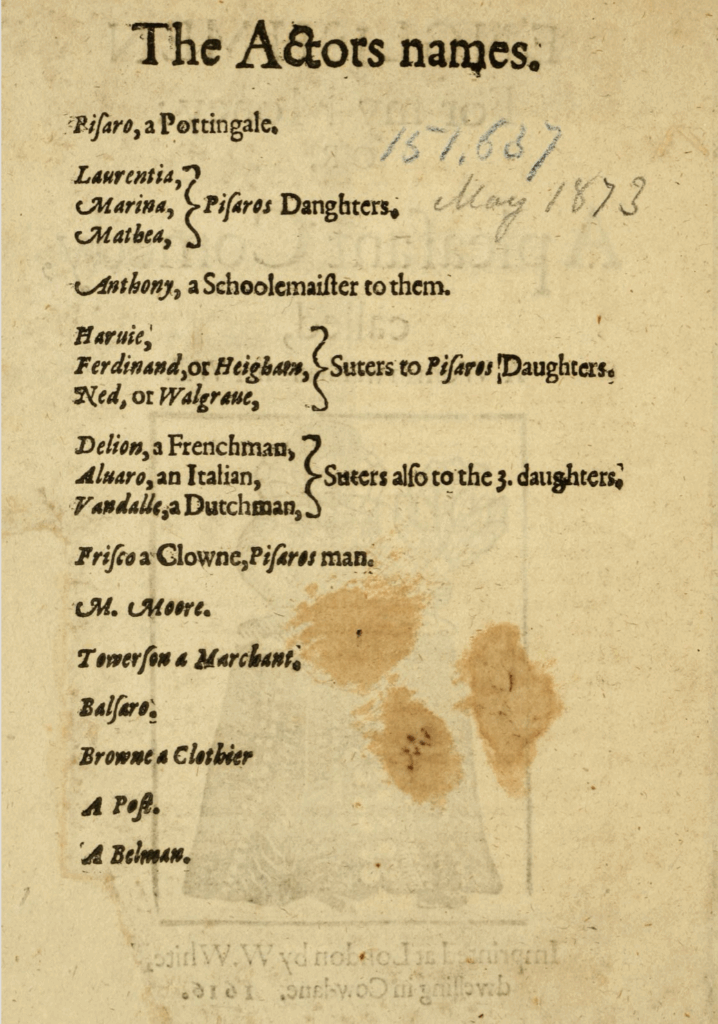
“The Actors names” page contains more markings, 151.687 and under it in pencil May 1873, which is the accession date from which the Boston Public Library obtained the book.
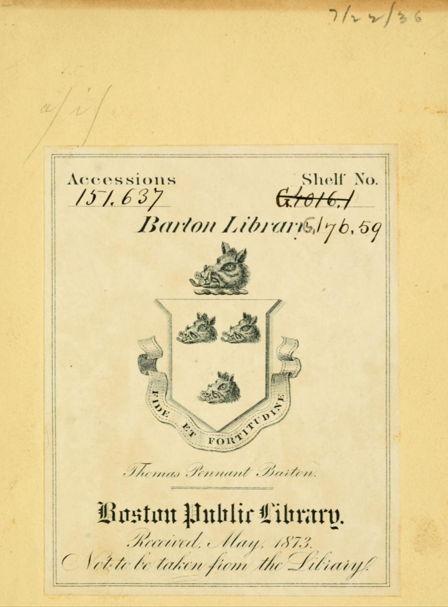
Barton Library Bookplate and Boston Public Library classification label. Contains the accessions number, 151.637, an original shelf number crossed out and new that reads G.lyb.59. Holds the Barton Family crest, which has four hogs and in Latin reads “Fide Et Fortitudine” which translates to Faith and Fortitude. Underneath the crest Thomas Pennant Barton appears. Boston Public Library is labeled underneath the crest and Thomas Pennant Barton’s name and an inscription reads “Received May, 1873. Not to be taken from the Library.” Top right corner of the back-cover pastedown has the date of 7/22/36 written in pencil.
Analysis
Being that the only inscriptions are found at the beginning and end of the book and understanding Thomas Pennant Barton as bibliophile, we can infer that this book was intended to become a part of his vast collection. We can also infer that Barton used this book to compare its contents to that of Shakespeare’s works. This is why the book is in such great condition and we find minimal annotations and no marginalia. The book was meant to be preserved for future generations. There is value in the content, but the ownership and the history of the book is the more interesting part.
Works Cited
“Barton, Thomas Pennant (1803-1869) Collection”. Boston Public Library. https://www.bpl.org/archival_post/barton-thomas-pennant-1803-1869-collection/
Chambers, E. K. The Elizabethan Stage. Oxford, Clarendon Press, 1923; Vol. 3, p. 334. “Catalogue of the… library of… William Holgate… which… will be sold by auction by messrs. S. Leigh Sotheby & Co. on June 8th and three following days”. Holgate, William. 1846.
https://www.google.com/books/edition/Catalogue_of_the_library_of_William_Holg/1JEIAAAAQAAJ?hl=en&gbv=1
“City Comedy”. Oxford Reference. https://www.oxfordreference.com/view/10.1093/oi/authority.20110803095613901
“Cow Lane”. Map of Early London. https://mapoflondon.uvic.ca/COWL1.htm “English-men For my Money: Or, A pleasant Comedy, called, A Woman will haue her Will.” Boston Public Library. Haughton, William. 1616. https://archive.org/details/englishmenformym1616haug/mode/2up
“Haughton, William”. Encyclopædia Britannica (11th ed.). Cambridge University Press, 1911; Vol. 13, p. 66.
“Haughton, William”. Encyclopædia Britannica. 13 (11th ed.). Cambridge University Press. p. 66.
“Portrait of Thomas Pennant Barton.” https://en.wikipedia.org/wiki/Thomas_Pennant_Barton#/media/File:Portrait_of_Thomas_Pennant_Barton.jpg
“Rose Theatre”. Britannica. https://www.britannica.com/topic/Rose- Theatre-London
“The Thomas Pennant Barton Shakespeare Collection at the Boston Public Library”. Boston Public Library. https://archive.org/details/bplsctpbs
“Will of William Holgate”. The National Archives https://discovery.nationalarchives.gov.uk/details/r/D102076
Natalie Poll HST 475 Fall 2020 Semester
