
The Discovery of Witchcraft by Scot, Reginald (1538-1599)
Written in English and Imprinted in London by William Brome 1584.
Call: 39999066730159
ESTC: S116888
Physical State
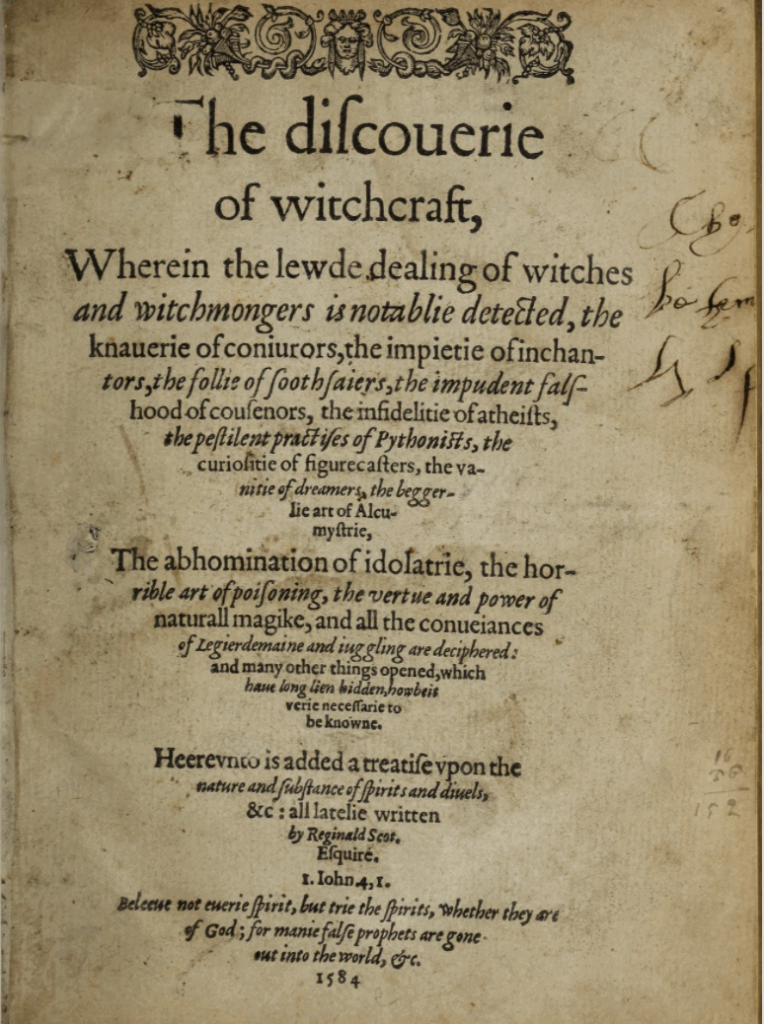
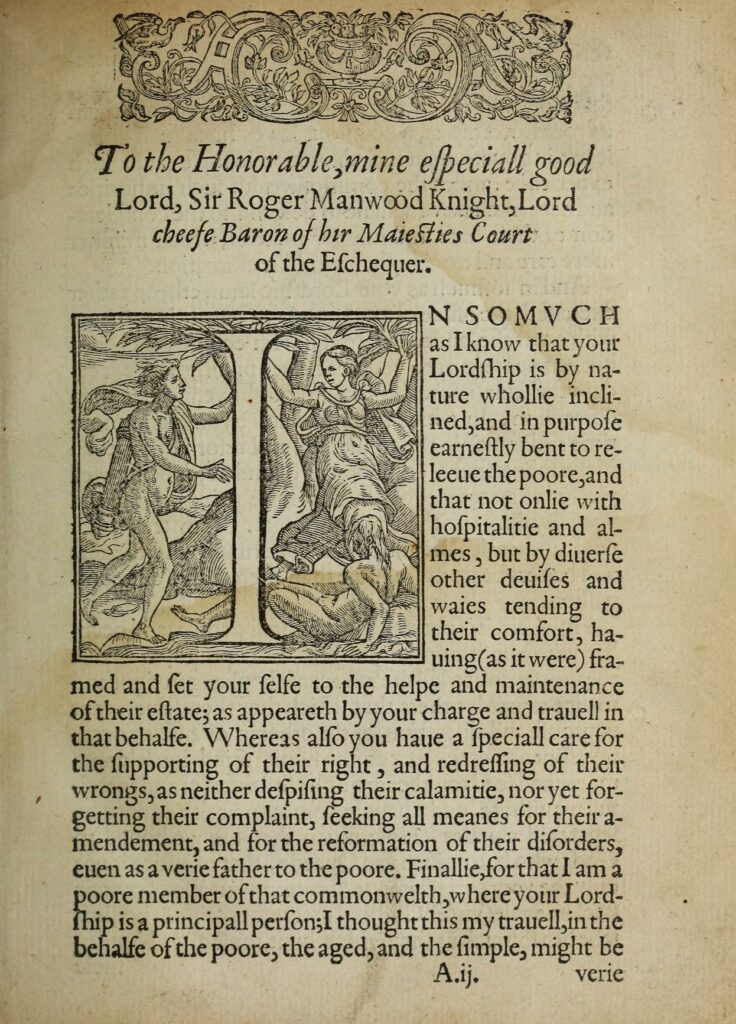
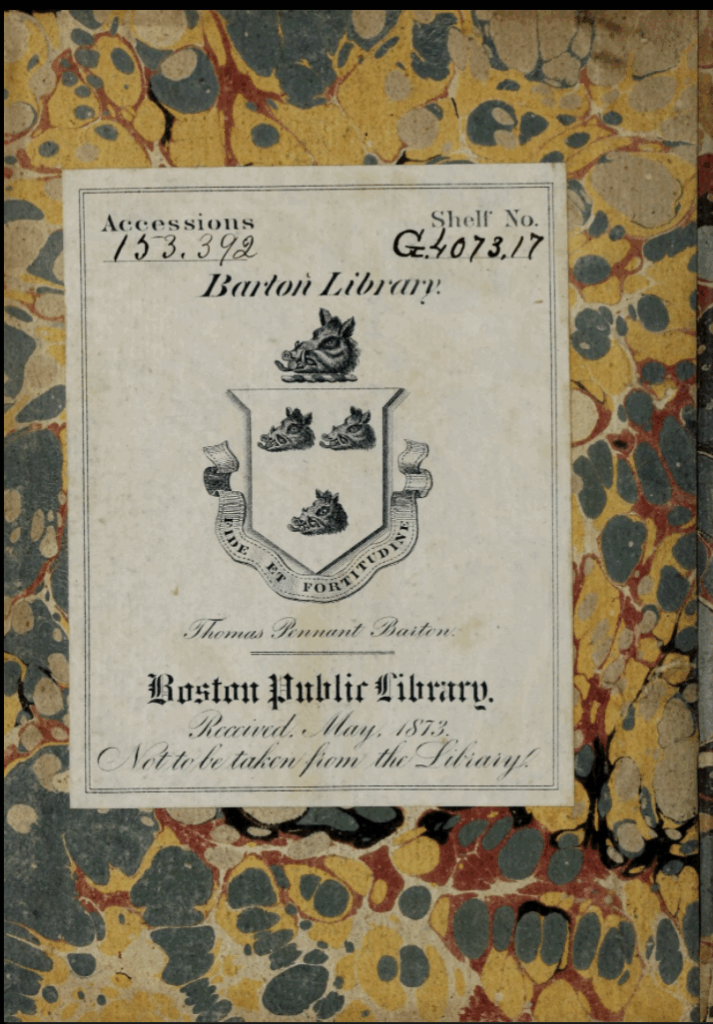
A beautiful book with a brown, rustic cover. Outside binding is sewn on. The book was originally bound in calfskin, and later rebacked in goatskin. The pages are yellow stained throughout. The obvious flaw, albeit quite small, are the stained pages that can be seen throughout the book. These stains do not necessarily impair the reader’s ability to go through the text, but it is something that is noticeable. The two pages after you open the cover are marbled paper flyleaves, a standard practice in the 19th century for book binding. Right away there are rather large initials at the start of the paragraphs along with headers and illustrations within the top margins of the pages. Typically throughout, these are just at the start of a new chapter or topic. The font itself is in perfect condition. For the most part, it is printed in the center of the pages and there are very little typos and errors. At the start of paragraphs or topics, there are small, but elaborate illustrations. This is the same for the end of the paragraph and also we see a signature “Your loving friend” signed by “Reg. Scott” at the end of the Epilogue.
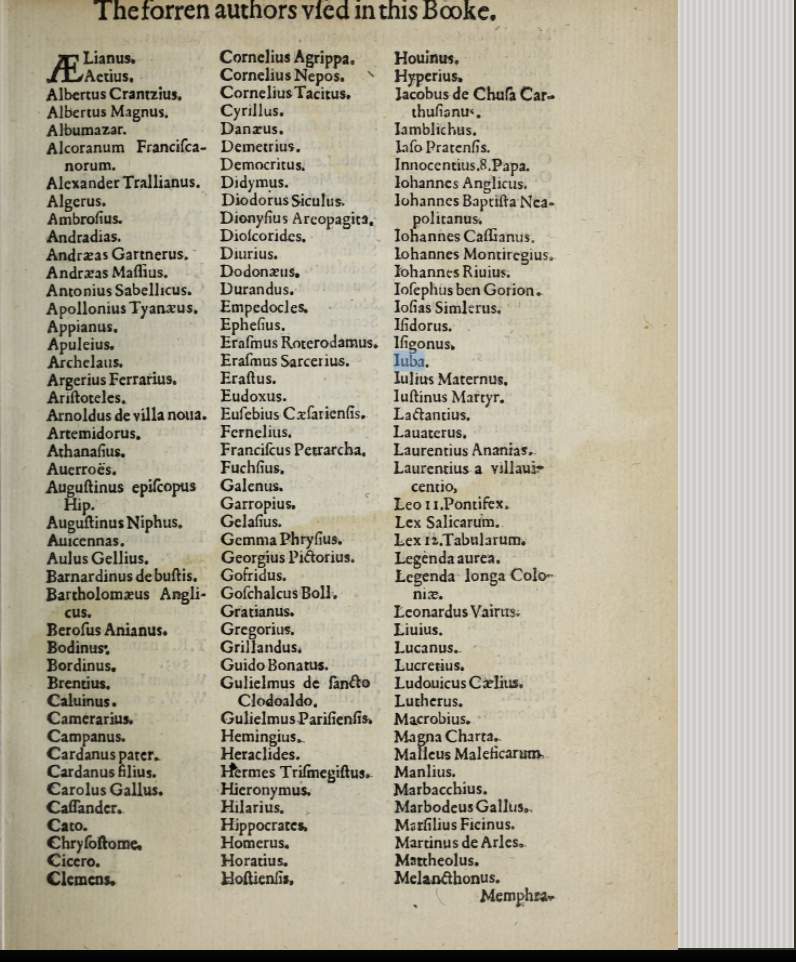
Continuing on, Reginald offers a list of contributors to his work before starting the actual material of the book, which are very interesting as the list was pretty lengthy. The chapters of the book are listed at the start of each (titles and numbering), and remain at the top of each page that corresponds to the given chapter. The marginalia throughout this work is actually the names of the contributors that Reginald had listed earlier on in his book. They are accompanied by a number to help the readers know what part of the work they contributed to. Readers can use the number to refer back to the list of foreign authors that Reginald Scot incorporated in this book. It might be interesting the study these authors further and see if they have further works on the topic of Witchcraft.
For the most part, the book carries on the exact same way through the duration of 560 pages. Reginald Scot also offers page numbers in the top left and top right corners of each page with a normal numbering system. Lastly, skipping ahead to the end there are about 10-15 pages of tables of content. Within the contents reference is made to the information used and discussed in the book. The tables of content are followed by the two more pages of marbled flyleaves.
Content Overview
In 1584 when Scot published his book, an overwhelming majority of people believed in witchcraft. In the 1500s, some 80,000 witches were sentenced to death with over 80 percent of those witches being females. The earliest records of witchcraft being documented date back to roughly 900 B.C. Everyday life had ancient superstitions about witchcraft instilled into its fabric.
In Discovery, Scot speaks out in defense against accused witches of the time, this stemmed from when he was on an actual witch trial involving a woman named Margaret Simmons. He outlined his experience of this trial in his work as “ridiculous” and it is more than likely that him being a part of a trial led directly to this book. He faced serious criticism in the making of this book as witchcraft was seen as a sin and crime by both the state and the church at this time. He outlined his thoughts on those who believed in witchcraft as “mentally ill” and “corrupt”. He backed himself by using scriptures as evidence to avoid any discrediting of his information and thoughts. For the better part of half this book, this is what Scot focuses on. In the second half he focuses on the “tricks” used by witches and attempts to explain that these things can be done without the use of “magic”. Some of these tricks are still used today in the weaponry of magicians.
Significance
This book played a large role in the overall scope of witchcraft during this time. As mentioned, it was something that was largely believed to be true and dangerous to normal citizens. For Scot to take a risk and expose witchcraft as a false, made up magical claim was revolutionary in a sense. He had his critics, but overall his work allowed people to stop living in fear, or for some to accuse him as a user of witchcraft and become more paranoid. Based on the result of people becoming more paranoid is the exact reason why Scot had to write this book. He wanted people to stop living in false fear of something that did not exist whatsoever. His largest critic was the likes of King James I who took the throne in 1603. James ordered that all books be destroyed and for Scot to be punished for spreading false information.
Provenance
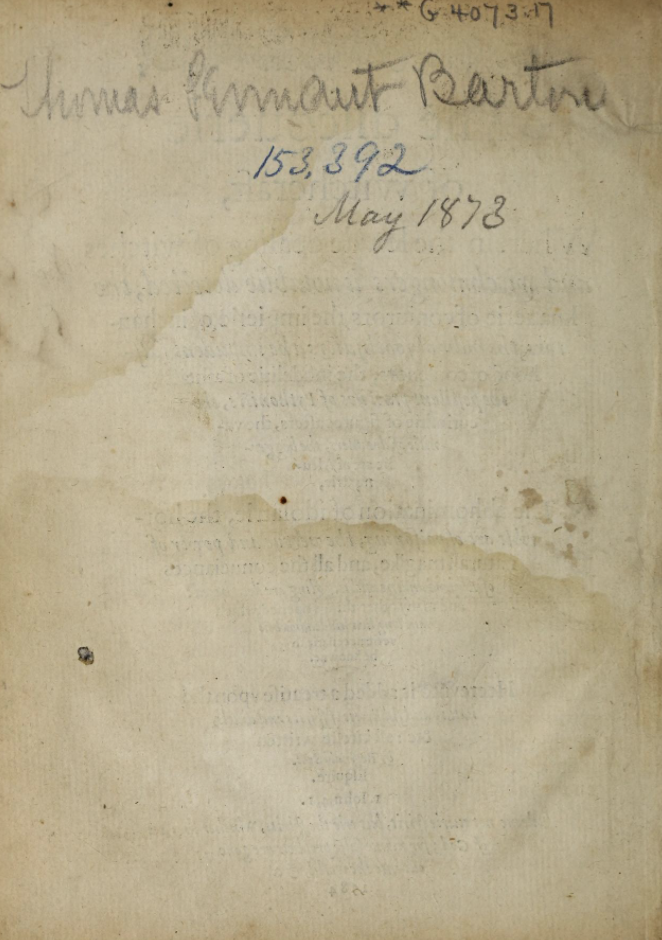
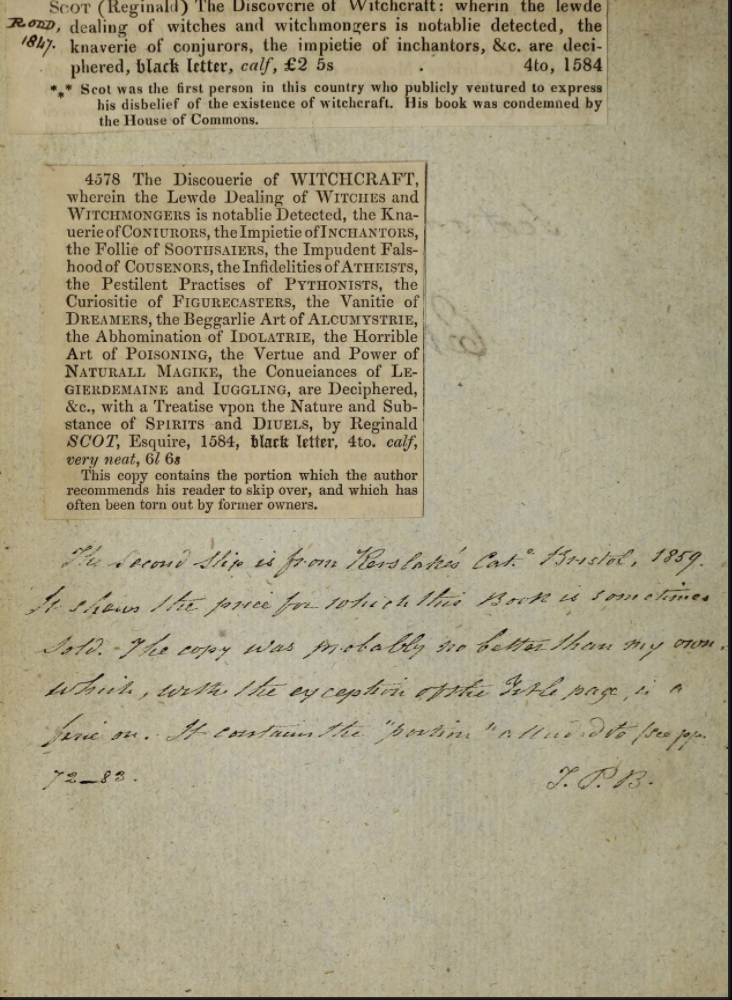
The booksellers plate gives a description of the book in which it states specific details within the books. Things like “Figurecasters” and “Poisoning” are mentioned within this description. It also makes note that this book is the one that includes the author’s note to skip over certain sections, and some of those sections are already torn out by previous owners.
Along with the booksellers plate, there is a note from Thomas Pennant Barton, who is discussed in the paragraphs to come. This note below the booksellers plate highlights his interaction with this particular copy of the book. He mentions that this copy, the one reviewed here, was overall not in better condition than his other one. He mentioned that only the title page on this copy was better than his other. So, therefore there are two copies, or were two copies, of this book in Thomas’ possession at one point in time. Unfortunately there is no history on the other copy, but one could question on why he wanted to get a second copy which wasn’t better than the first.
There are two important names that are linked to this work other than Scot Reginald. The first is Thomas Rodd whose name shows up in a sales description. Thomas was a relatively well-known bookseller and antiquarian throughout his life. His deceased father was also a bookseller, therefore it makes sense in why he chose to follow this path. His father sold normally for the British Museum, collecting rare books spanning all different genres. Similar to his father, Thomas also sold a diverse collection of works and did not focus on specific genres. Thomas Rodd was also responsible for selling Thomas Pennant Barton Shakespeare’s First Folio which helped him become the first Shakespeare collector in the United States. Barton purchased a large amount of his collection from three different sellers, two of those being Thomas Rodd and Horatio Rodd, Thomas’ brother.
The son collected manuscripts from all over the world in many different languages. His extensive collection of works resulted in him stumbling upon this of Reginald Scot, in which he ultimately sold. The second name of importance in this book is that of Thomas Pennant Barton. He was an American diplomat who is remembered almost entirely for his collection of books pertaining to Shakespeare and English Drama. He was noted as being the first American to have “a purposeful collection of Shakespeariana”. He amassed extensive works in French, Spanish and Italian. Some 4,000 pieces of work in his library came from his deceased father-in-law, Edward Livingston. Edward was a jurist and statesman who was responsible for the Louisiana Civil Code in 1825. The bulk of Livingston’s works were based on history and judiciary fields. It would be safe to say with what information is known about Barton, that these categories did not interest him as much as others might have. However, it helped make his collection into something more diverse and well-rounded.
Unfortunately, there is no information available as to why Barton wanted to come in possession of a book about witchcraft. It is known that he is a large Shakespeare fan, so it is possible that Shakespeares Macbeth, which focused on witches and witchcraft, intrigued him to learn more about the topic. It would make sense considering he had such a large collection of Shakespeare’s works. Another possible reason or contributing factor could be the idea of witchcraft in the U.S. at the time. Events like the Salem Witch Trial took place around the time he came across this work, so its possible that the general feeling of witchcraft could have helped push him to become more educated on the material. However, it is much more likely that Shakespeare and specifically Macbeth were the reason Barton was interested in Scot’s witchcraft.
The Boston Public Library currently holds this book in its “Barton Library” collection. This along with countless other works, mostly Shakespeare, have resided in the Boston Public Library ever since his death. BPL lists Thomas Pennant Barton under their “Performing Arts” section in the library. This is due to the fact that a majority of his works, the more notable ones, are focused on Drama and Plays. It is not documented on how BPL was able to acquire his complete collection, nonetheless it remains one of their most popular collections largely due to the fact of the countless Shakespeare works.
https://archive.org/details/discouerieofwitc00scot/page/n3
nicholas prystash hst 475 fw 2020
