
VVorkes of Armorie, deuyded into three bookes, entituled, the concordes of armorie, the armorie of honor, and of coates and creastes, collected and gathered by Iohn Bossewell Gentleman
XX CR3509.B677 1572
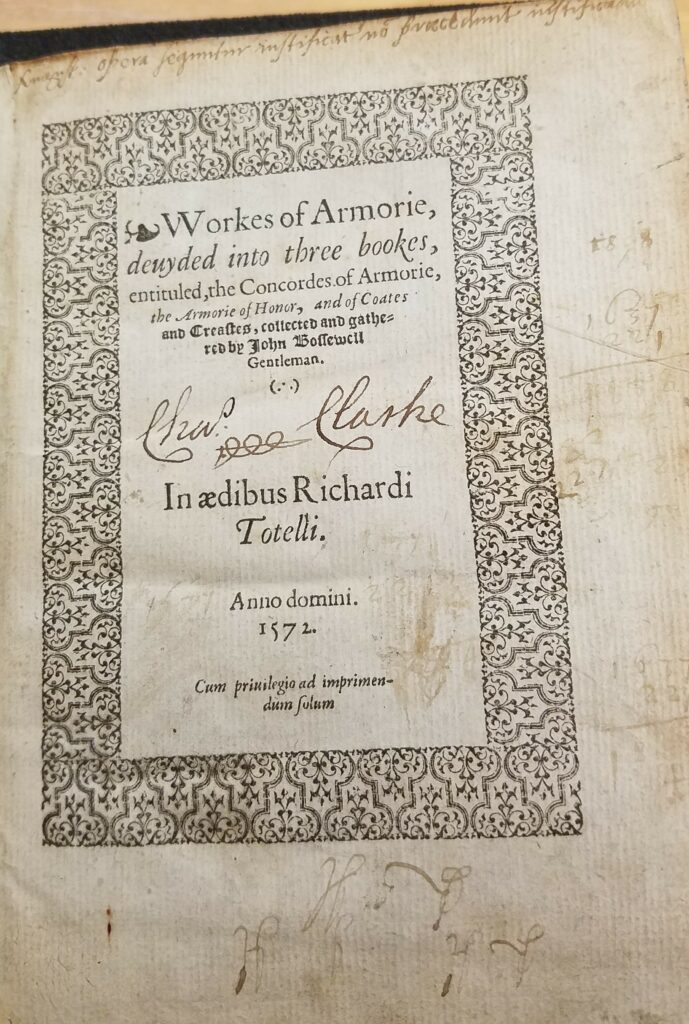
John Bossewell’s Workes of Armorie is a lesser known work on heraldry published in England in 1572. The text tells many individual fables and legends relating to the various animals and objects represented, each characterized by their highly symbolic and allegoric rhetoric. Bossewell drew much inspiration from fellow heraldic writer Gerald Legh’s own popular text on armory.
About the Author
Very little is known about the personal life of John Bossewell, except that he was a gentleman and heraldic writer. Via his own account he hailed from the north of England and is speculated to have been a member of the family of Bosevile which was well established in the neighborhood of Doncaster.[1] It has also been suggested that Bossewell was the son and heir of Thomas Bosevile of Stainton.[2] However, that has never been officially proven. He died in 1580 according to his will and inventory which were drawn up that same year.
What is known is that Bossewell appears to have acted as a notary, but by his own tastes defined himself as an antiquarian with a particular interest in heraldry. Indeed, the first part of his Workes of Armorie “The Concordes of Armorie” is a mere abridgment of Gerard Legh’s Accidens of Armory.[3] Like Legh his work is filled with symbolism and allegory, though he never achieved the same level of recognition that his predecessor did. This book was the only work of his ever published.
Publishing
This copy of Workes of Armorie was first published by Richard Tottel at his printing house, The Hand and Star, on Fleet Street in London in 1572. The work was later reprinted in 1597, though no changes were made to the text.
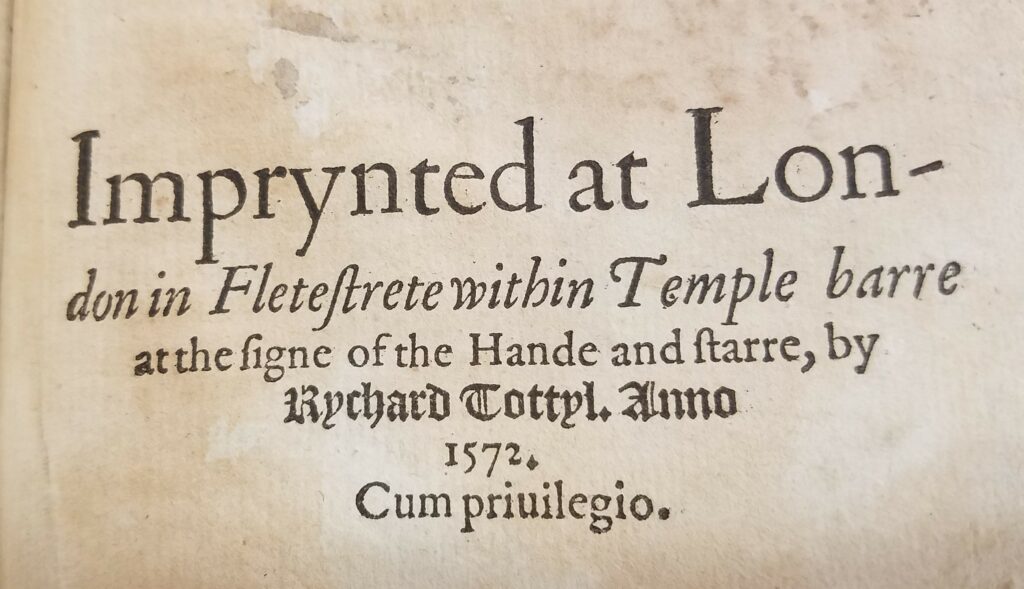
While not much is known about the author of this text, significantly more information is available on its printer. Richard Tottel was a publisher who achieved the majority of his relative fame, and financial security, from a patent that he was first granted in 1553, and that was later renewed until his death in 1594, which gave him the exclusive right to print all authorized books on common law.[4] As Tottel’s primary audience was lawyers, people who were deeply interested in social standing, it makes sense for him to have published this armorial.
Though he primarily printed and published law texts, Tottel also managed to carve out a place for himself in the world of literary publications with his publication of the anthology of poems “Songs and Sonettes” or as it is more commonly referred Tottel’s Miscellany.
Tottel was nominated a member of Stationer’s Company of London upon its founding in 1557.[5] He remained an active in the Stationer’s Company and in his own printing health for many decades, until his advanced age and failing health began to catch up with him. Richard Tottel passed away in 1594.
Also worthy of note is that Tottel not only printed Bossewell’s Workes of Armorie in 1572, but also Legh’s Accidens of Armory a decade prior. Bossewell clearly held Legh in high regard as he drew heavily, or rather paraphrased, from Accidens of Armory in his own book, seeking to further the work into heraldry that Legh had begun before his passing.
Content
With the writing of this book, John Bossewell saw himself as doing the dutiful and necessary work of expanding the amount of available information on heraldry and its significance to the public.
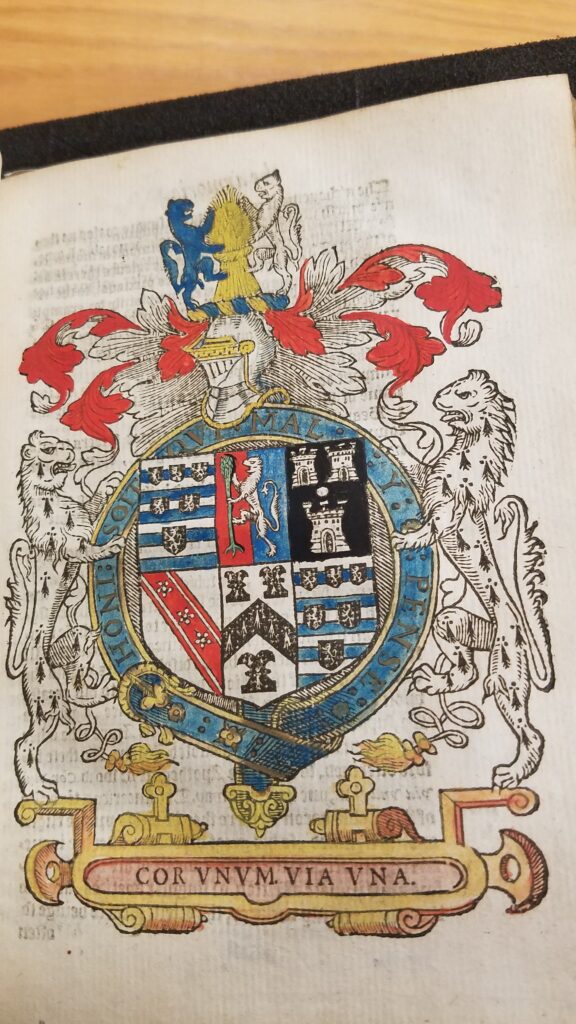
Workes of Armorie is comprised of many different highly symbolic legends. These tales seek to explain from antiquity the various aspects of armory. Interesting, some of the tales mention real English Earls and their coats of arms or figures like Saint George, while others are based upon characters and crests of Bossewell’s own design. Contemporary critics of the book have remarked that he “confidently made public such information as he possessed” but also that they “cannot award to Bossewell any great degree of merit in tracing the antiquities of English heraldry, or in developing any true or perfect system of the art.” [6] Thus revealing that Bossewell’s work never quite achieved the level of importance or success that he had hoped it would; However, the book is vital in its own way for expanding upon the amount of heraldic literature available to the public both in the past and for posterity.
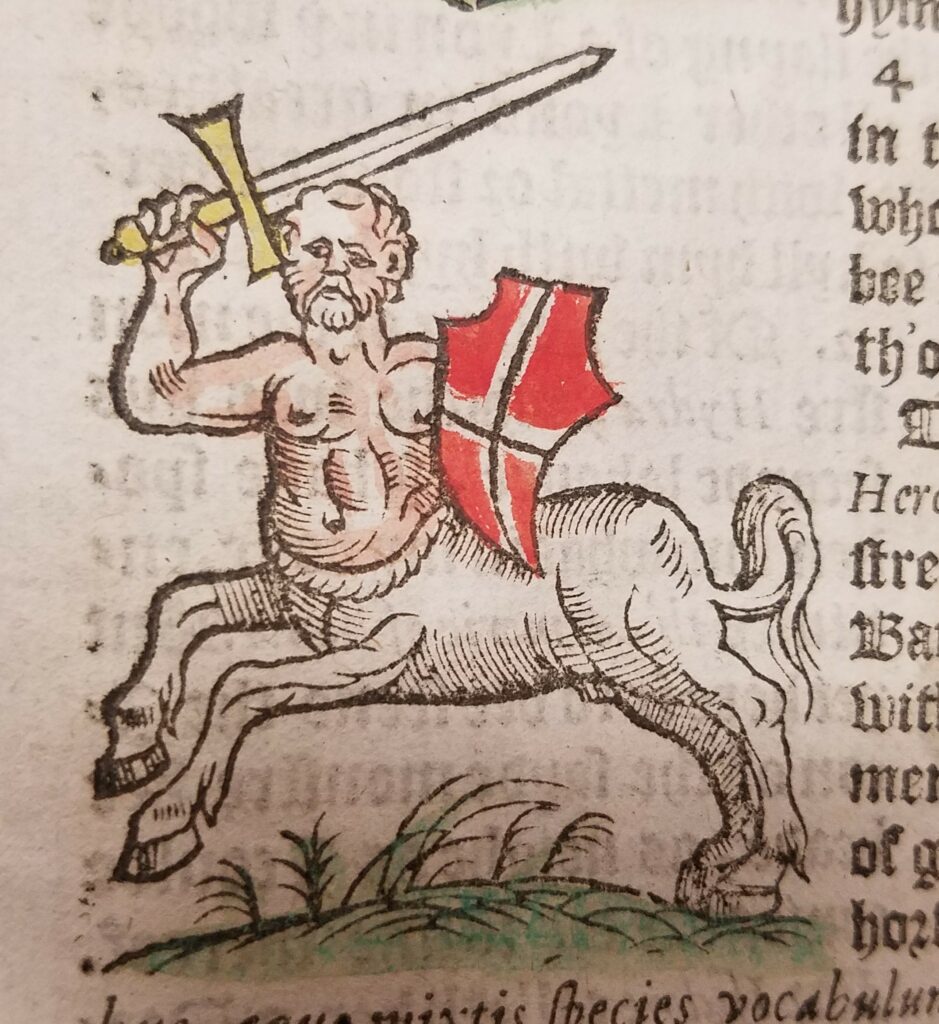
Even though Workes of Armorie cannot be classified as a particularly successful book commercially, the provenance detailed below reveals that someone obviously valued the book enough to take the time to beautifully hand color all of the woodcuts.
Physical Description

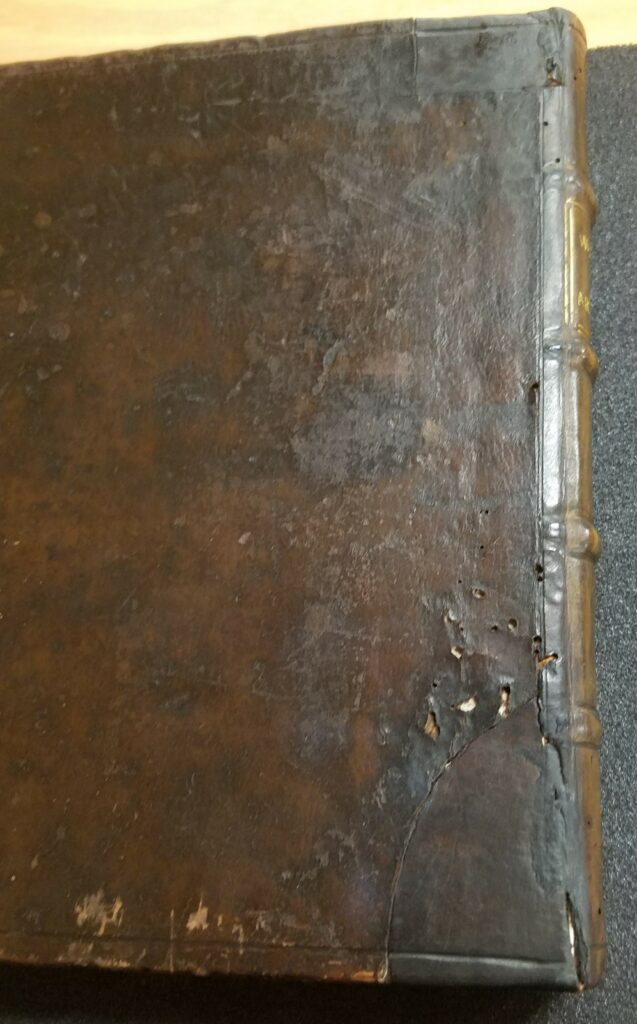
While relatively simple and unadorned, bound in brown leather without any tooling or gilded edges save for the title on the spine, this edition of Bossewell’s Workes of Armorie is an overall nice edition of the text. There is a repair to the binding evident on the back cover, where a corner of the leather and board has been replaced. Also visible are several small holes in the leather of the binding and throughout the pages, indicative of bookworm damage. Minor staining some of the pages, revealing heavy readership.
There are, of course, several bookplates and instances of writing throughout the text that reveal signs of usage and ownership. While these markings will be discussed in further depth in the sections below, it is important to mention the most prevalent sign of provenance, as it makes this copy particularly unique. Of the 410 woodcut shields, crests, and coats of arms nearly all have been carefully hand colored.
Provenance
There are several instances of ownership and use throughout this copy of Workes of Armorie. From these signatures and notes in the margins we are better able to make sense of the history of our own copy of this work, but are also offered a glimpse into the world of the past as our previous owners lived it. While, unfortunately, there are still many blank spaces in our chain of ownership that we may never be able to unearth, several unique aspects of this book have been brought into the light as a result of this examination. A few forgotten facts left tucked between pages have been found.
Cha. Clarke
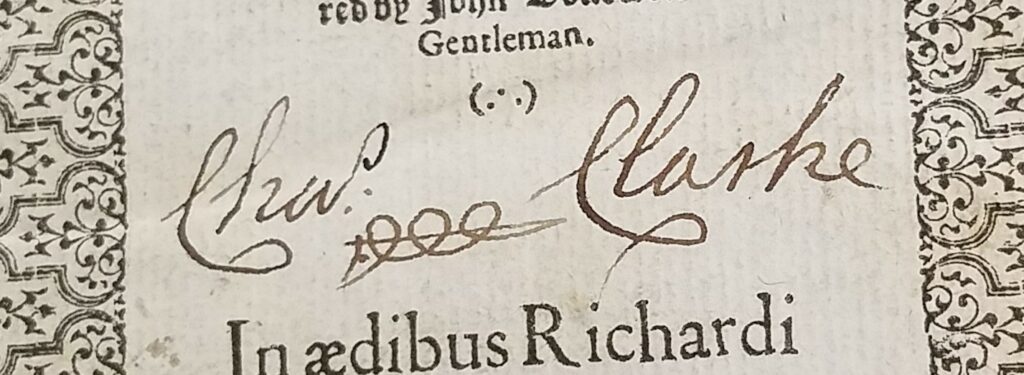
This handwritten “Cha. Clarke” is believed to be an abbreviation for Charles Clarke, who appears to be the earliest identifiable owner of the book. Unfortunately, as this is an exceedingly common name in early modern England, nothing has been found to indicate that this particular Charles Clarke is any of the ones that appear in online databases. However, much of the writing in the text, namely the Latin inscriptions and several of the corrections in the text appear to be in the same hand as this signature. It is possible too that Clarke was the one to color the woodcuts, as he seems to have spent a fair bit of time correcting the book.
Latin Inscription

Written along the top margin of the title page is a phrase in Latin. To the best of my, admittedly, poor translation skills the inscription reads: Agusta: opera sequuntur iustificat non praecedunt iustificaan. Which roughly translates to “more august by not: the works that precede the justifier of the following does not justify the.”[7] This translation leaves much to be desired, but it is could possibly refer to a comparison between Bossewell and Legh’s works on heraldry, as it seems to be a common theme that Legh was considered the superior authority.
There is no direct mention of who wrote the inscription, but it does appear to be in Clarke’s hand.
CXVII. h. 181
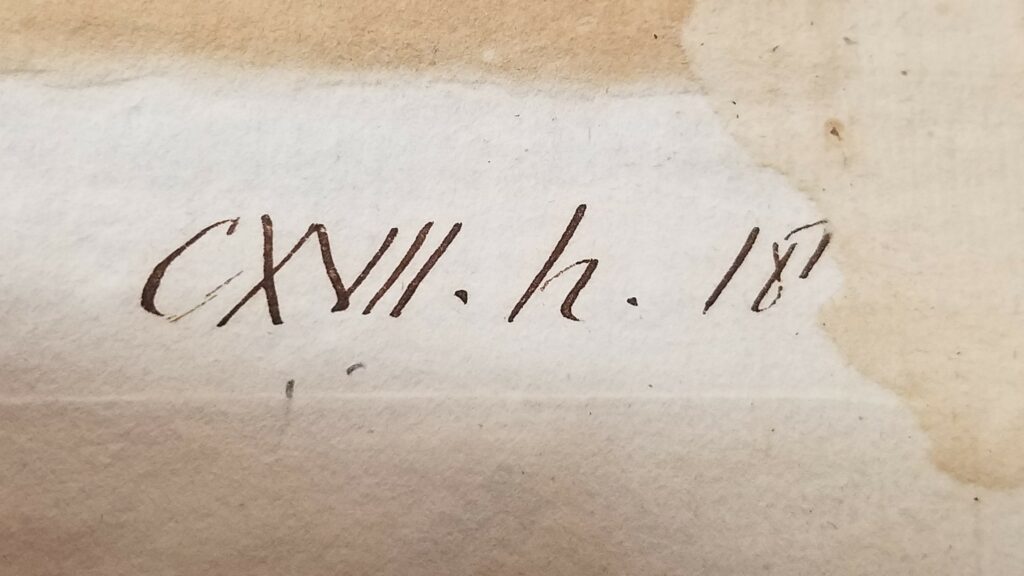
This string of numbers is handwritten near the top of the pastedown for the front cover. Research has yet to discern the significance of this writing. CXVII is the Roman numeral for 117, but there’s been no apparent connection to “h. 181” found yet.
The writing appears to to be shelf number for a library organizational system; however, there has been no record of other book’s from Clarke’s library found as of yet.
Corrections
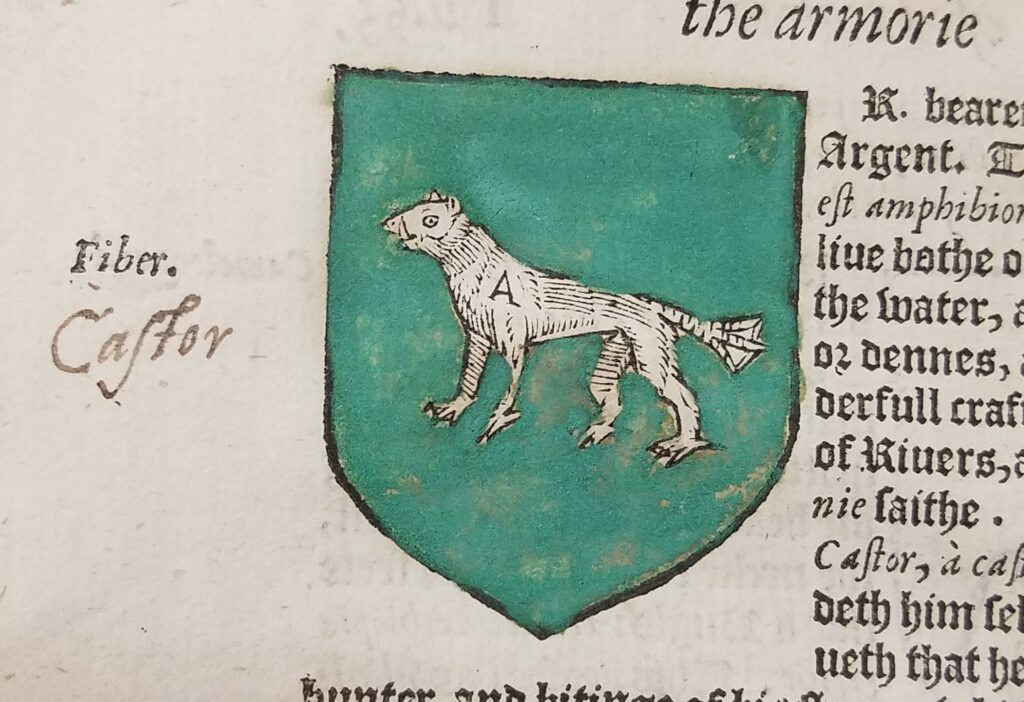
One of the readers of the book, likely Clarke, took the time to make several small corrections throughout the text. These corrections are generally correction of the Latin and the terminology used in the test.
Firstly, on the verso of Folio 53 someone has written “castor” next to a woodcut of a beaver labelled “fiber.” While both are valid translations for beaver, it seems our editor had a clear preference for the former.
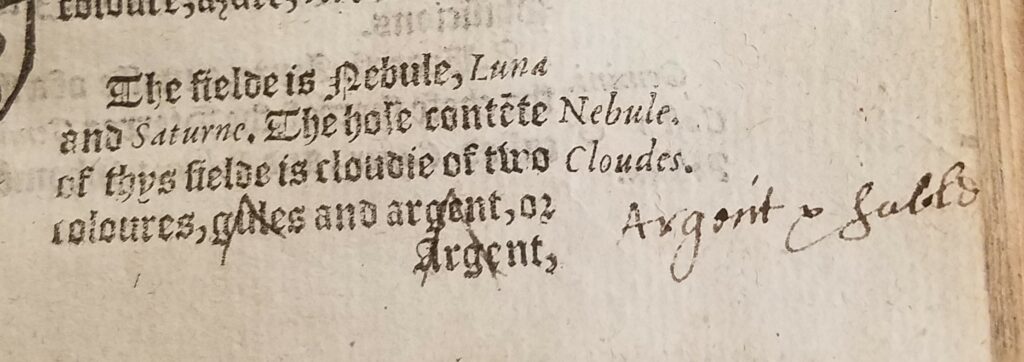
Other small corrections can be seen throughout the text. These corrections appear to all be correcting the Latin word choices. This is seen on the verso of Folio 83, where the phrase “gules and argent” is crossed out and corrected with “argent and sable.” In this case the swapping of words changes the colors of the crest from red and black to black and white. Not visible in this photo, but the associated crest has been colored according to the editor’s preferences in black and white.
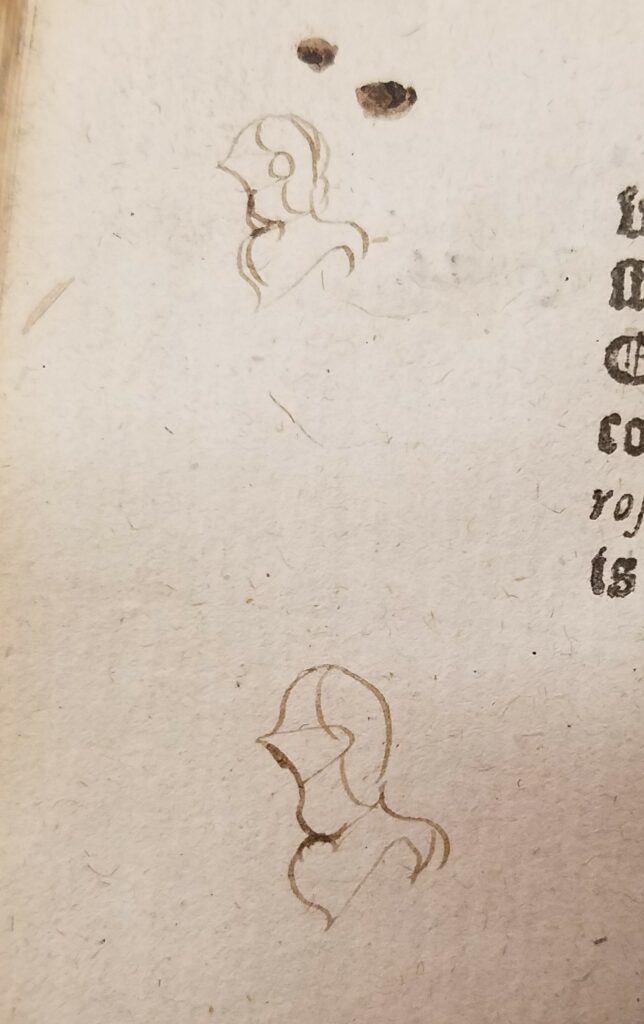
On the verso of Text corrected to read argent and sable Corrections to the text made, so that it reads argent and sable Folio 104 are someone’s practice attempts at drawing knights. While this instance of marginalia does not appear to be correcting any aspect of the text, it certainly does make it livelier.
Coloring
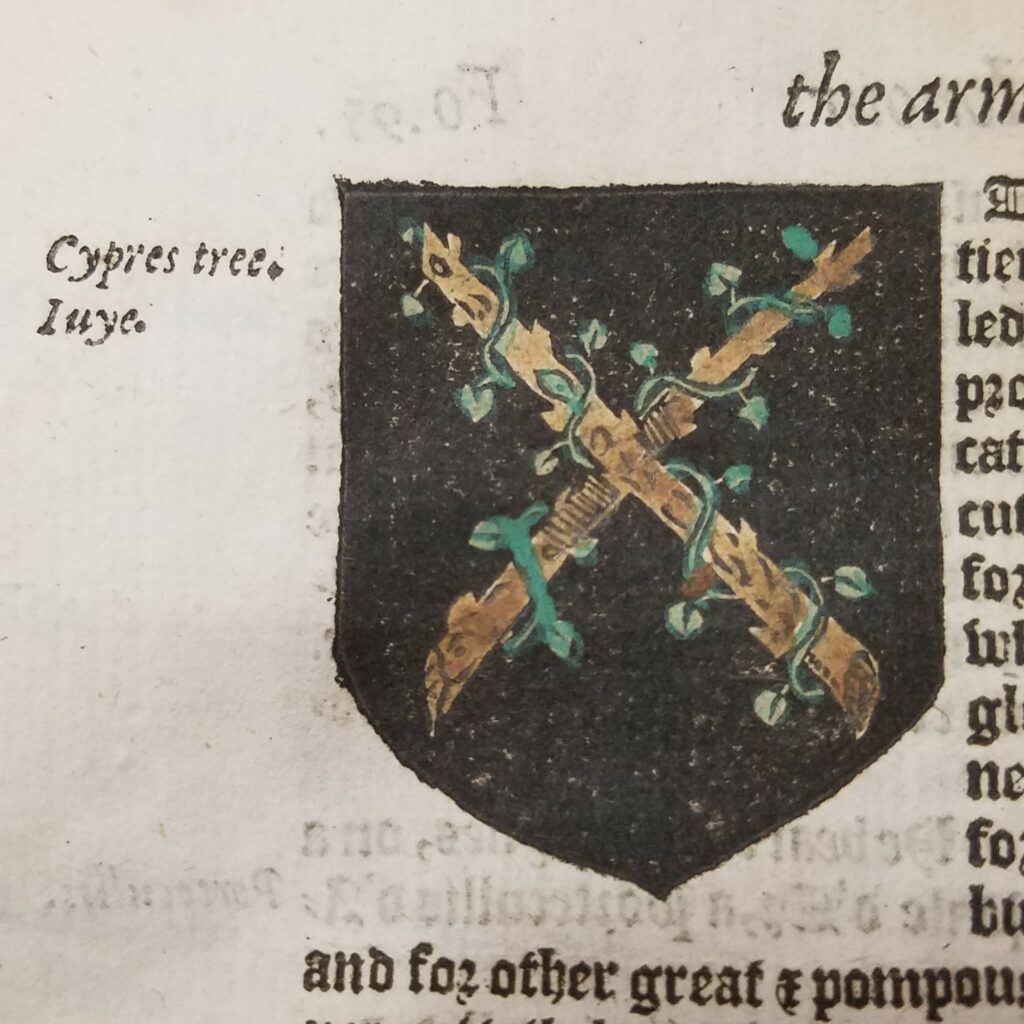
It is impossible to write about the provenance of this book without mentioning the most obvious example of use: The fact that someone took the time to carefully color all of the more than four hundred woodcut images by hand indicates that the book was used frequently enough by some individual for them to decide to color the pictures instead of reading the key and picturing the proper colors in their mind. There is no clear indicator of who is responsible for illuminating text, but it is likely that it was done by the same person that made the corrections throughout the text, as the changes made to the text correspond to the coloring of the associated drawings. While we may never know if this artist was indeed Cha. Clarke, it is obvious that their careful work made the book far more appealing to its subsequent owners because of the life that it brought to the pages.
Clarke’s Unknown Contemporaries
Title Page Marginalia
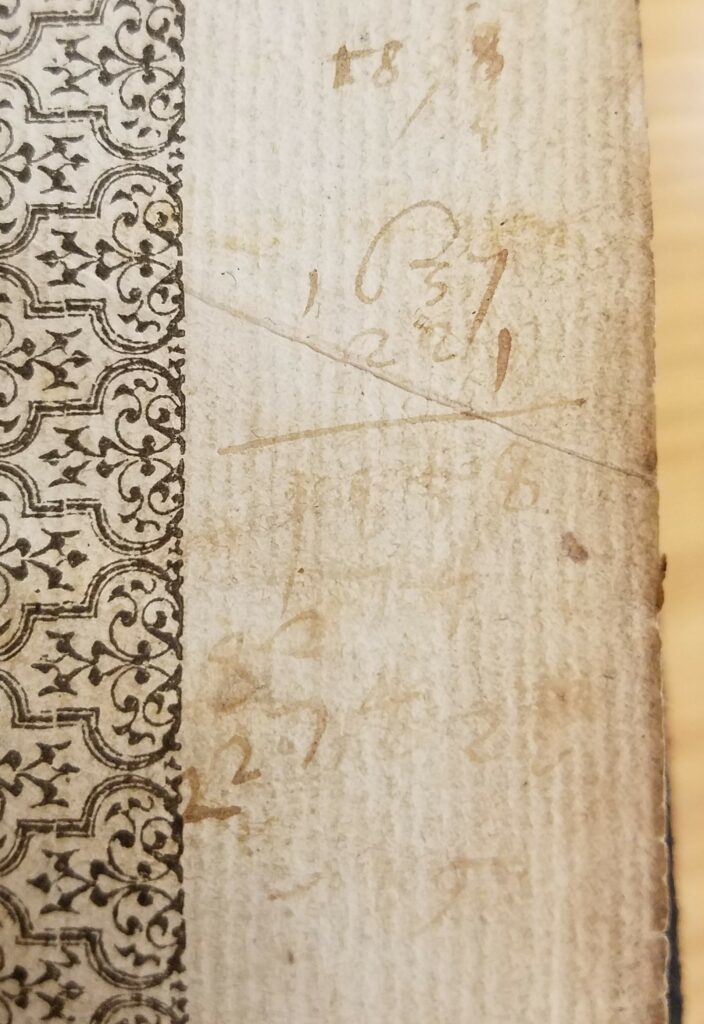
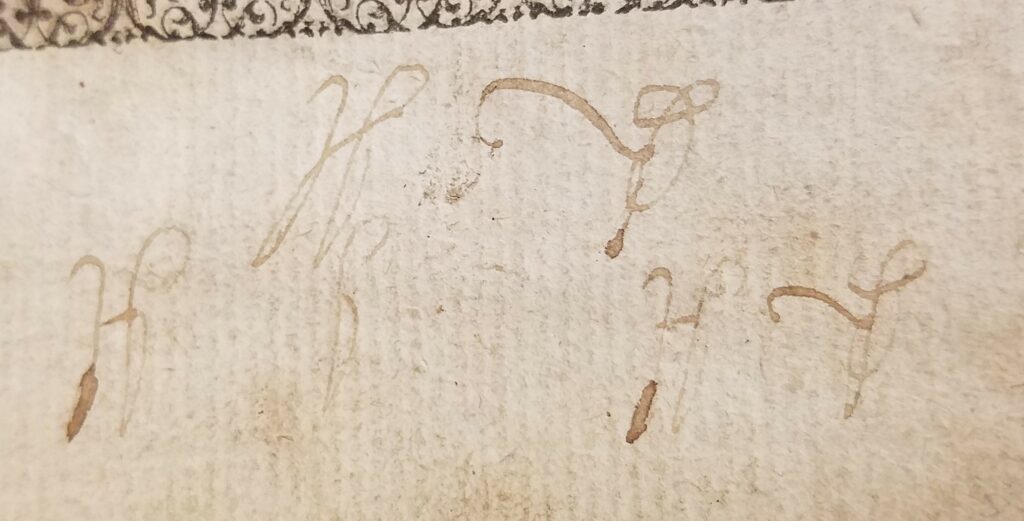
Also present on the title page are other small bits of writing. The most noticeable is the math done in the margins of the text. It is likely that this math was done by a later relative of Clarke that was attempting to do the math for how old he would be if alive today or perhaps how long he had the book for.[8] Also visible along the bottom of the page was somebody practicing their penmanship or their initials. This writing could have been made by a younger relative of Clarke, perhaps one that inherited the book after his passing.
Rear Endpaper Rhyme
Scrawled upside down on the verso of the final leaf of the book is the following rhyme: God made man and mad made money, God made bees and bees made honey.
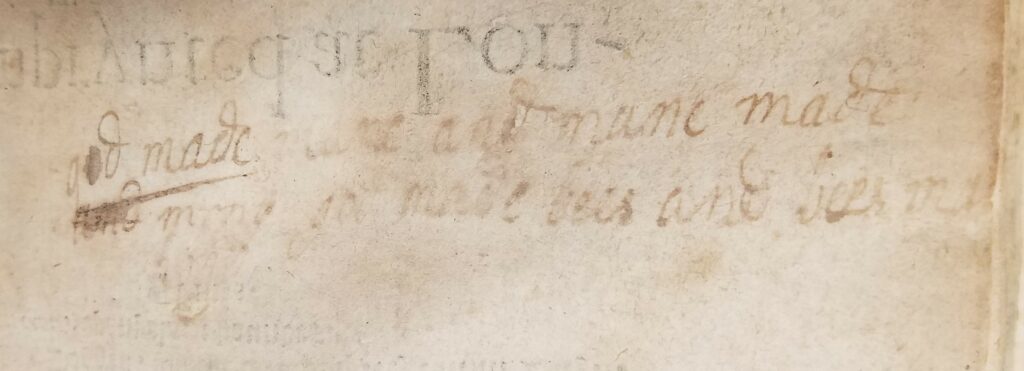
Rhymes of this sort were common during the early modern period because of their easy to remember flow and their common biblical themes. Indeed, one can find instances of this rhyme being modified and expanded upon in the provenance of other period books. For example, the following expansion of the rhyme was written in the fly-sheet of an Englishman from Denham’s bible, “God made bees, and bees made honey, God made man, and man made money, Pride made the devil, and the devil made sin; So God made a cole-pit to put the devil in.”[9] Thus reveals that rhymes of the sort truly were very catchy, and it is thus unsurprising that they often wound up added to the pages of books for other people to find and get stuck in their head for days on end.
Unknown Symbols
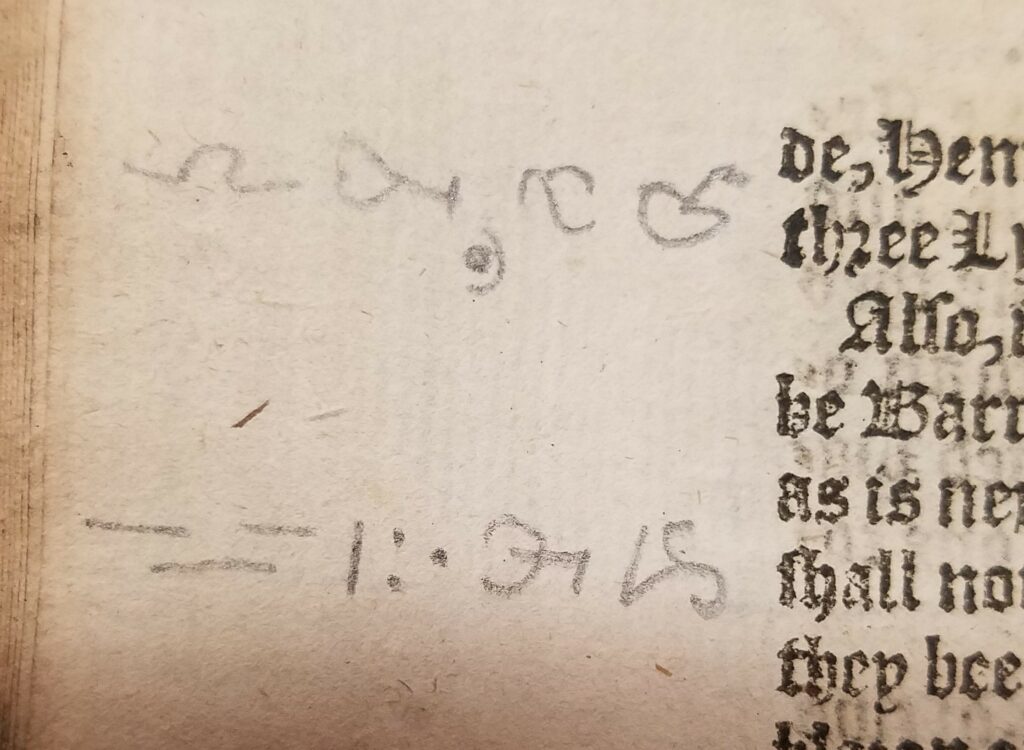
On the verso of Folio 31 several unusual characters have been penciled onto the page. These symbols are likely a form or shorthand or a secret code of some type. Research has not yet revealed any other instances of these particular symbols found in other works. So, as of yet no clear answer has been found to the mystery of the unusual symbols or who and when they were added to the text.
Hewer Edgley Hewer
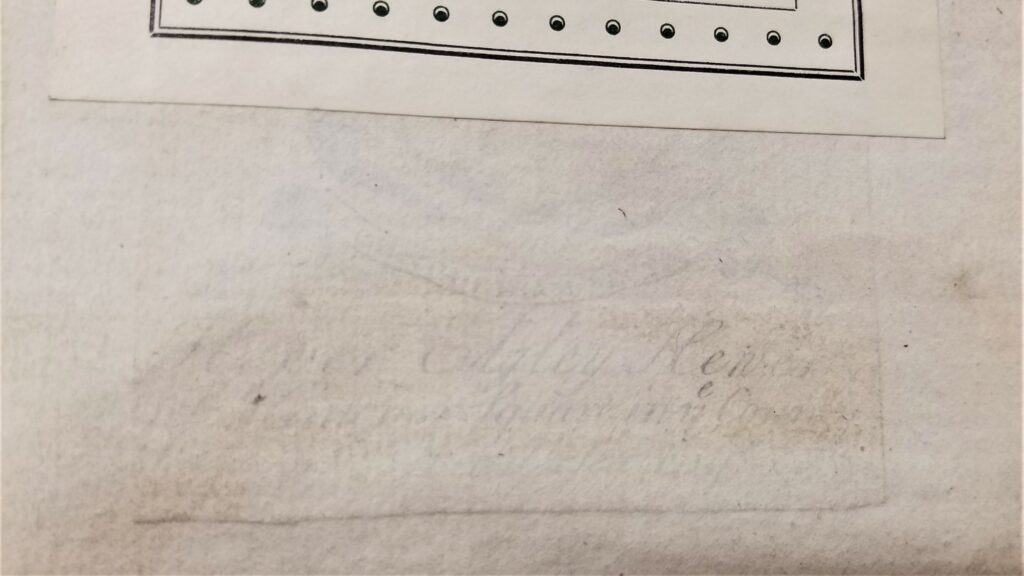
The bookplate has had a sheet of paper and another bookplate pasted over it, making it nearly impossible to read. This bookplate was perhaps the most tantalizing of all of the signs of ownership in the text. While it had once been prominently displayed in the book, subsequent repair work and owners obscured the plate nearly entirely. Not only was there another bookplate covering the top half of Hewer’s, but an entire page had been pasted over it, making it nearly impossible to discern. However, with the help of several insightful librarians from MSU Special Collections, the name on the bookplate was eventually discerned to be Hewer Edgley Hewer.[10]
Once the mysterious name was revealed, it was then possible to find mentions of it in several texts. Originally called Hewer Edgley, he was the nephew of William Hewer (1642-1715) a close friend and Samuel Pepys. As William Hewer had no children of his own, he was selected as his heir on the condition that he adopt Hewer’s surname.[11] Thus, our friend became Hewer Edgley Hewer.
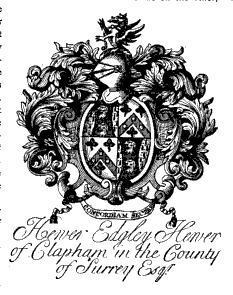
Edgley Hewer lived from 1692-1728, and was elected a fellow of the Royal Society of London on June 27, 1723.[12] While this was an extremely honorable accolade for young Edgley-Hewer to be selected for this scientific society, even more exciting was the mention of his bookplate that appeared in various volumes of the Journal of the Ex Libris Society. After digging through several volumes of the journal, one finally appeared that contained an actual facsimile of the elusive bookplate, shown on right.[13]
Lawrence Strangman
The second bookplate in the text was perhaps the easiest piece of provenance to identify. Mostly because it was one doing the obscuring rather than the one obscured.
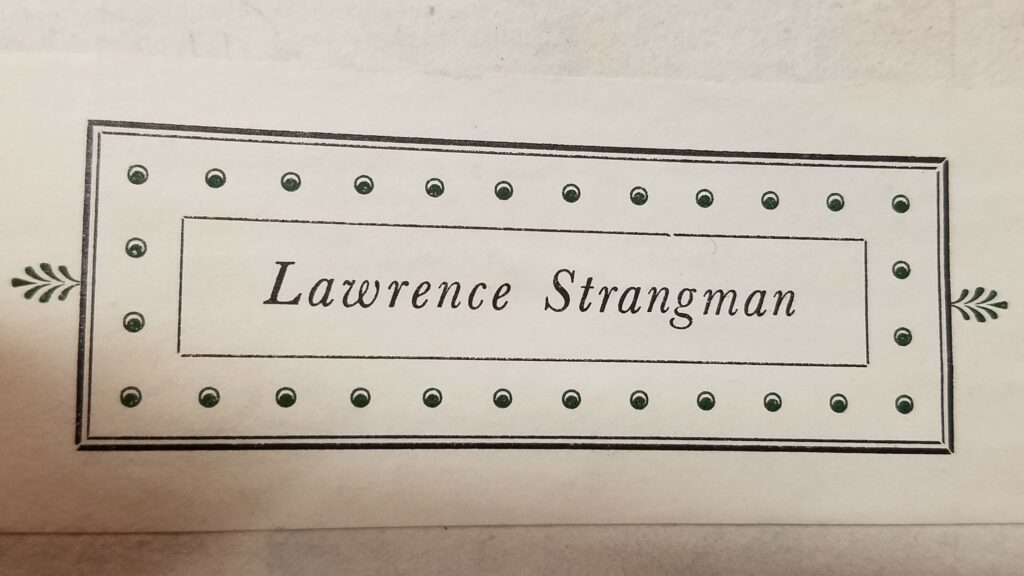
Strangman (1908-1980) was an alumnus of Trinity Hall Cambridge and book collector who specialized primarily in 16th to 20th century English literature.[14] After his death his collection was pieced out and sold to various universities and booksellers across the globe. While the majority of the Strangman Collection went to Trinity Hall, references to his bookplate appear in the provenance findings of other colleges in the United States, like the University of Utah.[15] Very little is known about his personal life, but thanks to the Strangman Collection his love of books will continue to be documented.
W. D. Chase
William D. Chase was an avid book collector and almanac writer of some importance. He and his brother founded Chase’s Calendar of Events in 1957, the guide has remained in print ever since and continues to grow in size and readership. Chase began collecting books with his wife Helen in 1943, the same year they were married. The Chase’s continued to add to their collection until 2016, when their collection was rehoused at Michigan State University.
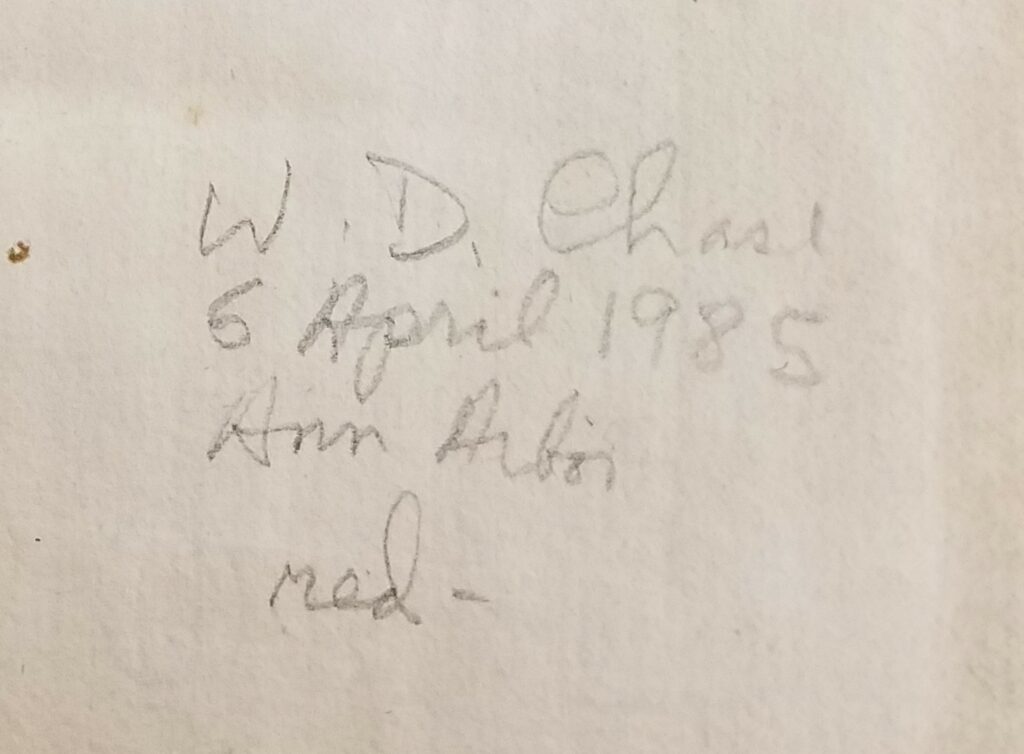
Unsurprisingly, the majority of the Chase collection was centered around their love of almanacs, calendar customs, and items dealing with chronology through the ages. [16] This does make it a little bit unusual that Workes of Armorie was bought by the two. However, we have William’s name and date of acquisition clearly recorded on the flyleaf, so there can be no doubt about the fact that something in this heraldic book charmed and intrigued the couple enough to make it their own.
Miscellaneous bookseller information
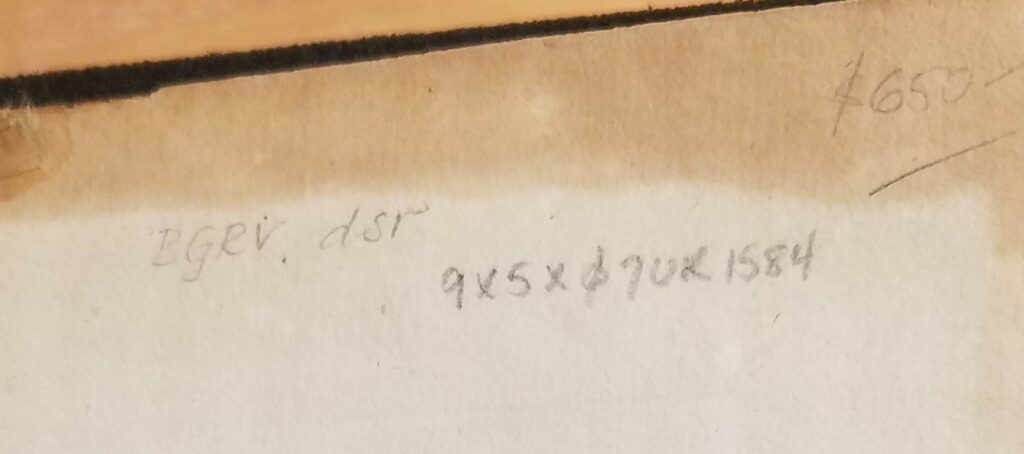
The recto of the front flyleaf also contains writing, in pencil of course, from some of the booksellers that Workes through the hands of. These of Armorie has passed notations describe the condition of the book, namely the fact that its woodcuts were “neatly coloured by a contemporary hand”, the asking price, $650, and two strings of letters and numbers that are likely a code for bookseller’s own records meant to obscure the price they themselves paid and other important information of the sort.
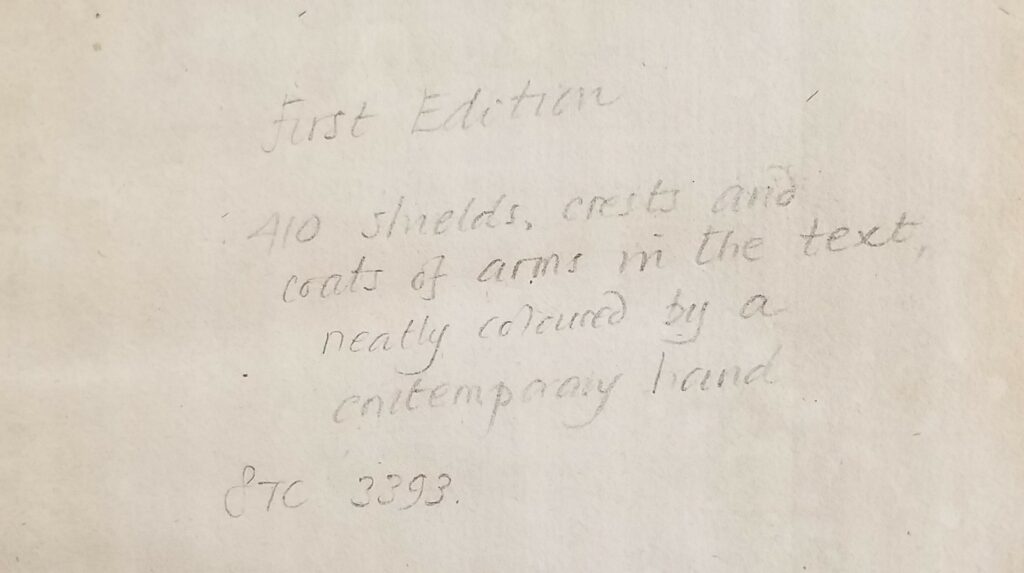
These inscriptions don’t reveal anything about the particular bookseller or shop that made them, but they do help us further piece together the chronology of the book. It can be assumed that after leaving the Strangman Collection, Workes of Armorie was bought by an unknown individual who was either a bookseller or later sold the book to one. And with this bookseller Bossewell’s work likely remained until it was purchased by William and Helen Chase. Though this is of course merely speculation rather than proven fact.
Miscellaneous Papers
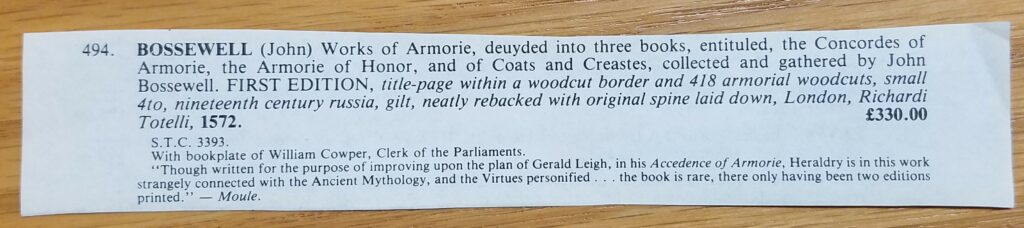
Though not physically and permanently added to the book, several bookseller’s descriptions were tucked between the pages of Workes of Armorie. Of the two catalog descriptions, one refers to John Bossewell’s work and the other does not. The first description refers to a different copy of this edition of the text, as it lists a bookplate belonging to William Cowper that is missing from our book. However, it does reveal that the book was offered for £330.00 pounds, which serves to give an indicator of the relative value of this particular copy.
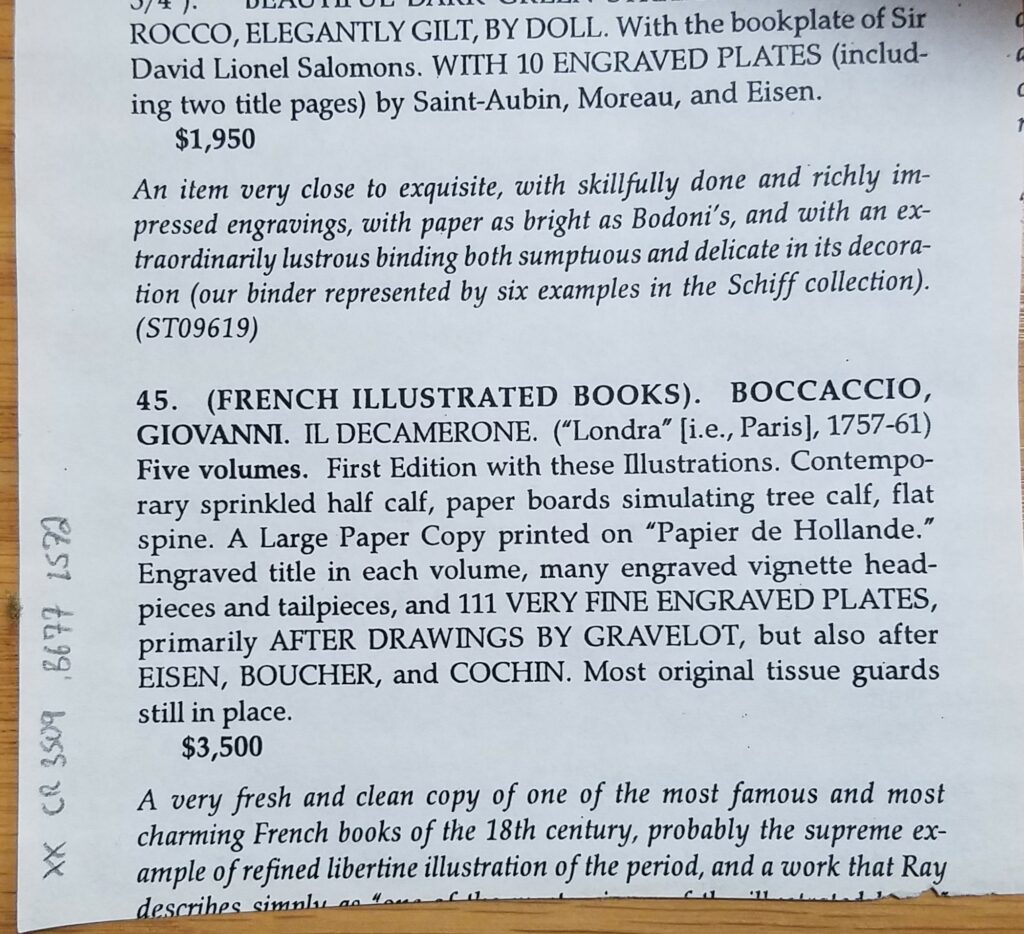
The second description in Workes of Armorie does not actually refer to the book at all. Rather it is a description of Boccaccio’s II Decameron, which MSU Special Collections does have a copy of. Interestingly enough, the call number written on the sheet, XX CR3509.B677 1572 does belong to Bossewell’s book. So, it’s possible that the seemingly irrelevant description was placed in Workes of Armoire for a reason.
There was also a telephone number tucked into the final pages of the book. As of yet, the Bookseller’s description for Boccaccio’s Decameron owner of the number has not been determined as a quick search on the internet did not reveal who it belonged to. However, it is believed that the telephone number belongs to an individual bookseller or bookstore. Perhaps our author here will gather up her courage in the future and call the number in order to know once and for all. No promises shall be made though, especially if our good friends across the pond are unwilling to reverse the charges.
Citations
[1] Stephen, Leslie J., and C. J. Robinson. Dictionary of National Biography. Vol. 5. London: Smith, Elder, & Co.: Macmillan and Co., 1886. pp. 422. https://books.google.com/books? id=7RJFAQAAMAAJ&pg=PA422&lpg=PA422&dq=”Herald and Genealogist, ii.113″&source=bl&ots=hEZ1310FqA&sig=ACfU3U0yOBUuLF6DtAJkAat5N2bEDiebOQ&hl=en&sa=X&ved=2ahUKEwiN2djPntHIAhUOXaOKHRY1CjQQ6AEwAHoECAMQAQ#v=onepage&q=”Herald and Genealogist, ii.113″&f=false.
[2] Nichols, John Gough. The Herald and Genealogist. Vol. Volume the Second. London: J.G. Nichols and R.C. Nichols, 1865. pp 115. https://books.google.com/books?id=dzlUAAAACAAJ&printsec=frontcover#v=onepage&q&f=false.
[3] Stephen, Leslie J., and C. J. Robinson. Dictionary of National Biography. Vol. 5. London: Smith, Elder, & Co.: Macmillan and Co., 1886. pp. 422.
[4] Wikisource contributors, “Tottel, Richard (DNBOO),” Wikisource. https://en.wikisource.org/w/index.php?title=Tottel, Richard_(DNB00)&oldid=2349235
[5] Wikisource contributors, “Tottel, Richard (DNBOO)”
[6] Nichols, John Gough. The Herald and Genealogist. Vol. Volume the Second. London: J.G. Nichols and R.C. Nichols, 1865. pp 112. https://books.google.com/books?id=dzlUAAAACAAJ&printsec=frontcover#v=onepage&q&f=false.Bossewell
[7] Translation via Google Translate. Experts in period Latin will soon be consulted to try and find a more complete translation.
[8] Lundeen, Andrew. Expert advice as to the general nature of math found in the margins of books.
[9] Dixon, James Henry. “Quotes ‘God made bees…..” Your Dictionary. LoveToKnow, Corp. Accessed November 3, 2019. https://quotes.yourdictionary.com/author/quote/577601.
[10] Boehmer, Tad and Lundeen, Andrew. Expert opinions. I cannot thank you two enough!
[11] Wikipedia contributors, “William Hewer,” Wikipedia, The Free Encyclopedia, https://en.wikipedia.org/w/index.php?title=William_Hewer&oldid=880360896
[12] “List of Fellows of the Royal Society G, H, I.” Wikipedia. Wikimedia Foundation, September 29, 2019. https://en.wikipedia.org/wiki/List_of_fellows_of_the_Royal_Society_G,_H,_I.
[13] Wright, W. H. K., F.R.Hist.Soc. H. K. Wright, and F.L.A. H. K. Wright, eds. Journal of the Ex Libris Society. Vol. 12. London: A. & C. Black, 1903. pp. 9. https://books.google.com/books?id=_E3QAAAAMAAJ&pg=PA9&lpg=PA9&dq=”edgley hewer” coat of arms&source=bl&ots=qHkHxB_rsN&sig=ACfU3U2KYTOKUKnhwJXUCHq 42ChUiOg_fA&hl=en&sa=X&ved=2ahUKEwjK5ZPu_dblAhUIC6wKHQCEDxYQ6AEwCnoECAYQAQ#v=onepage&q=”hewer edgley hewer” coat of arms&f=false.
[14] Attar, Karen. A Directory of Rare Book and Special Collections in the UK and Republic of Ireland. London: Facet Publishing, 2016. pp. 50. https://books.google.com/books?id=sQUUDgAAQBAJ&pg=PA50&lpg=PA50&dq=lawrencestrangman&source=bl&ots=1Bpb2KFzUZ&sig=ACfU3U3-482y4ReDY-Xyk5LXAX-GUfO8wA&hl=en&sa=X&ved=2ahUKEwjg9_L28TIAhUSEawKHcJvBxkQ6AEwB30ECAkQAQ#v=onepage&q=lawrence strangman&f=false.
[15] “Book of the Week – Mercury: or the Secret and Svvift Messenger.” OPEN BOOK. University of Utah: J. Willard Marriott Library, February 5, 2018. https://openbook.lib.utah.edu/tag/lawrence-strangman/.
[16] “William D. and Helen M. Chase Collection.” MSU Libraries. Michigan State University. Accessed November 3, 2019. https://lib.msu.edu/giving/ebookplates-view/?id=1263.
Created by Katelin Ivey for Dr. Brockey’s HST 483: History of the Book class, Fall 2019, Michigan State University.
