
The staggering state of the Scots statesman: for one hundred years, viz. from 1550 to 1650
DA803.S42
Book details
This text was published in 1754 in Edinburgh, Scotland. It was printed by Wal. Ruddiman jun. and Company and sold by the Booksellers in Town. It was written by Sir John Scot of Scotstarvet but was not published until nearly one hundred years after his death.
The text itself
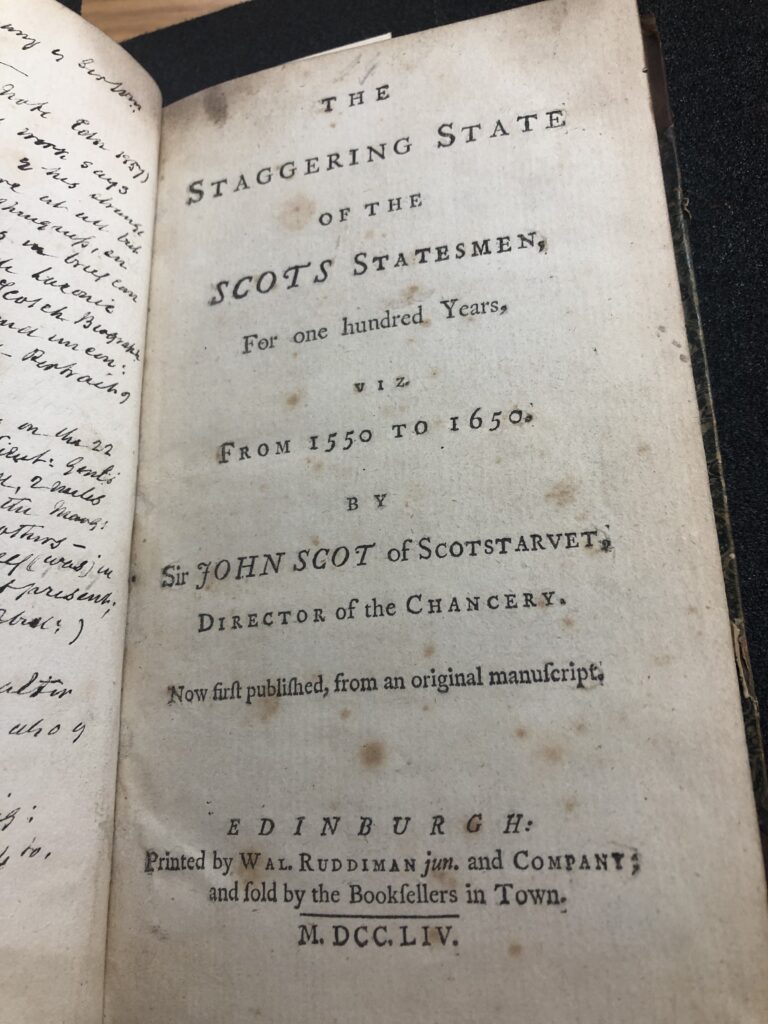
This work was how Sir John Scot consoled himself after losing office as judge and directory of chancery in Scotland [1]. This work sat as a manuscript for nearly one hundred years before being published. It was printed during a time of interest in Scottish political history. The preface acknowledges that the author focuses more on the histories of specific families and leaders rather than significant events in Scottish history. It also states that Dr. Mackenzie helped with the transcription of dates in the printed version of this text. The preface and introduction were not written by Sir John but were added in during the publishing of the text.
The physical state of the text
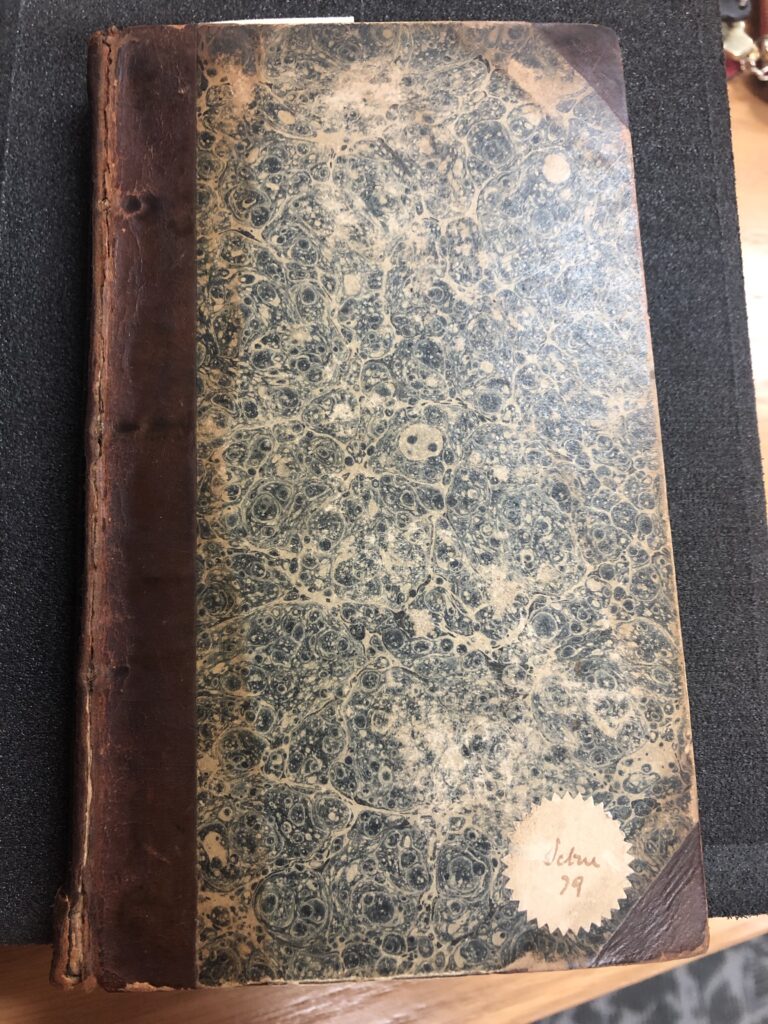
This book is bound with marbled paper boards with flower symbols engraved on the brown spine. The front cover also contains a stamp marked “Seton 79”; this stamp is also present on the front pastedown. On this pastedown, a bookplate also designates Sir Bruce Gordon Seton as an owner. In the fly leaves of the book, there are also a few inscriptions describing the lineage of the Seton family and referencing their mentions in the text. In terms of the physical text block itself, the edges of the pages are dyed blue. Throughout the book, there are a few marks of use, which are evident in the form of penciled-in marginalia. The binding as well as the text block itself are fairly worn.
Sir John Scot
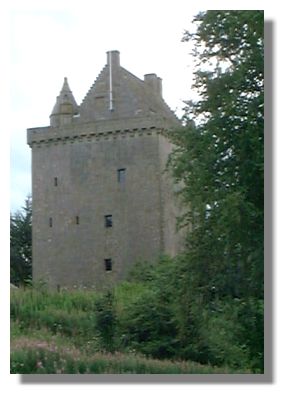
Sir John Scot of Scotstarvet, or Lord John Scott Scotstarvit, is the author of The staggering state of the Scots statesman. He lived from 1585 to 1670 in Scotland [1]. He was a judge, politician, advocate, author, and laird – a laird being a Scottish owner of a large estate [5]. Sir John Scot acquired land surrounding Scotstarvit tower and rebuilt it in 1627, making him a laird [6]. The office of director of chancery was run by his grandfather and his father and was eventually passed to Sir John. He attended St. Leonard’s College in St. Andrews, Scotland. He then became an extraordinary and later an ordinary lord of session. Extraordinary lords of session were lay members in the court of session who did not need legal qualification [9]. Sir John served on the war committee during the war of England and Scotland. After losing his office to a Quaker appointed by Oliver Cromwell, Scot invited many Scottish scholars and learned men into his grand home and continued his work in the form of literature and correspondence. He donated a substantial amount of classical texts to the library of St. Leonard’s College. He married three times and fathered a total of eleven children in these relationships.
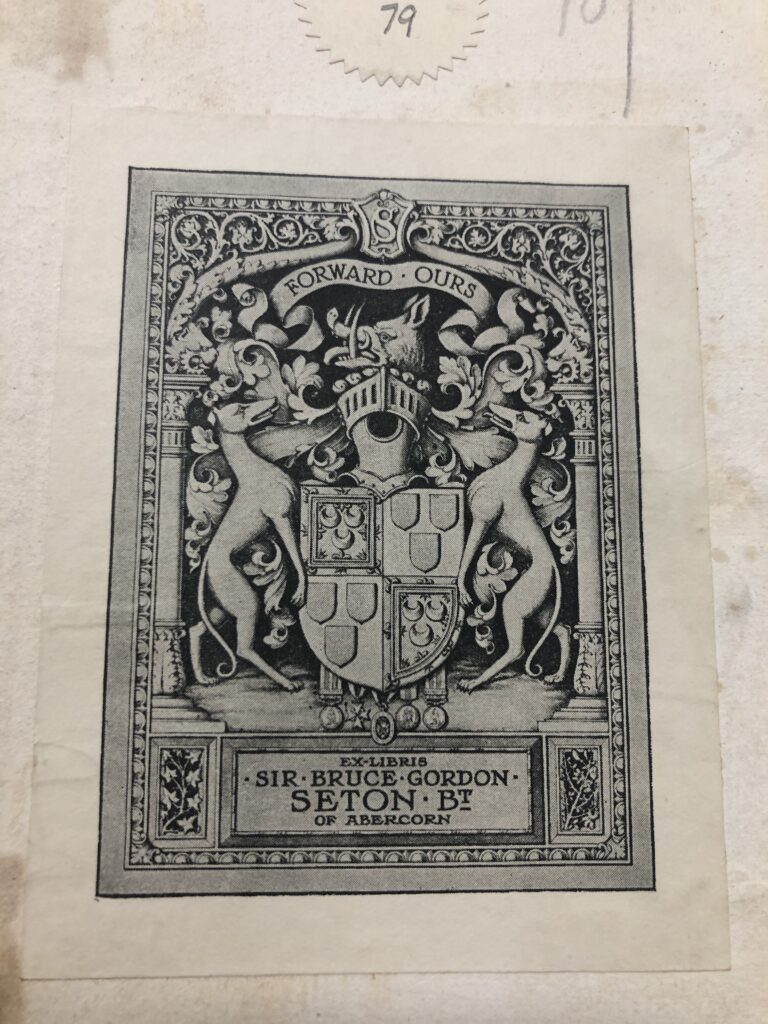
Sir Bruce Gordon Seton of Abercorn
Sir Bruce Gordon Seton was the 9th Baronet of Abercorn who lived from 1868 to 1932. He trained in medicine at the University of Edinburgh and St. Bartholomew’s Hospital in London, England and underwent military training at Sandhurst. In 1926, he was elected a fellow of the Royal Society of Edinburgh [3].
Walter Ruddiman Jun. and Company
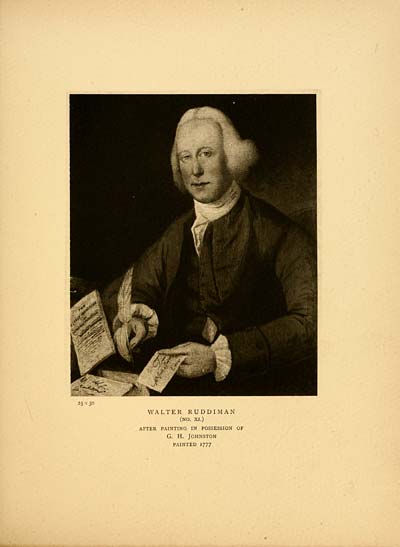
Walter Ruddiman was a printer, publisher, and newspaper proprietor in Edinburgh, Scotland who lived from 1719 to 1781. His father was a farmer, but Ruddiman moved to the city in 1745 and became a citizen there nine years later. His first project was Weekly Magazine, which was a weekly broadsheet that provided a description of local magazines and newspapers and, thus, avoided newspaper taxes because literary periodicals did not require such taxes. In 1772, Ruddiman’s eldest son Thomas became a partner in his magazine business. After Ruddiman and his wife died, Thomas inherited the family business [7].
Sources:
[1] “John Scot, Lord Scotstarvit.” Wikipedia, Wikimedia Foundation, 2 Nov. 2018, en.wikipedia.org/wiki/John_Scot,_Lord_Scotstarvit.
[3] “Bruce Gordon Seton.” Wikipedia, Wikimedia Foundation, 22 Aug. 2019, en.wikipedia.org/wiki/Bruce_Gordon_Seton.
[5] “Laird.” Wikipedia, Wikimedia Foundation, 1 Nov. 2019, en.wikipedia.org/wiki/Laird.
[6] “Scotstarvit Tower, Ceres, Fife.” Scotstarvit Tower – Clan Scott Scotland, www.clanscottscotland.com/scotstarvit-tower/4591108204.
[7] “Walter Ruddiman.” Wikipedia, Wikimedia Foundation, 3 Apr. 2017, en.wikipedia.org/wiki/Walter_Ruddiman.
[8] “Histories of Scottish Families.” (117) Illustrated Plate – Walter Ruddiman, Junior – Ruddimans in Scotland – Histories of Scottish Families – National Library of Scotland, digital.nls.uk/histories-of-scottish-families/archive/95593213?mode=transcription.
[9] “Extraordinary Lord of Session.” Wikipedia, Wikimedia Foundation, 9 Oct. 2019, en.wikipedia.org/wiki/Extraordinary_Lord_of_Session.
Created by Gabrielle Grace for Dr. Brockey’s UGS 200H class. Fall of 2019.
