
XX PR3401 .A1 1705
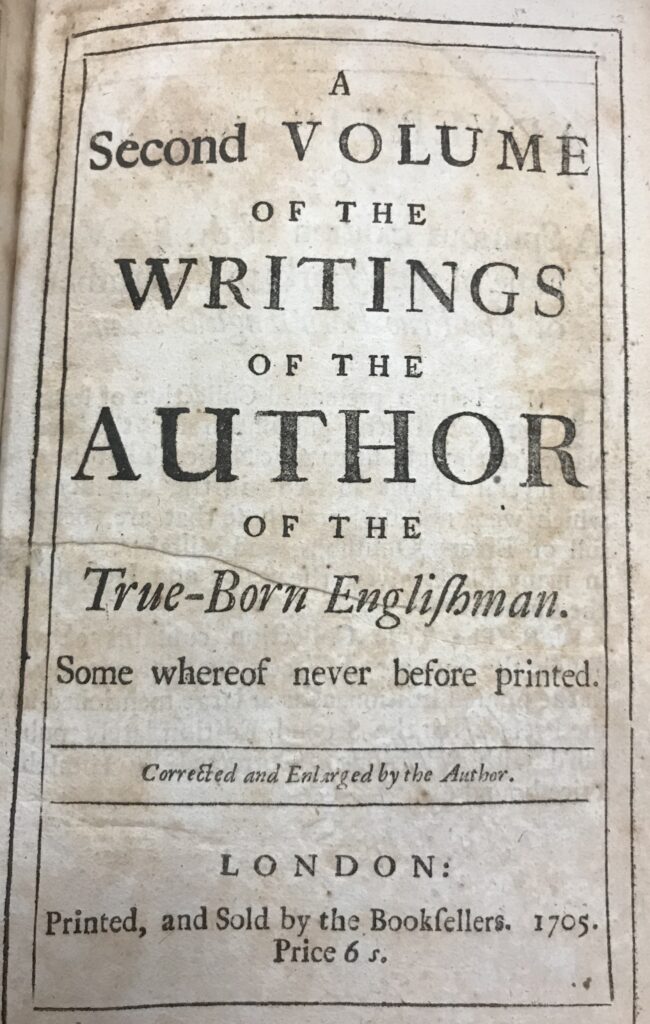
A second volume of the writings of the author of the True-born Englishman.: Some whereof never before printed. by Daniel DeFoe was published in 1705 by the Booksellers in London. The book contains a satirical poem in which DeFoe defends England’s King William III against xenophobic attacks by his political enemies and ridicules the notion of English racial purity.[1] Essentially, DeFoe defended the king, who was not native to England, and other foreigners to the English people who considered themselves “true-born” and higher class than all foreigners. [2]
DeFoe writes in the preface of the book: “Methinks an Englishman, who is so proud of being called a good fellow, should be civil; and it cannot be denied but we are in many cases, and particularly to strangers, the churlishest people alive.” This shows the message of the book that Englishmen should be civil and accepting of non-Englishmen.
About the author
Daniel DeFoe, formerly Daniel Foe, (c. 1660-April 24, 1731) was most likely born in London, England, or just outside the city, in autumn 1660. DeFoe attended Reverend Charles Morton’s dissenting academy in Newington Green; he was intended for the nonconformist ministry, but in 1681, chose to follow his father in trade and the political life of the city. At one time DeFoe said, ‘the pulpit is none of my office’. [6]
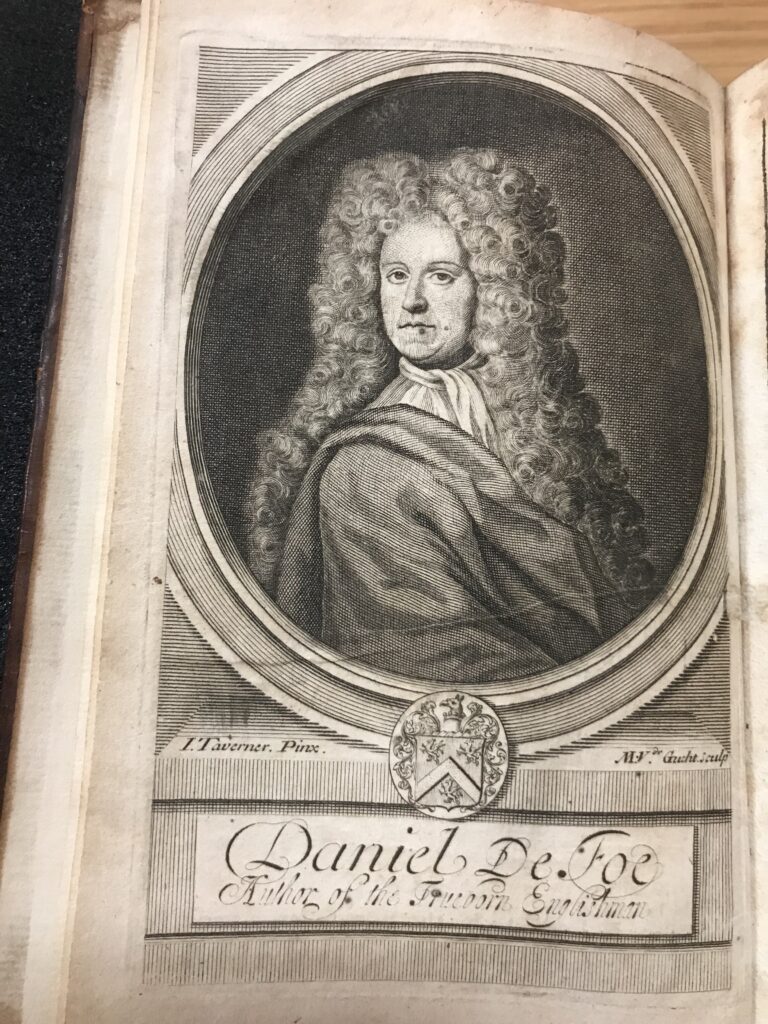
In the 1680s, DeFoe began investing in ships and expanding into the export-import business with tobacco, logwood, wine, spirits, and cloth goods. He also opened a brick and pantile factory in Tilbury. After going bankrupt in 1692, DeFoe was sent to prison. After being released, DeFoe began writing for money and submitted projects to the government and private investors. DeFoe wrote political pamphlets and poetry in support of his hero King William, and he began to exhibit some signs of literary ambition. [6]
DeFoe’s first volume of the writings of the author of the True-born Englishman. required 50 editions by mid-century, and he hoped the poem would establish his reputation as an important poet. After the poem was published, it was immediately pirated by a former printer of DeFoe’s and was even abridged into a chapbook. [6]
Physical Description
Englishman.
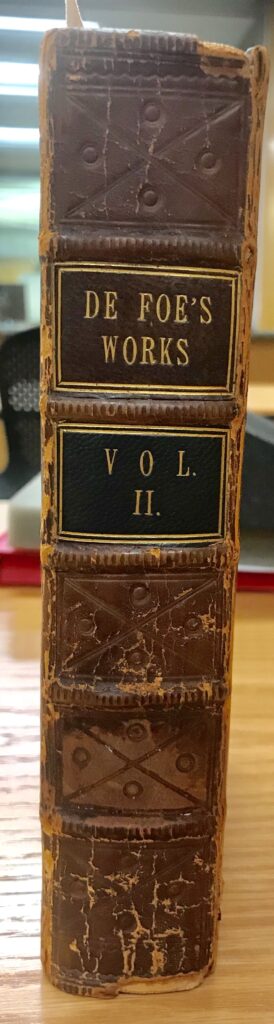
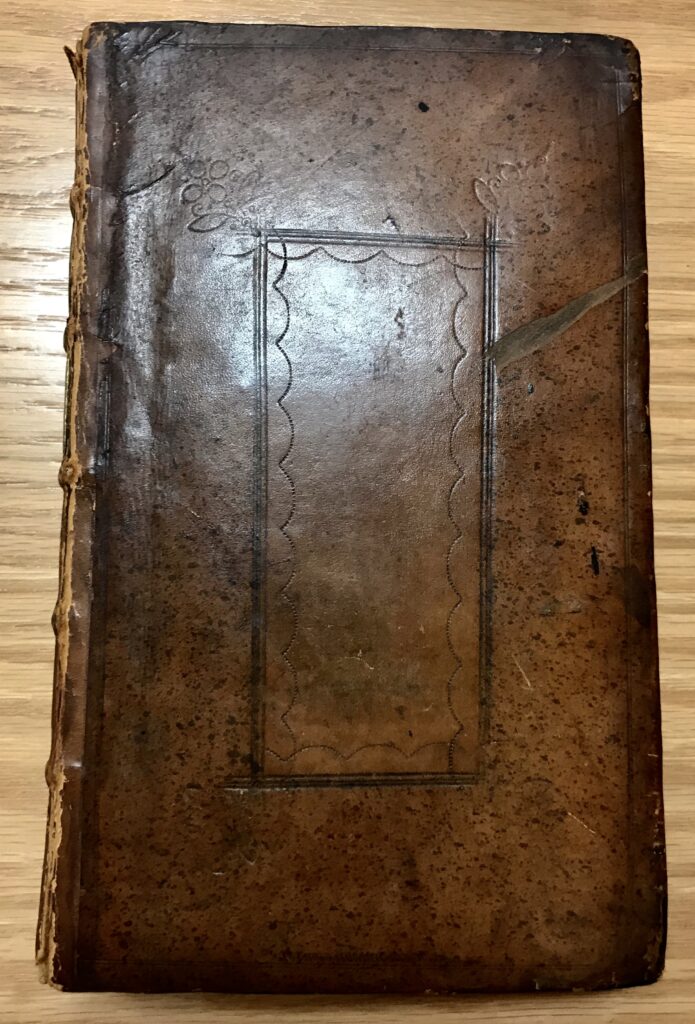
This copy of A second volume of the writings of the author of the True-born Englishman is bound in brown leather, featuring a rectangle engraving on the front cover. Small flowers are engraved on the outside of each corner of the rectangle. The spine has five raised bands; it is divided into six compartments. The words “De Foe’s Works” are found in gold tool in the second compartment, and the phrase “Vol. II.” is also found in gold tool in the third compartment. Each of the other compartments contain a pattern of an X with a small circle in each of the four sections of the X. The board edges are also gold-tooled. This copy has a colophon date of 1705.
There are scratches on both covers and the spine of the book. One especially large scratch can be found on the front cover of the book. The spine is especially scratched, which may be a sign of being substantially used and worn over time.
Evidence of Ownership and Use
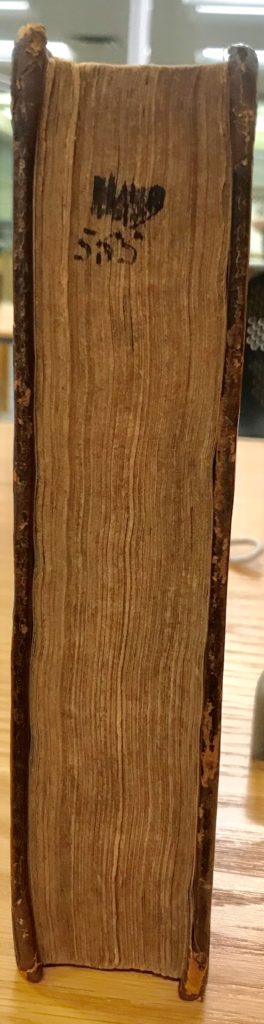
The first evidence of use or ownership is located on the upper portion of the text block. The number 565 is written on the text block, along with a number that has been scratched out above it with ink. This shows that at one point in time, this book may have been a part of a collection or library that had at least 565 books. It also shows that the book has historical importance because a previous owner needed to distinguish between his numerous books.
The second evidence of ownership is located on the front pastedown. This evidence is a Jacobean Armorial bookplate. Jacobean Armorial bookplates commonly feature scallop shell ornament underneath a shield; the bookplate found in the book does portray this description. An image of a rabbit eating greenery is featured atop an elaborately shaped shield. The name M. Eusebius Wither is located at the bottom of the bookplate.
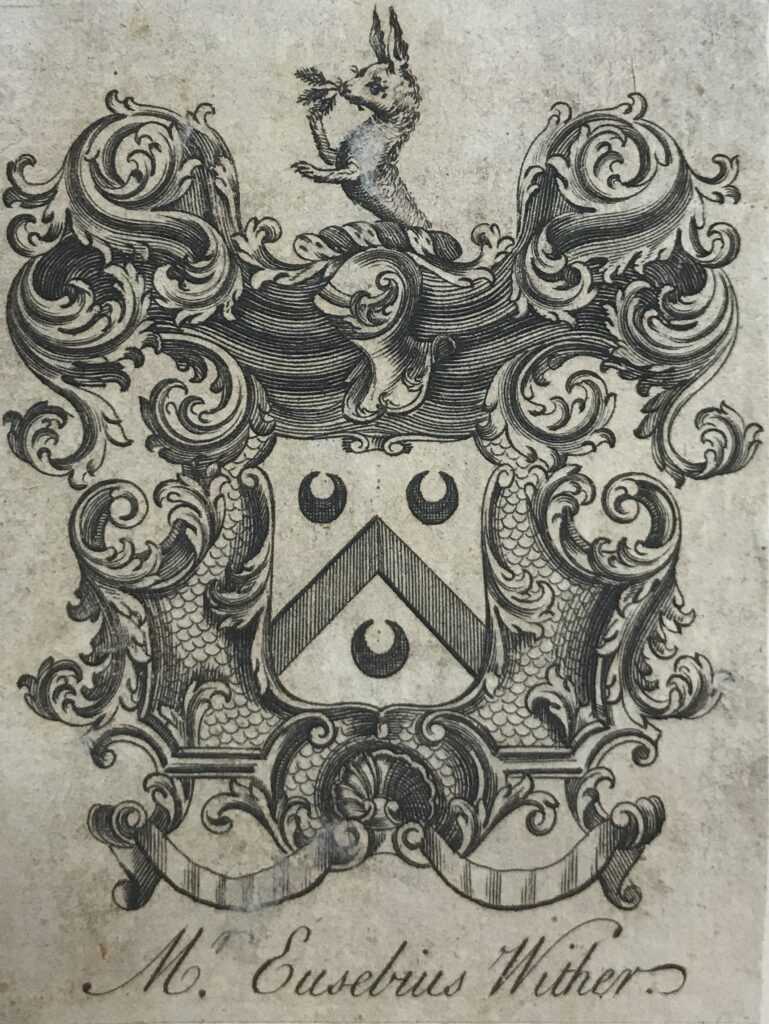
There was little historical evidence found of who Eusebius Wither was. One piece of evidence of his life that was found was in an auction log from the London Auction Market for Second-Hand Books, 1755-1802. On page 162 of this log, the item up for auction reads “The Genuine Library of English Books of Mr Eusebius Wither, of North End, Lately Deceased. Also a Large Mahogany Book Case.” The log also states that the auction date was set as May 23-25, and was advertised in the May 29 issue of the Public Advertiser. [3] In a nominee log found from 1626-1698, a Eusebius Wither is mentioned. It states: “Eusebius Wither, Son of Anthony Wither of St. Martins in the Fields, in the County of Middlesex, Gent”; it also states that the “place of his abode” was Drury-lane. [7]
The third and final evidence of ownership can also be found on the front pastedown. This evidence is an Armorial bookplate with “I. Johannes Whitefoord Mackenzie Armigeri” inscribed on it; this is the bookplate of John Whitefoord Mackenzie. The bookplate features a crest with an arm embowed holding a sword, as well as a shield that has a deer head with large antlers and three boars heads surrounding a small star on it.
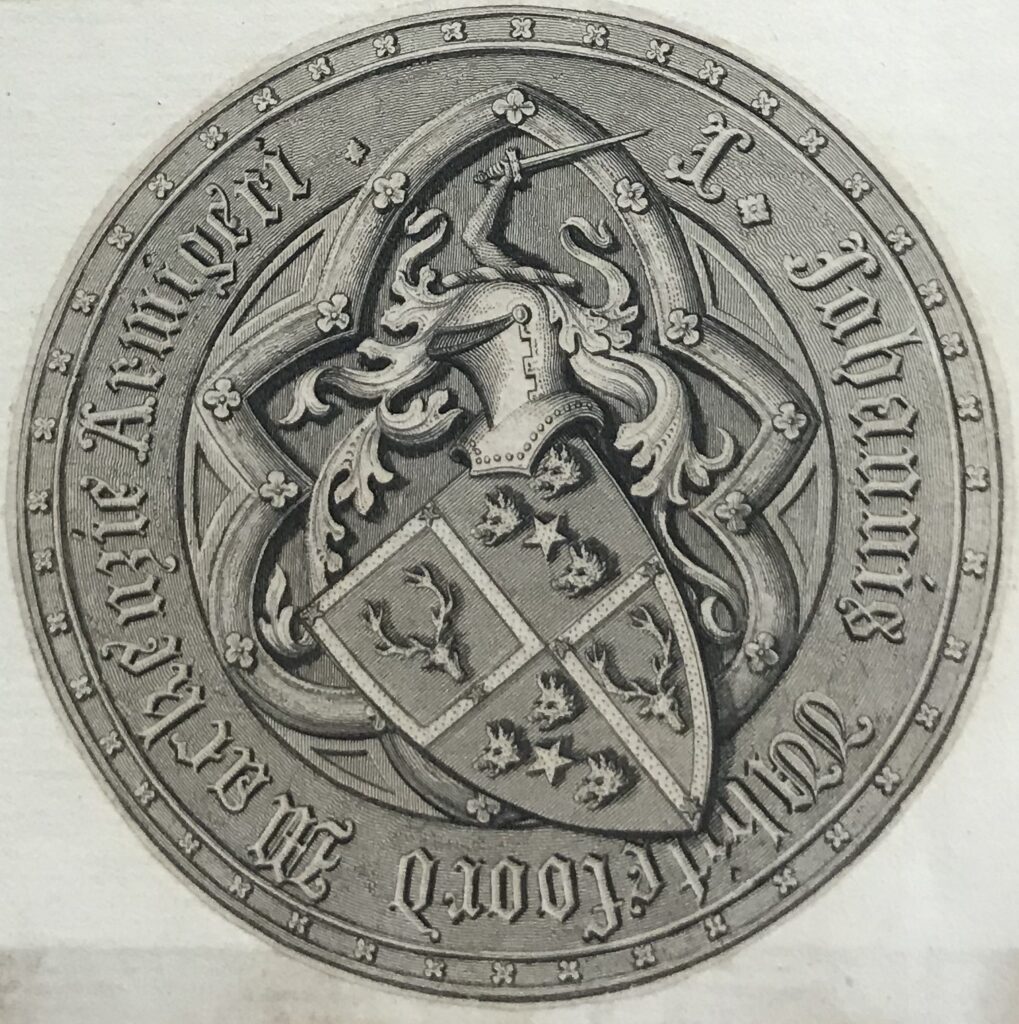
John Whitefoord Mackenzie was born on August 29, 1794; he was the eldest son of John Mackenzie M.D. of Edinburgh. He died November 8, 1884. A solicitor, he was apprenticed to Francis Napier and became a member of the Society of Writers to His Majesty’s Signet on May 26, 1818.[4]
The Society of Writers is a private society of Scottish solicitors, dating back to 1594 and part of the College of Justice. Writers to the Signet originally had special privileges in relation to the drawing up of documents which required to be signeted, but these have since disappeared and the Society is now an independent, non- regulatory association of solicitors. [5]
Mackenzie established a fine collection of early Scottish books, most of which are distinguishable only by their bookplates, and a good number of which are in the National Library of Scotland. His library was sold by Messrs Thomas Chapman & Son in two sales, the first starting March 24, 1886, and the second part starting April 27, 1886. [4]
The fact that a notable, well-known collector like John Whitefoord Mackenzie had A second volume of the writings of the author of the True-born Englishman in his collection shows that the book has historical as well as intellectual importance.
Further research
MSU Special Collections also has Volume I of DeFoe’s works. This book contains two, identical bookplates that are located in Volume II of DeFoe’s works – those of Eusebius Wither and John Whitefoord Mackenzie. This shows that there is a definite connection between the two men, as Mackenzie has purchased at least two books that Wither had in his collection. This may be evidence that perhaps Mackenzie was a fan of Wither’s collection and purchased several books in his vast collection.
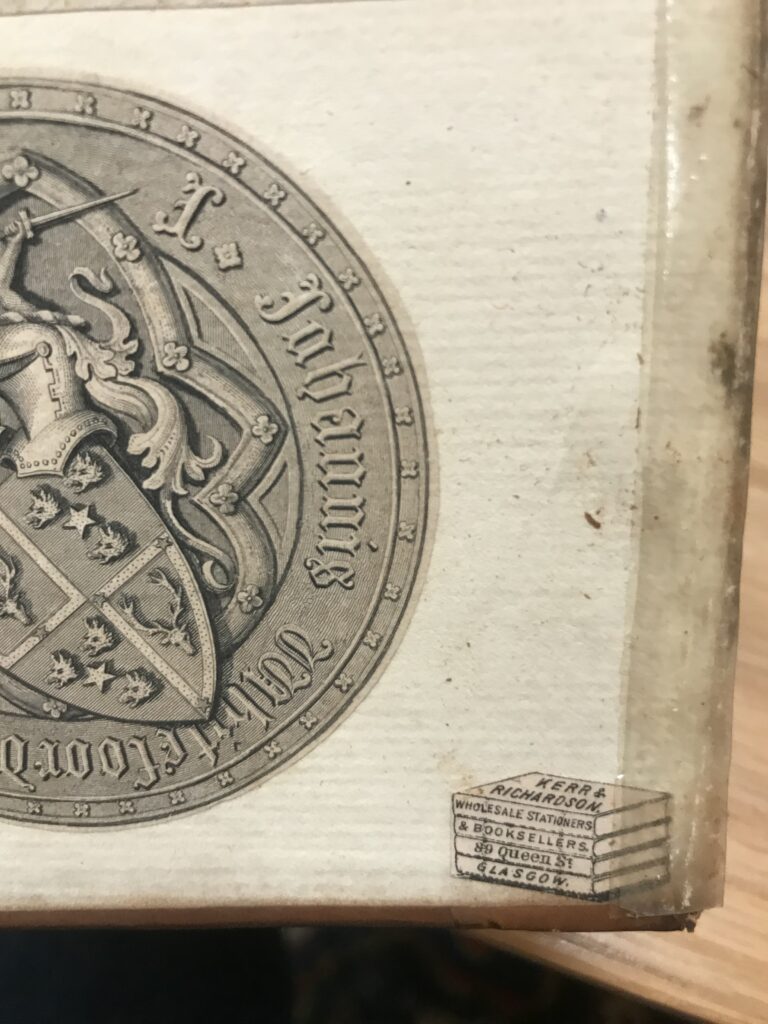
While looking through Volume I of DeFoe’s works, a different bookplate Kerr & Richardson bookplate was found on the front pastedown that was not on the front pastedown of Volume II. The bookplate reads “Kerr & Richardson Wholesale Stationers & Booksellers. 89 Queen St. Glasgow”. Kerr & Richardson are famous booksellers from the 19th century. Numerous books have the Kerr & Richardson stamp on them across many years in history, which shows the extent of the publisher/bookseller’s popularity.
References
[1] “The True-Born Englishman.” Wikipedia. May 05, 2018. Accessed October 11, 2018. https://en.wikipedia.org/wiki/The_True- Born_Englishman.
[2] “Daniel Defoe.” Biography.com. April 02, 2014. Accessed October 11, 2018. https://www.biography.com/people/daniel-defoe-9269678.
[3] Noblett, William. Samuel Paterson and the London Auction Market for Second-Hand Books 1755-1802. June 2014.
[4] “Mackenzie, John Whitefoord (1794-1884).” British Armorial Bindings. Accessed October 18, 2018. https://armorial.library.utoronto.ca/stamp- owners/MAC007.
[5] “Society of Writers to Her Majesty’s Signet.” Wikipedia. August 31, 2018. Accessed October 18, 2018. https://en.wikipedia.org/wiki/Society_of_Writers_to_Her_Majesty’s_Signet.
[6]Backscheider, Paula R. “Defoe, Daniel (1660?-1731), Writer and Businessman | Oxford Dictionary of National Biography.” (1660?-1731), Writer and Businessman | Oxford Dictionary of National Biography. November 10, 2017. Accessed October 18, 2018.
http://www.oxforddnb.com/view/10.1093/ref:odnb/9780198614128.001
.0001/odnb-9780198614128-e-7421;jsessionid=D3B921B1916332B06EB57E689F6D3553?docPos=1&mediaType-Article.
[7] “A Particular Accompt of the Moneys Paid into the Receipt of Exchequer, upon the Late Million Act, for the Benefit of Survivorship Containing the Names of the Several Nominees, Their Ages, Places of Abode, the Sums Paid upon Each Nominee’s Life: As Also, the Deaths of Such Nominees as Were Certified into the Office of the Receipt of Exchequer before the 24th of December, 1693.” Michigan Family Review. Accessed November 08, 2018.
https://quod.lib.umich.edu/e/eebo/A70274.0001.001/1:2?rgn=div1;view.
Created by Helen Korneffel for Professor Brockey’s HST 475, MSU, Fall 2018.
