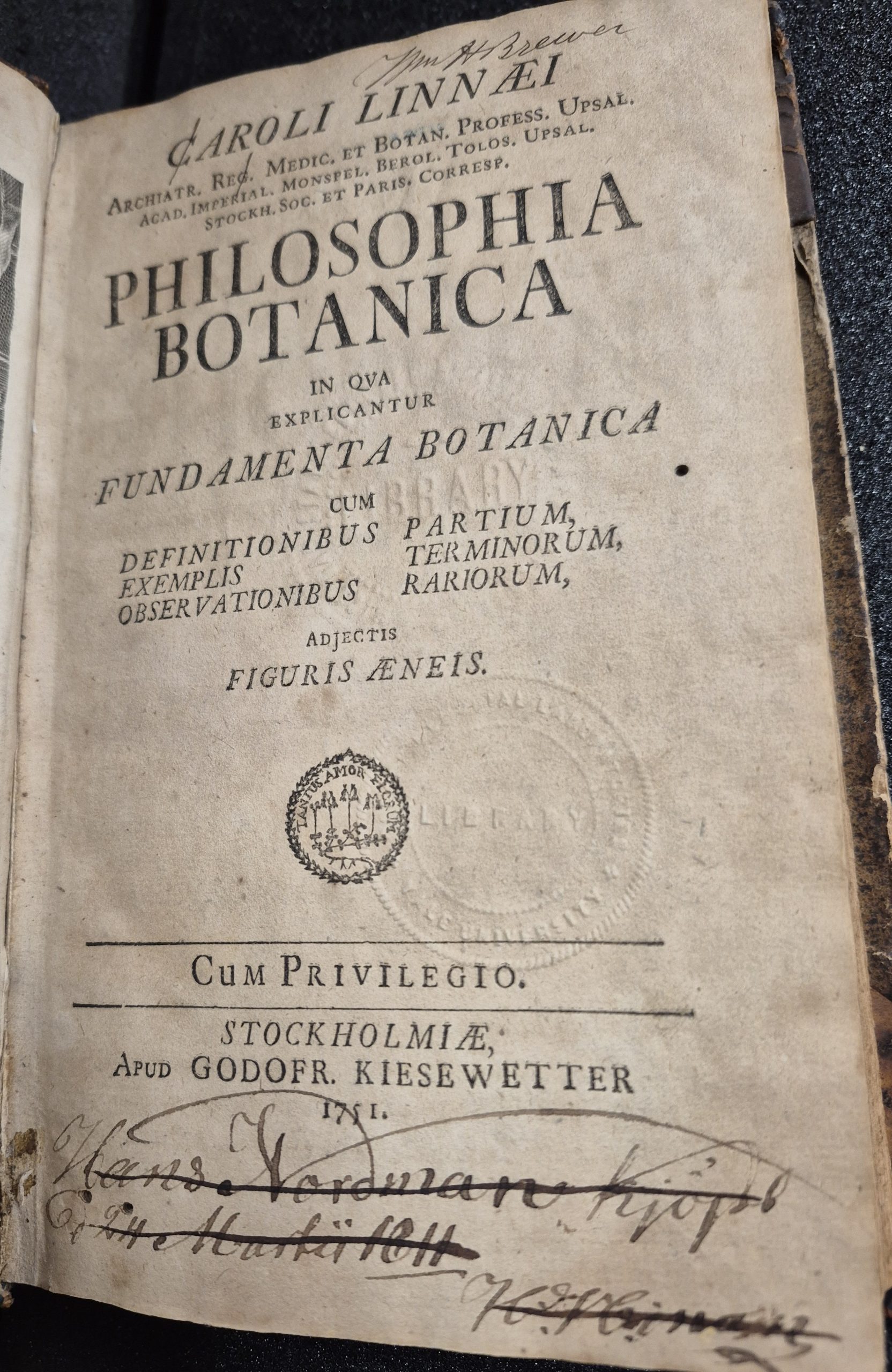
Full Title: Philosophia Botanica in Qua Explicantur Fundamenta Botanica cum Definitionibus Partium, Exemplis Terminorum, Observationibus Rariorum, Adjectis Figuris Æneis.
Translation: Botanical Philosophy in Which the Fundamentals of Botany are Explained with Definitions of Parts, Examples of Terms, Rare Observations, and New Figures Added.
Author: Carl Linnaeus
Imprint: Published by Gottfried Kiesewetter in Stockholm, Sweden, 1751
MSU Library Call Number: XX QK 91 .P5 1751
About the Author
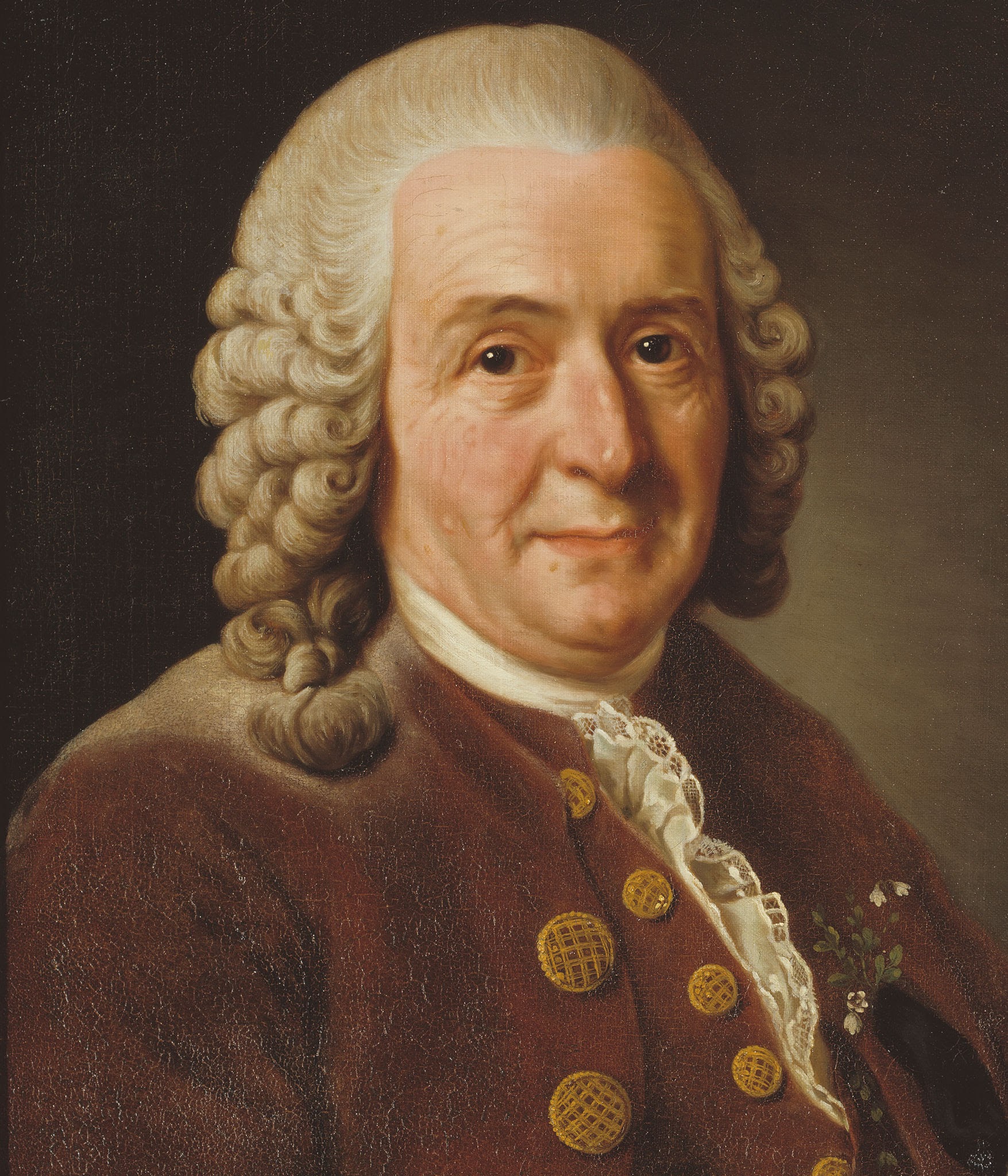
Carl von Linné (1707-1778), more commonly known as Carl Linnaeus, was a Swedish botanist and physician. He is best known for inventing the binomial nomenclature naming system. The binomial nomenclature system gives a systematic name to every living organism. This is also called the scientific name or Latin name. It consists of two parts, the first identifying the genus of the living organism, and the second identifying the species within the genus. Linnaeus published several books about his botanical findings, but Philosophia Botanica was the first to outline his idea of binomial nomenclature. He is now know as the “father of modern taxonomy” due to his contributions to the science of classification.
Physical Book Condition
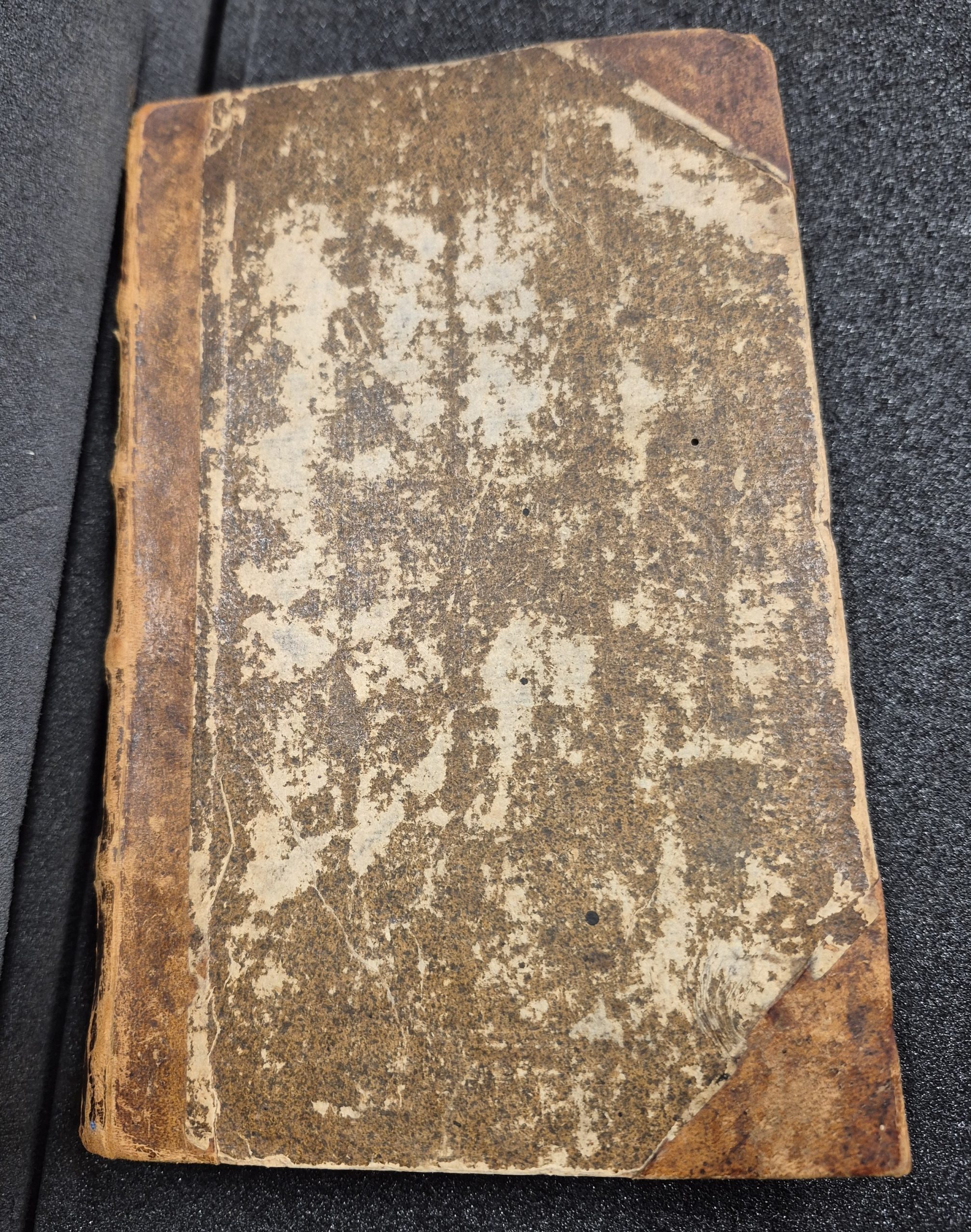
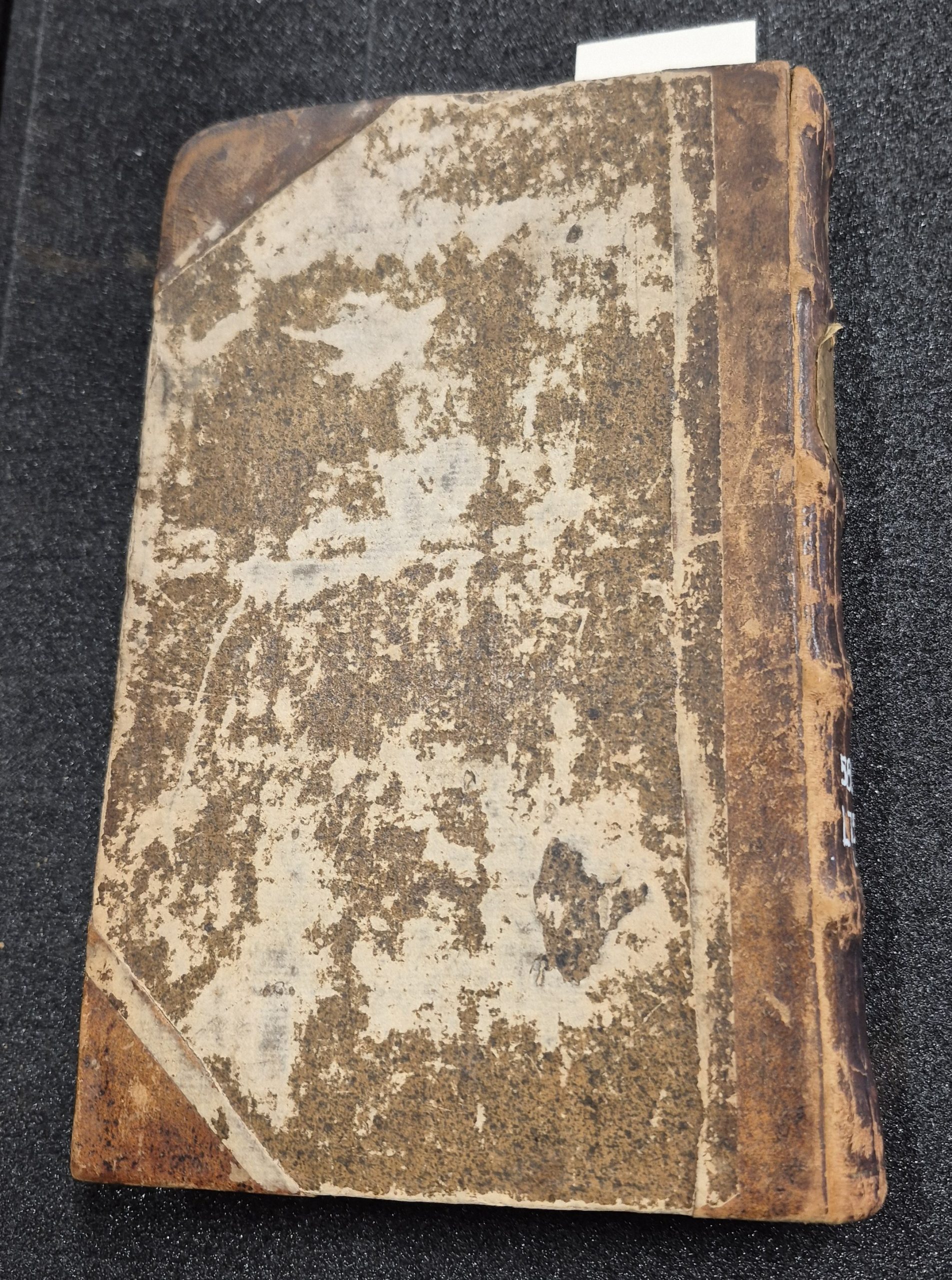
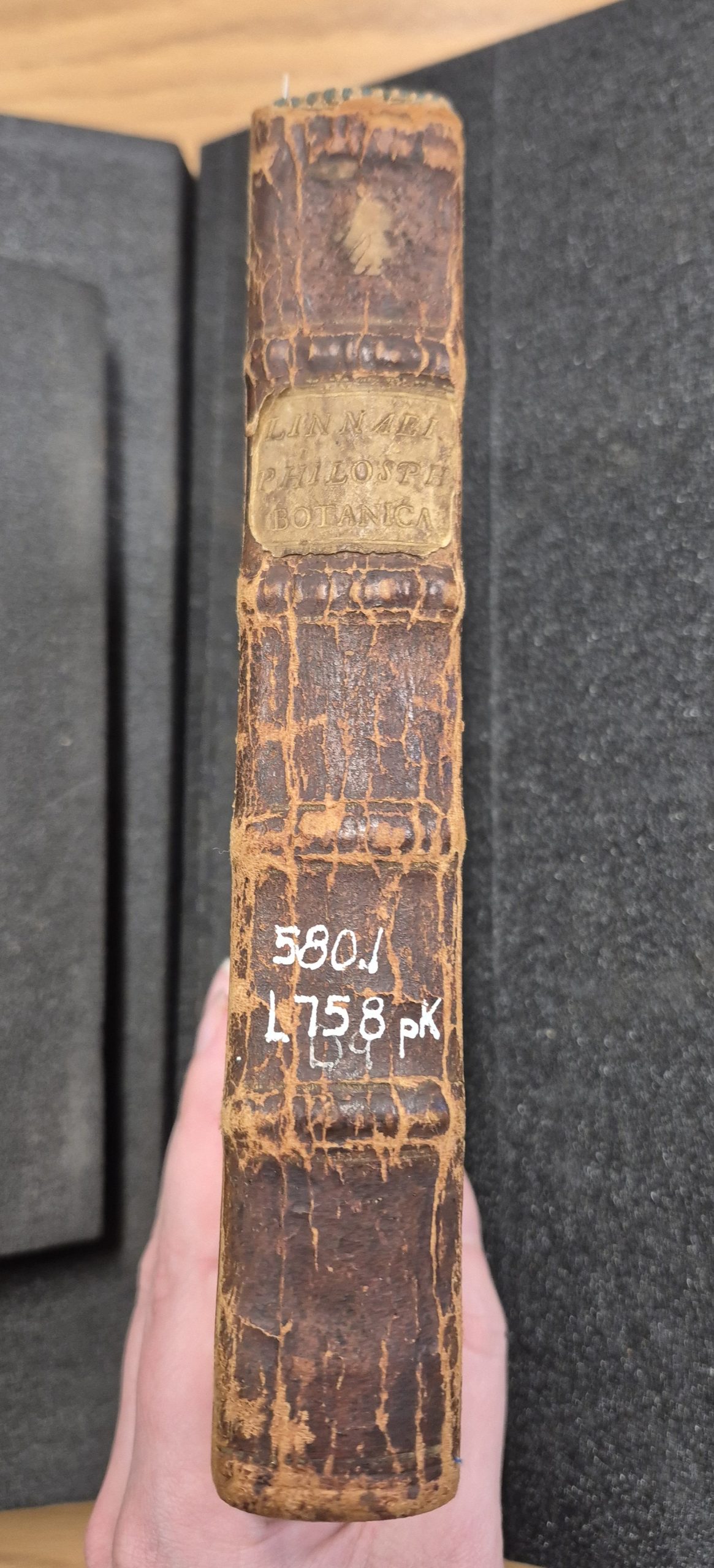
The physical condition of this copy of Philosophia Botanica is decent. Most of the damage to the book is on the outer portions of the boards and binding. Both the upper and lower boards are scuffed on the outside, leaving a patchy coloration and a rough feel. They are still functional, just a bit battered.
The leather on the binding of this copy is cracked and lifting in some places. The identification of the book on the spine, reading “Linnaei Philosph Botanica,” has been rubbed away quite a bit, and is difficult to read. A library call number has been written in white on the spine.
Along with various typical signs of use, such as folded corners, dirt along the edges of pages, and discoloration, this copy of Philosophia Botanica was a tasty feast for many bookworms. There are bookworm holes in multiple places starting in the front of the book, one going through the front board and continuing 300 pages into the text block. These holes do not impede reading or comprehension of the material printed.
Provenance
Lars Christian Haggren
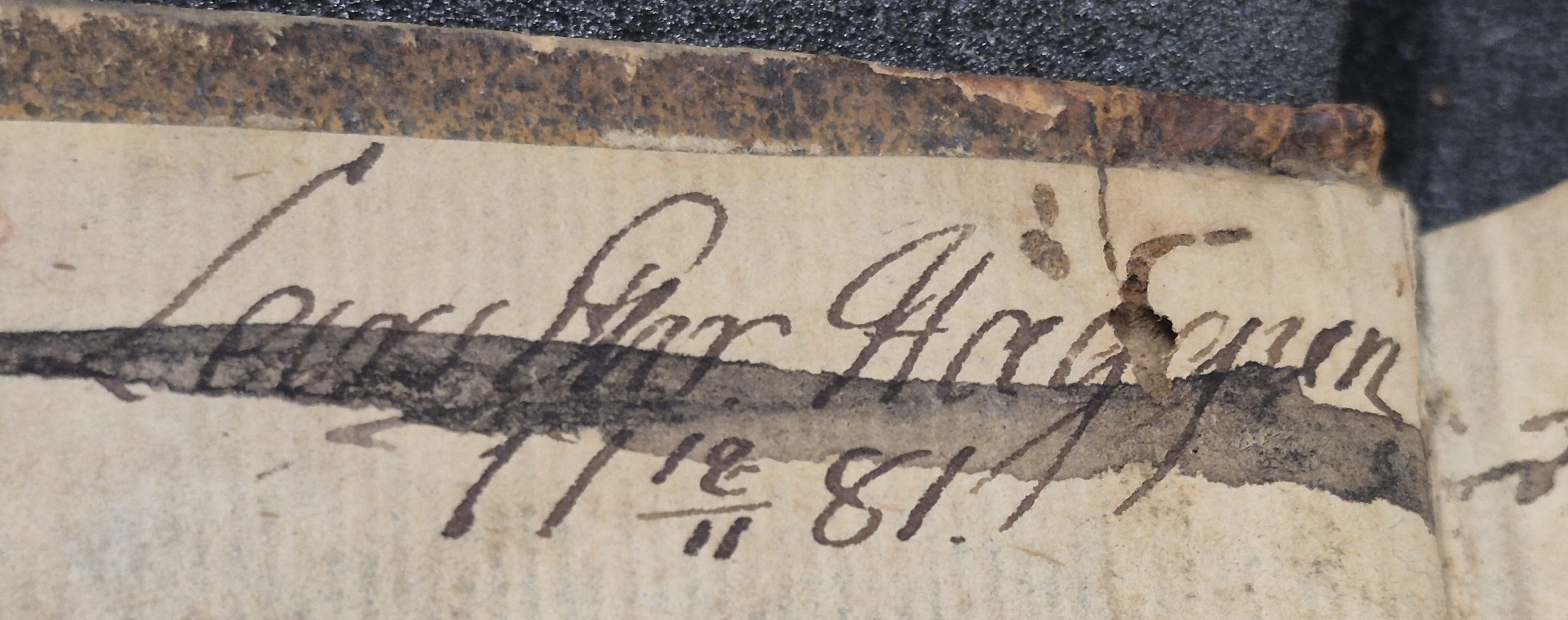
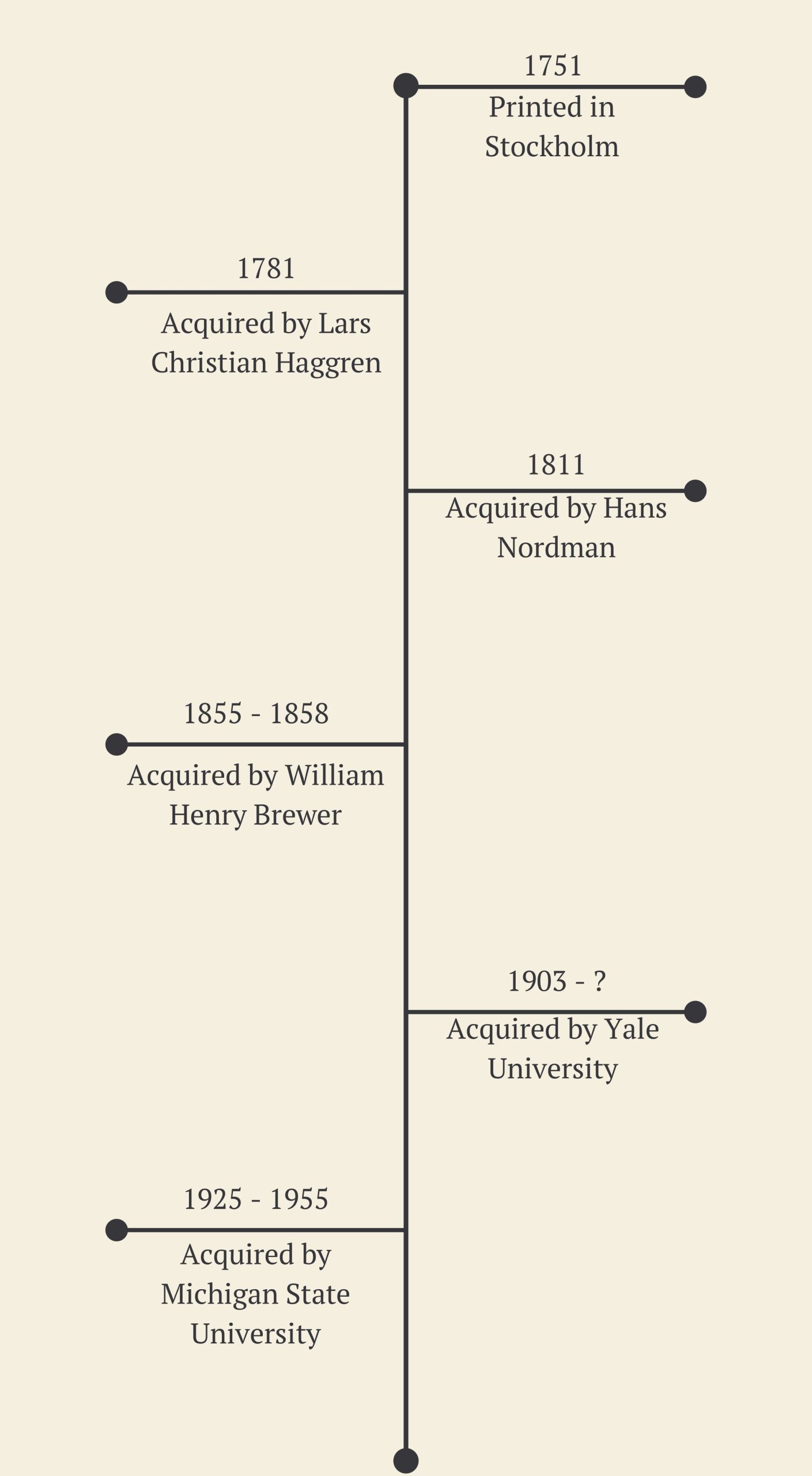
Lars Christian Haggren‘s signature can be found on the top right of the front pastedown of Philosophia Botanica, along with the date November 18, 1781. Haggren most likely used this book as reference material for his scientific studies and writings, as it provided many key details about an emerging scientific practice
Lars Christian Haggren, born March 15, 1751, was a Swedish scientist. He lectured on natural history and conducted research in various fields. Haggren, who may have been a follower of the Linnaeus family, took up research on a phenomenon that was originally discovered by Elisabeth von Linné, daughter to Carl von Linné. Named the “Elisabeth Linnaeus phenomenon”, Haggren researched orange flowers that glowed at dusk. This research was published in Swedish, French, and German journals. Haggren found that “the marigold of ‘orange or flame colour’ flashed light on dry, dusky evenings as well as the ‘yellow . . . brilliant’ nasturtium [flower]” which Elisabeth had documented.
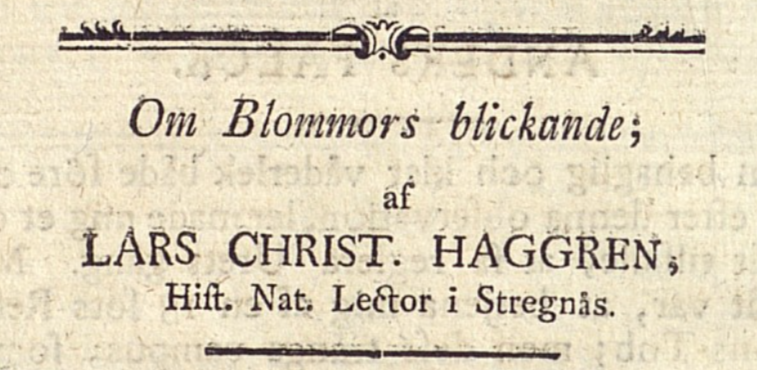
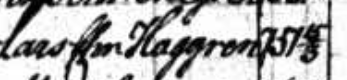
Haggren can be found in Strängnäs Cathedral Parish records from 1780 – 1800. These household clerical surveys listed everyone that lived in the parish, and kept record of how well each person knew the catechism, or principles of the Swedish Lutheran church. The last marking next to Lars Haggren’s name is dated September 21, 1800, but no death records can be found.
Hans Nordman
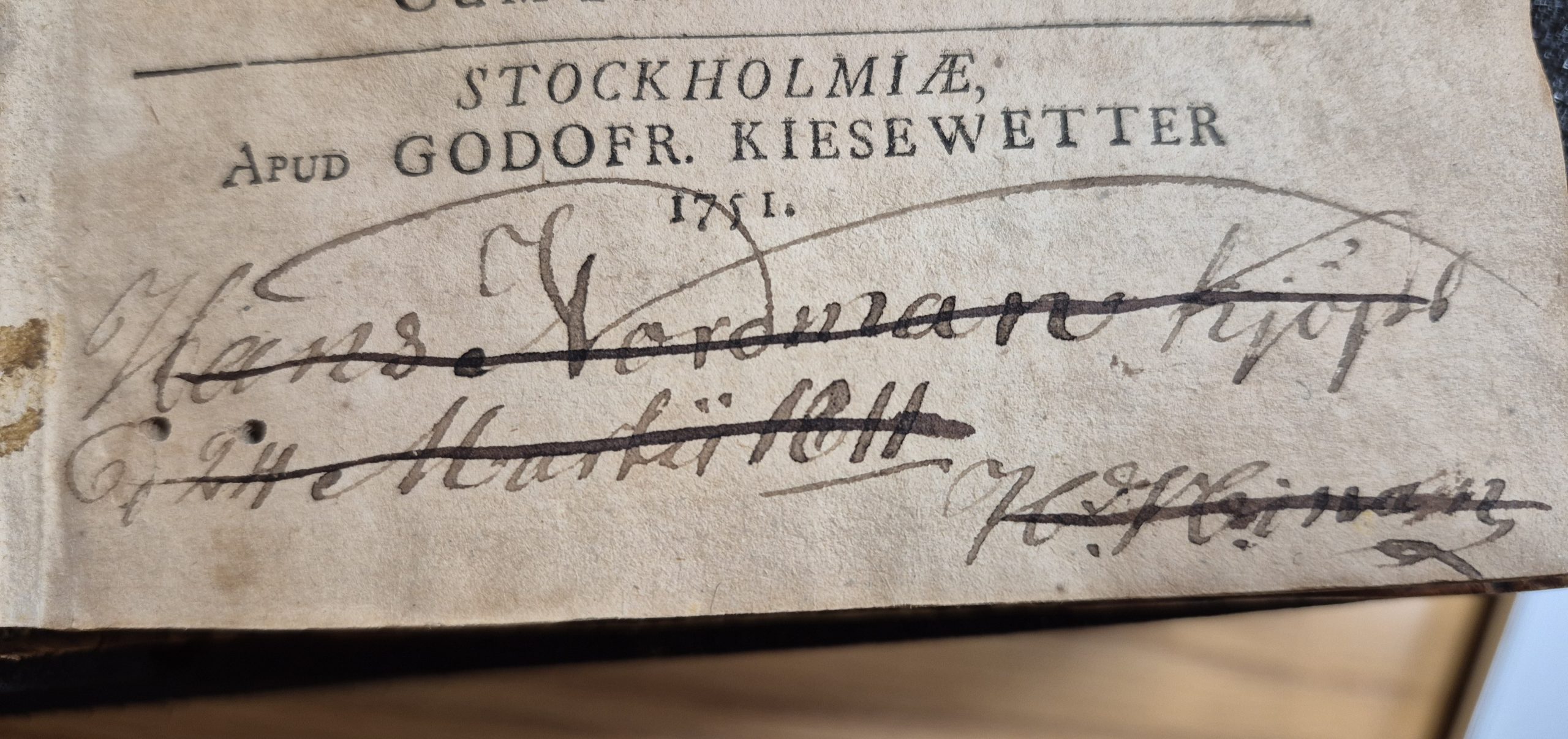
Hans Nordman’s signature can be found on the bottom of the title page of Philosophia Botanica. The full inscription reads “Hans Nordman kjöpe D 24 Martii 1811 H. Weiman,” which translates to “Hans Nordmn bought (date) 24th March 1811 H. Weiman.” H. Weiman may be a bookseller that held the book between when it left the hands of Lars Haggren and entered the hands of Hans Nordman.
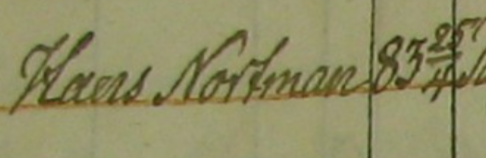
Hans Nordman, whose name may have been written as Hans Nortman in offical records, was born April 25, 1783. His name can be found in Swedish household examination books, which had the same purpose as the household clerical surveys. Hans Nordman had a daughter named Fredrica in 1811, and was married to Ana Stina Danielsdotter in 1812. Nordman lived about 75 miles from the last known location from this book, from at least 1806 – 1815. This traveling could have happened while the bookseller was in possession of Philosophia Botanica.
William H Brewer
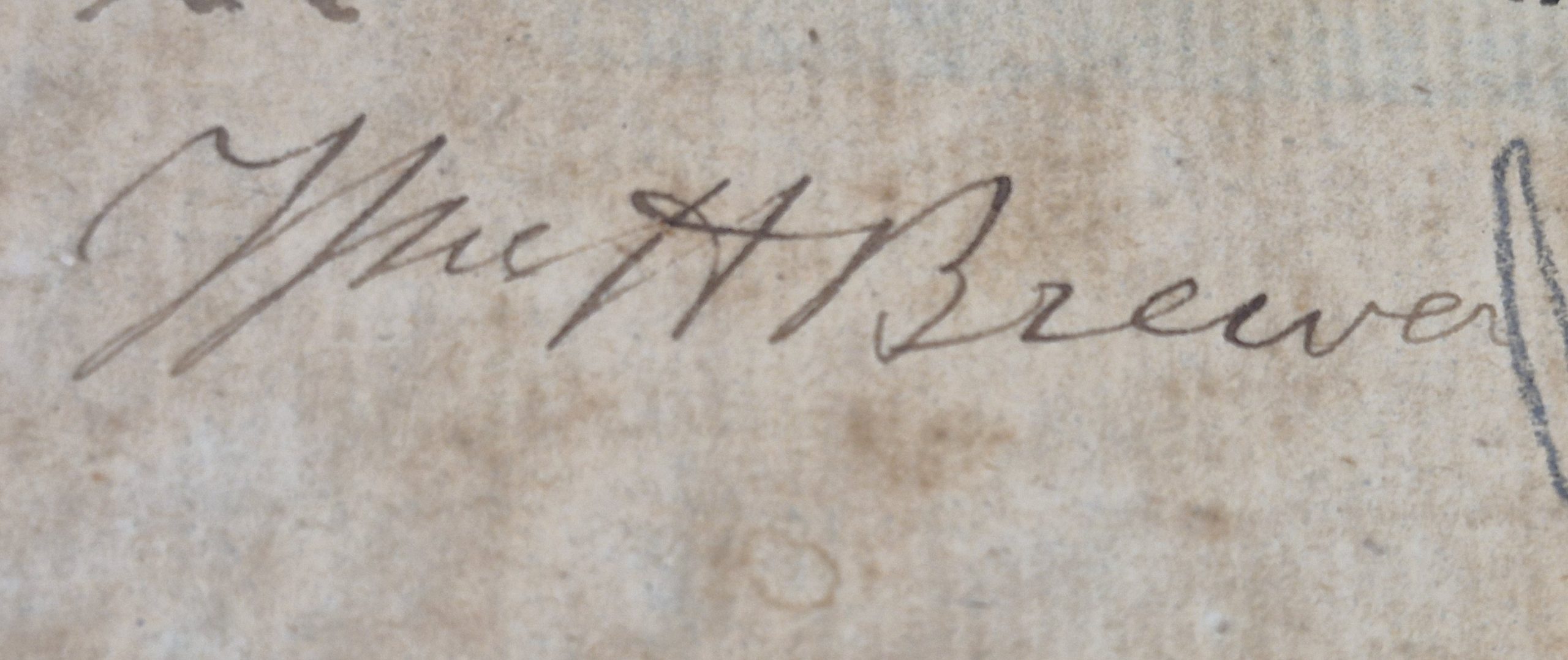
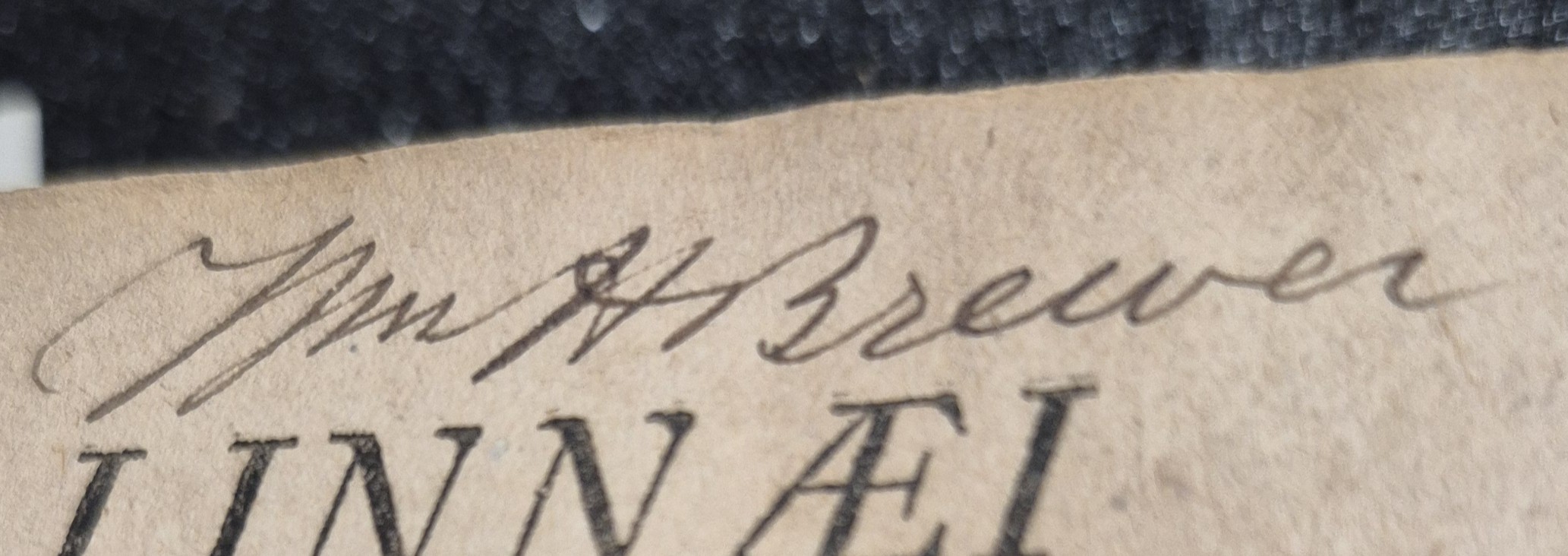
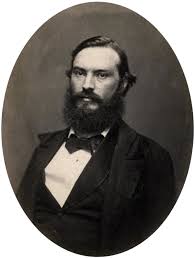
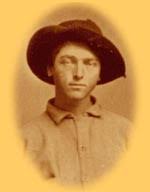
William Henry Brewer‘s signature can be found on the top middle of the front pastedown of Philosophia Botanica, as well as on the top right corner of the title page. This book was most likely used by Brewer as a studying or reference tool for his scientific classes, either while he was taking them or teaching them at Yale University.
William Henry Brewer was an American botanist, professor, and explorer. He was born in 1828 in New York, and later studied soil chemistry at Yale University in 1848. He went back to study at Yale in 1852, earning a Bachelor’s degree in Philosophy. He was a teacher at multiple academies between his studies and after earning his Bachelor’s degree.
From 1855 – 1858, Brewer traveled to Europe and studied natural history and organic chemistry under various professors. This is most likely when he picked up this copy of Philosophia Botanica.
Once back in America, Brewer was recruited as the chief botanist of the California Geological Survey, which went on expeditions to document the geology of California. The information collected in this survey was previously unknown. A book of Brewer’s experience while on this expedition, named Up and Down California in 1860-1864, contained his scientific findings. It also included his journal entries, which contained letters to his brother and observations of the social and economic states of the people the expedition encountered. Up and Down California in 1860-1864 was published in 1930 by Yale University Press, twenty years after Brewer’s death.
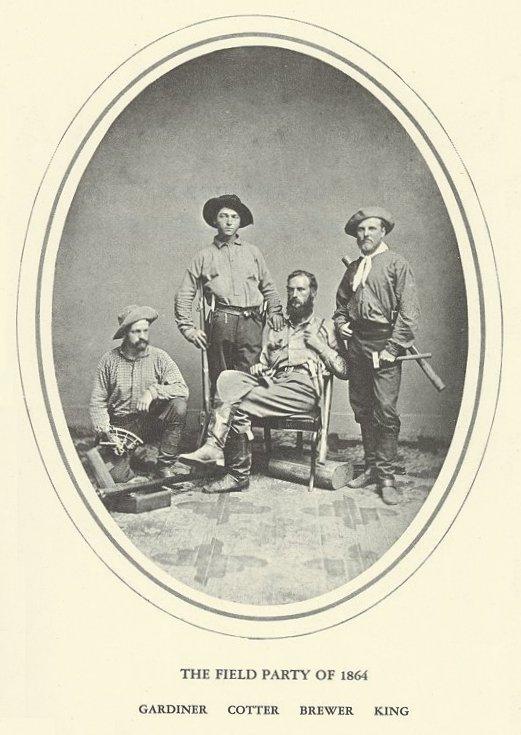
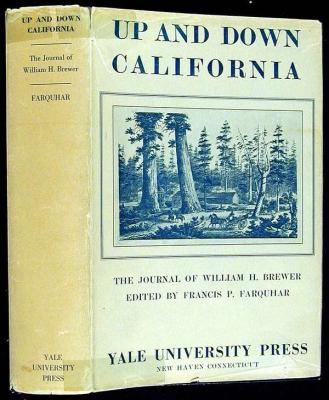
After he returned from the California Geological Survey expedition in 1864, William Henry Brewer became the first Chair of Agriculture at the Yale’s Sheffield Scientific School. This school focused on the study of the natural world.

Brewer took part in two more expeditions while serving as the Chair of Agriculture of Yale. The first was to Greenland, which ended poorly in a shipwreck. The second was to Alaska, which was much more successful. The Harriman Alaska expedition (1899) allowed a group of scientists to gather information about the plants, animals, and other fields of Earth science that were previously unknown about Alaska. After the expedition was finished, 13 volumes of a document called The Report were published. These documents described every species of fungi, lichen, moss, and fern they found in Alaska, along with many other topics.
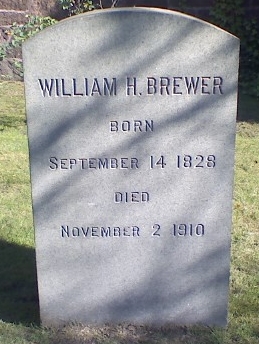
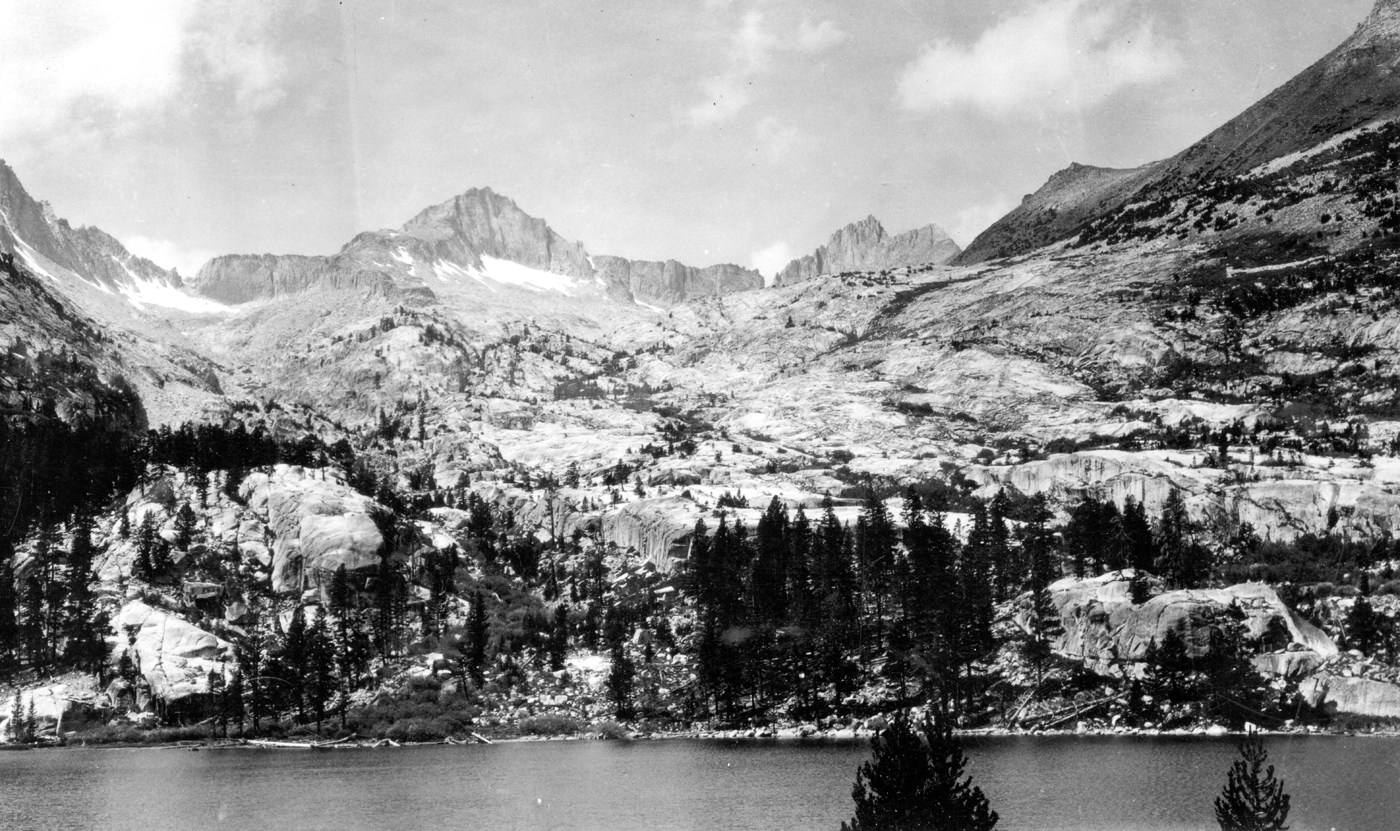
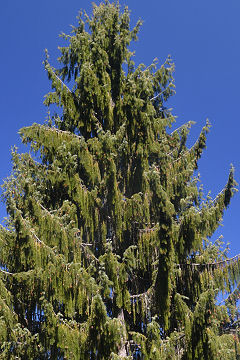
William Brewer retired from teaching in 1903, and lived the rest of his days in New Haven, Connecticut. He died in 1910. He has both a mountain in the Sierra Nevada mountain range (Mount Brewer) and a species of spruce tree found exclusively in Northern California and Southern Oregon (Picea breweriana) named after him.
Yale University
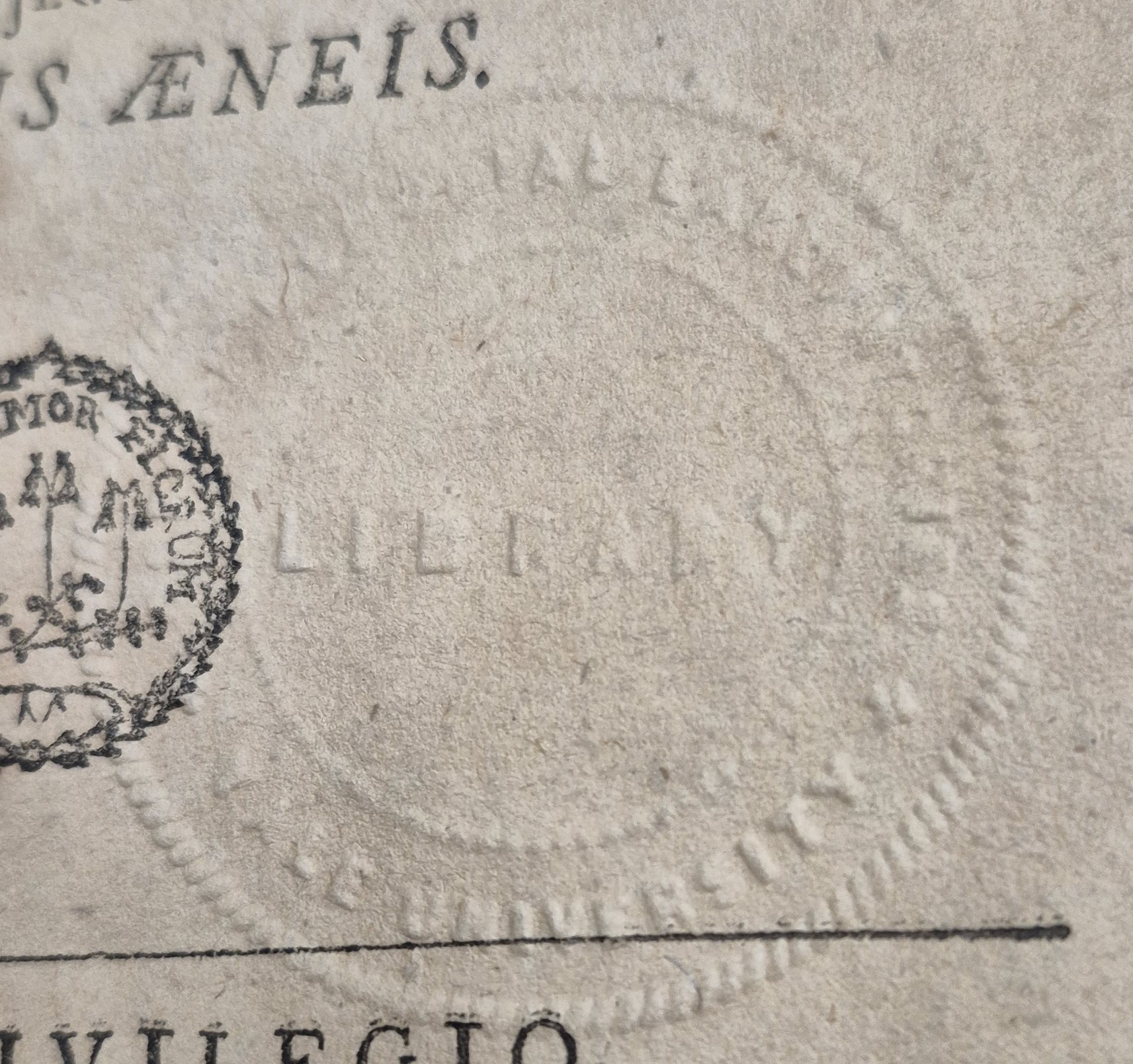
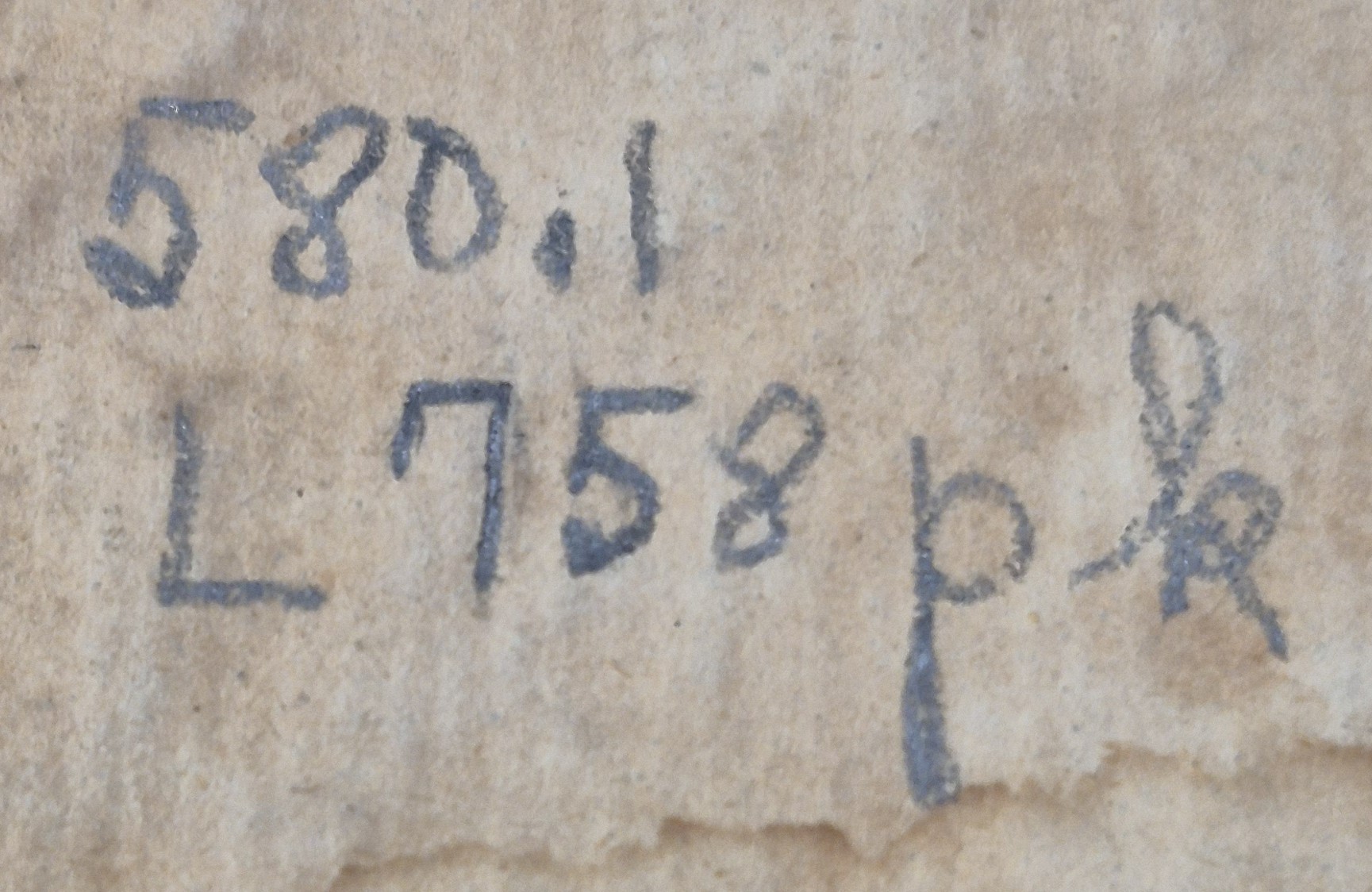
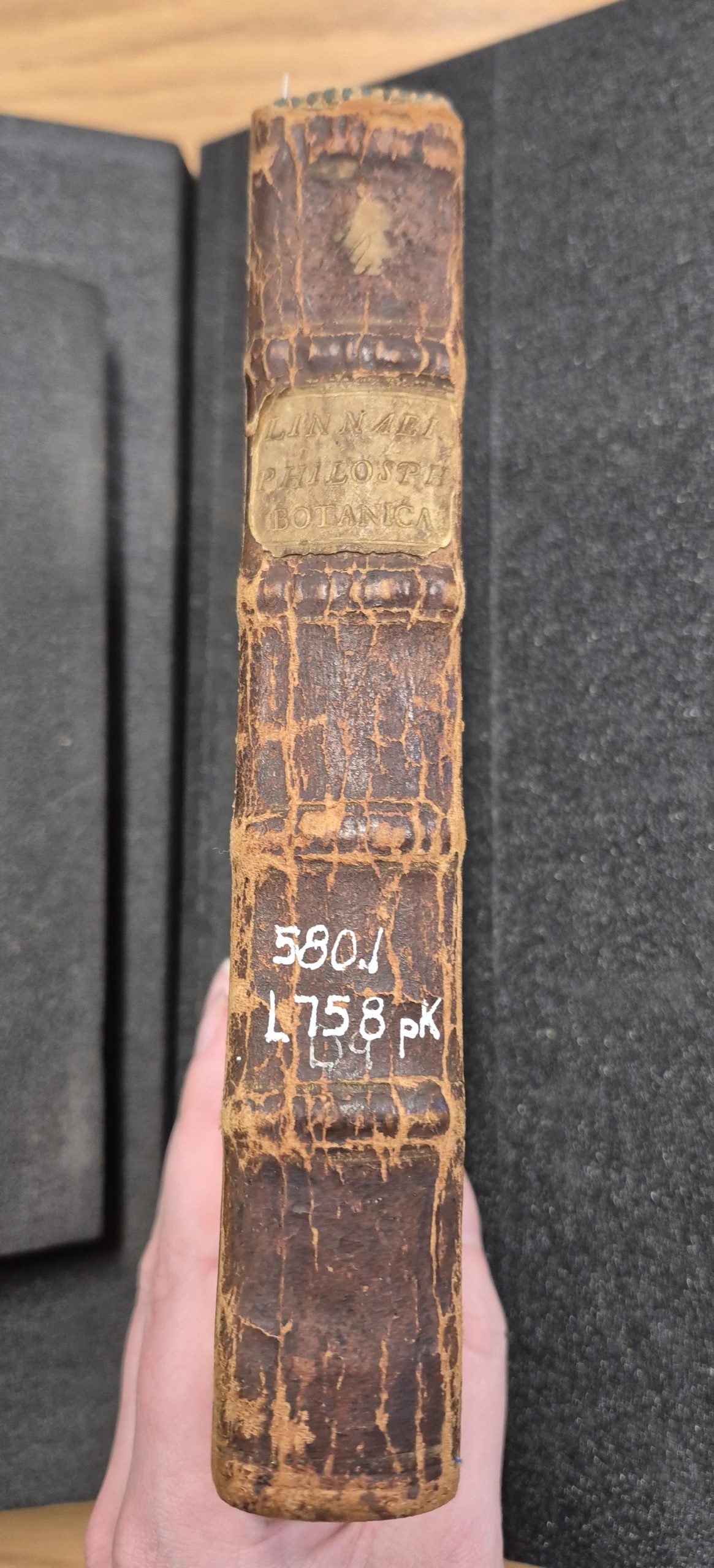
An embossed stamp reading “Yale University Library” can be found on the title page of Philosophia Botanica. Yale most likely acquired this copy of Philosophia Botanica through William Henry Brewer. The call number written on the spine in white ink and in pencil on the front pastedown is most likely from this book’s stay at Yale.
This copy of Philosophia Botanica was probably donated by William Brewer or his descendants. He was an avid book collector, especially books about science, a large number of which ended up in the Yale University Library. Through correspondence with the Yale University Beinecke Rare Book & Manuscript Library, it has been found that William Brewer and his son, Arthur Brewer, donated over 700 books to the library throughout William’s tenure as a professor until 1949. It is most likely that Philosophia Botanica was donated sometime after his retirement.
Michigan State University
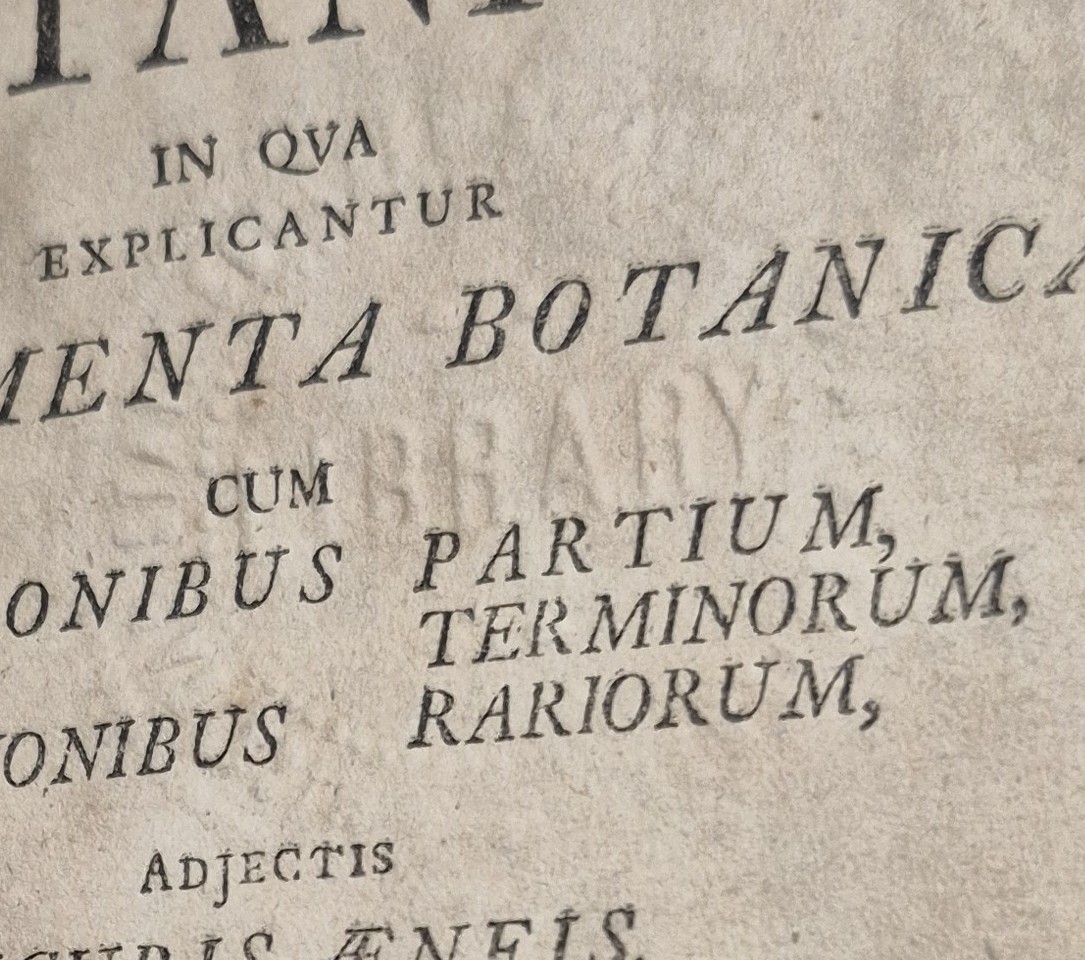
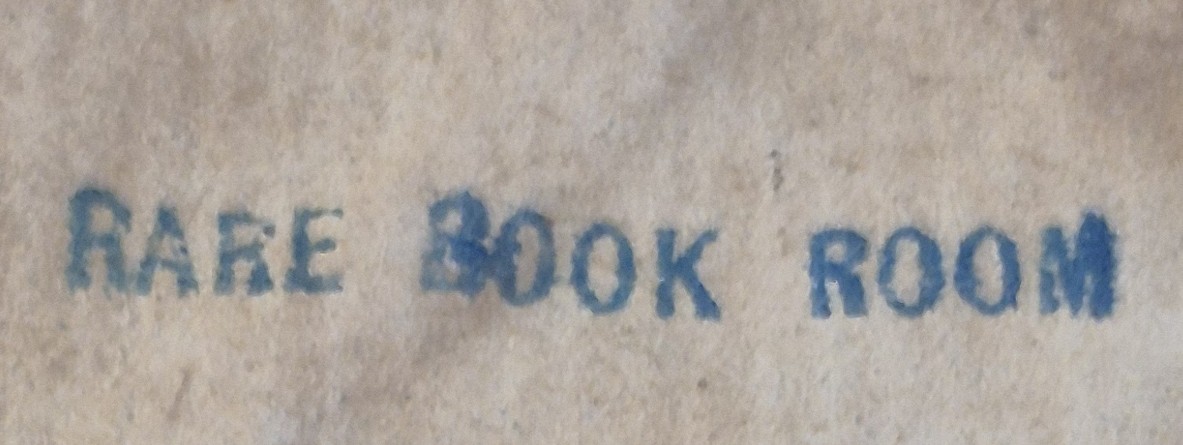
Although difficult to read, and embossed stamp stating “Michigan State College of Agr. and App. Science Library” can be found on the title page of this copy of Philosophia Botanica. There is also a stamp reading “Rare Book Room” on the front pastedown of the book. Michigan State University most likely got this copy of Philosophia Botanica from Yale University, but there are no specifications as to when. Both of the previous pieces of provenance help narrow down the time in which MSU could have acquired this book.
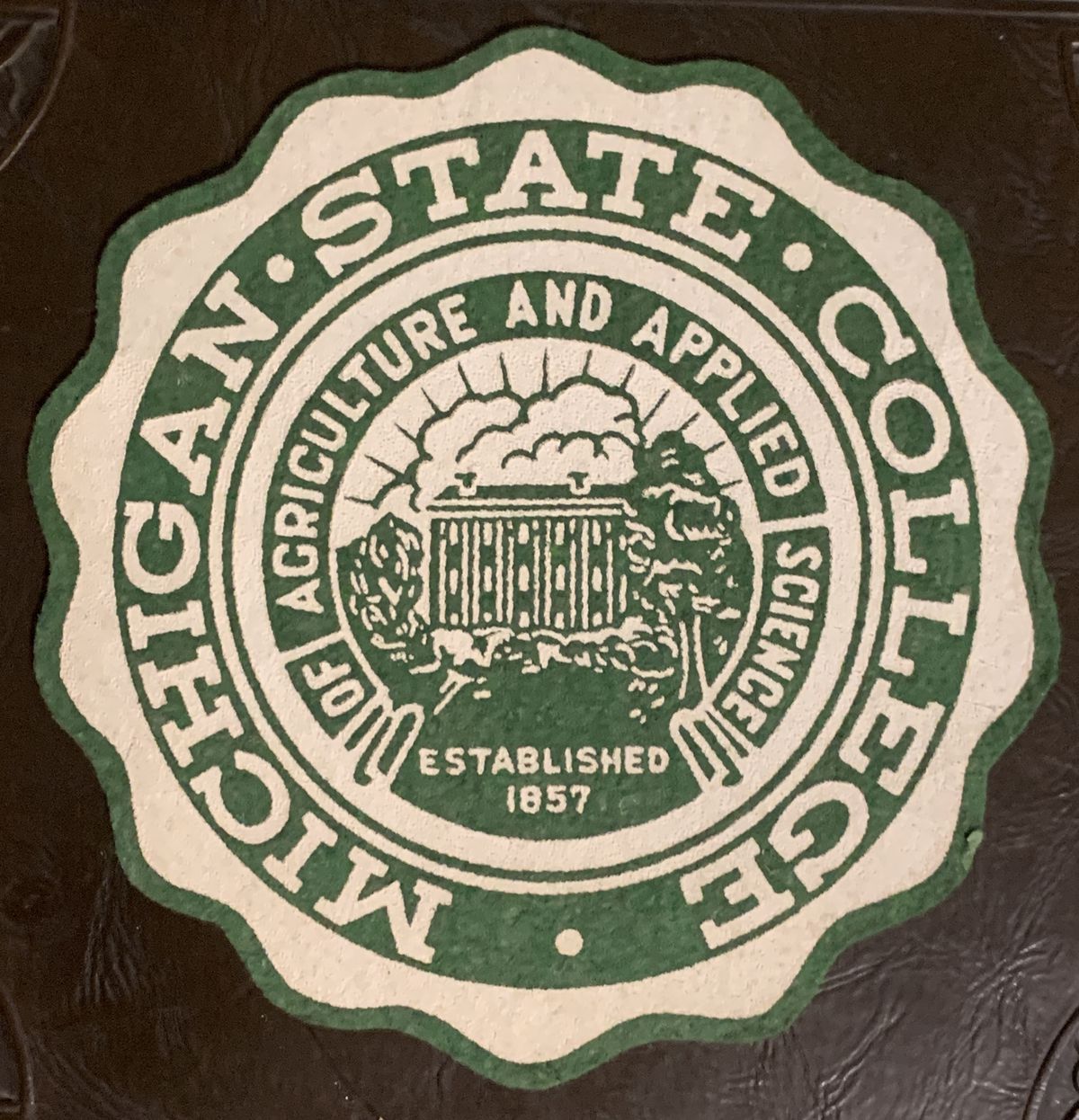
Michigan State University established the Special Collections Department in 1962, which replaced the rare book room. Therefore, the book would’ve had to have come into MSU’s possession before 1962 due to the rare book room stamp on the front pastedown. The date can further be narrowed down through the embossed stamp. Michigan State University went by the name Michigan State College of Agriculture and Applied Science from 1925 – 1955. For both the embossed stamp and the rare book room stamp to be used, the book will have come into MSU’s possession sometime from 1925 – 1955.
As of today, this copy of Carl Linnaeus’s Philosophia Botanica resides in Michigan State University’s Murray & Hong Special Collections.
Timeline
References:
- https://www.britannica.com/biography/Carolus-Linnaeus
- https://www.merriam-webster.com/dictionary/binomial%20nomenclature
- https://en.wikipedia.org/wiki/Carl_Linnaeus#
- https://skbl.se/en/article/ElisabethChristinavonLinne
- https://www.jstor.org/stable/48570404
- https://hosting.devo.se/kvah/catview.html?method=start&bookId=752&pageNo=62
- https://www.ancestrylibrary.com/search/collections/9731/records/101304430?tid=&pid=&queryId=505bd274-d2a2-4689-905c-1b0baf733d3d&_phsrc=cRE31&_phstart=successSource
- https://records.myheritagelibraryedition.com/research/record-10180-193335867/hans-nortman-in-sweden-household-examination-books
- https://en.wikipedia.org/wiki/William_Henry_Brewer
- https://www.nybg.org/library/finding_guide/archv/brewer_ppb.html
- https://www.yosemite.ca.us/library/up_and_down_california/
- https://ogc.yale.edu/governance/sheffield-scientific-school
- https://plants.jstor.org/stable/10.5555/al.ap.person.bm000200064\
- https://naturalhistory.si.edu/research/botany/about/historical-expeditions/harriman-expedition
- https://www.findagrave.com/memorial/68723863/william_henry-brewer
- https://msuprovenance.wordpress.com/tag/michigan-state-university/
- https://www.jstor.org/stable/40857050
Created by Sarah Cromwell
Spring 2025
HST 475 taught by Professor Brockey
Michigan State University
Special thanks to Tad Boehmer of MSU Special Collections and Moira Fitzgerald of the Yale University Beinecke Rare Book & Manuscript Library

