
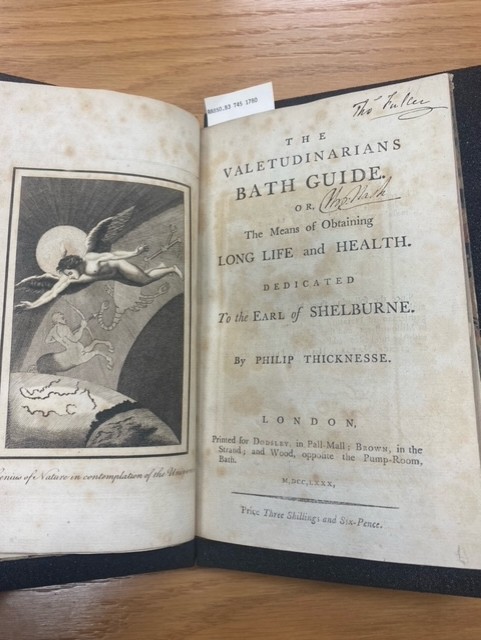
Book Identification:
The Valetudinarians Bath Guide. Or the meaning of Obtaining Long Life and Health was written by Philip Thickness and was published in 1780 at the Pall-Mall; Brown, in the Strand; and Wood, opposite the Pump-Room, Bath, England.
MSU library call number: RA850.B3 T45 1780
Physical description:
The book is in relatively good condition with no noticeable damage to the pages except for a slight tear on page 73/74, as well as only having minimal wear to the binding and spine. With only slight damage to the bottom and top of the boards. The gold tooling on the spine is in great condition as well as the leather that is not covered by marbling.
Though there is a good amount of mold or water stains throughout the book, but not to the point of any of the pages becoming illegible or too delicate to handle.
Contents:
- The contents of The Valetudinarians Bath Guide contain the accounts of the author’s medical experiences in Bath, as well as anecdotes of his previous medical encounters.
- The majority of the medical discussion is that of the properties of the water in Bath that makes its baths so special. This includes discussion on the temperature of the water, the minerals in the water, and which water women were allowed to bathe in compared to men.
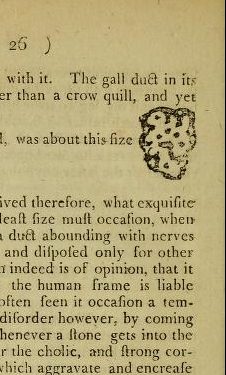
- The author will often bring up anecdotes of his previous medical experiences, one such example being his recollection of the largest gallstone he ever saw, which is represented by a to scale printed image of the stone.
Author:
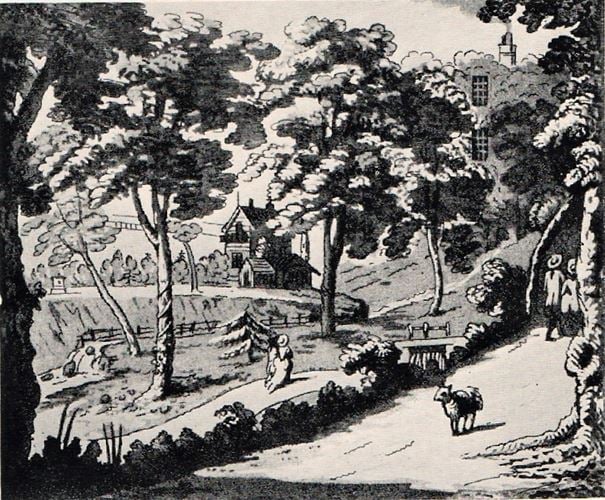
Philip Thicknesse is the author of this book and is an interesting character. Thicknesse was born in 1719 in Staffordshire, England and would go on to become a British Army officer as well as a writer. In 1742 Thicknesse would then abduct a woman by the name of Maria Lanove and they would elope to Bath and start a family. Thicknesse would go on to have two more wives both eventually passing, causing Thicknesse to sell his home in Bath, and move to St. Catherine’s Hermitage where he would carve out a hermit’s cell for himself which would have resembled that of a poor hobbit hole on the property of a wealthy landowner.
In his will he requested that his right hand be cut off and sent to his son as a reminder of his son’s failed duty to him.
More can be seen about Thicknesse Here
Significance:
The book is specifically dedicated to the Earl of Shelburne, who would have been William Petty Fitzmaurice the second earl of Shelburne and would later become the Prime Minister during the American revolution and is a key figure in making peace with America. The message to the Earl seems to imply that the Empire is going through difficult period that would be causing the Earl and the King much stress, and that this book would be of use to them in overcoming sickness and stress because of the mounting revolution.
Evidence of provenance:
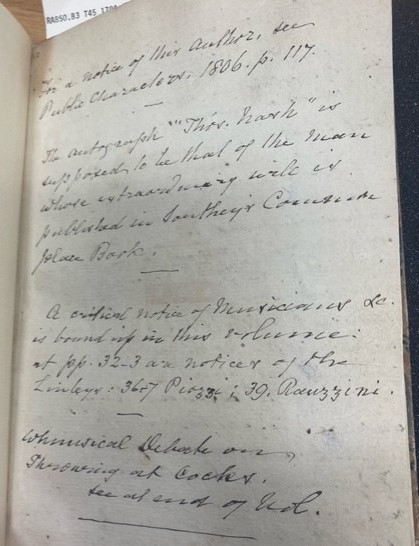
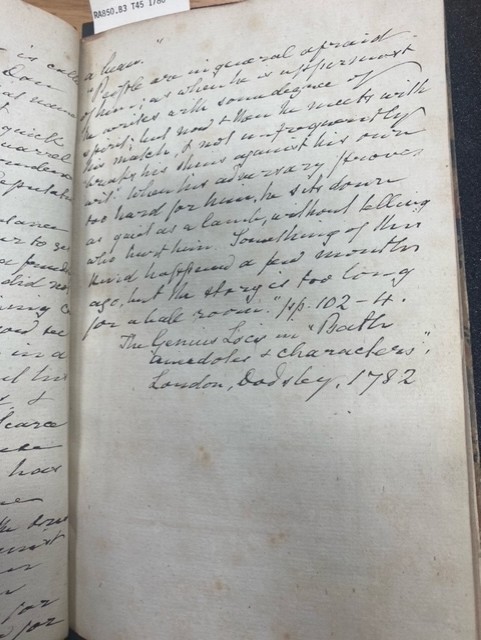
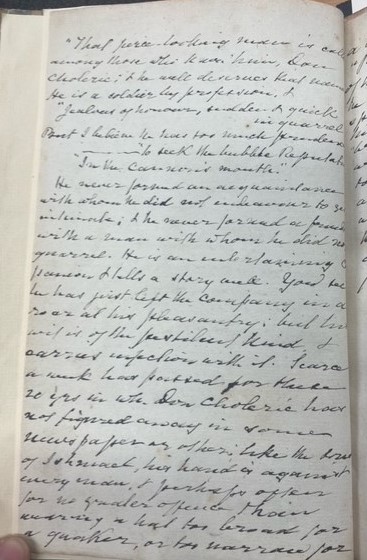
Within this copy of The Valetudinarians Bath Guide there are a number of handwritten signatures as well as two bookplates, one from Thomas Fuller and the other from William Clark. There is message that spans 3 pages that reflects on the author as well as the contents of the book. There are also two minor pieces of writing within the book, one being the name Dr. Grahm written next to a part of the text talking about Dr. Grahm, and the other being what believe to either be a book sellers code or a library’s cataloging number neither of which I was able to find anything significant.
Thomas Hark
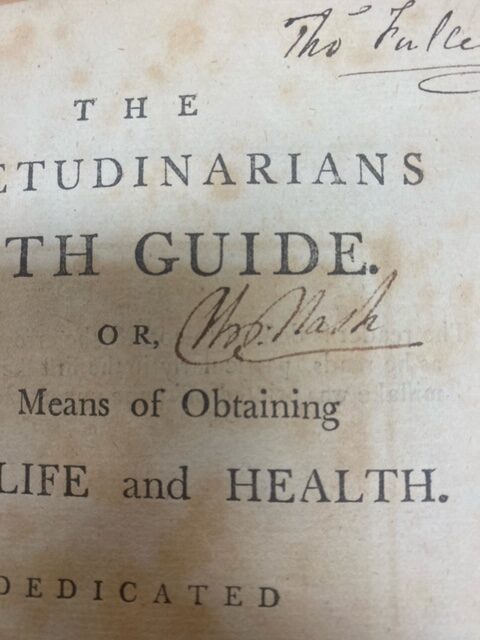
I believe Hark to be the first owner of this book as there is other provenance referencing him, as well as the other pieces of provenance pointing to being later in the timeline. Admittedly I was unable to find much information on Hark. What I was able to find is that he was most likely a poet/author located in Bath whose writings were popular enough to be featured in a collection of other authors in the book Southey’s Common-Place Book. After going through multiple digitized editions, I found a multitude of Thomases but none being Hark. But given the certainty of the message that references Hark, that his works were published in that book I may just not have found the correct edition. With publication dates for this book ranging throughout the 1800s it is difficult to pin down which edition Hark is actually in.
Thomas Fuller
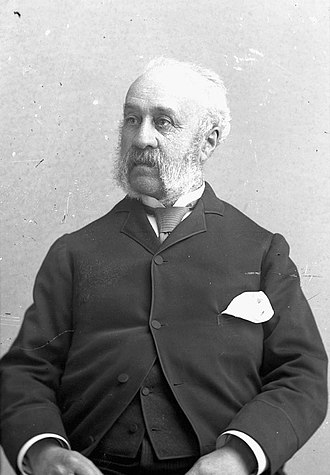
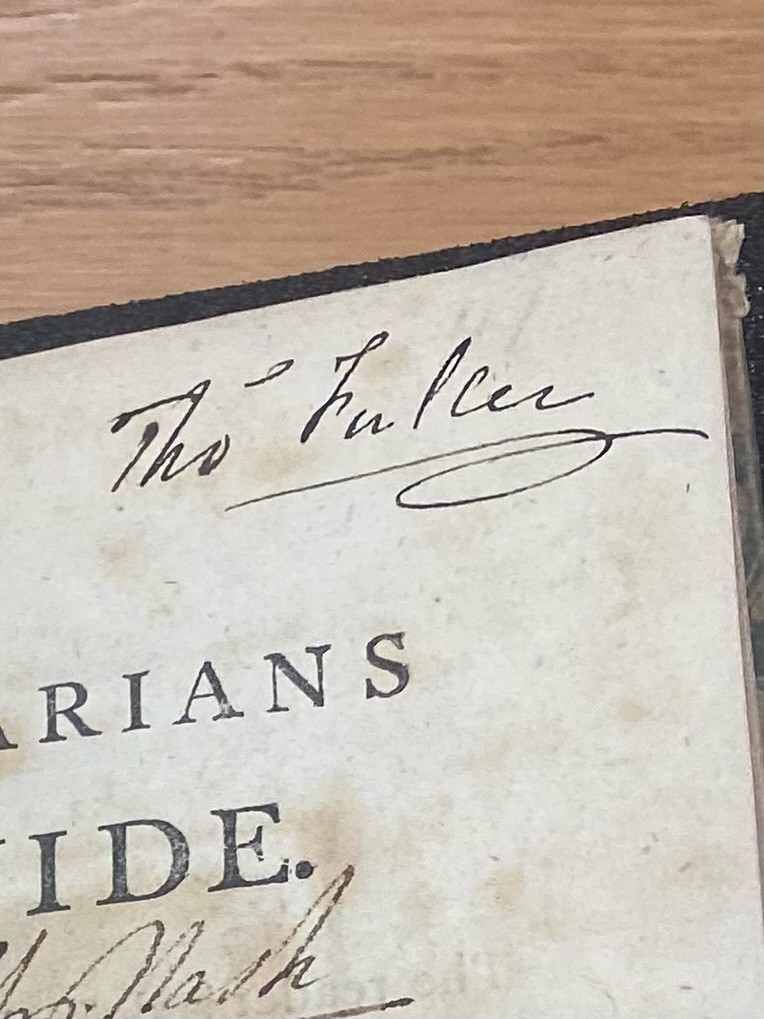
Mr. Fuller is next in line for ownership of the book. Fuller’s signature and bookplate can both be found in the book and I also believe that the message about the author was written by Fuller given the similar handwriting and timeframe that they would need to appear in. Fuller’s bookplate is recognized by a roaring/yawning Lion coming out of a crown, with a banner with the Latin phrase Honestas-Optima-Politia (Honesty is the Best Policy). Fuller was born in Bath in 1823 and became a very famous architect who would travel the world to work on many famous buildings such as the St. John Cathedral in Antigua and Barbuda, the New York state capitol building in Albany, and the Parliament house in Canada. Fuller would eventually emigrate to Canada and would live out the rest of his life there. I believe that because of his constant travel and eventual emigration, Fuller was not able to bring many possessions with him, leading to him either giving away or selling this book before leaving Bath.
William Clark
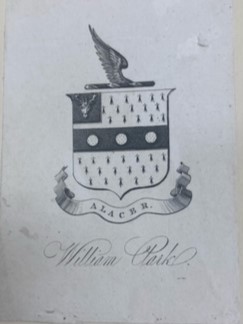
Clark is who I believe to be the next owner of the book, as his bookplate pasted onto the back board of the book and in the timeline, he is the youngest of the three, being born in 1844. Clark’s bookplate is recognized by the crest having an animal with antlers in the top left corner as well as a bird above the crest. The word Alacer is written on a ribbon below the main crest, which translates from Latin to Enthusiastic. Clark was a writer who was born in New York but moved to England at a young age. Spent most of his life around England but moved to Bath around the last decade or so that he was alive. Clark moved to Bath because he began to have severe arthritis in his hands and sought out the health resorts in Bath to help alleviate his pain.
Uncharted territory
Other than what has already been talked about, there are no other distinct pieces of provenance that jump out at me as to where this book has been past Clark. There seems to be a bookseller’s code or library code on the back board, but other than that there is nothing more to go on in my eyes. As for how it got to the US, let alone MSU I’m not sure. But MSU has a large collection of 18th century book and would most likely have been purchased in the creation of that collection.
Provenance and book use
- Because of how little I was able to find out about Hark, it is hard to say what specific use he would have gotten from this book, but it may have just been used as what its advertised as and used as a guide to the bath waters in Bath and their possible healing properties
- In the case of Fuller, given that he grew up in Bath he would have had a good amount of information on the properties of the waters. It seems like Fuller had more of an interest in the Author and previous owner, given the lengthy message he wrote about them. Though he dose comment on the subject of the book, his focus is more on the author’s life and character so he may have gotten the book out of interest in the author.
- For Clark it seems as though because he moved to Bath for the healing waters, he would have gotten the book to help him further understand the properties of the water and how they might help him with his arthritis. And with the amount of water/ mold stains throughout the book perhaps he brought it with him while soaking in the water.
Bibliography
“Fuller, Thomas.” Dictionary of Canadian Biography. Accessed March 25, 2025. https://www.biographi.ca/en/bio/fuller_thomas_12F.html.
Internet archive: Digital Library of Free & Borrowable Texts, movies, Music & Wayback Machine. Accessed March 25, 2025. https://archive.org/search?query=Southey%2Bcommon-place%2Bbook.
“Philip Thicknesse.” Wikipedia, February 11, 2025. https://en.wikipedia.org/wiki/Philip_Thicknesse.
Thicknesse, Philip. “The Valetudinarians Bath Guide, or, the Means of Obtaining Long Life and Health … / by Philip Thicknesse.” Holdings: The valetudinarians Bath guide, or, The means of obtaining long life and health … / by Philip Thicknesse. :: Library Catalog, January 1, 1780. https://catalog.lib.msu.edu/Record/folio.in00001834291?sid=59409588#description.
“Thomas Fuller (Architect).” Wikipedia, September 4, 2024. https://en.wikipedia.org/wiki/Thomas_Fuller_(architect).
“The Valetudinarians Bath Guide, or, the Means of Obtaining Long Life and Health : Dedicated to the Earl of Shelburne : Thicknesse, Philip, 1719-1792 : Free Download, Borrow, and Streaming.” Internet Archive, January 1, 1780. https://archive.org/details/valetudinariansb00thic/page/26/mode/2up.
“The Valetudinarians Bath Guide, or, the Means of Obtaining Long Life and Health : Dedicated to the Earl of Shelburne : Thicknesse, Philip, 1719-1792 : Free Download, Borrow, and Streaming.” Internet Archive, January 1, 1780. https://archive.org/details/valetudinariansb00thic/page/26/mode/2up.
“William Clark Russell.” Wikipedia, March 5, 2025. https://en.wikipedia.org/wiki/William_Clark_Russell#Later_years.
“William Petty, 2nd Earl of Shelburne.” Wikipedia, March 2, 2025. https://en.wikipedia.org/wiki/William_Petty,_2nd_Earl_of_Shelburne.
Special Thanks
Thank you to Professor Liam Brocky for your help with research
Thank you to my mother, Mischele McManus for your help transcribing
Sean McManus, for Dr. Brockey’s HST 475-001 class of 2025
