
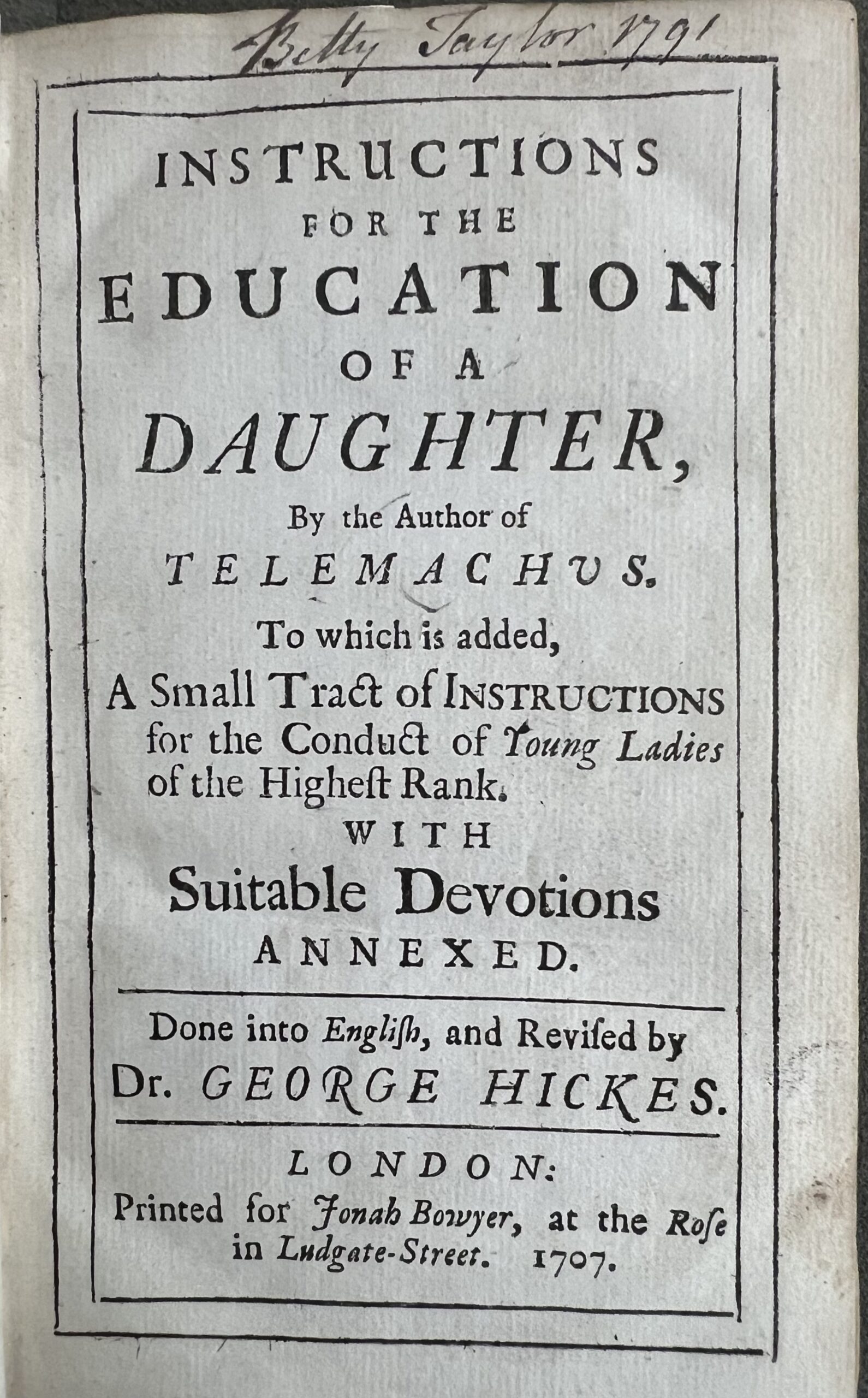
Full Identification
Author: François de Salignac de la Mothe-Fénelon, translated and edited by George Hickes
Title: Instructions for the Education of a daughter, By the Author of Telemachus. To which is added, A Small Tract of Instructions for the Conduct of Young Ladies of the Highest Rank. With Suitable Devotions Annexed.
Publisher: Printed for Jonah Bowyer
Place of Publication: The Rose in Ludgate Street, London, England
Year of Publication: 1707
MSU Library Call Number: LC1422 .F413 1707
Physical Description of the Book
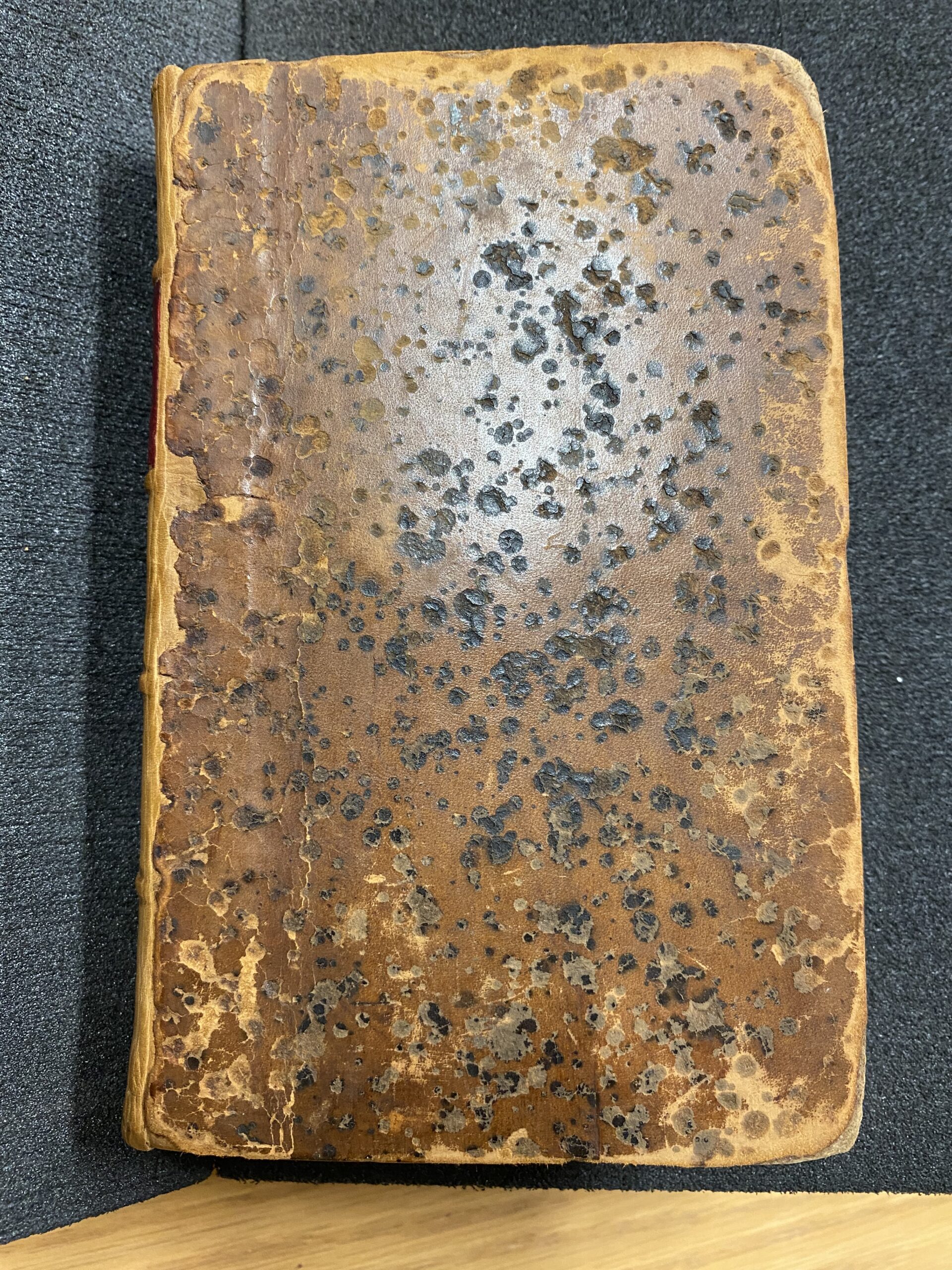
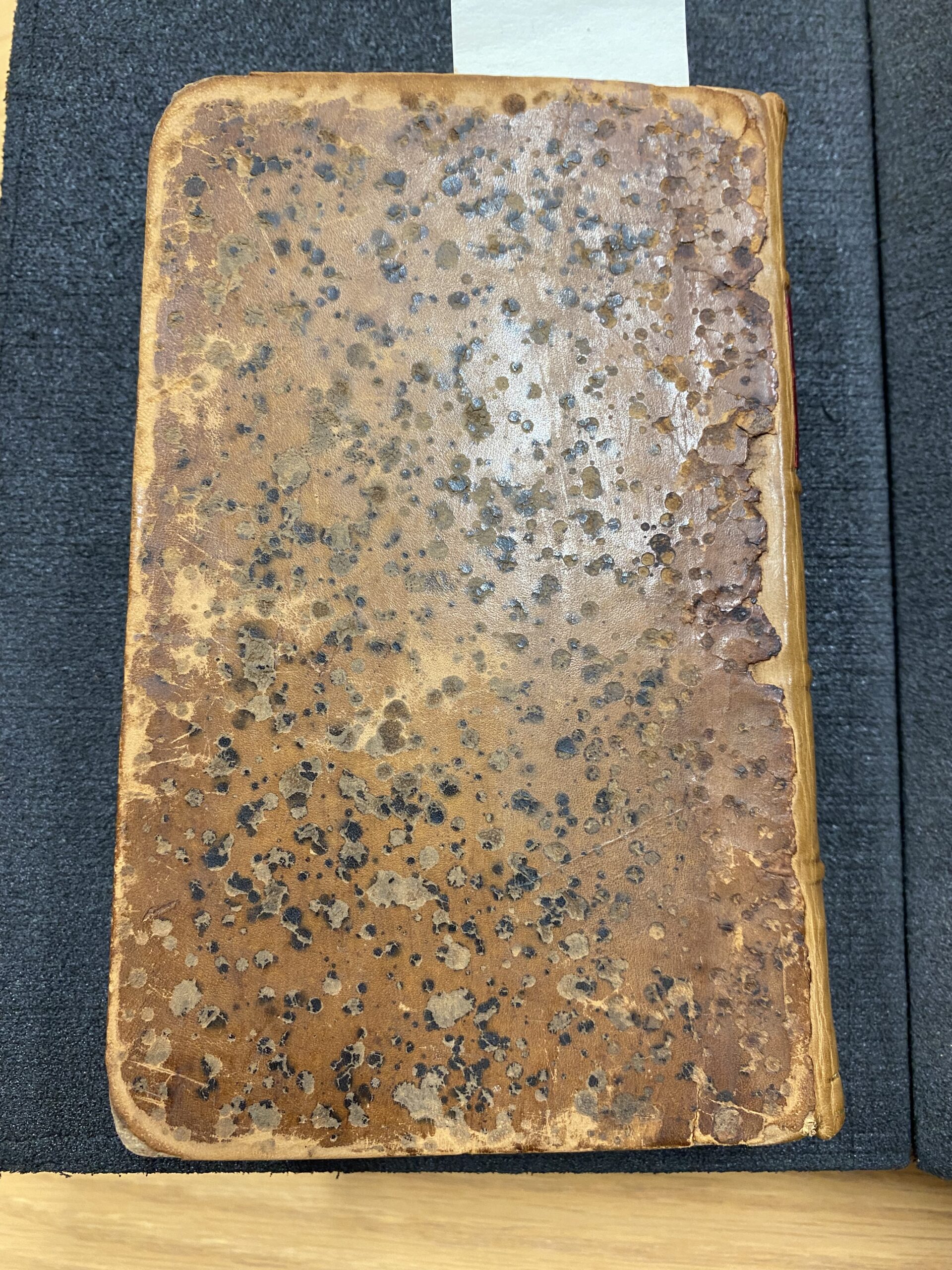
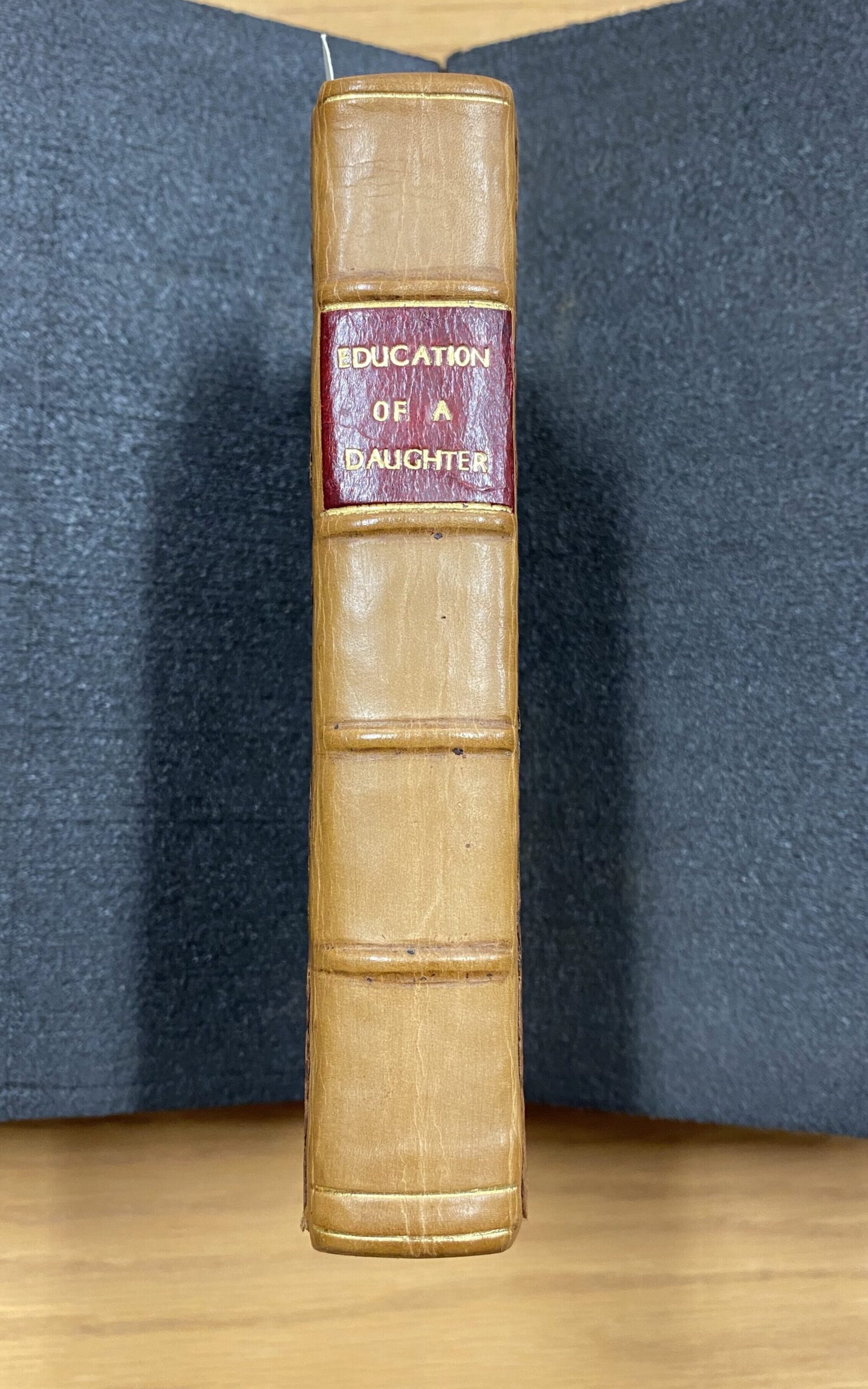
This copy of Instructions for the Education of a Daughter is 17 cm. It is bound in leather and has visible wear along the edges and deterioration on the front and back covers.
The spine is in excellent condition compared to the front and back covers. It seems to have been rebound, as the coloring of the leather on the spine and covers do not match. In addition, there are raised bands and a decorative title plate made of red leather with the title in gilded lettering on it on the spine.
The pages in this copy have minimal discoloration and staining, leaving the book’s content very legible for the reader. None of the pages have holes or tears; however, some gatherings are separating from the binding. Notably, the pages in the section titled “Instructions for a Governess,” which provides governesses with instructions for educating the girls they care for, are separated from the binding, and a page is cut out near pages 324 and 325. There is writing and a bookplate on the front pastedown and free endleaves indicating ownership, although there are no marginalia or annotations throughout the book.
Contents of the Book
Significance of the Book
Instructions for the Education of a Daughter provides modern audiences with a window into the cultural and societal norms of the time it was written and the attitudes towards education, morality, and the role of high-ranking women in the 18th century. It emphasizes decorum, grace, and proper behavior in social settings and includes practical advice on manners, etiquette, and other aspects of social conduct. In addition, there are specific sections entitled “Instructions for a Young Princess” by Monsieur De la Chetardye (on page 300) and “Instructions for a Governess, according to this Model of the Lord Archbishop of Cambray” (beginning on page 339), which provide further notes and details on how to educate young women, particularly those of a certain class.
There is also an additional devotions section towards the end of the book, beginning on page 346. This inclusion underscores the religious and moral dimensions of education during that period. It reflects the importance of incorporating religious teachings into the upbringing of young women. This is an interesting inclusion, as the book was published a few decades after the beginning of the Enlightenment period. It shows that religion was still relevant and particularly important to the author despite the undertone of the era.
This book impacted literature and intellectual conversation in a variety of ways. Fénelon utilizes didactic prose to convey his ideas and advice and emphasize moral and educational instruction. He also uses a form that allows him to address the reader directly and create a more intimate and instructional tone. This writing further contributes to the author’s opinion that education is vital to moral virtue, good social behavior, and character.
Elements of this Book
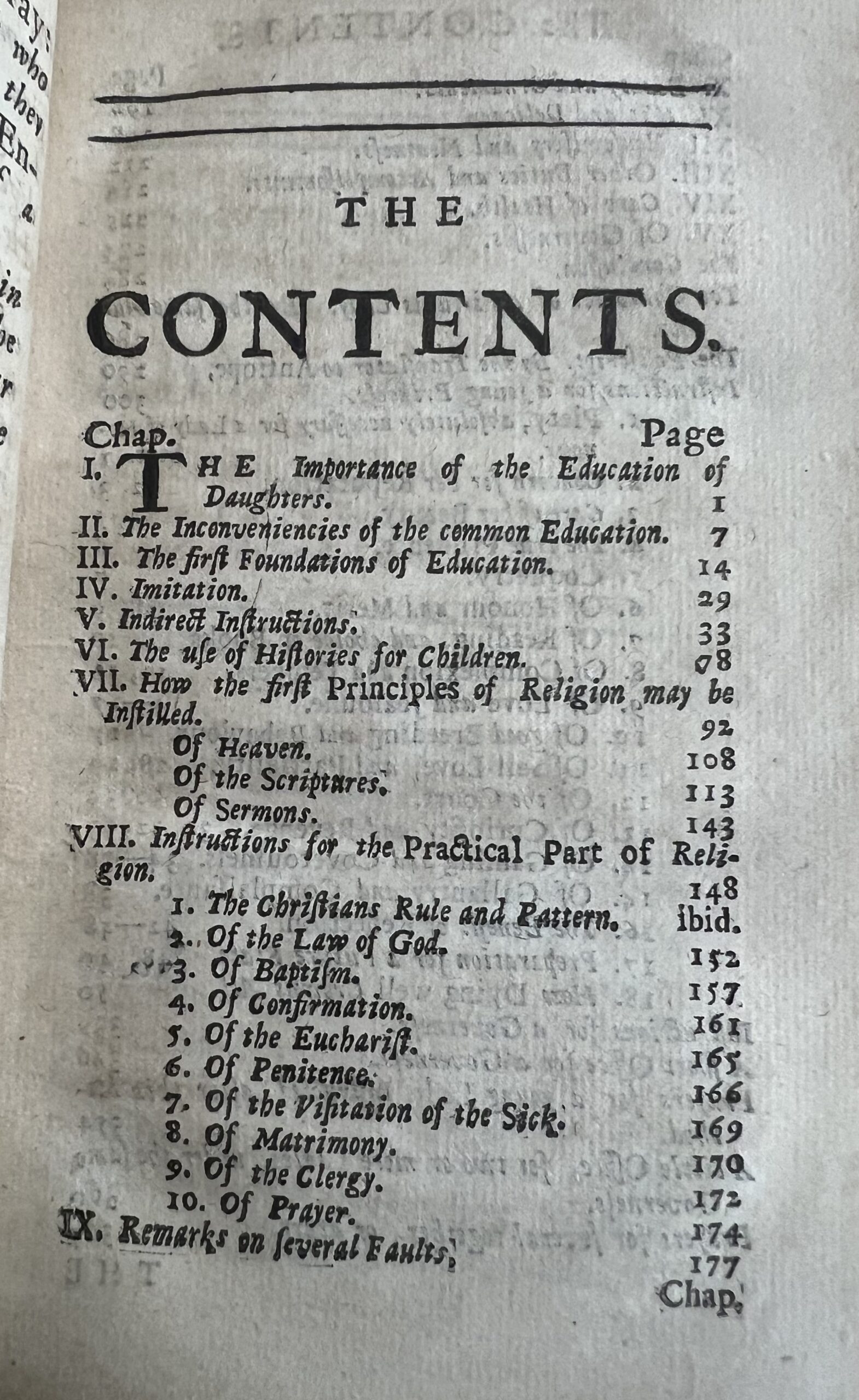
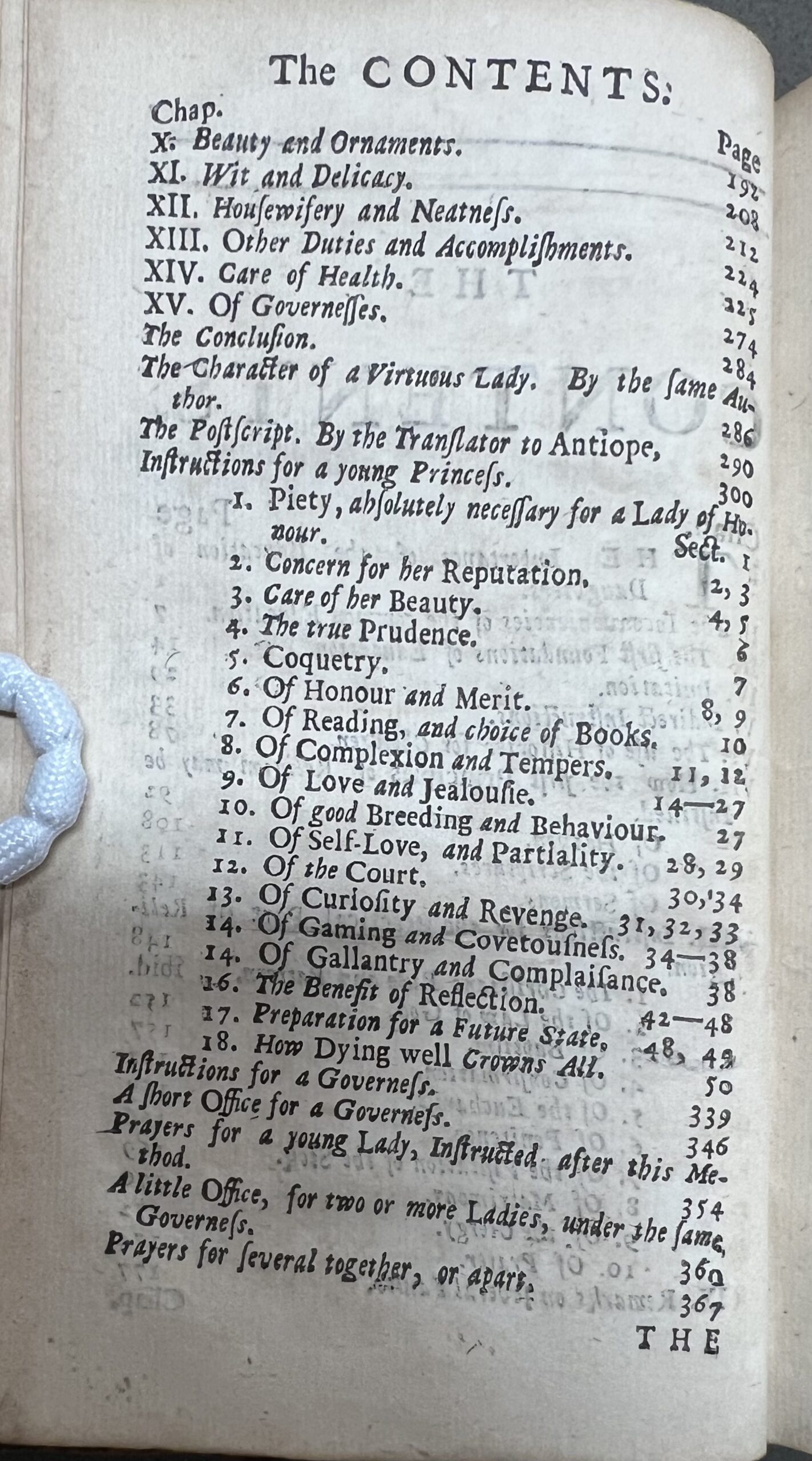
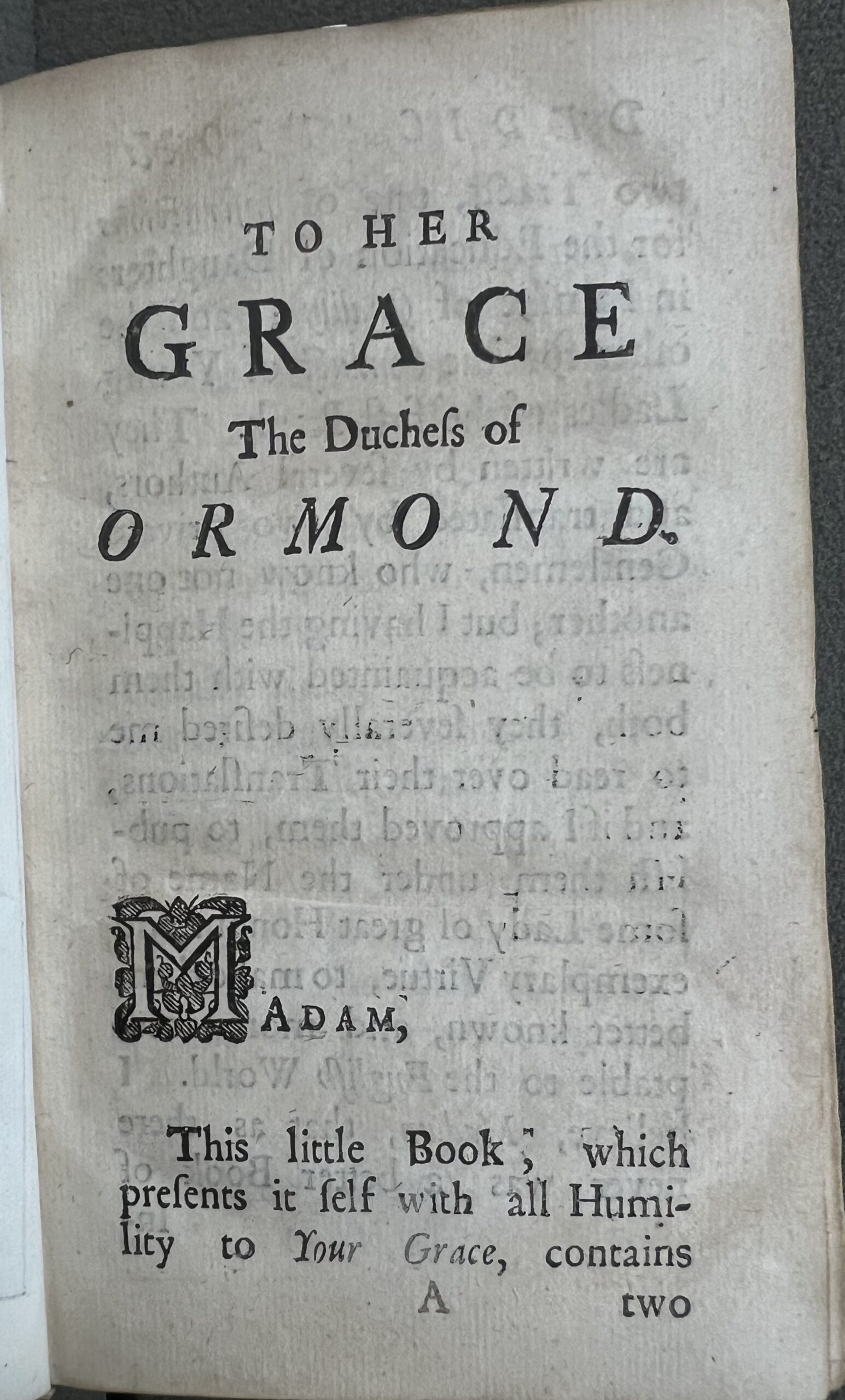
This book includes a contents page indicating all of the chapters in the book, along with additional content, such as “Instructions for a Governess” and “Prayers for a young Lady.” This copy also includes a dedication to the Duchess of Ormond, a postscript by the translator (page 290), devotions (beginning on page 346) for young women to read, and an advertisements page for books sold by Jonah Bowyer.
The Dedication: To the Duchess of Ormond
The the dedication to the Duchess of Ormond from the book’s translator, George Hickes. At the time of publication, the Duchess of Ormond was Mary Butler (1664-1733). Mary Butler, also known as Mary Somerset, was the daughter of Henry Somerset, the first Duke of Beaufort, and Mary Capel. She married James Butler, the second Duke of Ormond, Ireland, army officer, and Jacobite conspirator. She had a son named Thomas, Early of Ossory, and two daughters named Lady Mary Butler and Lady Elizabeth Butler, named after James’ first wife. In 1702, Duchess Mary Butler was named a Lady of the Bedchamber to Queen Anne. After the publication of this book, in 1715, her husband’s titles were forfeited, and he was forced to go into exile because he supported Jacobite Rising of the time. Meanwhile, she remained in England and retained her property.
The Author: François de Salignac de la Mothe-Fénelon
François de Salignac de la Mothe-Fénelon (1615-1715) was a French archbishop and theologian. His historical, intellectual, and cultural significance lies in his contributions to education, theology, and literature in the 17th and 18th centuries, particularly in France. He was most known for his didactic novel Les Aventures de Télémaque (The Adventures of Telemachus), in which Telemachus searches for his father and expresses Fénelon’s views on education, morality, and politics. The novel was widely read and translated, impacting France and the rest of Europe.
His contributions to education and teaching were regarded so highly that in 1689, he was appointed as the tutor to the Duke of Burgundy, who was the heir to the French throne. Around the same time, Quietism, a theological and spiritual debate within the Catholic Church, was introduced. Fénelon’s support for some of the Quietist principles led to a conflict with Church authorities. His writings were subsequently condemned, and he was required to retract certain views.
The Translator and Editor: George Hickes
George Hickes (1642-1715) was an English scholar known for his work in linguistics and Old English studies. He lived during a tumultuous time in English history, including the English Civil War, the Interregnum, and the Restoration, all of which shaped the political and religious views of the time. Hickes was a clergyman and a nonjuror, an individual who refused to recognize the legitimacy of the new monarchs, William III and Mary II. This refusal reflected the complex intersection of political and religious loyalties during this period, and he wrote many pieces discussing theological controversies, influencing the evolving Anglo-Saxon and philological studies.
History of Ownership
The Printer: Jonah Bowyer
Little information about the printer, Jonah Bowyer, was found. He began printing in 1702, just before this book was published, and ended around 1727. He was located in London, England, at the Rose in Ludgate Street, at the corner of St. Paul’s Churchyard. An advertisement page is at the end of this copy, highlighting other works sold by Jonah Bowyer.
Betty Taylor, 1791

Unfortunately, conclusive information about Betty Taylor could not be found. However, it can be assumed Betty Taylor was a mother, governess, or young woman, and therefore used this copy for educational purposes in 1791.
Frederick Arthur Heygate Lambert
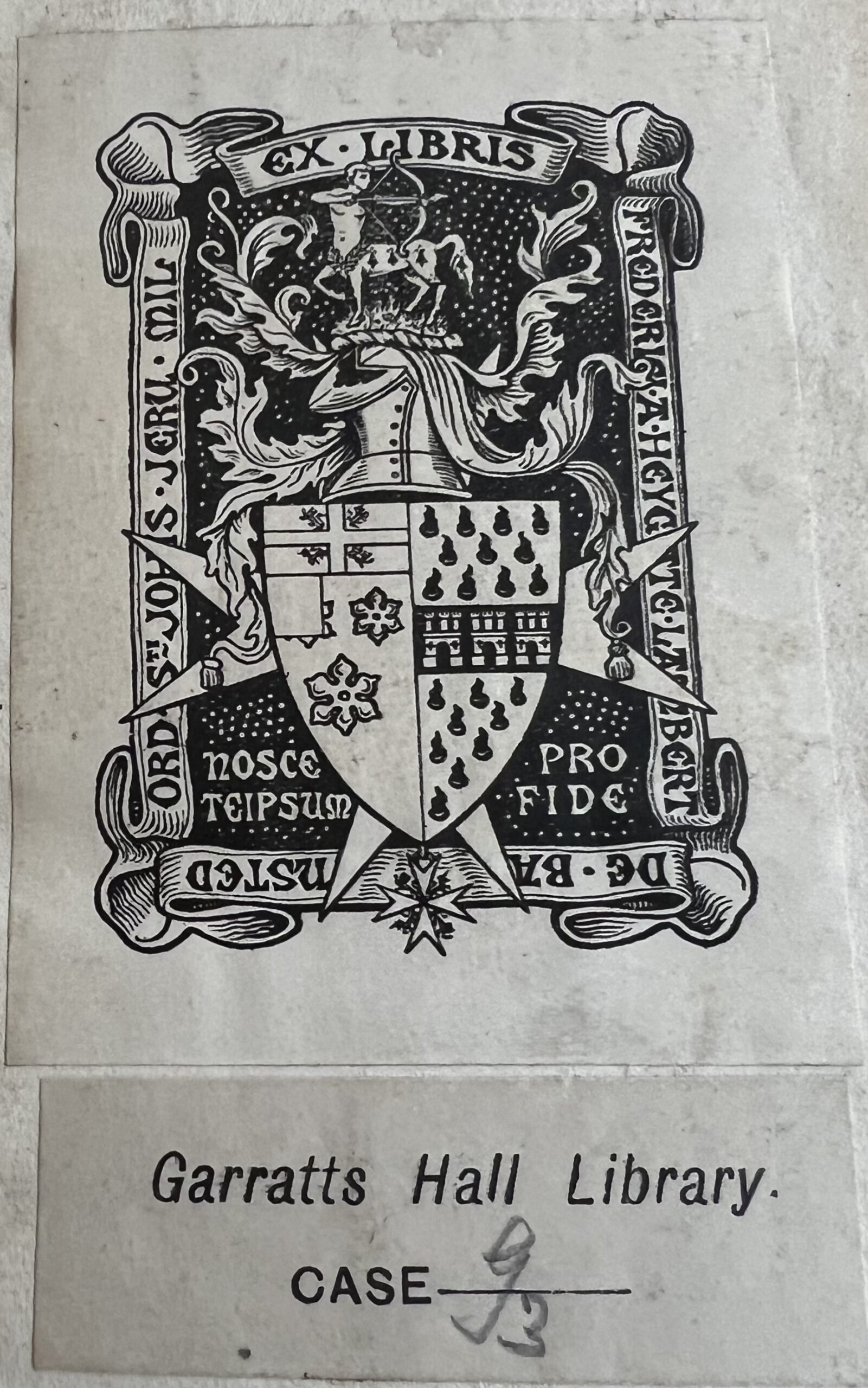
This copy contains provenance data in the form of a bookplate and auction sticker. The bookplate included in this copy belonged to Frederick Arthur Heygate Lambert. Lambert was born on November 3, 1857, to Frederick Lambert of Garratt’s Hall and Caroline Emma, the youngest daughter of James Heygate. He attended Eton College, a boys’ school founded in 1440 by Henry VI in Berkshire, England. In 1902, he succeeded his father’s estate, which included Garratt Hall in Banstead and properties in Woodmansterne.
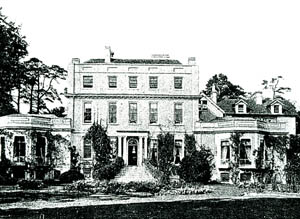
Garratt’s Hall (pictured above) was a large country house with stables, outbuildings (including “Little Garratts”), lodges, gardens, ponds, and parklands. It was the family’s home from 1534 to 1744 and again in 1857 when the estate was repurchased. It remained in the family until 1925, four years before Frederick Lambert passed away. Today, “Little Garratts,” two lodges, and the stables, divided into three houses, remain. A photo of the Fairlawn House could not be found.
In 1884, he married Agnes Helen, the second daughter of the Reverend Robert Higgens, Vicar of Wareside in Hertfordshire. Their marriage resulted in the coat of arms on the bookplate pasted in MSU’s copy and in the photo of the stamp to the right.This coat of arms combines both the Lambert and Higgens sides of the family.
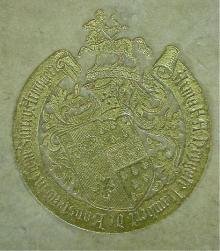
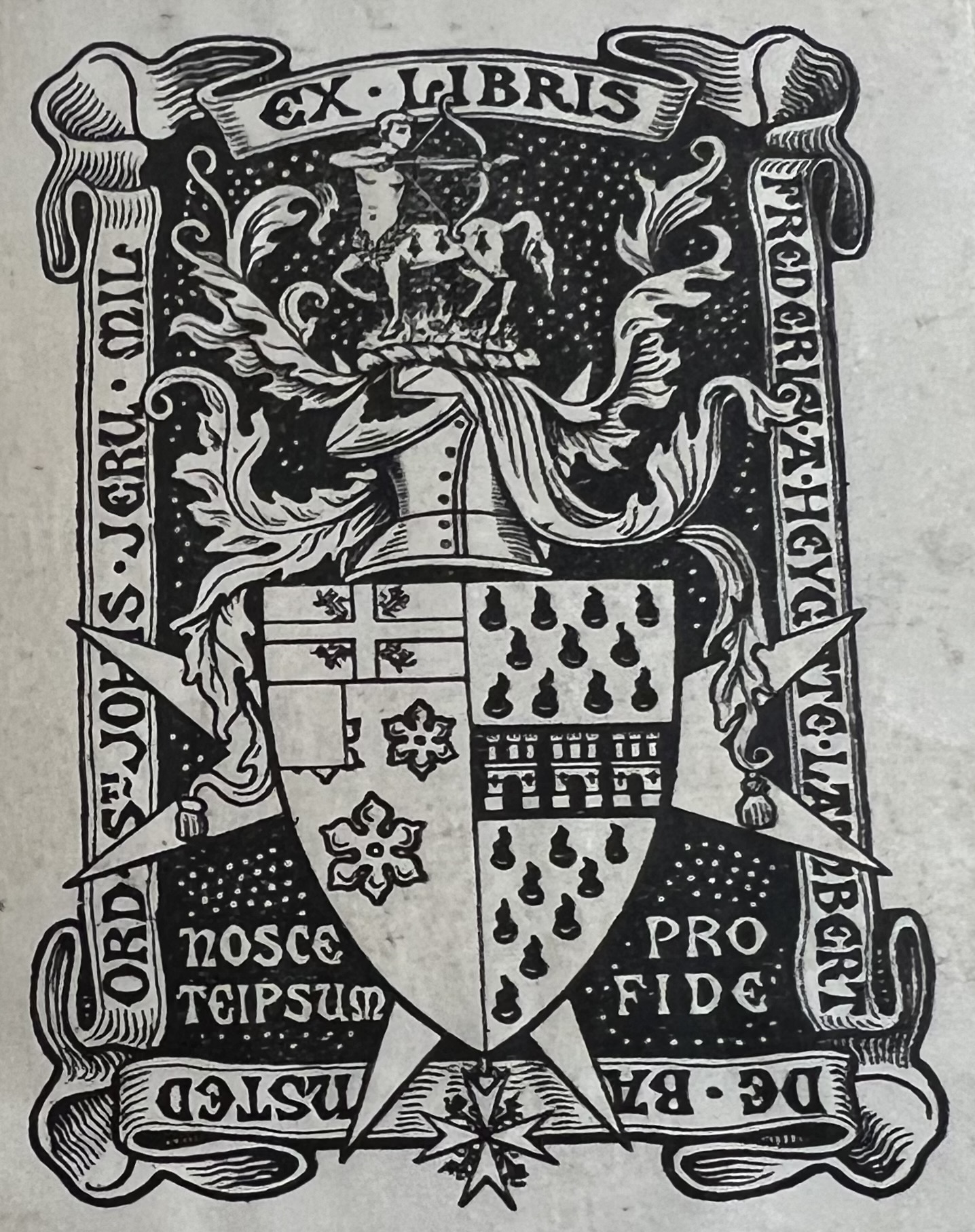
In the coat of arms (pictured above), a crest in the shape of a centaur sits atop a horse on a helmet in this coat of arms. Centaurs are mythological creatures associated with the eminence in the field of battle. The helmet featured is turned sideways with the visor turned down and is that of an esquire’s. Additionally, there are three narcissus flowers of the Lambert family. These flowers often represent creativity, inspiration, awareness, inner reflection, vitality, forgiveness, rebirth, and new beginnings. Additionally, the coat is made of an impalement, fess, and canton. On the fess are three castles representing the Higgens family. It is not entirely clear what the meaning of castles is on coats of arms. However, many believe castles represent spiritual power, vigilance on the watch, home and safety, or in the case of threes, Dublin through its mystical connection to the number. There are argent tinctures and no marks of cadence.
Frederick Lambert held many titles. He was a Justice of Peace, meaning he was a local magistrate to administer criminal or civil justice in minor cases. As a Fellow of the Society of Antiquaries, he would have engaged in research, participated in excavations, published his findings, curated antiquities, advocated for preservation, and attended society events. He also served as the Colonel of the Middlesex Imperial Yeomanry and in France and Flanders during WWI from 1914 to 1918. Lastly, he was also a Knight of Justice of the Order of St. John of Jerusalem. The Order of St. John of Jerusalem was founded in the 11th century as a medieval chivalric order to care for the sick and participate in the Crusades. After relocating to Malta, they played a significant military role against threats and, in the 19th century, became a charitable and humanitarian organization focusing on medical missions. Thus, Lambert’s being a knight meant he was actively involved in humanitarian work, upheld values of charity and mercy, and potentially held leadership-like roles within the organization.
Lambert died on November 3, 1929. His collection of books at Garratt Hall was sold by Sotheby’s on three separate occasions. The first batch was sold in December 1919, the second in February 1926, and the third in July 1930.
Michigan State University
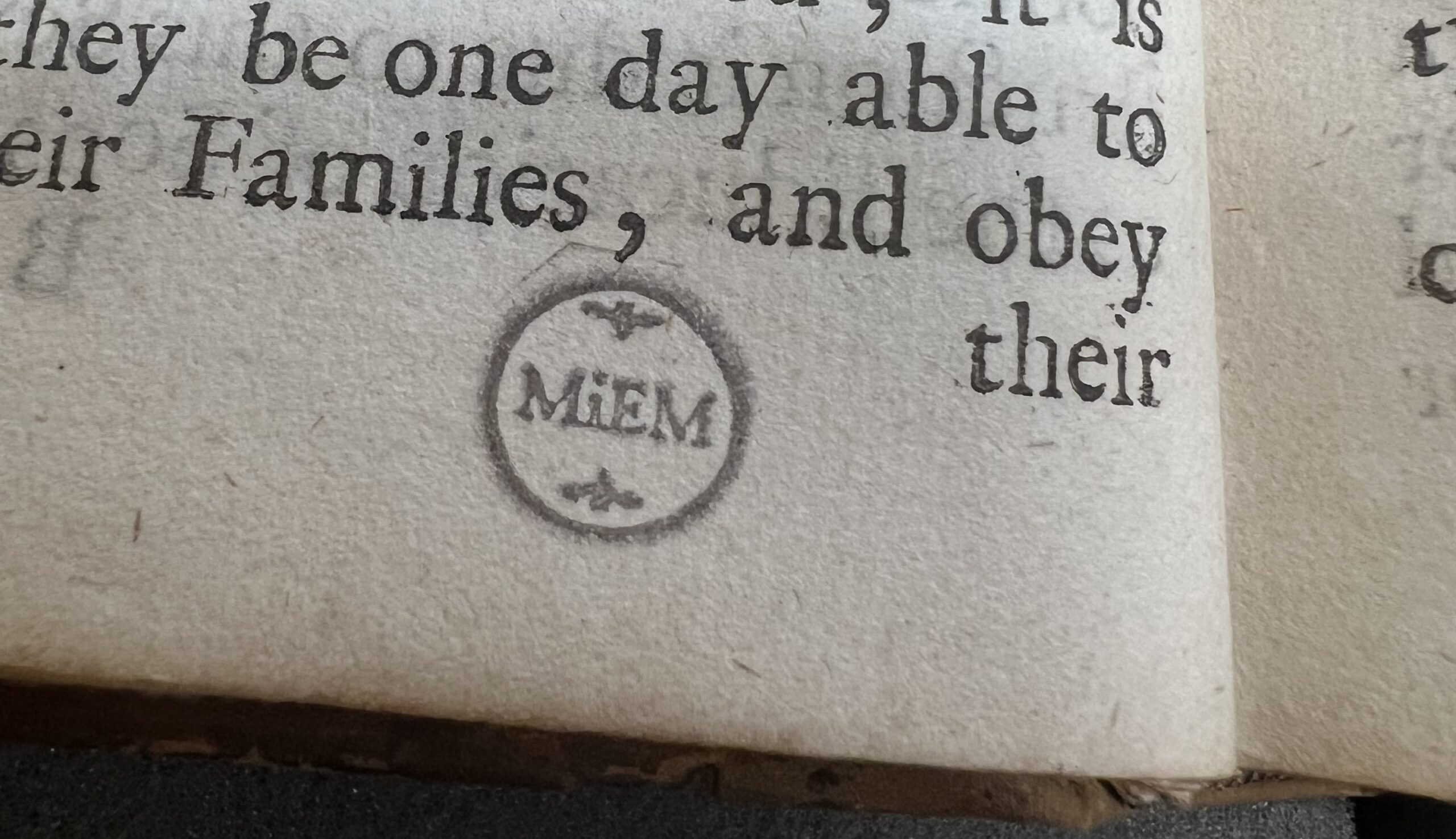
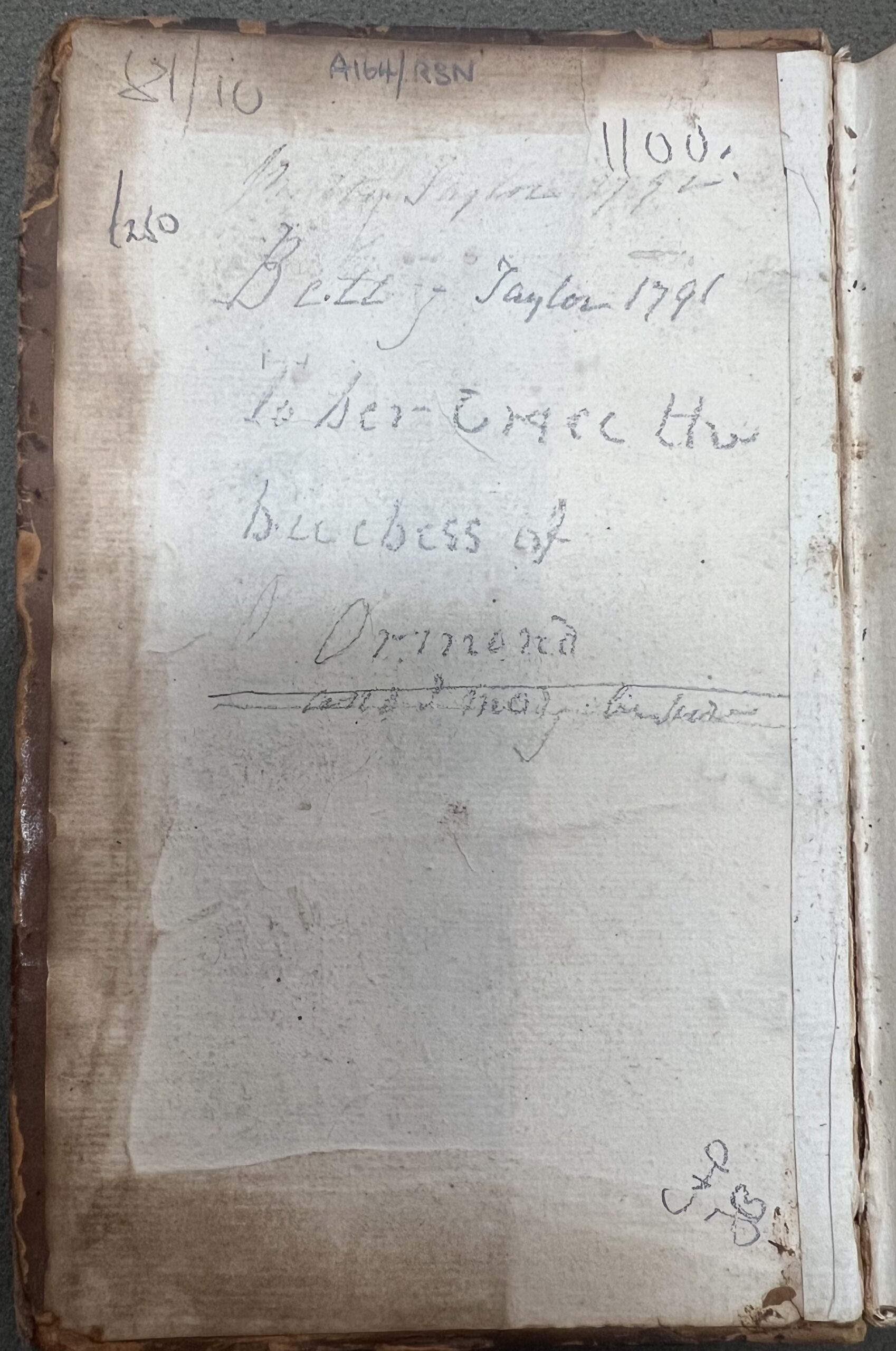
It is difficult to ascertain when Michigan State acquired this copy. There is a stamp in the book that says “MiEM,” indicating it belongs to the MSU library. Additionally, many markings on the pastedowns could indicate when exactly the book was acquired. However, it is inconclusive as these markings could have also come from previous owners and librarians. Despite this, given that books from Garratt Hall were sold between 1919 and 1930, one could assume this copy was acquired after the Special Collections was founded in 1962 and when travel became more accessible. The book came into MSU’s possession between 1962 and 2023.
Sources
Banstead History. (2022, December 9) “Garratts Hall.” Grand Houses. https://www.bansteadhistory.com/houses_az.html
Britannica, T. Editors of Encyclopaedia. (2023, August 2). François de Salignac de La Mothe-Fénelon. Encyclopedia Britannica. https://www.britannica.com/biography/Francois-de-Salignac-de-La-Mothe-Fenelon
Britannica, T. Editors of Encyclopaedia. (). Justice of the Peace. Encyclopedia Britannica. https://www.britannica.com/topic/justice-of-the-peace
British History Online. (n.d.). Parishes: Woodmansterne. https://www.british-history.ac.uk/vch/surrey/vol4/pp246-250
Eton College. (n.d.). Our History. https://www.etoncollege.com/about-us/our-history/
Fellow of the Society of Actuaries (FSA). SOA. (n.d.). https://www.soa.org/education/exam-req/edu-fsa-req/
Five Books for Catholics. (n.d.). François Fénelon. https://www.fivebooksforcatholics.com/francois-fenelon/
George Hickes 1642-1715. Book Owners Online. (n.d.). https://bookowners.online/George_Hickes_1642-1715
Heraldry and its symbolism. My Lineage. (2023, August 5). https://www.mylineage.com/heraldry-and-its-symbolism/#:~:text=In%20heraldry%2C%20the%20castle%20has,emblem%20of%20grandeur%20and%20society.
Ioannou, A. X., & Malafantis, K. D. (2020). The Literary Works of François Fénelon on the Achievement of Child Well-being. Pedagogical Research, 5(2), em0061. https://doi.org/10.29333/pr/7939
Mary Butler, Duchess of Ormonde. (2023, September 23). In Wikipedia. https://en.wikipedia.org/wiki/Mary_Butler,_Duchess_of_Ormonde#:~:text=Mary%20Butler%2C%20Duchess%20of%20Ormonde%20(1664%20%E2%80%93%2019%20November%201733,2nd%20Duke%20of%20Ormonde%2C%20Ireland.&text=The%20duke’s%20first%20wife%2C%20Lady,Butler%2C%20who%20died%20in%20infancy
Mission. Sovereign Order of Malta. (2023, November 6). https://www.orderofmalta.int/about-the-order-of-malta/mission/
National Trust Collecrions. (n.d.). Lady Mary Somerset, Duchess of Ormonde 91664-1733). https://www.nationaltrustcollections.org.uk/object/486210
Narcissus: Ultimate flower guide. Interflora. (n.d.). https://www.interflora.co.uk/page/flower-types/narcissi
The Women’s Print History Project. (2019). Jonah Bowyer. https://womensprinthistoryproject.com/firm/7431
University of Toronto Libraries. (n.d.). Lambert, Frederick Arthur Heygate (1857 – 1929). https://armorial.library.utoronto.ca/stamp-owners/LAM001
Created by Yasmeen (Yazzy) Amjad in Fall 2023 for HST 475: History of the Book at Michigan State University.
