
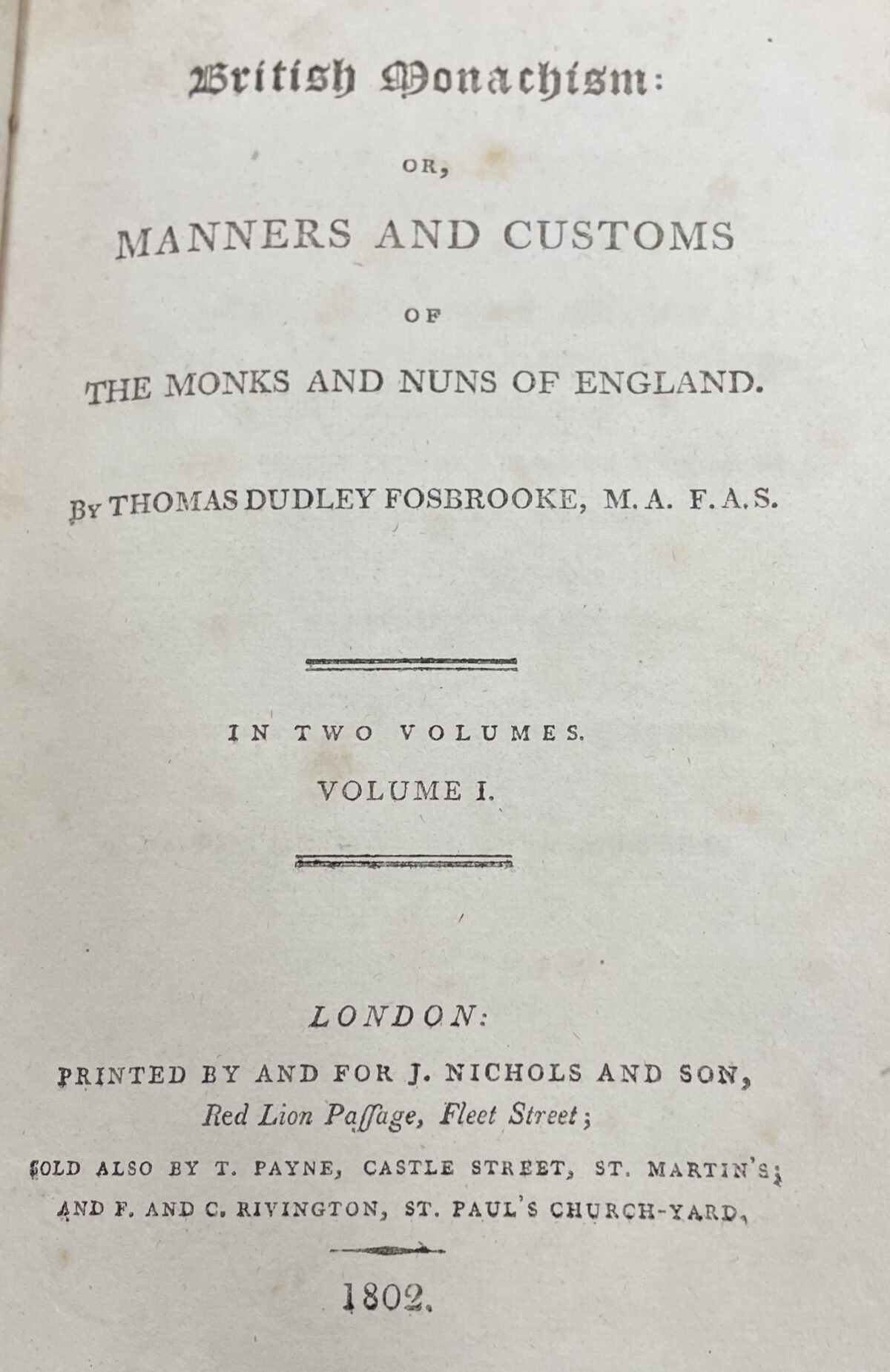
BX 2592 .F672 1802
British Monachism is a work in two volumes by Thomas Fosbroke [sometimes spelled Fosbrooke] that details the lives of English monks and nuns and was published three times. All of the editions were printed in London by John Nichols and his son John Bowyer Nichols. This is the first edition, published in 1802. Nichols and son or Thomas Payne first sold the book. The revised second edition is believed to be the first academic text to use “mediæval” to describe the Medieval period (Matthews 2011).
Monachism is defined as “the mode or rule of life characteristic of monks and nuns; the monastic system or principle; monasticism” (Oxford English Dictionary). Fosbroke illuminates for his readers the history of day-to-day lives of English Monks and Nuns. A foldout dividing volumes I and II enumerates the Benedictine rules, as well as the rules of other monastic orders. These rules are the principles which various monastic communities follow. Printing the rules on a foldout serves as a useful tool for comparison between orders, as well as a reference for the reader which is easy to reach.
The book as an object
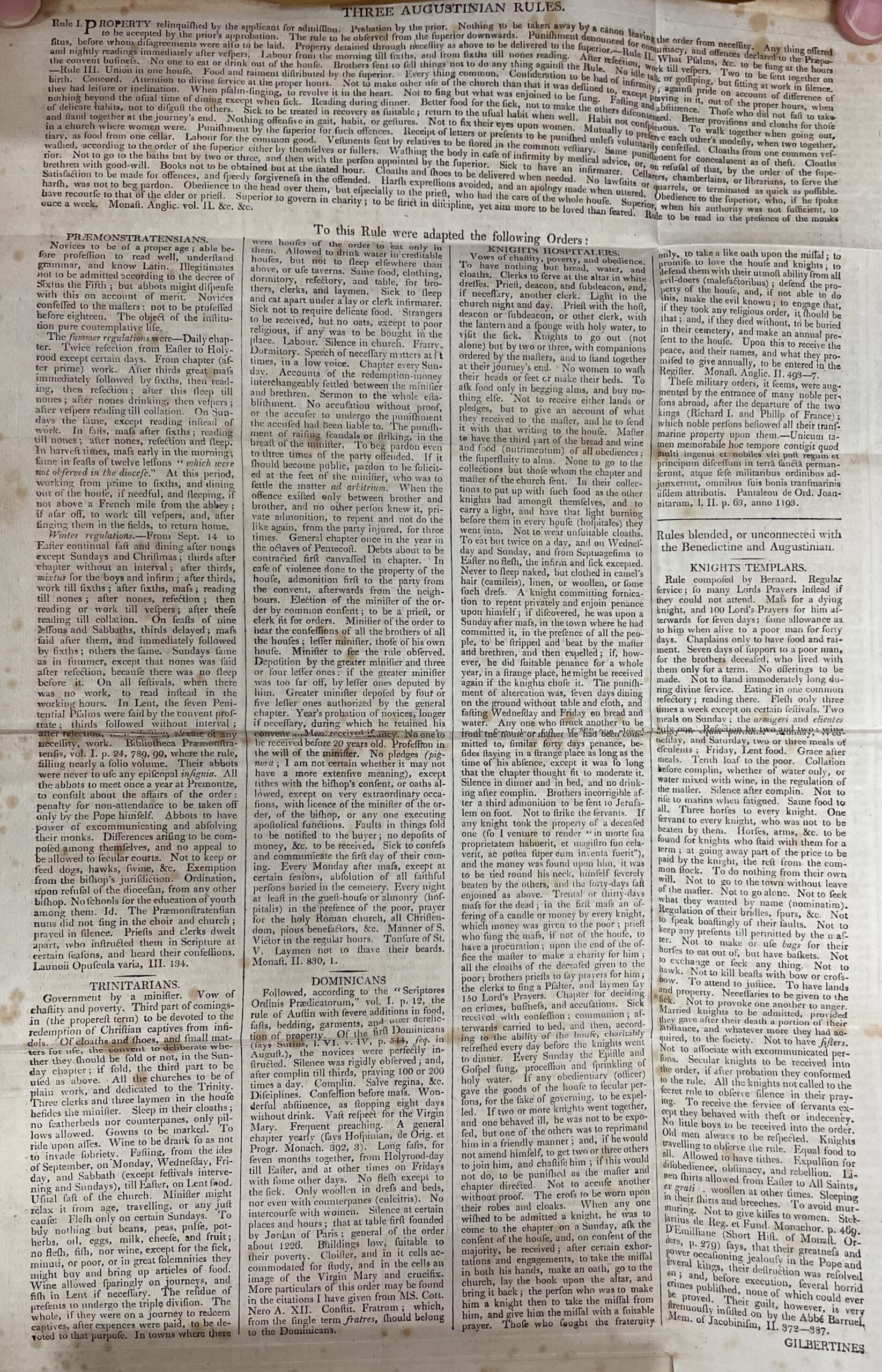
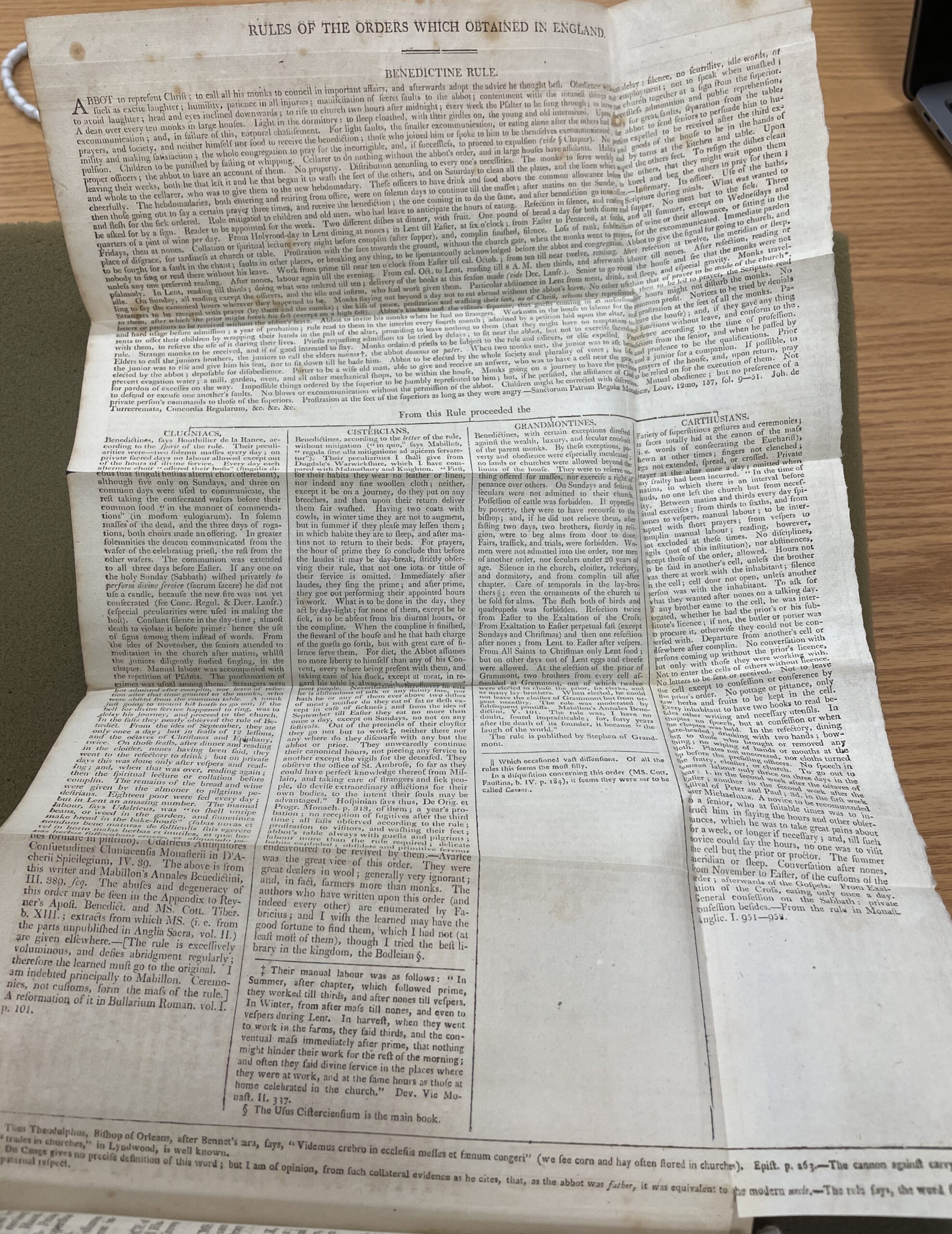
The book has retained its original binding. Quarter bound in marbled blue calfskin, with the quarters and binding in plain calfskin. The sewn binding is unraised and has a painted red label with “Fosbrooke British Monachism” gilded onto it. 21 x 14 x 3 cm. Two foldouts divide the volumes.
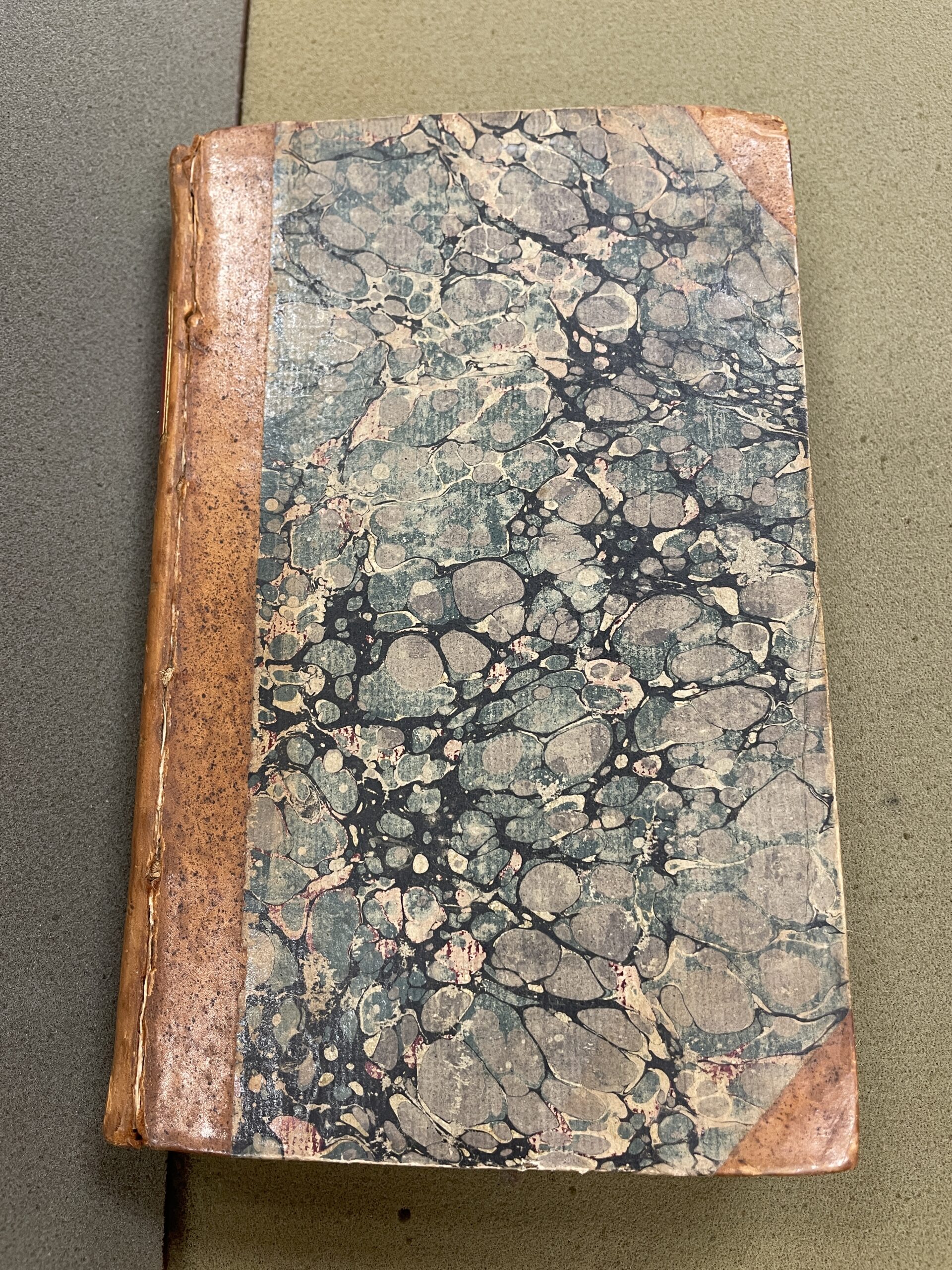
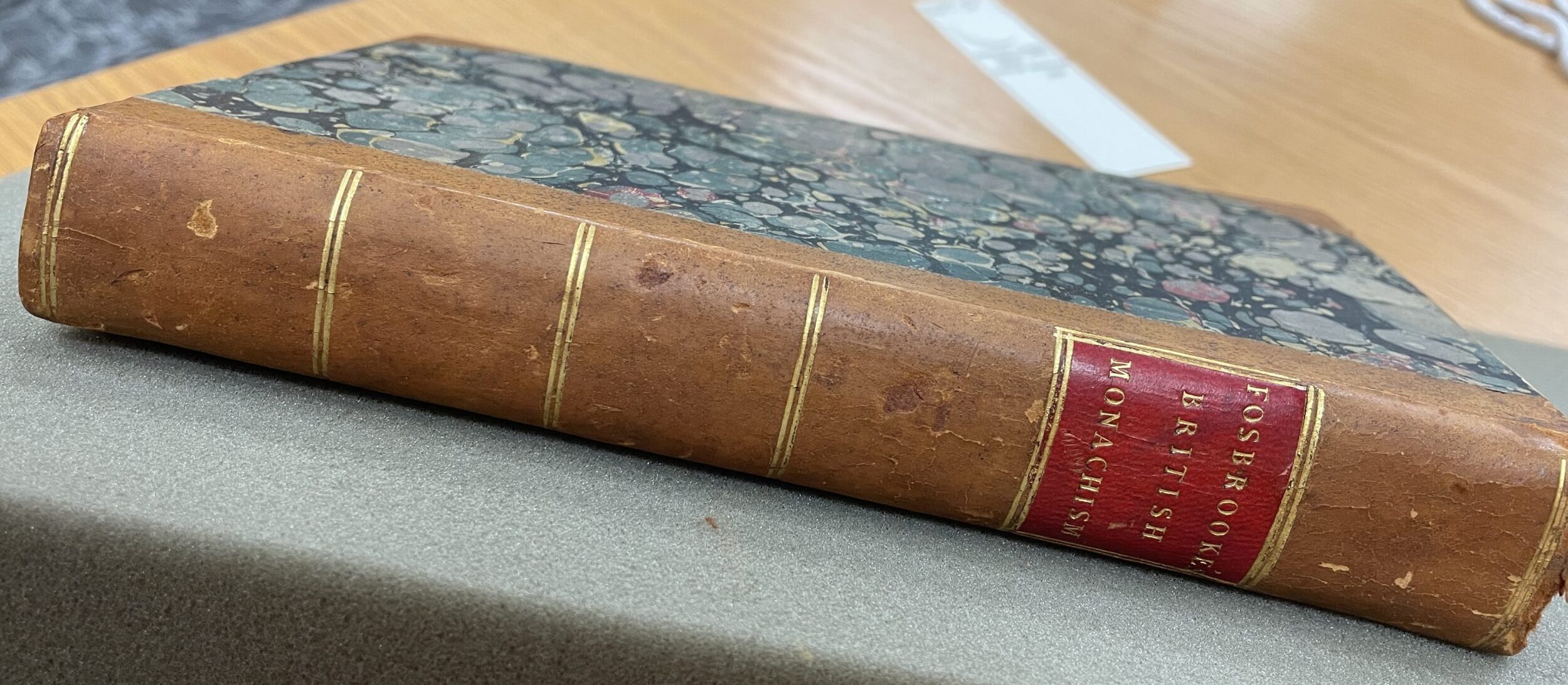
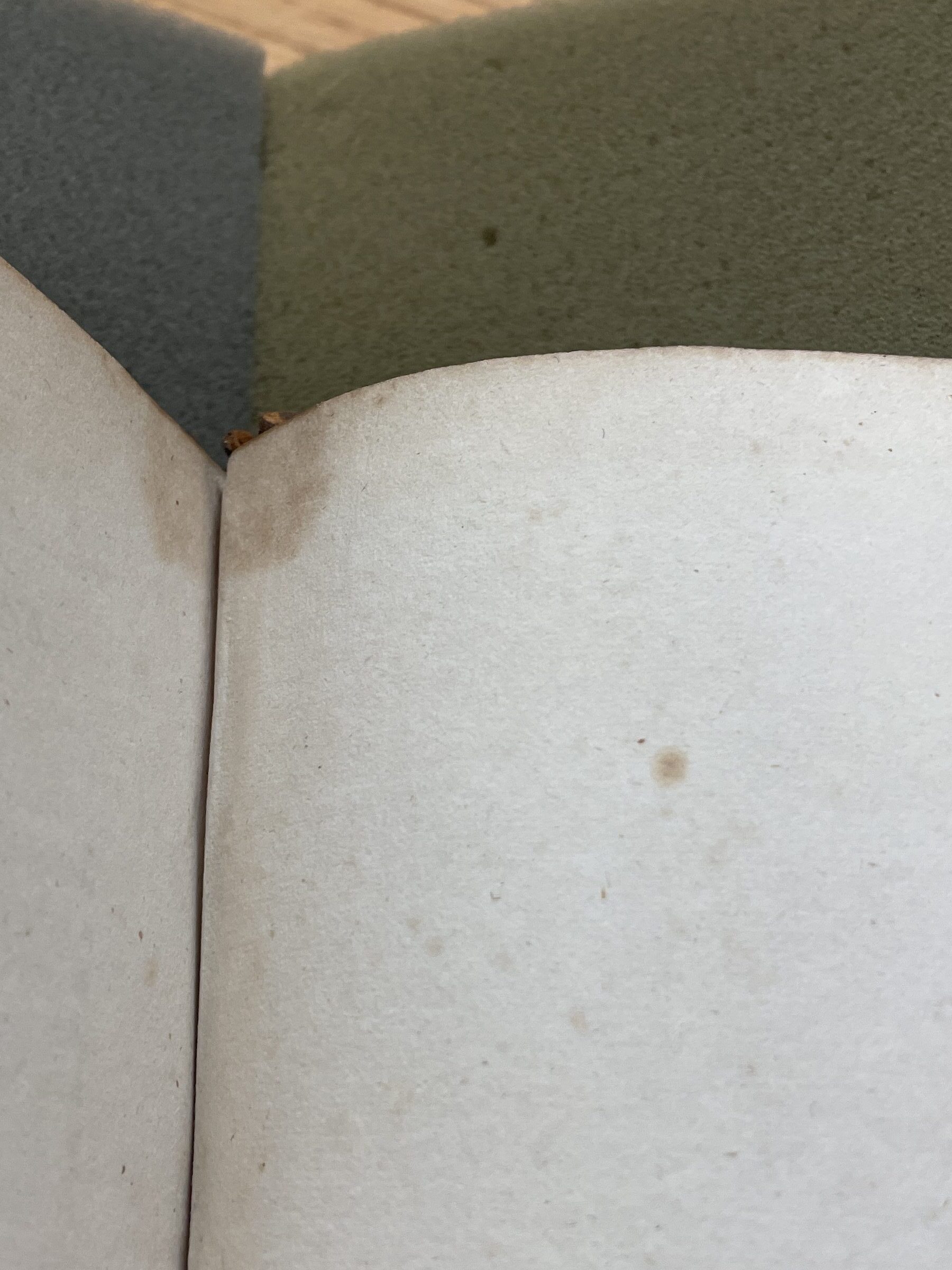
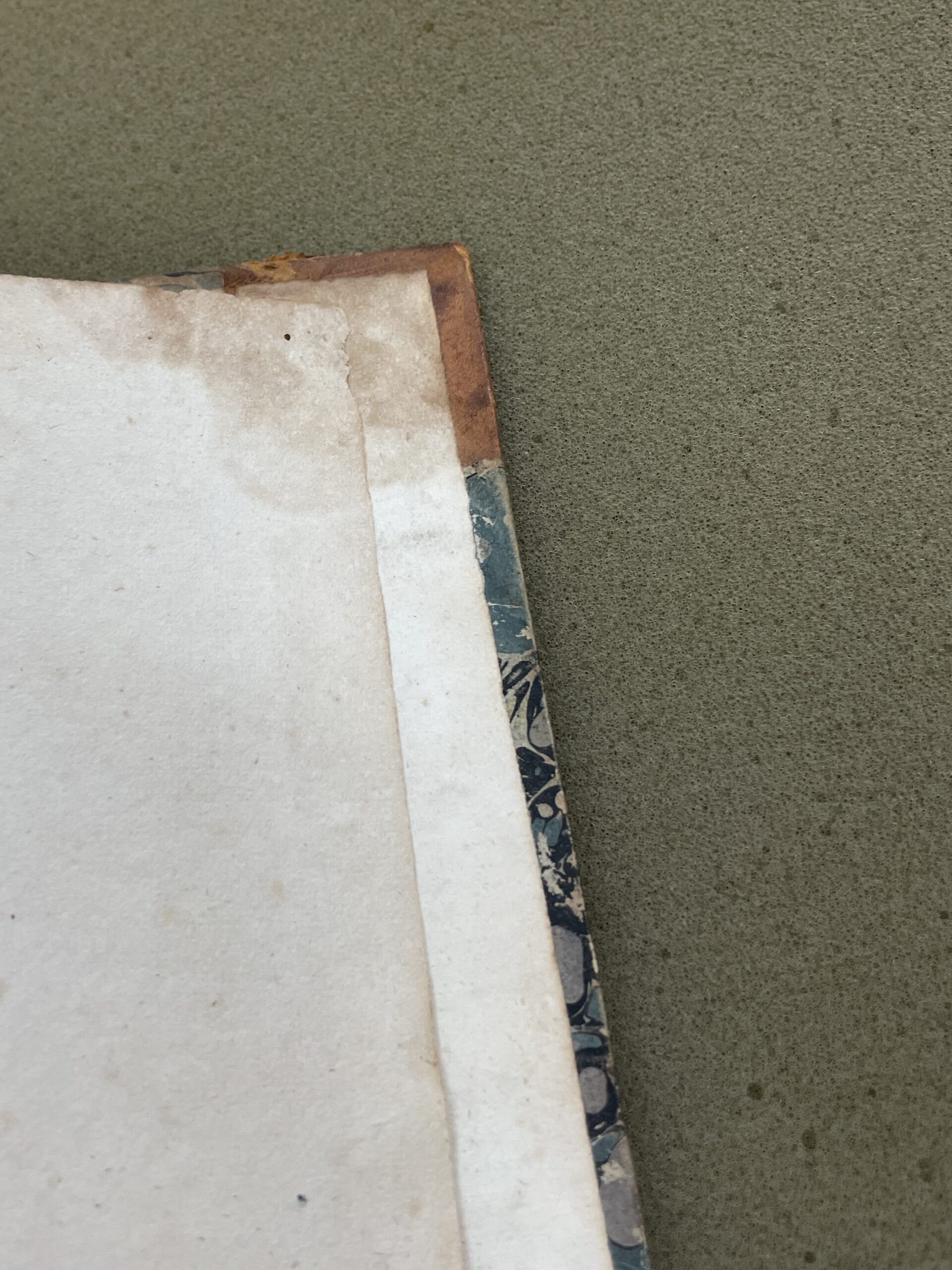
The book shows light signs of wear. The front panel is coming loose. There is water damage on all the corners of the book and in the upper gutter.
Thomas Dudley Fosbroke
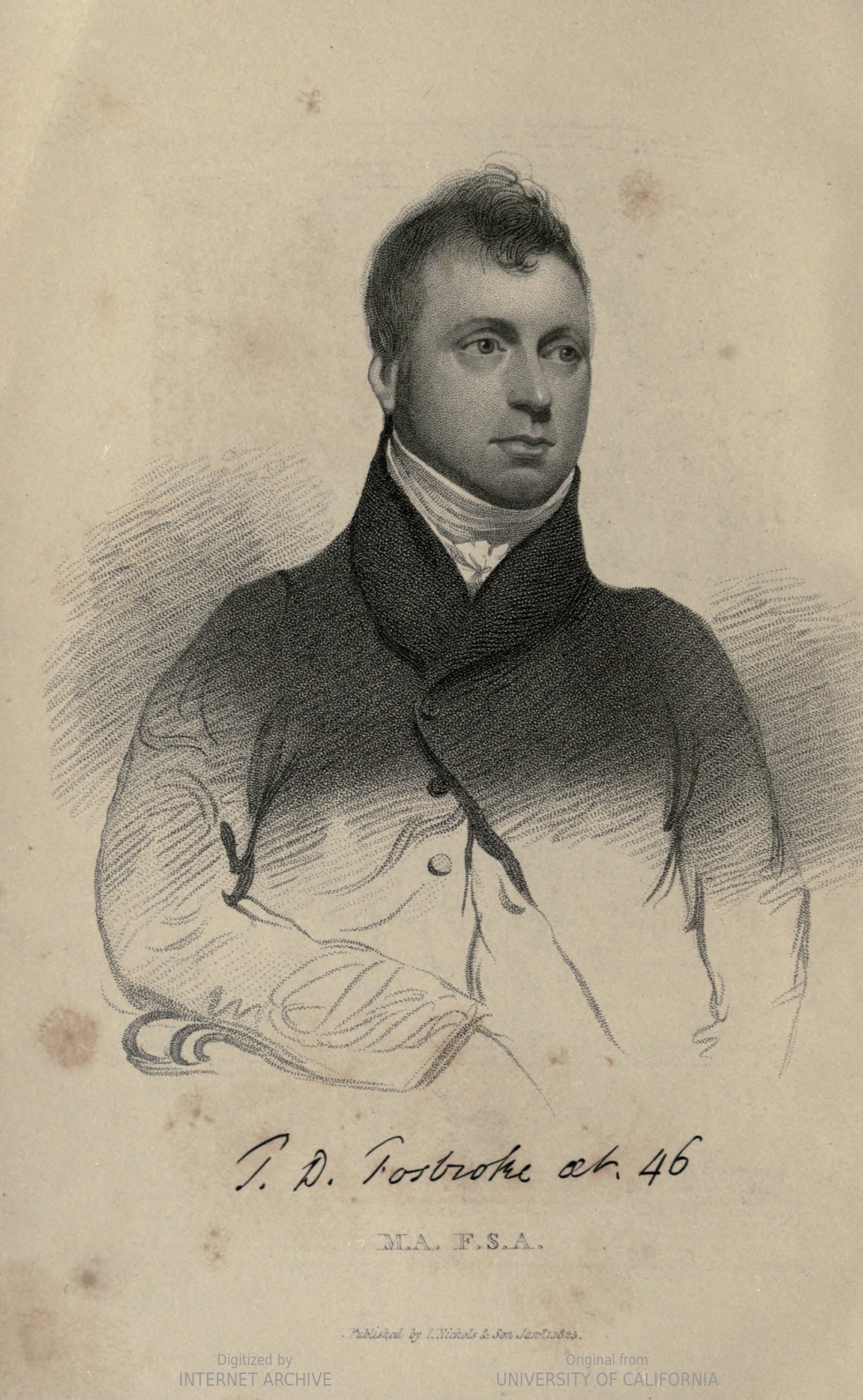
Fosbroke (1770-1842) was an English clergyman and historian. Well educated, he attended Pembroke College, Oxford, where he received a BA in 1789 and MA in 1792 (Foster 481). Though he wanted to be a lawyer,“it was his father’s dying wish that he should be placed in the Church,” so he began a career in the clergy soon after he graduated (9).
Fosbroke became a member of the clergy in Horsley County, Gloucester in 1792, then a priest from 1794 through 1810 (Foster 10).
An avid historian, Fosbroke reportedly spent 8-9 hours researching every day. He was elected a fellow of the Society of Antiquaries of London (FSA) in 1799. FSAs were a community of men interested in English history. He contributed reviews and articles to Gentleman’s Magazine, the first magazine in English to call itself a magazine (Britannica).
Besides British Monachism, Fosbroke published several other popular or influential books. Several were on Gloucester, a guide to Antiquarianism, and the enormous work Encyclopædia of Antiquities.
Fosbroke was impoverished for most of his life, and depended on a vicarage in Walford for housing (Fosbroke 12).
Publisher, Printer, and Seller
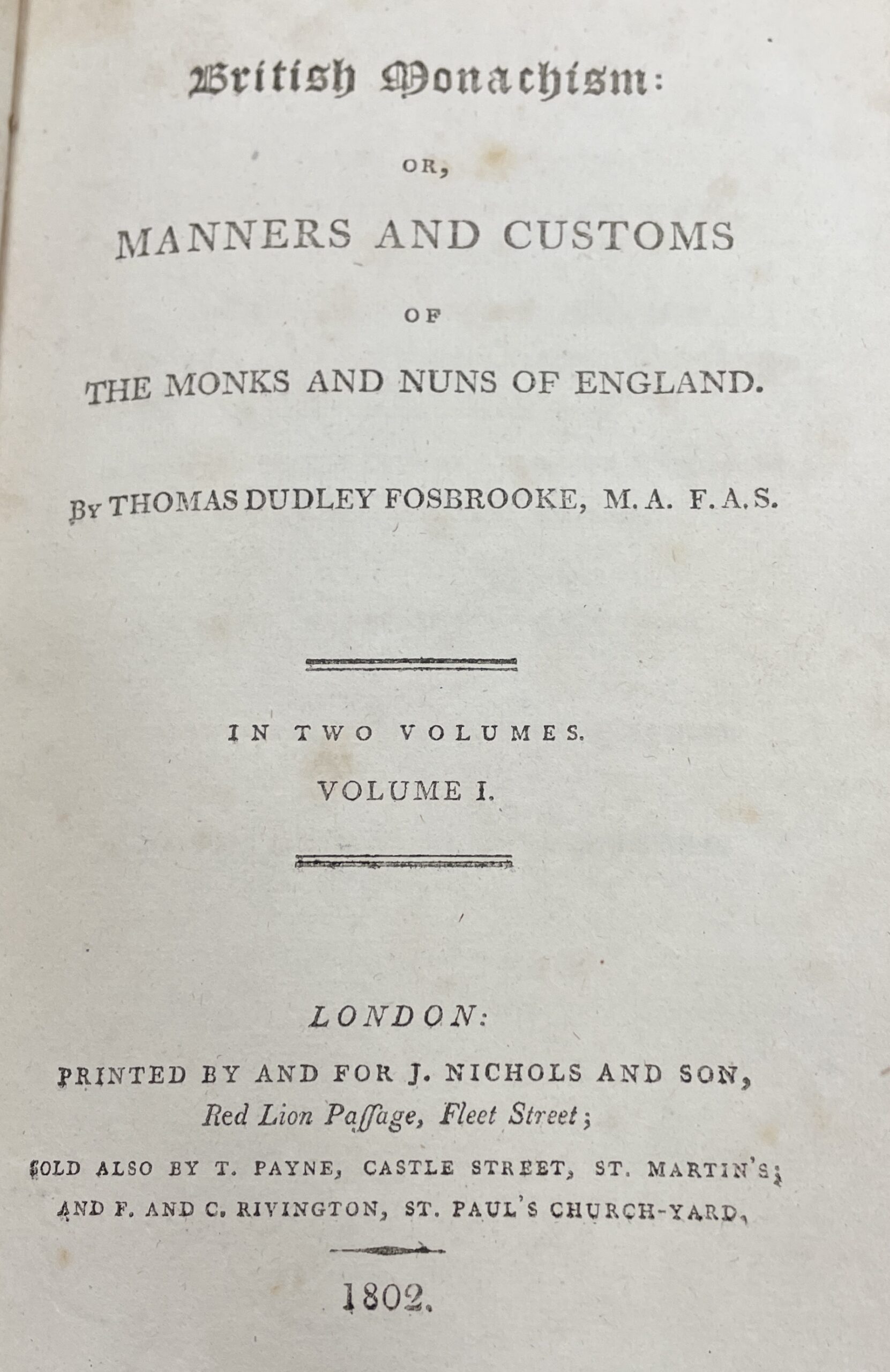
British Monachism was printed and published by John Nichols and his son John Bowyer in 1802 at their shop on Red Lion Passage, Fleet Street, London. A colophon at the end of the book confirms Nichols and Bowyer printed British Monachism. Nichols and Son published scholastic and academic texts, especially history (Fallon). They published Gentleman’s Magazine and FSA authors. The printers were close with Fosbroke, exemplified by John Bowyer writing an obituary for Fosbroke in the third edition of British Monachism. Nichols and Son sold some of the books they published, but the title page lists two other booksellers.
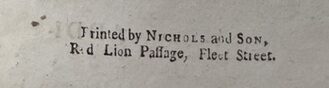
One of the possible booksellers is Thomas Payne and Son bookshop on Castle Street, London. Thomas Payne (1719?-1799) and his son sold classical texts and scholarly works for patrons in their shop in St. Martin’s. Its patrons claimed the bookshop was one of the largest in London (Fallon 229-230). Furthermore, Thomas Payne is believed to be one of the first booksellers to distribute catalogues of the rare and used books housed in his shop (237). There is no provenance evidence which would point to Payne selling this book, though he could have.
The other possible booksellers are F and C Rivington in their shop in St. Paul’s Churchyard, London. Francis (1745-1822) and Charles (1754-1831) were third generation booksellers. Their family was well “connected with the Company of Stationers,” a trade union for craftspeople involved in “bookselling, stationery, printing, bookbinding, printselling [sic], or engraving trades or professions” (Septimus 29; Saunders 221). Their publications were often religious. In Charles’s obituary the author acknowledges the family’s ties to the Society for Promoting Christian Knowledge, a large Anglican charity, and the “innumerable…valuable works on theology and ecclesiastical affairs” (Septimus 29). British Monachism is a suitable title for the Rivington’s bookshop, but again, there are no signs that they sold this particular book.
Provenance
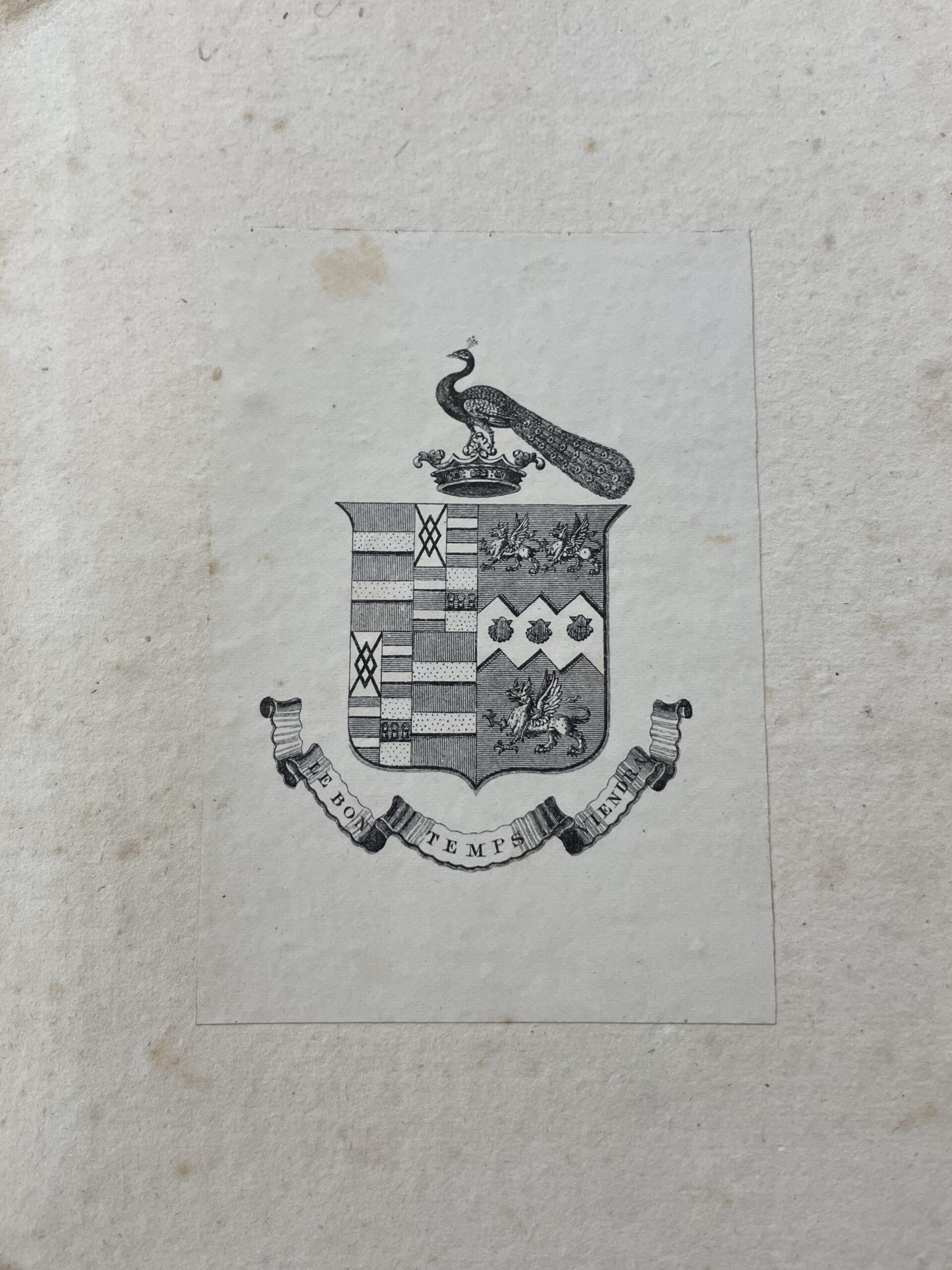
Below these marks is a bookplate glued to the pastedown. Its key characteristics are these: a peacock on top of a crown, a shield divided in two down the middle, and the French phrase “Le Bon Temps Viendra” written on a scroll. The peacock on a crown, or coronet, means that this plate belongs to the son of the shield’s patterns. I struggled to describe the symbols and patterns on the shield, which has a complex tincture pattern on the left, while the right’s three gryphons and three conchs is more straightforward. At this point I googled “Le bon temps Viendra heraldry” and the first result is a wordpress for a Provenance project with a book that had the same bookplate. The page cites several indexes of heraldry that connect the peacock and “Le bon…” with the Harcourt family (Burke). The pattern on the left with the complex tinctures is Harcourt, while the pattern on the right is unknown. In the comments, someone asserts that it is Edward William Harcourt because he has a book with the same bookplate, and has a link showing both books being part of Harcourt’s catalog as of 1883. Unfortunately, Edward William Harcourt’s catalog does not list any books by Fosbroke.
This lead is important, though, because it could have belonged to Edward and been given away before or received after this catalog was published. Or, it belonged to Edward’s only brother, William Harcourt (Oxford Dictionary of National Biographies).
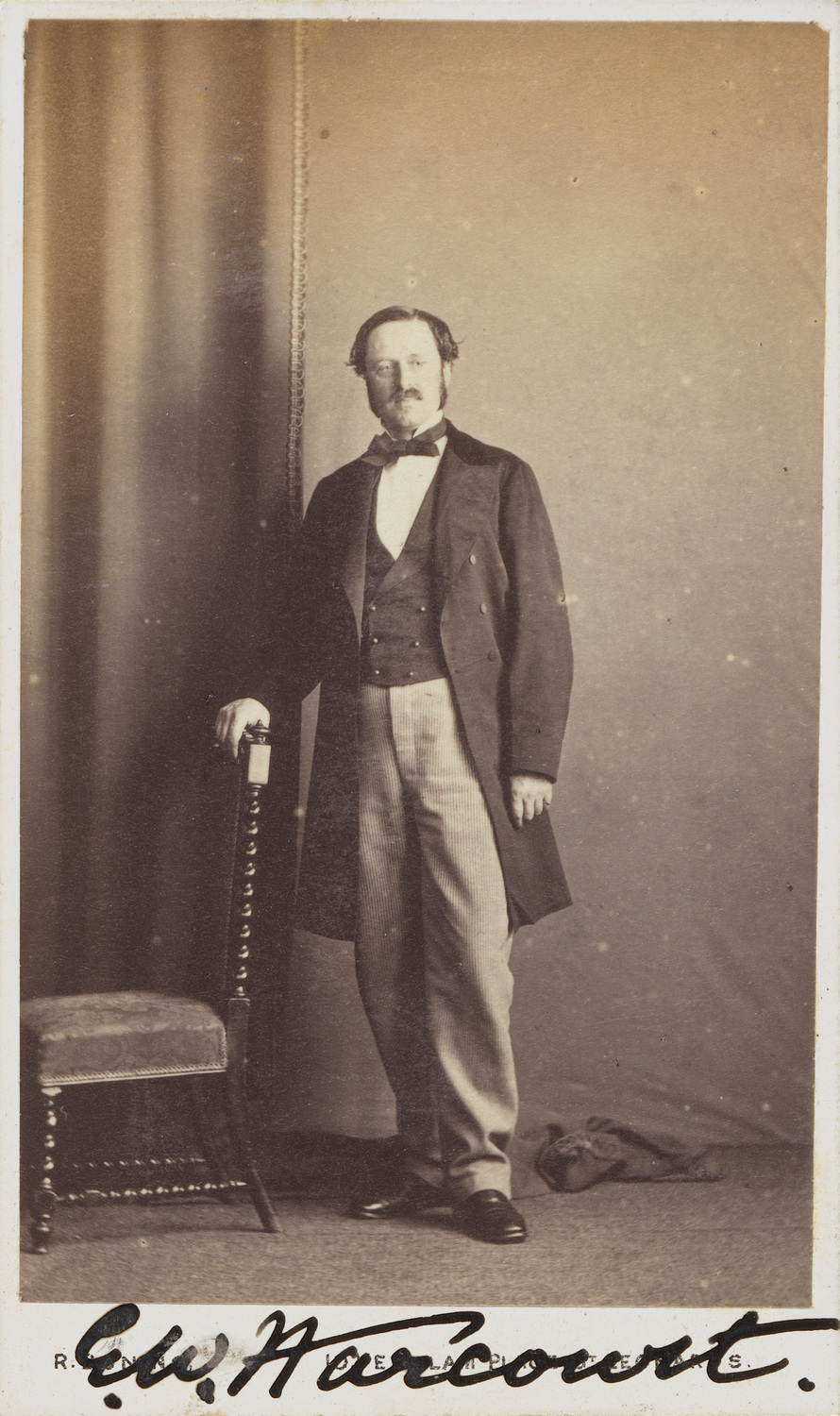
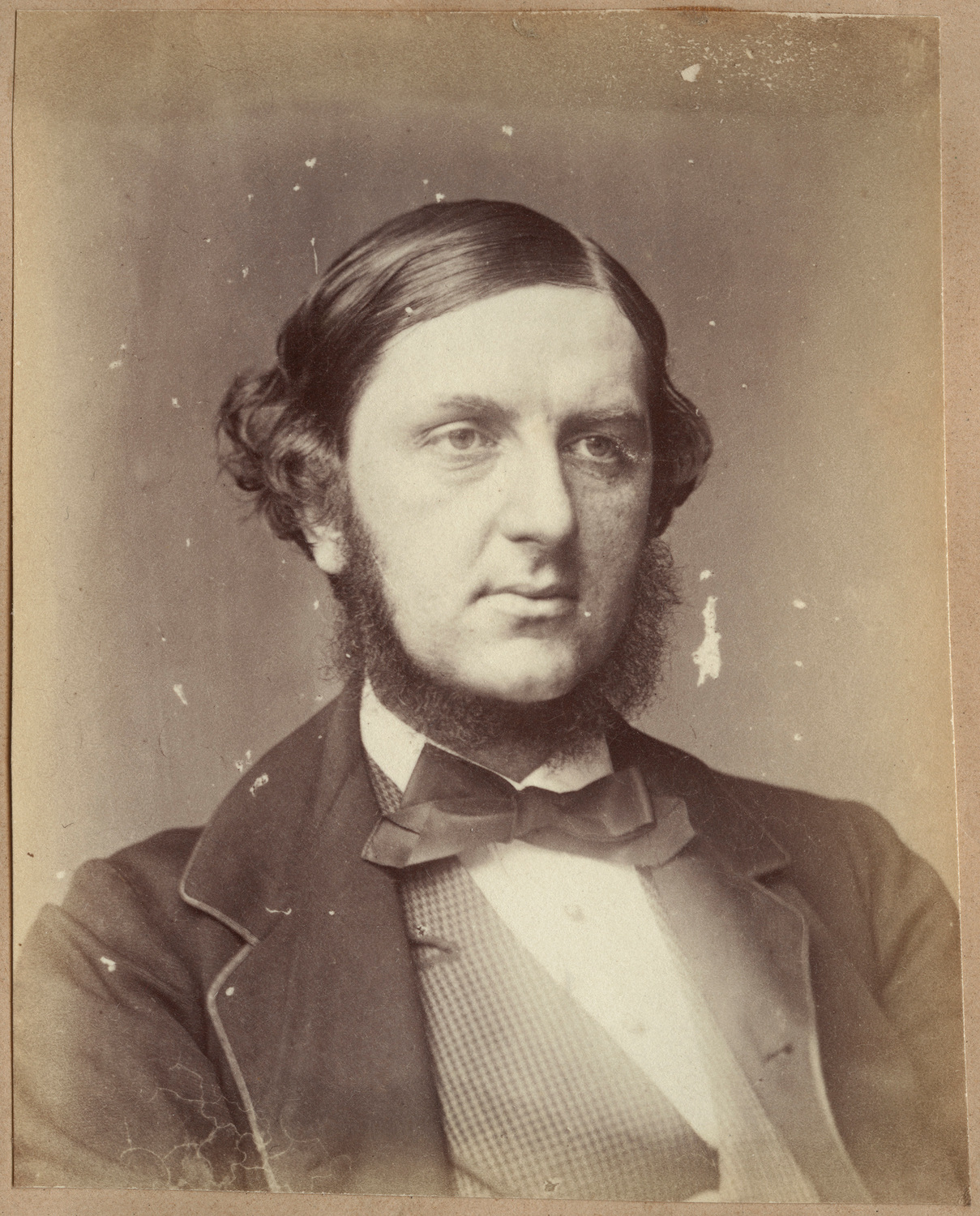
William Harcourt was a lawyer, MP, Home Secretary, and Chancellor of the Treasury. He inherited and died in Nuneham House, outside of Oxford, and near Gloucester (the site of one of Fosbroke’s major works).
Edward William Harcourt was a lawyer who practiced in Oxford. Neither of them were born when the book was published.
No records exist of FSA membership and the Harcourts did not appear in the Gentleman’s Magazine subscribers index I found, so it is hard to say which of the brothers would have owned the book based off those leads.
Several other books owned by Edward William Harcourt have an identical bookplate (University of Canterbury).
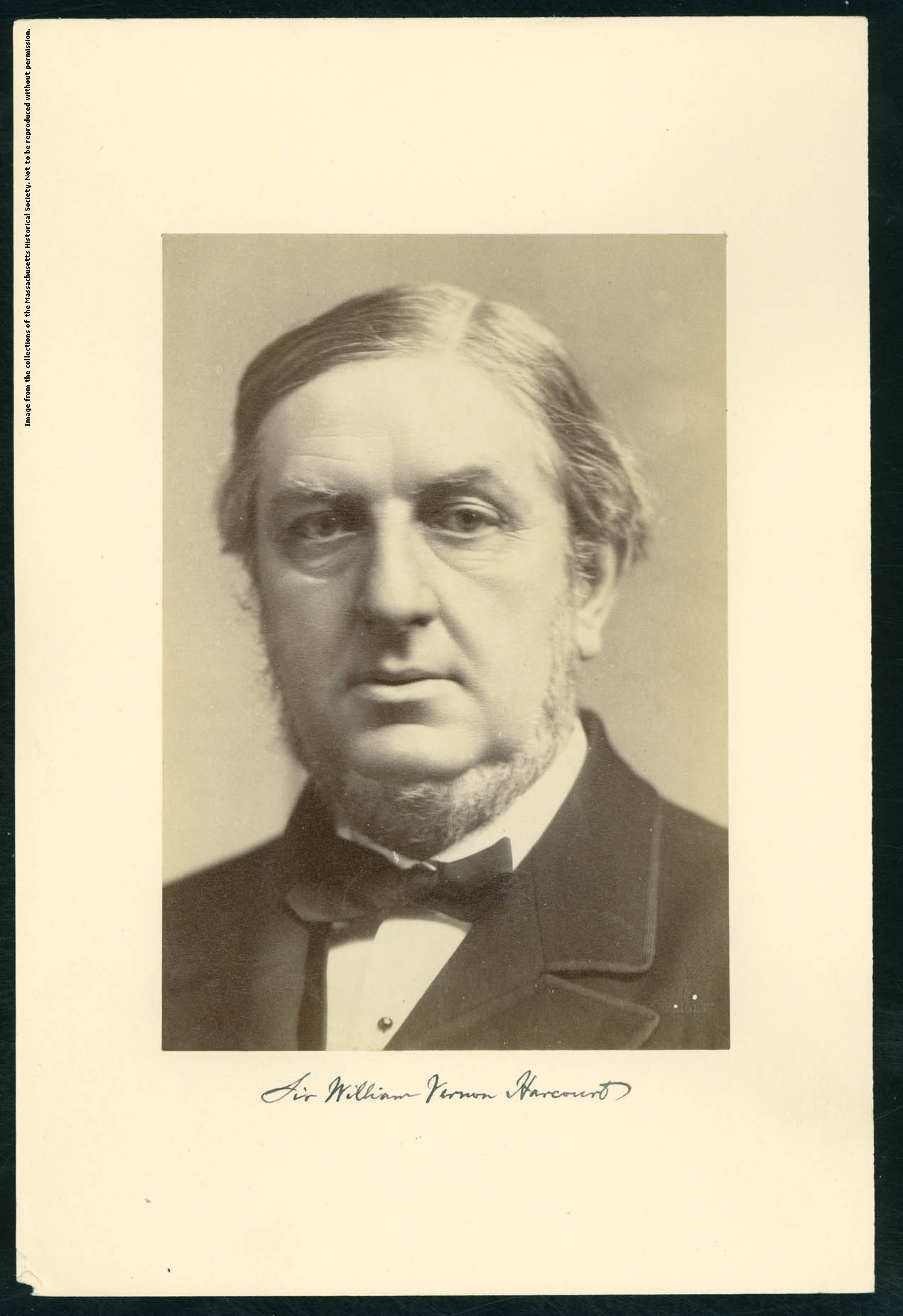
Edward William and William’s father was a clergyman, also named William (Stansky). William senior was 13 when the book was first published, and became a clergyman in Yorkshire in 1811. He would have been 22 but far north of Oxford-Gloucester, and London for that matter. William senior inherited Nuneham house from his brother, who inherited it from their Edward, also a priest, in 1861 (Aston).
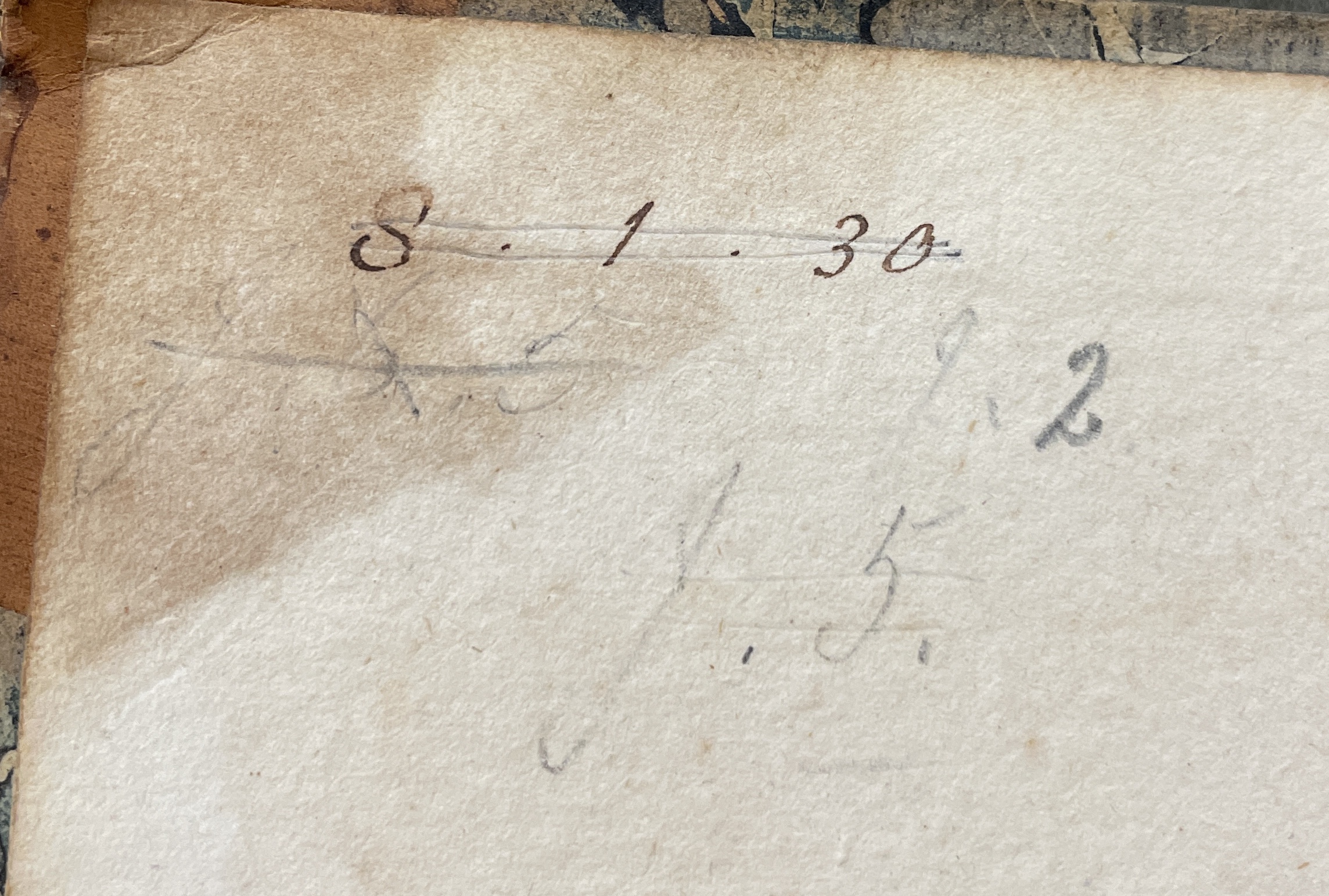
Upon opening the book and scanning the pastedown from top to bottom, there are a few erased or faded seller’s marks, but I have not been able to decipher any of them. One reads “S [or 8] . 1 . 30” and is written in ink but has been crossed out; another is “J.6.5” “L.2.” and “J.5.” which are written in pencil, have been struck through, and are lightly erased. None are written in the same hand.
The other sign of provenance is a latin inscription from KR to DEB: ““D.E.B. Pro tut tantis officiis liebenter perfectis gratias a sum amicus”. This translates to “‘Thank you my friend for all your support and loving service.”
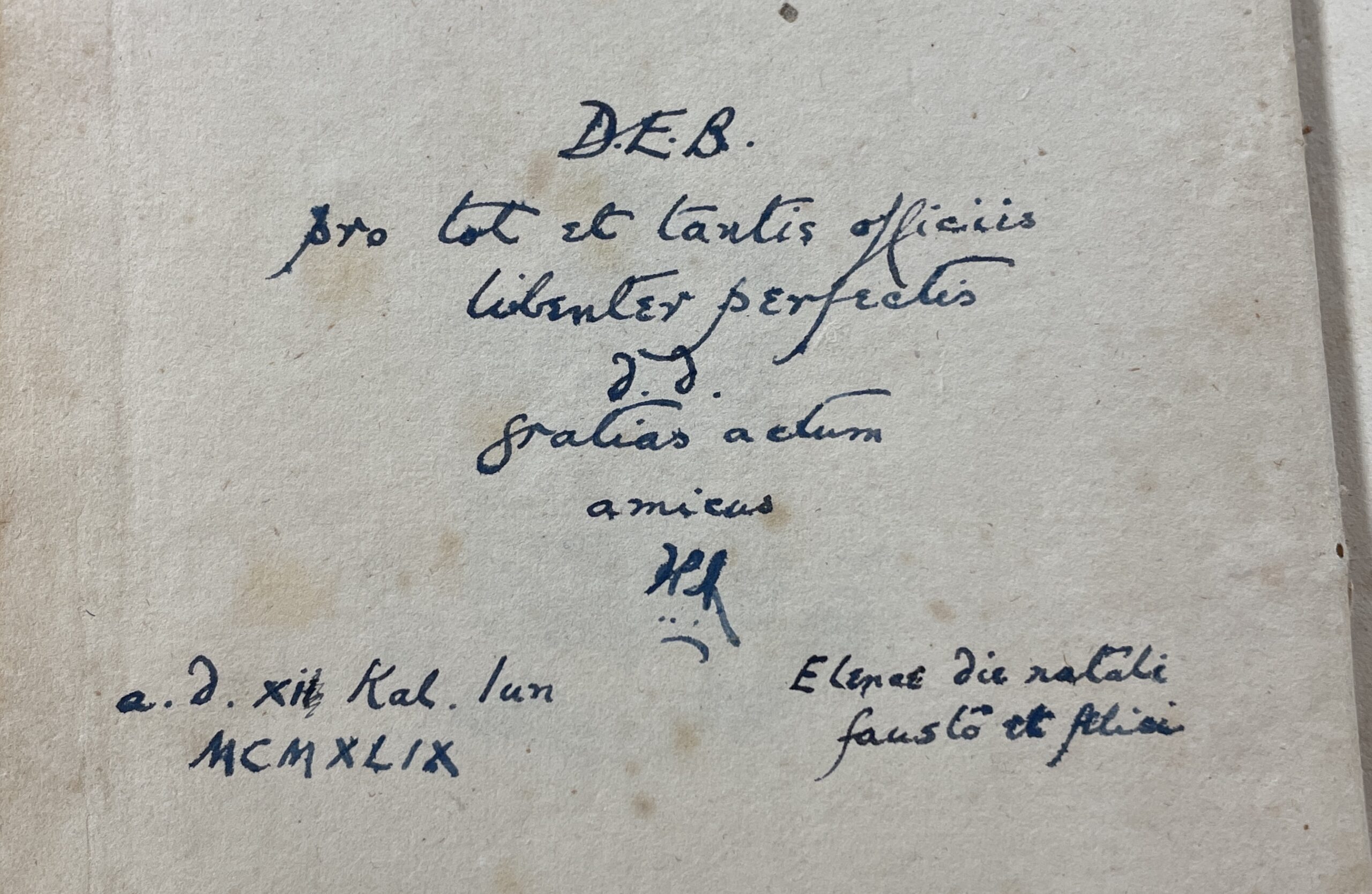
The inscription is dated, and I initially didn’t understand what it meant except for the roman numerals for 1949. After some digging I realized the text above the year was a date: said “A.d. Xi Kal. lun.” This could be May 22: in roman type the abbreviation for June is IVN, and writing the numbers before kalendis means it is how many days proceeding the first of the month. Xi means there are 11 days before the first of the next month, so it could be 11 days before June first. Or it is December 22 because the roman type for January is IAN. Both spellings resemble the inscription.
The final inscription on the page reads “Elenet die natali fausto et petiai,” which translates to “I wish you a happy birthday.”
This book was a birthday present from someone highly educated to someone highly educated, and their birthday is May or December 22nd. They both know Latin and probably have a shared interest in the church, England, and monachism.
I was unable to find someone with the initials DEB whose birthday was May or December 22nd. I could not find a connection to Michigan State University.
Works Cited
Aston, Nigel. “Harcourt [formerly Venables-Vernon], Edward (1757–1847), archbishop of York.” Oxford Dictionary of National Biography. January 03, 2008. Oxford University Press. Date of access 18 Nov. 2023, <https://www.oxforddnb.com/view/10.1093/ref:odnb/9780198614128.001.0001/odnb-9780198614128-e-12237>
“Bookplate of Edward William Harcourt.” University of Canterbury Library Provenance, digitalvoyages.canterbury.ac.nz/omeka-s/s/provenance-project/item/543. Accessed 18 Nov. 2023.
Britannica, The Editors of Encyclopaedia. “The Gentleman’s Magazine”. Encyclopedia Britannica, 16 Jun. 2017, https://www.britannica.com/topic/The-Gentlemans-Magazine. Accessed 18 November 2023.
Burke Cahalan, S. (2011, July 26). Le Bon Temps Viendra. Manuscripts on Microfilm. https://manuscriptsonmicrofilm.wordpress.com/2011/07/08/le-bon-temps-viendra/
David Matthews, From Mediaeval to Mediaevalism: A New Semantic History, The Review of English Studies, Volume 62, Issue 257, November 2011, Pages 695–715, https://doi.org/10.1093/res/hgr010
Edward William Vernon Harcourt. 1860. London, https://www.npg.org.uk/collections/search/portrait/mw159201/Edward-William-Vernon-Harcourt?LinkID=mp97797&role=sit&rNo=0.
Fallon, D. (2019). ‘stuffd up with books’: The bookshops and business of Thomas Payne and son, 1740–1831. History of Retailing and Consumption, 5(3), 228–245. https://doi.org/10.1080/2373518x.2019.1703322
Fitzpatrick, Barbara Laning. “Rivington family (per. c. 1710–c. 1960), printers, publishers, and lawyers.” Oxford Dictionary of National Biography. October 04, 2008. Oxford University Press. Date of access 17 Nov. 2023, <https://www.oxforddnb.com/view/10.1093/ref:odnb/9780198614128.001.0001/odnb-9780198614128-e-70881>
Fosbroke, Thomas Dudley, 1770-1842. British Monachism: Or, Manners And Customs of the Monks And Nuns of England. 3d ed., with additions. London: M.A. Nattali, 1843.
Foster, J. (1968). Alumni oxonienses: The members of the University of Oxford, 1715-1886: Their parentage, birthplace, and year of birth, with a record of their degrees. being the Matriculation Register of the university. Kraus Reprint.
“monachism, n., sense 1”. Oxford English Dictionary, Oxford University Press, July 2023, <https://doi.org/10.1093/OED/5160784652>
Morrell, J. (2004, September 23). Harcourt, William Venables Vernon (1789–1871), founder of the British Association for the Advancement of Science. Oxford Dictionary of National Biography. Retrieved 28 Oct. 2023, from https://www.oxforddnb.com/view/10.1093/ref:odnb/9780198614128.001.0001/odnb-9780198614128-e-12249.
Oxford. (n.d.). Dates: The roman calendar system. cabinet. https://www.cabinet.ox.ac.uk/dates-roman-calendar-system-0
Rivington, Septimus. The Publishing House of Rivington. Rivington,#x9C; Percival Co, 1894.
Saunders, J. London, VI, Charles Knight & Co., London, 1844, pp. 209–224
Sir William Vernon Harcourt. 1860. London, https://www.npg.org.uk/collections/search/portrait/mw156943/Sir-William-Vernon-Harcourt.
Smith, B. (2008, January 03). Fosbroke [Fosbrooke], Thomas Dudley (1770–1842), antiquary. Oxford Dictionary of National Biography. Retrieved 28 Oct. 2023, from https://www.oxforddnb.com/view/10.1093/ref:odnb/9780198614128.001.0001/odnb-9780198614128-e-9954.
Stansky, P. (2008, January 03). Harcourt, Sir William George Granville Venables Vernon (1827–1904), politician. Oxford Dictionary of National Biography. Retrieved 28 Oct. 2023, from https://www.oxforddnb.com/view/10.1093/ref:odnb/9780198614128.001.0001/odnb-9780198614128-e-33693.
“William Vernon Harcourt,” photograph, Portraits of American Abolitionists collection, photograph number 81.311, from https://www.masshist.org/database/viewer.php?item_id=1159&img_step=1&mode=large#page1
Created by Abraham Frank in Fall 2023 for Dr. Brockey’s HST 475. Special thanks to Andrew Lundeen, Tad Boehmer, and Dayna Topalian
