
A Historical View of the Rise and Progress of the Sect Self-styled Latter-day Saints
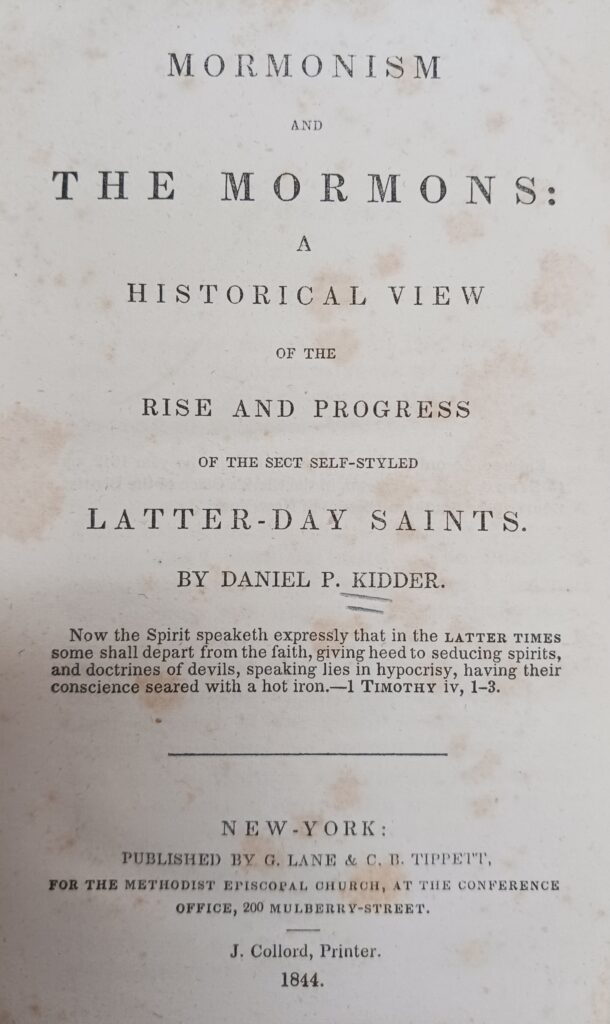
Full Identification
Author: Daniel P. Kidder
Title: Mormonism and the Mormons: A Historical View of the Rise and Progress of the Sect Self-styled Latter-day Saints
Publisher: G. Lane & C. B. Tippett
Place of Publication: 200 Mulberry-Street, New York, New York
Year of Publication: 1844
Library Call #: BX8611 .K45 1844
Physical Description of the Copy
This copy of Mormonism and the Mormons is a small (14 cm) octavo format book bound in tree calf design brown leather. It has visible wear along the edges of both boards.
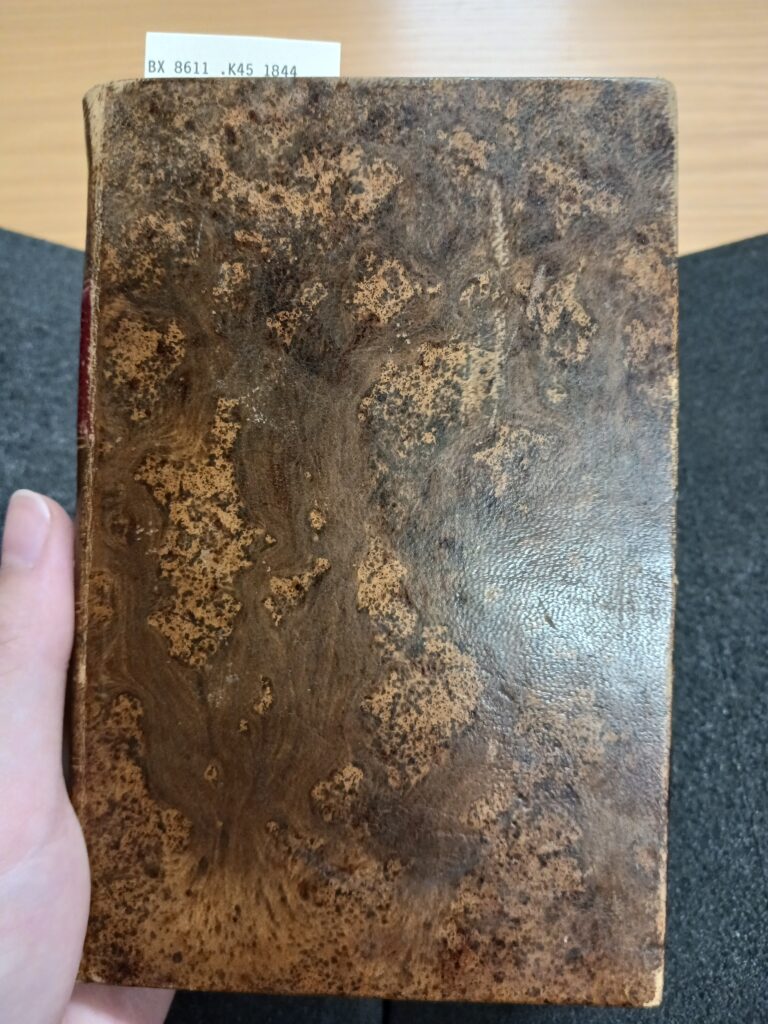
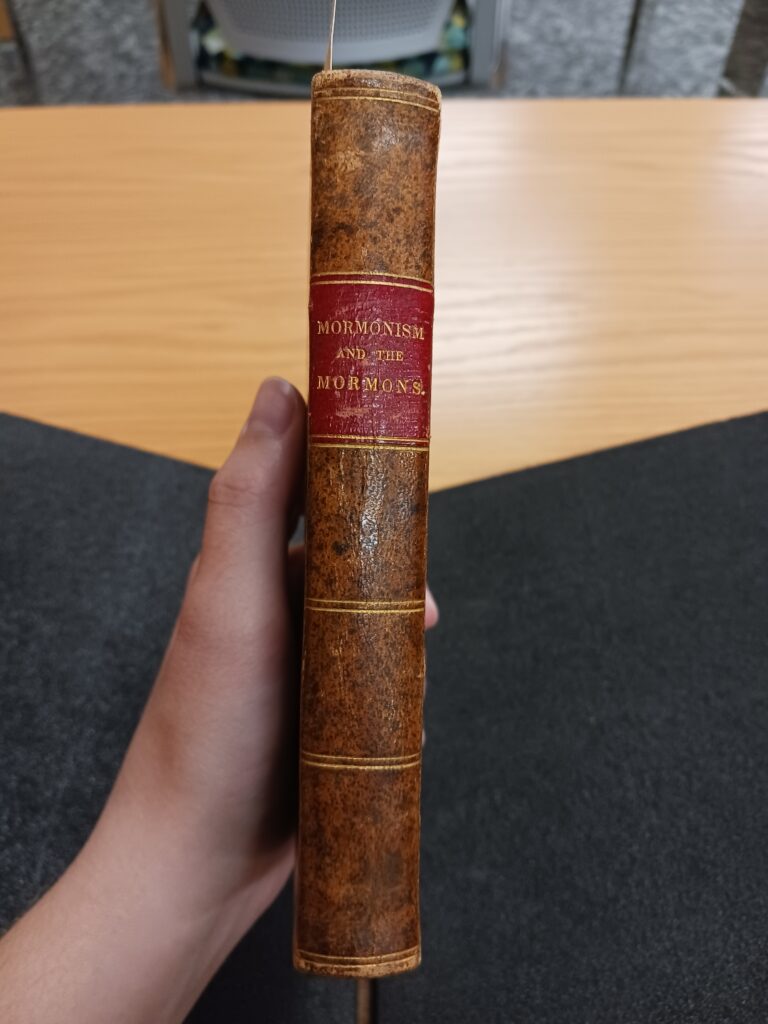
The spine is decorated with horizontal gilded bands and a decorative title plate of red leather with gold lettering. The book’s fore-edges are decorated with brown speckling. Due to the copy’s age and wear, the threads used in binding are visible at the junctions of the pastedowns and flyleaves. There are two bookplates on the first pastedown and a handwritten inscription on one of the initial flyleaves.
The pages are thin and most are marred by foxing stains across the page from age and use. None of these stains impacts the legibility of the text. Staining is more frequent on pages near the beginning and end of the book. There is occasional dog-earing near the middle of the text, and one page (pp 181–182) is ripped along the bottom edge in a jagged tear. The upper corners of some pages are slightly water-damaged. There is no marginalia on any page of the preface, main text, appendix, or contents guide.
Contents
Mormonism and the Mormons attempts to compile a history of Mormonism from its inception to the mid-nineteenth century (the time of publishing) with the goal of limiting the social spread and influence of the religion.
The book was produced for the Methodist Episcopal Church and is accordingly biased toward a Methodist worldview in its assessment, listing some of its subsections under names such as “Extent of the delusion” and “Mob law” (though it does temper these with sections like “Honesty of many of its followers” and “Relation of Mormonism to Christianity”).
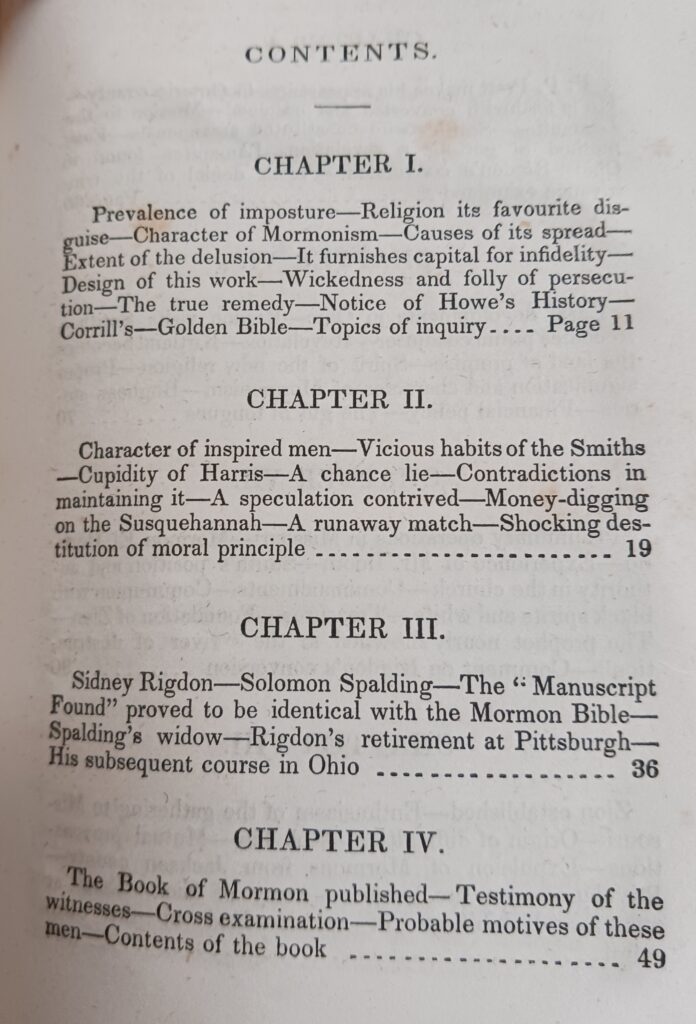
Its explicit stated purpose, in fact, is to provide readers with information on Mormonism they may not previously have had access to in order to communicate to them the “ruinous nature of this delusion” and the “spiritual blindness and misery” it will inflict on “successive victims”. It is a book created by a Methodist minister for the Methodist Church, cautioning any and all readers to the perceived social evil of Mormonism.
This text, to supplement the personal experiences and understandings of Mormonism of the author, draws from a few other key texts, listed here:
- The Book of Mormon, translated by Joseph Smith, Jr., carefully revised by the Translator, 1840
- Doctrine and Covenants of the Church of the Latter-day Saints; carefully selected and compiled from the Revelations of God – Joseph Smith, Jr. and others, 1835
- History of Mormonism; or a faithful Account of that singular Imposition and Delusion, with Sketches of the Characters of its Propagators, to which are added, Inquiries into the probability that the Historical Part of the Golden Bible was written by one Solomon Spalding, and by him was intended to have been published as a Romance – E. D. Howard, 1840
- A brief History of the Church of Christ of Latter-day Saints, (commonly called Mormons,) including an Account of their Doctrines and Discipline, with Reasons of the Author for leaving the Church – John Corrill, 1839
The above texts are split between the official texts of the LDS Church itself and histories attempting to mitigate its social influence; Mormonism and the Mormons is itself a work of the latter kind.
As a work explicitly intended to influence public opinion on a religion, this book helps to characterize the place of Mormonism in the public consciousness and the ways in which, directly and indirectly, people responded to and pushed against it in the mid-nineteenth century. It is one instance of the 19th century focus by Christian religious leaders and followers alike on a faith as “exceedingly strange and unsettlingly familiar” as Mormonism.1
On the Publisher, Printer, and Author
This book was originally published by G. Lane and C. B. Tippett in New York for the Methodist Episcopal Church. This publisher published many books for the Methodist Church, including bibles, hymnals, a Conference journal, works explaining the gospels, and memoirs and other books with subjects relevant to the Methodist Church. Books published through G. Lane and C. B. Tippett indicated which branch of the Church the book was produced for, if applicable (e.g., the Sunday School Union).2
Mormonism and the Mormons‘ printer is J. Collord, who printed several materials for the Methodist Church as well as a book called Ten Years in Oregon on frontier life in the Western United States.3
The author, Daniel P. Kidder (or Daniel Parish Kidder) was a Methodist minister and missionary. He attended Wesleyan University and entered ministry in 1836; just after, in 1837, he traveled to Brazil for mission work. After three years abroad, he returned to the United States to serve as secretary for the Methodist Sunday School Union, one of the main bodies for which G. Lane and C. B. Tippett published materials.4
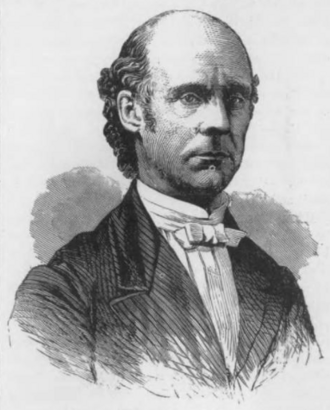
Over the course of his life, Kidder produced extensive writing on theology, Christian history, and the populations he encountered in Brazil, as well as moral instructional stories to be used by the Sunday School Union.5 Mormonism and the Mormons contains some of his roughly ethnographic interests (which can also be seen in his works describing the populations of Brazil) molded into an argument against the further propagation of Mormonism.
History of Ownership
Andrew Landy
This copy contains provenance data in the forms of two bookplates—one of which includes a handwritten note along its top edge—and one handwritten inscription with a name, date, and location. The inscription, located on the second flyleaf of the copy, reads “Andrew Landy; Nov. 20, 1876; Lansing” in careful, decorative script in brown ink.
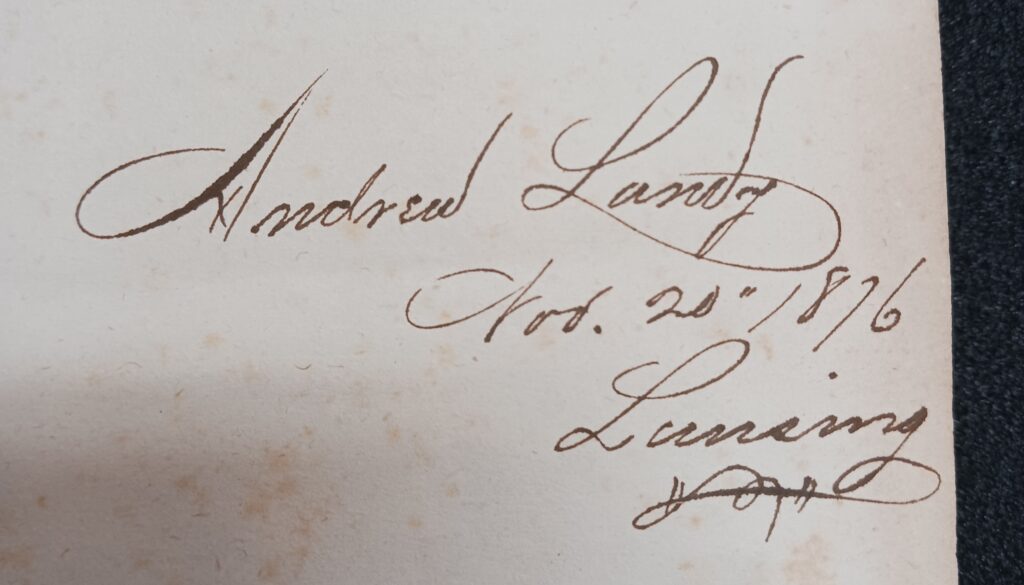
It is likely that the Lansing of this inscription is not Lansing, Michigan, but Lansing, Iowa, a city in the northeast corner of the state on the banks of the Mississippi River. In 1849, a twenty-year-old Swiss farmer named Andrew Landy moved to Allamakee County, the county home to the city of Lansing. He was elected to the State Legislature as a county representative in 1871, in which he served for a single term.6
Over the course of Landy’s time in Iowa, Mormonism was increasingly visible in the public consciousness. Beginning in the mid-1840s, members of the LDS Church migrated en masse from Nauvoo, Illinois via the Mississippi River, stopping (and sometimes settling) in eastern Iowa.7 As a citizen (and recent former county representative), it is possible that Landy came into possession of Mormonism and the Mormons in the hopes of learning about a population of concern in his home state.
Andrew Langenbacher
The first of the two bookplates in the copy is yellowed to a similar shade to the pastedown below and reads “Private Library; Andrew Langenbacher; No. ____” in print, with handwritten additions of “61” along the “No.” line and a note along the top reading “‘Wilkins.’ 25¢”.
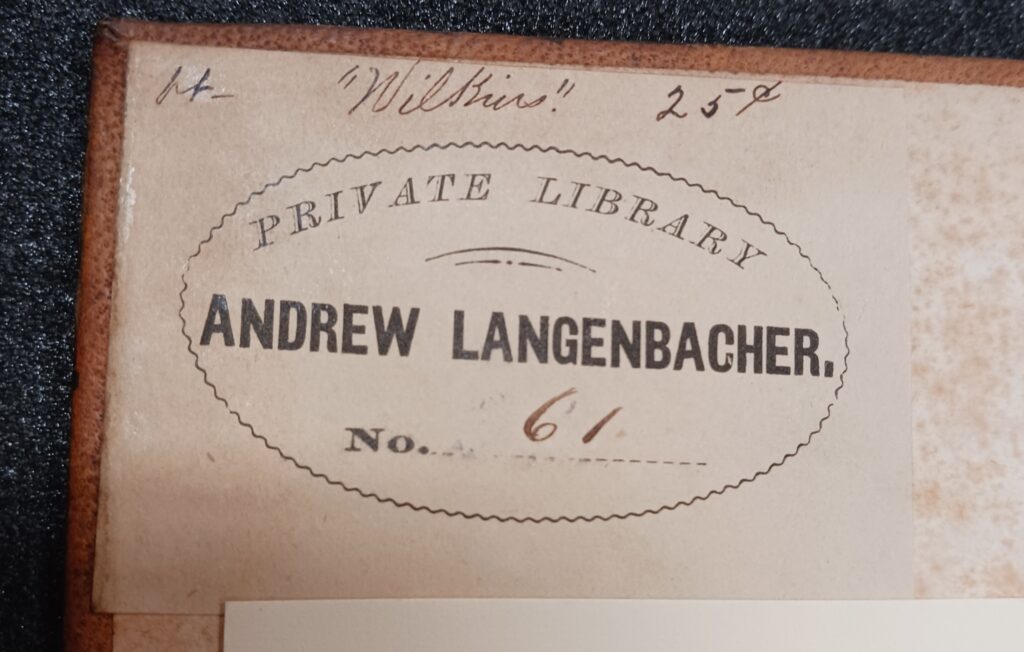
It is possible that Wilkins here refers to a bookseller which sold Langenbacher the book for 25 cents, but searches for such a seller have led to dead ends. This assumption does help fill in another blank in the chain of provenance, though, since it proposes a possibility for how this book made its way from the collection of Andrew Landy in Lansing, Iowa to the private library of Andrew Langenbacher. If this is the case, then it is likely that Langenbacher purchased more than one book through this seller at the time, since another MSU holding donated by him (The Scientific American Reference Book: A Compendium of Useful Information) is inscribed “Andrew Landy, March 23rd, 77”, suggesting the two books may have been acquired together.8
Unlike Landy, Langenbacher was a resident of Lansing, Michigan. Andrew Frank Langenbacher was born in Ingham, Michigan on October 28th, 1912. He married his wife Ruth at 23 in East Lansing and seems to have lived in the Lansing area his entire life.9 It is likely that Langenbacher worked for REO Motors, as he was deposed in 1956 in litigation for Alfred Spear v. REO Motors, and the Lansing REO plant was active throughout his life.10 He died on February 26th, 1973 at 60 years old and is buried at Evergreen Cemetery in Lansing.
There are few records of Langenbacher’s life, but there are indications of other Michiganders of the same surname with ties to the Methodist Episcopal Church. Longtime resident of the Lansing area, Mary L. Perry (née Langenbacher to a father named Andrew, though unlikely to be this book’s owner’s daughter, as he was 8 years old when she was born), is described in her obituary as a member of St. Paul’s Episcopal Church in Lansing.11 Another resident, Barbara Langenbacher, was listed in the Ludington Daily News in 1912 as an attendee of a Methodist event.12 Assuming a familial connection between Andrew and his contemporary Lansingite Langenbachers, he may have acquired this copy of Mormonism and the Mormons because of the family’s Methodist faith.
Michigan State University
The bookplate next to Langenbacher’s on the pastedown is entirely printed with no handwritten additions and reads “LIBRARY; Michigan State University; Gift of Andrew Langenbacher”. The printed name “Andrew Langenbacher” was typed with a typewriter sometime after the original printing of the unnamed “gift of” bookplate. In addition to this bookplate, there is a note on the verso of the title page written in pencil reading “G-22497”, made by the library likely during accessioning.

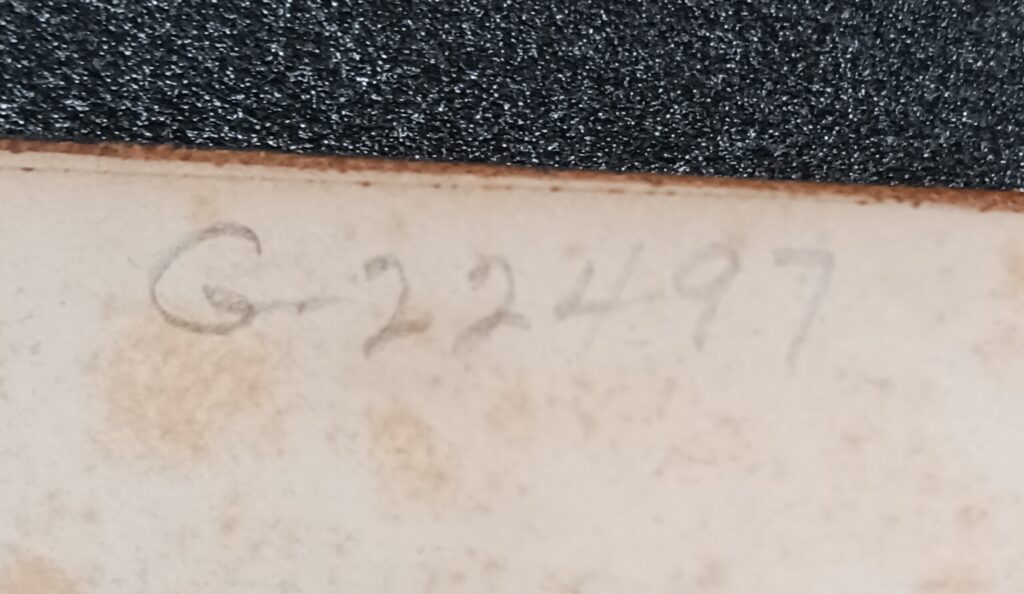
Because Andrew Langenbacher is listed as the donor, it is reasonable to assume the book was donated during his lifetime, meaning sometime before early 1973. Michigan State University only became the official name of the university on January 1st, 1964, so the book was likely accessioned into the MSU collection sometime between 1964 and 1972.13 If the donation occurred at the end of Langenbacher’s life, then it is possible it happened in 1973, or even later in the decade if the donation was specified in his will.
Mary L. Perry (the possible relative) attended Michigan State University, and it is likely that others in the family had ties to it as well, given their long-term residence in the Lansing area. The MSU library’s special collections department was established around a decade before Langenbacher’s death and two years before the official name change, so it is reasonable to assume his potential familial ties to the university motivated him to leave books to the library in death.
Sources
- Beneke, Chris.”What Kind of Prejudice Was Anti-Mormonism?,” Mormon Studies Review: Vol. 2 : No. 1 , Article 9. 2015. Available at: https://scholarsarchive.byu.edu/msr2/vol2/iss1/9
- OpenLibrary.org. “G. Lane & C. B. Tippett Publisher.” The Internet Archive’s Open Library: One page for every book, 2023. https://openlibrary.org/publishers/G._Lane_%26_C._B._Tippett.
- OpenLibrary.org. “J. Collord Printer.” The Internet Archive’s Open Library: One page for every book, 2023. https://openlibrary.org/publishers/J._Collord,_printer.
- Library of Congress. “Kidder, Daniel P. (Daniel Parish), 1815-1891.” Library of Congress LC Linked Data Service: Authorities and Vocabularies, 2023. https://id.loc.gov/authorities/names/n82031799.html.
- Ockerbloom, John Mark, ed. “The Online Books Page.” Daniel P. Kidder (Kidder, Daniel P. (Daniel Parish), 1815-1891) | The Online Books Page. http://onlinebooks.library.upenn.edu/webbin/book/lookupname?key=Kidder%2C+Daniel+P.+%28Daniel+Parish%29%2C+1815-1891.
- Alexander, W. E. “1882 Biographies from the History of Winneshiek and Allamakee Counties, Iowa.” Allamakee Biographies – 1882 – “L” Surnames. http://iagenweb.org/allamakee/BIOS/1882_L.htm.
- Goodwin, Robert H. “Among the Poorest of Saints: Mormon Migration to and Through Burlington, Iowa, 1846–1887.” Mormon Historical Studies, 1980.
- MSU Libraries. “Holdings: The Scientific American Reference Book : A Compendium of Useful Information.” MSU Libraries Catalog. https://catalog.lib.msu.edu/Record/folio.in00001529808?sid=4021730#description.
- FamilySearch. “Andrew Frank Langenbacher.” FamilySearch.org, 2021. https://ancestors.familysearch.org/en/LT5F-P1M/andrew-frank-langenbacher-1912-1973.
- MSU Libraries. “Et al – Deposition of Andrew Langenbacher, 1956.” et al – Deposition of Andrew Langenbacher, 1956 | Archives and Manuscripts. https://findingaids.lib.msu.edu/repositories/2/archival_objects/182959.
- Junior League of Lansing. “FOCUS,” p. 21. December 2013.
- MyHeritage. “Barbara Langenbacher.” MyHeritage, 2023. https://www.myheritage.com/names/barbara_langenbacher.
- Michigan State University. “History.” Michigan State University, 2023. https://msu.edu/about/history.
Created by Evie Cook for HST 475 History of the Book, 2023
