
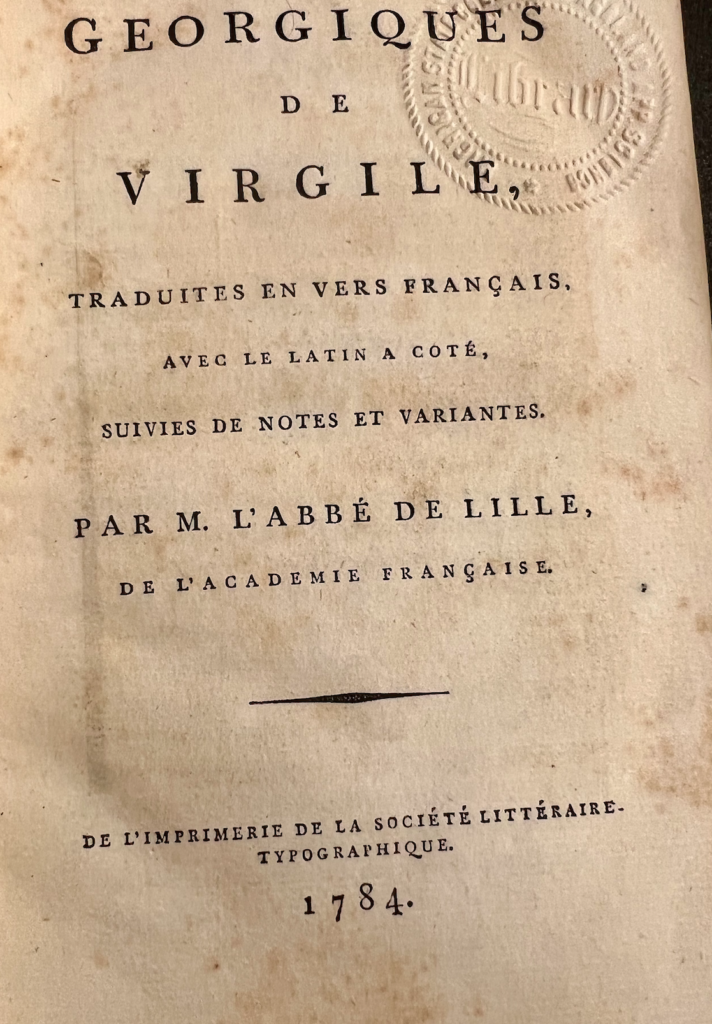
Les Géorgiques- Translated Title Page
Les Géorgiques de Virgile. (The Georgics of Virgil)
translated into French verse,
with Latin alongside.
followed by Notes and Variants.
by Mr. The Abbot of Lille From the French Academy
Of the printing press of the literary Society- typographical
Identification of Book
Author: Originally written by Virgil, this copy was translated into French by Jacques Delille of the French Academy
Title: Les Géorgiques de Virgile (The Georgics of Virgil)
Publisher: The printing press of the literary Society- typographical, France, 1784. .
MSU library call number: PA6809 .D4
Description of Book
The cover is in good condition and appears to be made out of an animal leather. The cover also features gold gilding along the border of both the front and back cover as well as gold designs on the spine that have unfortunately chipped away from wear. The spine also features red and black segments with gold writing in both. The red segments reading “Oeuvres de J Delille” translating to “works by J Delille” in referencing to the person that translated the Georgics from Latin to French. The black segment mentions the title of the book “Les Georgiques.” The inside of the book has a forest green ribbon attached to the spine to allow the reader to easily mark their place.
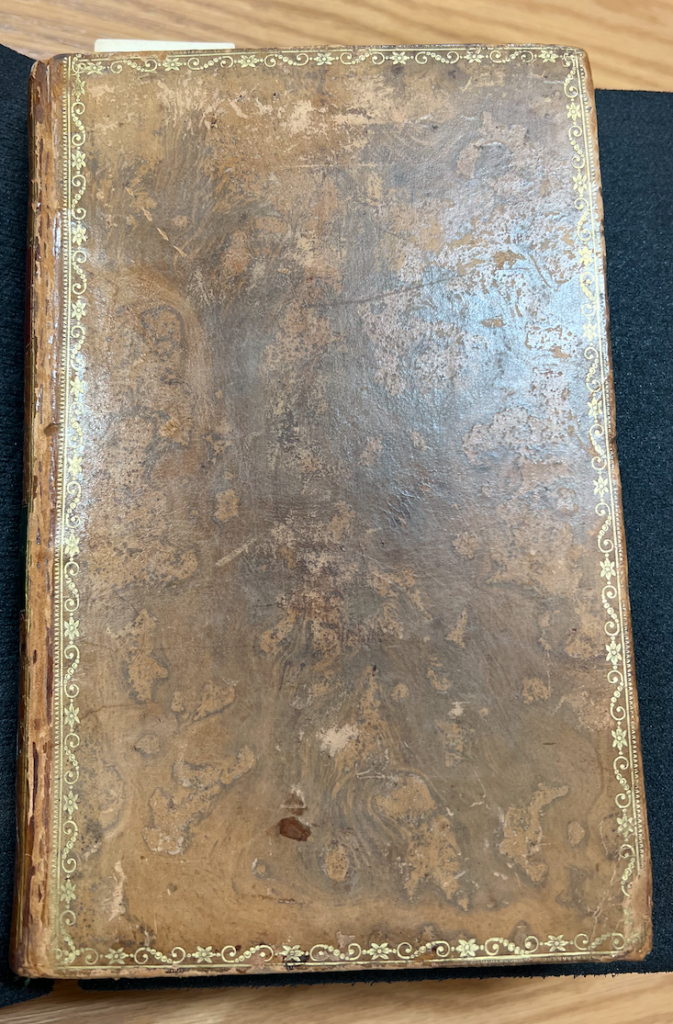

Also appearing stamped on the spine as well as penciled in on the inside of the book is “873 V9 F6 & FD.” These markings were likely made by Michigan State in order to catalog the book.
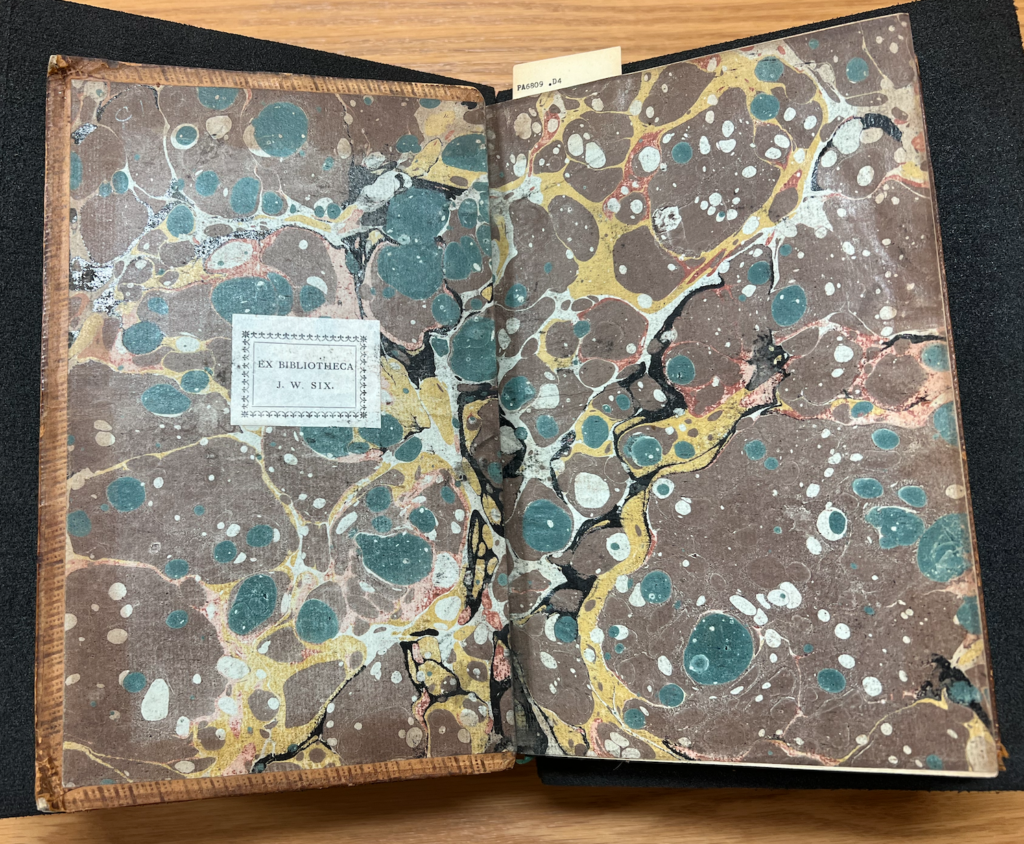
The inside covers of the book features a colorful display of brown, blue, white, yellow, black and white marbling.
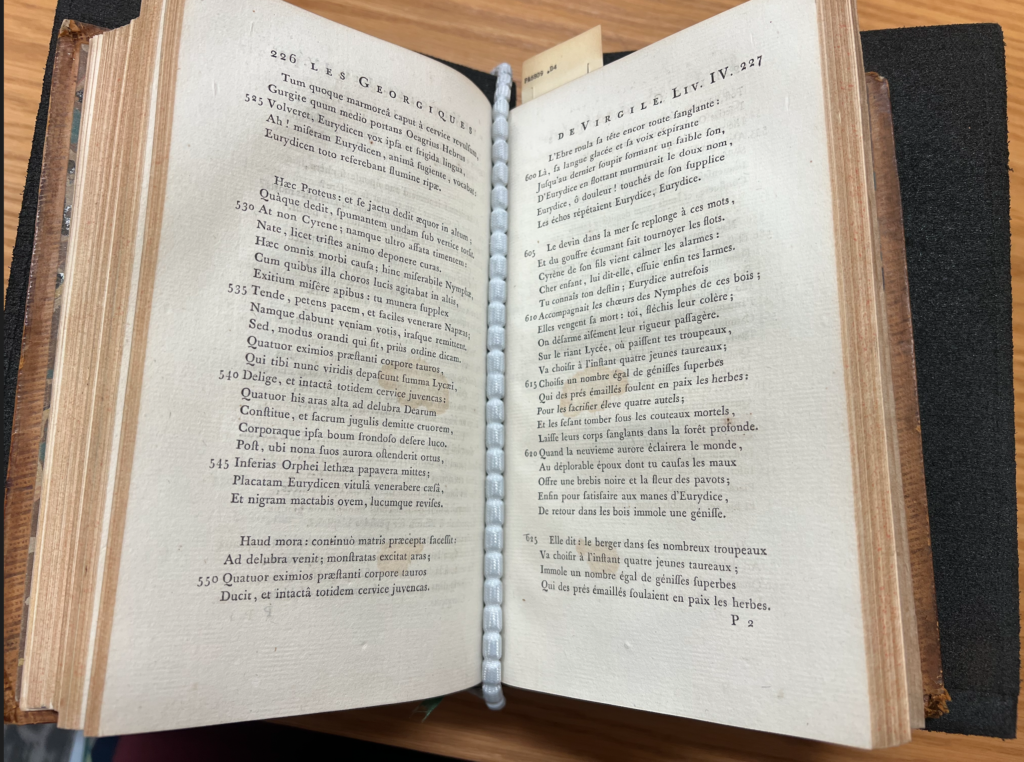
The pages of the book themselves are in fair conditions only featuring mild discoloration on some of the pages as seen on pages 226 and 227 for example
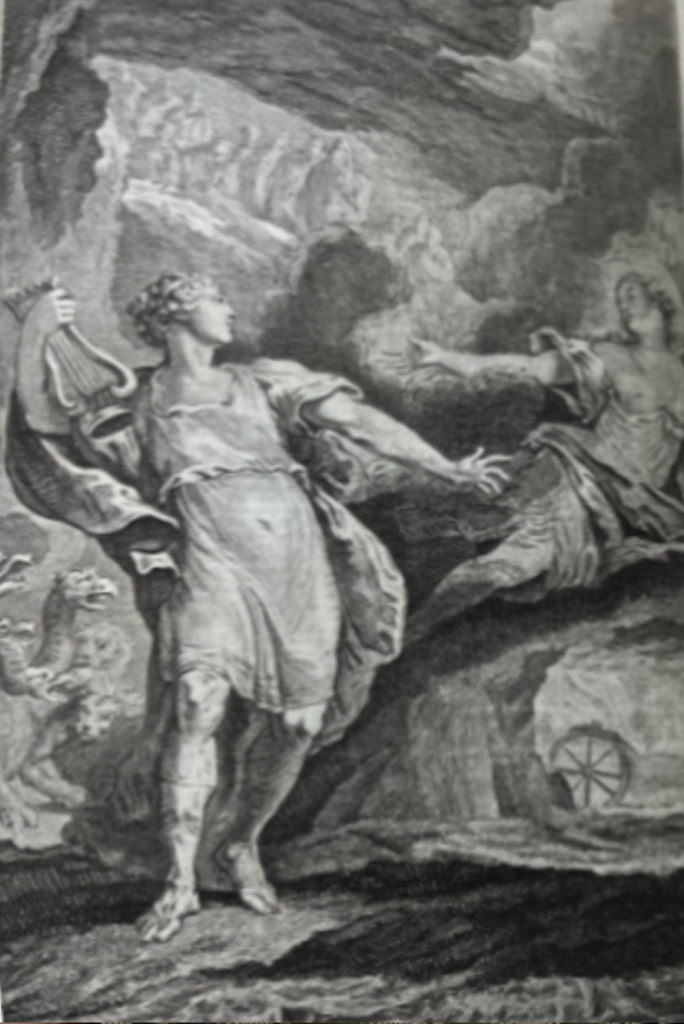
Engravings
The Georgics feature five engravings. Only two of the engravings in the book can be positively identified as being done by Joseph de Longueil (1730-1792), a French engraver living in Paris. However, as many of the engravings are similar in their craftsmanship, it can be somewhat assumed that all five engravings were done by Joseph de Longueil. All engravings in the book have been seen by a conservationist who has added support to the pages to prevent ink from fading from the images or transferring onto separate pages.
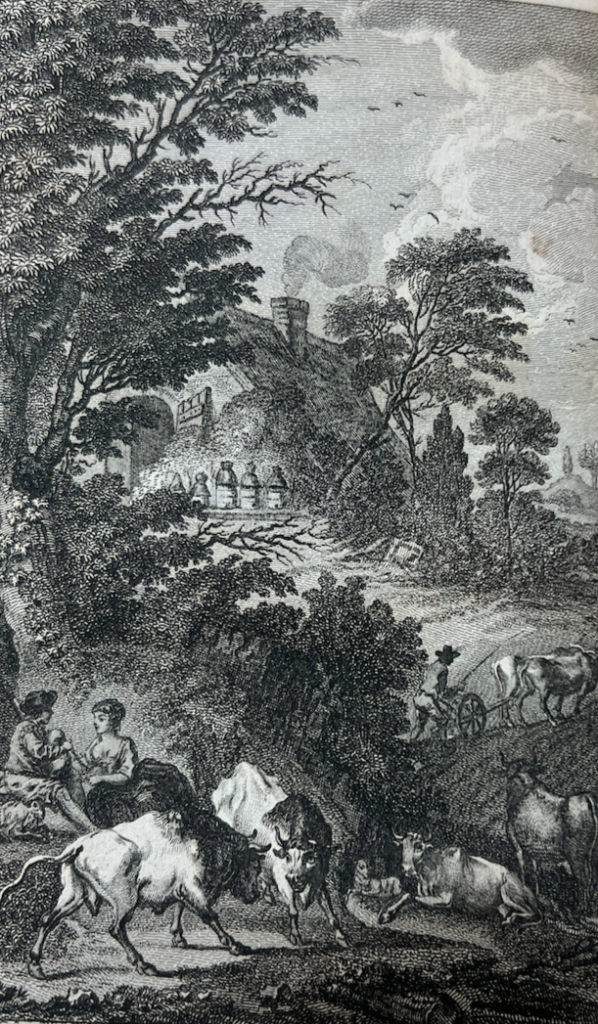
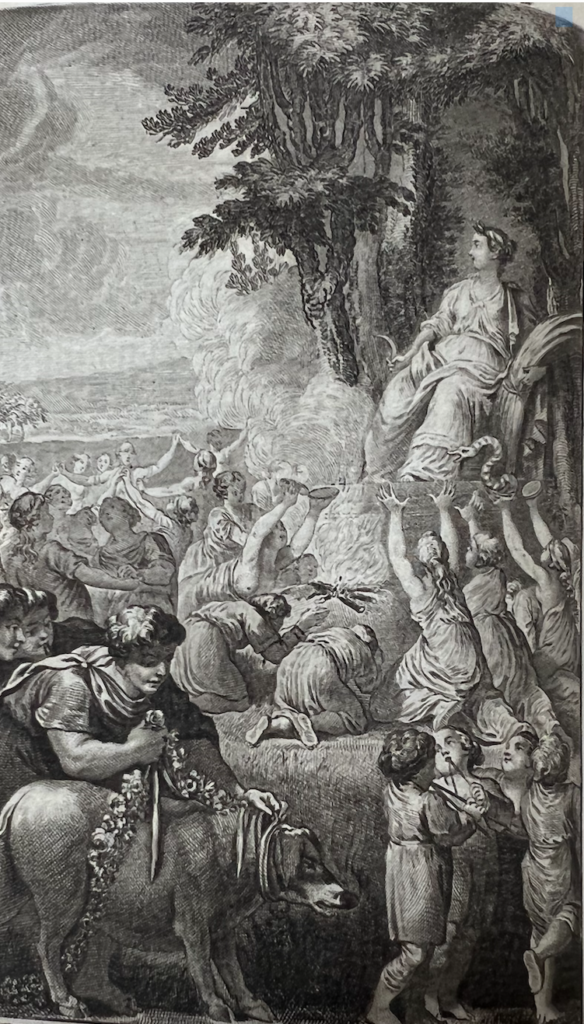
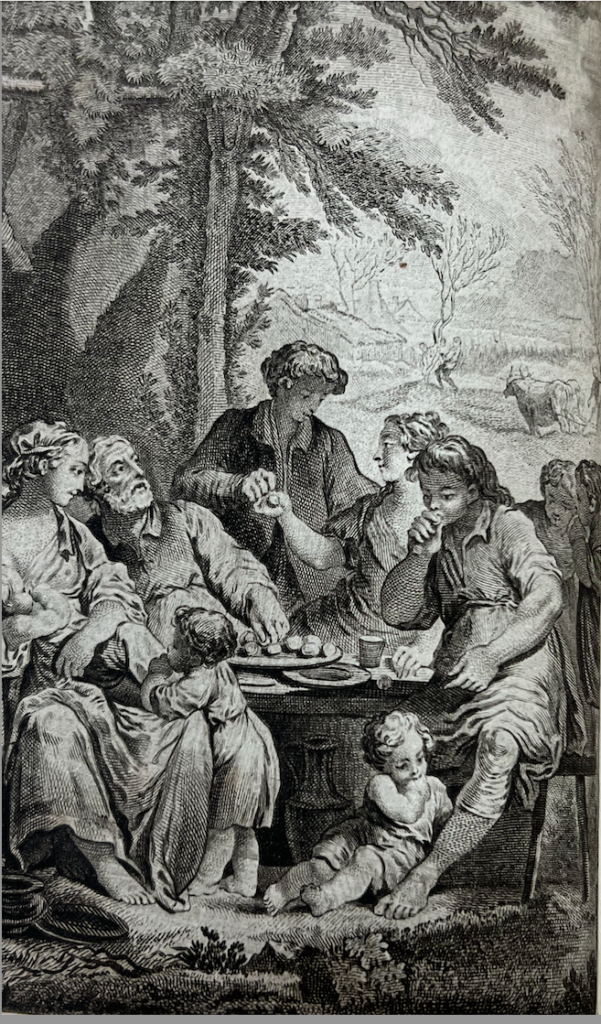
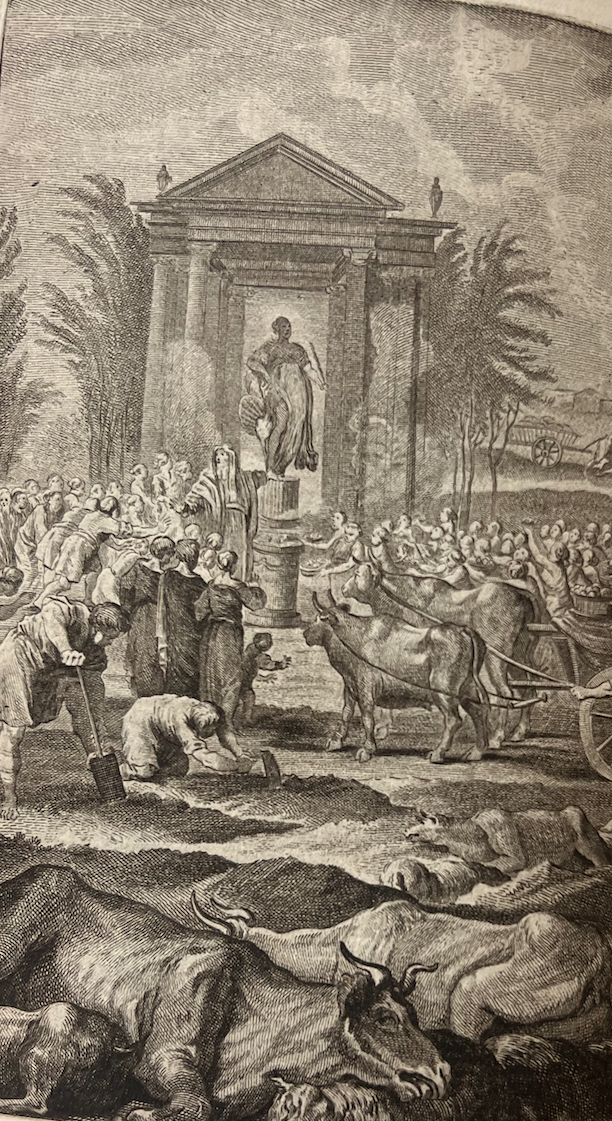
Book Significance
This book is significant both in its content as well as its translation into French.
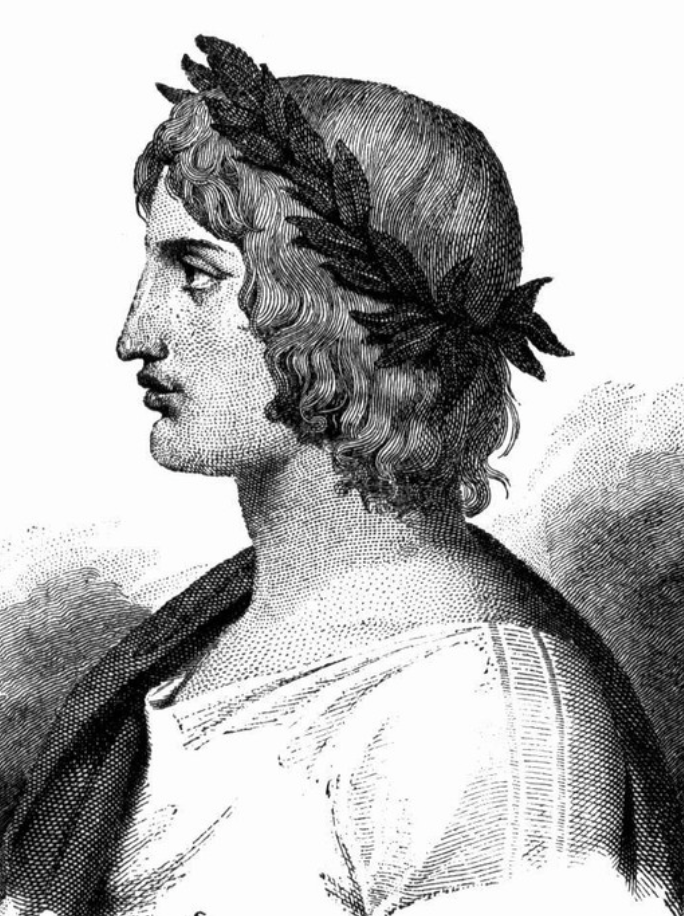
Published in 29 BCE and written in a hexametric format, the Georgics roughly translates to “Agricultural things.” However, there is much more to the Georgics than commentary about farming and agricultural lifestyle. Born around 70 BCE, Virgil grew up in a turbulent time in which Rome was engaged in constant civil war and revolts including the assassination of Julius Caesar. With this context in mind, the Georgics read as more than just an explanation of nature’s will and animal husbandry. Instead, the Georgics take the form of a subtle commentary about the ideal organization of society, heavily influenced by Augustinian thought. The first book of the Georgics begins with a dedication to Gaius Maecenas and talks about how individual labor contributes to the success of mankind. Intertwined with Greek mythology and ending with the pro-Augustine message, the first book of four sets a clearly political tone. Book two then uses nature as an analogy to the political state of Rome, using violent terminology to describe farmers’ battle against nature to raise crops. Book three discusses the raising and protection of livestock while paying tribute to the late Julius Caesar and Virgil’s mentor Maecenas. Book four is the most politically explicit as Virgil talks about how a perfect society can be modeled off of bees. Discussing how many worker bees can serve under a single monarch queen bee, Virgil alludes to how Augustine can reunite Rome under a single ruler and bring peace to the politically turbulent empire. Virgil’s support of Augustine makes sense when considering his close friendship with Maecenas, an association and supporter of Emperor Augustine.
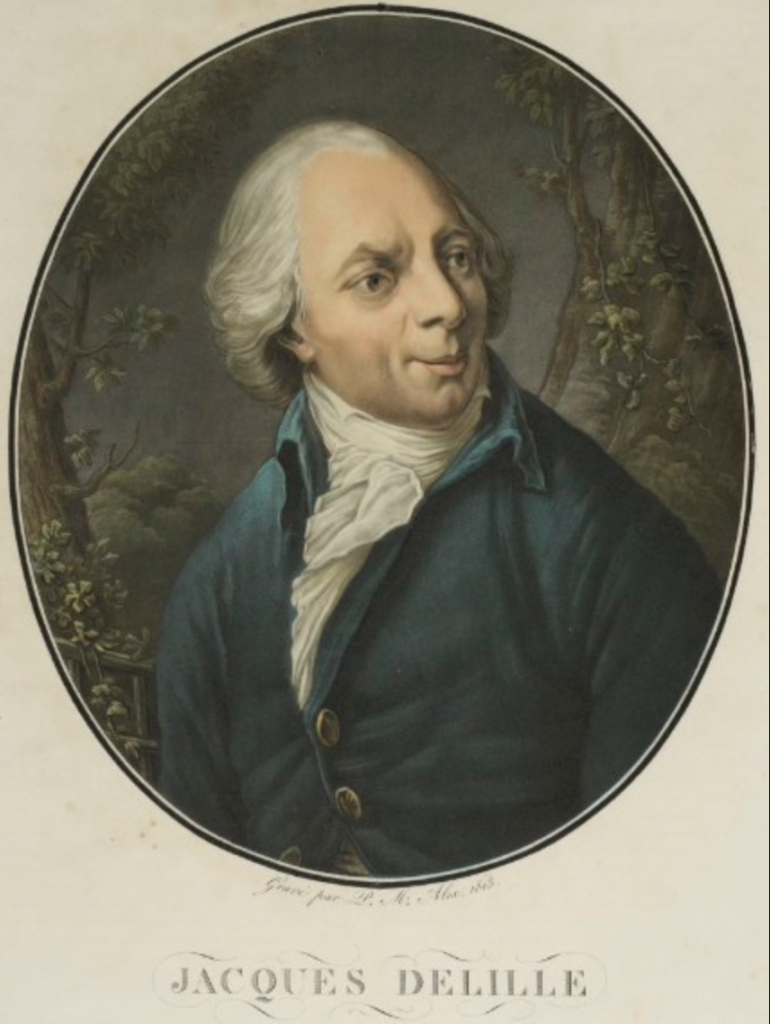
In addition to the contents of the book, the act of translating the Georgics to French was a historical feat in itself. Living as an elementary school teacher of illegitimate origins, Jacques Delille was only known for his amateur poetry. However, his translation of the Georgiques in 1769 would launch him into national popularity. Shortly after the publication of the translated Georgiques, Voltaire would nominate Delille for membership in the Academie Francaise. However, Delille would not be granted membership until 1774 as the king believed he was too young. Inspired by the works of Virgil, Delille would continue to publish his own poetry about nature and rural lifestyles. Delille was unique in his rejection of the traditional French style of poetry, instead favoring the English cadence. Delille would unexpectedly echo Virgil’s own life experience as the French revolution took hold of the country in 1789. Having pledged himself to the revolutionaries’ cause, Delille would narrowly escape the guillotine and would instead move to Switzerland for a number of years before finally returning to France.
Provenance
Creation
This book was first created by the hands of the printing press of the Literary Society- typographical. Located in France.
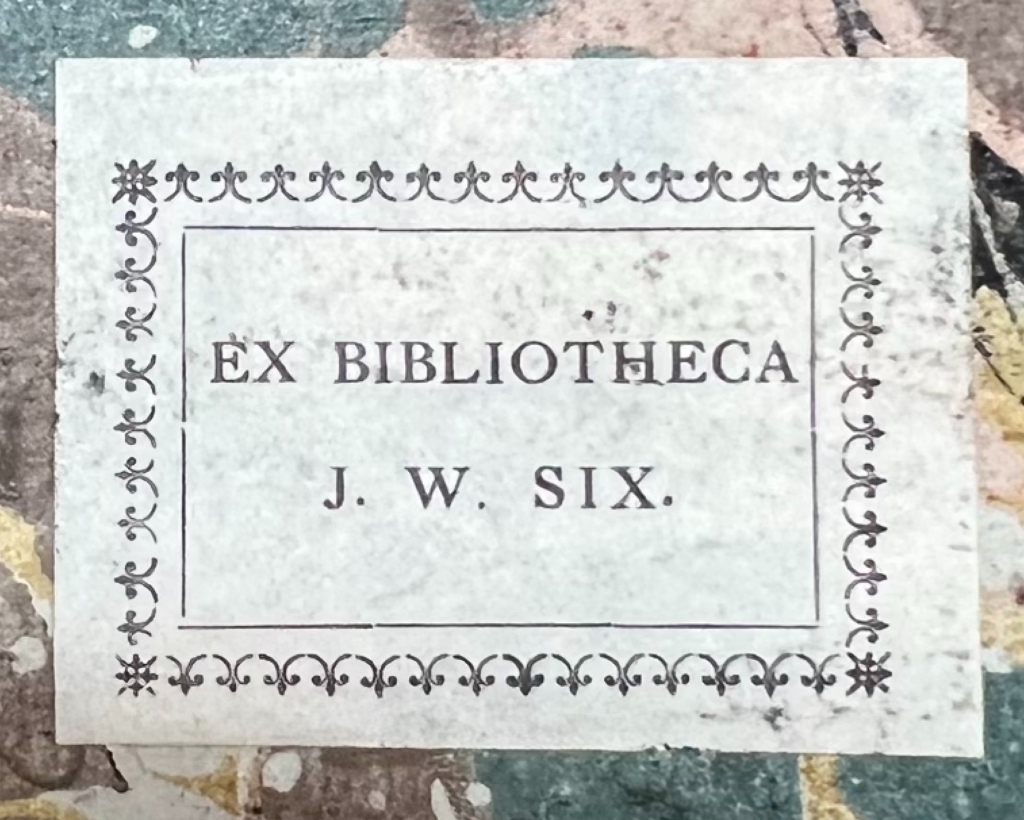
A bookplate Six van Vromade would place into his copy of the Georgiques.
The Six Family
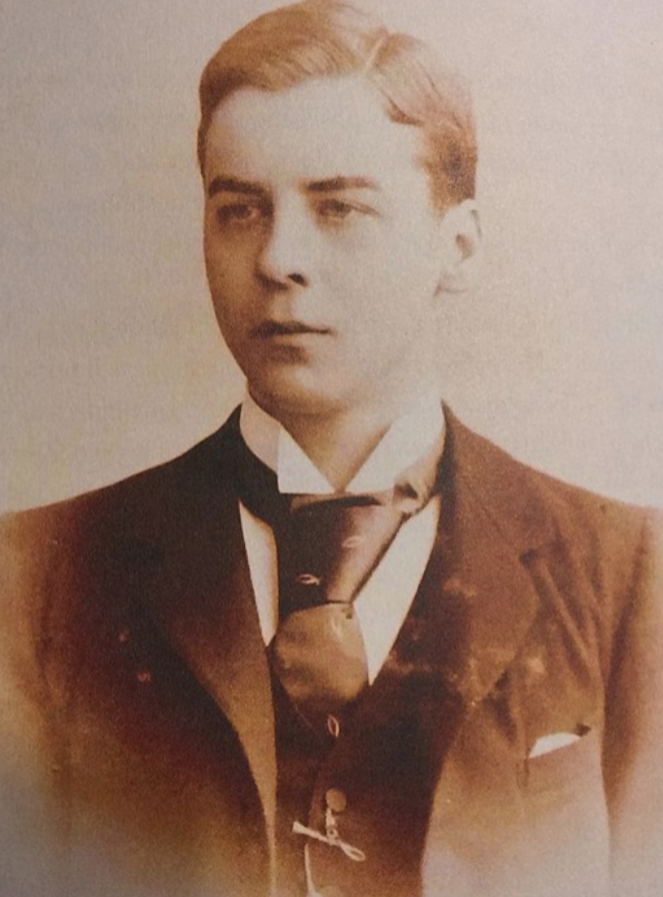
The book would eventually fall in to the hands of Jan Willem Six Van Vromade (1874-1936). After the death of his parents, Six Van Vromade inherited not only their vast estate but also their expansive library in the Netherlands. The library featured many works including Les Georgiques de Virgil and possibly even some books from his ancestors Nicolass Simon Van Winter and his wife the poet Lucretia Wilhelmina Van Merken.
Six de Vromade was a Technologist, an expert in chemistry, and would go on to be appointed as a member of the library committee of the Nederlandsche Chemische Vereeniging. After marrying his wife, Frieda Kouise Henriette Metzner in 1916, and having a daughter, Six de Vromade would begin to live abroad and began to sell off his parents estate via three auctions in 1925, 1926, and 1930.
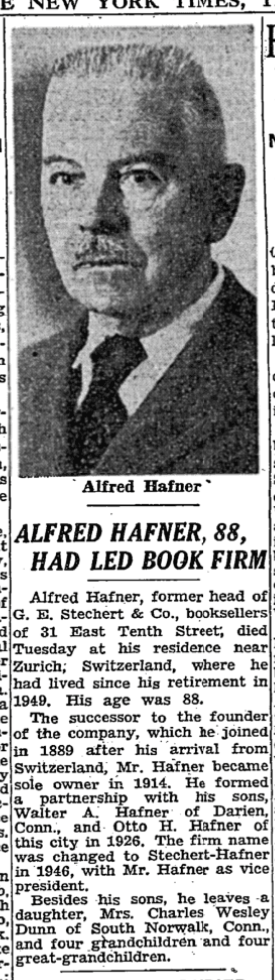
Alfred Hefner
It was likely during on of these auctions that bookseller Alfred Hefner would come into possession of Les Georgiques de Virgil. Owning G.E. Stechert & Co, Alfred would travel between the United States and Europe to buy and sell books. Not much is known about Alfred Hefner, however a copy of his obituary in the New York Times on April 15 1945 was published online. Reading:
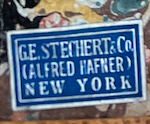
“Alfred Hafner, Former head of G.E. Stechert & Co., booksellers of 31 East Tenth Street; died Tuesday at his residence near Zurich; Switzerland, where he has lived since his retirement in 1949. His Age was 88.
The successor to the founder of the company, which he joined in 1889 after the arrival from Switzerland, Mr. Hafner became sole owner in 1914. He formed a partnership with his sons, Walter A. Hafner of Darien, Conn., and Otto H. Hafner of this city in 1926. The firm name was changed to Stechert-Hafner in 1946, with Mr. Hafner as vice president.
Besides his sons, he leaves a daughter, Mrs. Charles Wesley Dunn of South Norwalk, Conn., and four grandchildren, and four great-grandchildren.”
Michigan State College of Agriculture and Applied Sciences
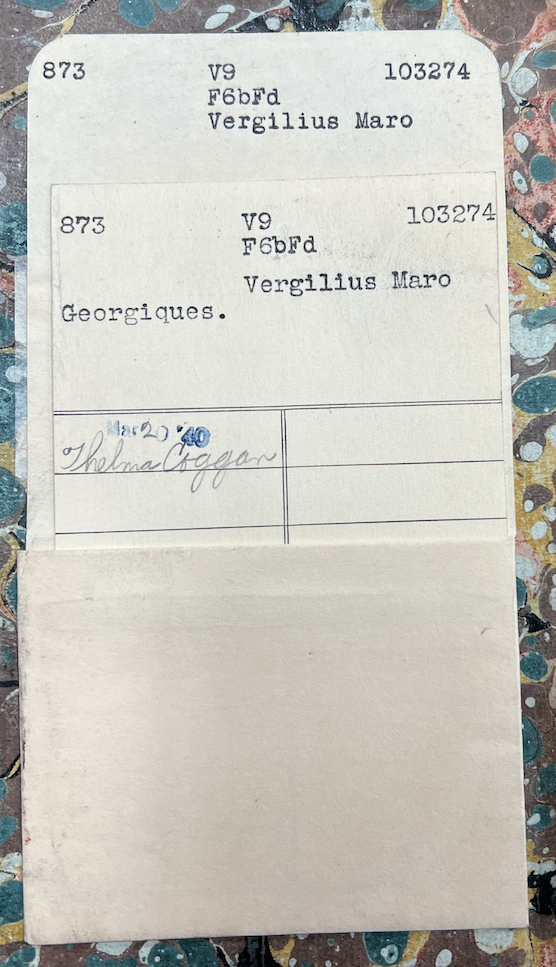
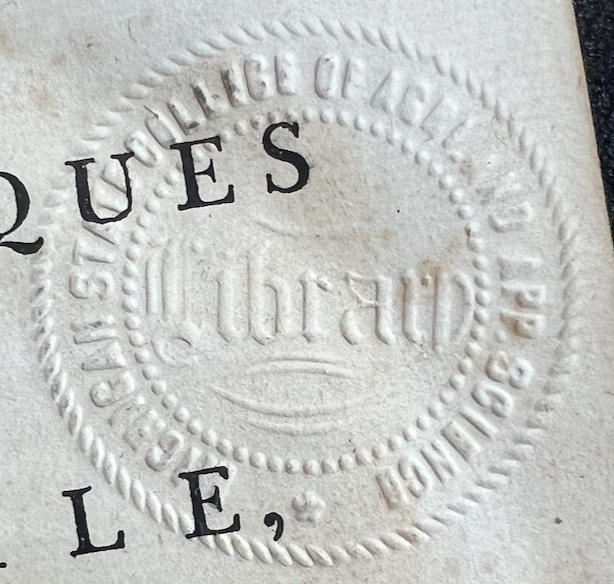
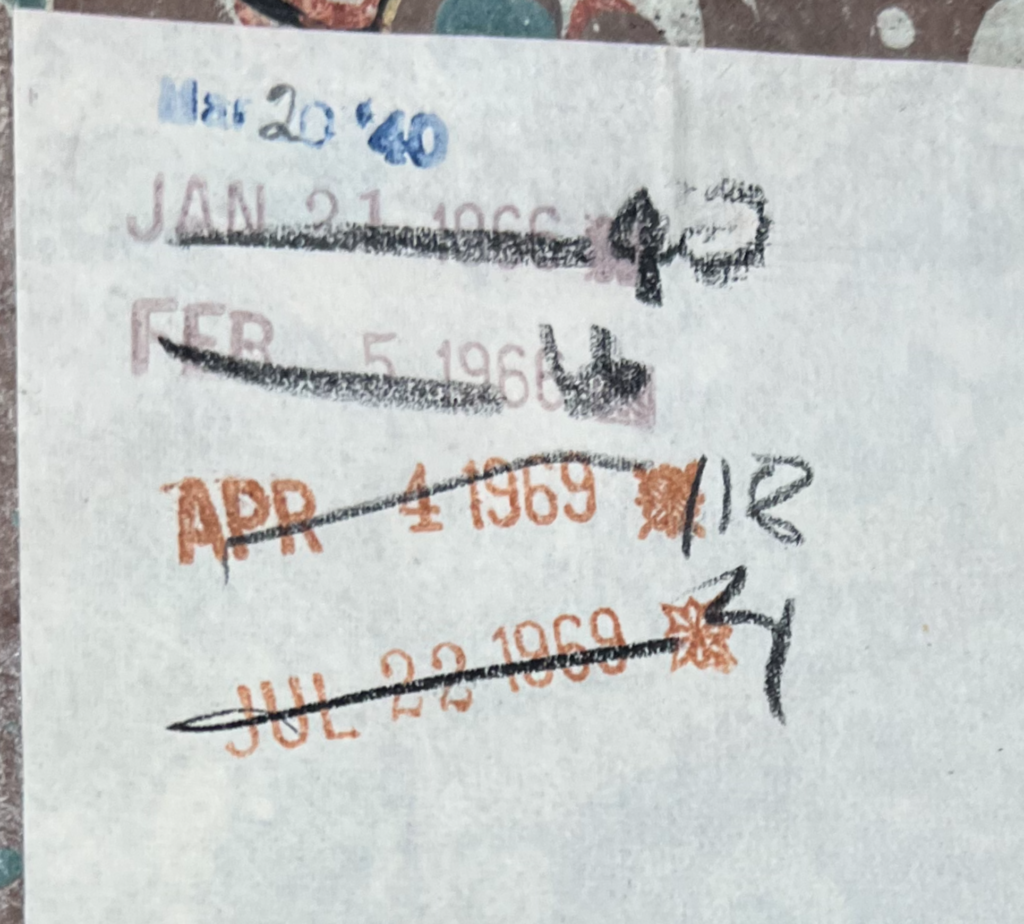
Although there is no record of the transaction, Michigan State University most likely bought Les Géorgiques from Alfred Hefner or a close associate sometime between 1925 and 1940. As the stamp on the title page reads as an abbreviation for Michigan State college of Agriculture and Applied Sciences, we can restrict the timeline to between 1925 and 1955 when Michigan State had that name. The possible year of purchase can also be narrowed in upon by looking at the inside of the back cover in which a library slip for MSU can be found. The book was by a student named Thelma Coggan on March 20th 1940. A record of Thelma Coggan appears in the 1939-1940 Michigan State College handbook listing her as the president of the Pan-Hellenic Council. Additional indication of when the book had been checked out can be seen on the Verso side of the final leaf. The dates listed in order are;
- March 20th 1940 (by Thelma Coggan)
- January 21st 1966
- April 4th 1969
- July 22 1969
Unidentified Marginalia
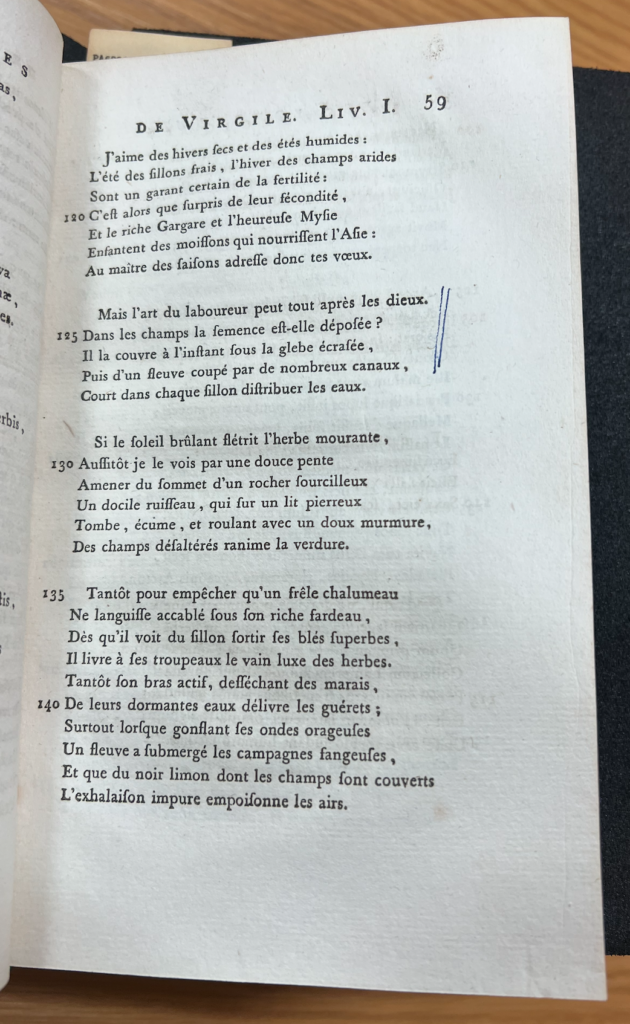
Two parallel lines made in blue ink on page 59.
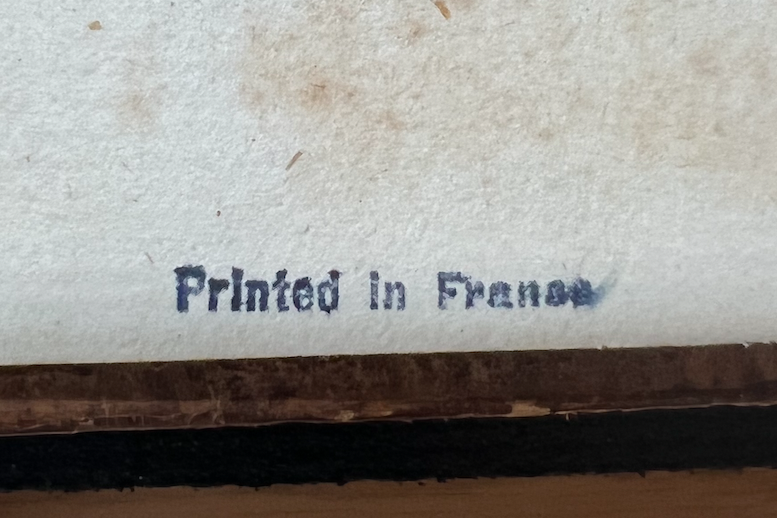
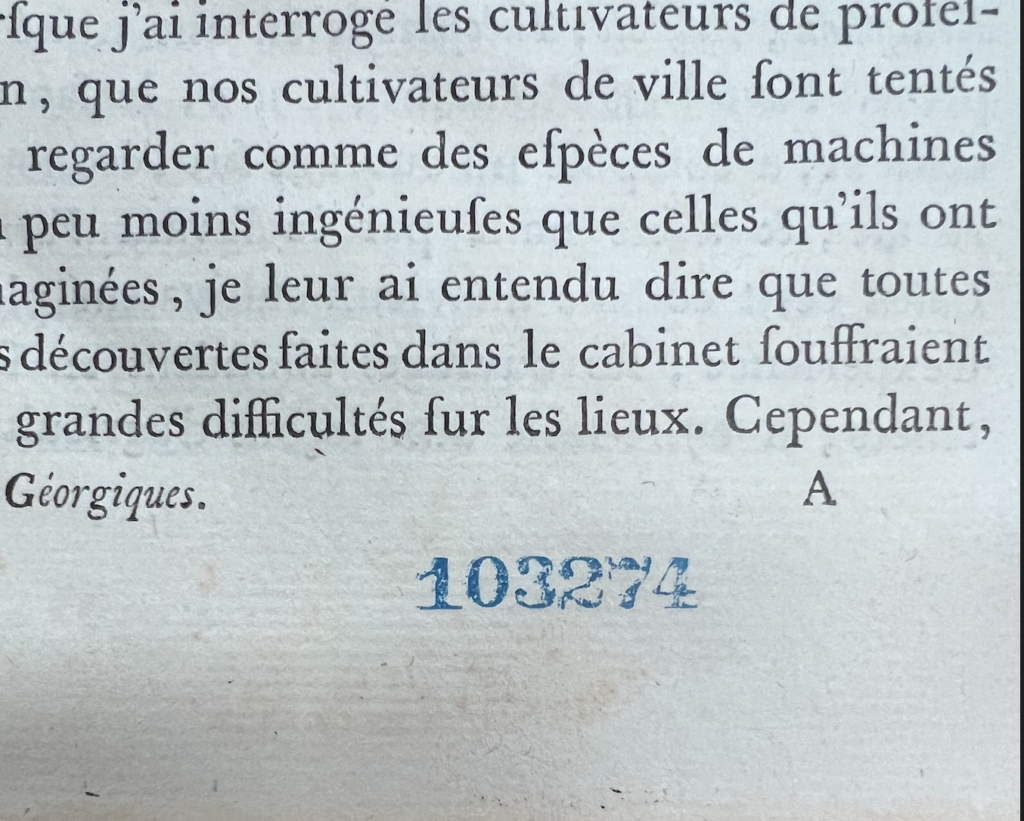
The book also features two blue stamps. One on the verso side of the first leaf reading “Printed in France.” The other stamp features the numbers 103274 and was likely the books identification number at some point.
Bibliography
“Alfred Hafner, 88, Had Led Book Firm.” The New York Times, The New York Times, 15 Apr. 1954, www.nytimes.com/1954/04/15/archives/alfred-hafner-88-had-led-book-firm.html.
“Jacques Delille.” Wikipedia, Wikimedia Foundation, 22 July 2023, fr.wikipedia.org/wiki/Jacques_Delille.
“Jan Willem Six Van Vromade.” Wikipedia, Wikimedia Foundation, 21 Apr. 2022, nl.wikipedia.org/wiki/Jan_Willem_Six_van_Vromade.
Limited, Alamy. “Joseph de Longueil, Frontispiece from ‘Virgil’, Joseph de Longueil (French, Givet, Ardennes 1730–1792 Paris), after Francesco Casanova (Italian, London 1727–1803 Brühl), 1770, Etching; Second State of Three, Sheet (Trimmed): 5 15/16 × 3 9/16 in. (15.1 × 9.1 Cm), Prints Stock Photo.” Alamy, www.alamy.com/joseph-de-longueil-frontispiece-from-virgil-joseph-de-longueil-french-givet-ardennes-17301792-paris-after-francesco-casanova-italian-london-17271803-brhl-1770-etching-second-state-of-three-sheet-trimmed-5-1516-3-916-in-151-91-cm-prints-image344622812.html?imageid=2FC391CC-ED59-45AD-95B4-871280D20C6D&p=546931&pn=2&searchId=d1252d7f36a3b17b7d4a57d3c27921a5&searchtype=0. Accessed 16 Nov. 2023.
Michigan State College. Student Handbook, projects.kora.matrix.msu.edu/files/162-565-2171/S53_1939_1940.pdf.
“M. l’Abbe Delille de l’academie Francaise [Picture].” Trove, nla.gov.au/nla.obj-136066920/view. Accessed 16 Nov. 2023. “Société Littéraire Typographique. Kehl, Allemagne (1780 – 1790) – Organisation – Ressources de La Bibliothèque Nationale de France.” Data.Bnf.Fr, data.bnf.fr/fr/17801420/societe_litteraire_typographique_kehl__allemagne/. Accessed 16 Nov. 2023.
Created by Isabelle Fanning in Fall 2023 for Dr.Brockey’s HST 475 class at MSU.
