
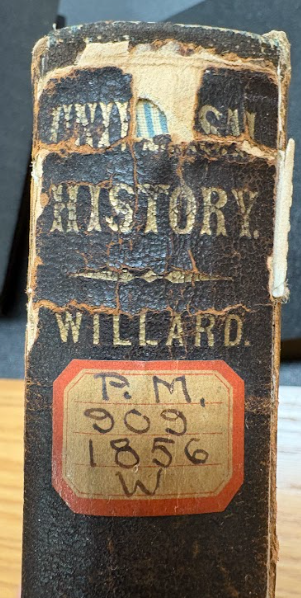
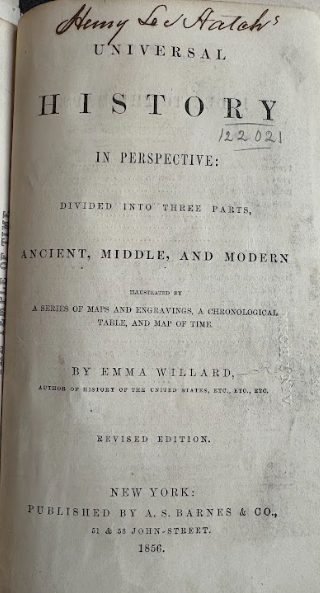
Author: Emma Willard
Full Title: Universal history in perspective : divided into three parts, ancient, middle, and modern : illustrated by a series of maps and engravings, a chronological table, and map of time
Publication: Revised edition published by A.S. Barnes & CO., in New York City, 1856
MSU Library Call Number: D21 .W685 1856
About the Book:
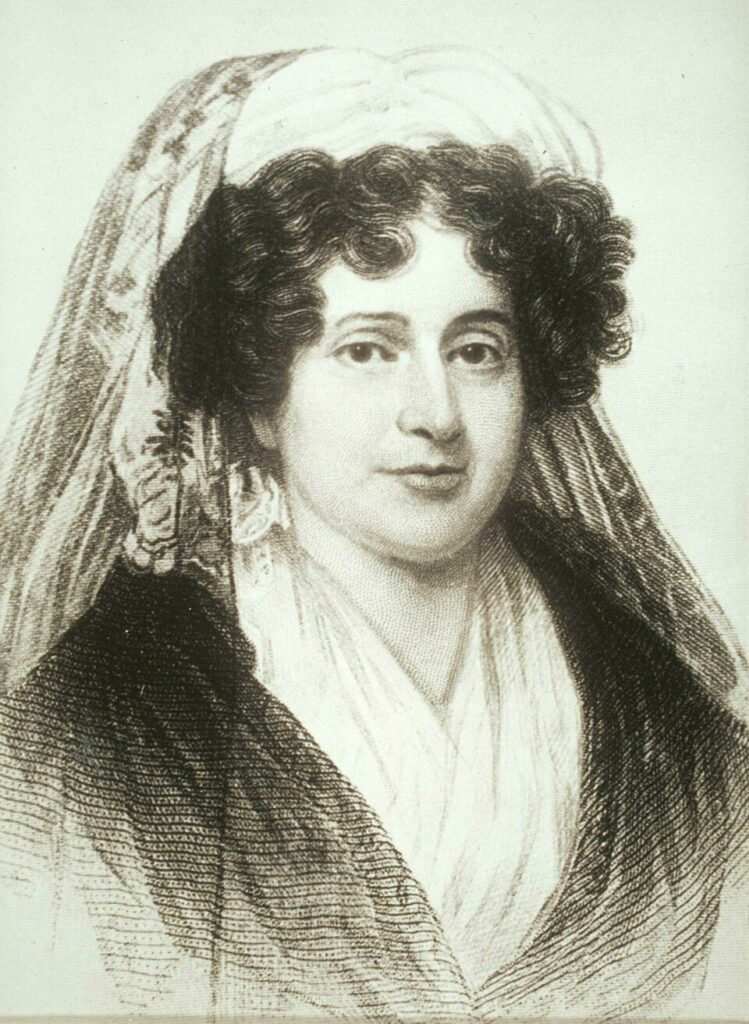
Author: Emma Willard (1787-1870) was an American author and female education advocate. Throughout the early 19th century she taught at several women’s schools, promoting female education and literacy. She eventually founded the Troy Female Seminary in 1821 in Troy, New York. This was the first school in the United States to offer higher education to women. Willard was also known for authoring several history and geography textbooks that were used in schools and universities during the 19th century. In fact, when this edition was printed and published in 1856, a copy was sent directly to the Agricultural College of the State of Michigan in 1858.
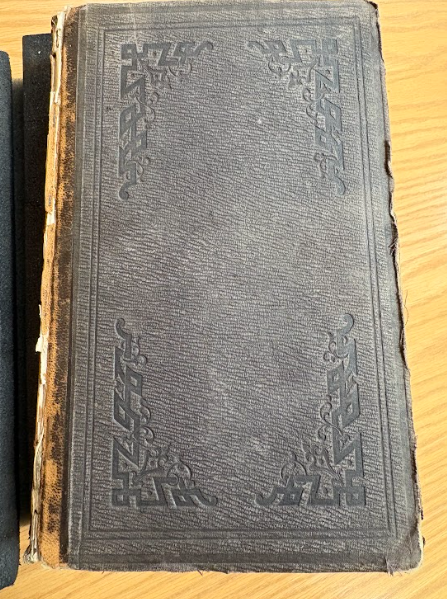
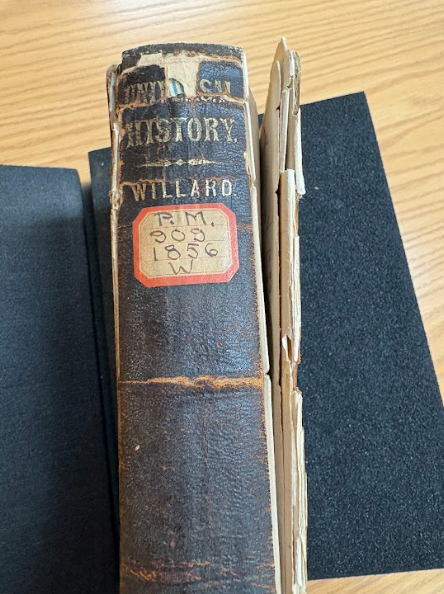
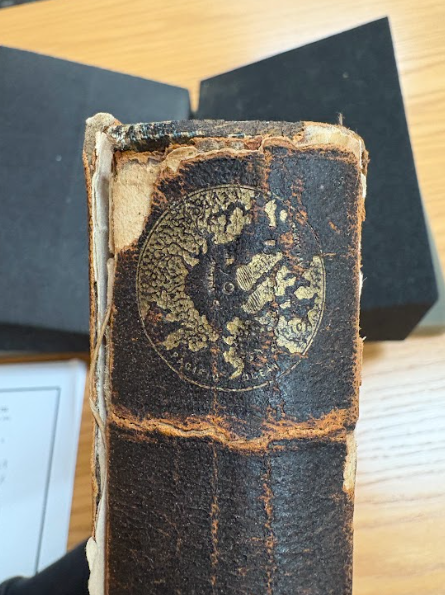
Physical Condition: While the book was obtained by MSU through a conservation funds grant, it is currently in very poor condition. The upper board and first two leaves are completely detached from the rest of the spine. The contemporary quarter calf leather spine and publisher’s stamped brown cloth over the boards also show significant damage and deterioration. The spine contains a gilded title and stamp of the Arctic Circle, along with a call number label. The marbled edges are barely visible.
Contents: The book was written as a textbook and contains many tools for students like timelines, maps, illustrations, and a civilization flow chart, that has been ripped out of this copy. It is divided into three parts ranging from 4004 B.C. to 1856 A.D., and follows Biblical stories up to contemporary events. This revised edition was published to include updated information about the Crimean War and other historical events from the mid 1850s.
Provenance:
Henry Lee Hatch

Henry Lee Hatch is the name featured most frequently throughout this book, often followed with a location of Keokuk, Iowa. Henry wrote his name on the title page, in margins, and in the end leaves of the book. Henry most likely used this book as a school textbook, as it features several sections of notes.
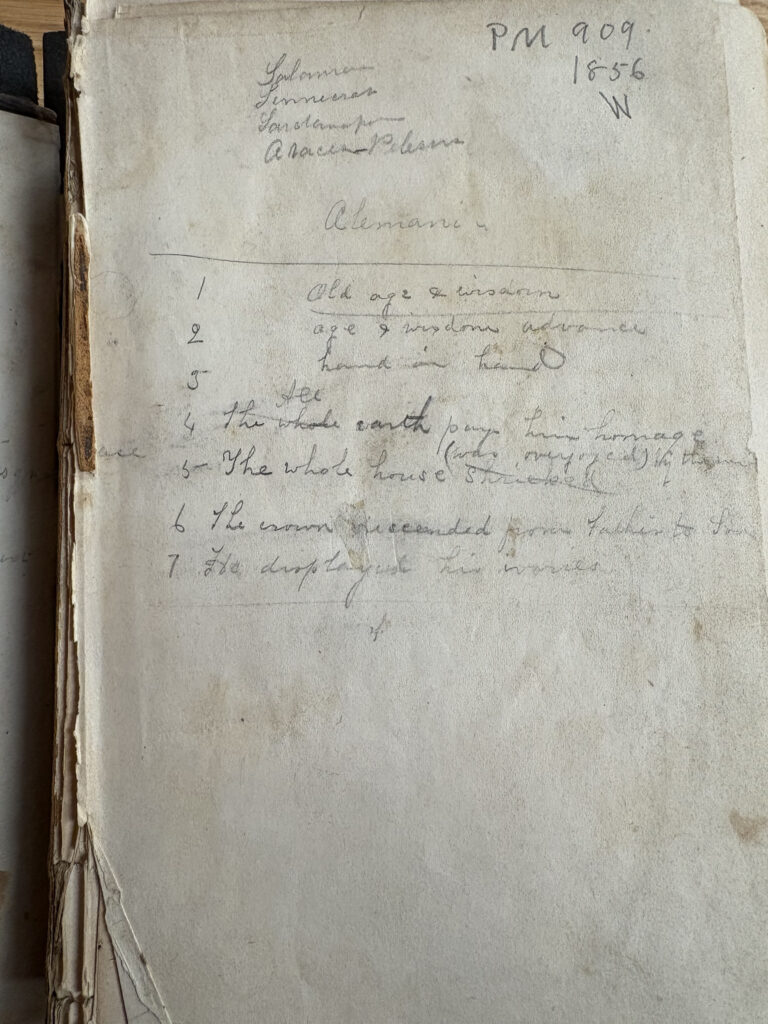
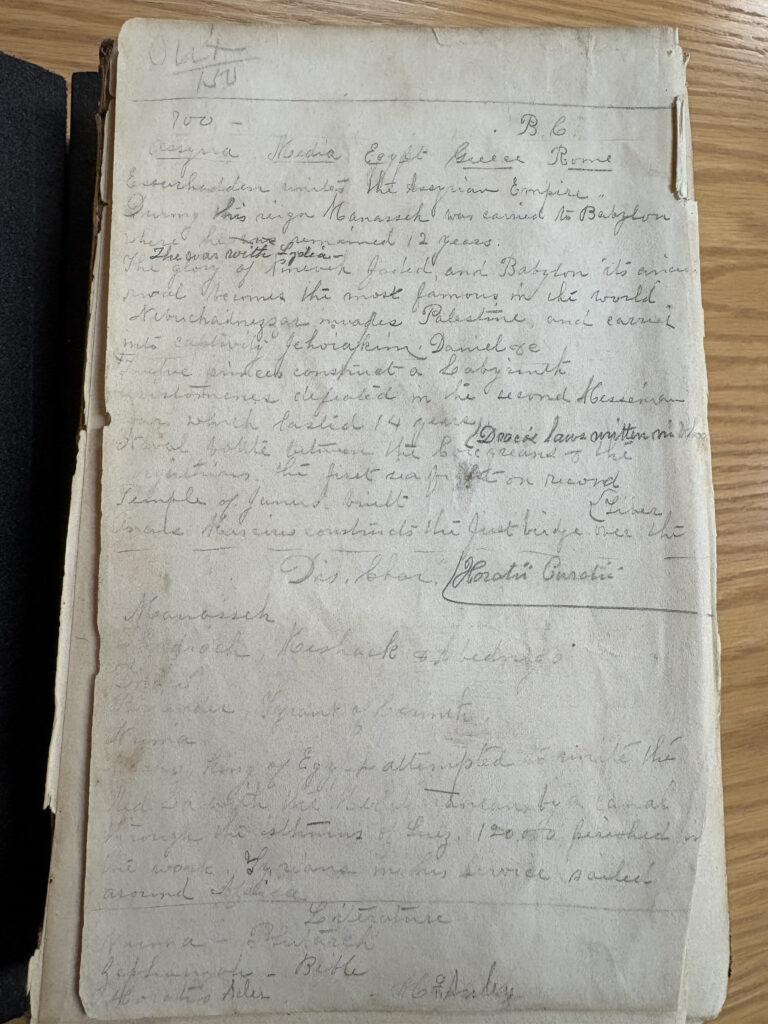
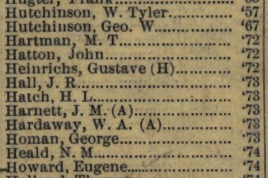
Henry Lee Hatch was born on February 4th, 1844 in Harrodsburg, Kentucky. His father was a wealthy, educated man from New Hampshire, who moved west with his brothers to work as a druggist and banker. Census records indicate Henry moved to Keokuk with his family around 1855 when he was 11, and lived there until he was 16 in 1860. Henry attended the Keokuk Classical School, which was a private institution that opened in 1858 and operated out of various buildings in Keokuk. Newspaper records show that he was apart of the first class, where he could have used this book. The written notes indicate the Henry was studying Christian biblical history, suggesting a religious connection to education. Interestingly, Mark Twain lived in Keokuk in 1856 and 1857, and returned often to visit his mother. He worked in his brother’s print shop and printed the town’s first directory in 1856, however the Hatch family is not listed.
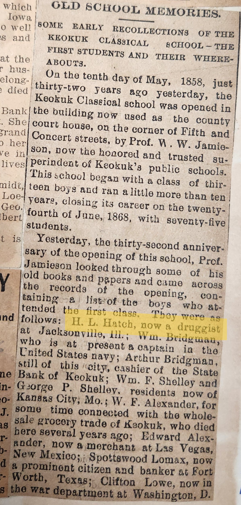
The outbreak of the Civil War in 1861 would have also had an impact on Henry’s education. There are no records of Henry enlisting, however many schools were shut down due to the war and conflict in the region. As a result, Henry did not attend medical school at Missouri Medical College in St. Louis until he was 27 in 1871. He graduated in 1873, and practiced in Jacksonville, Illinois where his entire family had moved sometime around 1861. He lived there with his family until his death in 1899. In his will, he states that any property of his estate, including books, would go to his wife and two daughters after his death. This suggests the book could have been sold as apart of the estate after the death of Henry and his wife.
Another note is written about smoking and the smell of cigars. The note features names of possible classmates or friends of Henry. The town of Jacksonville, Illinois, where Henry moved around 1861, was know for a growing cigar manufacturing industry throughout the late 19th and early 20th century. The town had 13 cigar factories by 1905 that produced nearly 200 thousand cigars per week. While cigar smoking was common during this time period, this note could suggest the book moved with Henry beyond Keokuk when his family moved to Jacksonville. The note also suggests the book would have been shared with others.
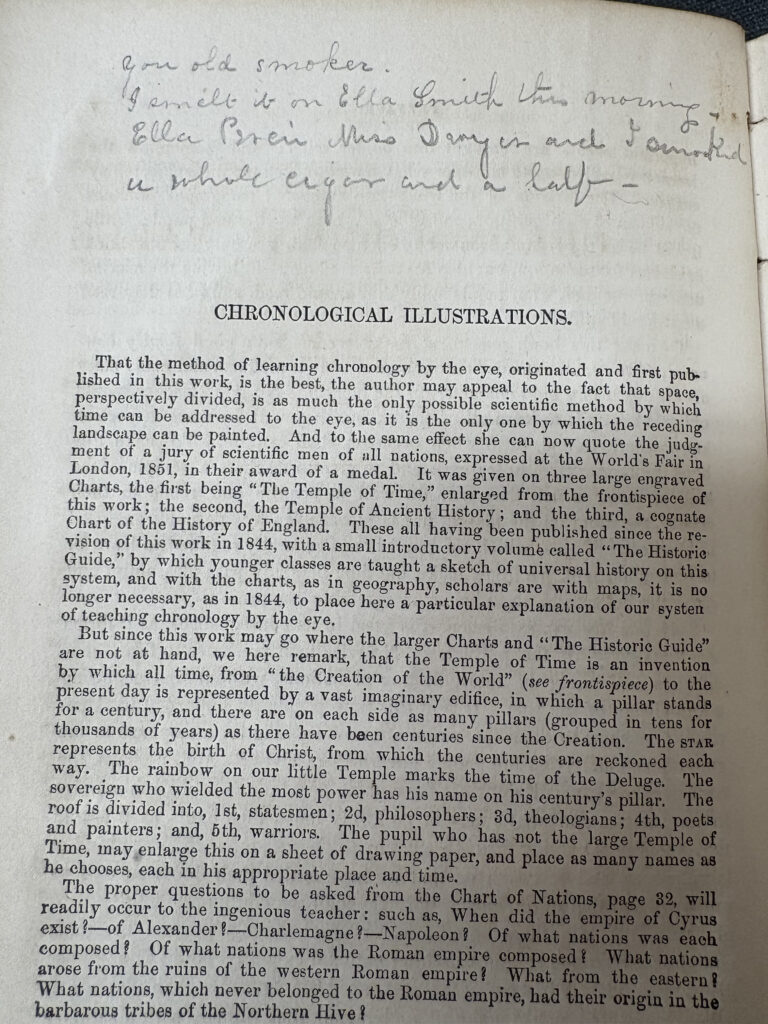
I smelt it on Ella Smith this morning
Ella Brein Miss Danyer and I smoked
a whole cigar and a half”
Thomas Lee Hatch
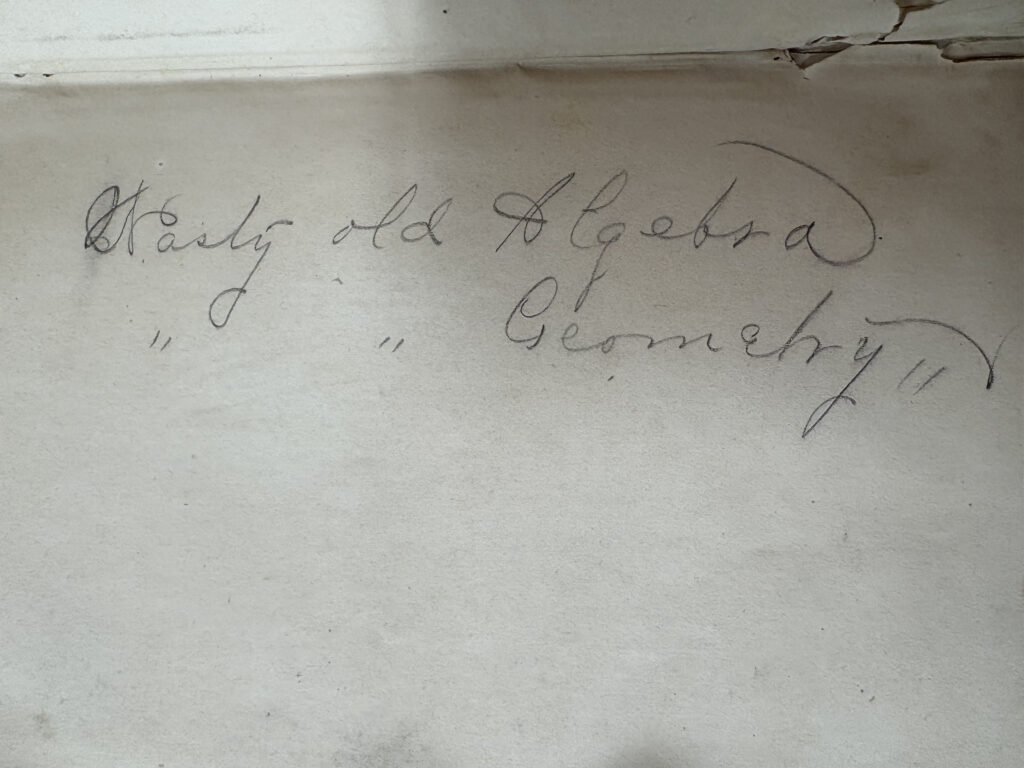
Thomas Lee Hatch, Henry’s long lost twin brother? Maybe not. Another name written on the blank leaf is Thomas Lee Hatch. The name is written twice in stylized script, also featuring the location Keokuk, Iowa. The name is accompanied by initials written “THL”.
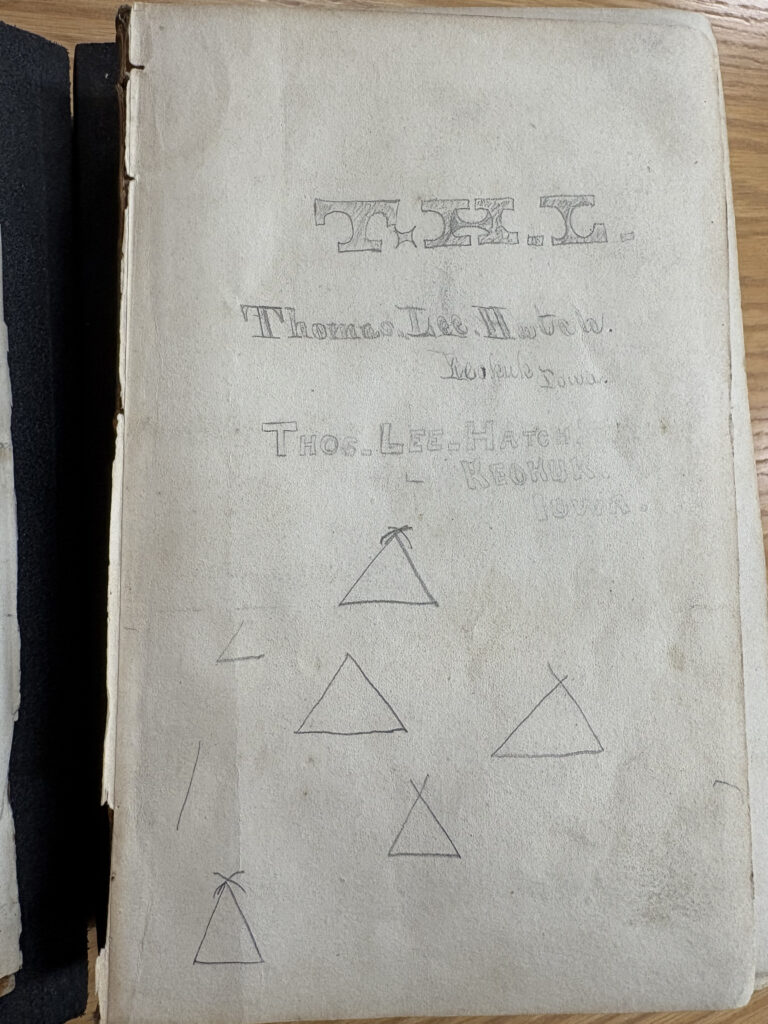
However, there are no genealogical records of a Thomas Lee Hatch that lived in Keokuk, nor did Henry Lee Hatch have any siblings, cousins, uncles, or grandparents named Thomas. It is possible Henry used an additional first name, with the initials representing “Thomas Henry Lee”, or it could be the first name of a classmate. Overall the stylized writing, arranged initials, doodles, and lack of records for Thomas Lee Hatch, suggest this is informal writing rather than proof of another owner.
George Hempl
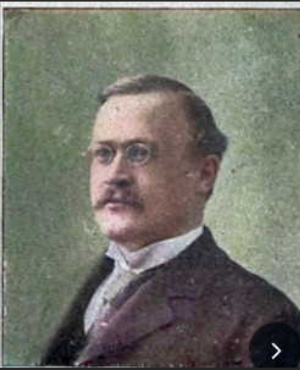
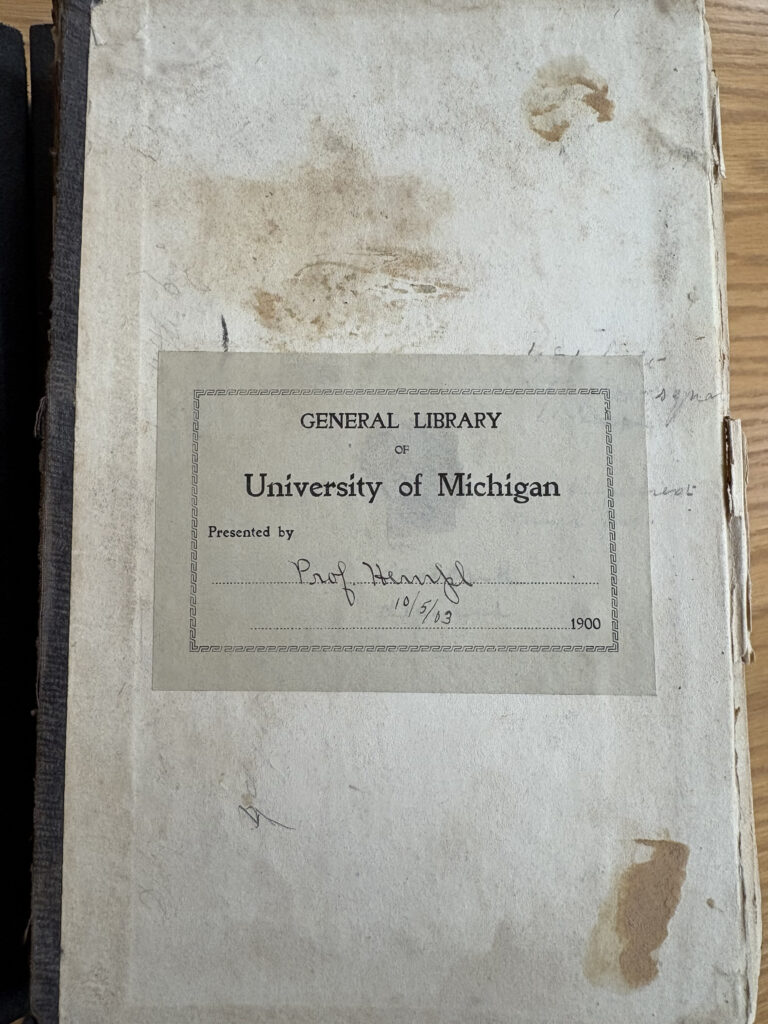
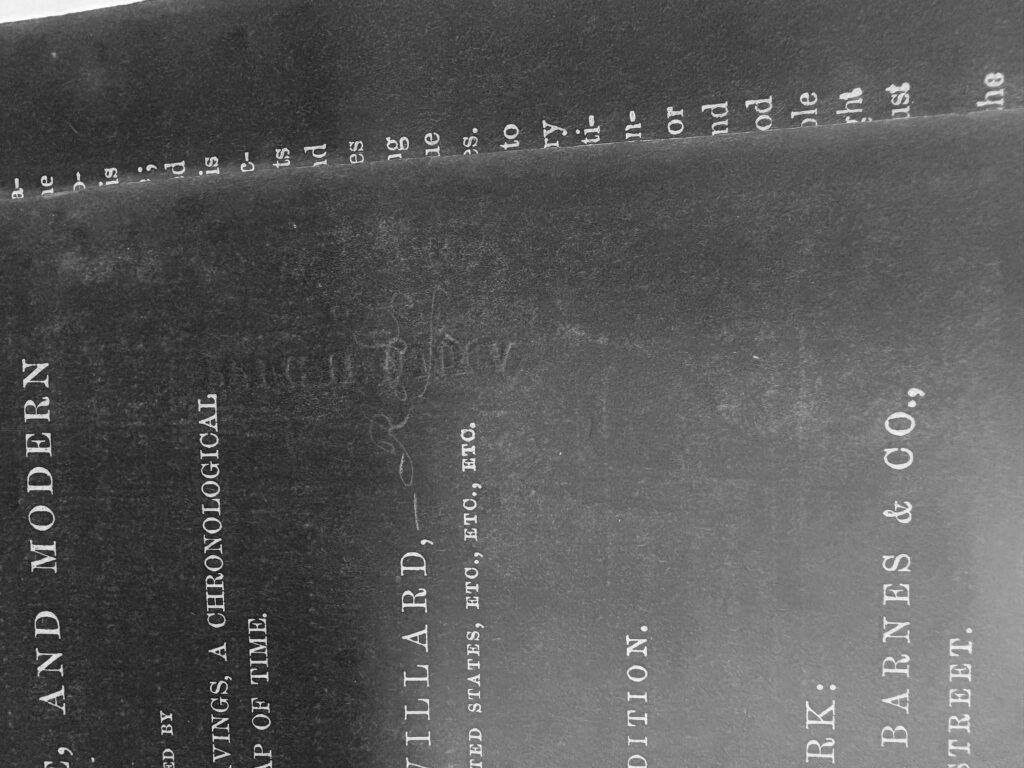
The next record of the book is in the possession of Professor George Hempl at the University of Michigan. A pastedown on the front board indicates the book was donated to the University library by professor Hempl on October 5th, 1903. Hempl worked as a principal at Saginaw High School in Michigan and at La Porte High School in Indiana from 1879 to 1884. He studied in Germany for three years and taught at Johns Hopkins for two years, before becoming a professor of English philology and general linguisitics at the University of Michigan in 1889. This suggests Hempl had connections in educational spheres to possibly obtain the book. A university Board of Regents meeting report from 1904 mentions Professor Hempl’s frequent and usual donations, suggesting he sought out books for the library. The book also features an embossed University of Michigan stamp suggesting library circulation.
Michigan State University
The book came into MSU’s possession through the Save America’s Treasures grant, 2005-2008. The grant provided the university with funds to purchase historic American textbooks with the purpose of conservation.

Half Dime Stamp
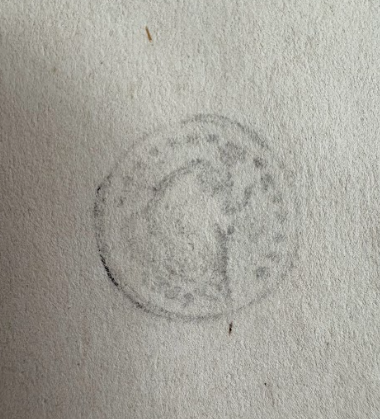
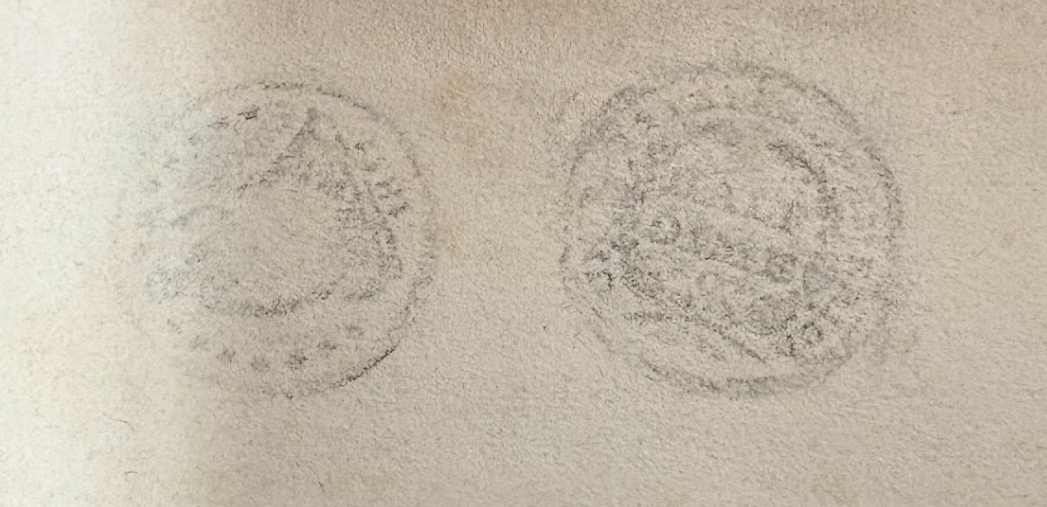
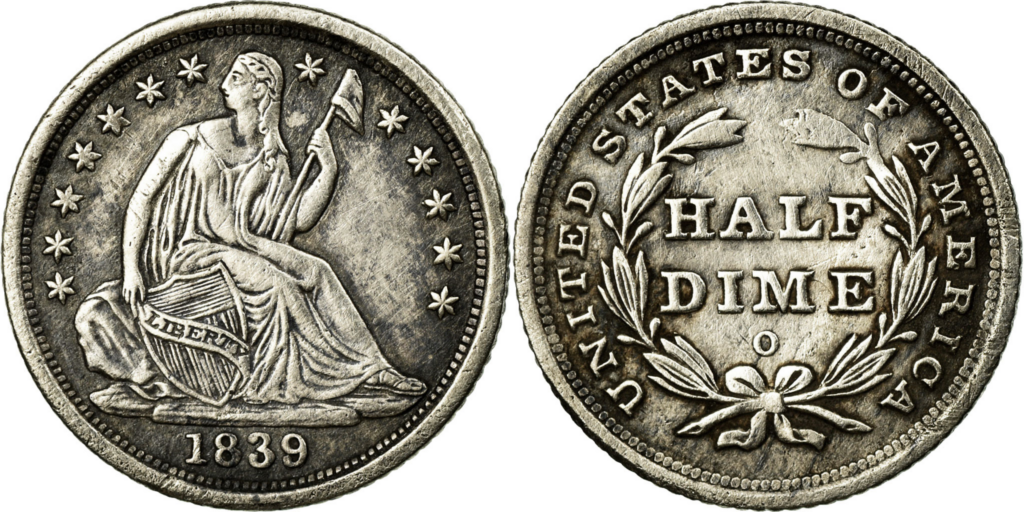
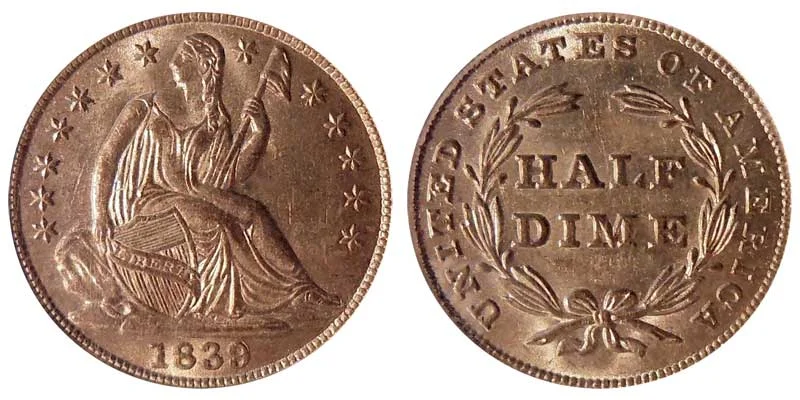
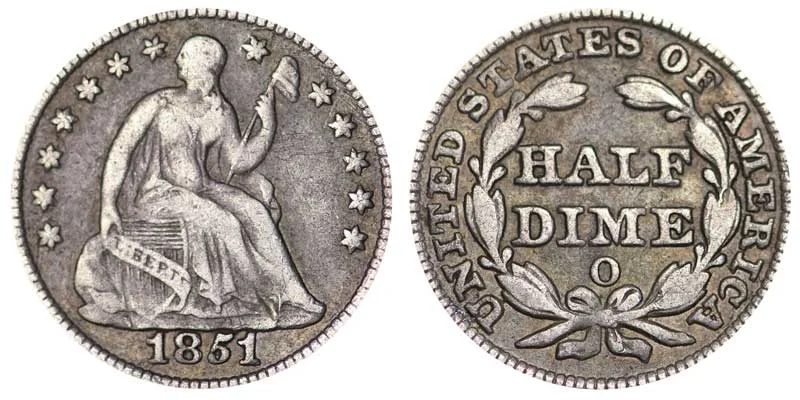
The book features a half dime stamp on the end leaves and end board. The stamp shows both sides of the “Seated Liberty” half dime which began production in 1837 and circulated until it was replaced by the nickel in 1873. The half dime used to make the stamp appears to be from 1839 or 1851 and produced at the New Orleans mint, which produced half dimes from 1838 until 1861. This places the production of the coin from seventeen to five years before the publishing of the book, suggesting the coin had time to circulate before it was used to stamp the book. The New Orleans mint variant could suggest the coin circulated within in the South or up along the Mississippi river, with the eventual connection to Henry Lee Hatch in Kentucky or Keokuk. The half dime stamps alone give no indication of an owner or a bookseller, but it does suggest the book could have been sold at some point. However, $0.05 would have been relatively cheap for a textbook in the mid 19th century which could suggest informal use of the coin as a stamp.
References
- https://www.ancestrylibrary.com/family-tree/person/tree/46096338/person/6518557915/facts?usePUBJs=true&_gl=1*mwkqqq*_up*MQ..*_ga*MTEyNDQ0OTE5NC4xNzc0Mzg0NjI3*_ga_4QT8FMEX30*c2RhOGE5MDc0LTNiOWItNGQ0OC1iMjAxLTExYzMxZTdmODk1OCRvMSRnMSR0MTc3NDM4NDc2MiRqMzAkbDAkaDA.*_ga_LMK6K2LSJH*c2RhOGE5MDc0LTNiOWItNGQ0OC1iMjAxLTExYzMxZTdmODk1OCRvMSRnMCR0MTc3NDM4NDYyNiRqNjAkbDAkaDA.
- https://becker.wustl.edu/static-files/arb/004-RG01H-MMC/RG01H-S01-B01-F27.pdf
- https://beckerexhibits.wustl.edu/legacy-exhibits/wusm-hist/roots/index.htm
- https://bullionexchanges.com/coin-info/seated-liberty-half-dime?srsltid=AfmBOopQTiopB1B2hC-zxJSe6UJ222j-ZKjUyJ0fsCPnomqgzaOPLmrf
- https://www.ancestrylibrary.com/imageviewer/collections/2469/images/41199_2221301230_7533-00723?pId=1439874100
- https://www.ancestrylibrary.com/family-tree/person/tree/5816601/person/272456893102/facts?usePUBJs=true&_gl=1*nz4cnw*_up*MQ..*_ga*Mjk3OTMwMDIuMTc3NDQ3OTY4Mg..*_ga_4QT8FMEX30*c2RhOGE5MDc0LTNiOWItNGQ0OC1iMjAxLTExYzMxZTdmODk1OCRvMSRnMCR0MTc3NDQ3OTY4MSRqNjAkbDAkaDA.*_ga_LMK6K2LSJH*c2RhOGE5MDc0LTNiOWItNGQ0OC1iMjAxLTExYzMxZTdmODk1OCRvMSRnMCR0MTc3NDQ3OTY4MSRqNjAkbDAkaDA
- https://www.jstor.org/stable/433495?seq=1
- https://findingaids.lib.umich.edu/catalog/umich-bhl-752
- https://www.loc.gov/collections/chronicling-america/?dl=page&fa=number_page:0000000001%7Cnumber_lccn:sn83025182&sb=date&sp=3&st=gallery
- https://quod.lib.umich.edu/u/umregproc/acw7513.1901.001/457
- https://www.myjournalcourier.com/news/article/home-cigars-17354551.php
- https://www.usacoinbook.com/coins/798/half-dimes/seated-liberty/1851-O/
Created by Logan Pritchard
Spring 2026
HST 475; Professor Brockey
Michigan State University
Special thanks to MSU special collections & Keokuk Public Library!
