
The Kings Maiesties Declaration to His Subjects, cocerning lawfull Sports to bee vsed
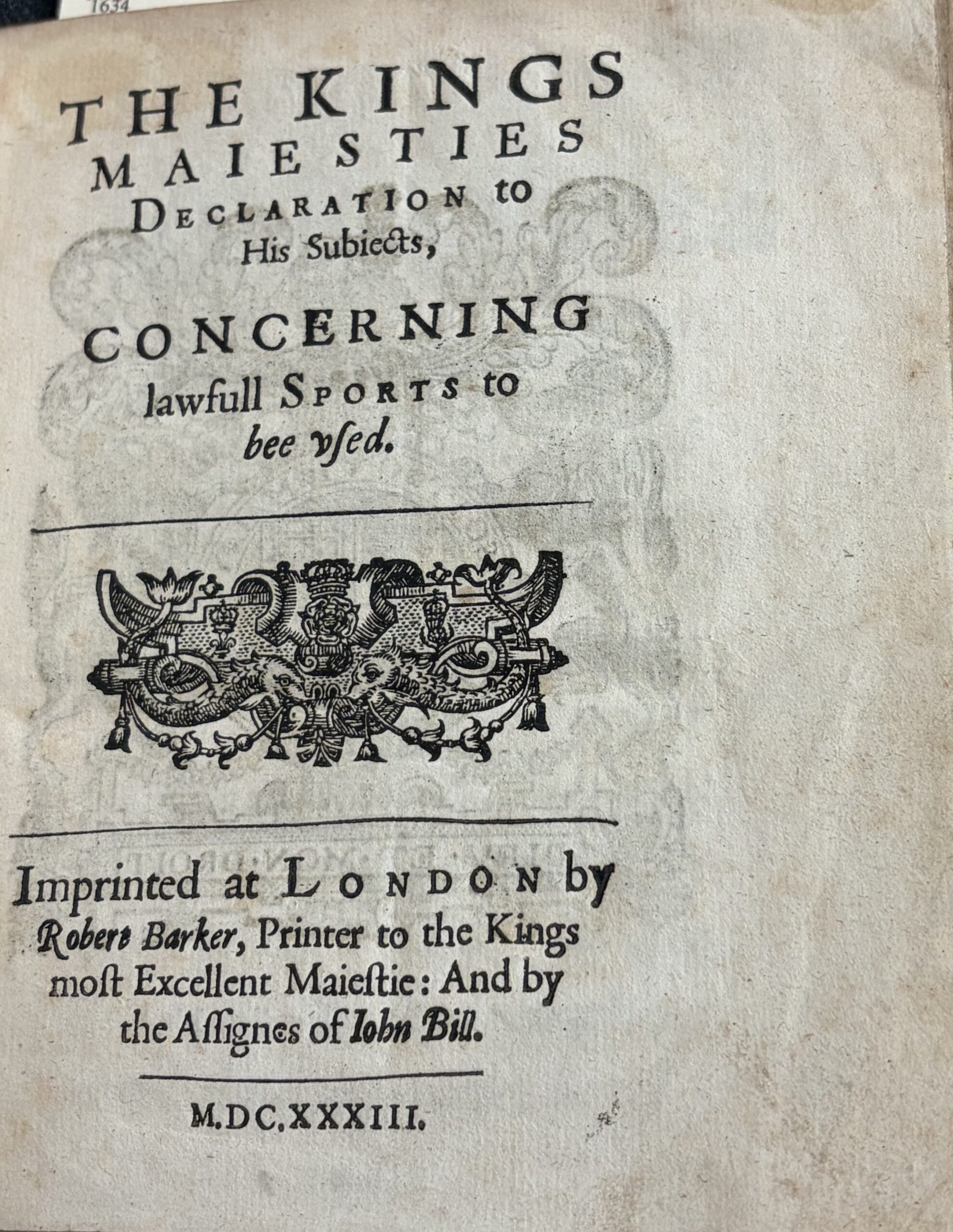
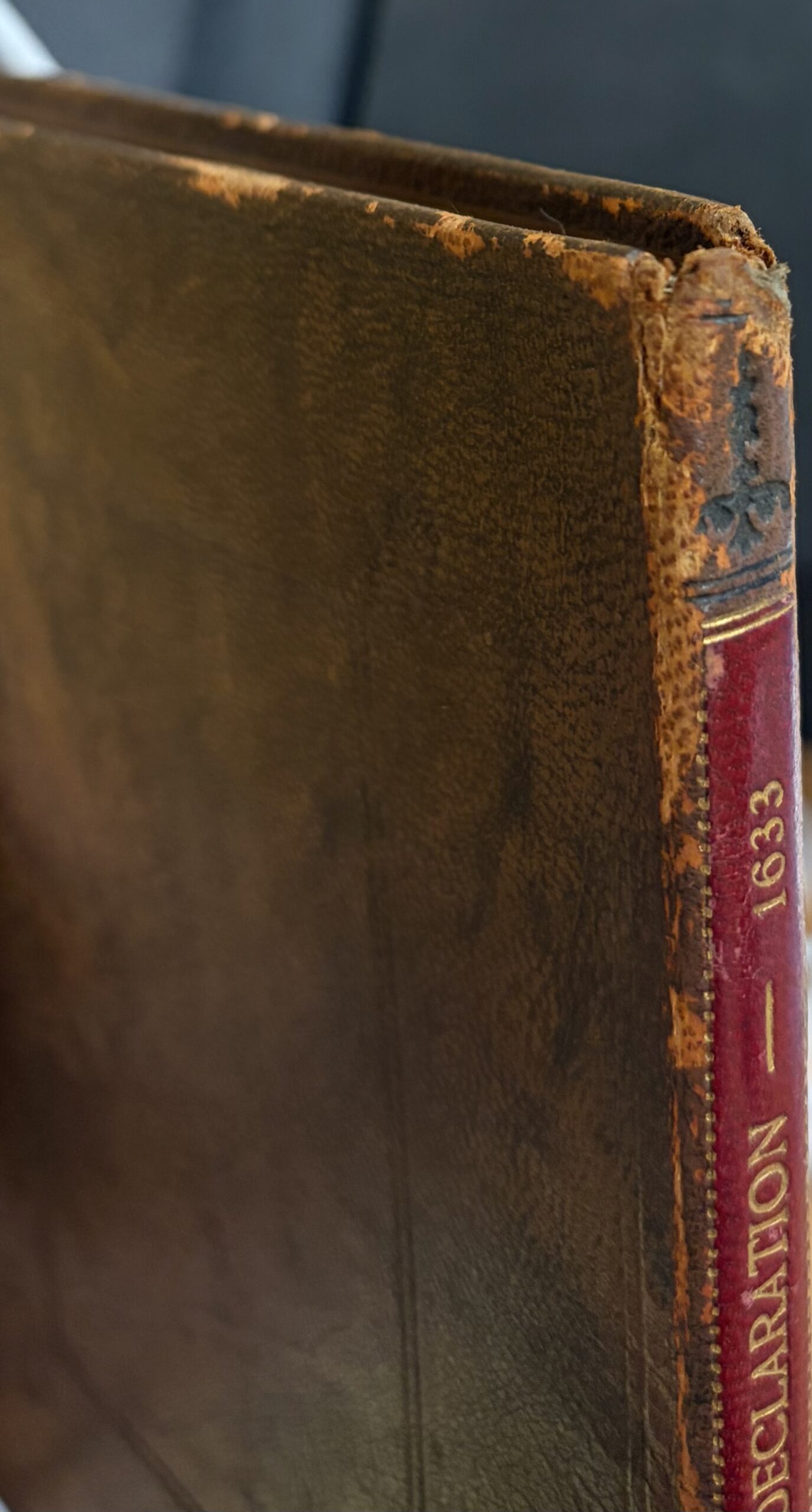
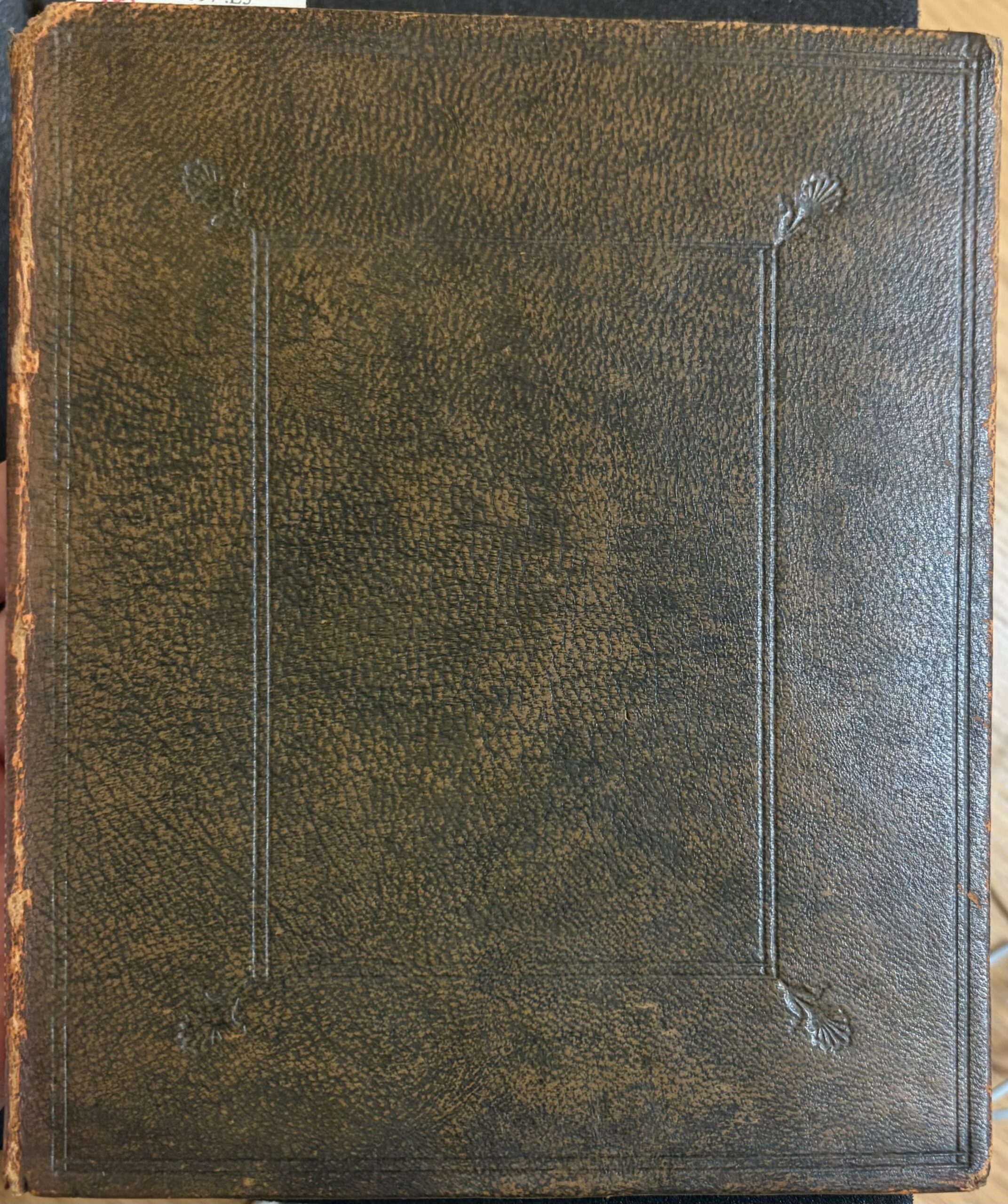
The Kings Maiesties Declaration to His Subjects, concerning lawfull Sports to bee vsed, which discuses uses of sports on Sundays as applicable to its published year of 1633. It goes by a shorthand title of “The Kings Maiesties Declaration” found on the rebound spine. MSU’s catalogue describes the rebinding as “Bound in full 19th-century leather in an antique style; boards and spine tooled and stamped in blind; red leather spine label tooled and lettered in gilt.”
The full identification of the book includes:
Author: Charles I, King of England, 1600-1649; England and Wales Sovereign (1603-1625 : James I) (corporate author)
Title: The Kings Maiesties Declaration to His Subjects, cocerning lawfull Sports to bee vsed
Publisher: John Bill, 1576-1630 (Printer/Publisher); Robert Barker, -1645 (Printer)
Place of publication: England — London
Year of publication: 1633
MSU library’s call number: XX BV4597 .E5 1634

More on its Physical Condition:
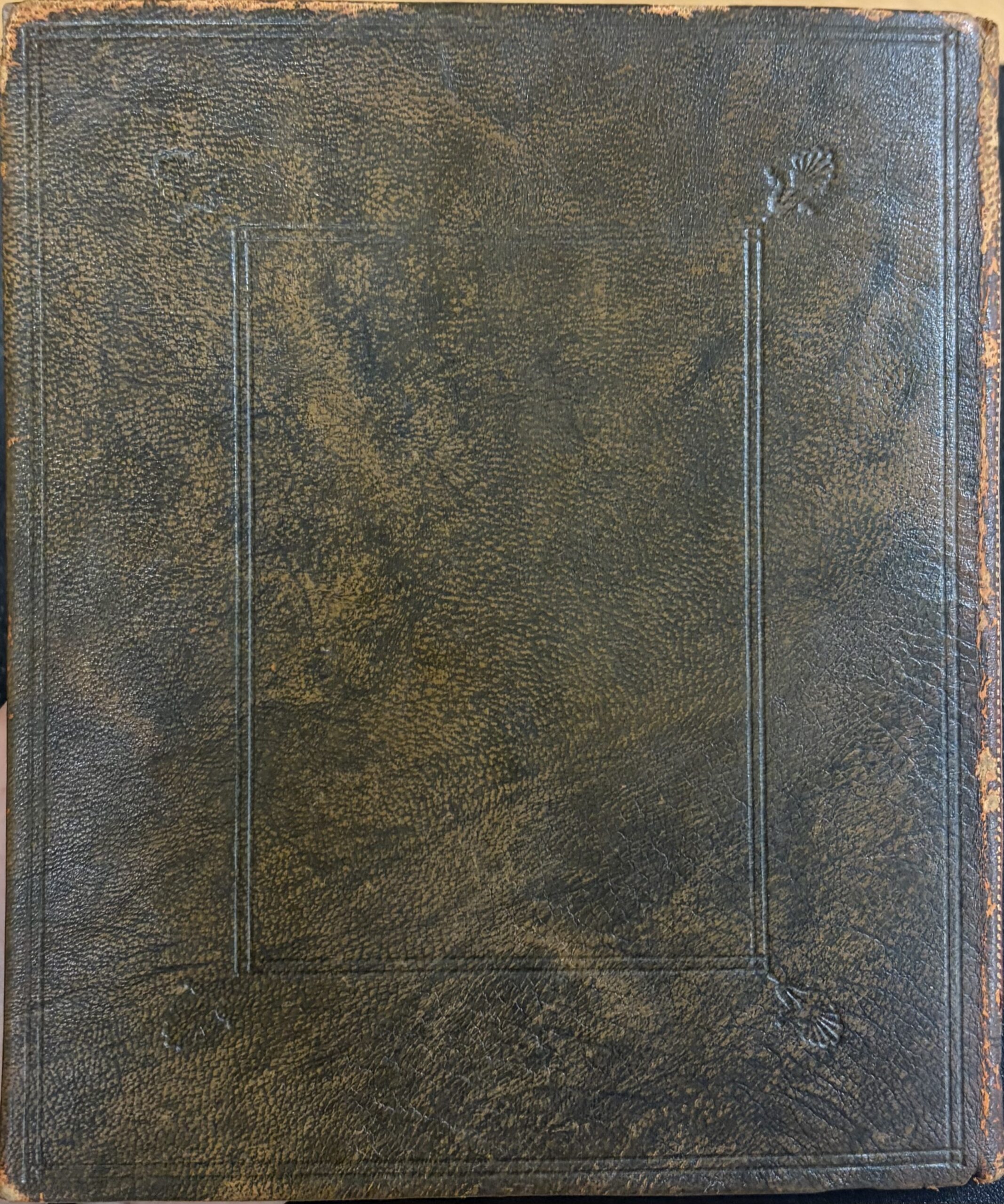
“The Kings Maiesties Declaration” is generally in quite good condition. There is some wear; the most concerning area of wear is found on the hinge/joint area between the front board and spine, which is noticeably thinner and more worn with some apparent cracking (figure 0.5). The leather bound exterior is still in quite good condition with minimal damage, scratching, or other defects to the center-front or center-back— most notable damage is seen along the end band and leather of the top of the book (figure 0.4). This kind of damage is not at all uncommon but is significant with pieces of binding beginning to come loose. Both the front and back board of the rebinding are seen to bow out (figure 0.8) opposite to each other. The gold gilding (figure 0.7) along the spine is still very much intact, with all words being clearly legible.
There are eight fly-leaves added to each the front and back preceding the original leaves—all of which are in excellent condition—an interesting characteristic as there are usually only two to four. These flyleaves were added during the rebinding process of which the date is currently unknown.



On Content and Context:
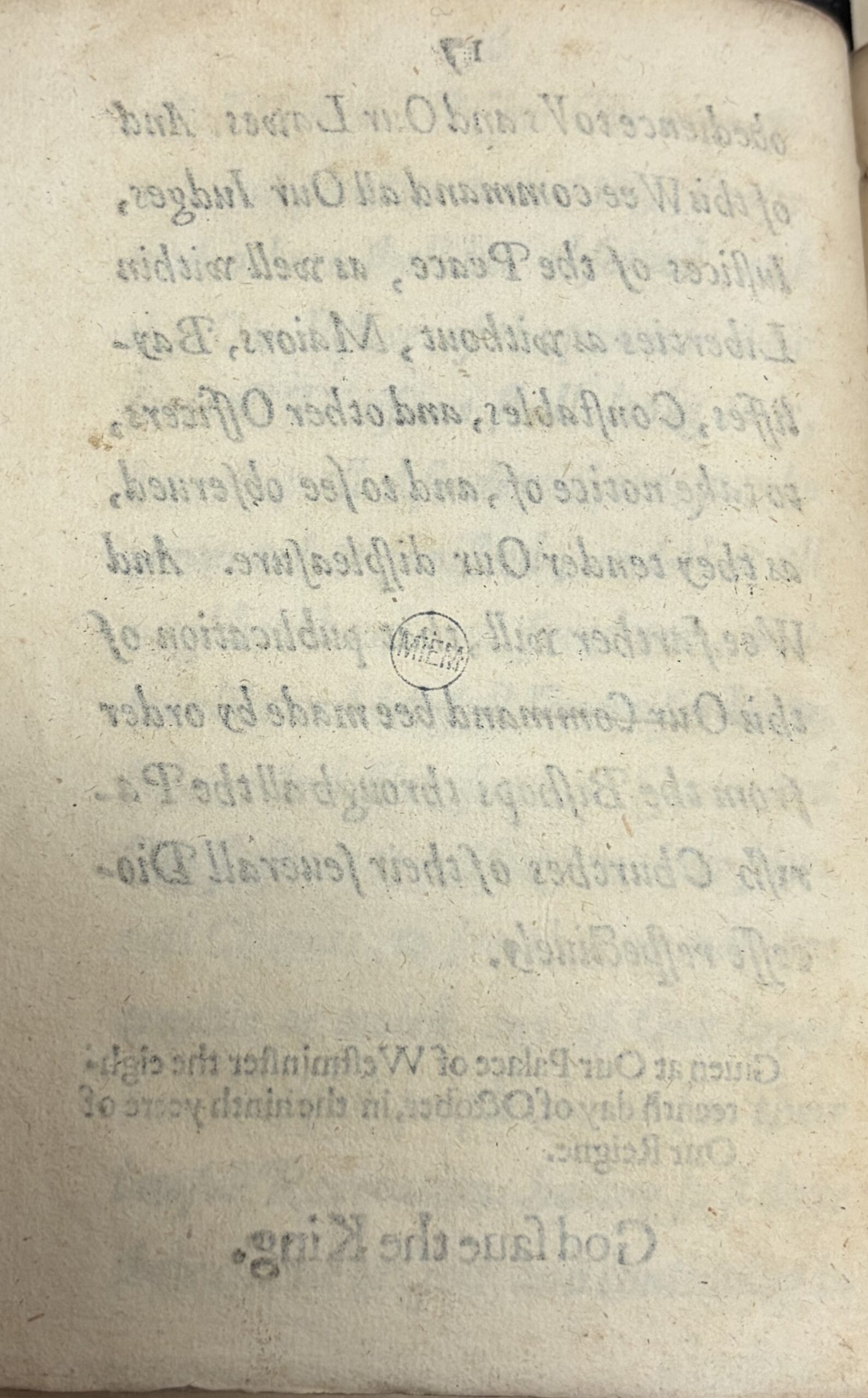
The book is divided into three parts: a foreword written by an assumed affiliate author, a transcription of the speech given by King James I in 1618, and a transcription of the speech given by King Charles I in 1633. There are two colophon type paragraphs signaling the end of each of these speeches which can be found in figures 0.10 and 0.11, respectfully, and mark the exact date and locations when/where these were given.
It’s important to understand that a decree like this was not received well by many clergymen across England (this is further elaborated on in figures 1.2 and 1.3). This decree conflicted with their religious practices and teachings— Sundays and holy days were seen as days of rest and worship and were dedicated as days to serve and give thanks to God. As such, because of their refusal to comply, some were shot and killed, which led to a growing tension within England’s public and contributed towards the cause of the English Civil War.
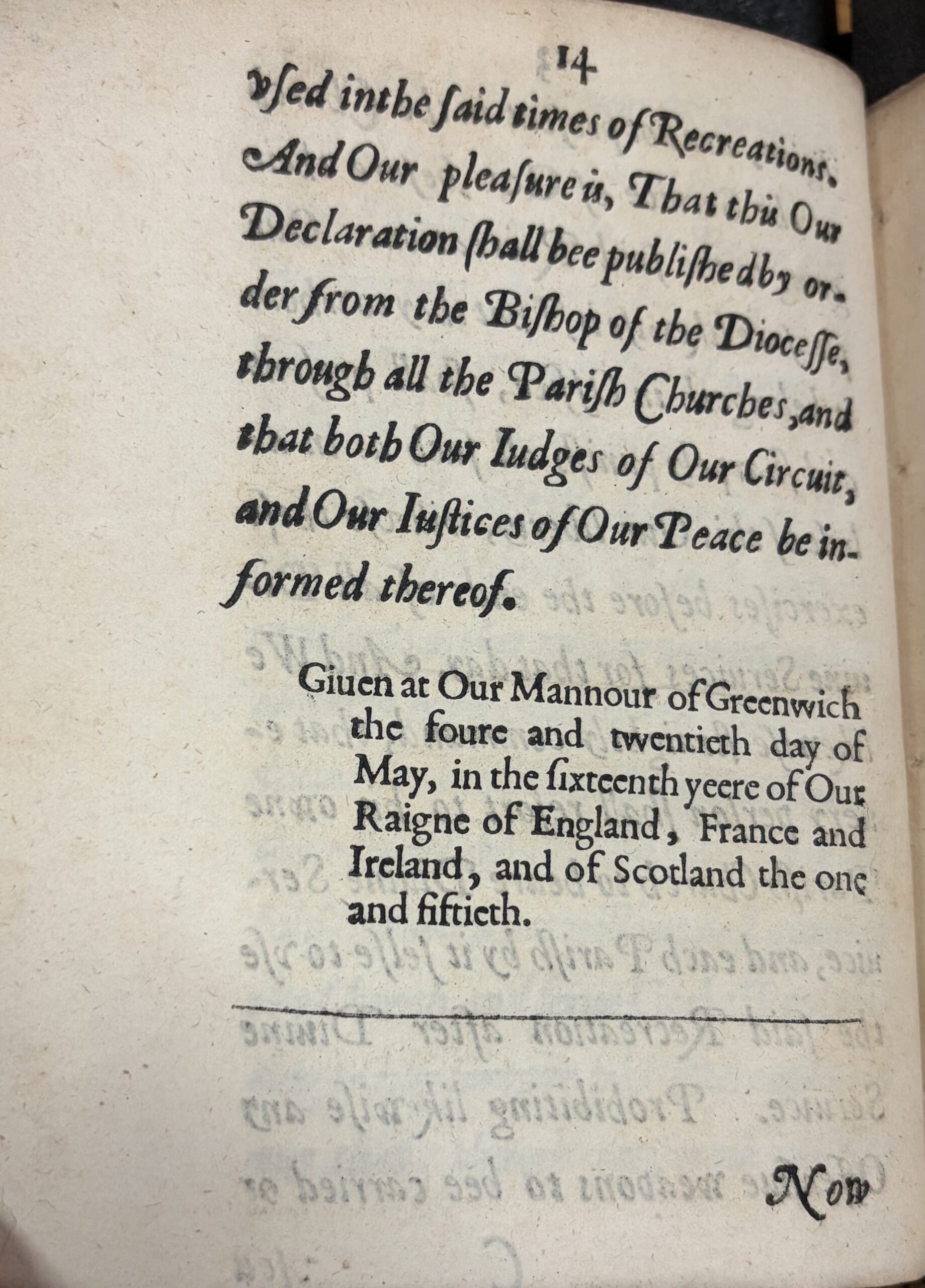
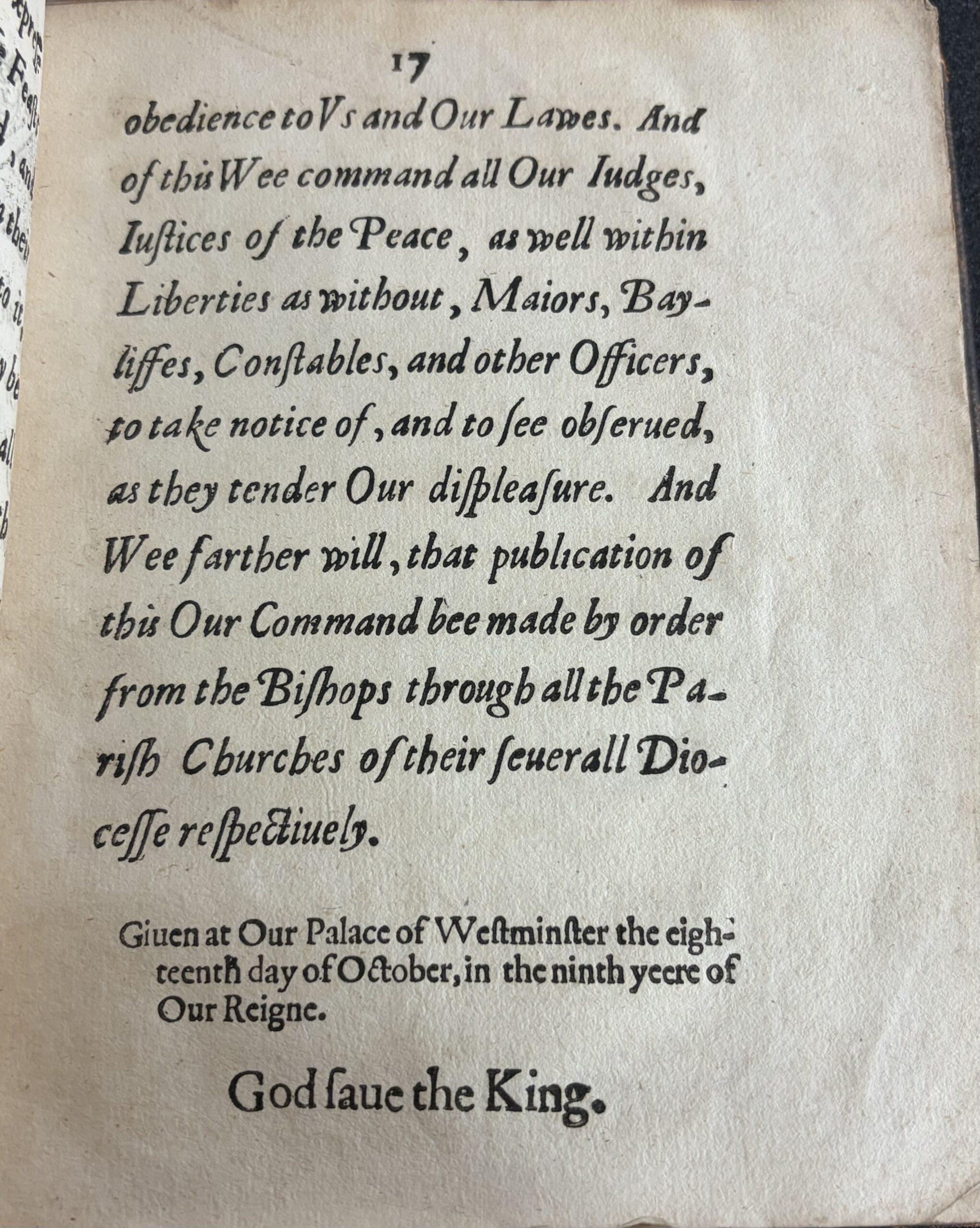
The initial 1617 declaration fostered under King James I in tandem with Thomas Morton, the then bishop of Chester, had been created in response to a dispute between the Puritans and gentry of Lancashire. The 1618 edit is largely the same with a notable exception, an additional paragraph stating the declaration made towards the people of Lancashire would now apply to the whole of England. Orders were given to the entire clergy of England to read this declaration aloud from the pulpit, but were not received well and thus the initial commands were revoked.
Its history of disdain doesn’t end there however, a reinstatement from King Charles I breathed new air into the declaration and a new wave of hatred for the decree. 15 years later Charles wanted to expand upon that same declaration adding an additional introduction and conclusion adding wakes and ales to the list of permissible recreations. The hostility towards this religious reform came with rising Puritan power leading up to the English Civil War, and any attempt to enforce the book came to an end in 1640 with Archbishop Laud’s fall. In 1643 it was ordered that the book be publicly burned by Parliament, making it increasingly rare to acquire.
“The Book of Sports” itself calls for what sports can be played on Sunday and holy days including dancing, leaping, vaulting, archery (for men), May-games (including May poles) and Whitsun-ales, but expressly forbidding bear baiting and bowling. These could only be played after divine service had been attended prior, and condemned anyone who had not attended before participating.
Beginnings
Printers
The imprint: “By Robert Barker, printer to the Kings most excellent Maiestie, and by the assignes of Iohn Bill, MDCXXXIII [1633}”; denotes both Robert Barker and John Bill as printers and/or creators of this book. More importantly, both were members of the King’s Printing House (KPH); located in Northumberland House it is a house of historical significance which underwent numerous iterations and names. Beginning station in 1600 John Bill and Robert Barker were some of the first to work in the house.
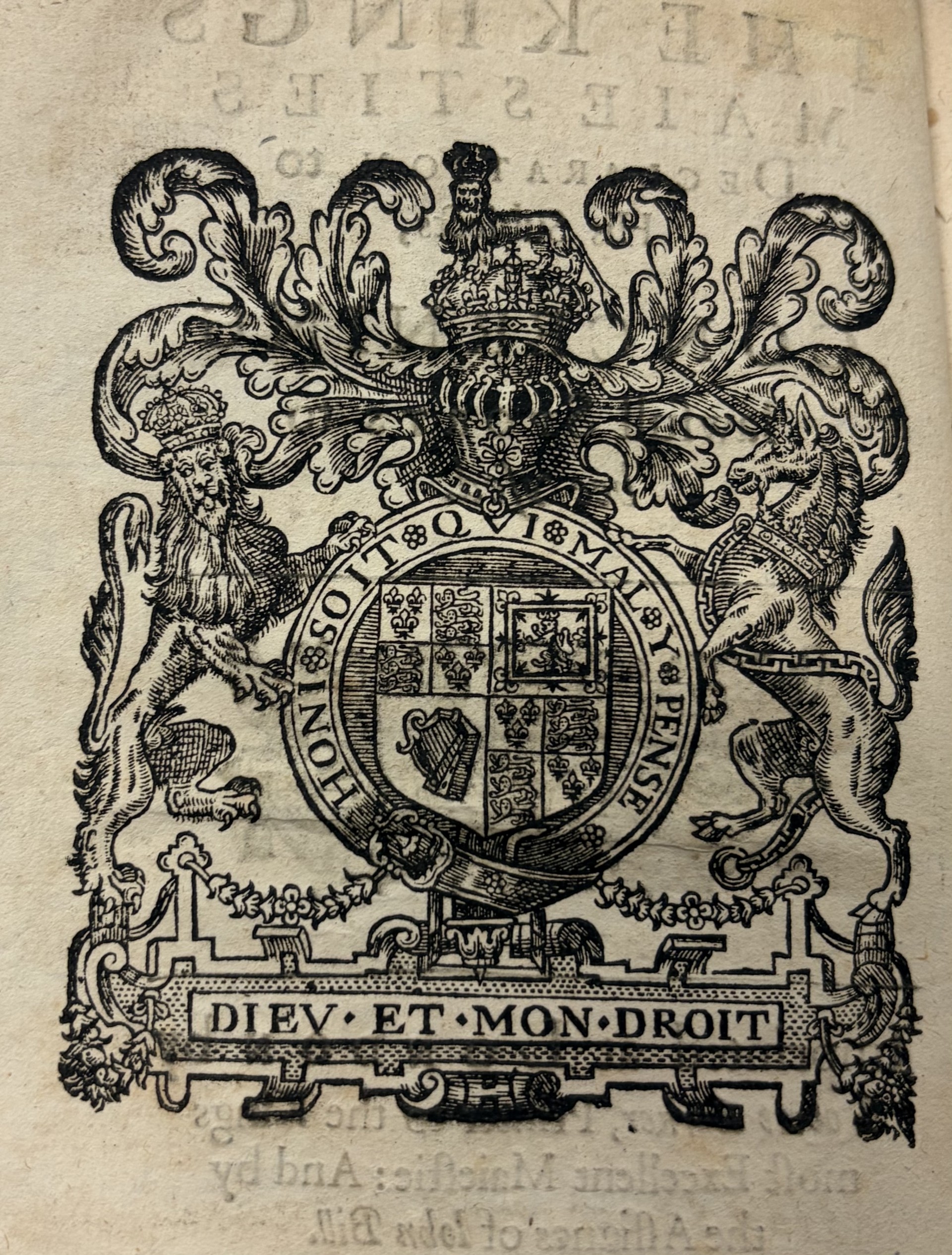
The crest of figure 1.1 furthers Barker’s and Bill’s association with the KPH as its inclusion marks the book as affiliated and endorsed by the royal family.
*An extensive timeline of the Bills, Nortons, and Barkers can be found bolded in the bibliography and is quite interesting to see the history of how, where, and who ended up making “The King’s Book of Sports”.
Robert Barker (-1645):
Robert had quite a substantial printing career being printer to King James I and Charles I. Barker began printing independently for a number of years before beginning work with his brother—Christopher Barker, originally printer to Queen Elizabeth I—in the KPH. He came into partial ownership of the house after Christopher’s death in 1599 during which he printed the first King James Bible, a notable text in the shift towards standardizing Christianity— a goal of both King James and Charles.
It’s important to note that while Robert had been an accomplished printer at one point his printing license had been revoked due a very unfortunate printing mistake resulting in one commandment of the Bible reading as “Thou shalt commit adultery”. Additionally, he and Martin Lucas who had helped him work on “The Wicked Bible” (different from the King James Bible) had been fined £300. His run in with the law didn’t stop there however, he was later imprisoned in 1635 due to numerous debts and died in 1645 in debtors prison.
John Bill (1576–1630):
Some of the earliest information on John Bill denotes him as an apprentice to John Norton, another notable printer in the King’s Printing House. His apprenticeship lasted from 1592-1601, soon after which he, John Norton, and Bonham Norton (father to John N.) set up a three-way joint-stock to deal in books (and other stationery) at home and abroad. His role as publisher was firmly cemented after this partnership, and later inherent John Norton’s position as supplier of books after his death in 1612.
John Bill is mentioned within the imprint on the title page—”and by the assignes of Iohn Bill” — this specification is important to point out. During this time imprint contracts were being signed in the KPH and those involved were legally bound to a specified number of years in which their names had to be included on an imprint (this is elaborated on in the timeline). Hence, John Bill was still accredited for works (like “The Kings Book of Sports”) which he most likely had no hand in making.
Unknown Scholar
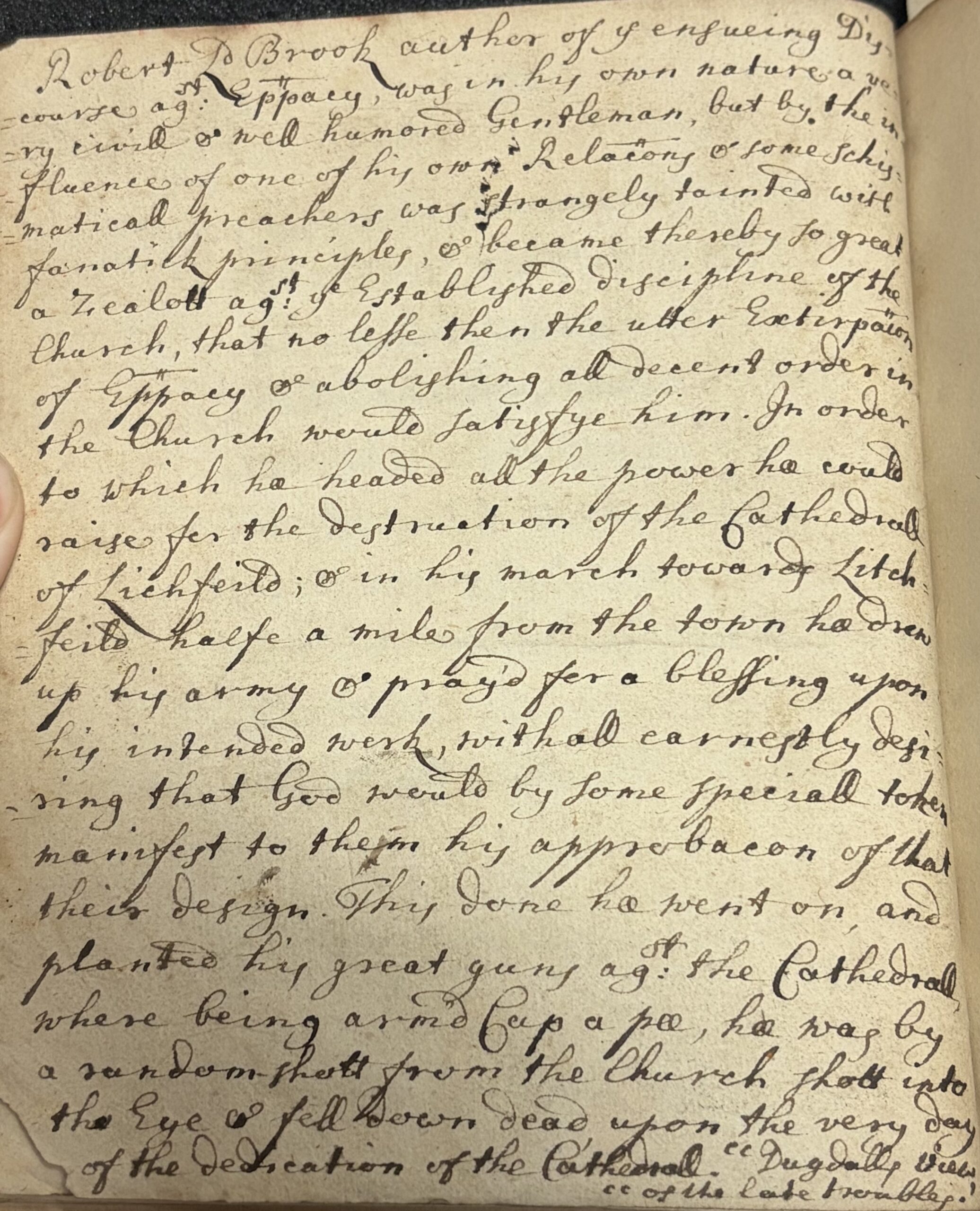
This book was held by an owner with some knowledge or connection to Lord Robert Brook (Greville). Based on the related research the owner of this book had been doing—looking into those involved in religious and political movements during the early to mid 1600s—their main motivation for purchasing this book can be assumed to come from there. With some speculation, its likely that whoever had authored these annotations had been an English-speaking scholar with some background or interest into British politics and religious figures/movements. There’s also a chance that this scholar could be among the first owners of this book given the script, diction, and references to relevant works.
The full transcription of this page:
Robert Ld. Brook author of ye ensueing discourse against: Episcopacy, was in his own nature a very civil o well humored gentleman, but by the influence of one of his own relations o’ some schematical preachers, was strangely tainted with fanatick principles or became thereby so great a Zealott agst; ye established discipline of the Church, that no lesse then the utter Escribattion of Episcopacy and abolishing all decent order in the Church would satisfye him. In order to which hee (he) headed all the power hee could raise for the destruction of the fathedreed if Lichfield; or in his march towards Litchfeild halfe a mile from the town hee drew up his army o pray’d for a blessing upon his intended werk(work), with all earnestly desiring that God would by some special token manifest to them his approbation of that their design. This done hee went one and planted his great guns against the Cathedral where being armed cap-a-pee (cap-a-pie) He was by a random shott from the Church shott into the Eye and fell down dead upon the very day of the dedication of the Cathedral. “Dugdale, view of the late troubles”
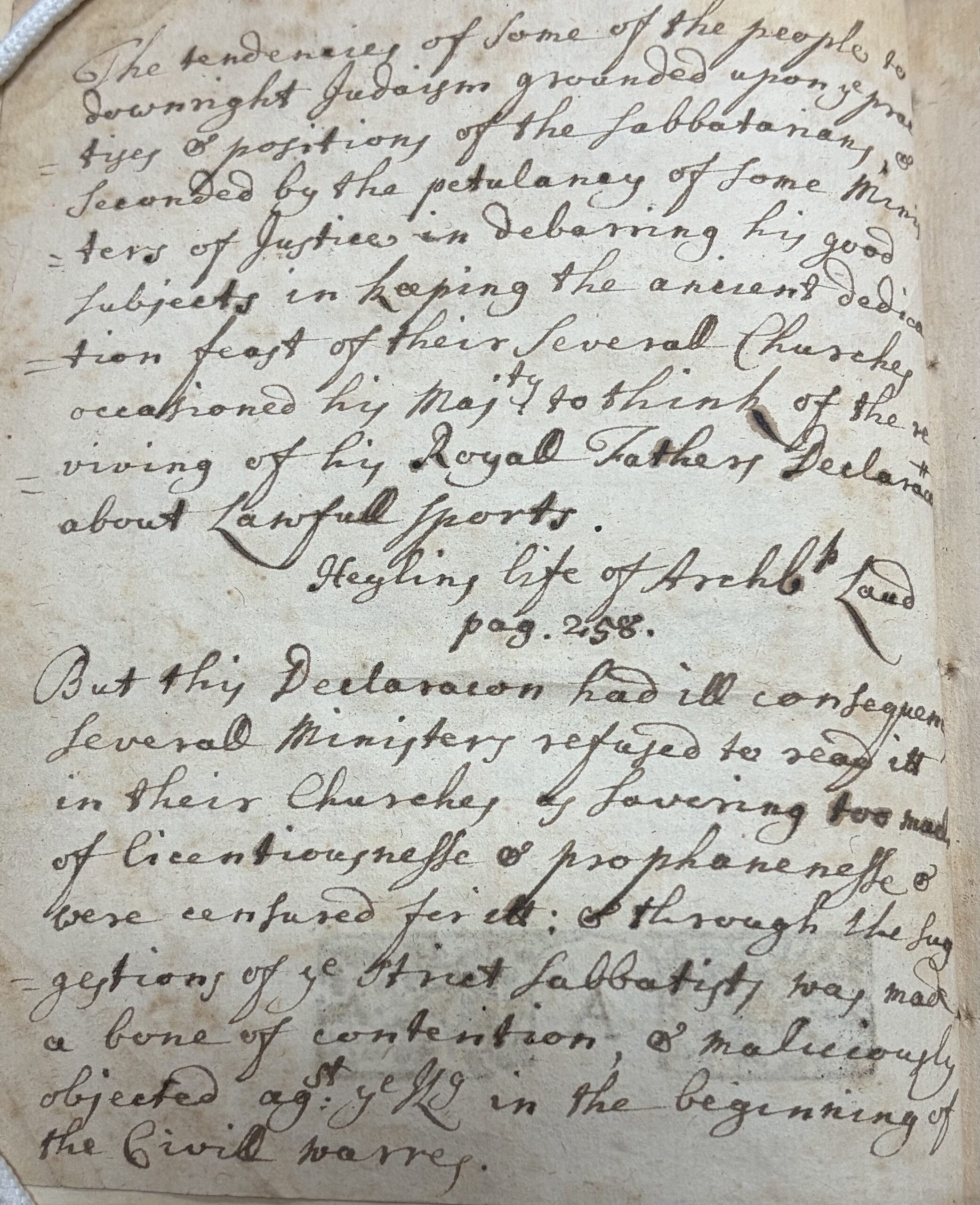
The author also references a work by Peter Heylyn—”life of Archbishop Laud pag. 258.”—in the English title, but was originally titled Cyprianus Anglicus and written in 1671. Due to this publication’s date a reference frame of when these annotation were written can assumed to be sometime in the late 18th century and early 19th century, no too long after the book’s initial publication. This time frame is also deduced from the script style which was commonly used at the time.
The full transcription of this page:
The tendency of some of the people to downright Judaism grounded upon ye practices of positions of the Sabbatanany, and Seconded by the petulaney of some Ministers of Justice in debasing his good subjects in keeping the ancient dedication feast of their several Churchly occasioned his majesty to think of the surviving of this Royal Fathers Declaration about Lawfull Sports. Heylins life of Archbishop Laud pag. 258.
But thy Declaration had ill consequences Several Ministers refused to read it in their Churches, of savoring too much, of licentiousness and profaneness and were censure for it and through the suggestions of the strict sabbatists was made a bone of contention and maliciously objected against the king in the beginning of the Civil warres.
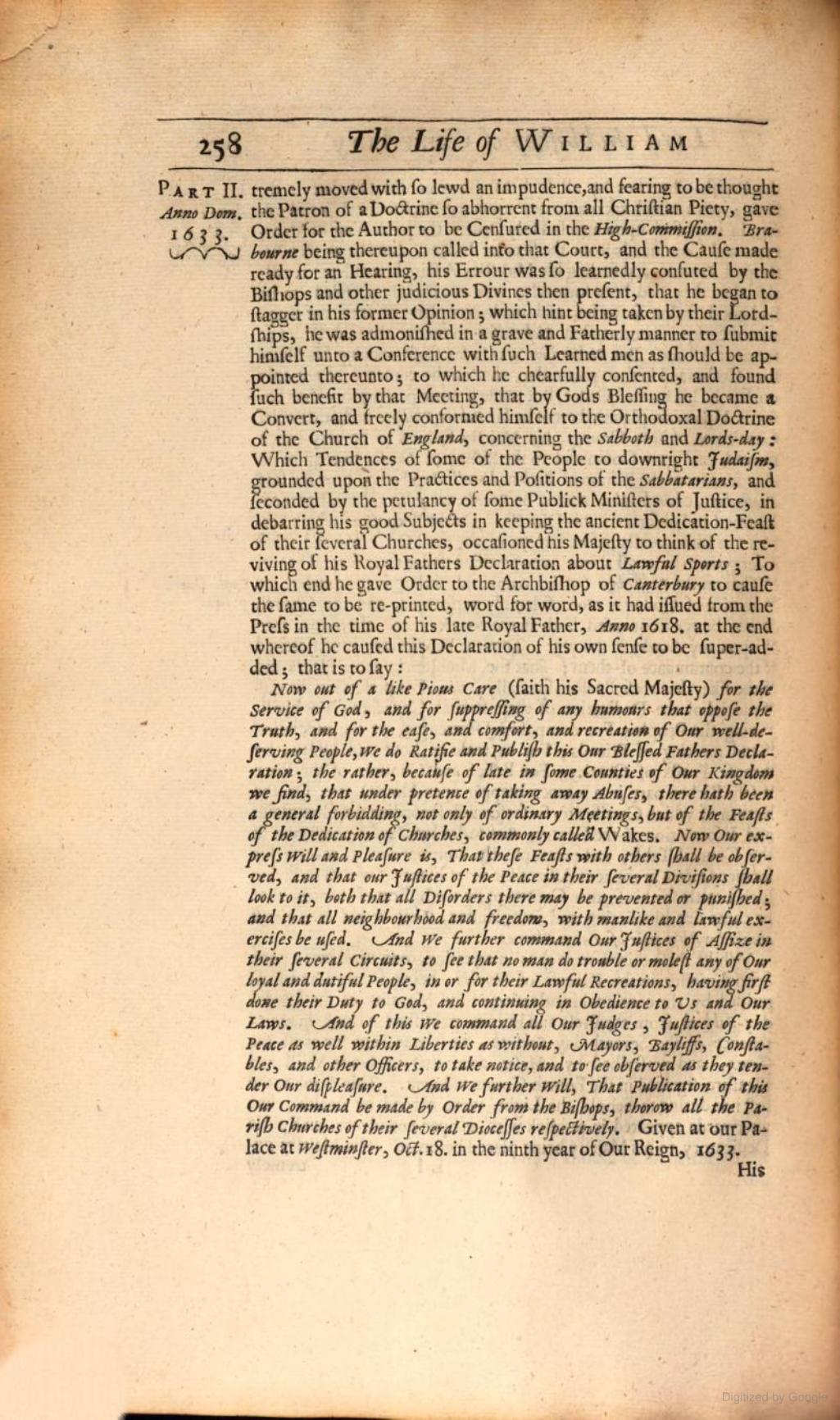
The quote referenced in the above annotation can be found to the left from an actual copy of The Life of William Laud. Based on the exact page numbers matching, and a very similar font and typographic style to the one used in “The Kings Book of Sports”, I believe this could be the exact edition referenced; at least, printed around the same time as “The Kings Book of Sports”.
Peter Heylin’s Cyprianus Anglicus (1668): Cyprianus Anglicus(1668) or “a Life of Archbishop William Laud” detailed the life of William Laud, an Archbishop of Canterbury appointed in 1633 by King Charles I (the same year this book was published). Laud had been a strong advocate of Charles’ religious reforms and for that (because of their strong dislike by the public) he was later arrested by Parliament in 1640 and executed in 1645 towards the end of the English Civil War. During his life he fathered his own reform movement aptly named Laudinism, which emphasized clerical hierarchy and liturgical ceremony as outlined by Charles. Episcopalianism was encouraged; an enforcement of uniformity within the Church.
Lord Robert Brook:
Robert Brook had been regarded as a powerful Puritan nobleman and a possible leader for the Parliamentarian cause. He came to that position after adoption by his uncle Baron Fulke Greville. Taken in after being orphaned, Robert was to inherit Fulke’s estate as the only son of an unmarried lord. Throughout his life Lord Fulke set out to give Robert an extensive education, attending both the University of Leiden and Paris. This education was important in shaping the essay which would later be referenced by our unknown scholar.
Coming into the title of Baron in 1628 after the murder of his uncle by a servant, Robert married soon after in 1631 to Katherine Russell. Their marriage further shaped his world view, primarily through his father-in-law who introduced him to a network of Puritans critical of Charles I. Brook and the head of this group, Lord Saye, sympathized with those resisting Archbishop Laud’s religious reforms (hence the connection to Cyprianus Anglicus). His involvement was furthered with his writing of A Discourse of Episcopacy (1641) where he attacks the political power of both bishops and the established church. This, of course, is the text the scholar comments on, and its connection to Cyprianus Anglicus further proves that he is the person described in the annotations.
*Lord Brook’s story doesn’t end there though, there is quite a bit more interesting information on him. A source with a good description of his life has been included in the bibliography and asterisked.
Pieces of Provenance
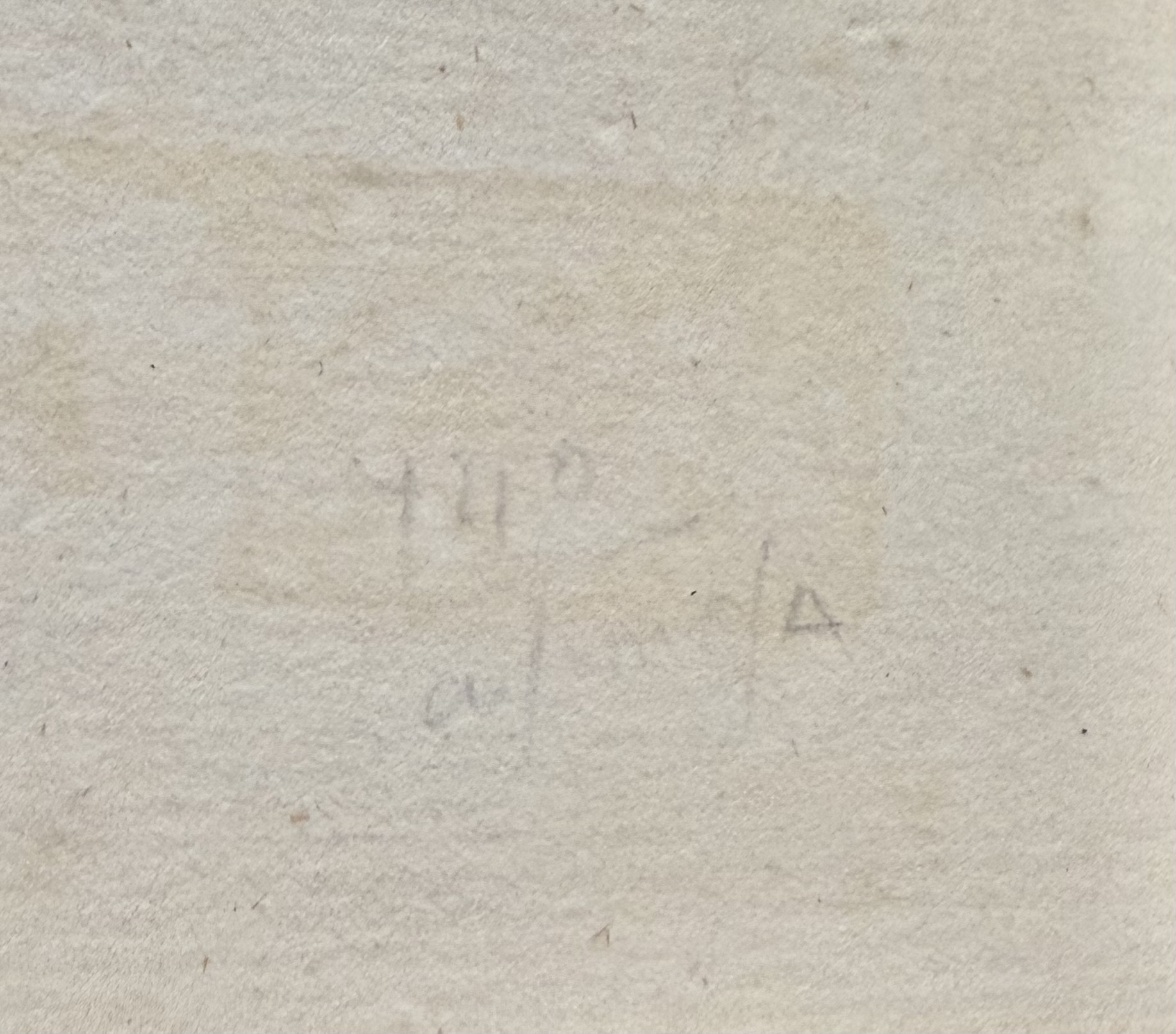
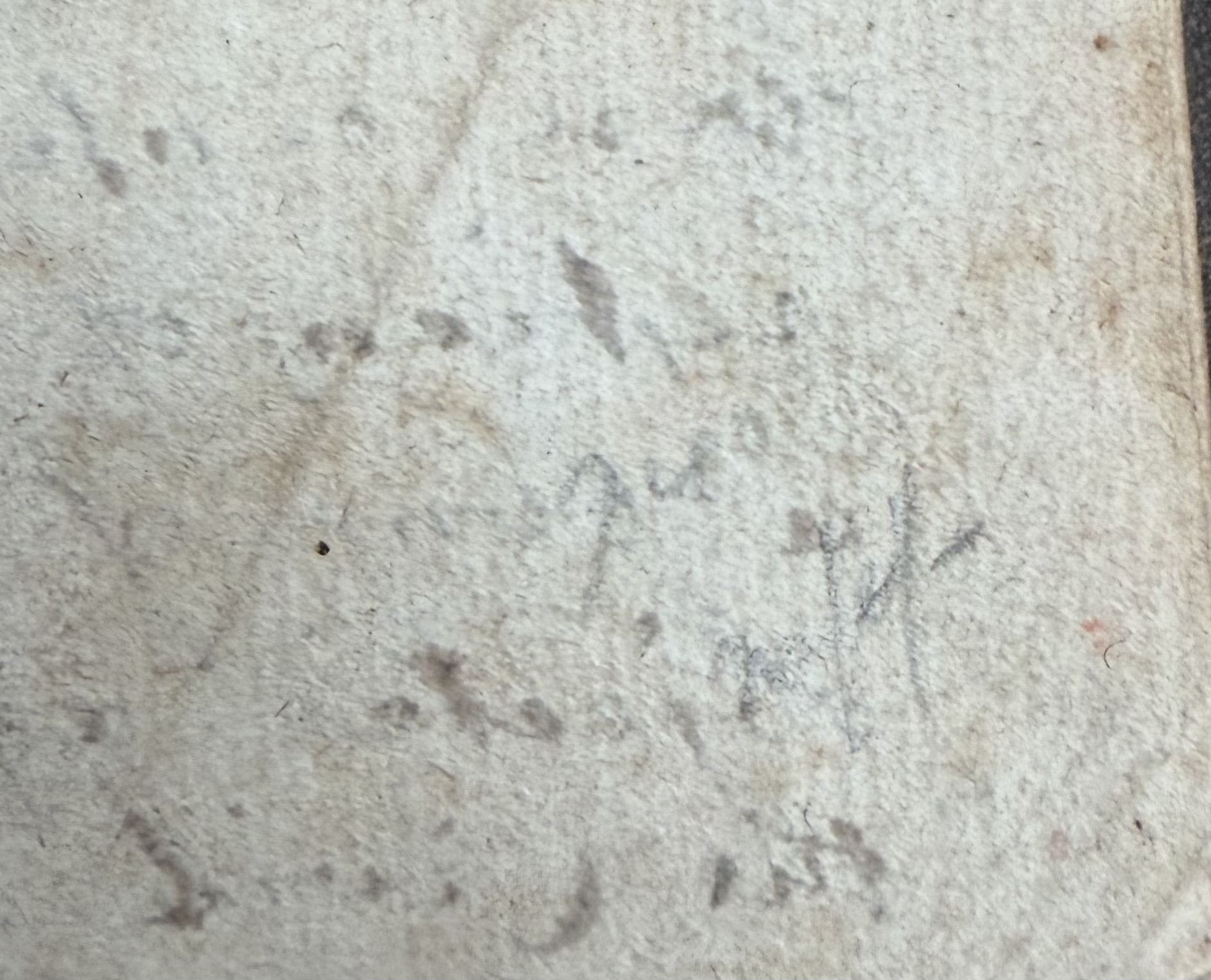
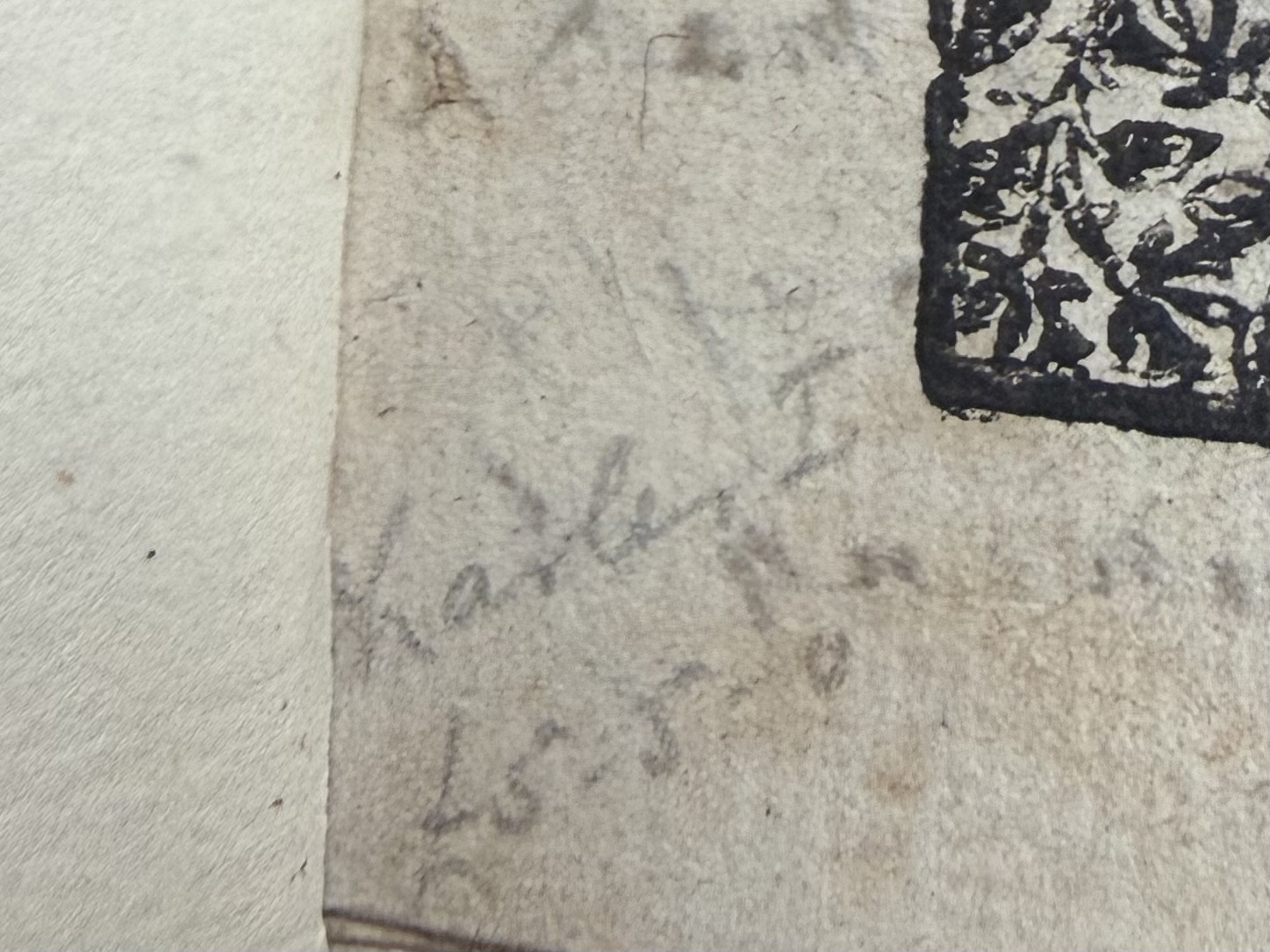
All of the above markings are made in pencil and are buyers marks which show how much the book was bought for. These markings are important to point out as they show the book went through multiple resellers and various buying processes before it came to MSU Special Collections.
While these pieces of provenance are interesting and can somewhat help to place the book within the United States or Great Britain (as seen on the right with the pounds symbol indicating a transaction most likely taken place in Britain or with and Englishman) they are largely unhelpful for tracing the owners connected to these numbers. Being commonly used and with no signatures nor initials attached, little more can currently be gained by looking at these pieces.

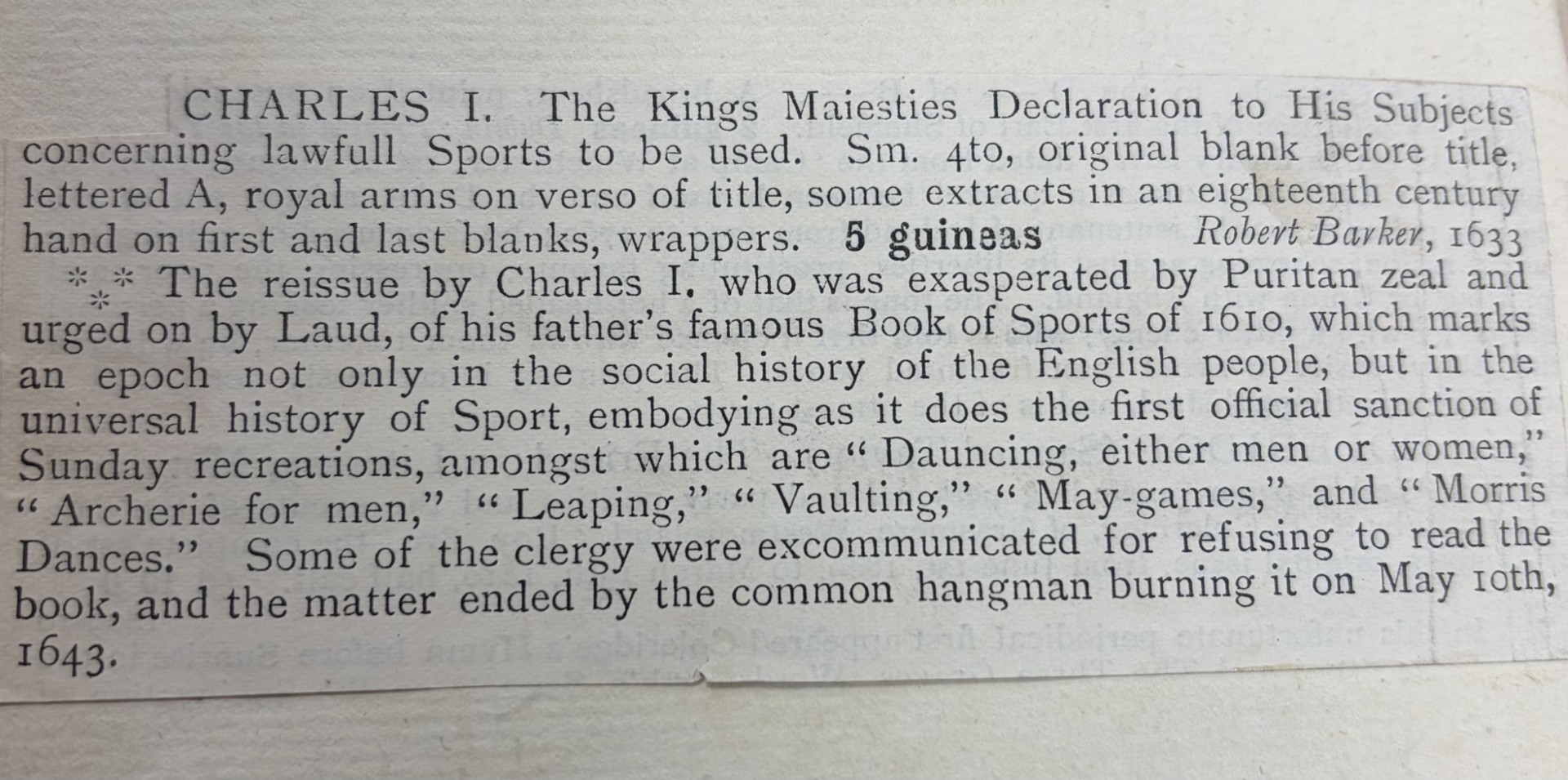
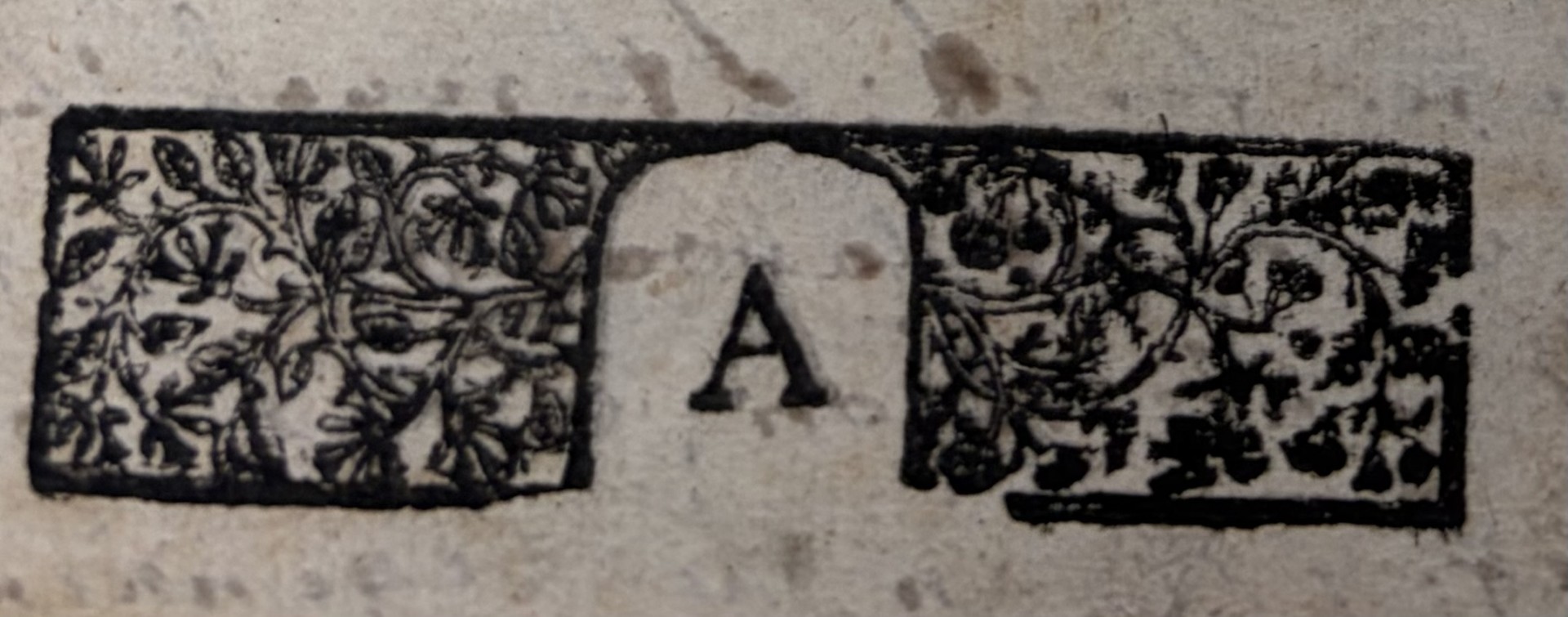
Figure 1.7: These are additional pieces of provenance that have more significance than the previous and could potentially trace back to an owner or place. When searched, 48289 came back as a Detroit area code. It’s not for sure if those numbers actually signify an area code, password, or some other value important to its writer. However, since the book did make its way to Michigan, the correlation to Detroit might not be entirely unplausible.
Figure 1.9: This stamped letter ‘A’ woodcut bares no particular owner. Though it has been included on the recto of the first original leaf, this bares no association to the KPH or other known author. It could be possible, though unlikely, that this is the initial of a previous owner, however no additional information could be found on the mark that links it to one person. Based its placement within the book and design style, it could be placed anywhere from the 17th century to the 18th century.
Figure 1.8: Despite the paste in being a major piece of provenance, after numerous searches throughout catalogue books, and sources of the like there was nothing connected to the description on the paper on-line.
Recent Ownership
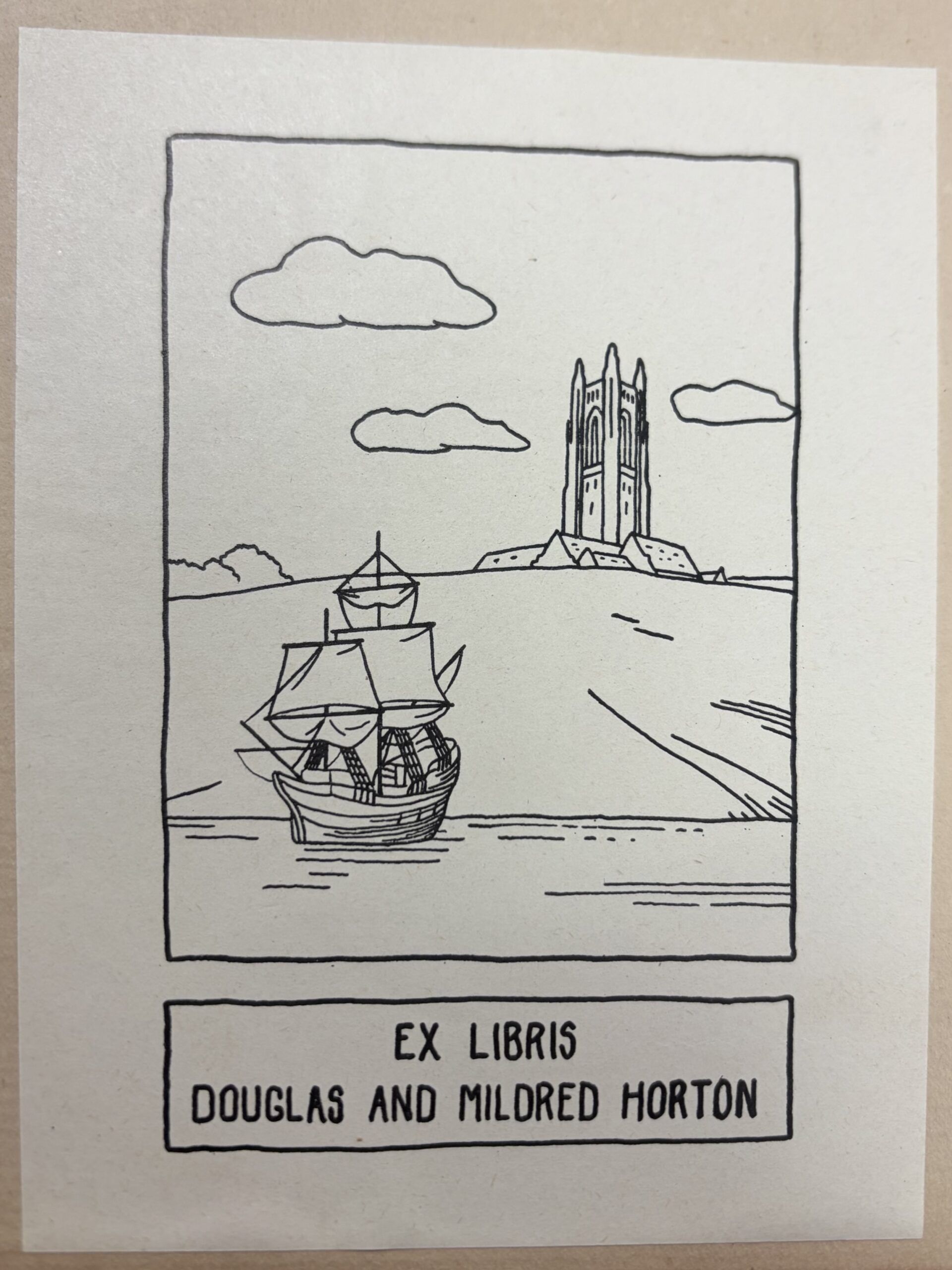
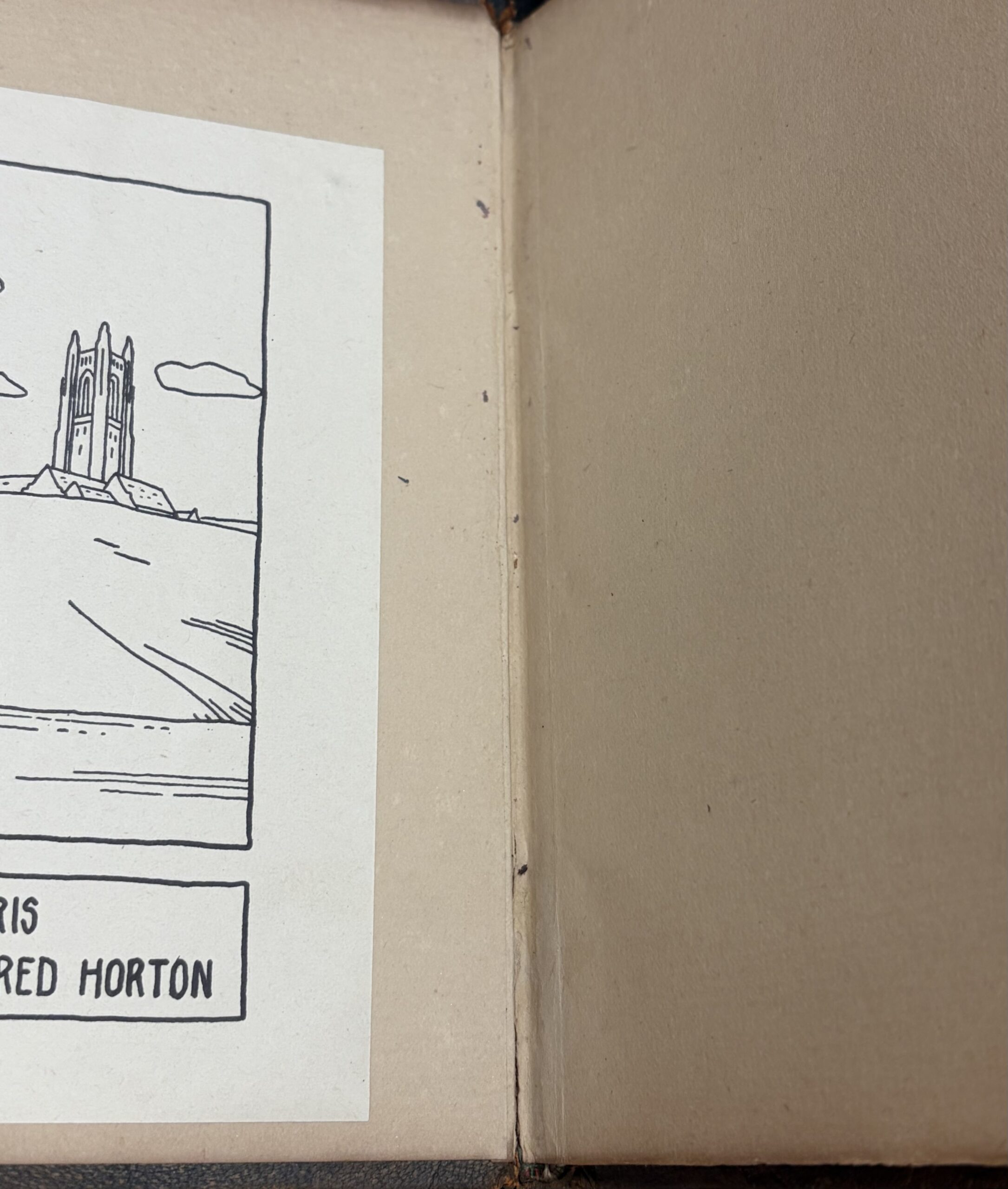
Two very prominent owners included Mildred and Douglas Horton. Their ownership is found on an explicit bookplate that once signified the book as theirs. Seen in the figure above which displays a ship sailing towards a bell tower and the Latin phrase “Ex Libris” or “From the library of…”.
On a loving and quite cute note, this book plate was designed not of a specific place but as a memorial of Mildred and Douglas greatest accomplishments. The ship featured in the drawing is indicative of Mildred’s time in the Navy and her founding of the WAVES. The bell tower she’s seen sailing towards pays homage to Douglas’s clerical experience and is a beautiful combination of their two accomplishments.
Mildred Helen (Horton) McAfee May (12, 1900 Parkville, MO – Sep 2, 1994 Berlin, NH):
Mrs. Horton was perhaps best known for her founding of the WAVES, the first women’s division of the Navy. Stemming from a leave of absence taken from initial career, McAfee became the Navy’s first woman to become a line officer on August 3rd, 1942.
She notably also has an impressive educational career, beginning with her graduation from Vassar College in 1920 and proceeded to obtain her Master of Arts in 1928 from Chicago University. After pursing a career in higher education she became president of Wellesley College in 1936 preceding her active service.


Douglas Horton (July 27, 1891, Brooklyn, NY – August 21, 1968, Randolph, NH)
Douglas Horton was also an accomplished scholar having graduated from Princeton University and Hartford Seminary after which he entered the ministry of the Congressional churches in 1915 as a Protestant clergyman. During his pastorate he worked as a clergyman in multiple places, serving at the First Congressional Church in Middletown, CT; then later spent time in both Boston and Chicago.
Most interestingly in his career he was a big proponent of ecumenical relations between major protest bodies relevant to his time in ministry. To further his passions towards the interconnections of churches—even those with unlike theological or governmental ideas—he participated in organizations that would become the National Council of Churches and the World Council of Churches.
It’s likely the acquisition of this book into the Horton’s library was driven by his clerical studies and because he was a clergyman.
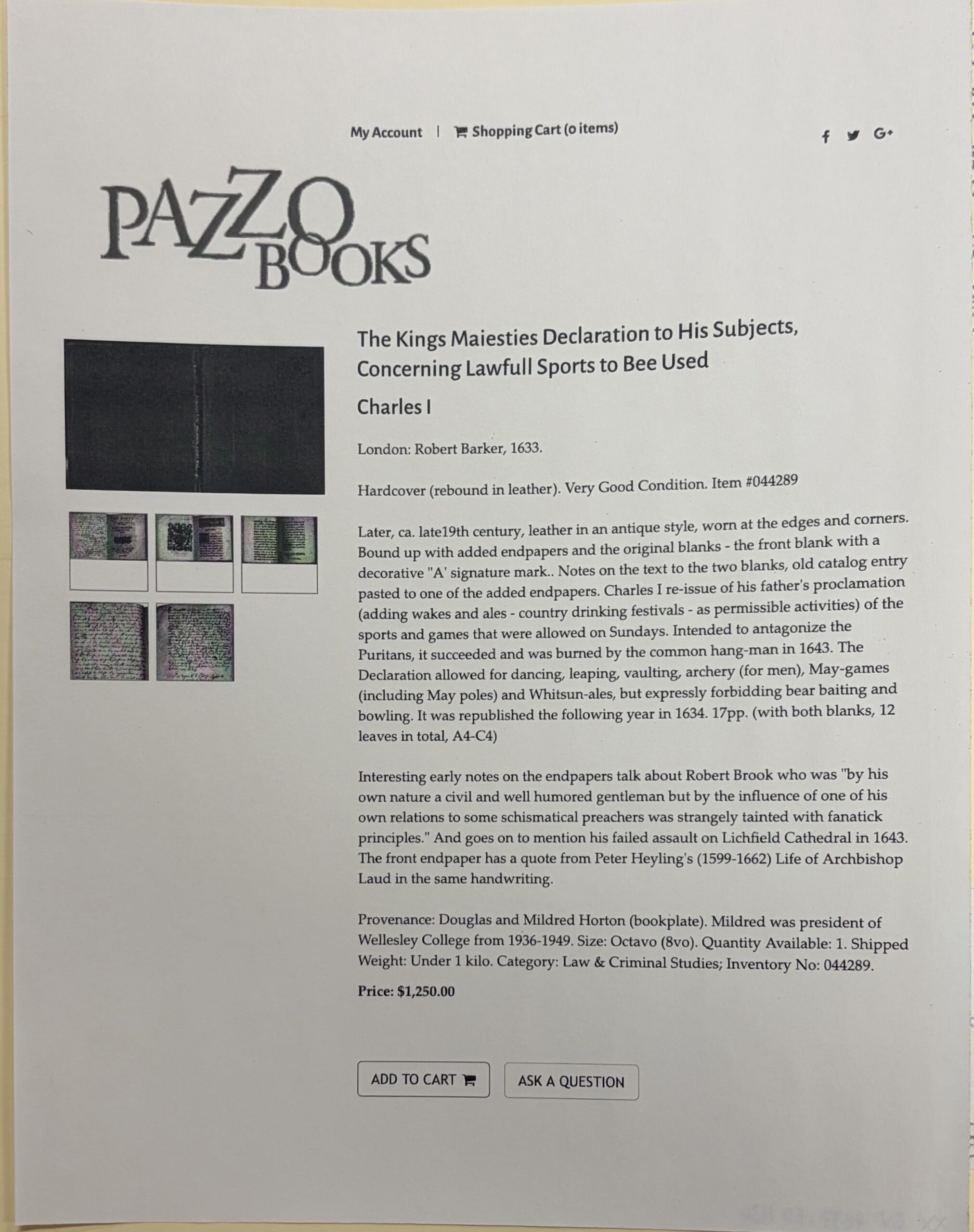
Pazzo Books:
After trying to get into contact with Pazzo books—who were the most recent owners before MSU—there was little additional information added to the provenance of this book. However, how the book came into their possession was vaguely found and was stated to have come from an auction— maybe associated with an estate sale from the Hortons?
This leads in to MSU’s acquisition which was rather recent; bought from Pazzo Books on September 19th 2023. It was stamped with MSU’s stamp of ownership on the last recto of the books original leaves in a black ink and its call number was written in pencil on the 3rd verso of its original leaves— cementing the book in our collections.
*It goes without saying many of the people referenced or who held this book had rich lives that can’t fully be described in brief descriptions. It’s strongly encouraged that if you’re at all interested to look at some of the sources in the bibliography and go down the same rabbit hole I did. There are some wonderfully interesting connections made between all those associated.
Bibliography
Wakely, Ben. “Time-Line 1600 King’s Printing House Is Based at Northumberland House.” TIME-LINE, September 1, 2007. http://www.english.qmul.ac.uk/kingsprinter/publications/transcripts/Reader_Aids/TIME-LINE.pdf.
*BCW Project. Robert Greville, 2nd baron Brooke, 1608-43. Accessed March 26, 2026. https://bcw-project.org.uk/biography/robert-greville-lord-brooke.
Mac, Laurin I. “Research Guides: Persistent Links for Library Resources: JSTOR.” JSTOR – Persistent Links for Library Resources – Research
Guides at University of Oregon Libraries, 2006. https://researchguides.uoregon.edu/persistentlinks/jstor.
U.S. Navy. “McAfee, Mildred H. (Horton).” Naval History and Heritage Command. Accessed March 26, 2026. https://www.history.navy.mil/our-collections/photography/us-people/m/mcafee-mildred-h-horton.html.
The Shaping of American Congregationalism: 1620-1957, John von Rohr. Cleveland: Pilgrim Press, 1992.
The Shaping of the United Church of Christ: An Essay in the History of American Christianity, Louis H. Gunnemann; Charles Shelby Rooks, ed. Cleveland: United Church Press, 1999.
The Living Theological Heritage of the United Church of Christ, volume 6, Growing Toward Unity, Elsabeth Slaughter Hilke, ed.; Thomas E. Dipko, postscript; Barbara Brown Zikmund, series ed. Cleveland: Pilgrim Press, 2001.
Crowther, David. “The Book of Sports 1633.” The History of England, January 31, 2022. https://thehistoryofengland.co.uk/resource/the-book-of-sports-1633/.
1969 Year Book of the United Church of Christ, New York.
H. G. Aldis et al, A Dictionary of Printers and Booksellers in England, Scotland and Ireland … 1557-1640, 1910
Haig, Robert L. “New Light on the King’s Printing Office, 1680-1730.” Studies in Bibliography 8 (1956): 157–67. http://www.jstor.org/stable/40371175.
N/A. “Declaration of Sports.” Wikipedia, May 1, 2025. https://en.wikipedia.org/wiki/Declaration_of_Sports.
A huge thank you to everyone who helped in anyway in creating this! To Amelia and the LEADR lab for helping troubleshoot and teach. From all those working the special collections desk and who saved my laptop charger (thank you!), to both Tad and Andrew for helping transcribe, and to Professor Brockey for helping me love this class and learn something new every time. You’ve all been amazing to work with and I can’t thank you enough!
Cristina Olivares Valencia
Created in Spring 2026 for Professor Liam Brockey’s “History of the Book” (English 475) course, Michigan State University.
