
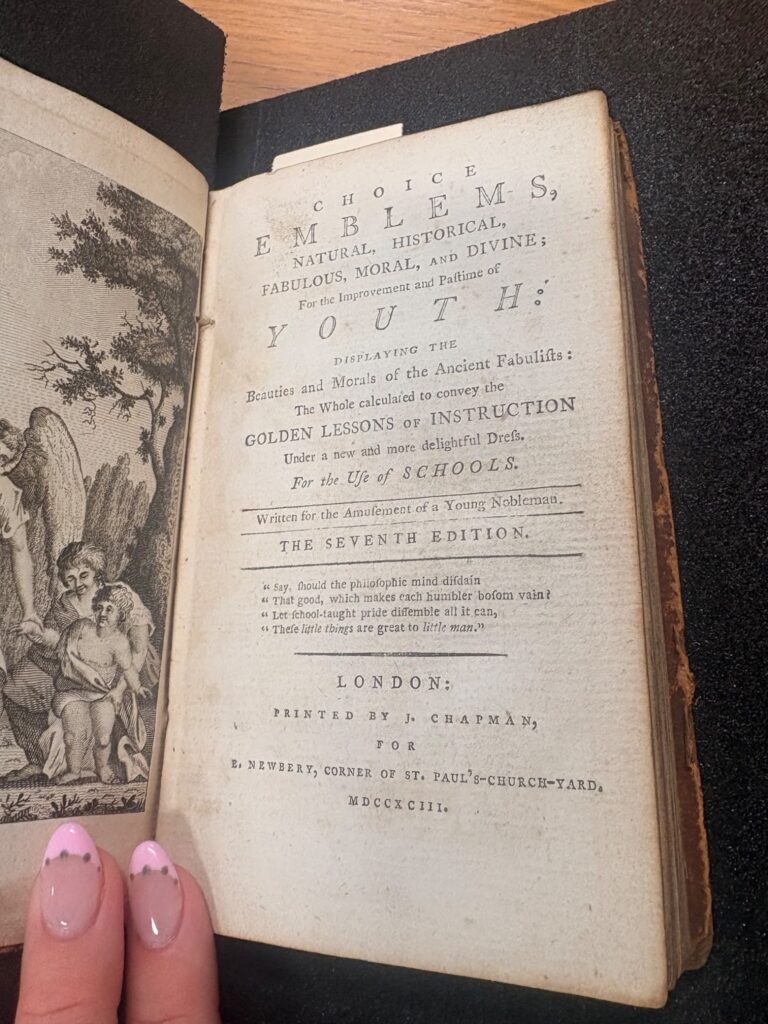
Full Title: Choice Emblems: Natural, Historical, Fabulous, Moral, and Divine For the Improvement and Pastime of Youth: Displaying the Beauties and Morals of the Ancient Fabulists: The Whole Calculated to convey the Golden Lessons of Instruction, Under a New and More Delightful Dress
Publisher: J. Chapman
Bookseller: Elizabeth Newbery
Place of Publication: London, England
Year of Publication: 1793
Michigan State University Library Call Number: PR3779. W5 C5 1793
Edition: 7th
Physical State of Book
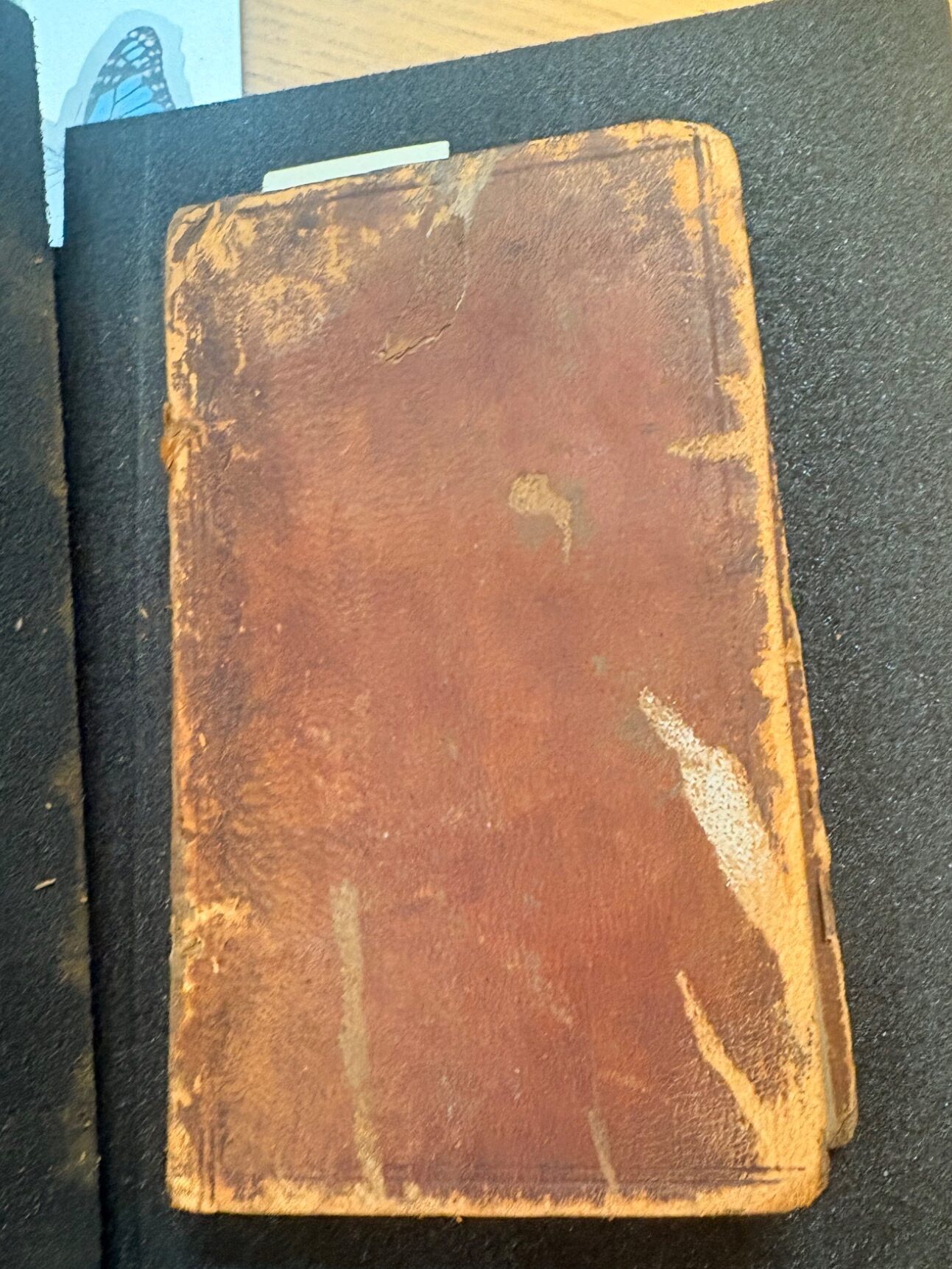
In full contemporary brown leather from calf; boards and spine tooled in bind. Consists of 192 pages with illustrations, engraving and woodcuts.
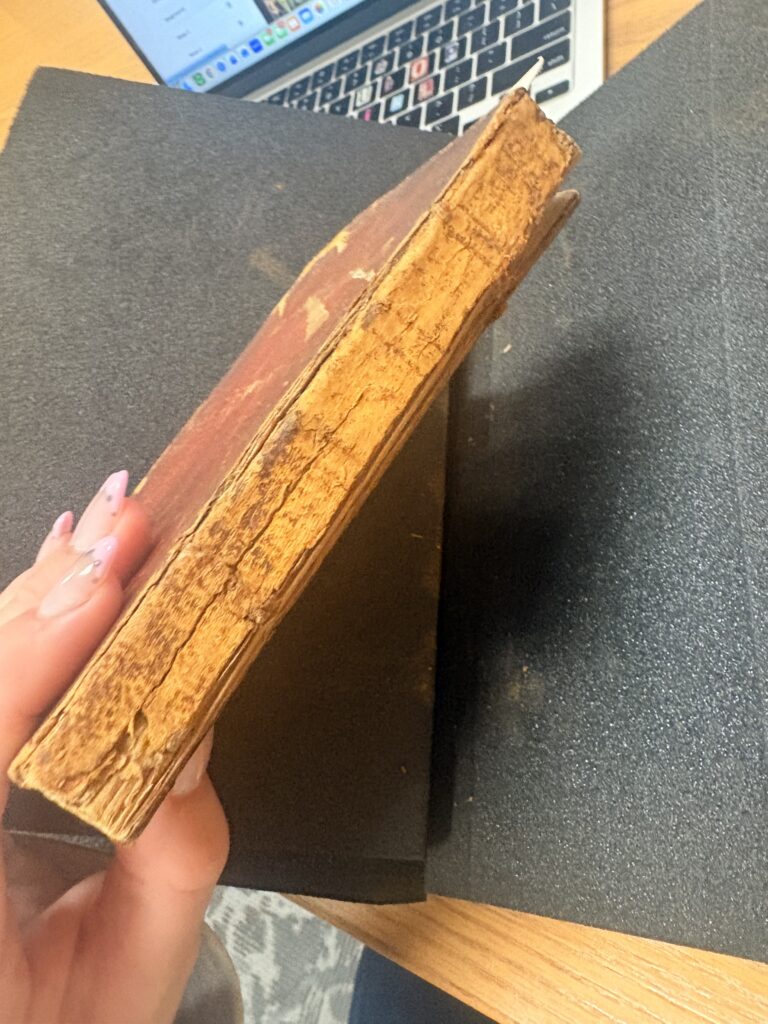
Small, handheld volume with a heavily cracked spine, which tells us it has been reread over and over again over the course of its life. Thick, laid paper with visible foxing and darkening along the outer margins of several leaves. the inner margins near the gutter show light creasing and compression, suggesting repeated opening and use of the text over time. There are subtle shadow-like impressions on certain pages, likely caused by previously inserted materials, such as potentially loose papers or notes, which temporarily shielded areas of the paper from uniform aging.
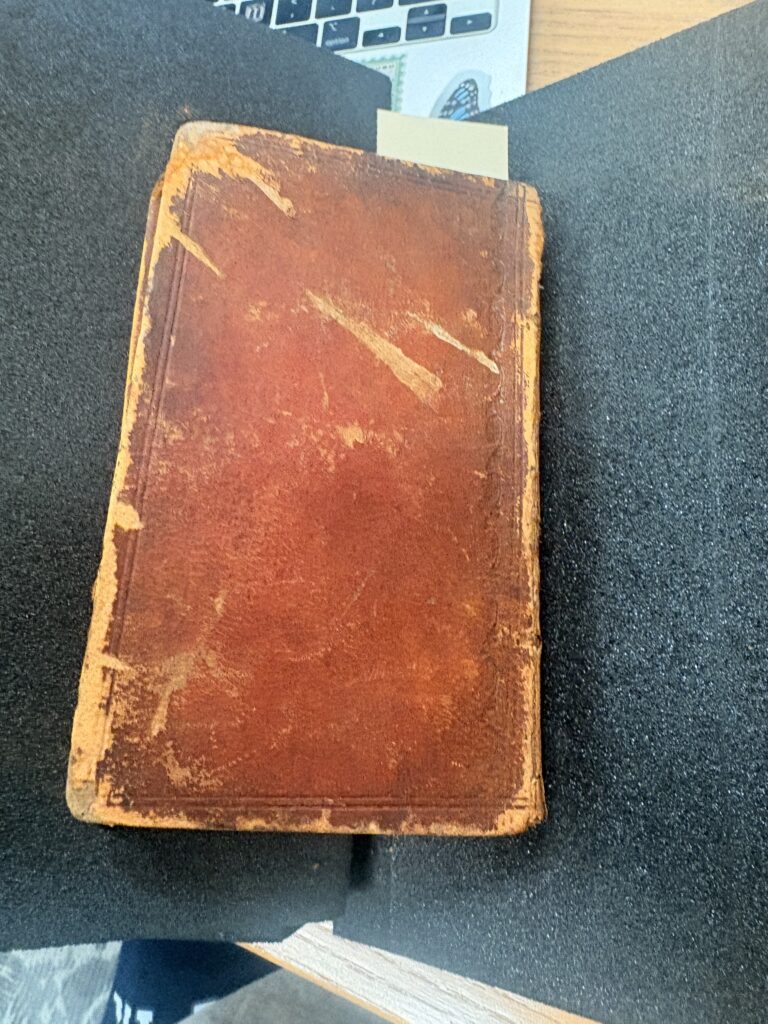
Overall, however, the book is structurally intact despite being clearly very well used.
Additionally, it contains engraved plates and emblem illustrations, which means that each image and text together ends in a moral lesson. This was an extremely popular educational format in the 17th-18th centuries.
Author
John Huddlestone Wynne
Although the title page does not mention an author, when cross-referencing with the online library database as well as the internet, I found that Choice Emblems was written by John Wynne.
John Huddlestone Wynne was born in 1743 and died in 1788. John was sent to St. Paul’s School and intended to pursue a liberal profession, but after his mother’s passing, his father decided to apprentice him to a printer. He spent some years in India (1759-1761), and upon returning from there, he began to write alongside his job as a printer’s apprentice. Over the course of the next twenty years, Wynne worked as a hack writer, which means that he was hired to produce low quality, rushed, unoriginal works “to order” for money, emphasizing quantity over quality. A bookseller, John Wheble, hired him as editor of the ‘Lady’s Magazine’, and he also worked as an editor for ‘The Gazetteer’. Another bookseller, Goldsmith, had him write “A General History of Ireland”, which was by far one of his most successful works. He was then employed as a compositor for ‘The General Evening Post’, whom he wrote a short article for every day. Along with Choice Emblems and A General History of Ireland, his writings for booksellers such as Wheble and Goldsmith included titles such as: Tales for Youth; The Prostitute: The Poem; A General History of the British Empire in America, and Evelina: A Poem.
Wynne was known to be an eccentric man to say the very least, and it was also confirmed by his own son that he suffered from a drinking problem, “it was impossible for a man of his ardent imagination to avoid on every occasion sacrificing too freely at the shrine of Bacchus”, which, to put it nicely, loosely translates to alcoholism. On one drunken night, he was run over by a hackney carriage and was reportedly “lame” for the last decade of his life. Additionally, “Some of the eccentricities which he developed are said to have been due to three promises he made to his mother on her deathbed – that he would a., shun horses, b. Never go into a boat, and c., never go into a belfry. John was a “notoriously irascible man”, and not long after the wedding and having a child, he and his wife separated.
Contents
Choice Emblems is a 18th century educational book which was printed for the intent of teaching children about the virtues of topics such as purity, fidelity, guilt, constant affection, zeal towards god, wisdom, and brotherly love. It uses short, straightforward instructions and prose on what is imperative for behaving as a person of society. It states it was written for the ‘amusement of a young nobleman’, and, ‘for the use of schools’.
This book reflects the rise of enlightenment era emphasis on moral education as well as printing culture centered in St. Paul’s churchyard in London.
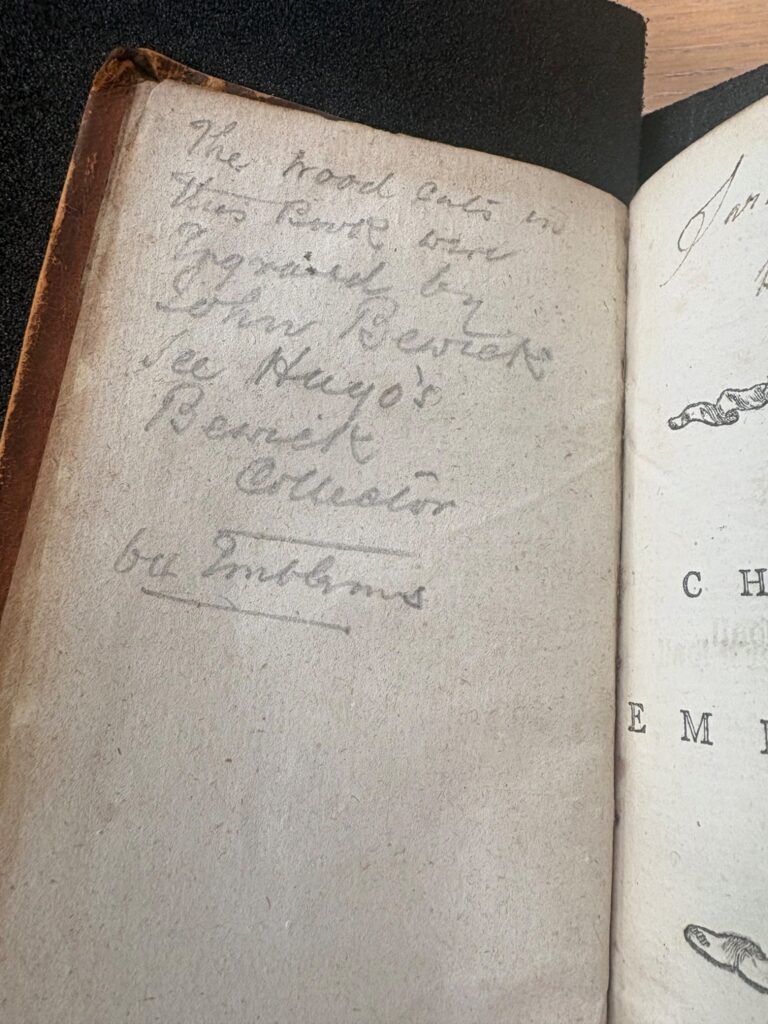
This transcription reads “The wood cuts in this book were engraved by John Bewick. See Hugo’s Bewick Collector. 64 emblems”.
John Bewick was born in Northumberland in 1760 and passed away in early 1795. He was a British wood engraver and illustrator and was recognized as one of the earliest to make a living solely through illustrating books, particularly children’s literature.
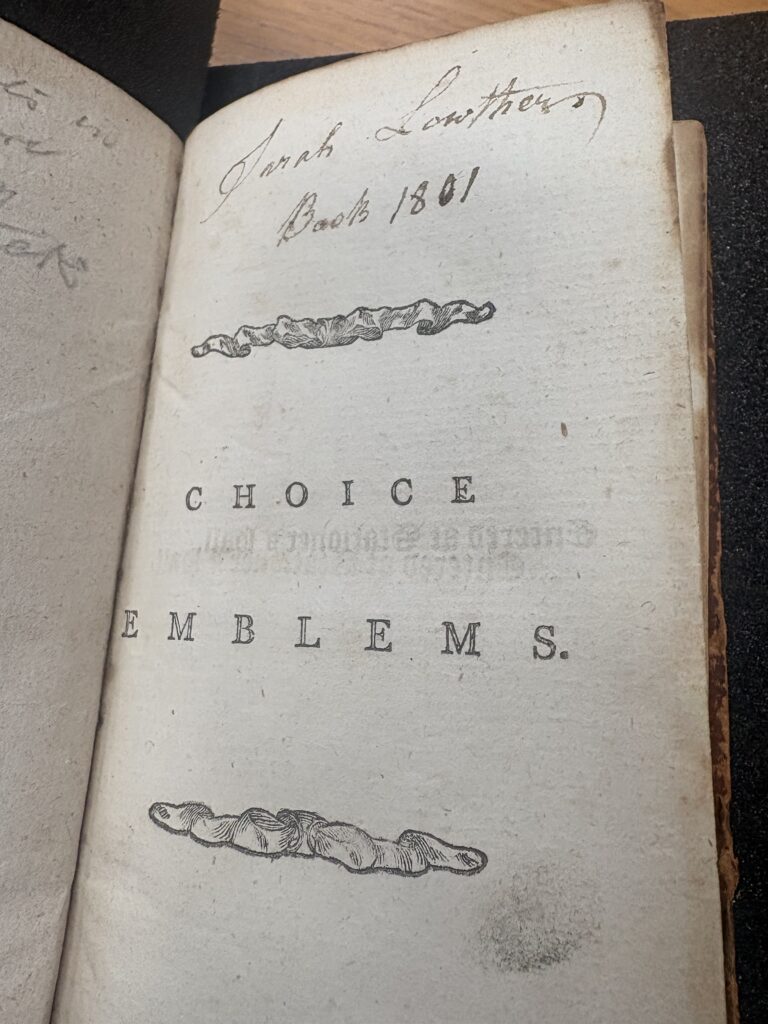
Title Page, notably void of any mention of author
Includes signature of Sarah Lowther (1790-1846); see under “Emblems” section
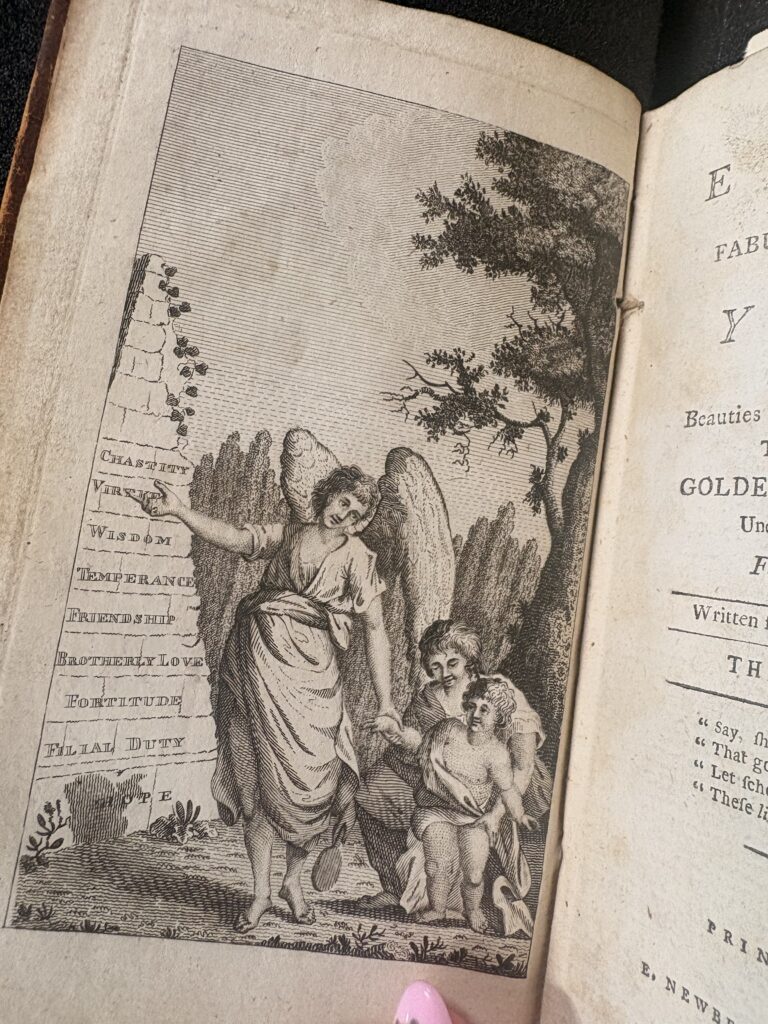
Frontispiece
Illustration of angel and mother teaching young child the ways of chastity, virtue, wisdom, temperance, friendship, brotherly love, fortitude, filial duty, and hope – to name a few.
Dedication
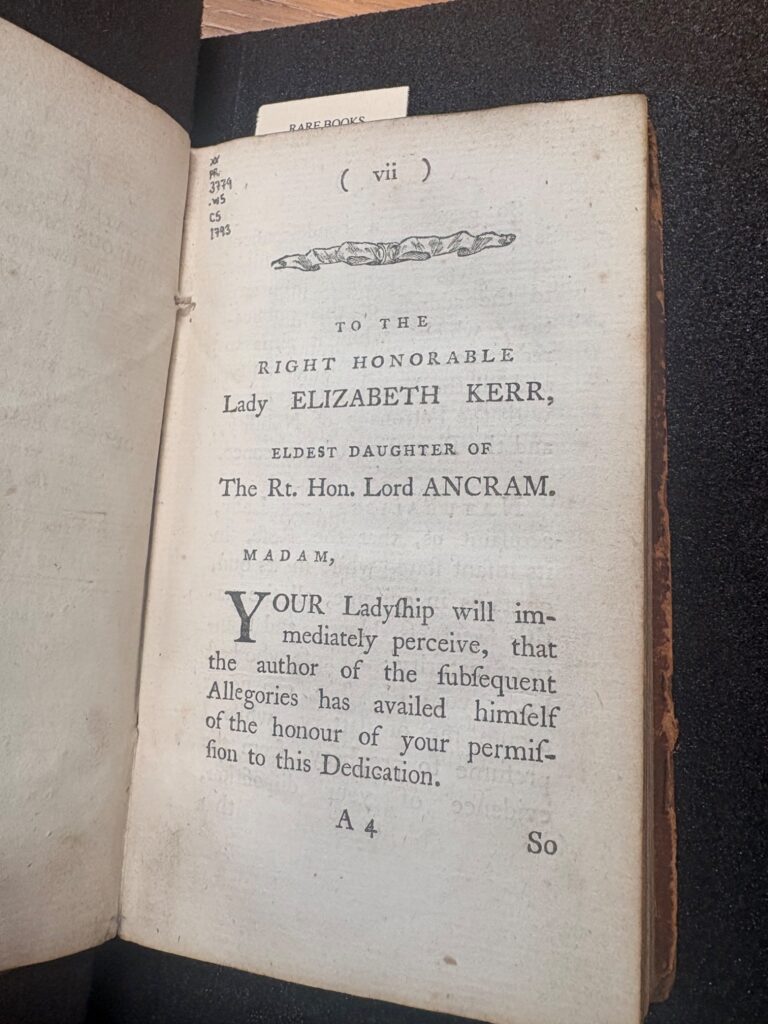
As stated on the page in photo to the left, Choice Emblems was dedicated to the Right Honorable Lady Elizabeth Kerr, Eldest Daughter of the Rt. Hon. Lord Ancram, and Wynne writes “your ladyship will immediately perceive that the author of the subsequent allegories has availed himself of the honour of your permission to this dedication”.
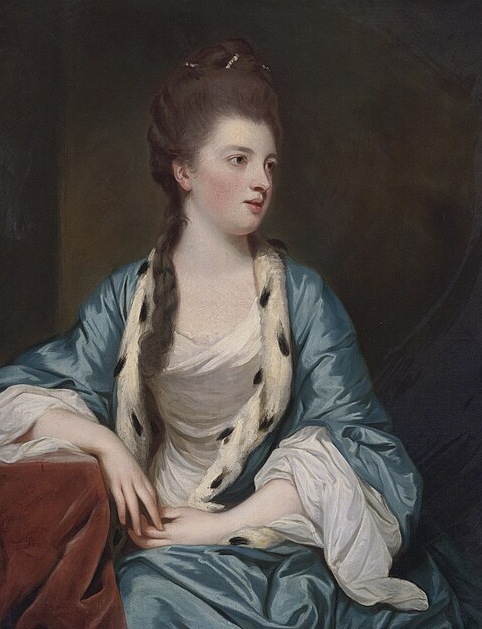
Lady Elizabeth Kerr, nee Fortescue, also known as Elizabeth, Marchioness of Lothian, and Elizabeth Kerr of Lothian, was born in 1745 in County Down, Northern Ireland, and passed away in Great Britain in late 1780. She was known as a noblewoman across both Great Britain and Ireland. On July 15, 1762, she married William John Kerr (1737-1815) who was referred to as Lord Newbottle/Newbattle and the Earl of Ancram. After her father died in 1775, her husband inherited the Marquistate of Lothian, automatically deeming Elizabeth a marchioness. Elizabeth had her portrait done by the painter Joshua Reynolds around the year 1769, which can be seen above. She had nine children with Lord Newbottle and the last was born a mere 16 days before her death, September 30, 1780.
Emblems
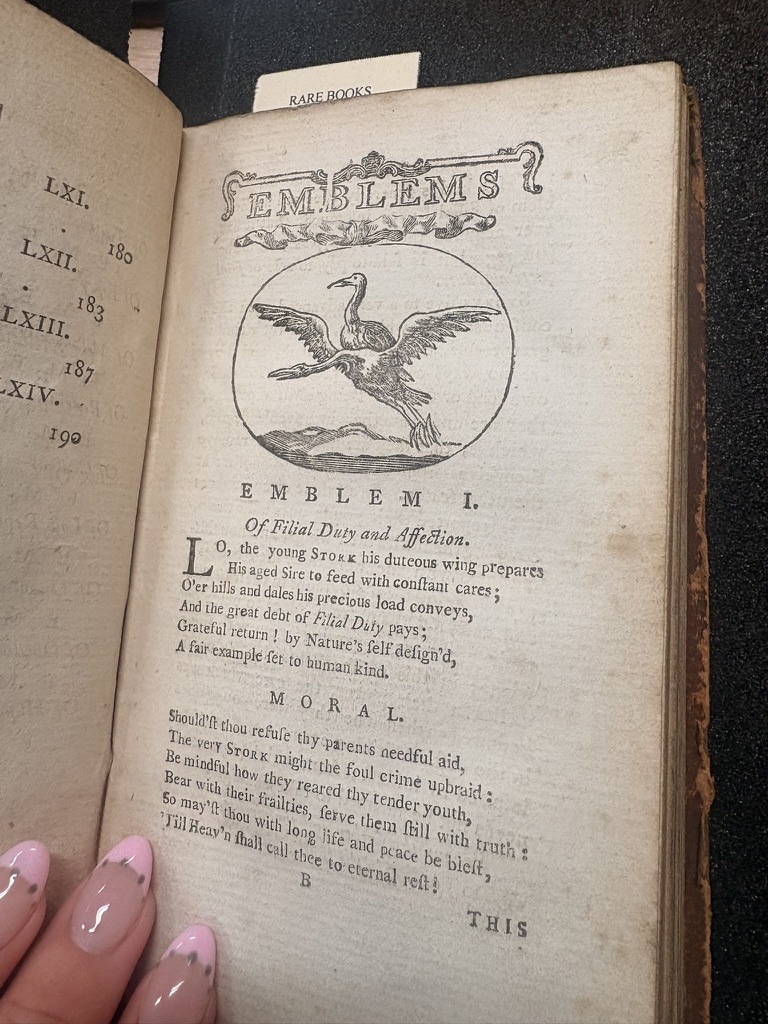
Emblem I: Filial Duty and Affection.
- Depiction of young stork taking care of its elder parent with the strength of his duteous wing.
- The moral of the story in the poem is that, when the stork was young, its parent took care of it. Now that the stork has grown older and stronger, so has its parent, yet much weaker, and so now it is time for the stork to return the favor.
- This is a poem of unconditional love, gratitude, and responsibility. Be kind to your parents and treat them how they treated you as a child. Do not ignore or abandon them, be kind to them in their old age.
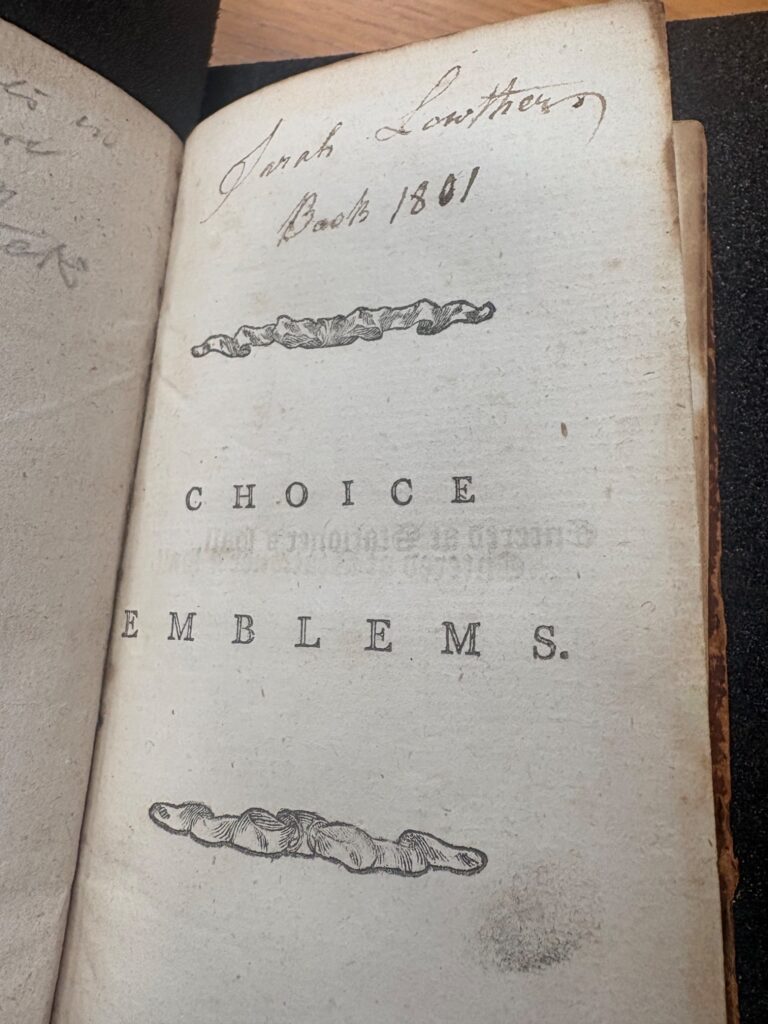
Sarah Lowther was born in 1790 in Yorkshire, England, which made her eleven years old in 1801, when she was presumed to have purchased Choice Emblems. It was entered at Stationer’s Hall, which was located in London, England, so it makes sense as to how the book came to be in her possession. There are very few records of her existence, and on Ancestry.com her parents are listed as unknown. We know that she was married on the 12th of August, 1812, in Sculcoates, York, England, to George Owen (1790-1856), captain and mariner, and they welcomed their first and only child Mary Ann Owen in 1813. Sarah died at 56 years old in June 1846 where she grew up, in Yorkshire.
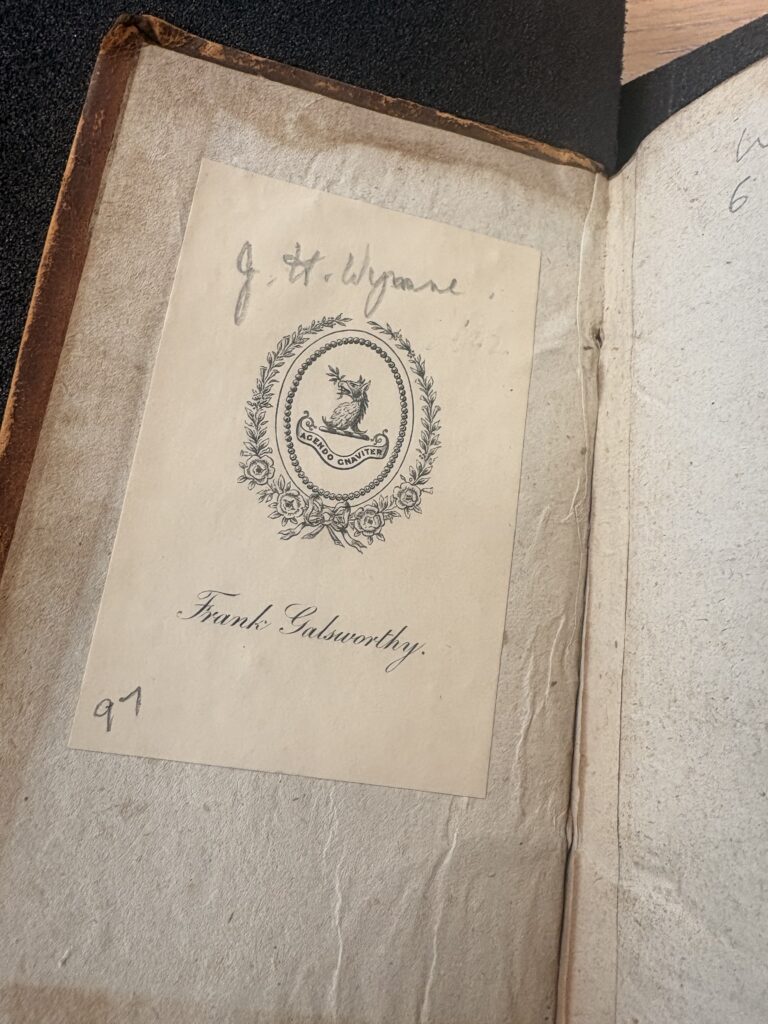
Frank Galsworthy was an English watercolor artist as well as an expert within the realm of flowers and gardens. He was born in Marylebone, England in 1863, and had originally trained to become an architect before moving to Green Acre Farm in Surrey from 1890-1959; where he discovered his talent and adoration for capturing nature. He traveled to New York City twice between the years of 1921 and 1925 to exhibit his work in two different Manhattan galleries, Anderson and Kingore. In 1930, he went on to win four RHS gold medals. Frank was the cousin of famous author John Galsworthy who wrote the Forsyte Saga. Notably, his works have gone up for sale at public auctions on sixty-six different occasions. Before his death in 1959, he requested that no flowers be used at his funeral as he “cared for them too much to let them be cut for that purpose”.
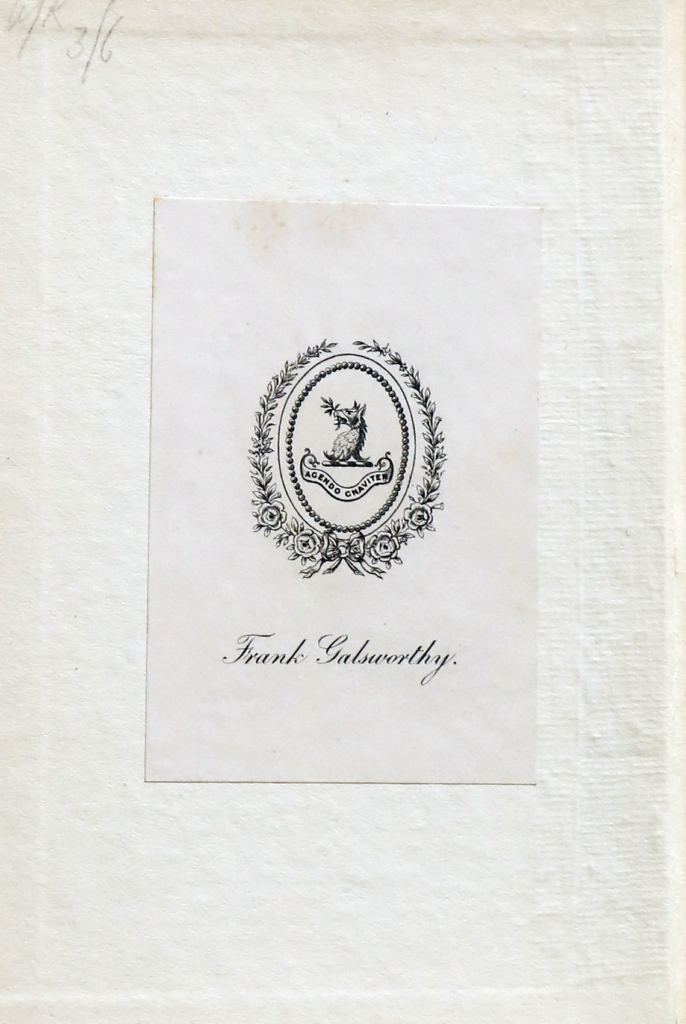
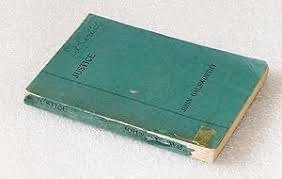
Aside from his artwork, Frank was also a well known book collector and had quite an enviable library. Many of the books in his collection were written by his cousin, John, and I was able to find one for sale online featuring some interesting provenance. The book is titled Justice: A Tragedy In 4 Acts, and it features the same exact bookplate found in Choice Emblems.
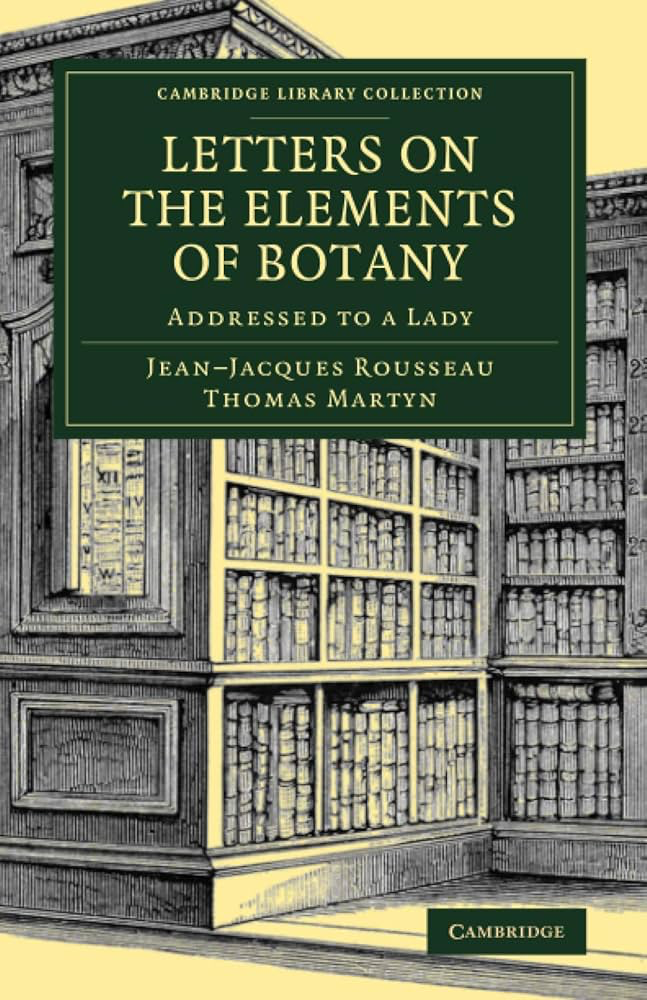
Frank Galsworthy’s unique bookplate has also been found in another rare books, such as Letters on the Elements of Botany, which makes sense to have been in his private library because of his devotion to flowers and botany. To the right is an updated, more modern edition of the original one he owned.
From the extensive research I’ve conducted on Frank Galsworthy’s private library as well as the contents within it, I can conclude that after Frank Galsworthy passed away, most, if not all of the books in his collection were put up for auction or donated to local booksellers. It just so happens that one local bookseller in particular resided much closer to Galsworthy than one would think, a short eight minute walk from his home in Green Acre Farm where he spent the last of his days – leaving his books behind. It is to be assumed that Charles W. Traylen (1905-2006), a British antiquarian bookseller who devoted 80 years to dealing with rare books, manuscripts, and maps, was the one who acquired Choice Emblems directly after Frank’s passing in 1959.
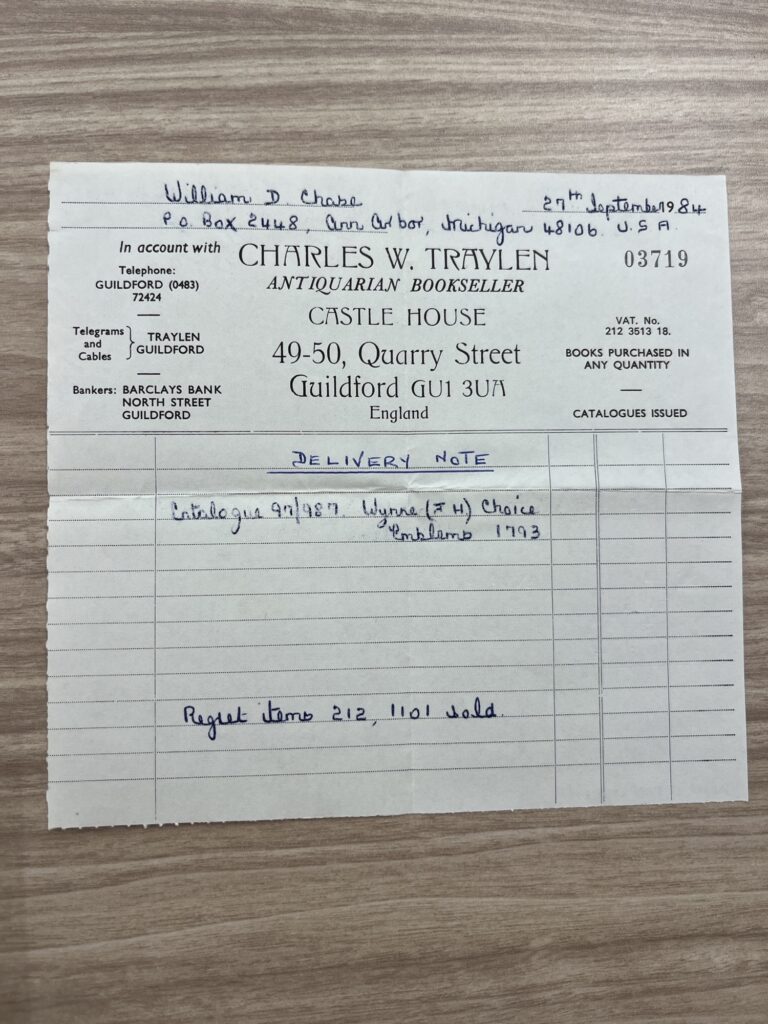
After sitting in Castle House, Charles W Travlen’s antique book shop, Choice Emblems made its way to William and Helen Chase, who began their vast collection of books in 1943. Helen and William were obsessed with learning about history and the written world, and their collection was so vast that it included books and leaves that date back all the way to the very first half century of printing. The original receipt was included with the library file, which states that on September 27, 1984, William D. Chase purchased Choice Emblems from Charles L. Travel, an antiquarian book seller sourced in England for $42.00 (pounds). He had it shipped to his P.O. box in Ann Arbor, Michigan, and it was in his and Helen’s collection until their donation of this book and many others to Michigan State in 2016.
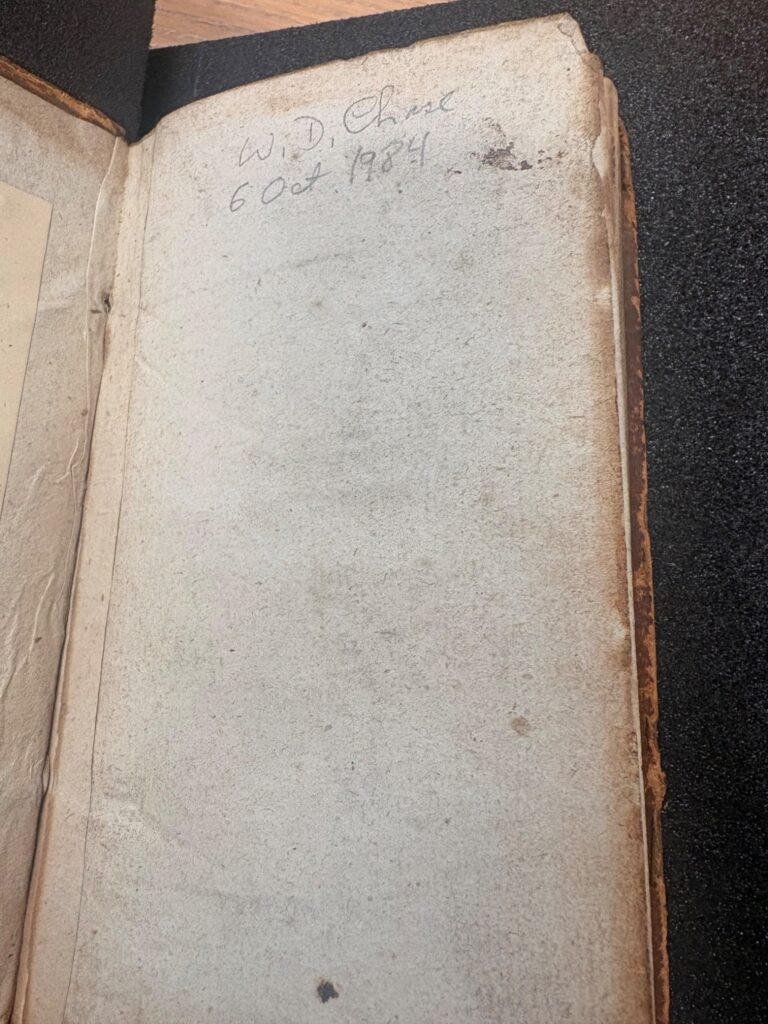
I believe that William Chase decided to purchase this book because it aligns perfectly with the type of books he and Helen strove to have in their collection. They owned hundreds of different almanacs, notably a copy of Benjamin Franklin’s Poor Richard’s Almanac, which consisted of proverbs and wit that advocated for morality and frugality, such as “Early to bed and early to rise, makes a man healthy, wealthy, and wise”. This is similar to the type of rhymes used to boost morale in Choice Emblems, such as “Encourage hope, which heals all human care, The least mad folly is a tad despair; If you are wise, that dreadful evil shun, nor fall unpitied, by yourself undone.”, and, “Who breaks her rules, breaks union, and will find, The sword must punish those no laws can bind.”.
Works Cited
Encyclopaedia Britannica. “John Galsworthy.” Accessed March 20, 2026. https://www.britannica.com/biography/John-Galsworthy.
FamilySearch. “West Virginia Marriages, 1854–1932.” Accessed March 20, 2026. https://familysearch.org/ark:/61903/1:1:XRZP-JQP.
Find a Grave. “Sarah Lowther.” Accessed March 20, 2026. https://www.findagrave.com/memorial/search?firstname=Sarah&middlename=&lastname=lowther&birthyear=&birthyearfilter=&deathyear=&deathyearfilter=&location=&locationId=&bio=&linkedToName=&plot=&memorialid=&mcid=&datefilter=&orderby=r&page=1#sr-216607769.
Jackson Bibliography. “Wynne, John Huddlestone.” Accessed March 23, 2026. https://jacksonbibliography.library.utoronto.ca/author/details/wynne-john-huddlestone/15817.
Michigan State University Libraries. “Ebook Plate Collection.” Accessed March 23, 2026. https://lib.msu.edu/support/ebookplates/1263.
WeRelate. “Robert Lowther.” Accessed March 23, 2026. https://www.werelate.org/wiki/Person:Robert_Lowther_%286%29.
WeRelate. “Sarah Lowther.” Accessed March 24 2026. https://www.werelate.org/wiki/Person:Sarah_Lowther_(3).
Wikipedia contributors. “Elizabeth Fortescue.” Accessed March 25 2026. https://en.wikipedia.org/w/index.php?title=Elizabeth_Fortescue&oldid=1339629693.
Wikipedia contributors. “File: Elizabeth Kerr of Lothian (1745–1780).” Wikipedia, The Free Encyclopedia. Accessed March 26, 2026. https://en.wikipedia.org/wiki/File:Elizabeth_Kerr_of_Lothian_(1745-1780)_by_Jo.
Wikisource contributors. “John Huddlestone Wynne.” Dictionary of National Biography, 1885–1900. Accessed March 26, 2026. https://en.wikisource.org/w/index.php?title=Dictionary_of_National_Biography,_1885-1900/Wynne,_John_Huddlestone&oldid=11882393.
Biodiversity Heritage Library Blog. “Basic Guide to Rare Book Research.” Accessed March 26, 2026. https://blog.biodiversitylibrary.org/2019/11/basic-guide-rare-book-research.html.
Feoli Fine Art. “Frank Galsworthy.” Accessed April 13, 2026. https://www.feolifineart.net/artist.php?id=308
Carr, Jean. Cornwall’s Daffodil King: P. D. Williams. DAFF Library, 2018. https://dafflibrary.org/wp-content/uploads/Frank-Galsworthy.pdf
AbeBooks. “The Dark Flower by John Galsworthy (Signed First Edition).” Accessed April 13, 2026. https://www.abebooks.com/signed-first-edition/Dark-Flower-GALSWORTHY-John-London-William/31171084411/bd
AbeBooks. “Two Forsyte Interludes: A Silent Wooing; Passers By by John Galsworthy (First Edition).” Accessed April 13, 2026. https://www.abebooks.com/first-edition/Two-Forsyte-Interludes-Silent-Wooing-Passers/32029884521/bd
AbeBooks. “Justice: A Tragedy in Four Acts by John Galsworthy (First Edition).” Accessed April 13, 2026. https://www.abebooks.com/first-edition/Justice-Tragedy-Four-Acts-John-Galsworthy/32029908046/bd
Weber Rare Books. Catalogue 199: Fore-Edge Paintings. Los Angeles: Weber Rare Books, 2010. https://jacksonbibliography.library.utoronto.ca/author/details/wynne-john-huddlestone/15817
Ancestry.com. “Family Tree Entry for Sarah Lowther.” Accessed April 13, 2026. https://www.ancestry.com/family-tree/person/tree/157349083/person/172629776272/facts
Ancestry.com. “Family Tree Entry for George Owen.” Accessed April 13, 2026. https://www.ancestry.com/family-tree/person/tree/157349083/person/172629776322/facts
University of Toronto Libraries. “Wynne, John Huddlestone (1742–1788).” Jackson Bibliography of Romantic Poetry. Accessed April 13, 2026 https://jacksonbibliography.library.utoronto.ca/author/details/wynne-john-huddlestone/15817
Special thanks to Tad Boehmer and Professor Liam Brockey for their help and contributions for my project!
Created by Claire Scannell for HST 475 Spring Semester 2026, taught by Professor Liam Brockey.
