
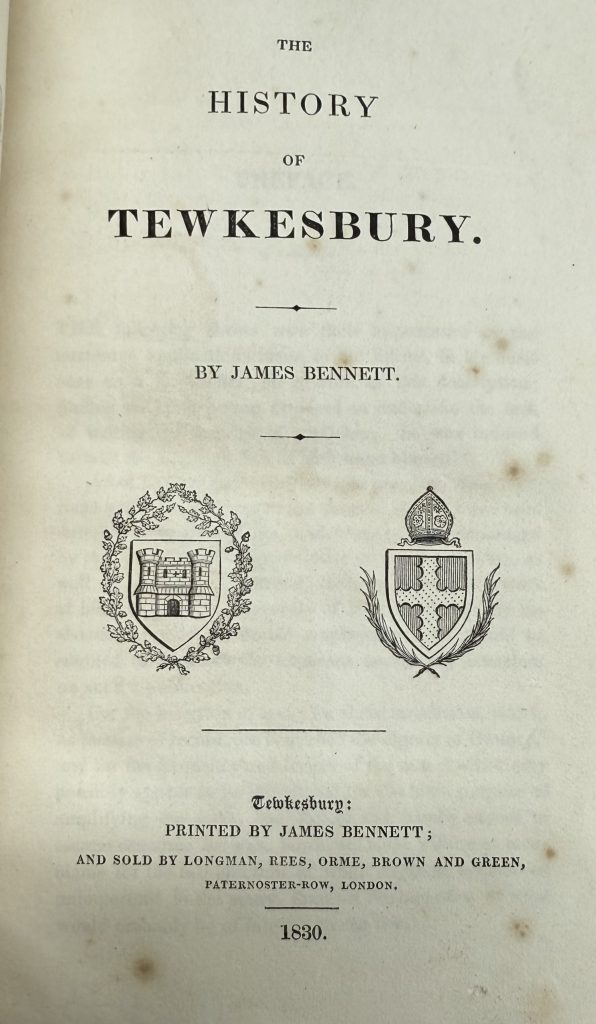
Identification
The History of Tewkesbury book was written by James Bennett (1785-1856), published in 1830 in Tewkesbury, and distributed/sold by a popular publishing firm located in London. The MSU library call number is DA690.T36 B4.
Physical State Of Book
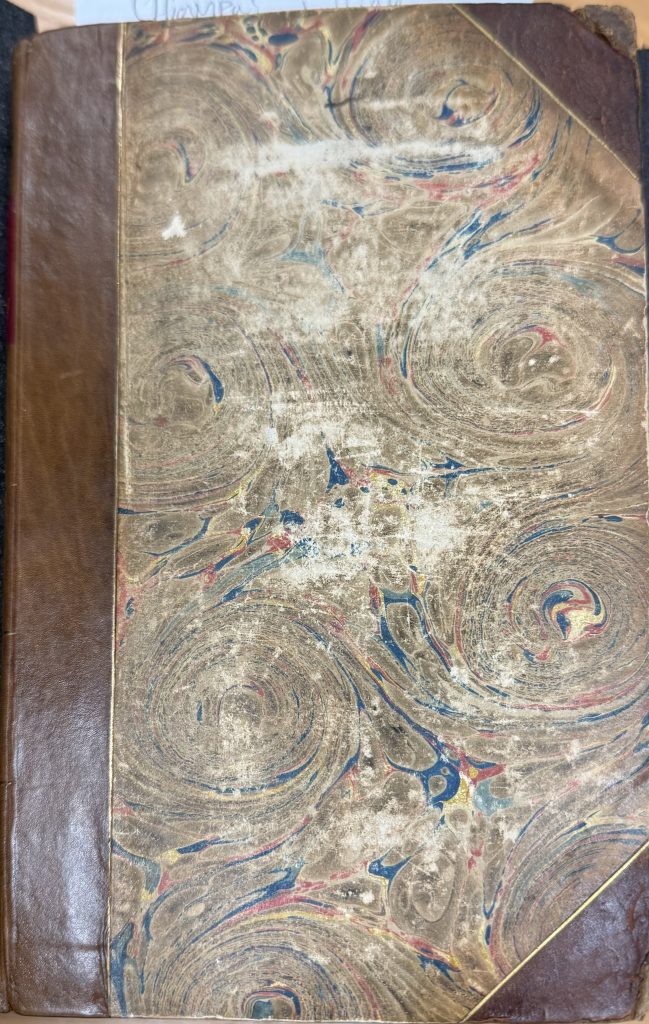
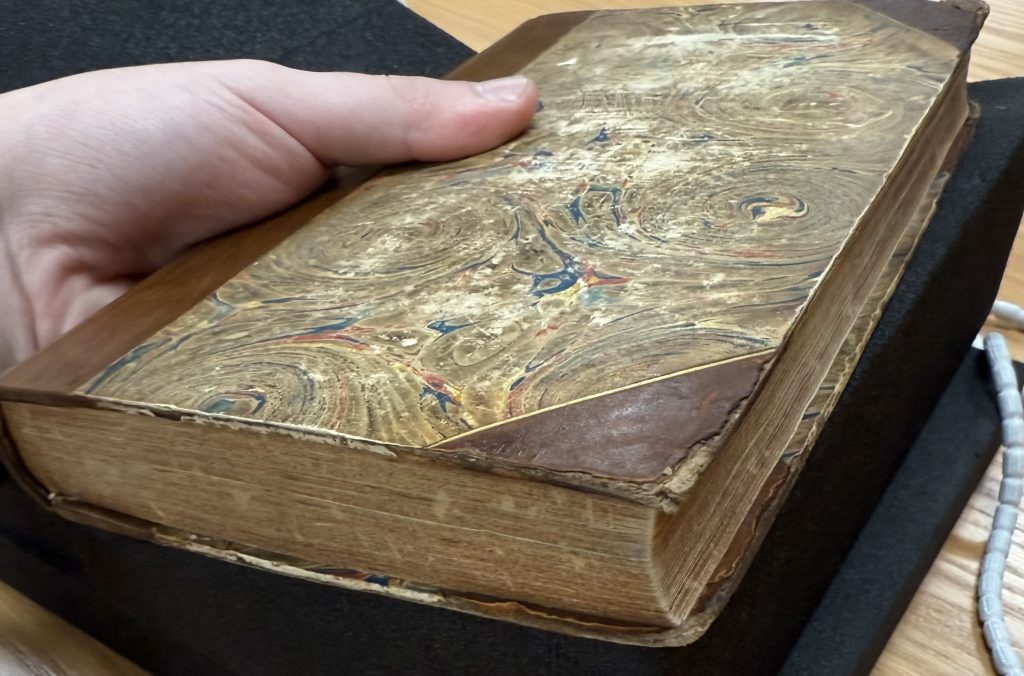
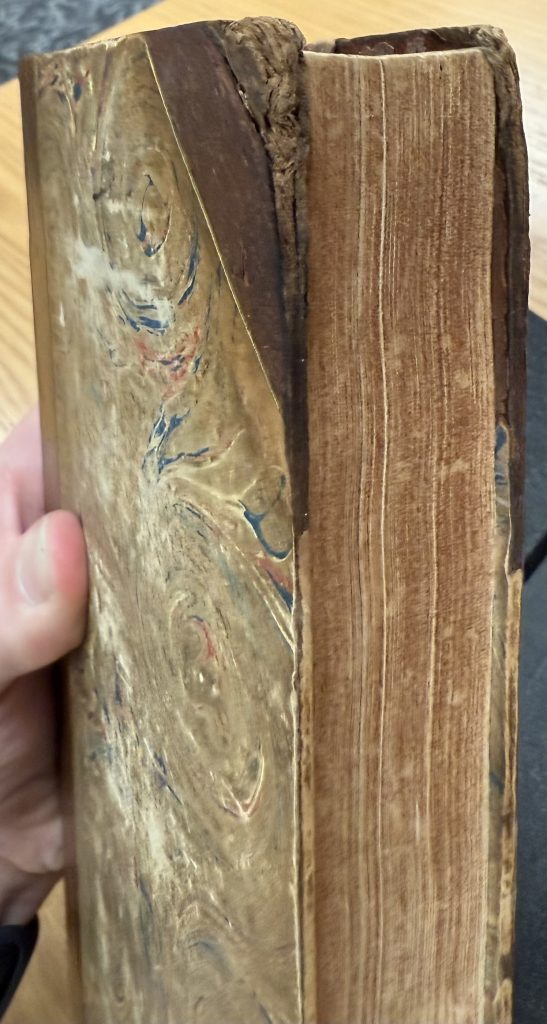
In the binding, a marble paper front and back cover is used, with a half-leather binding wrapped in brown leather with gold tooling lines near the edges and binding. The cover has a leather-ish feel, with some deterioration in the book’s corners and top/bottom sides.
Within the spine and fore edges (to the bottom of the text), the spine has a title label in red leather, with gold tooling lettering featuring the title “History Of Tewkesbury.” In contrast, the fore edges are a plain natural finish, showing discoloration over time as the pages have yellowed/darkened.


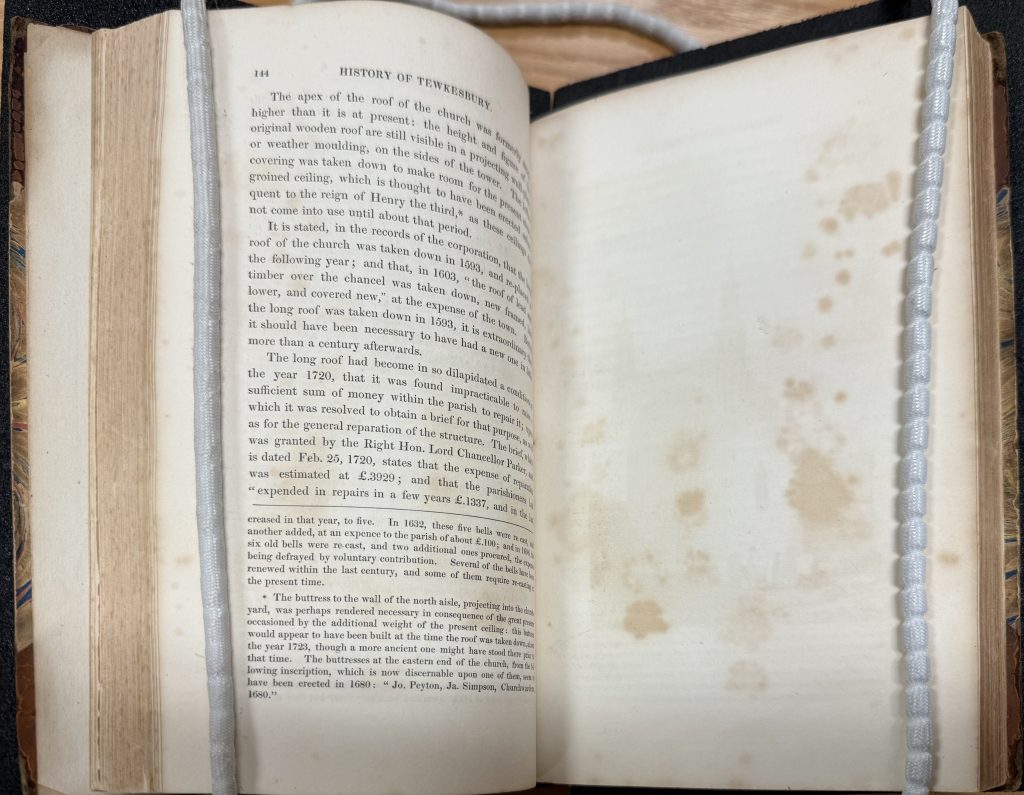
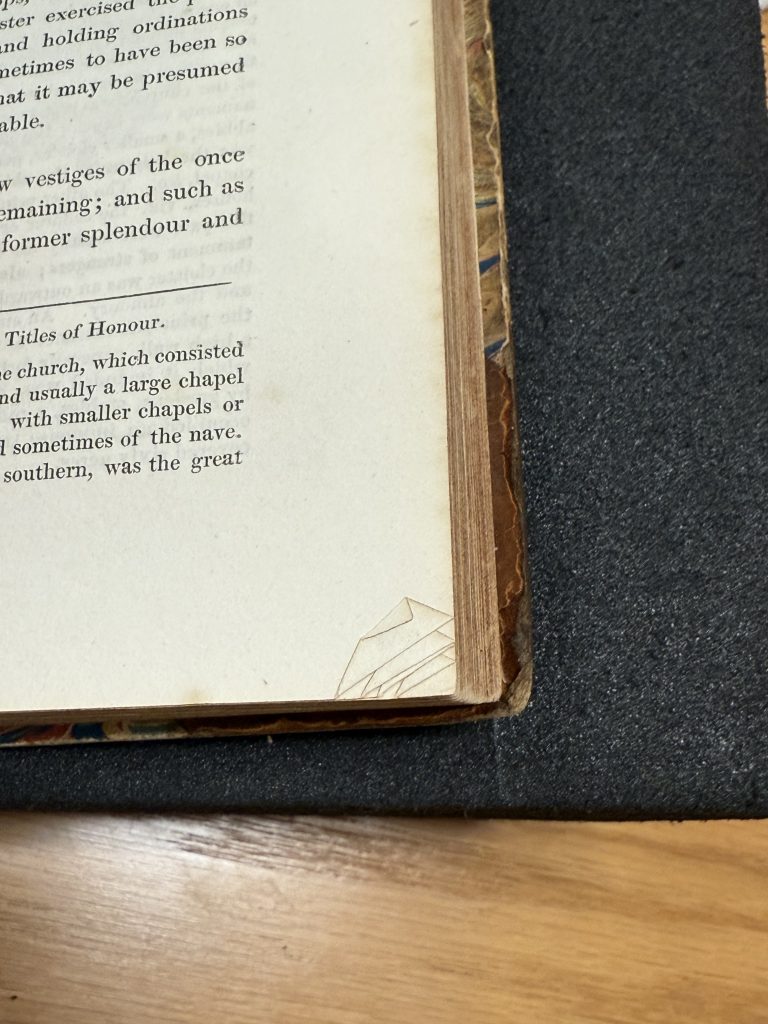
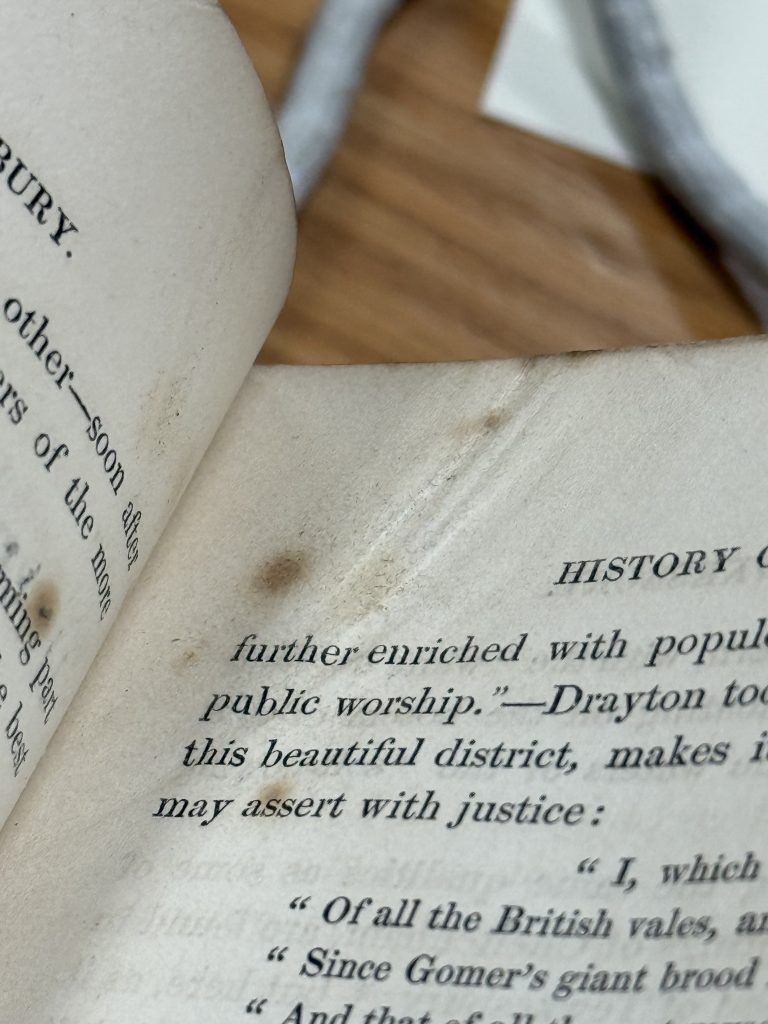
For the physical wear and tear, an additional three predominant features were noted inside and outside the book. Within the outside of the book, the corners and top/bottom edges of the binding have some noticeable cracking, deterioration, and scuffing. On the inside of the book, the pages are made out of linen, which prompts foxing to occur primarily on the front and end sections of the book, ranging in light and dark orange spots to be scattered across various pages. One last minor feature is that some pages have a tiny bending crease ranging four pages long due to improper handling, while another crease can be a page long in different corners.
Contents of the Book
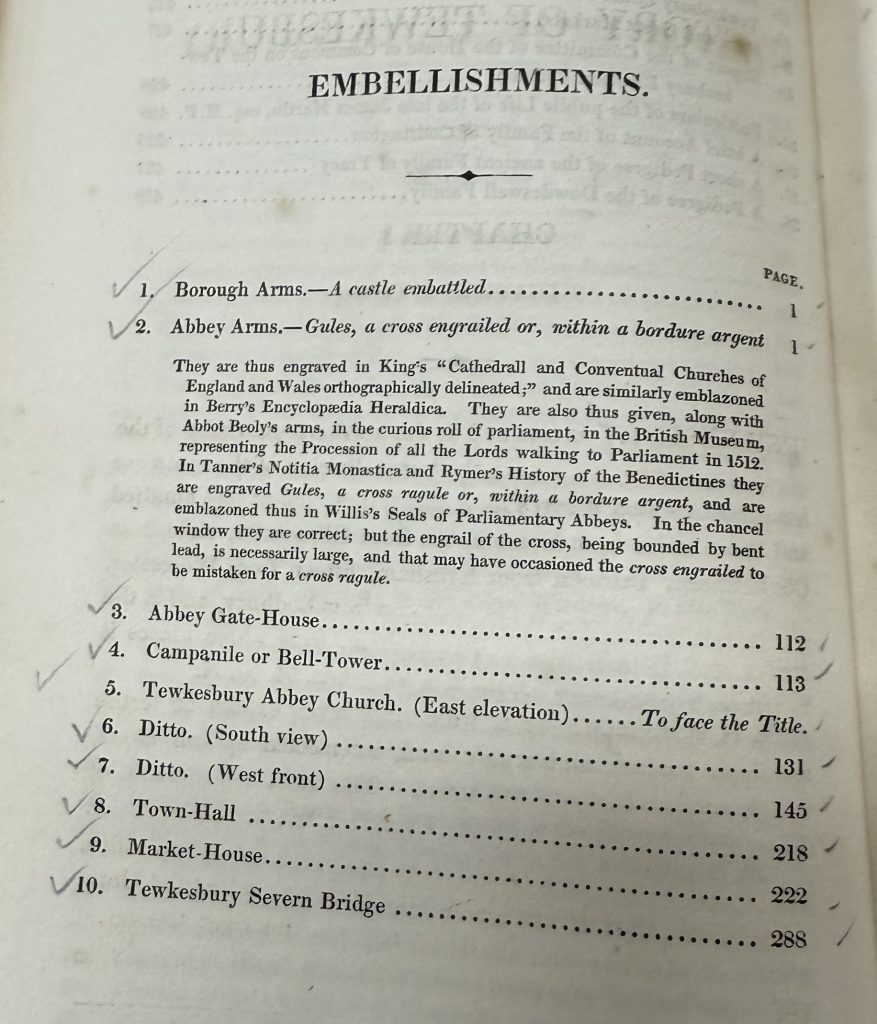
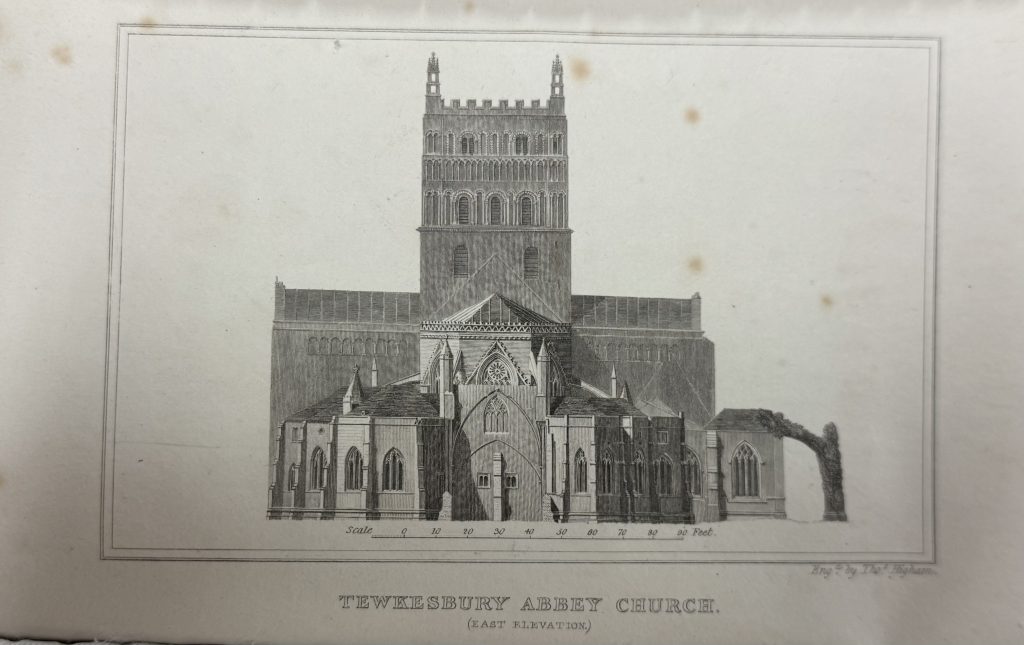
As the book mainly consists of text in a serif typeface, the fonts come in both big and small lettering depending on the context with footnotes and the end of various pages. Inside the book, 10 embellishments (or illustrations) are pasted throughout the pages, all referencing an important structure or identity to Tewkesbury; while it also contains 23 chapters and 38 contents of the appendix. The book has no noticeable page removals or additions, meaning the pagination is straightforward [8]-456.
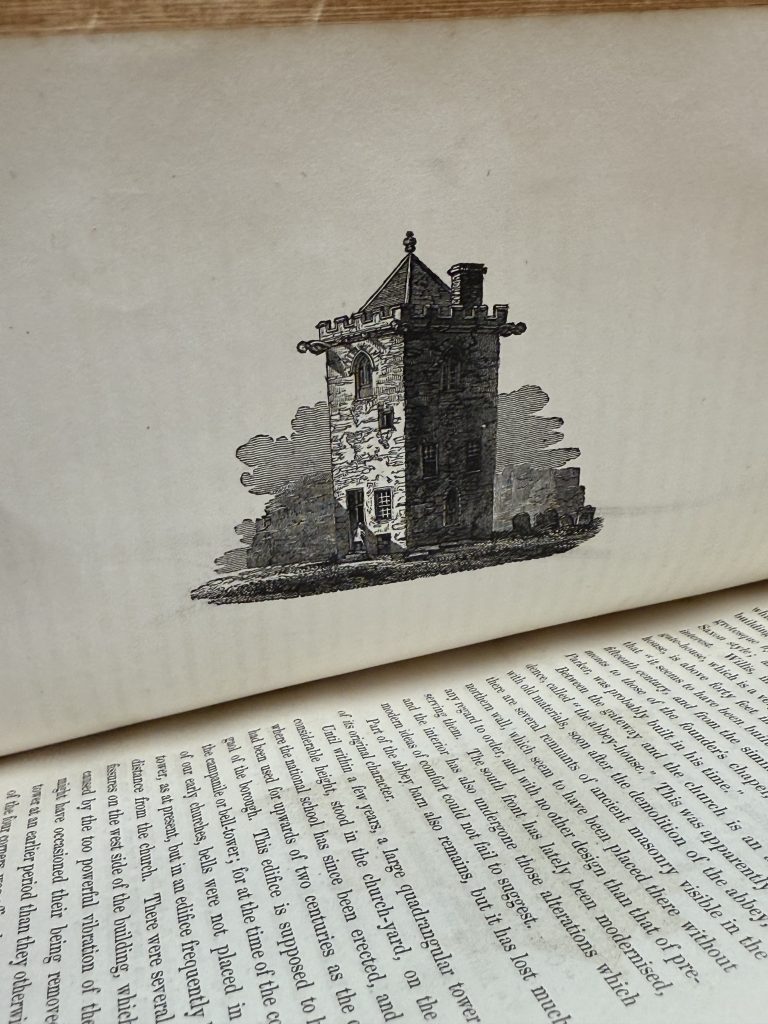
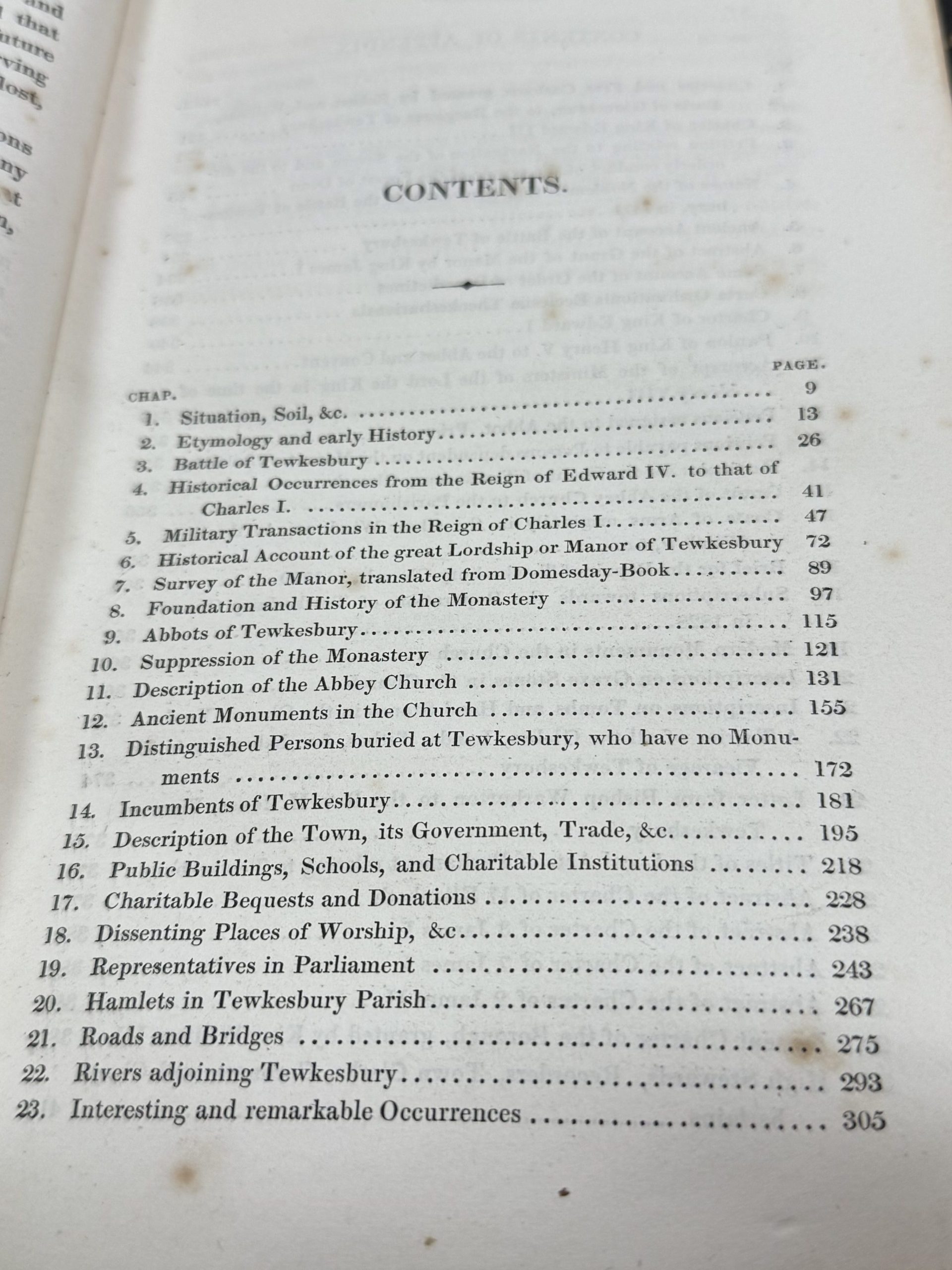
The History of Tewkesbury contains information about the town’s history and past relating to content about religion, monarchy, infrastructure, military, everyday life, government/parliament, and economy/trade. The book itself primarily goes through early, medieval, manorial, military, cultural, and governance history. Religion and monarchy become the two most frequent occurrences within the book, as many of the kings and few queens are mentioned, while church-related topics often arise.
The book itself gives a highly detailed work/reference to not only the town of Tewkesbury and its past but also to what past medieval English towns were like within multiple stages of history; as it can become valuable to read, look at illustrations, and to fully acknowledge what the past looked like through others eyes. As the book goes through King Edward III, James I, Charles I, and many other nobles throughout England, this book goes through the shifting of power through many centuries, where a simple book where documents could be lost now are preserved in Bennett’s work.

Coat of Arms
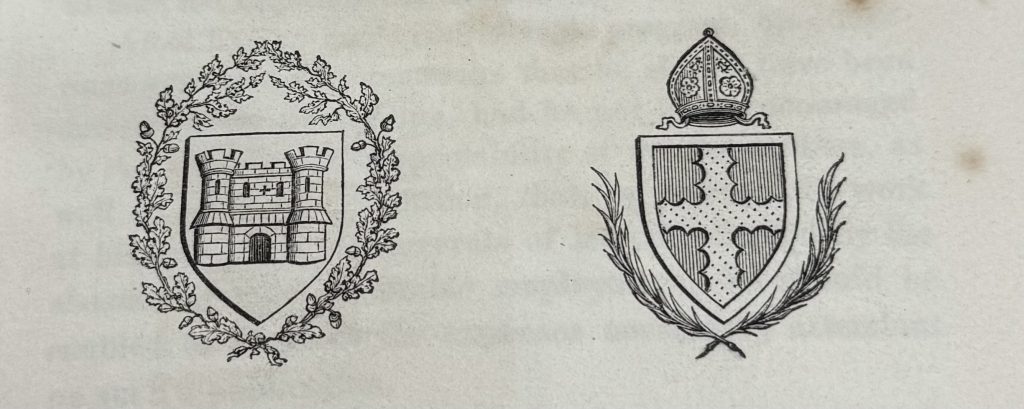
The book’s title page shows two coats of arms in the middle. On the left-hand side, the Borough Arms are shown, while on the righthand side, the Abbey Arms are displayed. To explain the coats of arms, Abbey Arms relates to Tewkesbury Abbey, a famous church built in the 12th century with major religious significance within the town. Even though the pages are in black and white, the colored version of the arms would have a red background, a gold cross, and a silver border. Borough Arms is explained as an embattled castle, relating to defending a town/structure (in this case, Tewkesbury Abbey).
Author – James Bennett (1785-1856)
As James Bennett became a distinguished printer and bookseller in the small town of Tewkesbury, Bennett wanted to write a book about his town’s history simply because no other person would take on a complex project to handle. Unfortunately, as the previous sentence is the only piece of information about the context, we do not know the timeframe for how long it took Bennett to write his book, but is rather striking that Bennett self published his book during the mid-19th century. Bennett would marry his wife in 1823, have four children, and outlive three of his children and his wife before death. Bennett would also publish a magazine that would essentially expand his 1830 book (updating information about the book) and publish versions until 1849.
Provenance
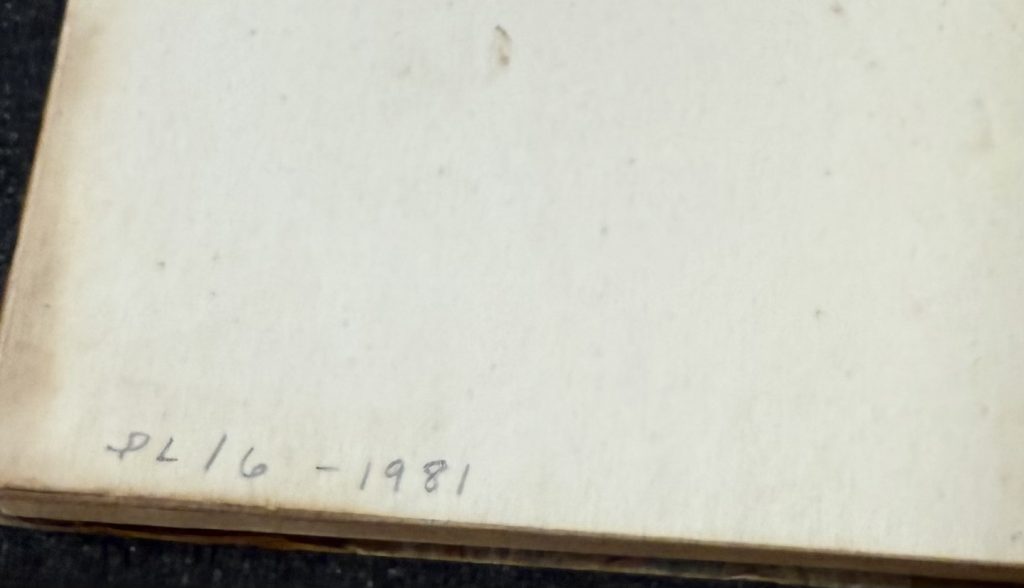
All throughout the History of Tewkesbury, a total of six unique elements were physically found within the book (after observing the book twice in March of 2025). The first three elements directly refer to former ownership, with James Fallon, Henry Fallon, and Charles Mapp being the former owners by their inscriptions and markers on the pastedown page. The remaining three elements are minor references to unknown British provenance and MSU ownership, primarily with handling and pencil markings on free endpapers (Notes written: Complete 12/11/78, £38 (including restoration), PL/6- 1981).
James Fallon- (1807-1885)
Presumably, James Fallon can be the original owner of this book; there are no mentions of a “Fallon” in the book or of his father. When viewing many England censuses, it was found that J.Fallon was a Barrister at law (lawyer) for much of his career, as he was also an alderman/recorder for the town in his later years. James would attend college at Queen’s College in Cambridge around 1828-1829. Fallon would spend most of his life in Cheltenham (a town near Tewkesbury). Married in 1840 to Anna Skillicorne, the couple had two sons, Henry in 1841 and William in 1853. The inscription says “James Fallon. Recorder of the Boro. October 1869”, meaning that J.Fallon’s position at the time had to write down and deal with legal issues within the borough of Cheltenham, and received the book in October of 1869.

Since James Fallon was a Barrister and Alderman for most of his career, the book was used to reference what past kings and queens did during their regimes while also viewing the town’s history of government (as James’s job relates to the government). James could also use the book as a guide to governance since it has a chapter about representatives in parliament.
Henry Fallon- (1841-1911)
From an ownership marker of Henry’s name below James’s inscription, it can be seen that the book was passed down to the eldest son. As Henry was born in 1841, not much information was accessible about Henry’s quiet life. Henry attended Worcester College in 1861, with mentions of Queen’s College in 1862, Cheltenham College, and King William’s College in previous years.
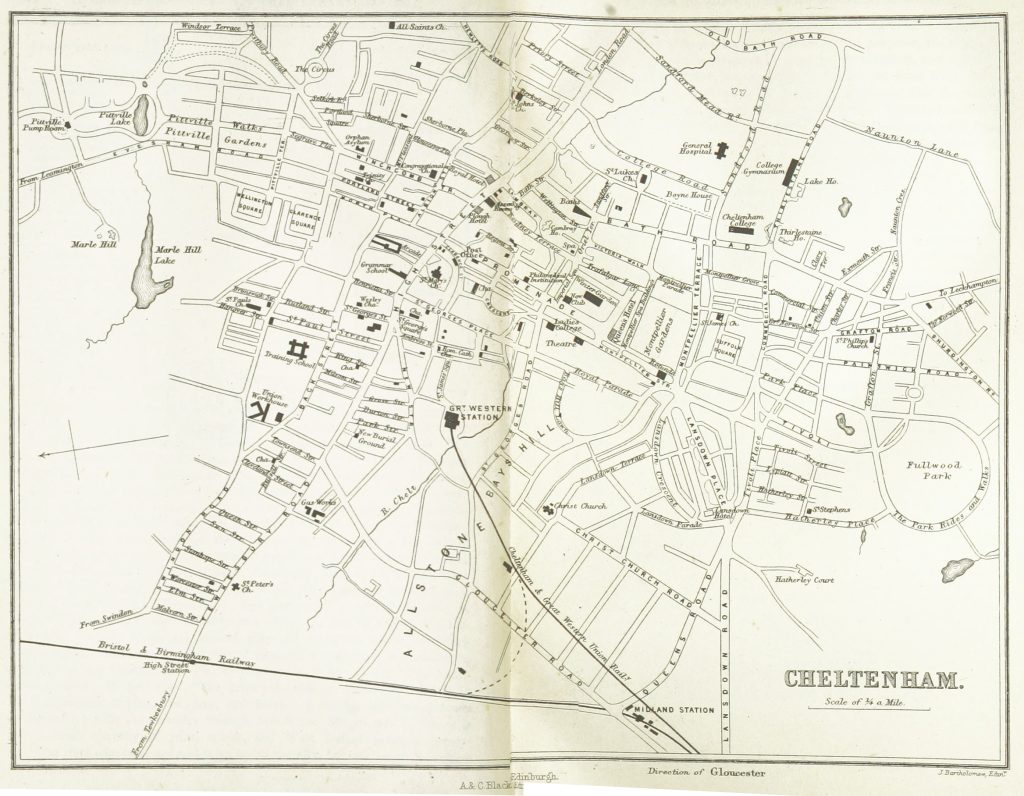
After college Henry was a curate for a church around 1881 (member of the clergy), while a 1901 census has some of the worst handwriting to figure out if his occupation was still in the church, but he did have a female servant during the time. Henry’s mom would die in 1890. Henry passed in 1911 with no wife, and his probate went to his brother William (who was married with no kids and would live until 1923), putting a dead end for how the book was managed once the Fallon bloodline ended. In the ownership marker, all that is said is “Henry N. Fallon.”

Bottom: “Henry N. Fallon”
Because we have Henry’s name in the book, we know that it was passed down to the eldest son, but its use was solely for church purposes; as there are many mentions of nearby churches, places of worship, and references to noblemen, the book’s purpose was to help Henry gain more knowledge about past religion within Tewkesbury, as his career was within the church.
Charles R. Mapp- (1877-1955)
As Mapp has a stamped ownership mark of “Charles R Mapp, Cheltenham,” we can see that the book did not travel far from the Fallons to the Mapps. Charles was born in 1887 in the county of Derbyshire and served in the military in 1916 (during WW1 as a Royal Engineer). When his father passed in 1919, Charles moved to Cheltenham and stayed there for the rest of his life. Not much is learned about his education, but in 1911, he was a schoolmaster (a male teacher) and was still in 1939. Aftering looking through more research I found a 1989 Geological Curator Cheltenham magazine, where Mapp was a professor for the College of St Paul and St Mary within Geology and Geography (now a part of the University of Gloucestershire). Mapp was involved with Cheltenham’s museum committee, specifically in the geology exhibits. Mapp would pass away in 1955 with no wife or kids, leaving a tale of how the book traveled across the pond to become unknown.
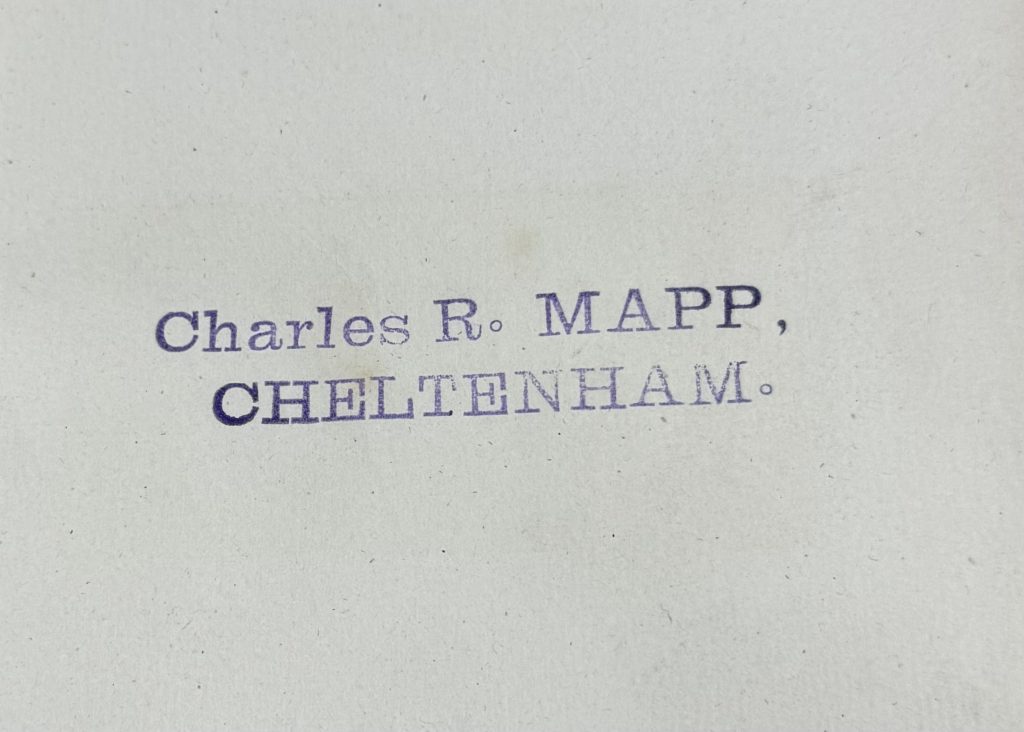
As Charles Mapp was a professor of geography and geography, author James Bennett can be considered a printer and a topographer, which could connect the two interests (geography and topography are in the same field). This means that Mapp used the book as a resource about how the town’s land has changed and evolved over time.
Unknown British Provenance/Michigan State’s Ownership
As there is a significant time from Mapp’s ownership to MSU’s ownership, minor inscriptions can give a sense of how the book landed in Michigan State’s hands. In the top left corner of the book, “Complete 11/12/78” is written in British handwriting. After discussing the writing with Tad Boehmer, a curator at MSU, the date would be flipped to 12/11/78, meaning that the book was completed inspection by the end of 1978.
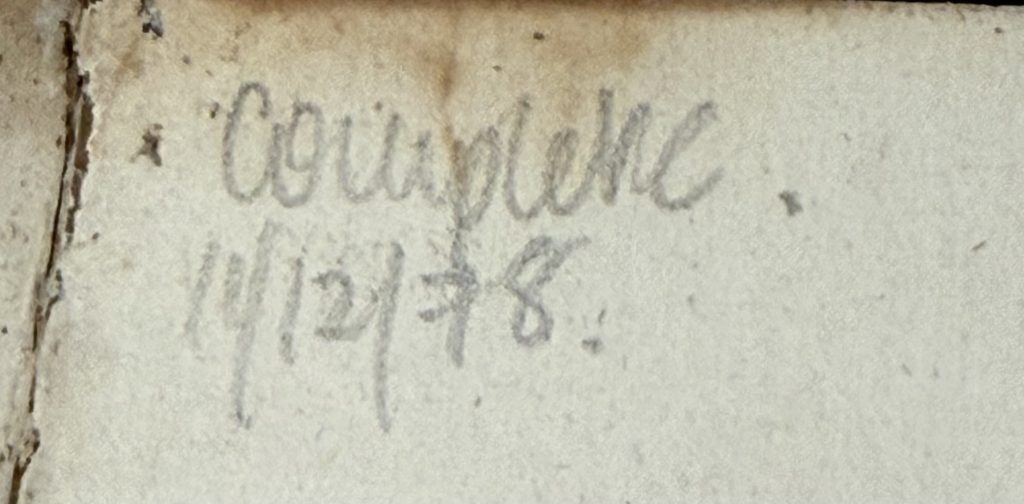
Under the complete date, pencil writing in cursive says “£38 (including restoration).” Thanks to Tad’s cursive translation, the inscription can tell the audience that the book was bought for 38 pounds (£278 or $361 in 2025 money), including some restoration. To the best of my knowledge, it is not easy to find any restoration that occurred, meaning that it could have been an add-on when purchasing the book; but regardless, the book was presumably bought around 1978 for £38, somewhere in England, which can help understand how the book traveled 3,700 miles.
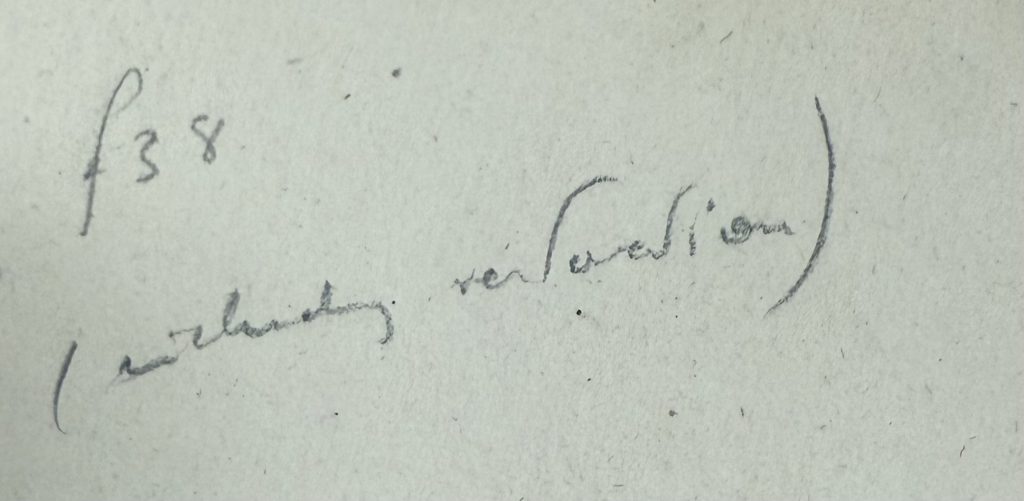
Within the bottom corner of the end page, a marking of “PL/6-1981,” is in pencil writing. At first, this was guaranteed to be related to MSU, as it could have been a note to the book’s reference or call number. However, it became more complicated after Tad received new information, as it revealed “PL” was a librarian’s initial, and “6-1981” means that the book was looked at by “PL” in June of 1981. From the previous two inscriptions, the audience knows that the book was in MSU’s hands around 1978 and 1981.
One last noticeable mark is on the list of embellishments page, with checkmarks and hash lines at the front and ends of the listed embellishments. The pencil marks on the page can refer to the “completion” mark, which was a sign of a British person verifying if the illustrations were still on each page (and after my research) and all ten embellishments were still within the book.
Bibliography
“Ancestry Person- Charles Richard Mapp.” Accessed March 11, 2025. https://www.ancestrylibrary.com/family-tree/person/tree/26679123/person/132051238623/facts.
“Ancestry Person- Henry Fallon.” Accessed March 11, 2025. https://www.ancestrylibrary.com/family-tree/person/tree/63093930/person/30124703311/facts.
“Ancestry Person- James Bennett.” Accessed March 11, 2025. https://www.ancestrylibrary.com/family-tree/person/tree/106192778/person/100052011997/facts.
“Ancestry Person- James Fallon.” Accessed March 11, 2025. https://www.ancestrylibrary.com/family-tree/person/tree/63093930/person/30124588025/facts?_phsrc=iac21&_phstart=successSource.
Bennett, James. The History of Tewkesbury. Tewkesbury : Printed by J. Bennett, 1830.
“James Bennett (Tewkesbury).” In Wikipedia, November 17, 2024. https://en.wikipedia.org/w/index.php?title=James_Bennett_(Tewkesbury)&oldid=1257876703.
“The Geological Curator.” Accessed March 11, 2025. https://www.geocurator.org/images/resources/geocurator/vol5/geocurator_5_5.pdf.
University Of Cambridge. “ACAD- A Cambridge Alumni Database.” Accessed March 11, 2025. https://venn.lib.cam.ac.uk/cgi-bin/search-2018.pl?sur=&suro=w&fir=&firo=c&cit=&cito=c&c=all&z=all&tex=Fallon&sye=&eye=&col=all&maxcount=50.
Wikimedia Commons contributors, “File:Cary’s new itinerary; or, An accurate delineation of the great roads both direct and cross throughout England and Wales – with many of the principal roads in Scotland, From an actual admeasurement (14760238186).jpg,” Wikimedia Commons,https://commons.wikimedia.org/w/index.php?title=File:Cary%27s_new_itinerary;_or,_An_accurate_delineation_of_the_great_roads_both_direct_and_cross_throughout_England_and_Wales_-_with_many_of_the_principal_roads_in_Scotland,_From_an_actual_admeasurement_(14760238186).jpg&oldid=896052722 (accessed March 29, 2025).
Wikimedia Commons contributors, “File:EW(1884) p.260 – Cheltenham (merged) – A + C Black (pub).jpg,” Wikimedia Commons,https://commons.wikimedia.org/w/index.php?title=File:EW(1884)_p.260_-_Cheltenham_(merged)_-_A_%2B_C_Black_(pub).jpg&oldid=914547932 (accessed March 29, 2025).
-William Chiampas, for Dr. Brockey’s HST 475-001 class during Spring 2025.

.jpg&oldid=896052722)
_p.260_-_Cheltenham_(merged)_-_A_%2B_C_Black_(pub).jpg&oldid=914547932)