
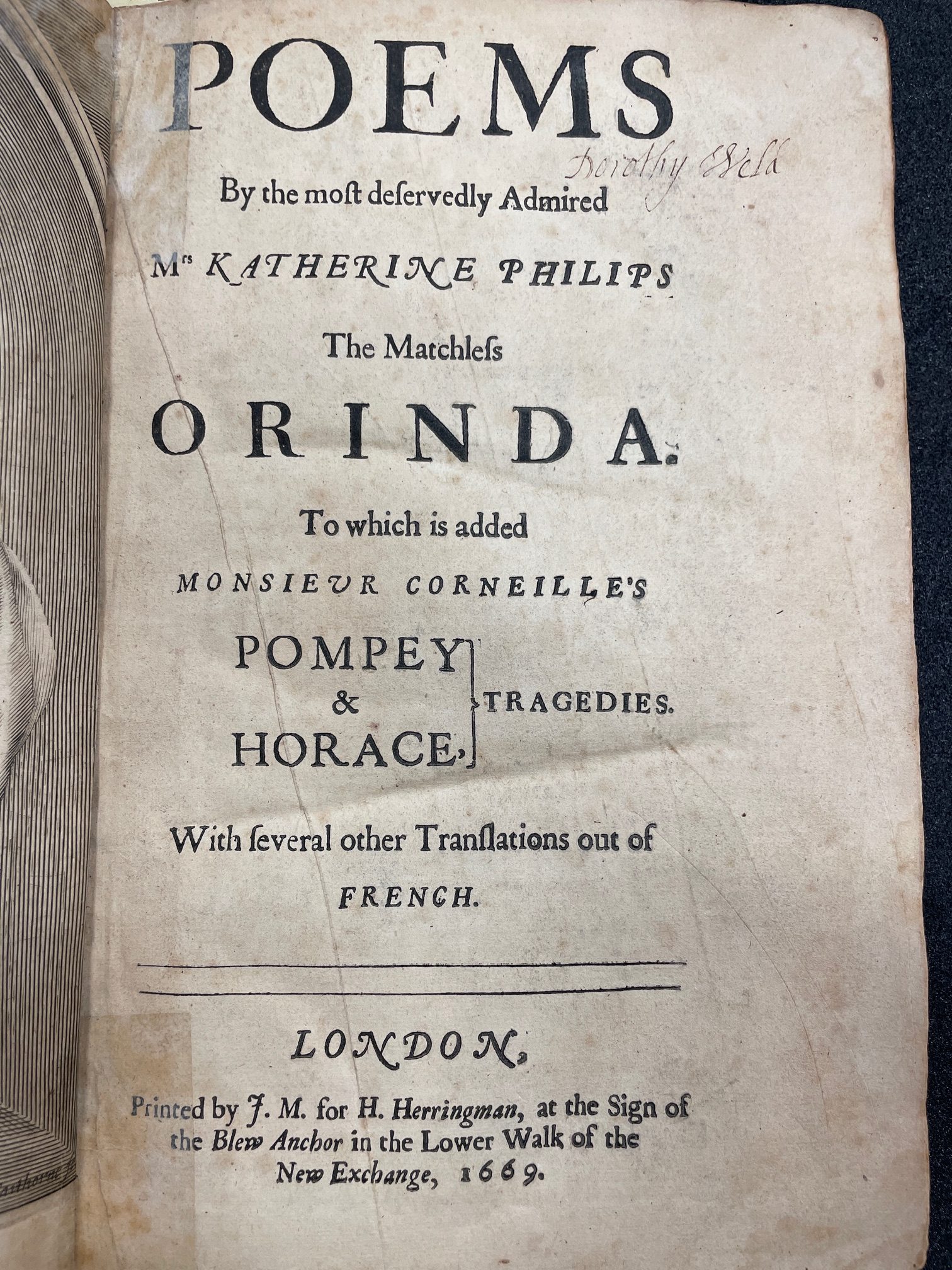
Full Title: Poems by the most deservedly admired Mrs Katherine Philips, the Matchless Orinda: to which is added Monsieur Corneille’s Pompey & Horace, tragedies: with several other translations out of French.
Authors: Katherine Philips, Pierre Corneille
Imprint: London, Printed by John Macock for Henry Herringman, at the sign of the Blew Anchor in the lower walk of the New Exchange, 1669.
MSU Call Number: PR3619 .P4 1669
ESTC Number: R20915
Wing Catalogue Number: P2034
About the Book
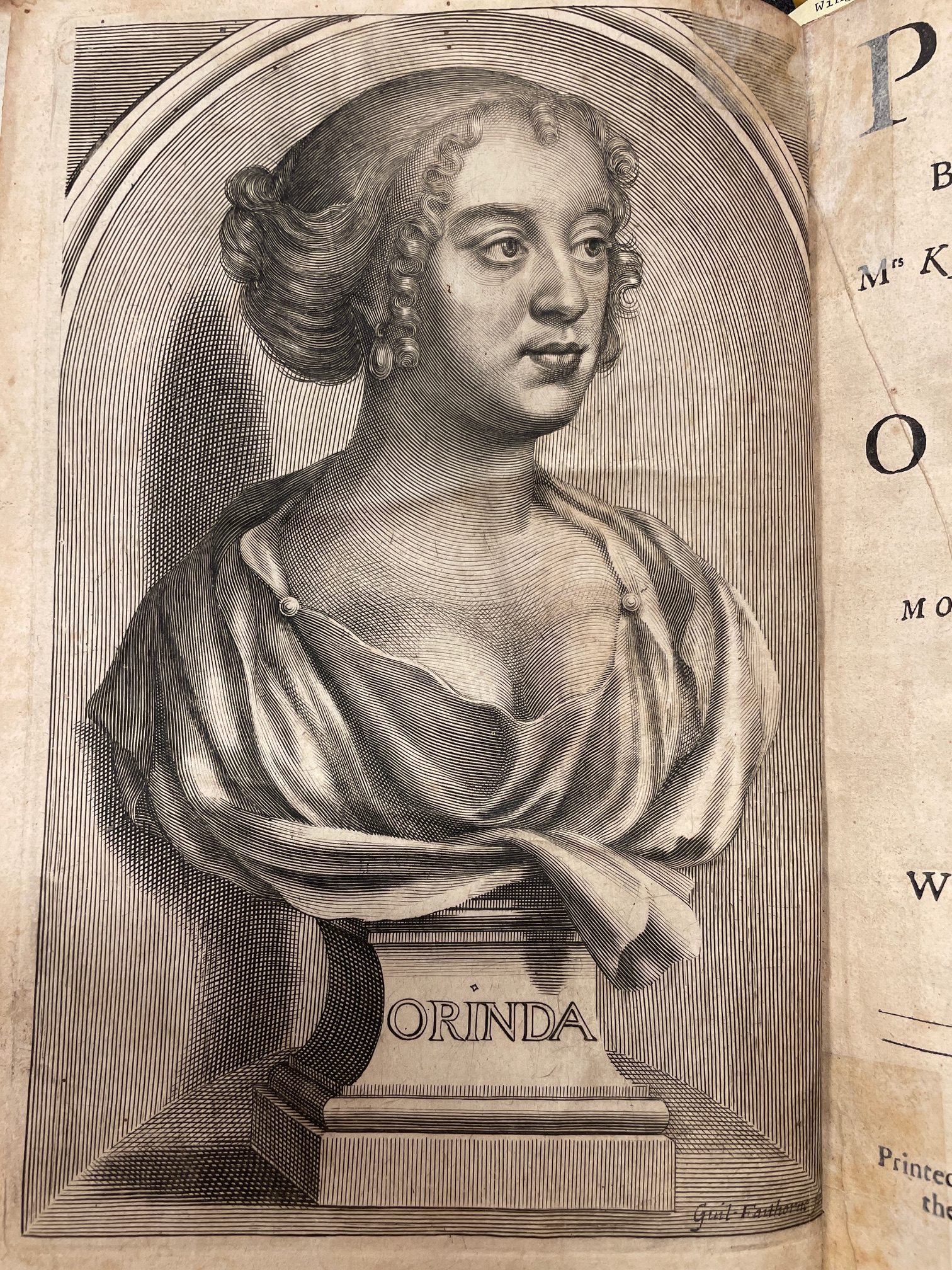
Katherine Philips (1631-1664) was a British woman writer whose poems were widely circulated in the 1650s and 60s.1 She also wrote under the pen-name “Orinda”. Poems presents a collection of her poetry, and she is best known today for the themes of female friendship in her poems. This book also includes her translations from French of plays by Pierre Corneille (1606-1684), who is considered a great 17th-century French dramatist.
Poems was printed by John Macock (1629-1692) in London, who has been identified as one of the printers of Shakespeare’s Fourth Folio.2 He often printed for Henry Herringman (1628–1704), a prominent London bookseller and publisher. No information about the bookbinder could be found, except for that the book was bound in contemporary calf leather.
The portrait depiction of Orinda was engraved by William Faithorne (1616-1691), who was well known for engraving other prominent figures such as Oliver Cromwell and King Charles I.
MSU’s Copy: Physical Features
MSU’s copy of Poems is bound in contemporary calf leather, with basic tooling around the borders. The spine features endbands with light gold tooling, and reads “Philips Poems”. The book is folio format, and is paginated with catchwords on each page.
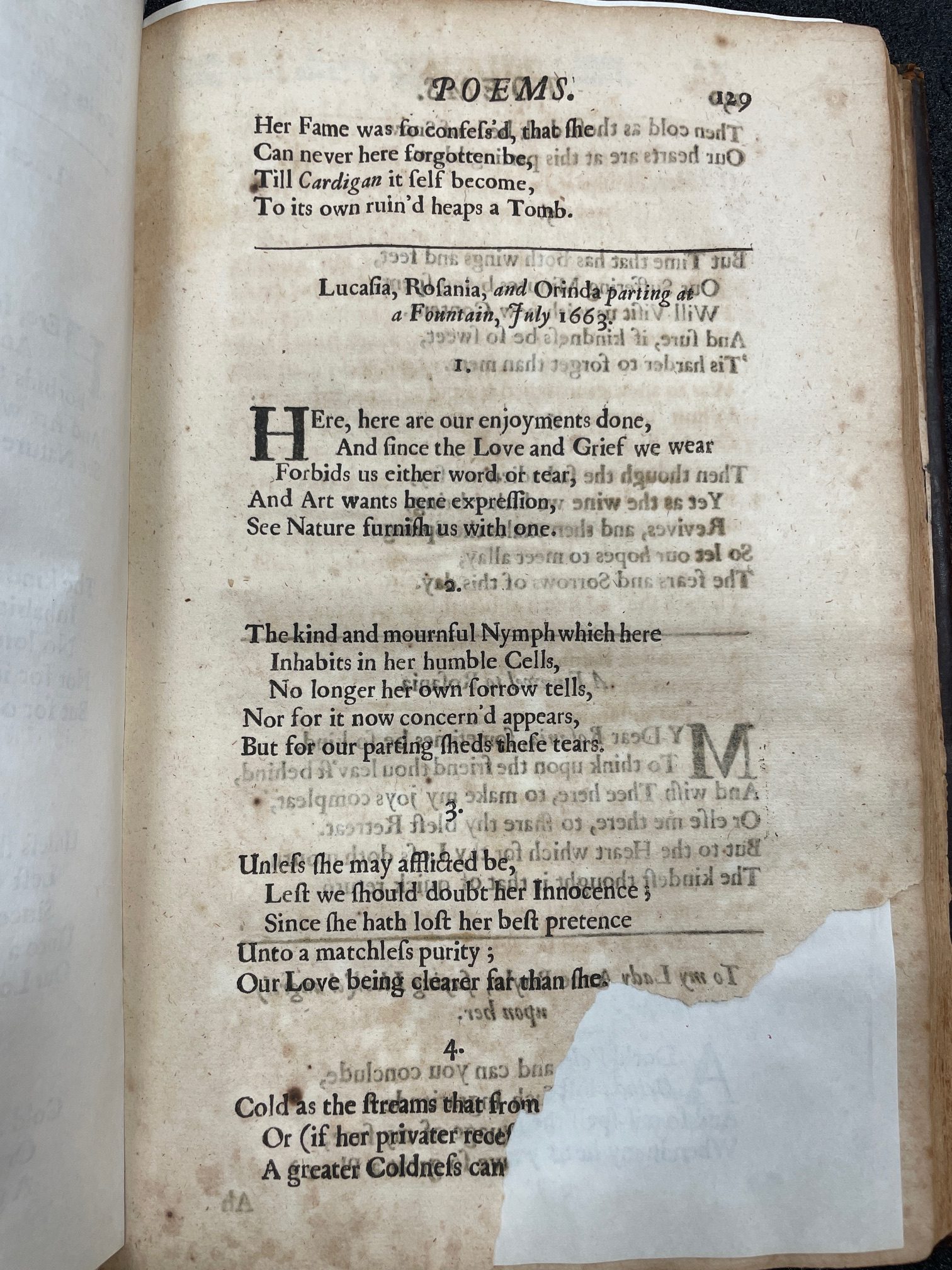
The pages throughout the book are browned and creased, and the bottom right corner of pg. 129 is ripped. Further additions to the book, such as facsimile leaves, catalogue clippings, and bookmarks, were left by previous owner Wayne H. Phelps and explored further below.

The First Owner: Dorothy Weld
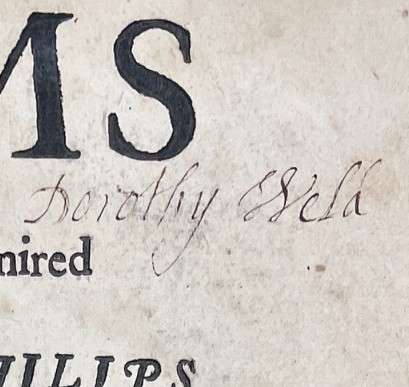
The signature that can be found on the title page of Poems belongs to the first owner of the book, Dorothy Weld. Dorothy was a member of the Weld family of Willey Estate in Shropshire, England3, which neighbored an estate known as Apley Park.4 The members of the family were often connected in marriage to the Whitmore family that owned Apley next door. Though all Dorothy Weld left behind is her signature, it is possible to narrow her identity down to a member of this specific Weld family, because as we will see, the book’s next home is Apley Estate.
Unfortunately, Dorothy is a Weld family name. There are quite a few Dorothys to sort through in the family line, and no real way to confirm which one owned this book. I have narrowed it down to two options who were alive during the publication of Poems in 1669.
Dorothy (Weld) Pickering
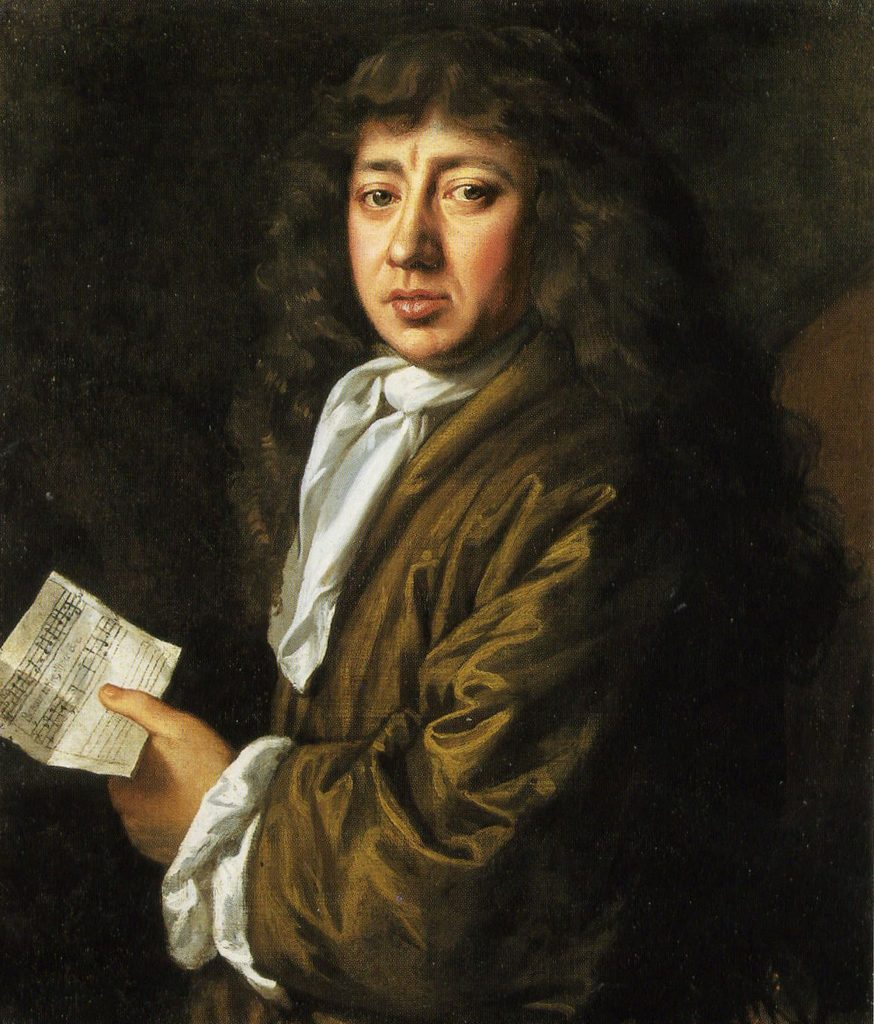
The first option, and least likely one, is Dorothy (Weld) Pickering (1633-1707), also known as Doll Wilde. She lived with her husband Edward Pickering in the Edmonton area near London, according to Samuel Pepys’ diary, where the two are mentioned.5 Samuel Pepys was an English writer best known for his famous diary that documented his daily life from 1660 until 1669.6 This is significant because Samuel Pepys also specifically mentions a copy of Poems by Philips from the same bookseller, H. Herringman, in London, and praises Philips as a “distinguished poetess.” There are two major issues with this theory, first and foremost that Weld and Pickering were married in 1663, six years before Poems was published.7 It is unlikely Dorothy would have written her maiden name in the book 6 years after getting married. The next issue is that the Pickerings lived approximately 150 miles from Willey Estate or Apley Estate in Shropshire, where the book resided next, so there is a significant question of how the book would have made it to its next home, on top of the name change.
Dorothy Weld
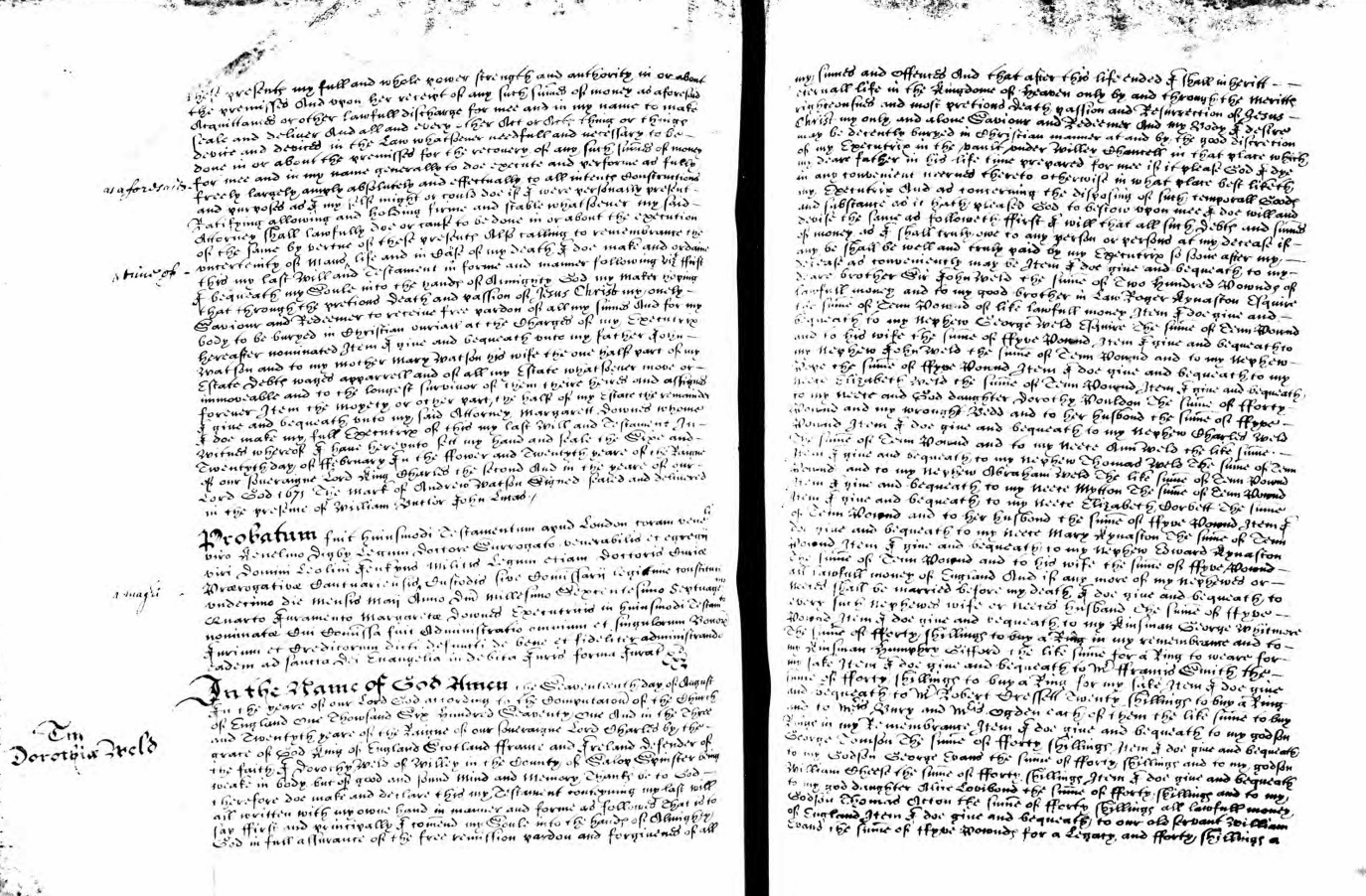
More promising is my second theory, though also more mysterious. Dorothy Weld (-1674) was the youngest daughter of Sir John Weld (1582-1623).8 Her siblings were born from the years of 1607-1618, so it is safe to assume she was born between 1619 and her father’s death in 1623. She was never married and had no children, which is evidenced by her last will and testament, labeled “Dorothia Weld” in which she leaves everything to her brother, nieces, and nephews.9 In the Willey Estate register10, a burial record for a Dorothy Weld is listed in Shropshire in 1674, which matches a listing on the Find a Grave site.11 She also had a niece, Dorothy (Weld) Holden (1649-) who married in 1665, and is mentioned in Weld’s will. Her niece, as with Dorothy Pickering, can be ruled out as a potential owner of the book due to a name change before the publication date.
So while all there is to know about this Dorothy Weld is that she was born in Shropshire, between 1619-1623, and died in Shropshire in 1674, she is the most likely candidate to have been the first owner of this book. She never married, so there is no name change to contend with, and her burial location of Willey, Shropshire places the book in its next confirmed location. Perhaps her belongings, including Poems, were left to a relative that then married into the Whitmore family of Apley, or perhaps the book was just gifted to those at Apley — there is no way to know for sure. Either way, many years later in 1867, the book’s next owner, William Orme Foster, bought Apley Estate, acquired Poems, and pasted his bookplate into the book.
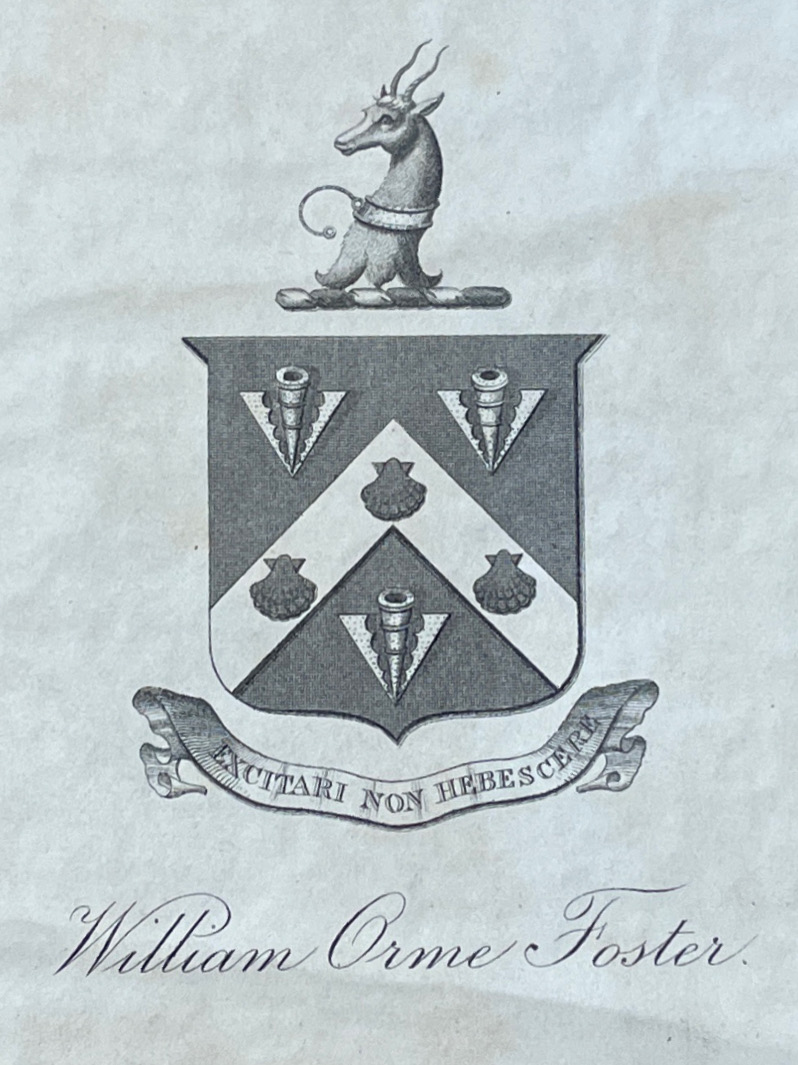
Bookplate: William Orme Foster
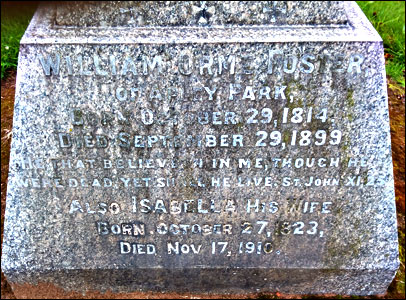
Inside the front pastedown of the book is this bookplate, belonging to William Orme Foster (1814-1899), who was a part of the Foster family of Apley Estate. The Foster family and their motto are found in Fairbairn’s Book of Crests, 1905 ed.12
William Orme Foster13 was the owner of the large industrial firm John Bradley & Co, the pioneering steam locomotive manufacturing company who produced the Stourbridge Lion14, which was the first steam locomotive to run on a railway in the United States. He was also a member of the English Parliament from 1857 until 1868. Foster inherited his business and wealth from his uncle James Foster in 1853, enabling him to later purchase Apley Park Estate in Shropshire, England. Foster is the second known owner of this copy of Poems.
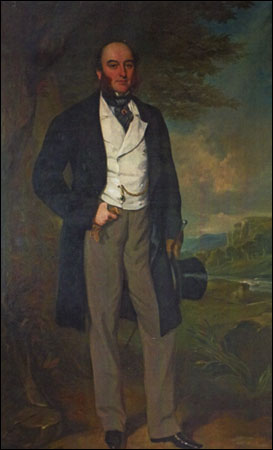
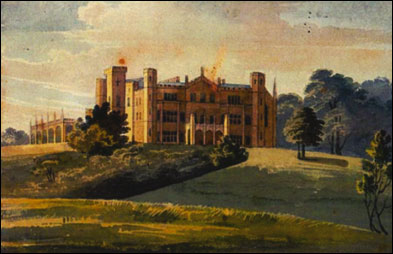
Apley Park Estate

Apley Park Estate in Shropshire is an important aspect of this book’s history, as Poems resided in Shropshire from its publication until most likely 1962. In 1867, Foster bought Apley from Douglas Whitmore, a descendent of the Whitmore family who had owned the estate since 1593.17 After purchasing the estate, Foster acquired Poems, where it stayed until after his death. After the last of the Foster family to own the estate died, it was turned into a boarding school and many of its contents were sold in 1962, according to the current owners of the estate.18 While there is no way to confirm the book stayed in the estate until 1962, it would make the most sense, as the next time this copy of Poems appears is in a rare book catalogue in 1969. It is from the book’s residency at Apley Park Estate from 1867-1962 with Foster that the identity of the book’s first owner, Dorothy Weld, can be confirmed.
Percy Dobell and Son Booksellers
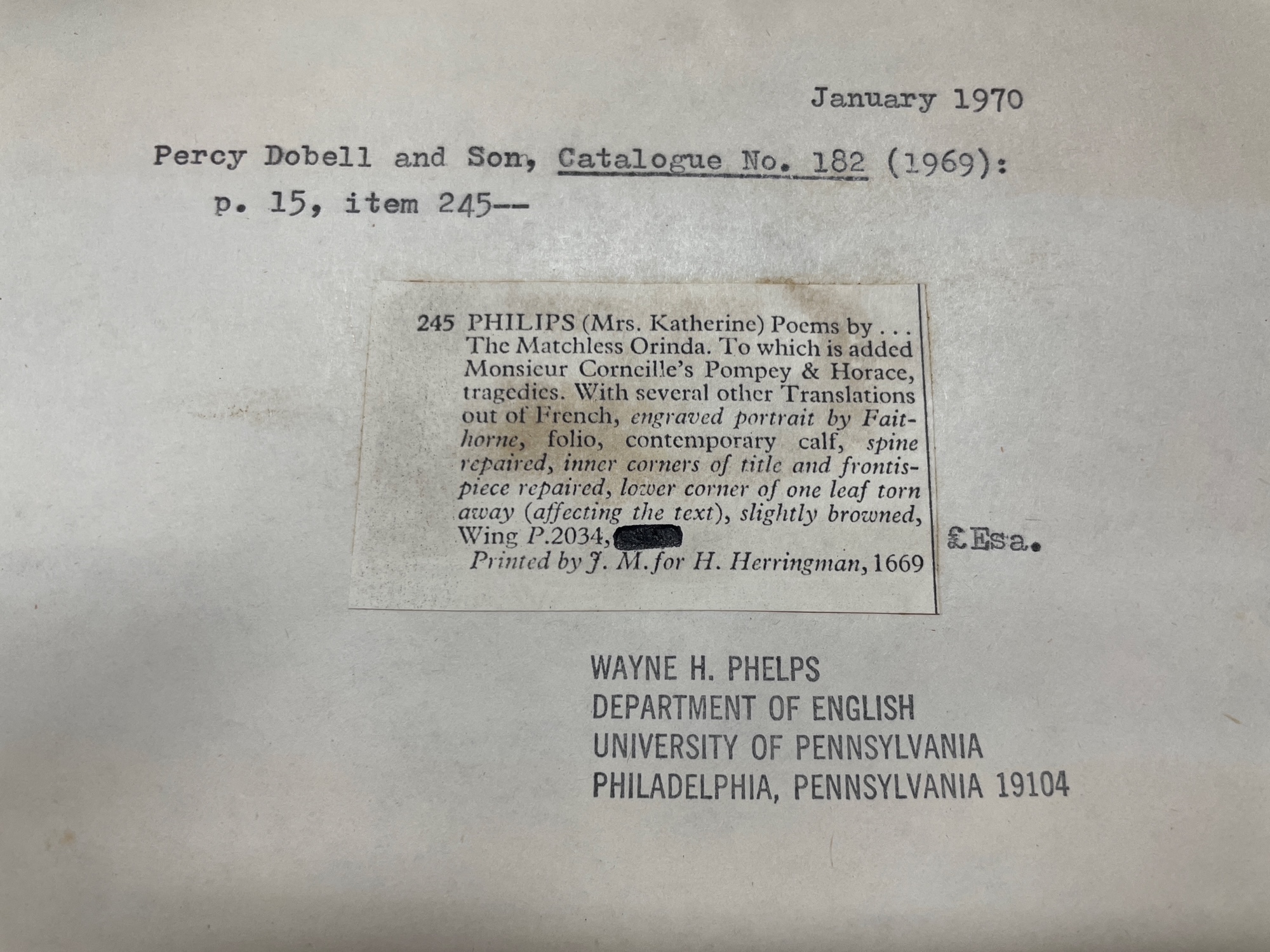
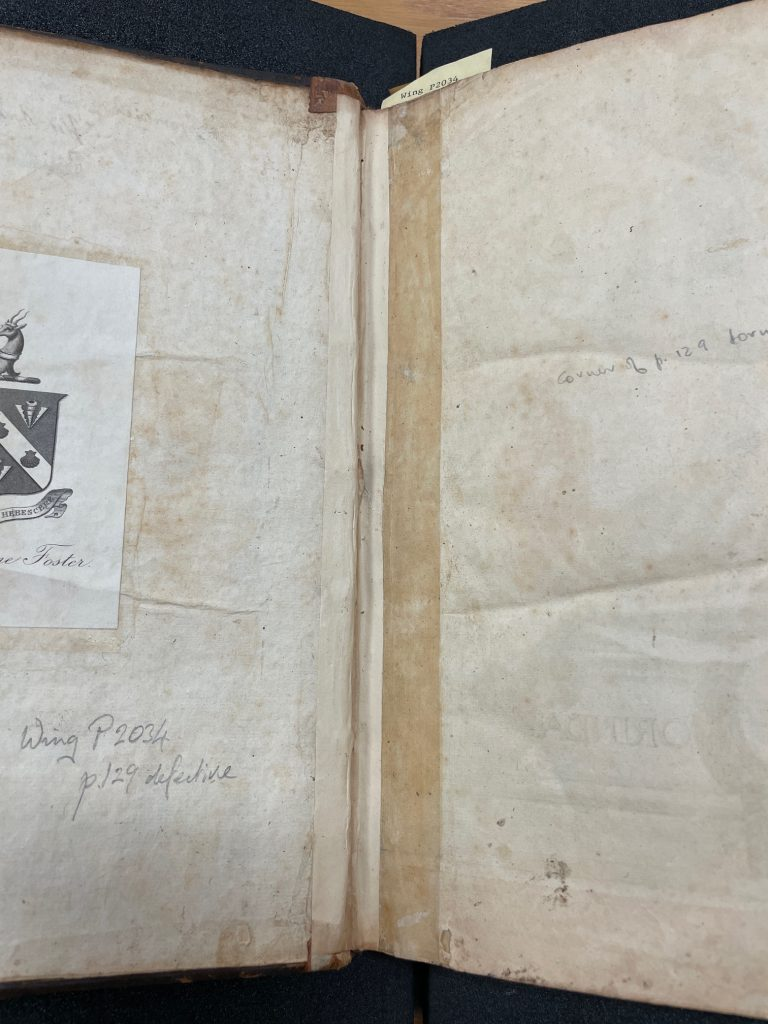
After Poems was likely sold out of Apley Estate post-1962, it was purchased by bookseller Percy Dobell and Son. This is confirmed by the catalogue record left by the book’s next owner, Wayne H. Phelps, dated 1969.
Percy Dobell and Son was an antiquarian bookshop, formerly a part of the “P. J. and A. E. Dobell” partnership that descended from Percy Dobell and Arthur Dobell’s father, Bertram Dobell. Bertram was the first bookseller to open a shop on the famous Charing Cross Road in London.19
While Phelps obscured the original price, The Grolier Club in New York20 was able to send me a scan of the original catalogue — No. 182 — that includes the original price of £14, which in today’s U.S. dollars is about $380.
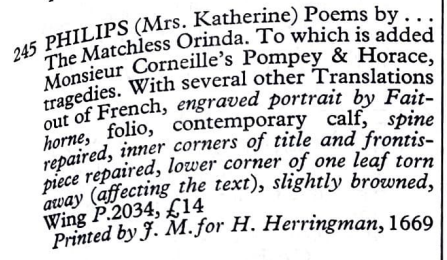
(Source: Grolier Club)
The information on the physical aspects of this copy of Poems in the catalogue listing is also valuable. The bookseller writes that they repaired the spine and inner corners of the title and frontispiece, which are the taped repairs that can be seen. It also notes that the lower corner of pg.129 was already ripped, so that damage must have occurred sometime during the book’s residency at Shropshire.
Wayne Howe Phelps
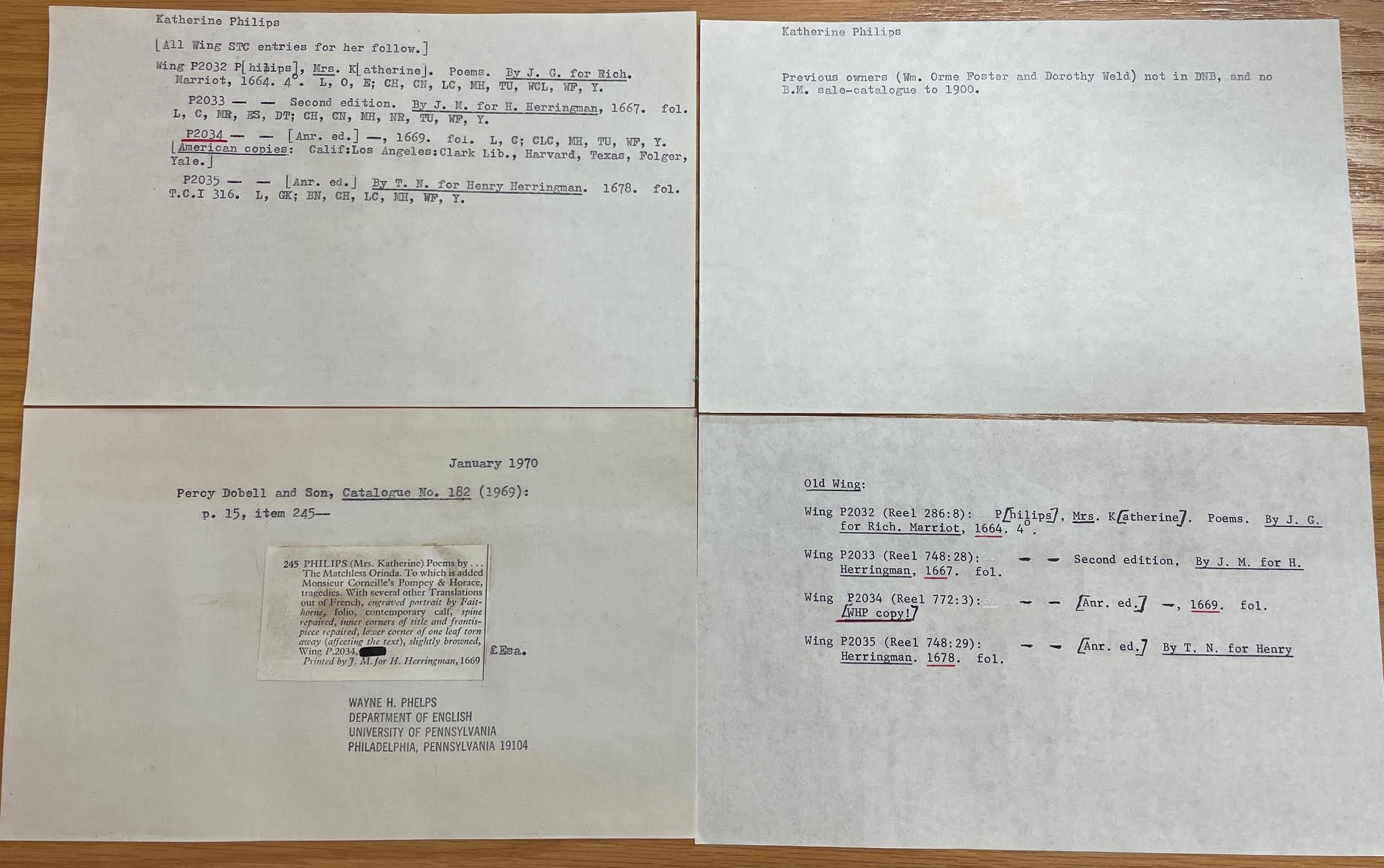
The book’s final owner before MSU acquired it was Wayne Howe Phelps (1938-2023), who bought the book from the Percy Dobell and Son catalogue in 1970. Phelps was a lifelong scholar of English and Shakespeare, and briefly worked as a professor at the University of Pennsylvania from 1968-197221, where he bought this copy of Poems in 1970. He was presented with the Albert Nelson Marquis Lifetime Achievement Award by Marquis Who’s Who in 2018.22
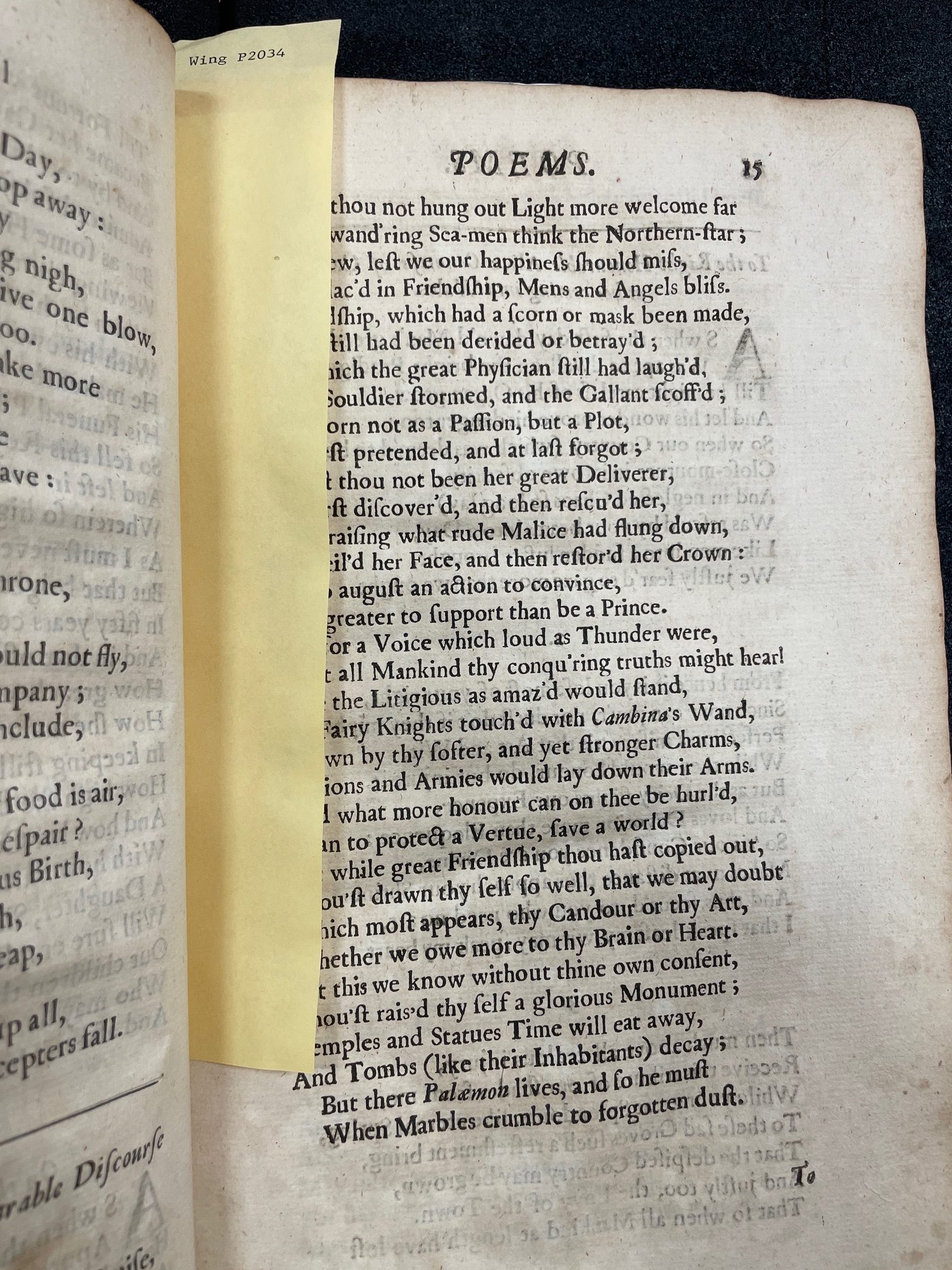
As mentioned above, Phelps left behind a variety of papers in the book. He included the 1969 Percy Dobell and Son catalogue clipping he bought the book from, where he obscured the price he paid; he instead left the note “£Esa” which is likely his own personal bookseller code. He also included a bookmark on pg. 15 identifying the Wing catalogue23 number. Responding to the torn corner of pg. 129, he placed facsimile leaves of the affected pages so they are again fully readable. Phelps also left a nondescript brown paper cover on the book that remains on MSU’s copy.
MSU bought Poems from Phelps’ estate on August 30th, 2024.

Watermark Mystery
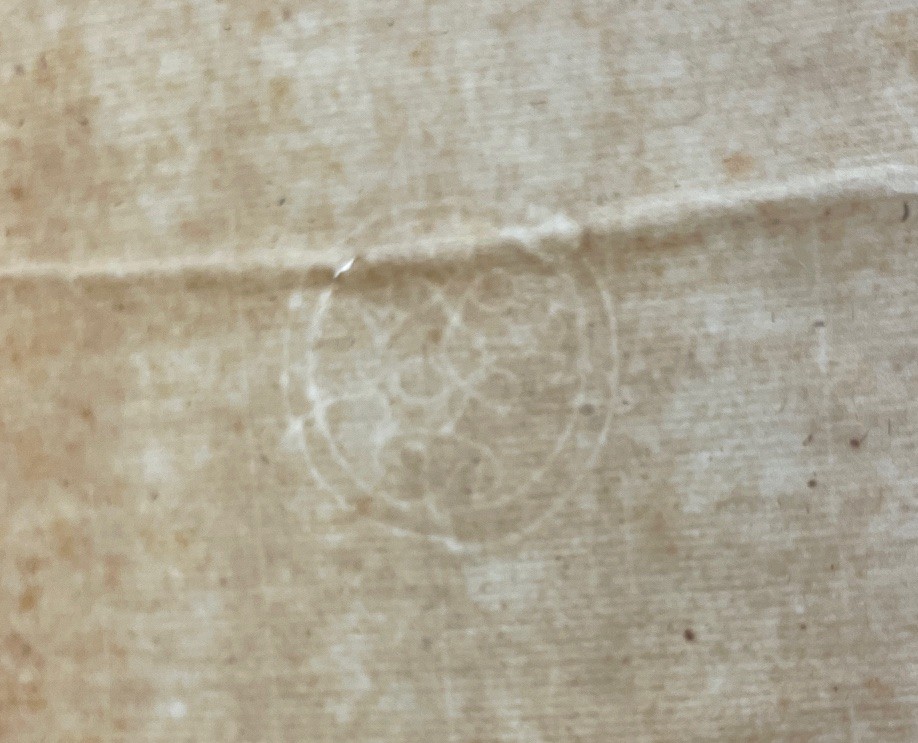
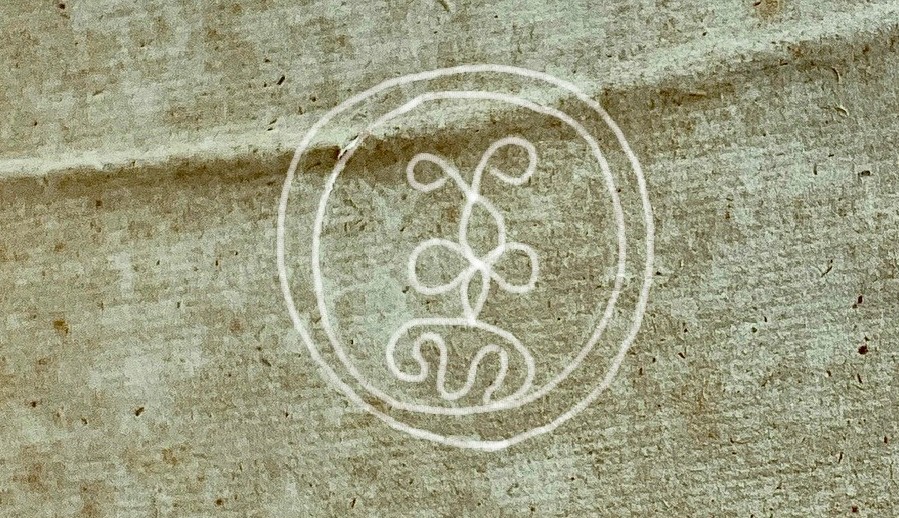
On the last page of the book, a watermark can be clearly seen. Despite thorough searching through multiple databases of known watermarks, there are no matches for this design. Based on other references, it is most likely that this watermark is a flower, though other flower watermarks do not exactly match this one. Unfortunately, the papermaker remains a mystery.
The Complete Timeline of Poems
| Year | Owner | Location |
| 1669 | Printed by John Macock (1629-1692) for bookseller Henry Herringman (1628-1704) | London, England |
| 1669-1674 | Dorothy Weld (-1674) | Willey Estate, Shropshire, England |
| 1674-1867 | Unknown; members of the Weld or Whitmore family of Shropshire | Shropshire, England |
| 1867-1962 | William Orme Foster (1814-1899) | Apley Estate, Shropshire, England |
| 1962-1970 | Contents of estate were sold to bookseller Percy Dobell and Son | London, England |
| 1970-2023 | Wayne Howe Phelps (1938-2023) | Pennsylvania, USA; New York, USA |
| 2024-current | MSU Special Collections | East Lansing, MI |
Sources
Cited Links
- Poetry Foundation: Katherine Philips ↩︎
- Project Muse: Shakespeare’s Fourth Folio ↩︎
- Wikipedia: Willey, Shropshire ↩︎
- Wikipedia: Apley Park Estate ↩︎
- Samuel Pepys’ Diary ↩︎
- Wikipedia: Samuel Pepys ↩︎
- All About History: Dorothy (Weld) Pickering ↩︎
- Wikipedia: Sir John Weld (1582 – 1623) ↩︎
- Ancestry: Will of Dorothy Weld. Note: this will is hidden behind a paywall. ↩︎
- The Willey Register ↩︎
- Find a Grave: Dorothy Weld (-1674) ↩︎
- Fairbairn’s Book of Crests, 1905 ed. ↩︎
- Wikipedia: William Orme Foster ↩︎
- Wikipedia: The Stourbridge Lion ↩︎
- Find a Grave: William Orme Foster (1814-1899) ↩︎
- Cosgrove and Furtho History: William Orme Foster ↩︎
- Cambridge: Apley Park ↩︎
- Lady Harriet Hamilton: Foster Family and Apley Estate ↩︎
- Ash Rare Books: Percy Dobell ↩︎
- Grolier Club ↩︎
- WWNYTV: Wayne Howe Phelps ↩︎
- Press Release: Wayne H. Phelps ↩︎
- Wikipedia: English Short Title Catalogue. Note: The Wing catalogue is now a part of the ESTC. ↩︎
Created by Katie Youmans in Spring 2025 for Professor Brockey’s HST475 class at Michigan State University.
Special thanks to Tad Boehmer, Scott Ellwood and Kevin McKinney of the Grolier Club, and Sharon Casey for their help.
