
sive, De lvdis græcorvm, liber singularis / Accedit Danielis SovterI Palamedes, sive, de tabulâ lusoriâ, aleâ, & variis ludis, libri tres.
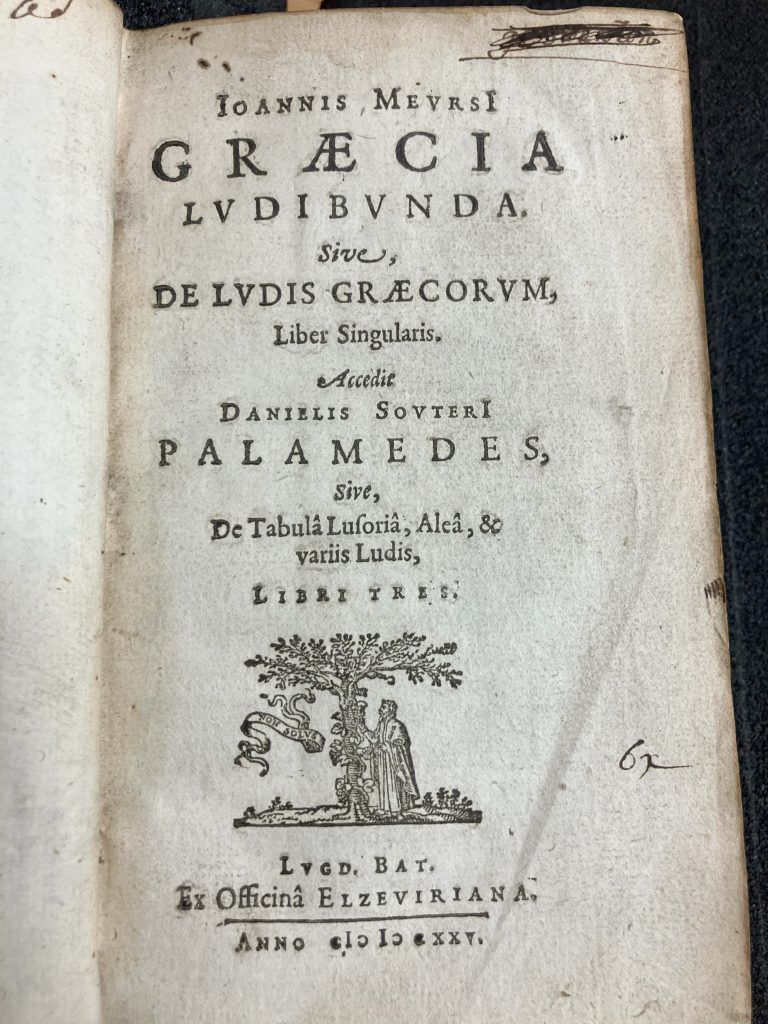

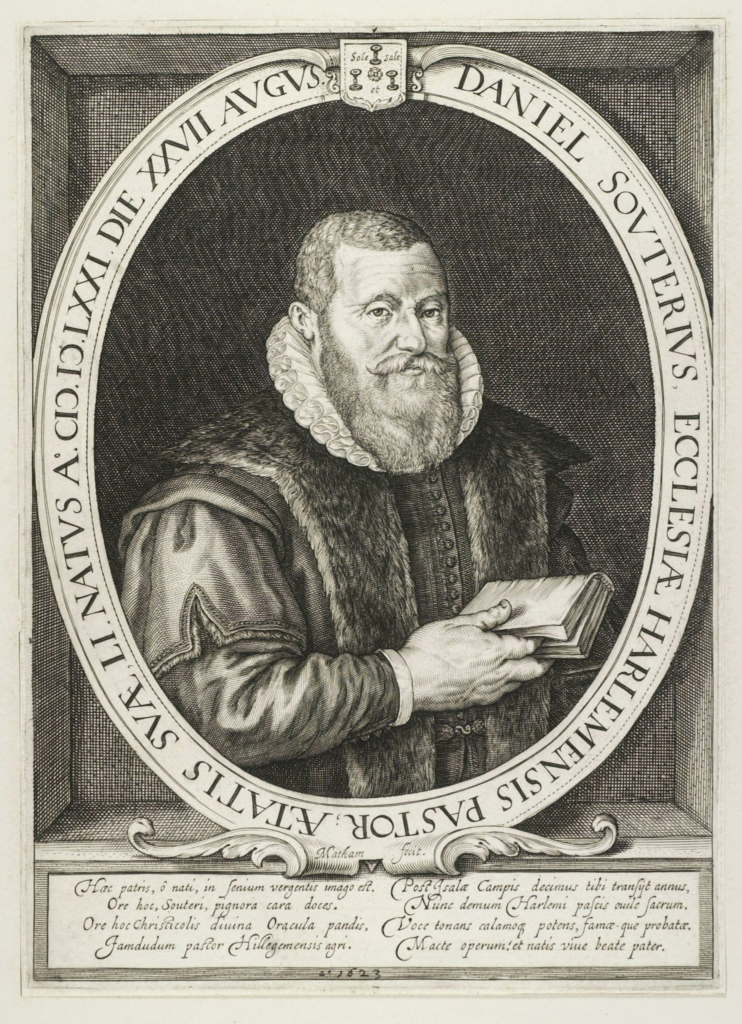
Ioannis Mevrsii Græcia lvdibvnda: ive, De lvdis græcorvm, liber singularis / Accedit Danielis SovterI Palamedes, sive, de tabulâ lusoriâ, aleâ, & variis ludis, libri tres. When translated the title reads “Playful Greece: or, On Greek Games, in one book; with the addition of Daniel Souter, Palamedes, on board games, gambling, and various games in three books” Ioannis Mevrsii Græcia lvdibvndaa is written in Latin and Greek, describing Ancient Greek games involving dice. The first book is written by Johannes Van Meurs with additional books added by Daniel Souter. Published in 1625 in Leiden, Netherlands, this book was a product of the House of Elzevir, a notable family involved in printing publishing, and selling of books during the 16th and 17th centuries. Græcia lvdibvndaa currently resides in Michigan State University’s special collections with the call number XX GV17 .M45.
Physical Description


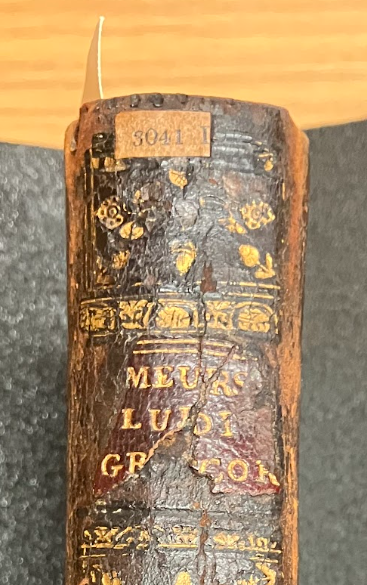
Græcia lvdibvnda is a leather bound book with a gilded decorated spine. The name is shortened to “lvdis græcorvm” on the spine, meaning Greek Games, along with Meurs for the author. There is cracking on the spine and the rest of the book is quite worn from time. Both interior covers are quite dirty and some pages are torn. Additionally, all pages have water damage along the edges of the page. There are several initials written in the back cover “K.C” and two on the title page from previous owners.

Luciani Samosatensis Dialogi aliquot
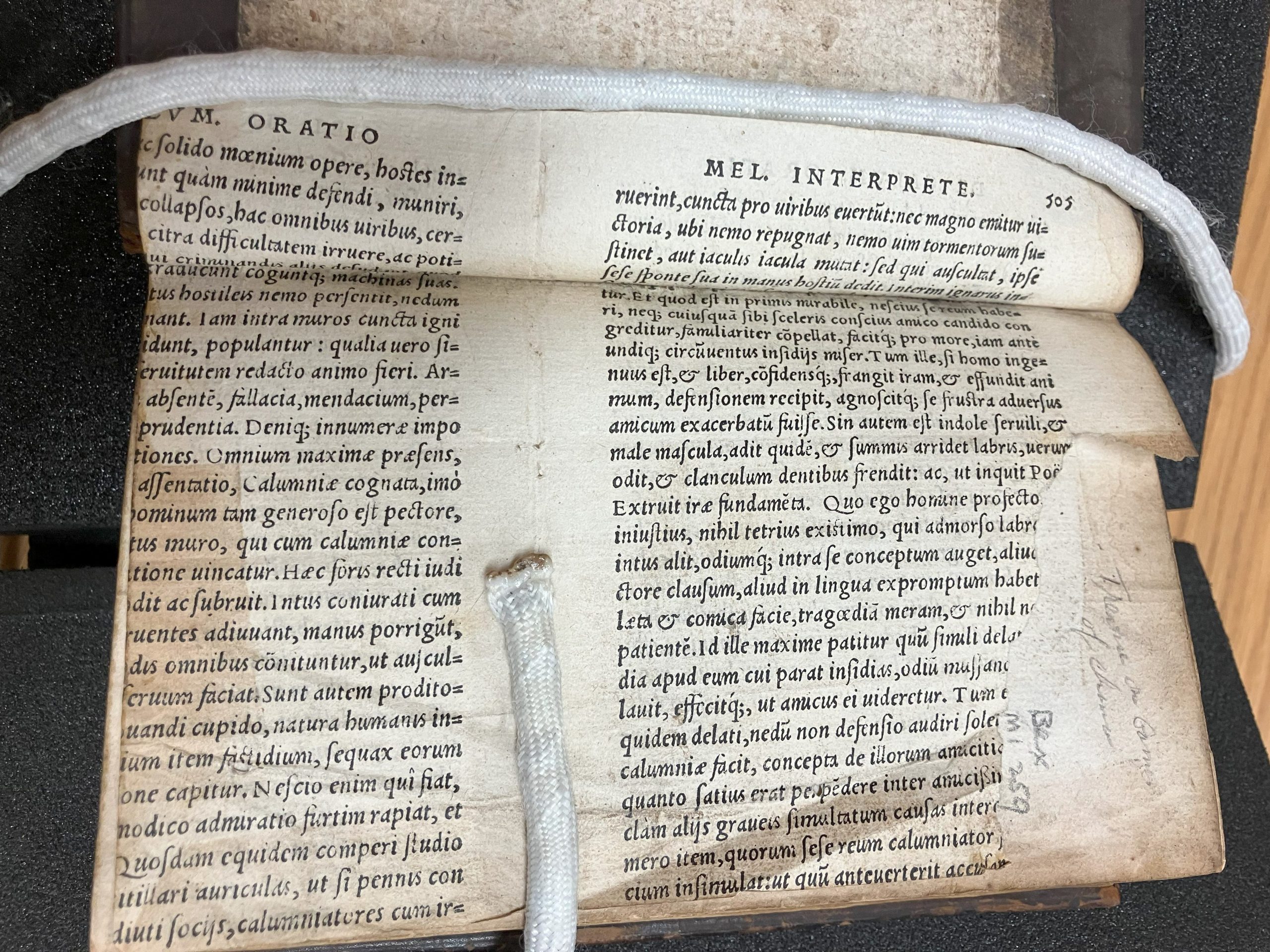
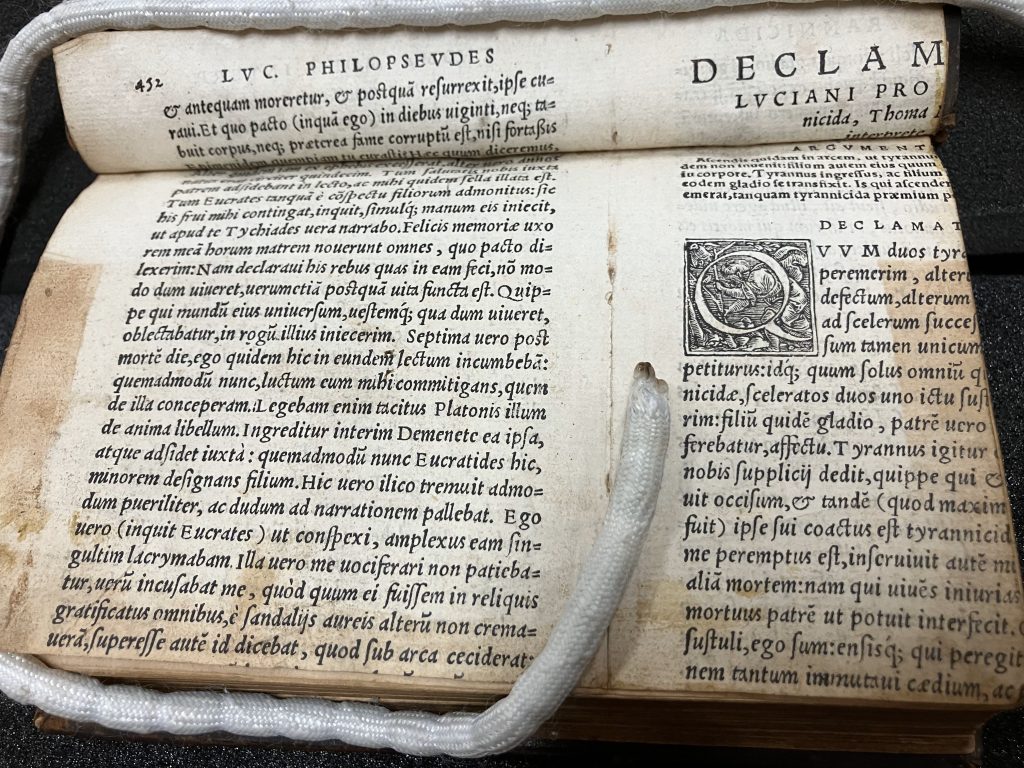

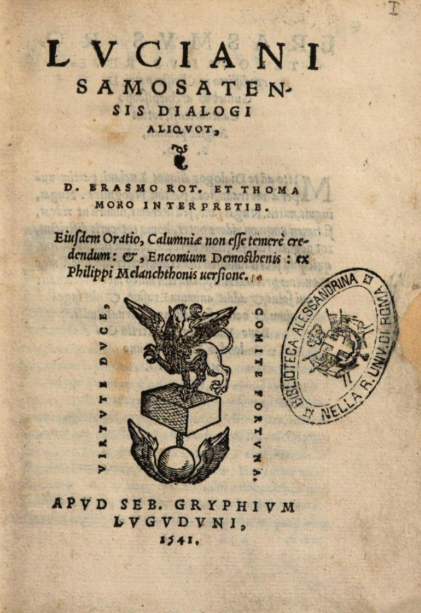
Most interesting about Græcia lvdibvnda is that another work is inserted in both the front and back of the book as waste bindings. During this time period it was common for printers to insert pages from other works instead of using blank pages, as it saved on costs. The Elzevir family could have needed to balance the number of folios in the book and Luciani Samosatensis Dialogi aliquot (shown left) was what they had on hand. This edition of Luciani Samosatensis Dialogi aliquot was printed in 1541 by Sebastian Gryphius, who usually worked in France, however the 1541 edition was printed in Leiden. This explains how the spare pages of this book were used by the Elzevir’s in Græcia lvdibvnda. Additionally, one of the pages used has a papermaker’s watermark (shown right).
Provenance
John Paterson

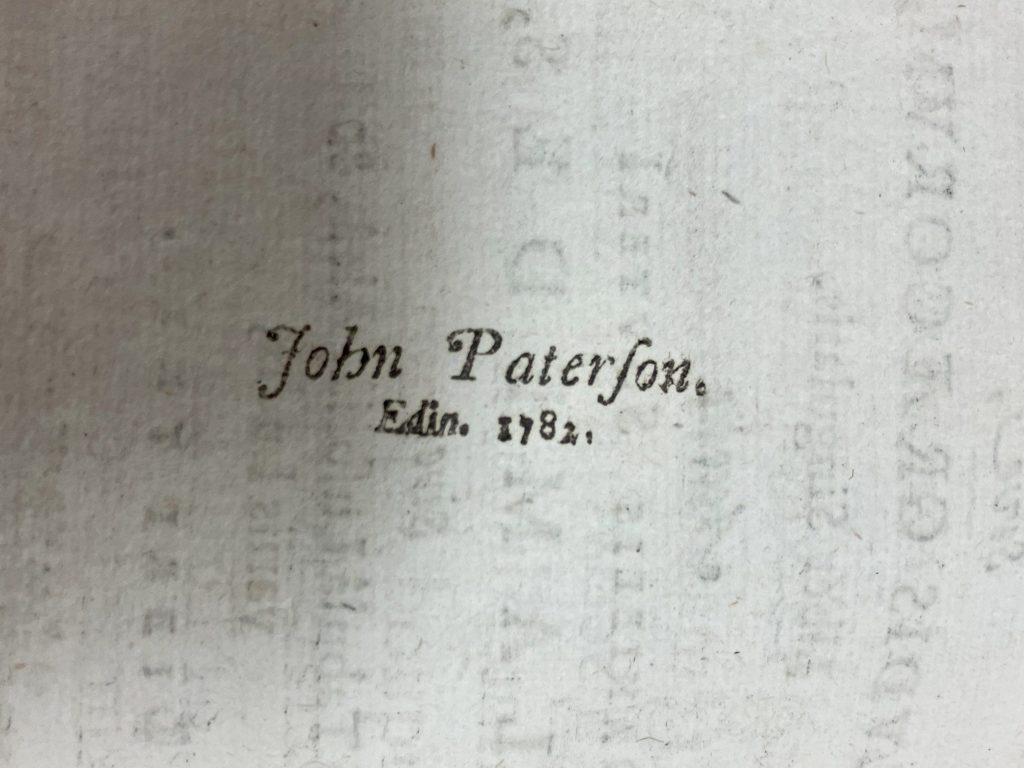
The most straightforward piece of provenance is the inscription “John Paterson. Edin. 1782.” When researching John Patersons who would have been in Edinburgh in 1782, I came across John Paterson the Scottish architect born ~1751. He is notable for his assistance in the Gothic remodeling of castles and was the secretary of the Bridge Committee of the Blackfriars Bridge in the 1760s. He had lived in Edinburgh on St John Street in the Canongate, living with Francis Charteris, Earl of Wemyss and March until 1784. From there he moved to Elgin to work with Sir James Grant. In 1789 he returned to Edinburgh to oversee the building of Old College for the University of Edinburgh. In 1791, Paterson opened up his own office at 2 North Bridge. Until his death in 1832, he lived at 24 Buccleuch Place in Edinburgh’s south side. He died on November 19th, 1832, but there is minimum information about his death. There are no records of John Paterson ever being married or having children, so his belongings would not have been passed down. I could find no record of an estate sale, so there is no way of knowing if he even still possessed the book at his death.
Sam Boyson


Inside the book on page 176 and 208 are stamps marking ownership. Firstly on 176 there is a stamp that reads LBSARTZ with a similar looking stamp on page 208 that reads “S Boyson Sam Boyson”. Both stamps look like they had to come from the same lettering, as the B on both stamps are identical. Whoever Sam Boyson was, he must have had a connection to LBSARTZ. However, no information turns up for any likely Sam Boyson who could have owned the book. Additionally, LBSARTZ does not turn up any results either, even when combined with Sam Boyson. Due to the fact that neither stamp can have a date or location attributed to them, this may remain a mystery.
Inscriptions
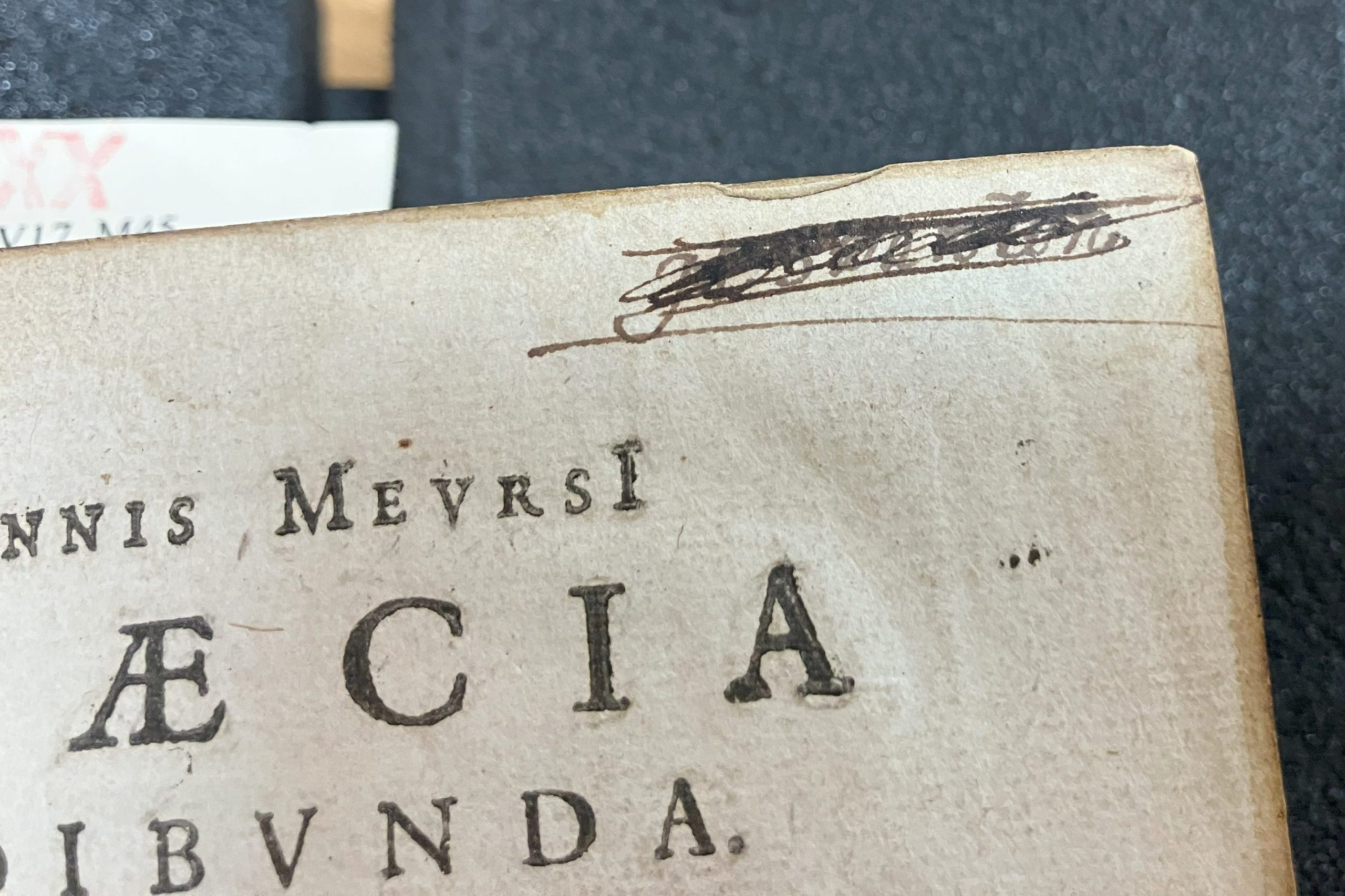
At some point in time there was a signature written in the top right corner of the title page. However, somewhere down the line someone crossed out this name, most likely to signify it no longer belonged to that person. On the verso side of the page you can see the signature peaking out slightly. When flipped and with enhanced contrast, you can start to see the signature better. The only concrete aspect of this signature is that it belongs to someone with an M initial, meaning it is not a signature from either John Paterson or Sam Boyson.


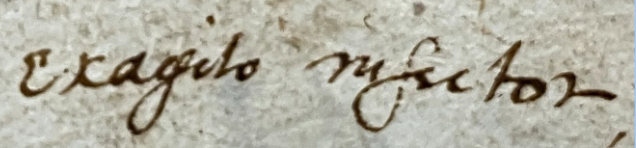
On the Luciani Samosatensis Dialogi aliquot insert is the phrase “Exagito Nisector”. The first word, exagito, is a latin word meaning to drive away, critique, or harass. The second word appears to say “Nisector”.

On the inside cover of the book is a pencil inscription, clearly starting with a B. However, the rest of the inscription is very illegible and I was unable to parse what it said.
Book Seller or Library Catalogs

“Bax MI 259”
There are three signifying factors leading me to believe that at one point this book was for sale at an auction or in a library catelog. On the spine of the book is a tag labeled “3041 I”, possibly a number associated with it either to catalog or its auction number. Additionally written inside on a blank page is “Treatise on Games of Chance” in pencil cursive, which most likely was someone giving a translated title to the book. Underneath in pencil but with a different handwriting it says “Bax MI 259” This might have been a previous library’s call number for the book, as it is not the number MSU has assigned it.
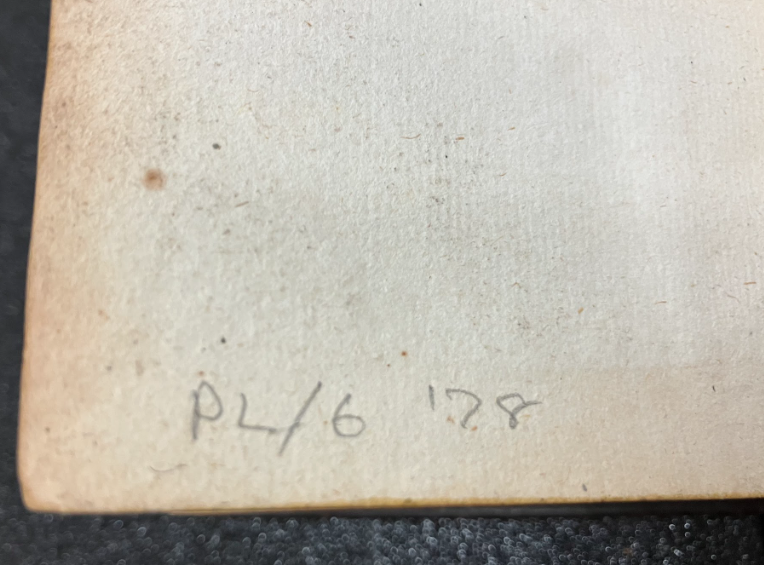
The third is this pencil inscription that differs in handwriting to the previous inscriptions. Originally I had read this as “PL/6 187” with no idea what that could refer to, however when looking at other students projects I had noticed they also had PL/6 in their book. It seems that PL refers to the initials of the librarian who was examining the book, 6 could refer to the month, and it was actually ’78 referring to 1978 as the year. I later got confirmation from Special Collections Librarian Tad Boehmer that the 78′ would mean the book was either gotten in 1978 or a year or two earlier and had been finally cataloged fully in 78′. This timeframe would explain why I hadn’t found any MSU provenance. Special Collections was started in 1962, so a book this old would not have gone into regular circulation and instead would have went straight to Special Collections, so there would be no embossing or stamps from the University.
References
The British Newspaper Archive. (1832, December 1). Edinburgh Evening Courant – Saturday 01 December 1832. The British Library Board.
Edinburgh, St John’s street, general. Canmore. (n.d.). https://canmore.org.uk/site/133327/edinburgh-st-johns-street-general
Exagito – Wiktionary, The free dictionary. Wiktionary. (n.d.). https://en.wiktionary.org/wiki/exagito
Gazetteer for Scotland. (n.d.). John Paterson from the Gazetteer for Scotland. Overview of John Paterson. https://www.scottish-places.info/people/famousfirst754.html
Lucanus, M. A. (1541). Luciani samosatensis Dialogi Aliquot D. Erasmo rot. Et Thoma Moro interpretibus. EIUSDEM oratio, Calumniæ Non esse temere credendum: &T, Encomium Demosthenis: Ex philippi melanchthonis uersione. apud Seb. Gryphium.
Wikimedia Foundation. (2022, December 26). John Paterson (architect). Wikipedia. https://en.wikipedia.org/wiki/John_Paterson_(architect)
Wikimedia Foundation. (2025, January 14). House of Elzevir. Wikipedia. https://en.wikipedia.org/wiki/House_of_Elzevir
Page by Max Levanduski for HST 475 History of the Book.
A special thanks to the classmates of HST 475, Tad Boehmer, Gillian MacDonald, Marissa Knaak, and Scott Bullock for their assistance on the project.
