
A Provenance project. ella cox.
Book Description
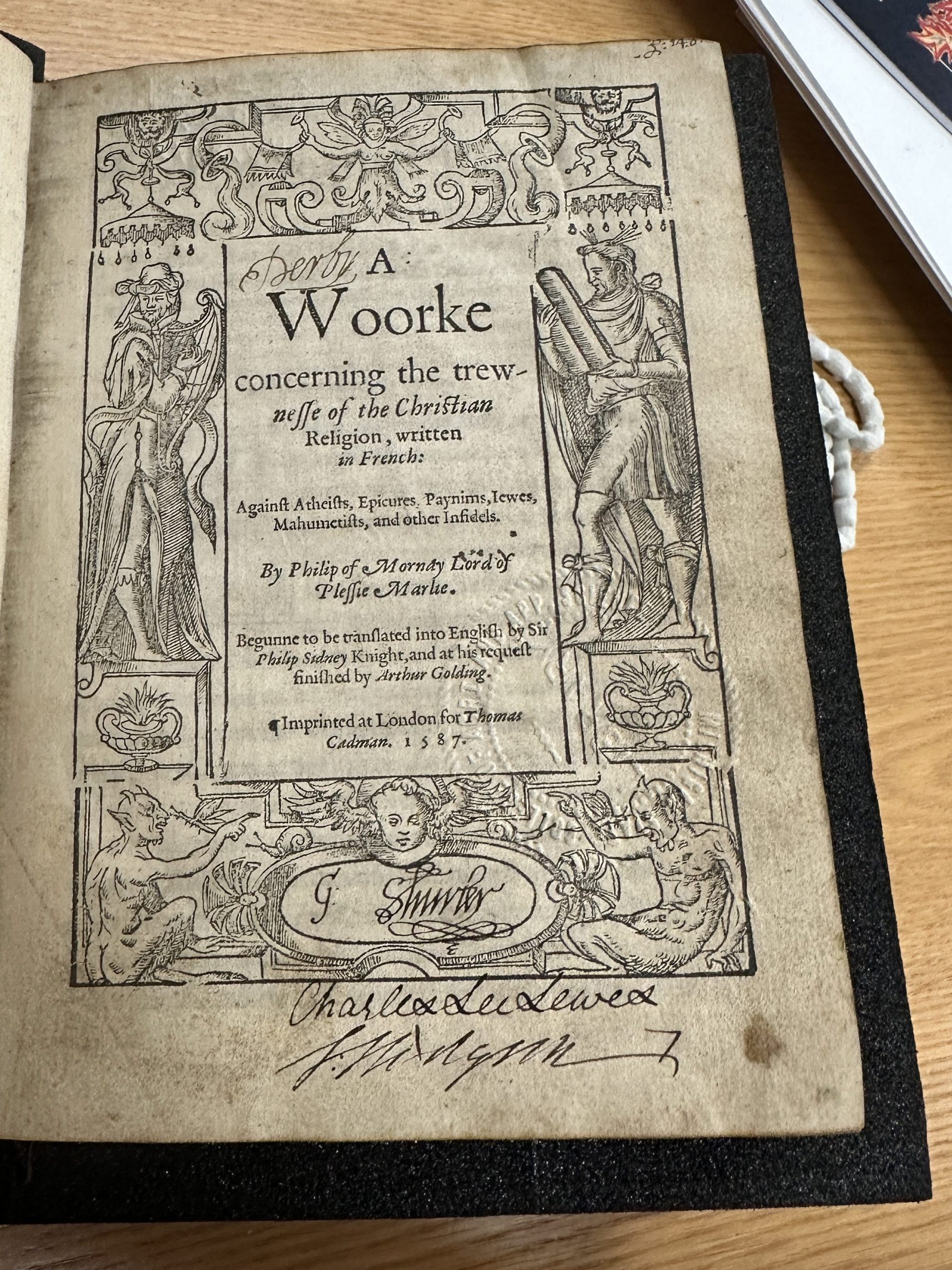
Author: Written by Philippe de Mornay, Lord of Plessis Marly (originally written in 1581). Translated into English first by Philip Sidney Knight and completed by Arthur Golding at Sidney’s request.
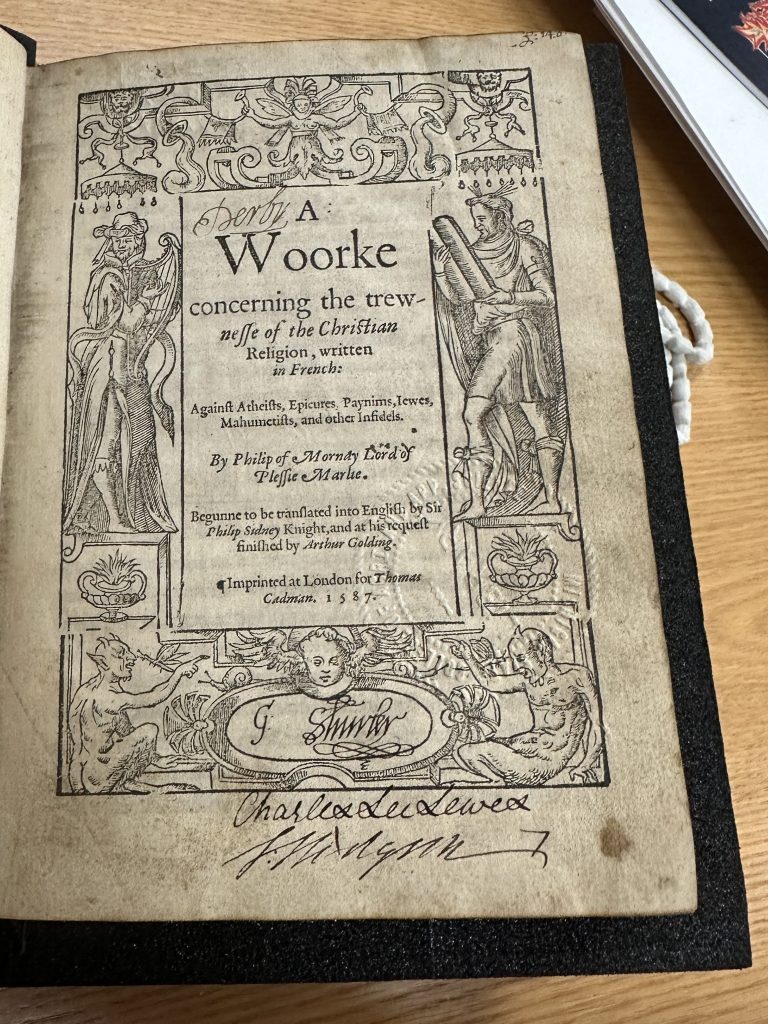
Title: “A Woorke concerning the trewnesse of the Christian Religion, written in French: Against Atheists, Epicures, Paynims, Iewes, Mahumetists, and other Infidels.
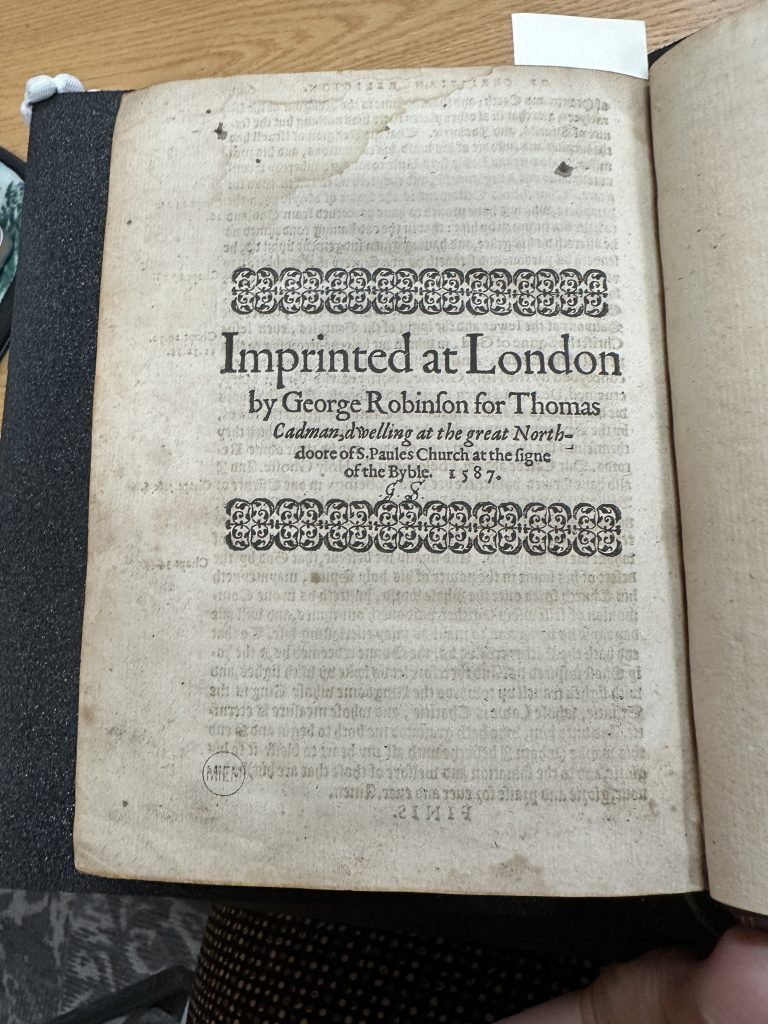
Publisher: Published for Thomas Cadman in London in 1587.
MSU Library Call Number: XX BT11000 .M613
Errors in paging: 481 to 490 skipped, catch words match so this is due to misprinting. Overall around 650 pages, 26 unnumbered at the beginning of the book.
Includes colophon.
Contents of the Book
Authors and Translators
Philippe de Mornay (1549-1623)
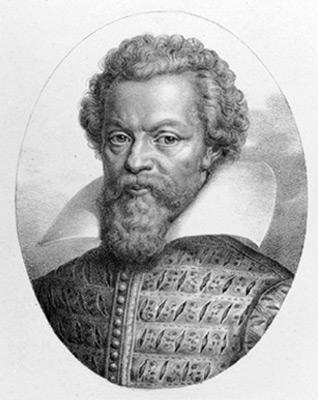
Philip of Mornay, or Philippe de Mornay, was the lord of Plessy-Mornay, a French Protestant writer, and a member of the Monarchomaques, an often violent anti-monarchist group that supported tyrannicide. In 1574, he began participating in campaigns of the King of Navarre for the Protestant cause, soon-to-be Henry IV, King of France. Over the next twenty years, Mornay worked closely with Henry IV, which included representing the King in England. During his visits to England, he befriended English Protestants such as Philip Sidney, who went on to translate this book into English.
He was a Huguenot apologist, and wrote many works about religion, from 1571 to 1611. In 1581 in Antwerp, he published Traité de la vérité de la religion chrétienne contre les athées, épicuriens, payens, juifs, mahométans et autres infidèles, the original French version of “A woorke on the trewnesse of Christian Religion”.
Philip Sidney (1554-1586)
Philip Sidney was a poet, scholar, courtier, and soldier who began the translation of Mornay’s work before he passed away. He came from an aristocratic family, and his mother was the sister of Robert Dudley the first Earl of Leicester, whom Arthur Golding wrote to in his dedication. He fought for the Protestant cause both in Ireland and against the Spanish in the Netherlands. Sidney also spent some time in France, when he was sent as a member of an accompanying delegation of the Ninth Earl of Lincoln, Edward de Fiennes, by Queen Elizabeth I’s license. While in France, the summer of 1572 ended with a failed marriage pact to end fighting between the French Catholics and Protestants, which led into the Saint Bartholomew’s Day Massacre on August 23. After France, Sidney was in Italy, and stayed in Venice and Padua, where he worked on languages and read. Some of his works include Astrophil and Stella, The Defense of Poesy, and The Countess of Pembroke’s Arcadia. He is often depicted as a strict Protestant, but recent biographers suggest that he was friendly towards Catholics he knew.
Arthur Golding (1535-1606)
Arthur Golding was an English translator who translated works from Latin and French. He is best known for his translation of Ovid’s Metamorphoses ,which first appeared in 1567. Within this translation, he embedded Christian symbolism, and translated the non-Christian work in a way that relates to Christianity. He translated works for many Protestant Leaders, and was a Calvinist himself. Golding also translated Aesop’s fables, Calvin’s commentaries, the Commentaries of Caesar, and work from Heinrich Bullinger, Theodore Beza, Niels Hemmingsen, and David Chytraeus.
Contents of the Book
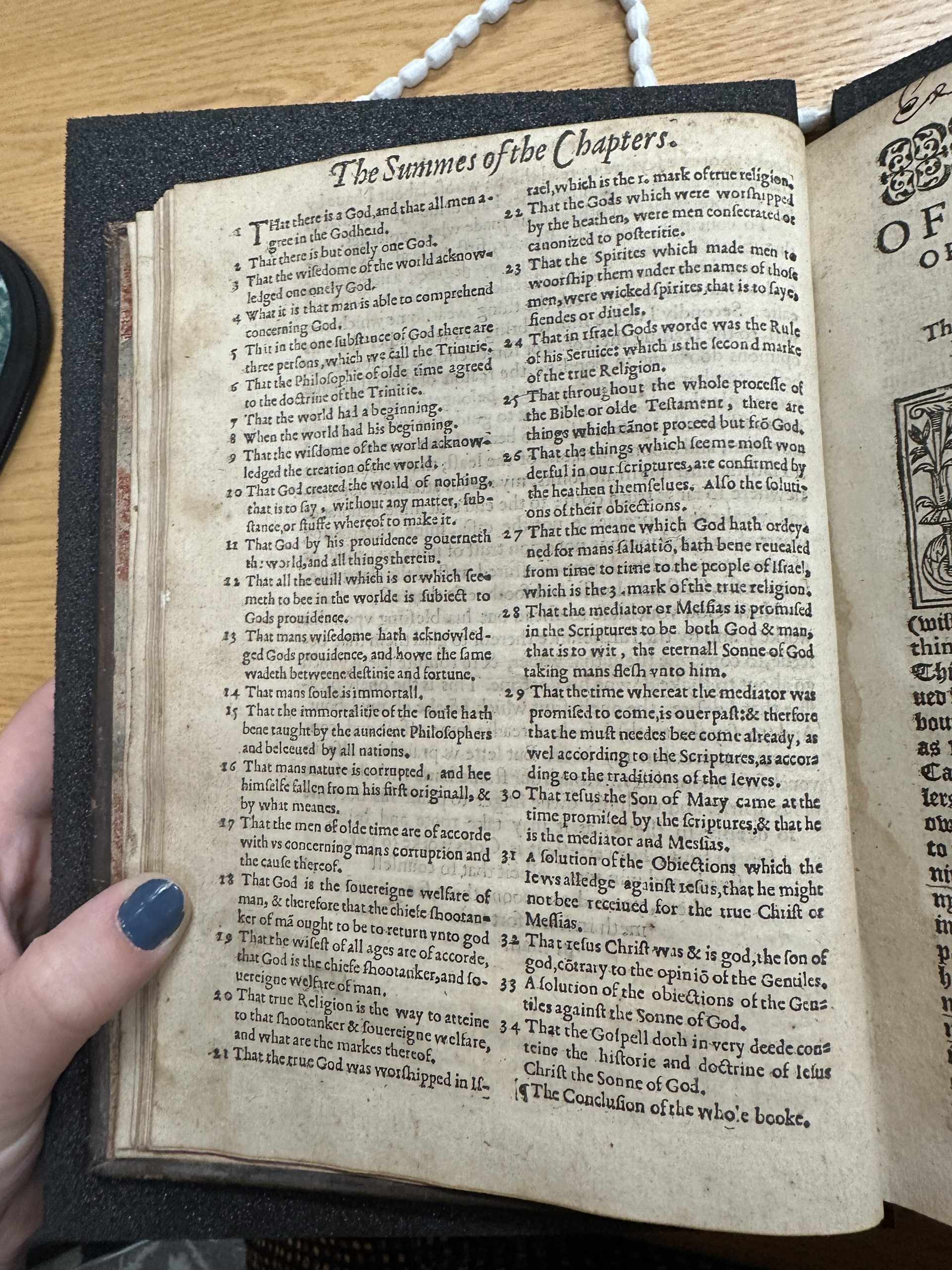
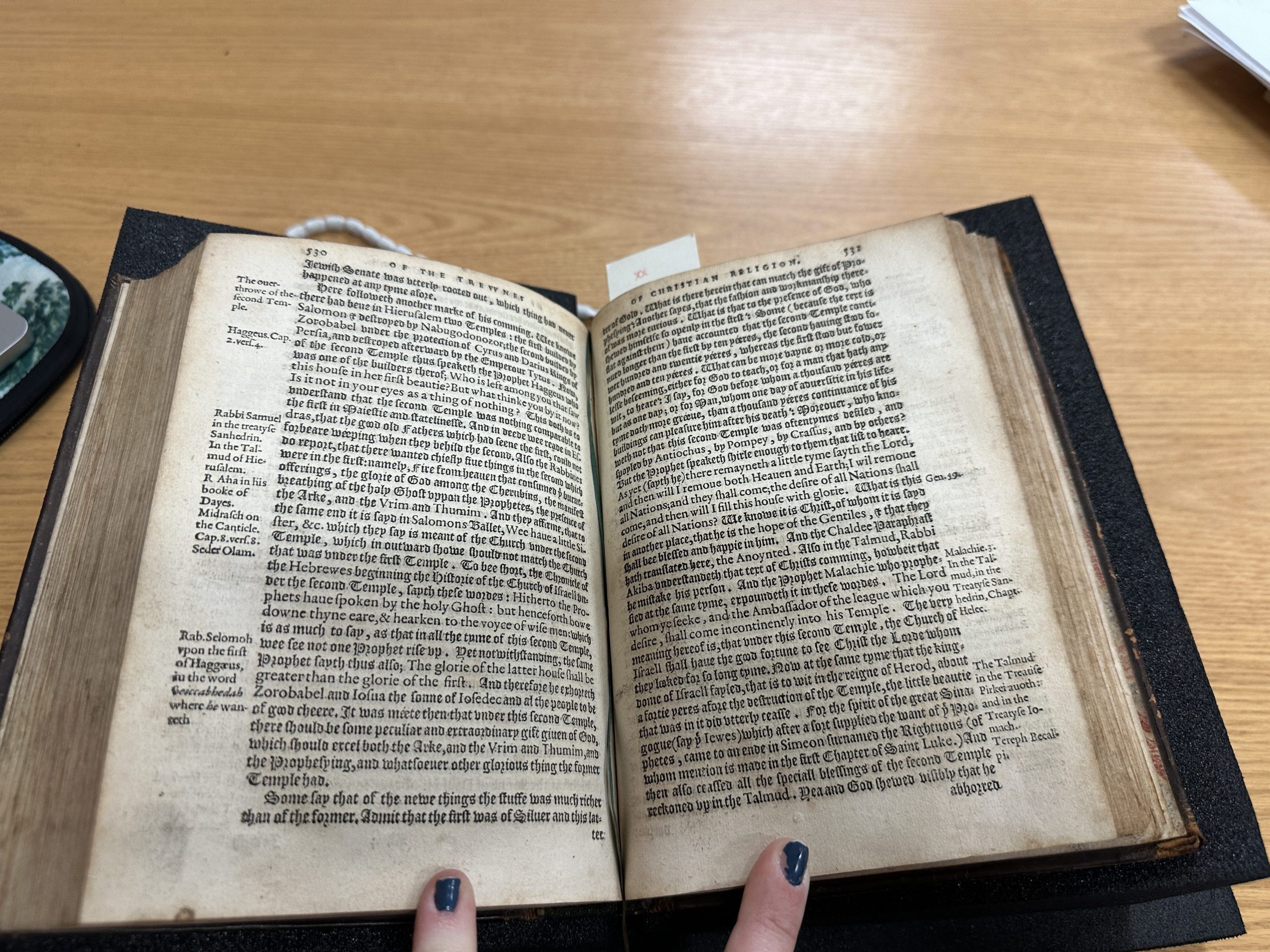
This image includes the chapter summary of this book. Each chapter is an explanation of the author’s beliefs and understanding of Christianity that gives it a label of ‘true’ religion.
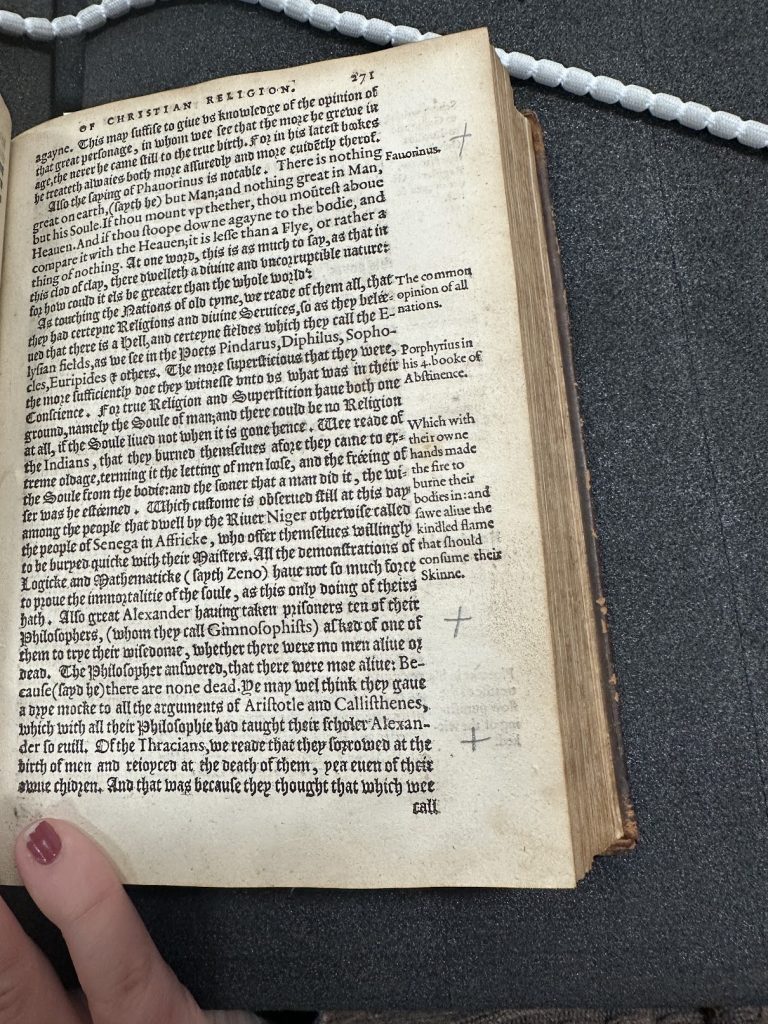
This book also has many printed side-notes throughout that give context to what is being discussed, cite bible verses, and name figures who are being discussed. These notes are in both English and Greek, and by being printed, they can be assumed to be part of the text itself, not marginalia that later owners added.
This book is an apologist work defending the Christian religion, often with the use of the Bible, historical figures such as Aristotle, people of Greek myth such as Orpheus, and more.
This book was published during the French Wars of Religion between Protestant and Catholic faiths, a series of 8 wars in the span of almost 30 years . During such a violent and contentious time, Philippe de Mornay saw this book a as a need for society, as he believed that Christians were not true followers. As a Protestant, Catholics were likely the Christians who he found unworthy or lacking. He discusses living in a time of hourly blasphemies, and wanted this book to bring people back to holiness. This book reflects a more widespread sentiment of strong religious beliefs during this time.
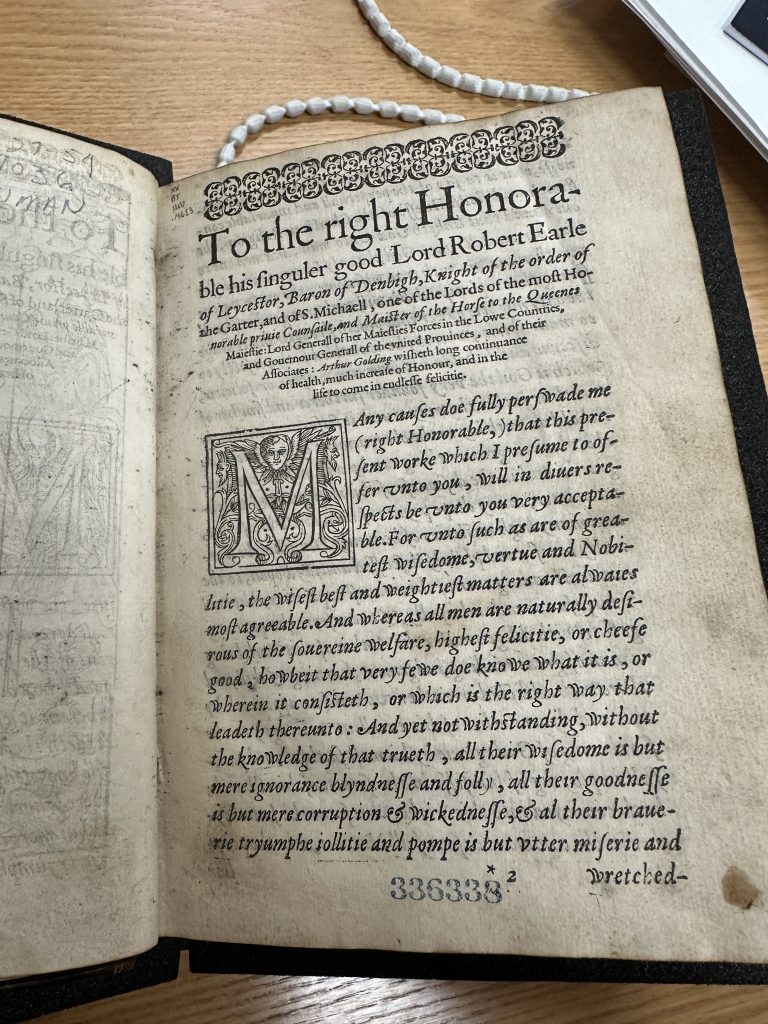
This book is dedicated twice: once to Lord Robert Earle by Arthur Golding, and once to Prince Henry King of Navarre (Later Henry IV, King of France) by Philip of Mornay.
Provenance
Publisher: Thomas Cadman, 1587
Thomas Cadman was the publisher and possibly bookseller of this book, but I was not able to find any information about him other his other publishings. I was able to find many books that mention him from this period within the University of Wisconsin-Madison library catalogue, which lists him as a publisher between 1574 and 1589 in their catalogue for “A work concerning the trewnesse of the Christian Religion”. In another book in their catalogue, the University of Wisconsin-Madison library includes that he sold books in Paule’s Churchyard, which was a hub for booksellers during this time. If this is the same Thomas Cadman, it’s possible that George bought this book from Cadman at the Churchyard.
Owners of this Copy
George Shurley (1569-1647) or George Shirley (1559-1622)
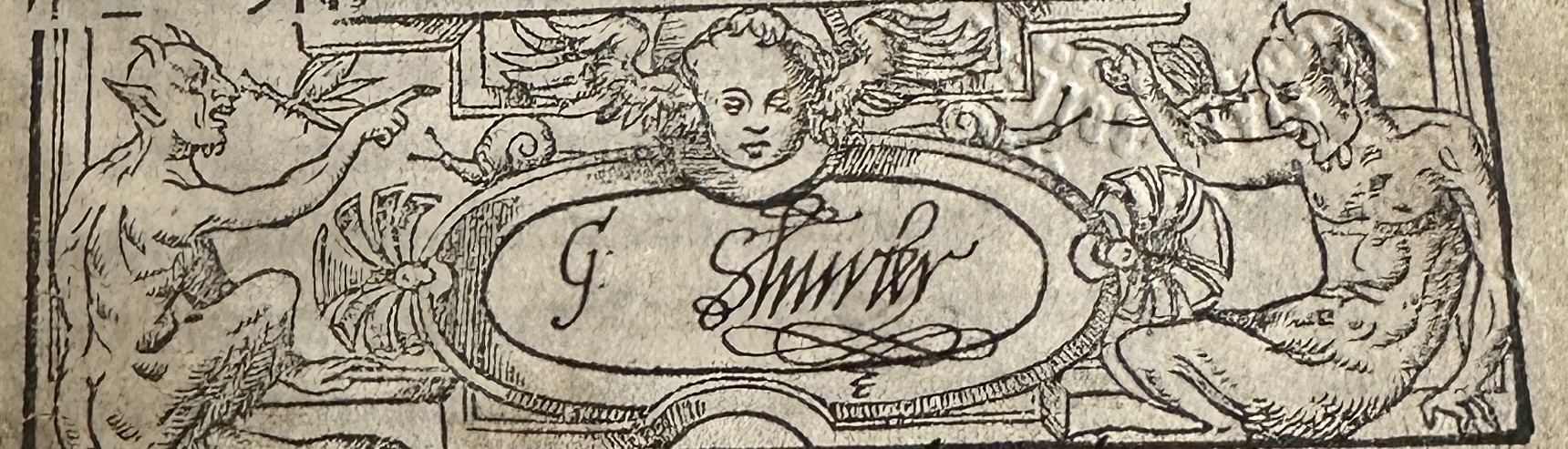
I struggled a lot with understanding George Shurley’s autograph, as the lines were so sharp and close together.The best I could identify was G. Shwuby or G. Shawby, which I could not find any existence of through research. After getting assistance from Tad and Andrew to read this, they suspected that this could be ‘G. Shurley’ or ‘G. Shirley’. Having a last name gave me something more to go off of which was really helpful for my research. Due to the placement of Shurley’s name in an intentional blank space, I assume that he is the first owner of this copy.
I was able to find two candidates for this book, but I am not sure which is a more likely owner. The first is George Shurley, who was once the Lord Chief Justice of Ireland beginning in 1620. He spent most of his life in Ireland, until he returned to Chester from 1641 to 1644 due to the Irish Rebellion, which he denounced once he returned. His brother, John Shirley, was a Member of Parliament around the same time as James Stanley. This similar level of status between George’s brother and James Stanley could explain how this book was acquired by James, but there is no record of this exchange.
Photo of George Shurley’s Grave
From Find A Grave
The other candidate I found was George Shirley, first Baronet (beginning in 1611). My reasoning for why this could be Shirley’s book is because even though much of his family followed Roman Catholicism, in 1585 he hoped to serve with the Earl of Leicester, to whom Arthur Golding dedicated this book. Due to the strong tensions between religious groups at this time, I am not sure how likely it is that Shirley would own this book, but due to his connection to the Earl of Leicester, it’s possible that George Shirley was interested in this book because of its relation to the Earl.
The Stanley Family, Earls of Derby
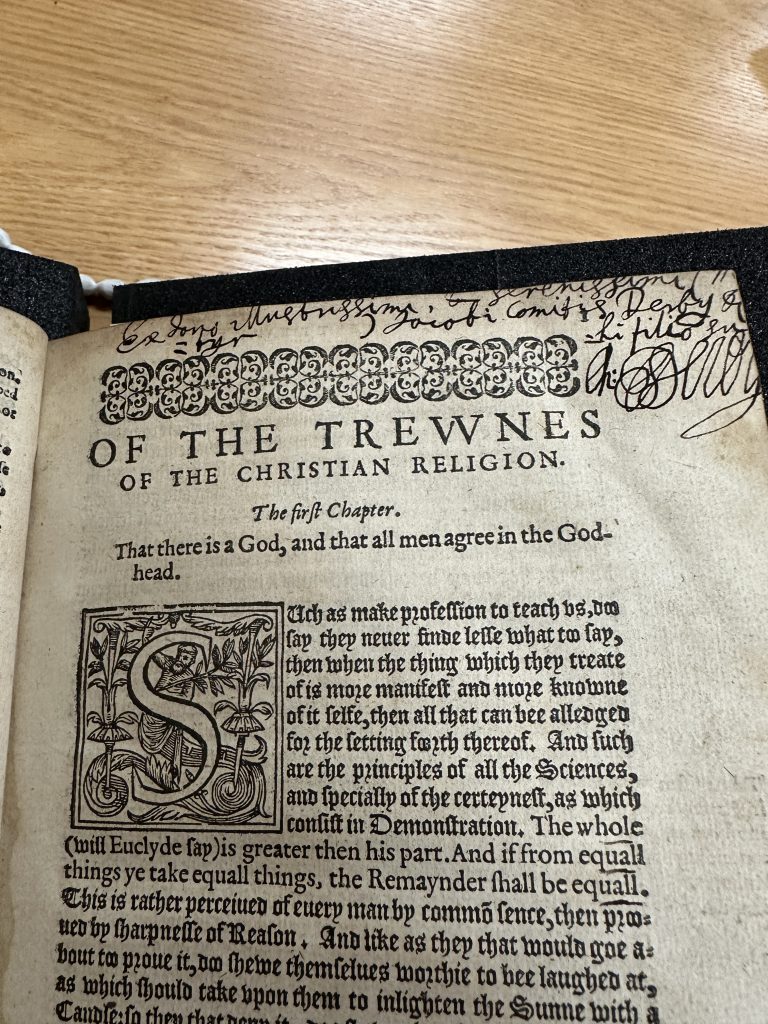
As discussed with the evidence of rebinding, there is an ownership inscription on the opening page that explains how James the Earl of Derby is gifting this book to his son, Charles Derby. The Stanley Family has the most evidence within this book, as there is not only this inscription but also an autograph and a bookplate within this book that help to identify the owners.
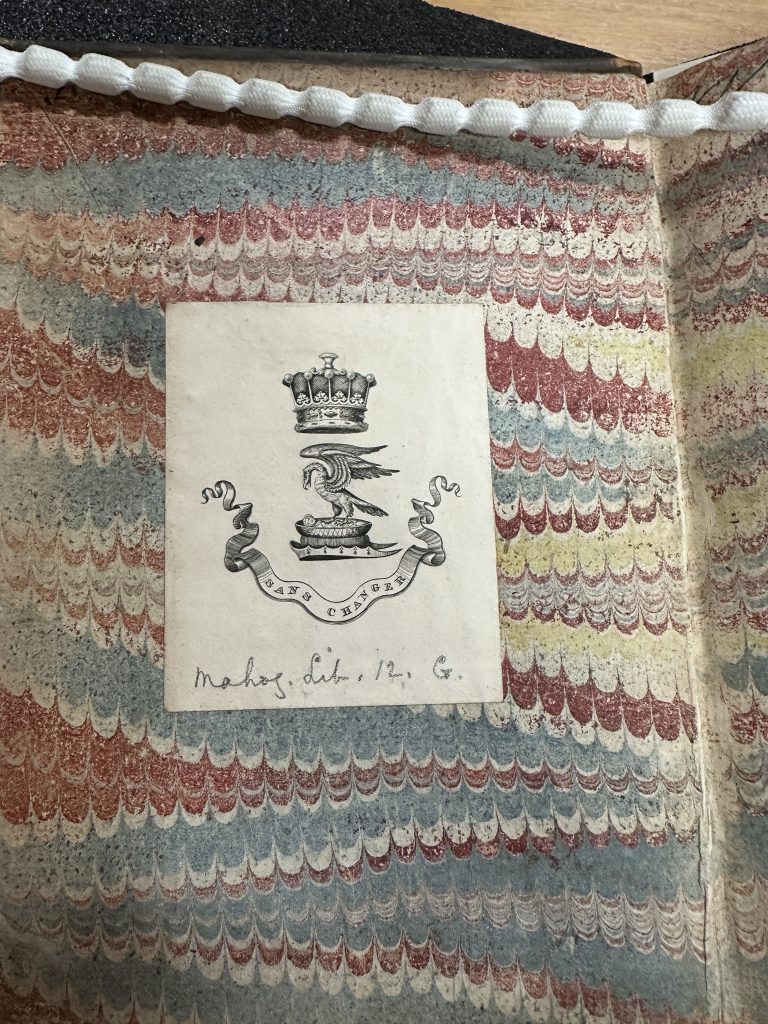
The bookplate took a long time for me to place, partially because there was no crest to assist my research.
I was able to identify the crown as a symbol for the status of Earls, but I struggled to place the center symbol of a bird perched atop a baby in a nest. After digging, and attaching the latin phrase of ‘sans changer’ (meaning without changing), I was able to find another similar design on Flickr, and I was able to confirm that the bookplate was related to the Stanley Family and the line of Earls of Derby.
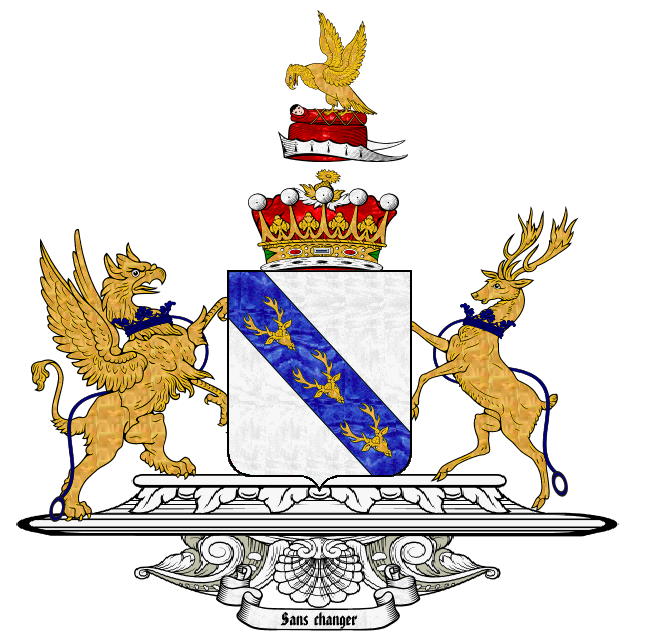
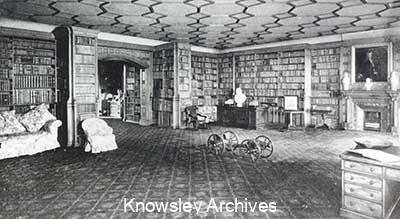
Another helpful part of this bookplate is the pencil writing beneath the bookplate symbol, which reads ‘Mahog. Lib. 12. G.’ Through finding the Stanley Family historical land and home, I was able to discover a Mahogany Library that exists in the Knowsley Hall, an estate that has been in the Stanley Family since the 1300s.
There is also an inscription on the first page of the book, which has been partially cut off. This inscription is in Latin and was read to me by Tad, which states “Ex dono illustrissimi & Serenissima _tyr Jacobi comitis Derby etc. _lui filio suo Ch. Derby”, the ‘_’ indicates where a word has been cut off. This translates to “From the gift of the most illustrious and most serene _ James Earl of Derby etc. _ to his son Ch. Derby.” This inscription was a great help in the provenance process, as it gave me more insight into autographs on the title page.
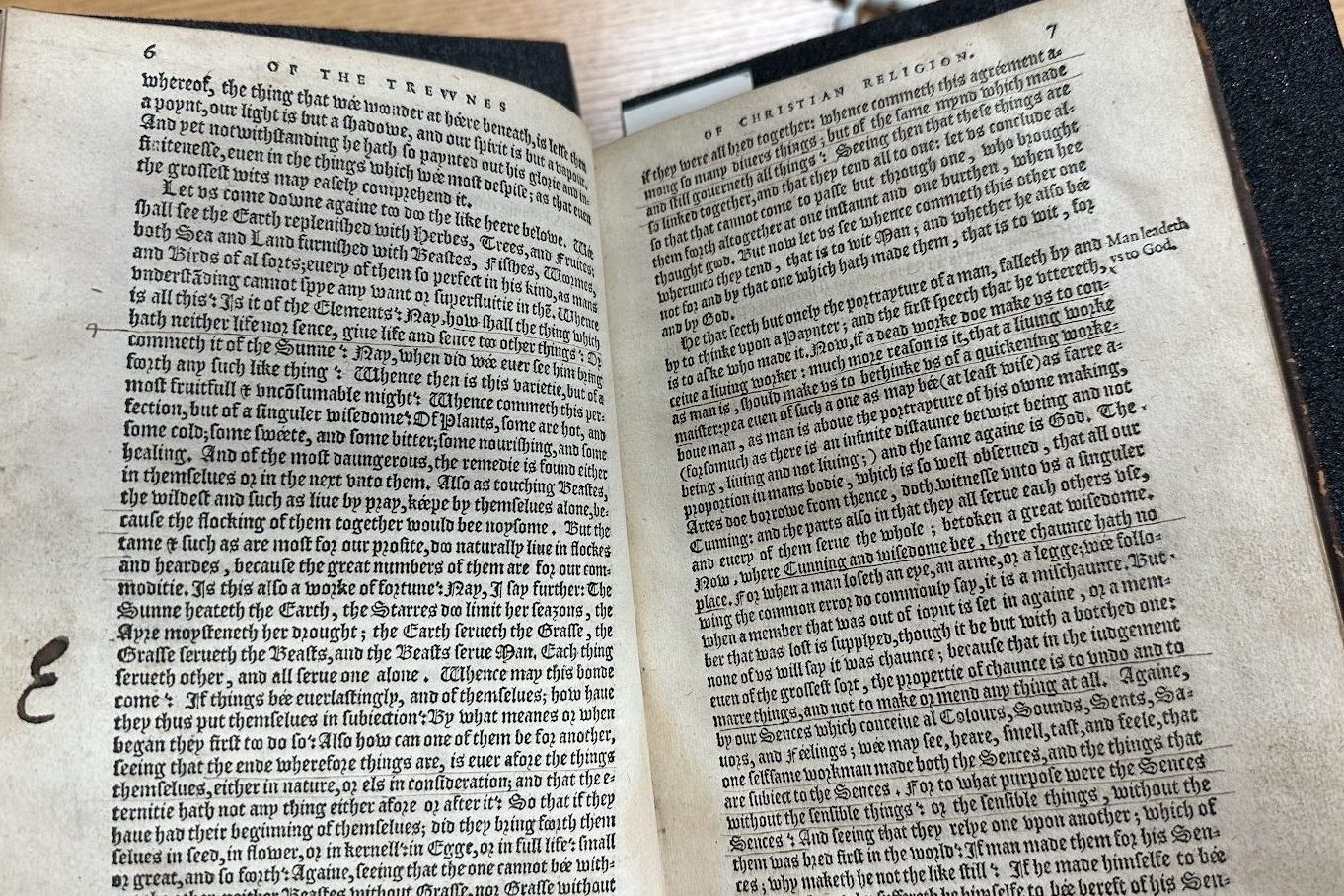
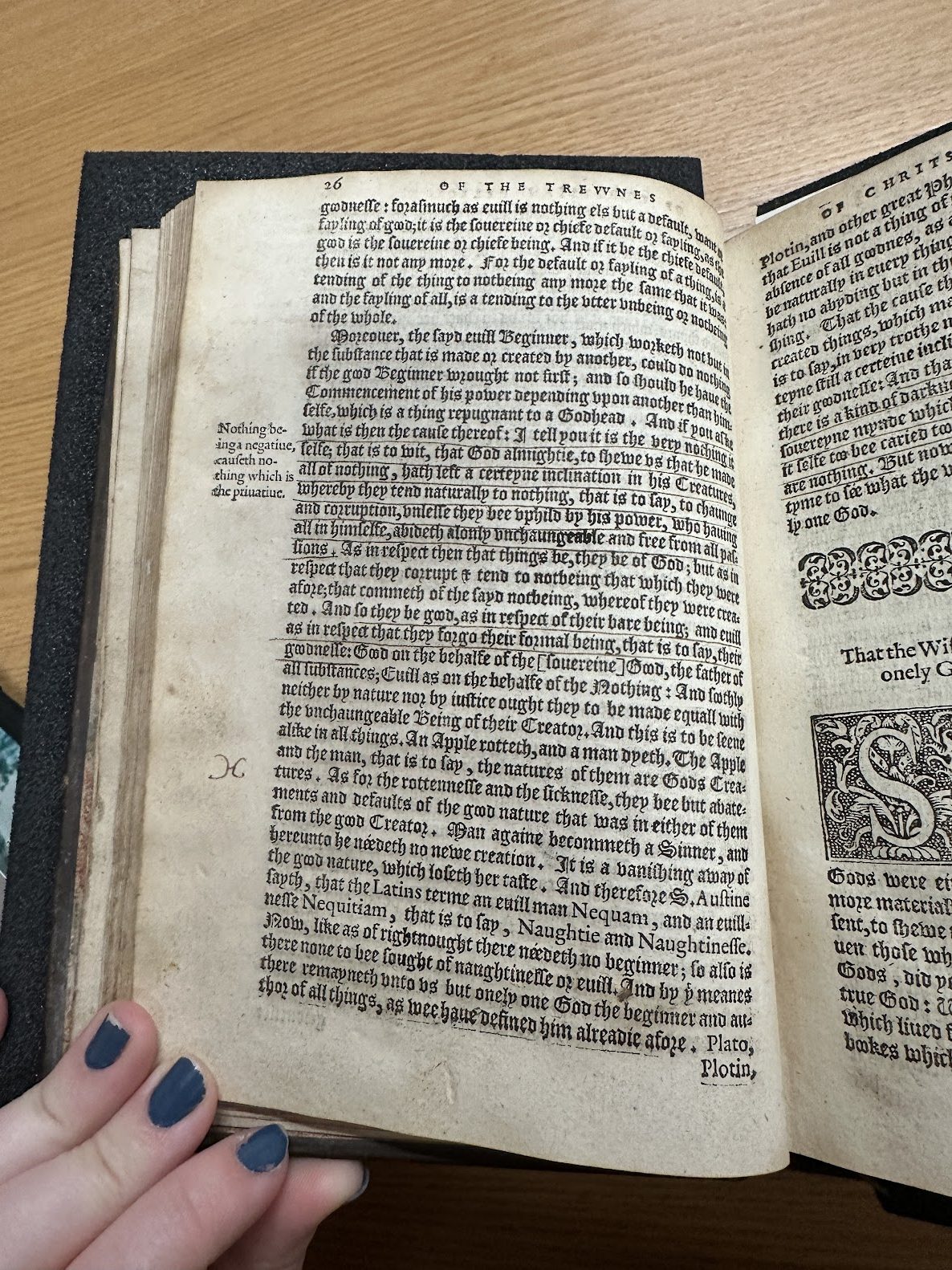
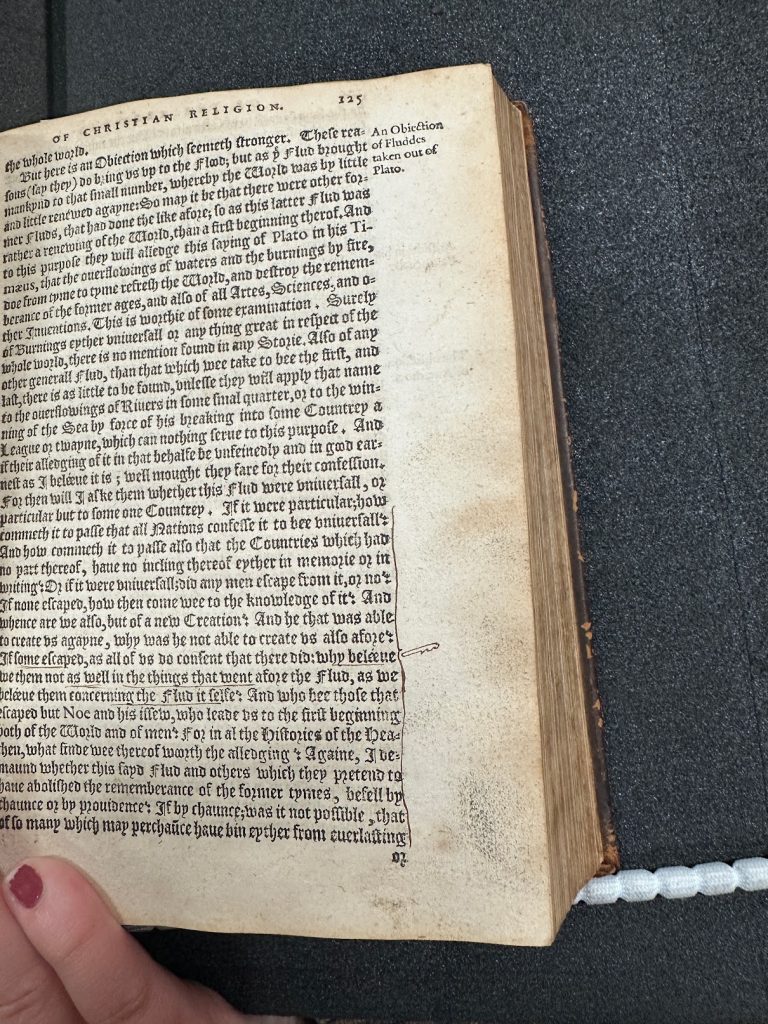
One of the Stanleys, possibly Charles, has left many interlinear markings through the book, especially the first 300 pages of the book. I identify Charles as the person who left marks throughout the book because the ownership inscription and the autograph on the title page are in different kinds of ink – the ‘Derby’ on the title page is in a brown ink, which matches many of the underlined sections of this book. He also once drew a manicule for a certain passage (page 125).
James Stanley, 7th Earl of Derby (1607-1651)
James Stanley was a politician and nobleman, and supported the Royalist cause in the English Civil War. He entered the House of Lords as Baron Strange in 1628.
The English Civil Wars (1642-1651) were fought between the Royalists, those who support Charles I, and the Parliamentarians, those who supported the English Parliament. Before the war, Charles I, King of Great Britain and Ireland (1600-1649), had gone against Parliament by dissolving it for a decade. A parliament was briefly assembled to raise money for the Bishops’ War in Scotland, which the King had lost. Three weeks later, Parliament was dissolved, and the Scots invaded England, forcing the King to negotiate and to recall parliament. Around the same time, an Irish insurrection occurred – the Ulster uprising, with Catholics pillaging and killing Protestants. Charles I, refusing to work with Parliament, mobilized an army on his own to quell the uprising, which made ending the revolt more difficult.
As a Royalist, James Stanley supported the monarchy and Charles I, and he fought throughout the Civil War, though many of his battles for the Royalists were unsuccessful or ended with defeat. James Stanley failed to get possession of Manchester or Bolton in 1643, later took over Bolton in the Bolton Massacre, led by Prince Rupert. He took part in the Battle of Marston Moor was a victory for the Parliamentarians, which led to the creation of the New Model Army for the victors. In 1650, he was chosen by Charles II (Charles I’s son) to command Cheshire and Lancashire forces for the Royalist cause.
In 1651, James was captured, tried by court-martial, and found guilty of treason. On October 15, 1651, he was beheaded due to his support of Charles I.
Charles Stanley, 8th Earl of Derby (1628-1672)
Though Charles Stanley did not participate much in the English Civil War, he did petition to save his father from execution, but was unsuccessful. He spent some time in Cheshire once he became Earl, and later, from his support of George Booth, the family lands on Isle of Man were returned to him. From 1666 to 1667 he served as Mayor of Liverpool.
There are no autographs or inscriptions that indicate who might have owned this book between Charles Stanley and William Harris, but it is possible that it continued to be in the Derby line’s possession until William Harris acquired the book. It’s possible the book was in Knowsley Hall for a century before it changed ownership.
William Harris (1782-1845)
This autograph is in the front end-leaf ,and it reads ‘720 Wm Harris Esq 1833.’ Because the m is smaller than the W, this indicates a shortened version of the name ‘William’, so I began to look into ‘William Harris’.
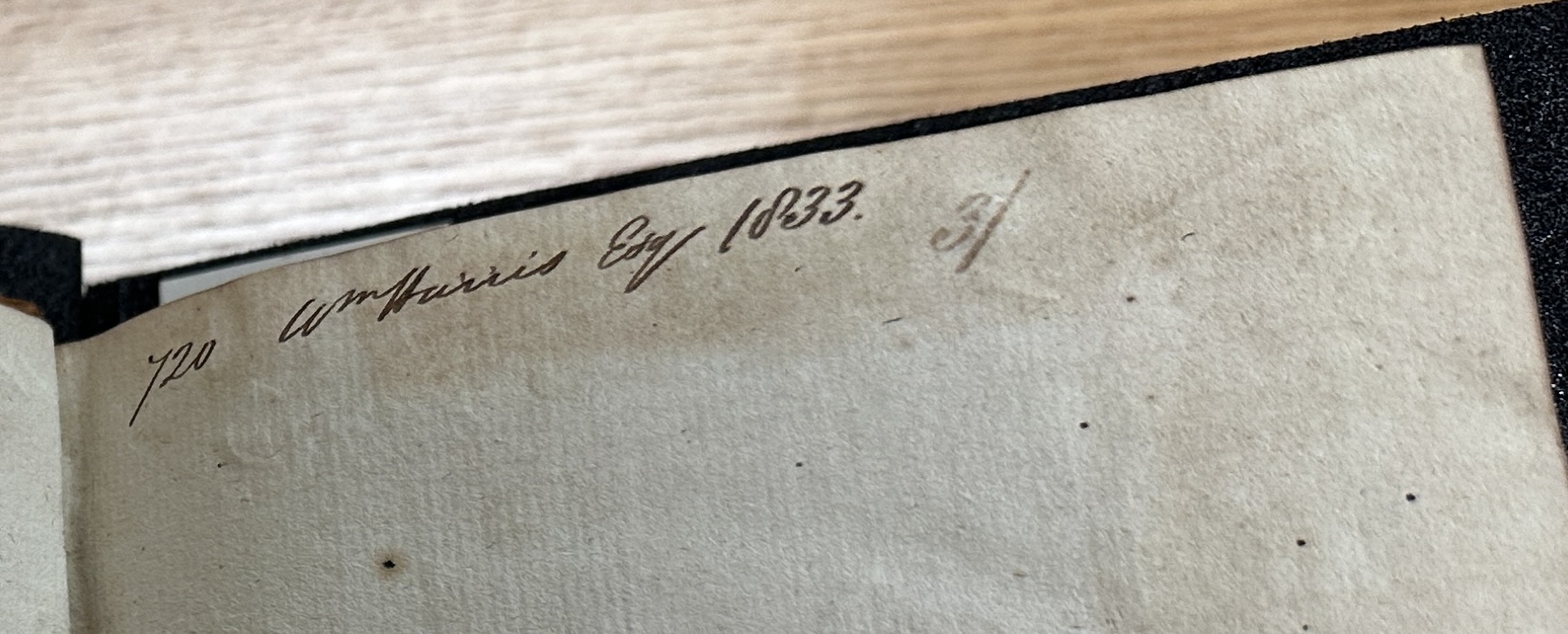
For a long time, I assumed that the ‘esq’ was referring to William’s place as a lawyer and was an abbreviation of esquire, as many of the definitions I looked up referred to esquire in a lawyerly sense. I was struggling to find any information referring to a William Harris in England or Scotland. There were many in the Americas, but it is unlikely that this book traveled to the United States and back in the 17th century. I decided to see if there was a different meaning of esquire, and I learned that in England, esquire was a term relating to social rank. I learned that esquire was considered above a gentleman but below a knight, and drew from a connection to those who served knights. Esquires include the heirs of Knights, Sons of Peers, and the heirs of certain individuals chosen by the crown to be recognized.
A possible owner of this book could be William George Harris, a British Army officer and Lieutenant-General, 2nd Baron Harris. Even though he was a Baron, this could have been used as a courtesy title to acknowledge his high rank. His father, George Harris, died in 1929, 14 years after receiving the title Baron Harris which passed to William upon George’s death. William served as the Colonel of the 73rd and the 86th Regiments of Foot soldiers, and fought in the French Revolutionary Wars, the Napoleonic Wars, and the Fourth Anglo-Mysore War.
I am unsure if this William is the owner of this book, and unfortunately William Harris was a relatively common name during this time, but due to his societal rank I believe William George Harris is a possible owner of this book.
Charles Lee Lewes (1843-1891)
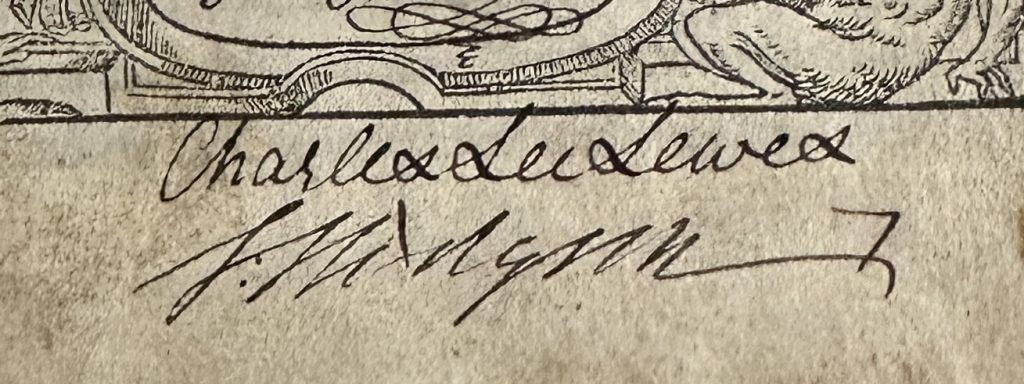
Charles Lee Lewes, along with the Earls of Derby, is a person that I can confirm owned or interacted with this book, and I was able to confirm this by finding his autograph on a photo of himself.
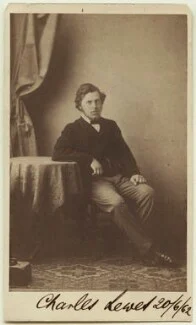
This is a photo of Charles Lee Lewes that I found on the National Portrait Gallery website, which includes a very similar autograph to the one included in the book. The date of this photograph also matches up with the information I found on a Charles Lee Lewes, the son of George Henry Lewes (1817-1878). Charles Lee Lewes was a post office clerk, the first London County Councillor, and after his father’s death he curated his library. He also shares the same name of his great-grandfather, Charles Lee Lewes (1740-1803) who was an actor and a member of the Covent Garden company.
Photo from the National Portrait Gallery.
George Henry Lewes (1817-1878) was a philosopher and critic, as well as an author. He wrote about and discussed philosophy, science, and literature, and wrote many articles relating to those subjects. He also had a relationship with Mary Ann Evans, who wrote under the name George Eliot. It is possible that Charles’ father George owned this book and it was part of his collection that Charles then curated, but I do not for sure how this book got to Charles Lee Lewes.
Leonard Hodgson (1889-1969)
‘L.Hodgson’ (below ‘Charles Lee Lewes’) was another name that I struggled to understand, much like George Shurley, that Tad and Andrew assisted me with interpreting. There were certain lines of the autograph that made me think there was a ‘t’ or an ‘i’ within the name, and because the letters were so close I thought maybe it was a short name, with a last name of ‘Aynn’ or ‘Aynm’, but Tad read it as ‘L. Hodgson’ or ‘L. Widgeon’.
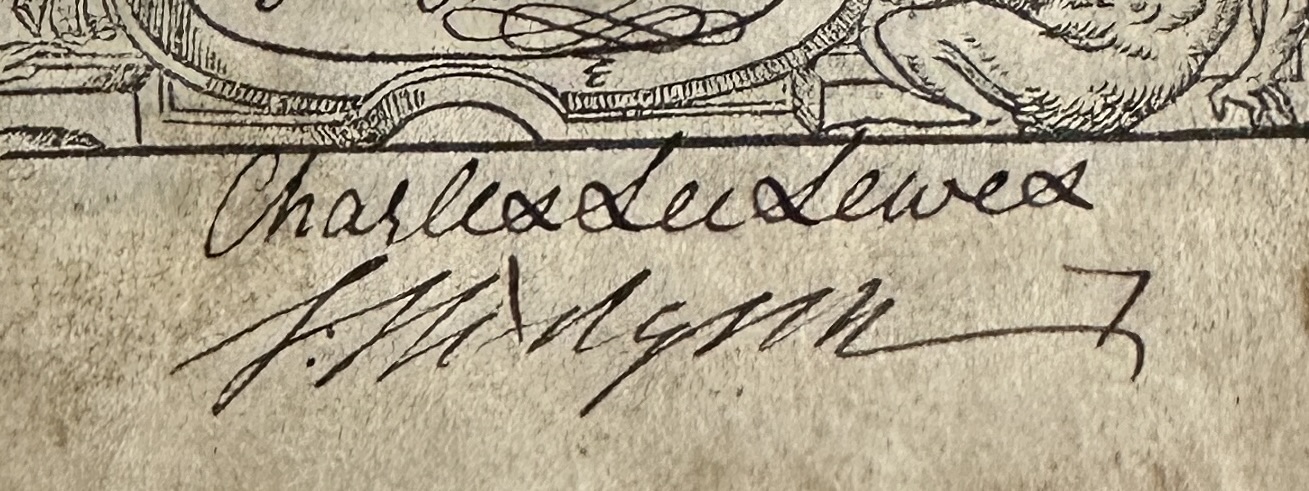
This gave me enough of a lead to find a Leonard Hodgson who seemed like a plausible owner of this book. Leonard Hodgson was a theologian, a deacon, bishop, and in 1919, he became the dean of divinity and tutor in theology at Magdalen College in Oxford. Hodgson wrote his own works regarding Christian apology and Christian philosophy, which would explain his possible ownership of this book. Some of his works include The Grace of God in Faith and Philosophy, The Place of Reason in Christian Apologetic, and Sex and Christian Freedom. He lectured internationally on philosophy and religion, and in 1944, he became regius professor of divinity at the University of Oxford. His works on Christian apologetics and theology make him a likely owner of this book.
I was not able to find a direct link between MSU and Leonard Hodgson, he did lecture in New York in the 1920s and in 1936, so Hodgson was in the United States soon before this book entered MSU’s collection, but I am not sure how exactly Michigan State acquired this book.
Michigan State College of Agriculture and Applied Science (Michigan State University)
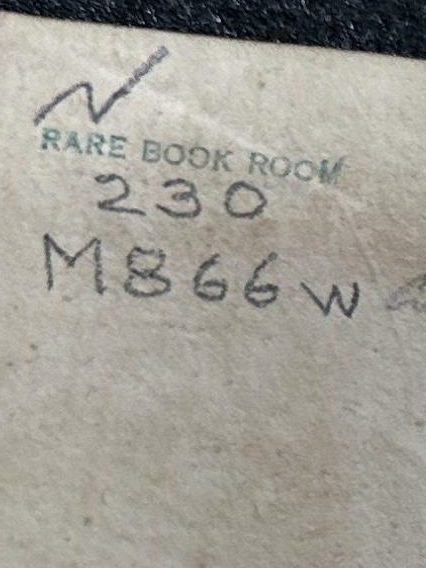
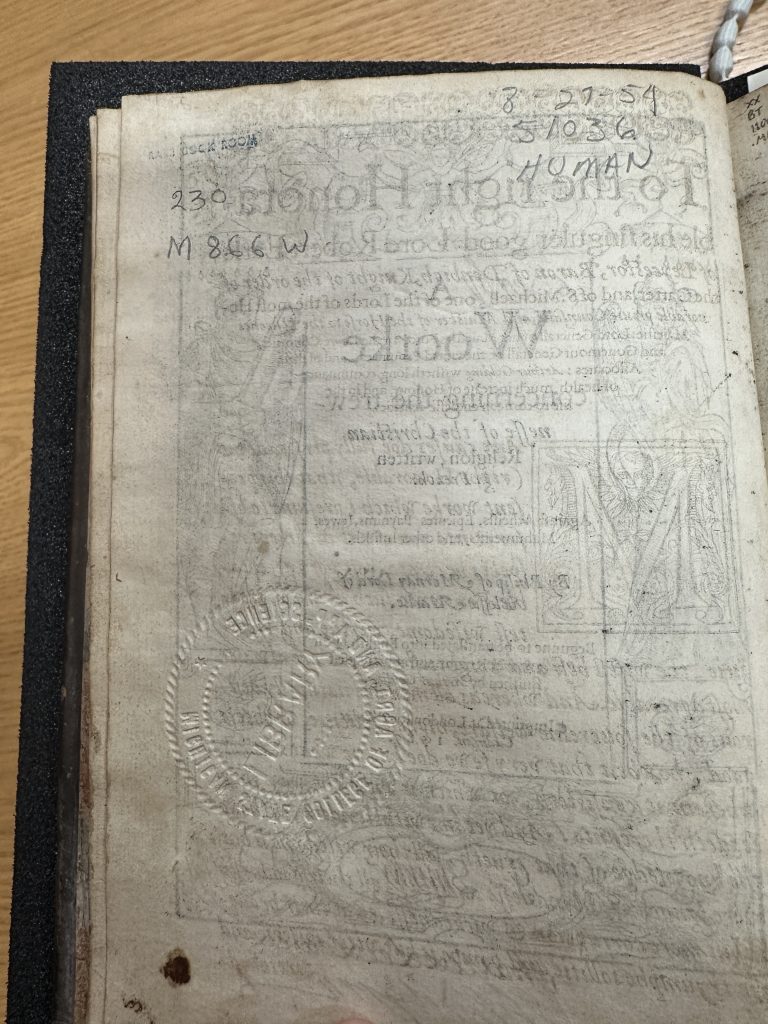
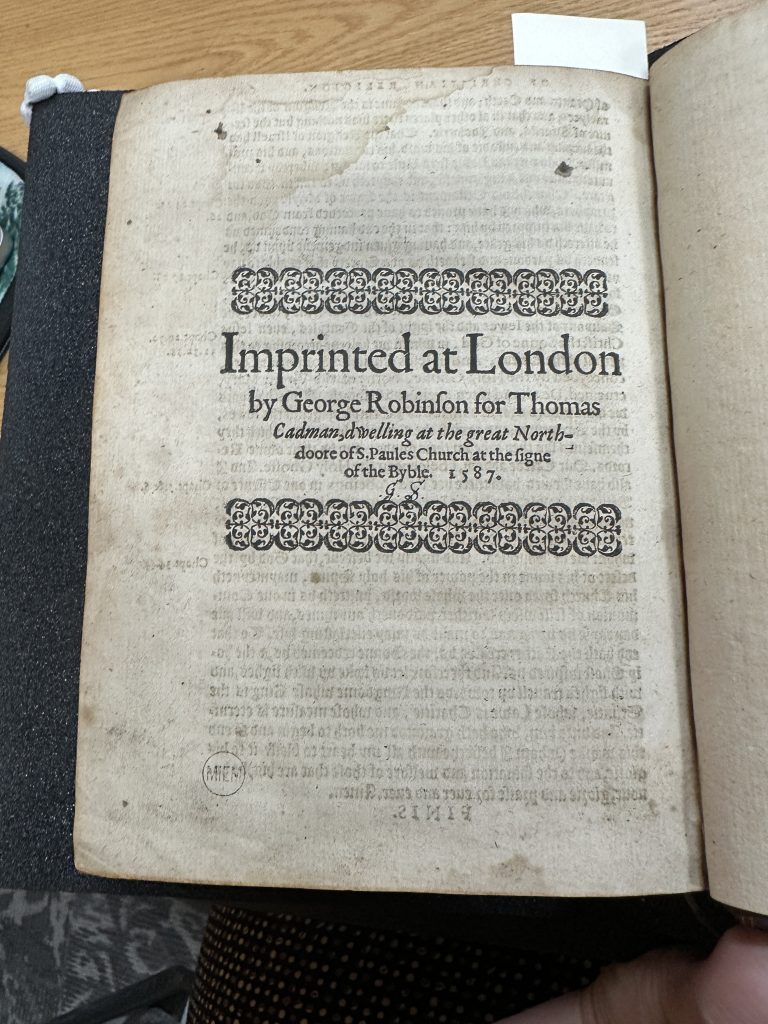
Using the provenance on this book, I was able to figure out the exact date this book was received or catalogued by MSU. I was able to accomplish this by inspecting the MSU stamp on the back of the title page and looking at the similar writing style on different marks.
The embossed stamp, stamped on the title page as well as page 99, reads ‘Michigan State College of Agri. And App. Science’ on the outer ring, with ‘Library’ in the middle. This name indicates that this book was catalogued or stamped between 1925 and 1955, because during that time, MSU was named ‘Michigan State College of Agriculture and Applied Science’. In 1955, ‘College’ was replaced with ‘University’. Above the stamp on the back of the title page, someone wrote a date and classification of the book: ‘8-27-54. 51036. HUMAN’. This supports the MSU name on the stamp, so this could be information written when this book was catalogued.
Both on this page and the front end-leaf, there is a blue stamp and another classification or mark. The stamp reads ‘Rare Book Room’, which was found on another peer’s book, which might have been a stamp used by MSU at some point. The stamp is also placed within the same space as other MSU markings, which leads me to believe that they relate to each other. The mark reads ‘230. M866W’. This could reference the Dewey Decimal System, as religion falls under 200. According to the Library of Illinois, 230 is ‘Christian theology’. The number and letter combination could be a shelf mark or a library classification system. This handwriting matches well with the date writing, so it is likely that these were done by the same person. Through connecting these pieces of provenance, I was able to place MSU’s ownership of this book first being marked in 1954.
Unidentified Provenance
This gallery includes marginalia and bookseller’s notes that I was unable to connect or find information about. Some of the marginalia is connected, as they are done in the same way or the same script, such as the brown ink that names Saturn and Jupiter and was used to write ‘anti.fio.iiia’. Two pieces of marginalia read ‘mem?’ and ‘+memom’, which Tad told me essentially meant ‘remember this’. There are many pages where someone has drawn a plus sign in the margins, and this could be connected to the person writing ‘remember this’, as they are both done in pencil.
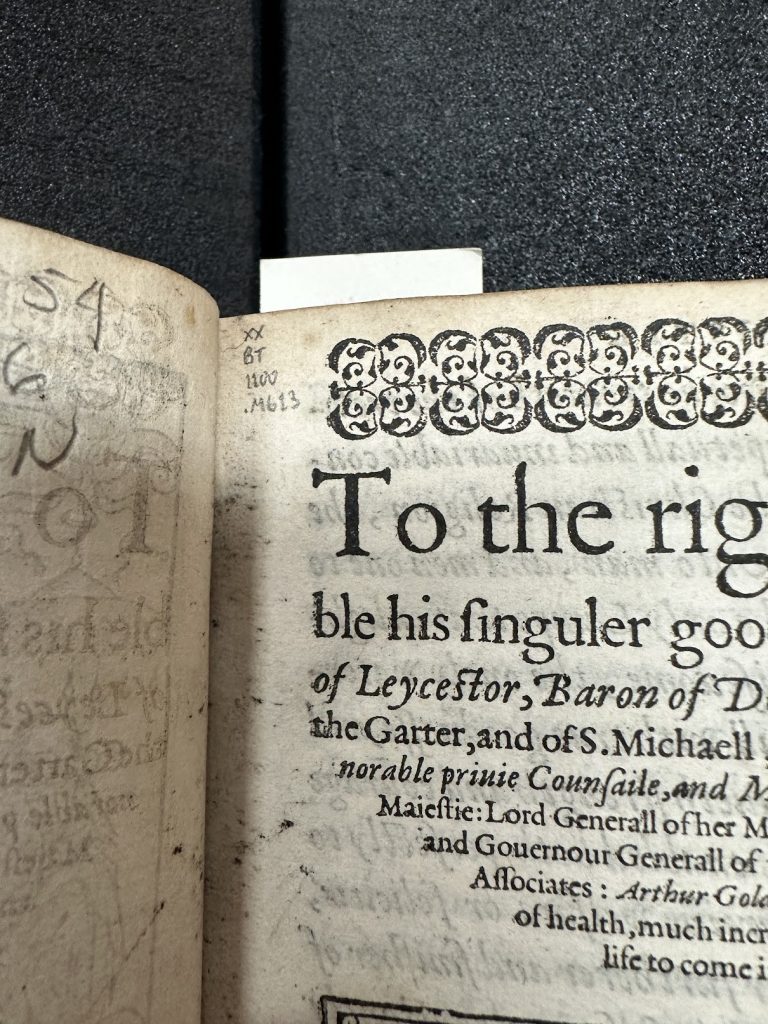
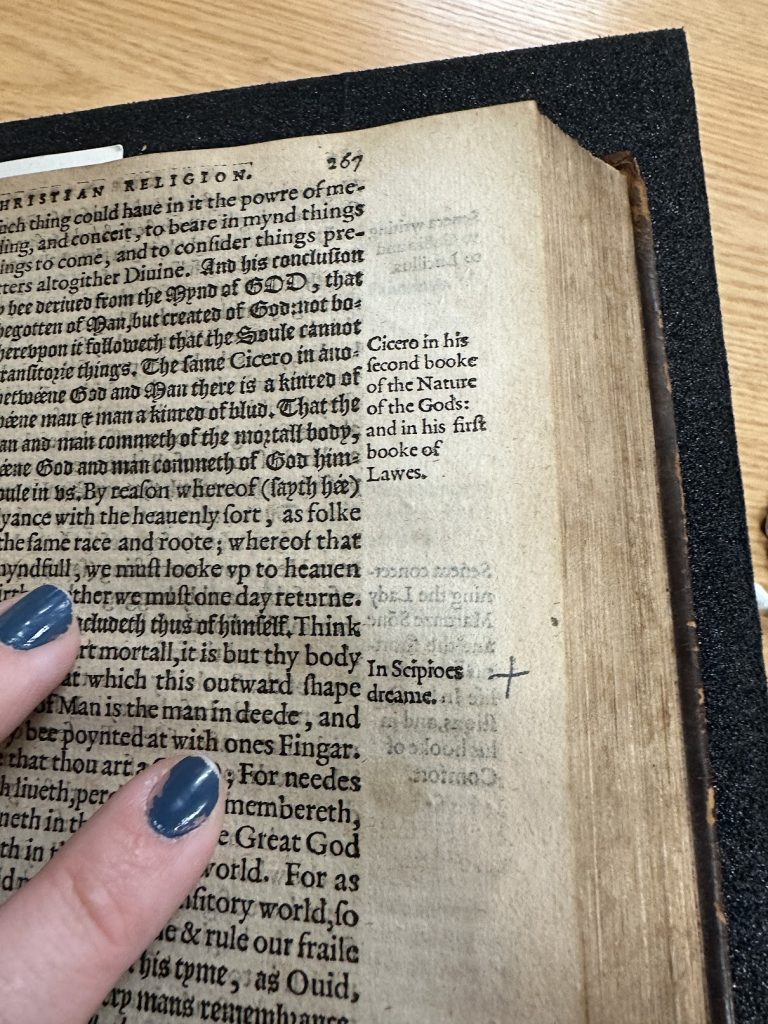
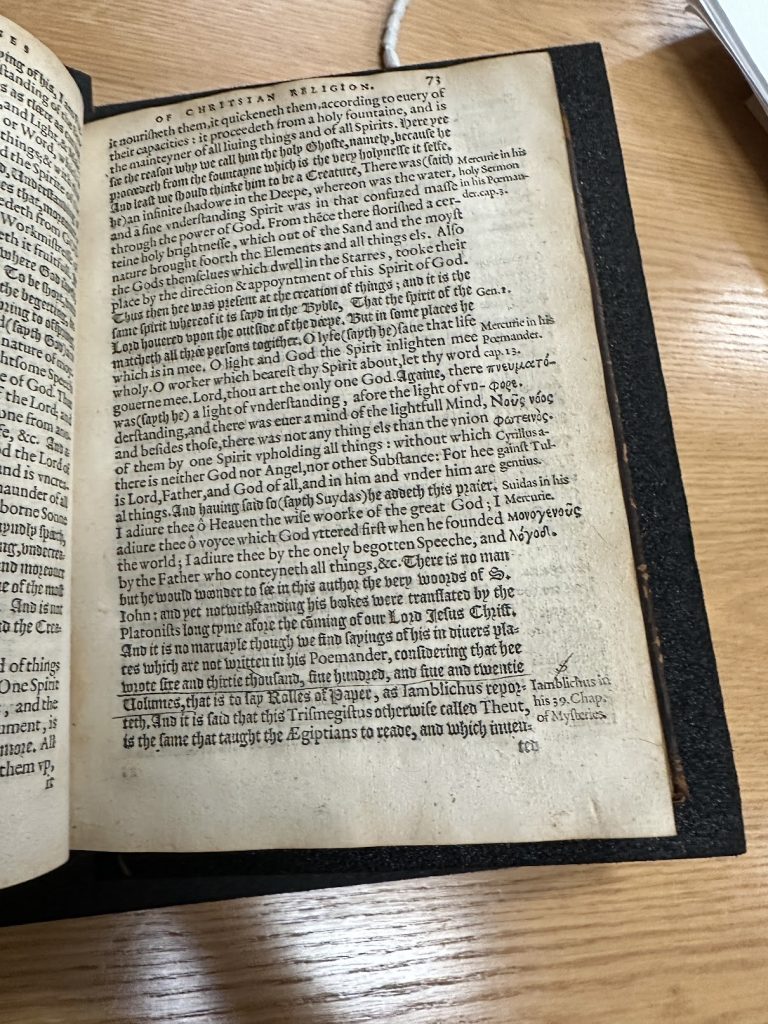
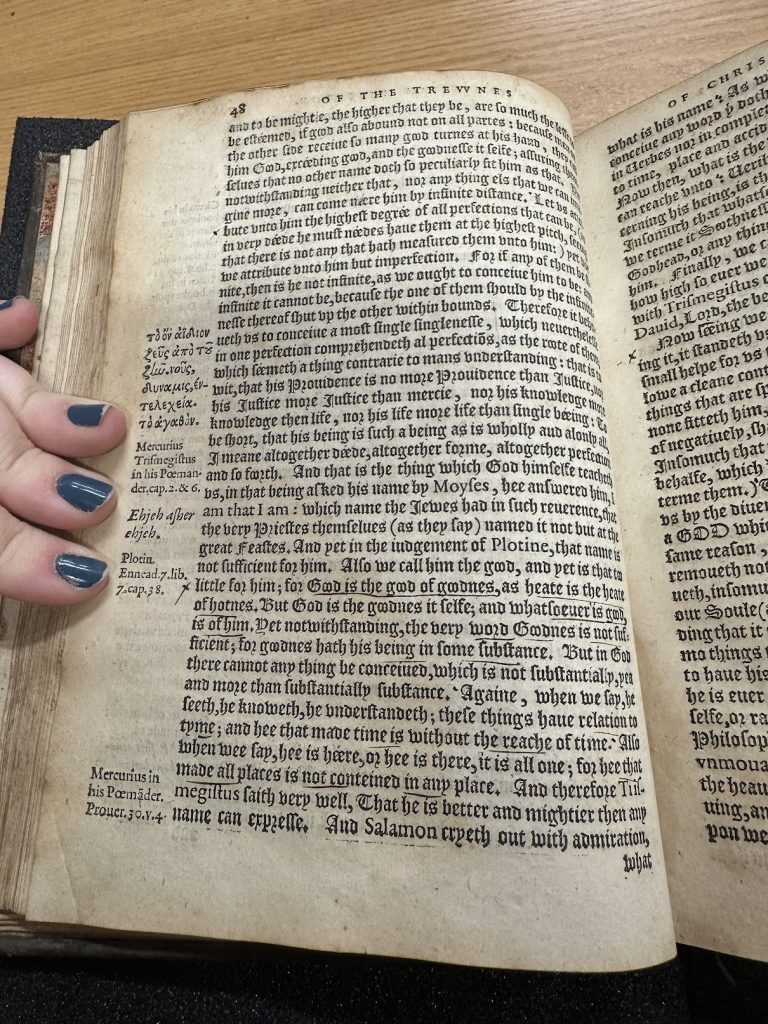
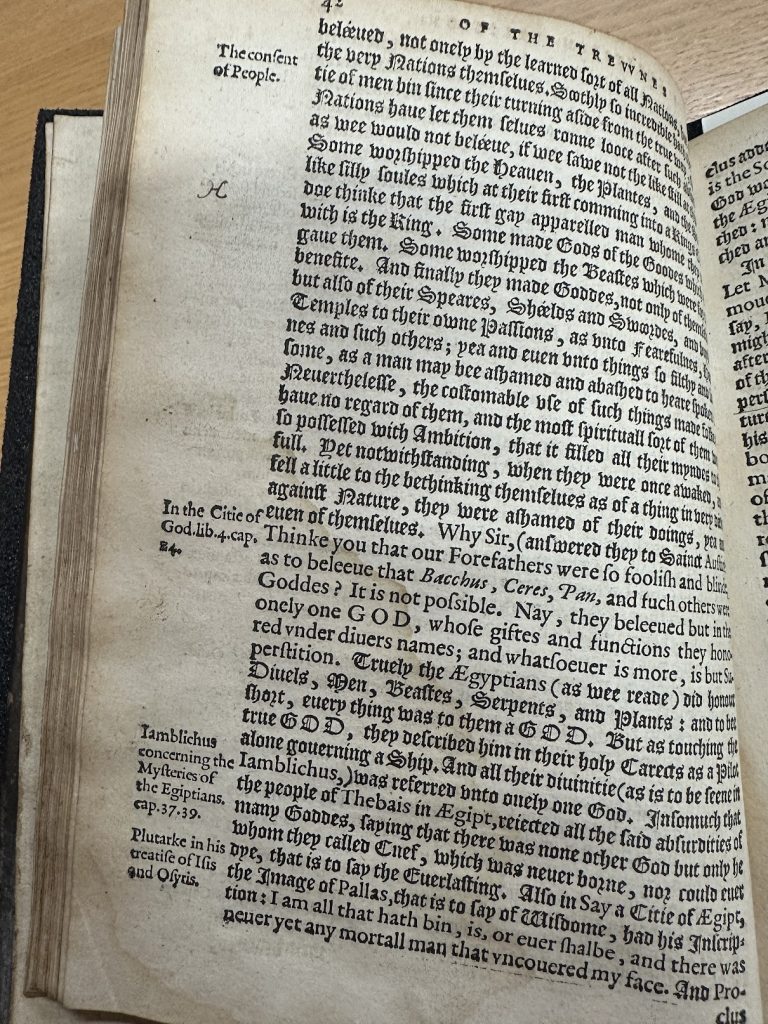
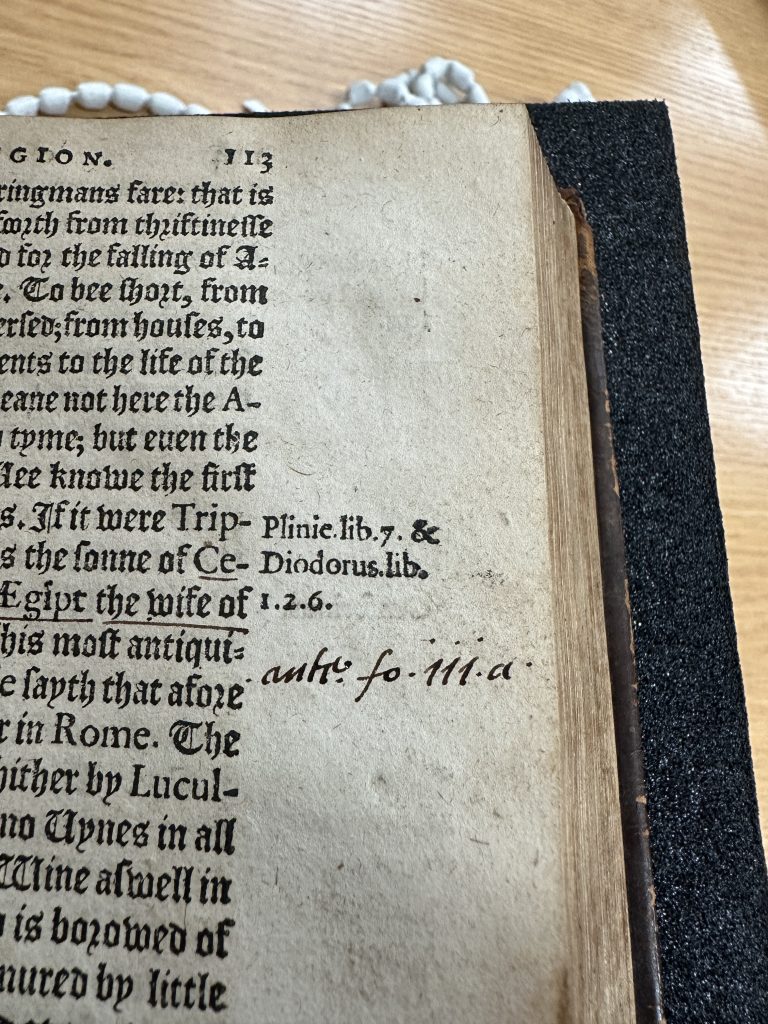
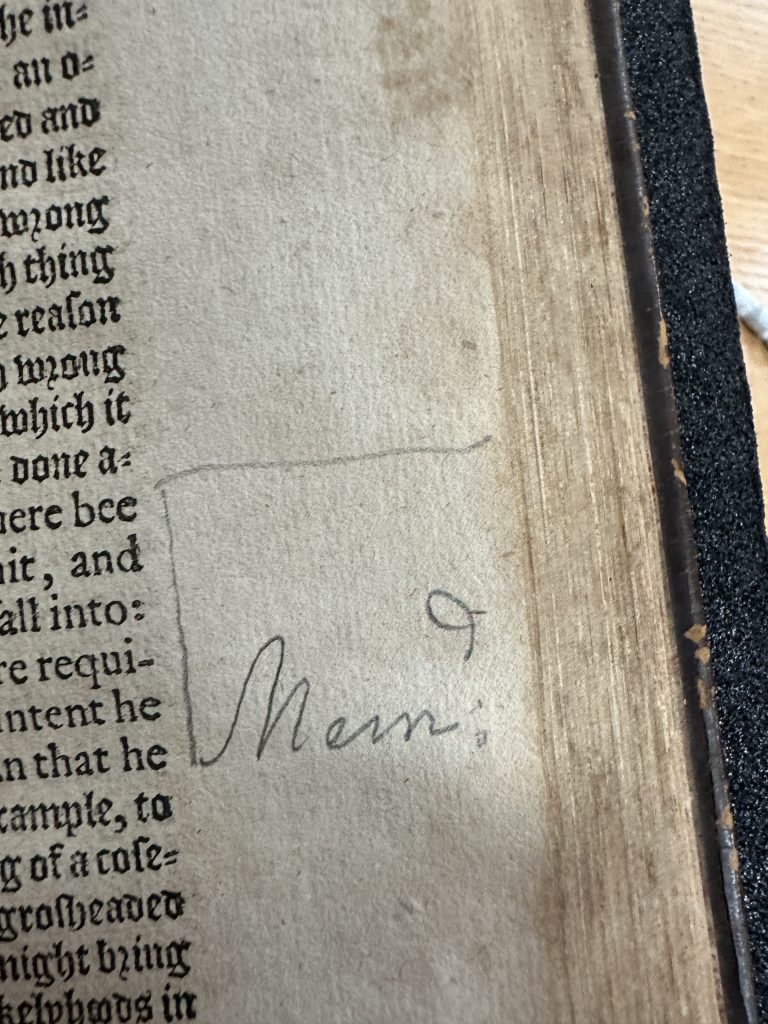
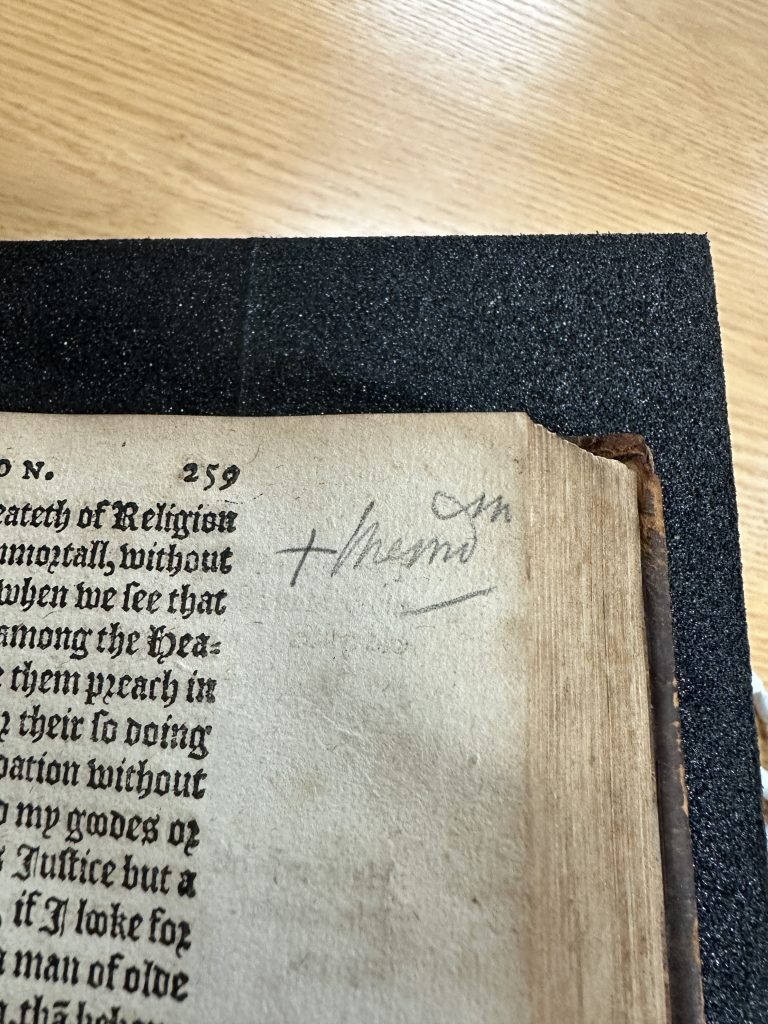
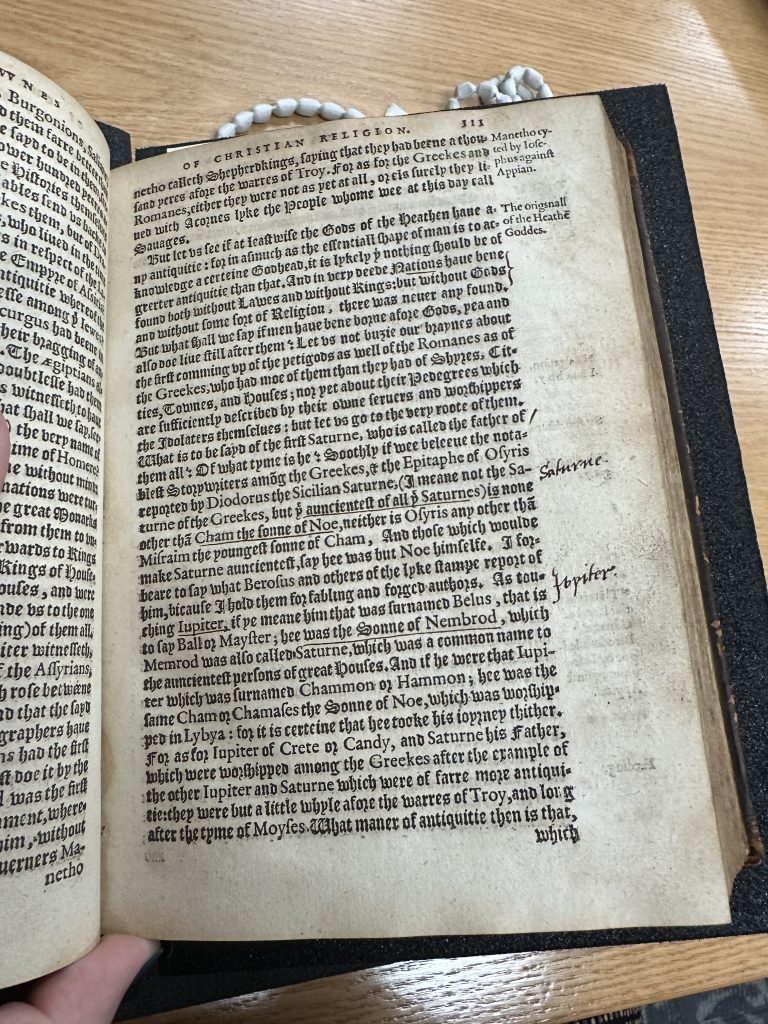
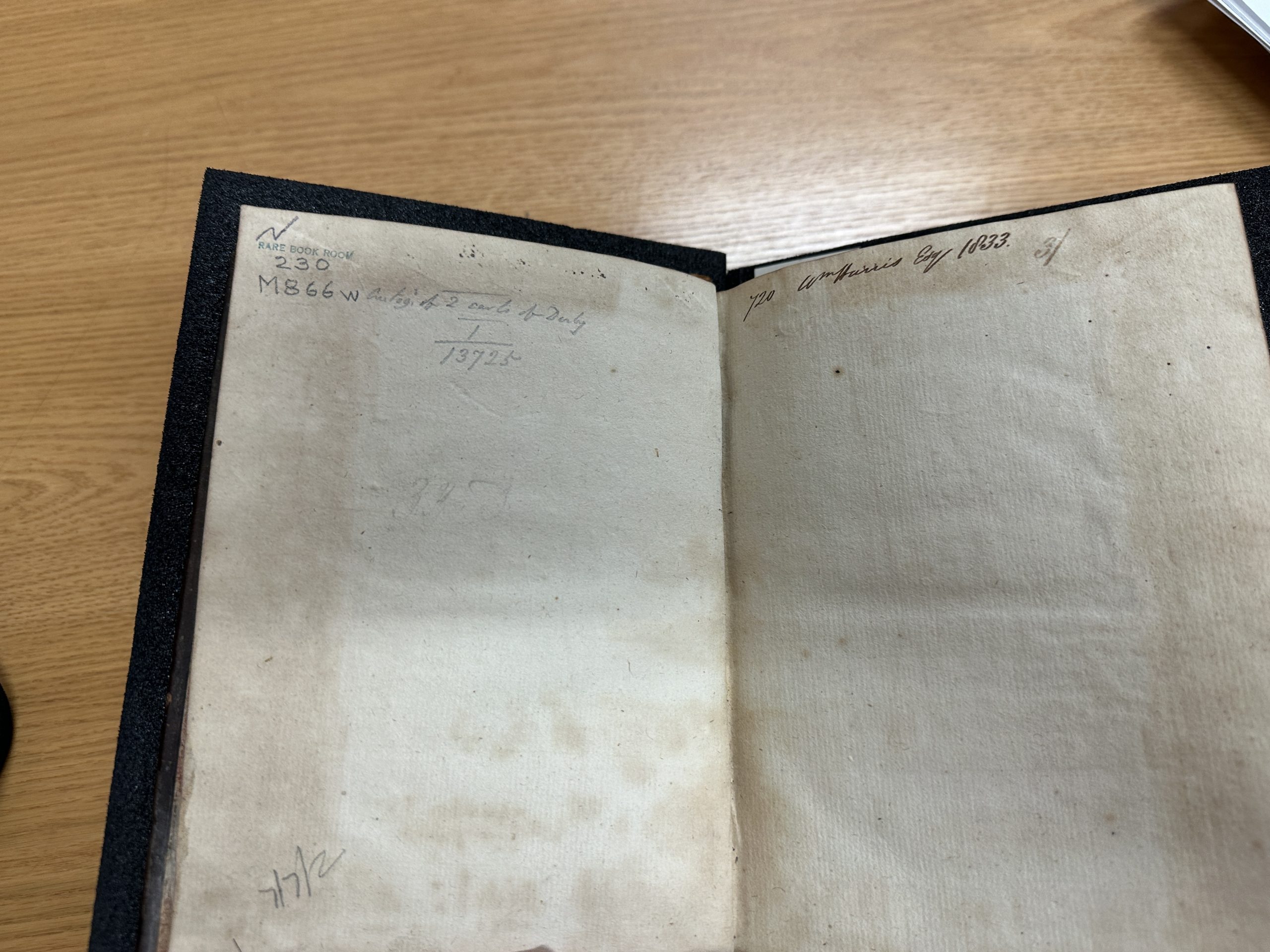
This image includes three examples of unidentified provenance. Near an MSU marking, someone wrote ‘autographs. of 2 earls of Derby. 1/13725’. This is most likely a bookseller’s mark, indicating the status of the people who owned this book. There is also a date at the bottom of the page that reads ‘7/2/2’. Which looks like modern script, so it’s possible that this is a marking from a student at MSU. A final piece of provenance is a very faint marking of someone’s inscription at the center of the page that seems to read ‘3.B. J.’ This could have been an owner’s shelf mark to keep track of where their books were held.
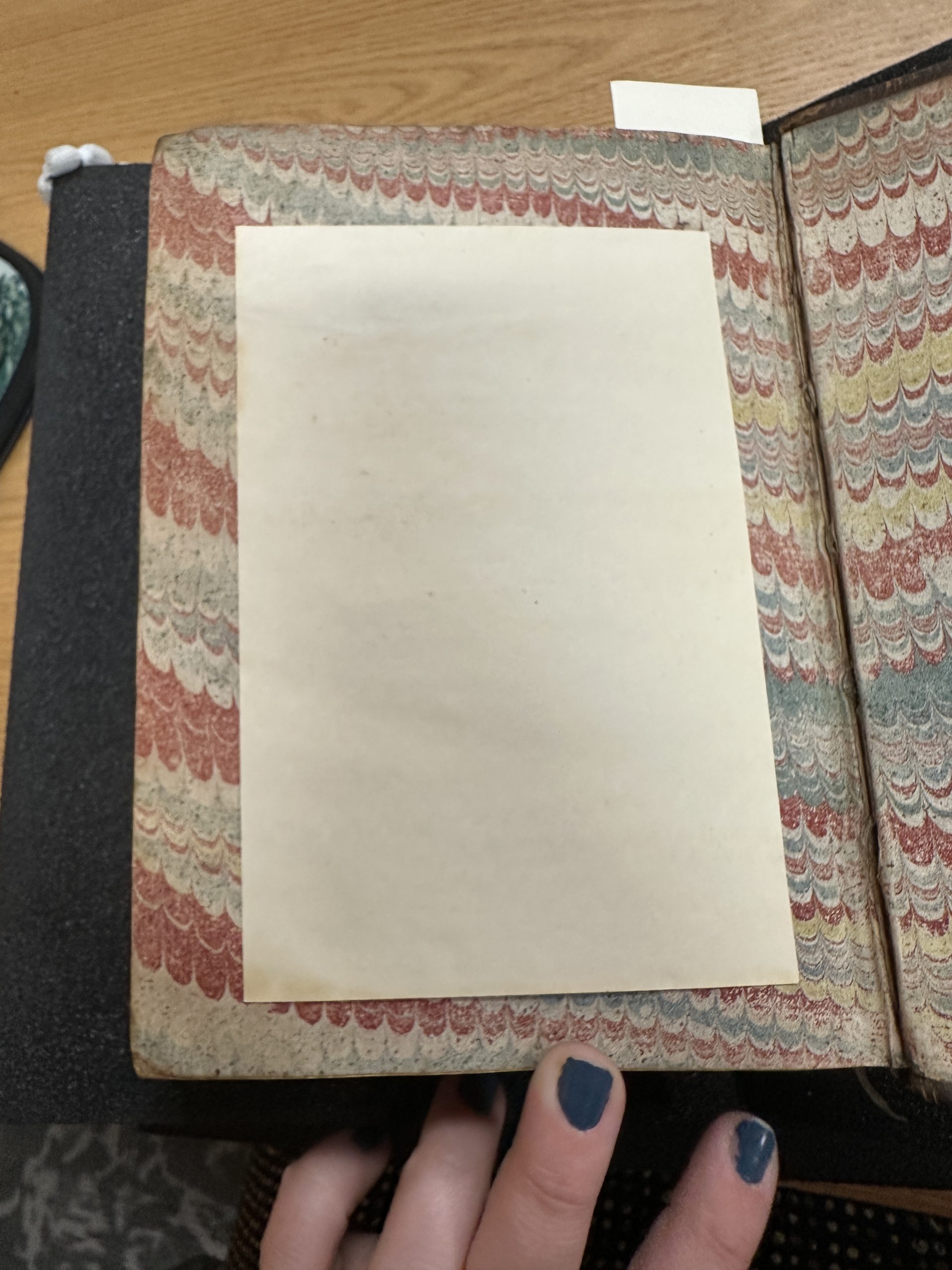
A final piece of unidentified provenance is this back paste-in paper that was never completed. I am not sure who might have planned on marking this book, but I assume they were going to add a bookplate to show their ownership.
There were many markings I could not identify or connect throughout this book, but these markings help me to understand the space between different owners during the nearly 500 years this book has existed. Some of these markings could relate to the same owners who autographed this book, especially regarding shelf markings, but there is no way to confirm the overlap or connection between these different pieces of provenance.
Possible Timeline of Ownership
For many of these previous owners, there is not a way to completely confirm but this is a possible timeline of who left their mark on this book.
- Thomas Cadman
- George Shurley
- James Stanley, 7th Earl of Derby
- Charles Stanley, 8th Earl of Derby
- William Harris
- Charles Lee Lewes
- Leonard Hodgson
- Bookseller (unidentified)
- Michigan State University
Physical Description
The following images display the wear of this copy.
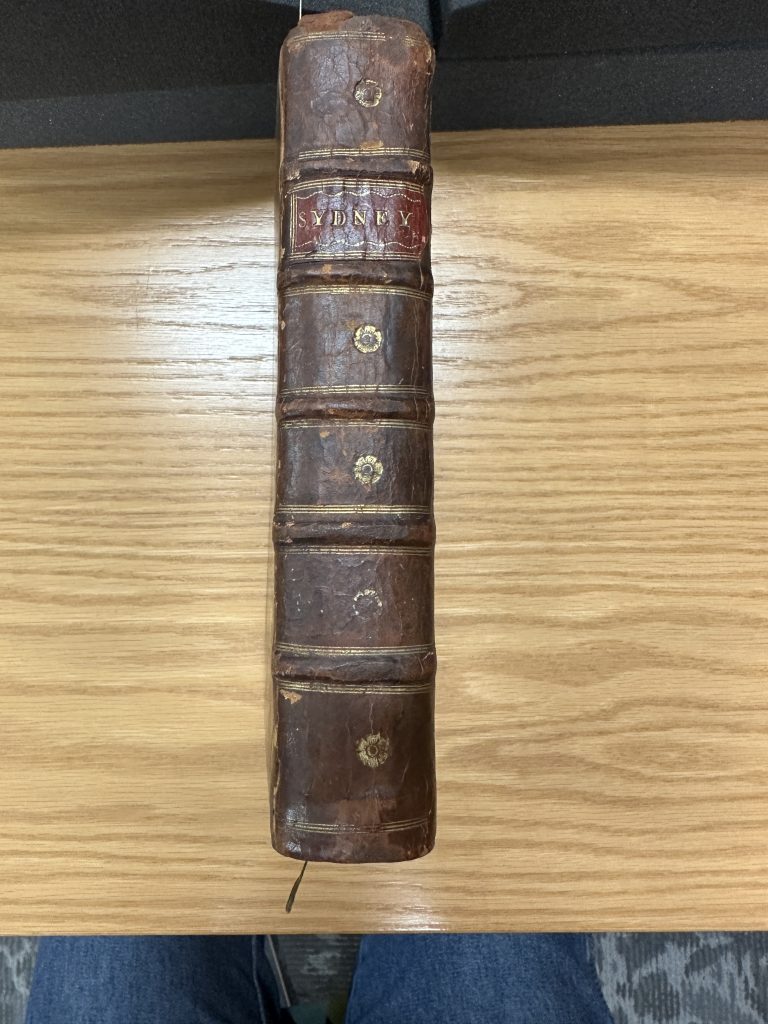
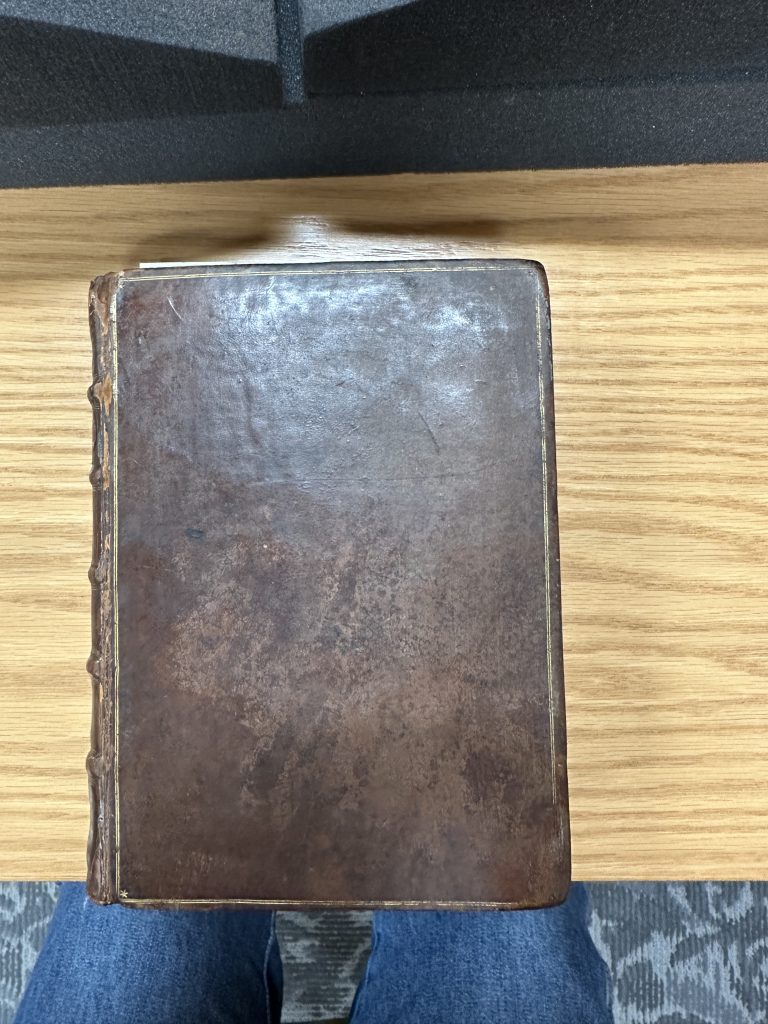
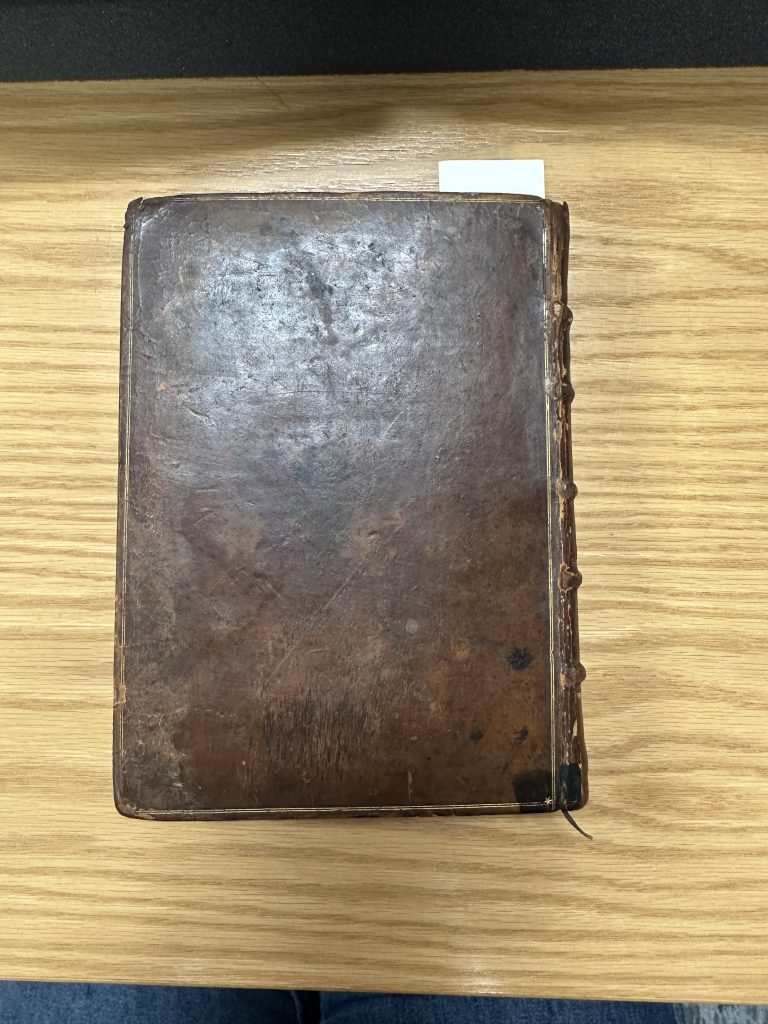
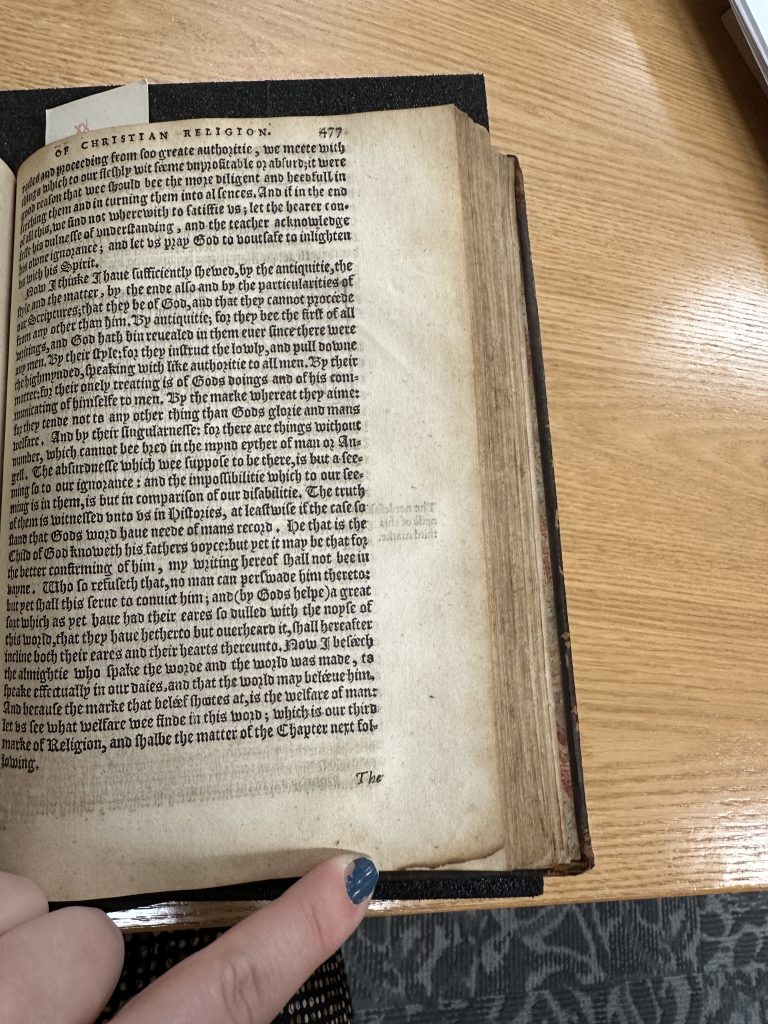
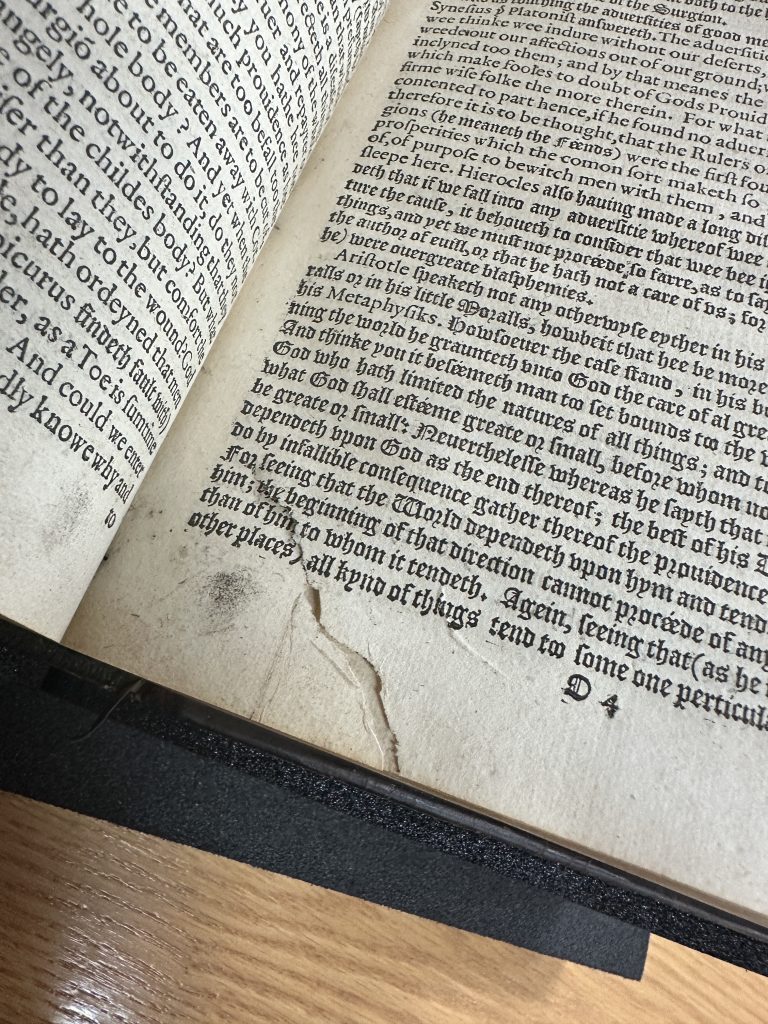
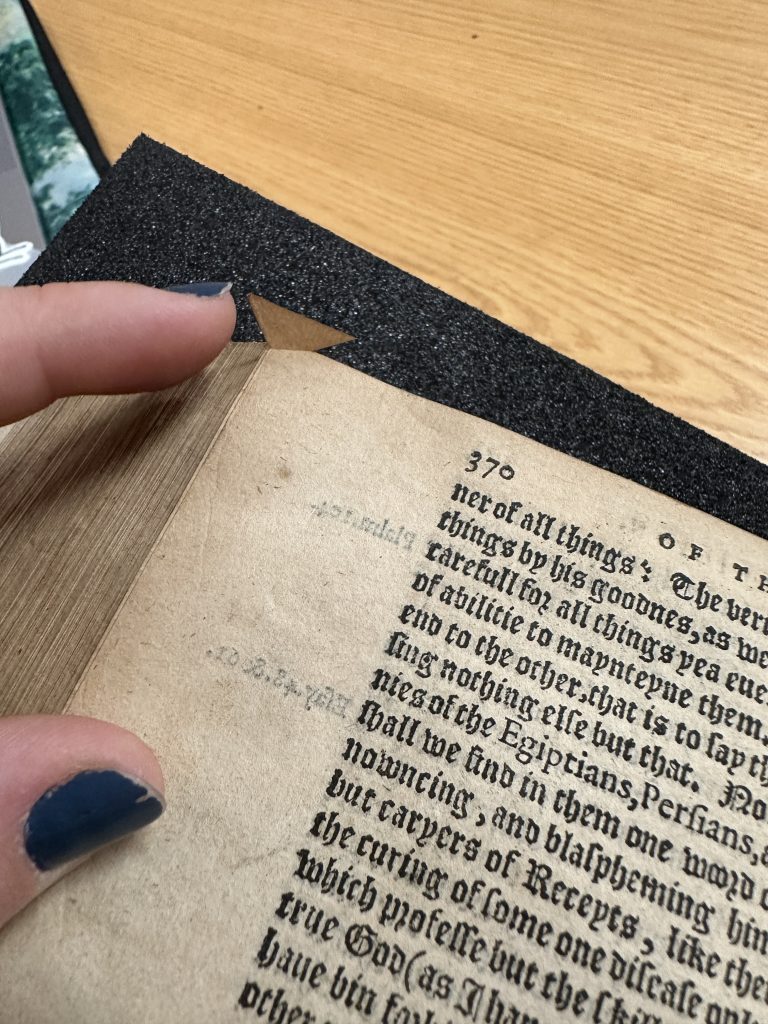
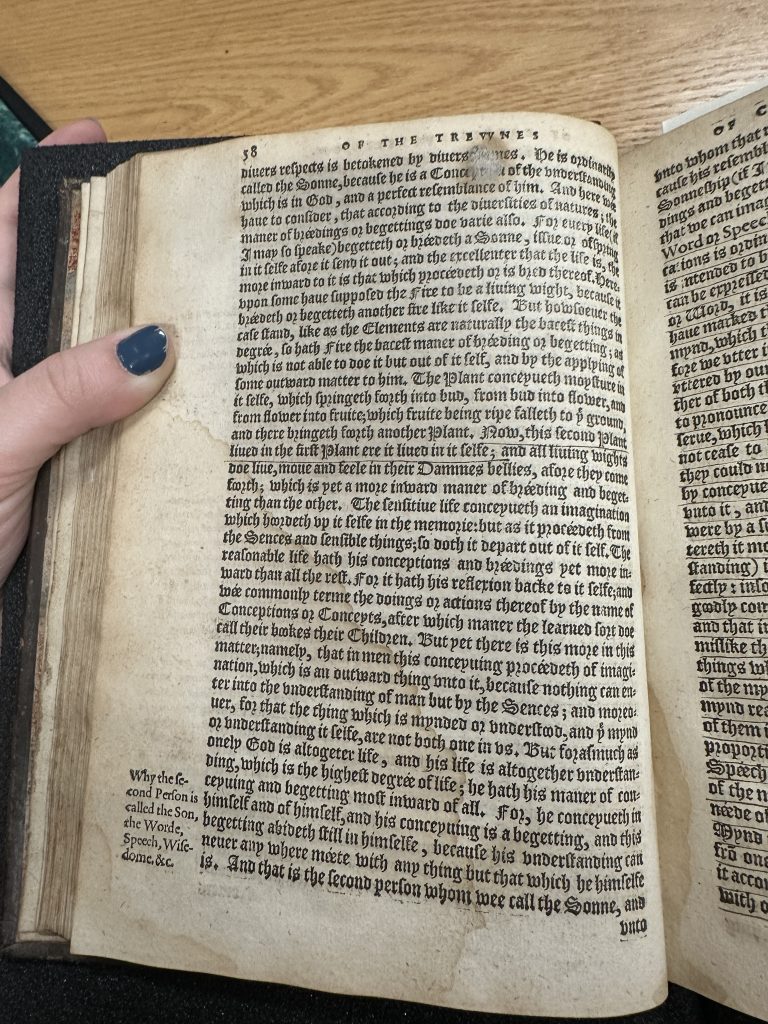
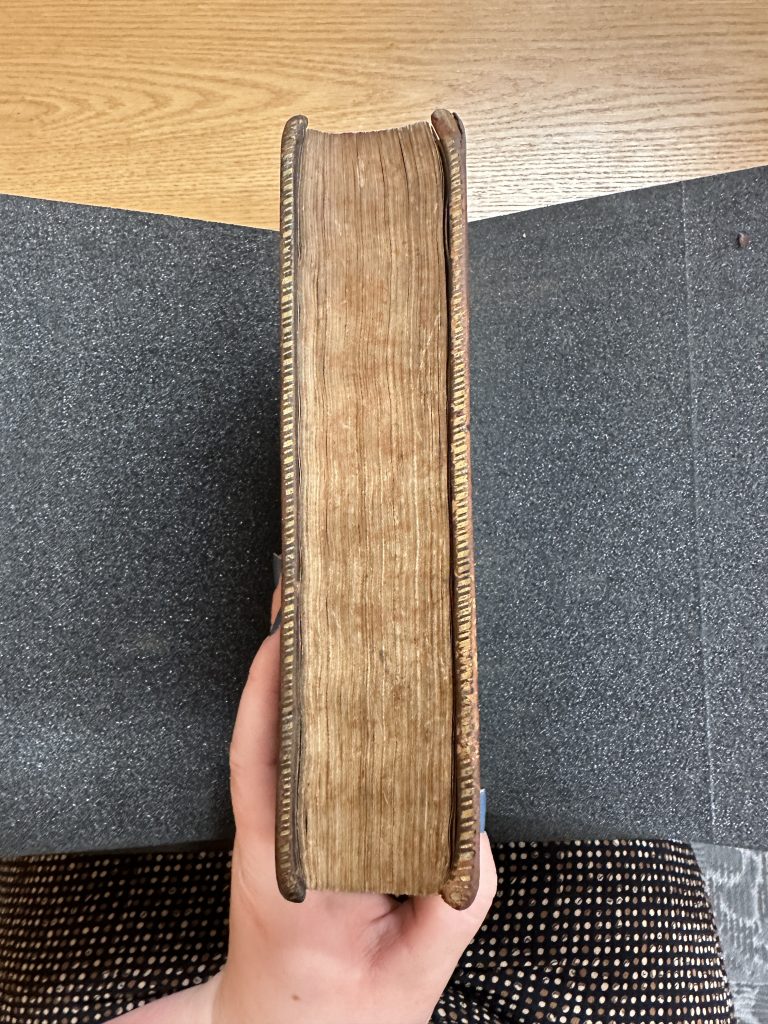
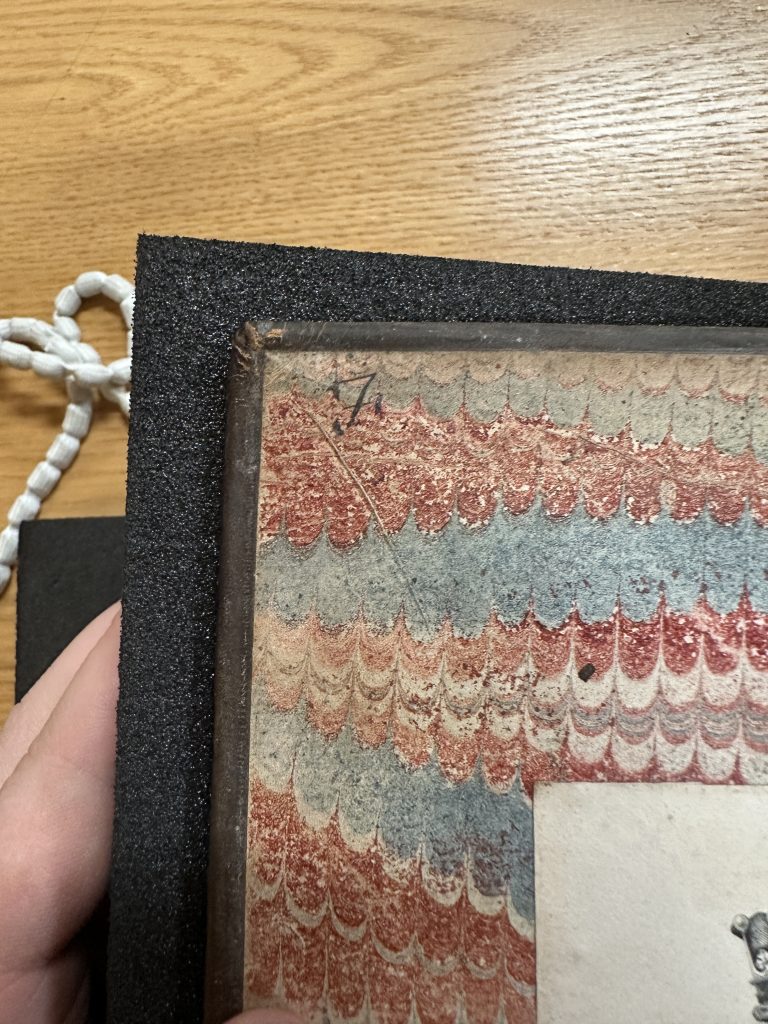
This copy of “The Trewnesse of Christian Religion” is weathered but structurally sound. The leather is discolored at scratched but still soft and a dark brown color, and the spine shows the worst wear, with the leather no longer shiny and the gilding wearing. The spine includes 5 gilded flower patterns between the raised bands, and a red insert with the name ‘SIDNEY’ pressed in, which is the name of the first English translator of this book. The top and end of the spine are worn and some of the leather has been worn off. There is also some gilding on the edges of the boards, which are worn down at the top and bottom edges, as well as gilding along the border of the front and back boards.
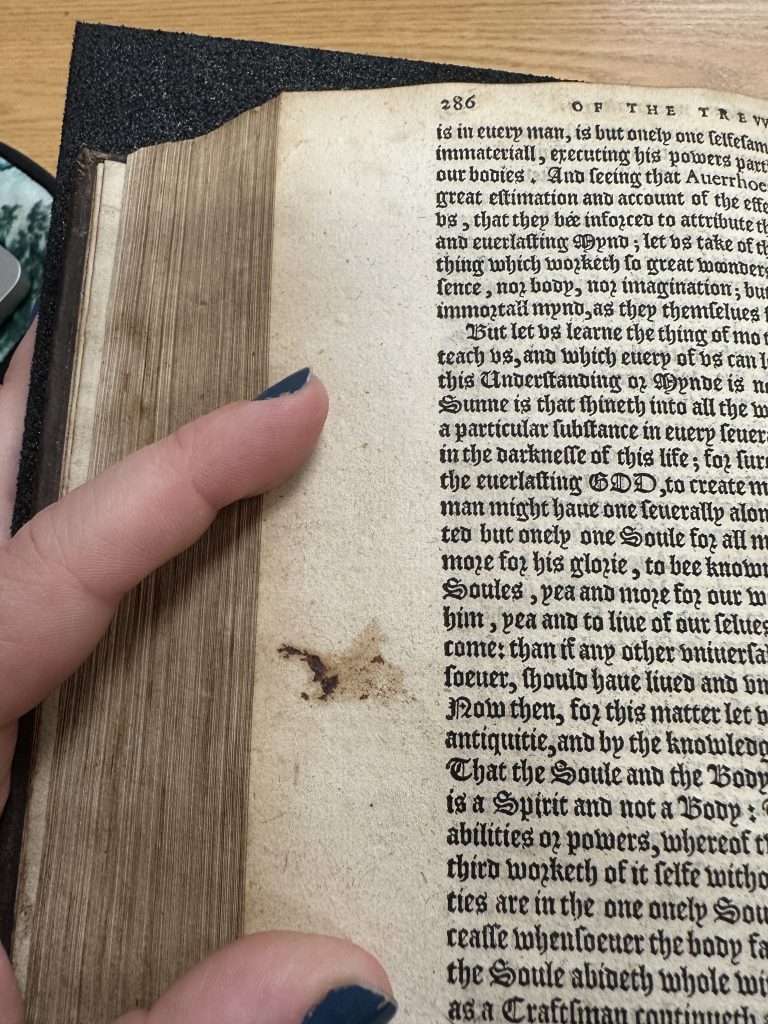
There are many different stains and spots throughout the book, such as those on pages 58, 56, and 286. The paper is browned from time but still bright, and most of the stains do not impact the readability. There are some stains on the edges of pages at a diagonal angle, but these do not impact the whole book. One page (477) seems to be singed as if the bottom of the page caught on fire. There are many small unique issues throughout the book. One page has a small piece of string in the gutter, and another page holds the body of a spider that at one point was crushed between the book’s pages.
There are multiple errors regarding printing, especially regarding pagination and ink outside of the text block. The paging skips 481-490 and continues on, but the catch words match, so this was not a removal of or mistake in the printing of text, but a mistake in the pagination. There are also ink spots outside of the text block, where the paper to be printed was not properly protected by the frisket. Another error is two témoins on separate pages.
At some point, this book was rebound, which might explain the difference in weathering between the spine and the book boards. The inclusion of a bound silk bookmark, which rests between pages 530 and 531 is another indication of rebinding, as well as parts of an ownership inscription being cutoff. This inscription is found on the page beginning the first chapter.
Citations
“A Woorke Concerning the Trewnesse of the Christian Religion, Written in French : Against Atheists, Epicures, Paynims, Iewes, Mahumetists, and Other Infidels | WorldCat.Org.” Accessed March 14, 2025. https://search.worldcat.org/title/4396508.
“Arthur Golding.” In Wikipedia, September 25, 2024. https://en.wikipedia.org/w/index.php?title=Arthur_Golding&oldid=1247603677.
“Charles Lee Lewes.” In Wikipedia, February 4, 2025. https://en.wikipedia.org/w/index.php?title=Charles_Lee_Lewes&oldid=1273799453.
“Charles Lee Lewes – National Portrait Gallery.” Accessed March 17, 2025. https://www.npg.org.uk/collections/search/portrait/mw130711/Charles-Lee-Lewes.
“Charles Stanley, 8th Earl of Derby.” In Wikipedia, August 15, 2024. https://en.wikipedia.org/w/index.php?title=Charles_Stanley,_8th_Earl_of_Derby&oldid=1240536076.
“Dewey Decimal System – A Guide to Call Numbers – Information Sciences Virtual Library – U of I Library.” Accessed March 21, 2025. https://www.library.illinois.edu/infosci/research/guides/dewey/.
“Earl of Derby.” In Wikipedia, February 13, 2025. https://en.wikipedia.org/w/index.php?title=Earl_of_Derby&oldid=1275597524.
“Edward Smith-Stanley, 13th Earl of Derby.” In Wikipedia, February 16, 2025. https://en.wikipedia.org/w/index.php?title=Edward_Smith-Stanley,_13th_Earl_of_Derby&oldid=1276007162.
“English Civil War.” In Wikipedia, March 25, 2025. https://en.wikipedia.org/w/index.php?title=English_Civil_War&oldid=1282303996.
“English Civil Wars | Causes, Summary, Facts, Battles, & Significance | Britannica,” March 21, 2025. https://www.britannica.com/event/English-Civil-Wars.
“Esquire.” In Wikipedia, March 22, 2025. https://en.wikipedia.org/w/index.php?title=Esquire&oldid=1281825928.
“European Heraldry :: House of Stanley.” Accessed March 14, 2025. https://europeanheraldry.org/united-kingdom/families/families-s/house-stanley/.
“George Harris, 1st Baron Harris.” In Wikipedia, March 18, 2025. https://en.wikipedia.org/w/index.php?title=George_Harris,_1st_Baron_Harris&oldid=1281049420.
“George Shurley.” In Wikipedia, August 19, 2023. https://en.wikipedia.org/w/index.php?title=George_Shurley&oldid=1171215065.
Harris, Margaret. “Charles Lewes’s Career.” George Eliot – George Henry Lewes Studies 72, no. 1 (June 5, 2020): 1–19. https://doi.org/10.5325/georelioghlstud.72.1.0001.
“James Stanley, 7th Earl of Derby.” In Wikipedia, February 16, 2025. https://en.wikipedia.org/w/index.php?title=James_Stanley,_7th_Earl_of_Derby&oldid=1276021869.
“James Stanley, 7th Earl of Derby | Royalist Leader, Civil War General | Britannica,” January 27, 2025. https://www.britannica.com/biography/James-Stanley-7th-Earl-of-Derby.
Knowsley Local History. “History – Knowsley Estate,” January 27, 2018. https://archives.knowsley.gov.uk/knowsley-village/history-of-the-knowsley-estate/.
Knowsley Local History. “Knowsley Archives,” April 2, 2025. https://archives.knowsley.gov.uk/ngg_tag/knowsley/.
“Leonard Hodgson.” In Wikipedia, August 7, 2021. https://en.wikipedia.org/w/index.php?title=Leonard_Hodgson&oldid=1037599610.
“Leonard Hodgson.” Accessed March 18, 2025.https://archive-cat.chch.ox.ac.uk/records/SOC/xxiii/c.85.
“Michigan State University.” In Wikipedia, March 25, 2025. https://en.wikipedia.org/w/index.php?title=Michigan_State_University&oldid=1282281192.
“Monarchomachs.” In Wikipedia, January 4, 2025. https://en.wikipedia.org/w/index.php?title=Monarchomachs&oldid=1267370425.
Mornay, Philippe de. A Woorke Concerning the Trewnesse of the Christian Religion : Written in French: Against Atheists, Epicures, Paynims, Iewes, Mahumetists, and Other Infidels. London : [By George Robinson] for Thomas Cadman, 1587. Accessed March 18, 2025. https://search.library.wisc.edu/catalog/9910068027802121
“On the Banks of the Red Cedar | Timeline | 1855.” Accessed March 20, 2025. https://onthebanks.msu.edu/Timeline/162-568-350/michigan-state-university-has-had-six-different-names-in-its-history/.
Oxford Dictionary of National Biography. “Golding, Arthur (1535/6–1606), Translator.” Accessed March 17, 2025. https://doi.org/10.1093/ref:odnb/10908.
Oxford Dictionary of National Biography. “Hodgson, Leonard (1889–1969), Theologian.” Accessed March 18, 2025. https://doi.org/10.1093/ref:odnb/58805.
“Philip Sidney.” In Wikipedia, March 12, 2025. https://en.wikipedia.org/w/index.php?title=Philip_Sidney&oldid=1280099028.
“Philippe de Mornay.” In Wikipedia, September 27, 2024. https://en.wikipedia.org/w/index.php?title=Philippe_de_Mornay&oldid=1248104542.
“Philippe de Mornay, Also Called Duplessis-Mornay (1549-1623).” Accessed March 18, 2025. https://museeprotestant.org/en/notice/philippe-de-mornay-also-called-duplessis-mornay-1549-1623/.
“Philippe de Mornay, Seigneur Du Plessis-Marly | French Diplomat & Huguenot Leader | Britannica.” Accessed March 18, 2025. https://www.britannica.com/biography/Philippe-de-Mornay-seigneur-du-Plessis-Marly.
“Sir George Shirley, 1st Baronet.” In Wikipedia, November 16, 2024. https://en.wikipedia.org/w/index.php?title=Sir_George_Shirley,_1st_Baronet&oldid=1257783152.
“Sir George Shurley (1569-1647) – Find a Grave…” Accessed March 16, 2025. https://www.findagrave.com/memorial/69310693/george-shurley.
“Stanley Surname Meaning, Stanley Name History, Stanley Crests, Coat of Arms & Genealogy : MyFamilySilver.Com.” Accessed March 17, 2025. https://www.myfamilysilver.com/pages/crestfinder-crest.aspx?id=176027&name=Stanley.
The Poetry Foundation. “Sir Philip Sidney.” Accessed April 1, 2025. https://www.poetryfoundation.org/poets/philip-sidney.
“William Harris, 2nd Baron Harris.” In Wikipedia, January 12, 2025. https://en.wikipedia.org/w/index.php?title=William_Harris,_2nd_Baron_Harris&oldid=1269024781.
By Ella Cox for Professor Brockey’s History of the Book, Spring 2025 Class. Thanks to Andrew Lundeen, Tad Boehmer, Professor Brockey, and the National Portrait Gallery.
