
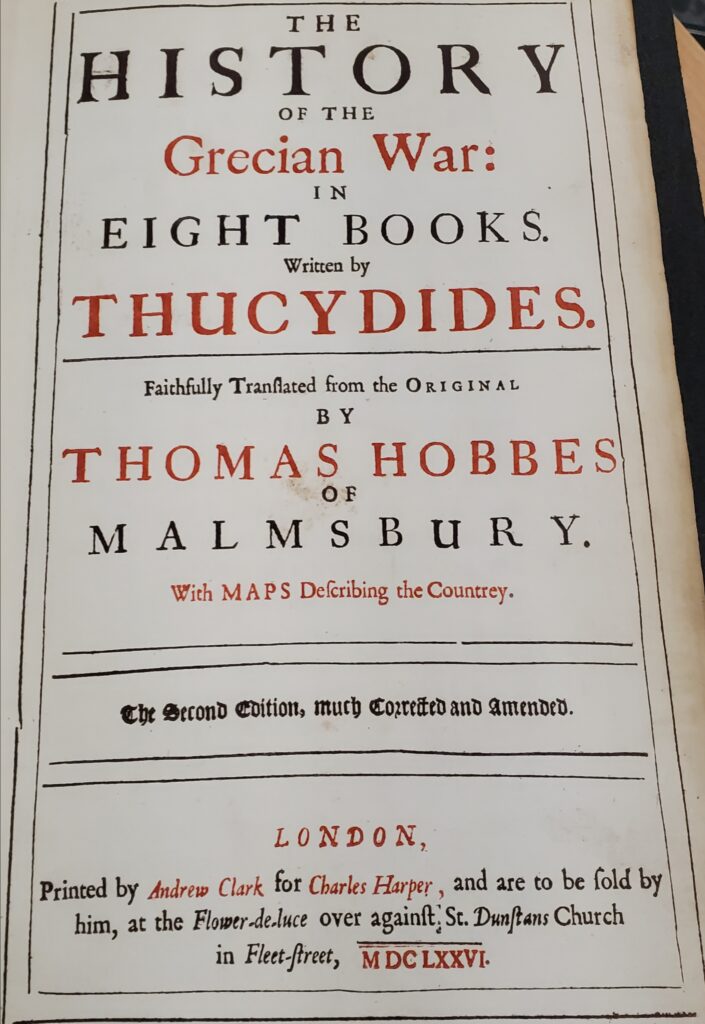
XX Folio D7229. T5H6 1676
The State of the Book
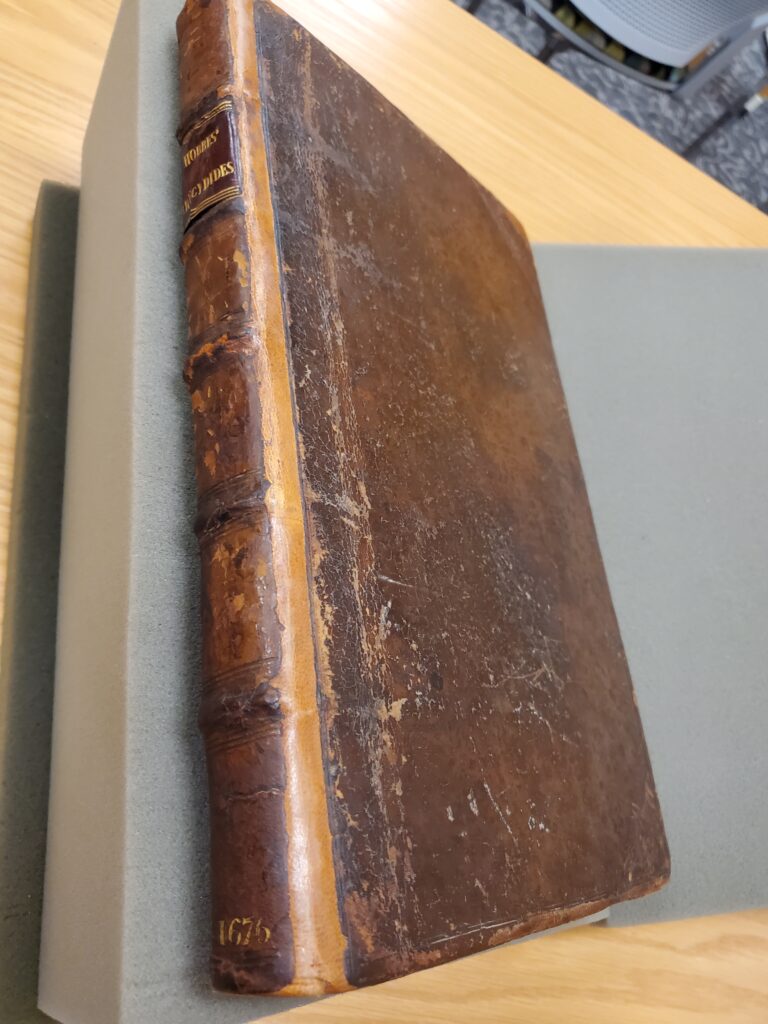
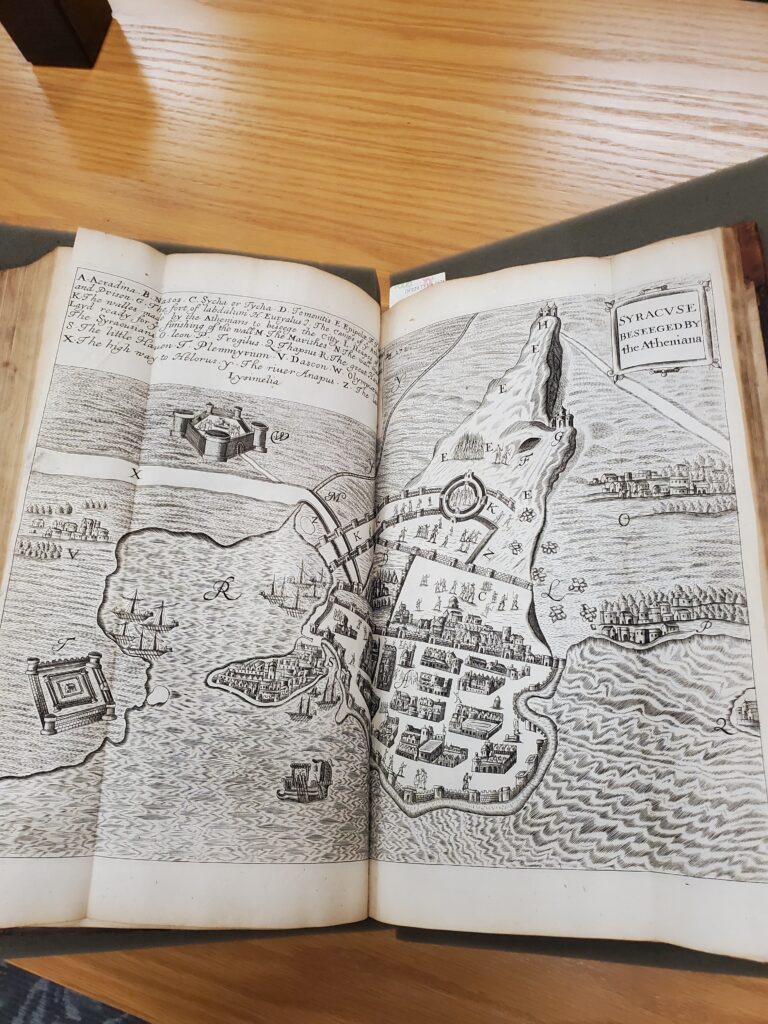
The Book is bound in a red-brown leather made from calf, with much of the color rubbing away to reveal a much lighter tan coloring below. The pages are folded in Folio and include some folded maps, one being a paste in and another having not been trimmed properly leading to a rather worn page.
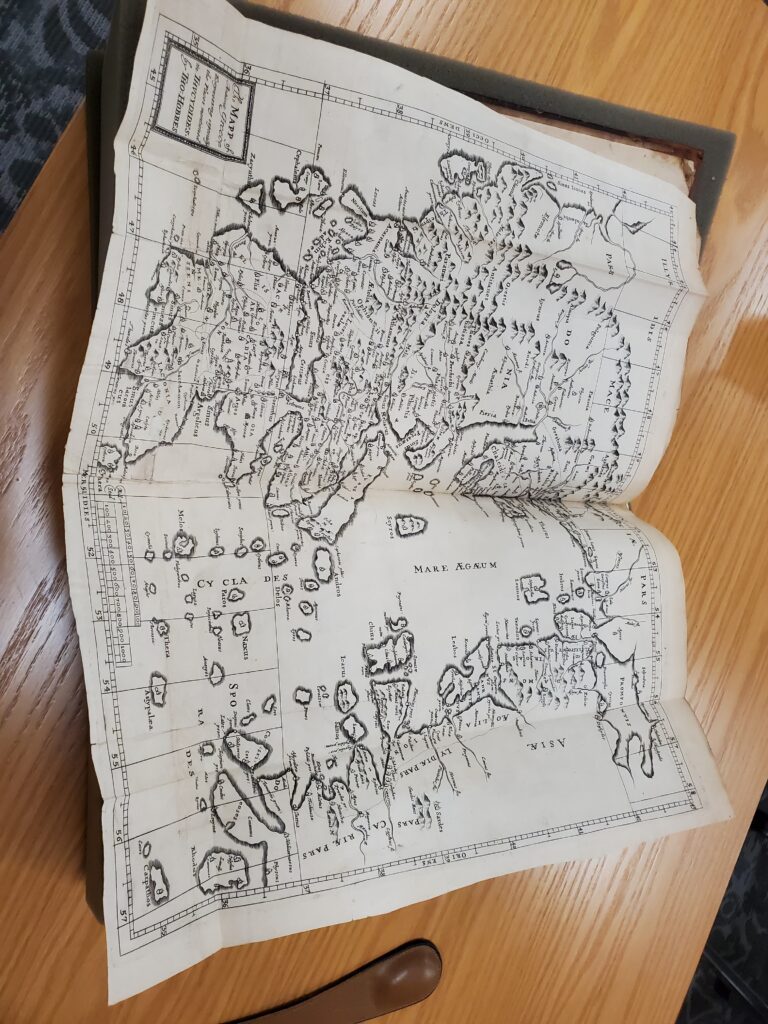
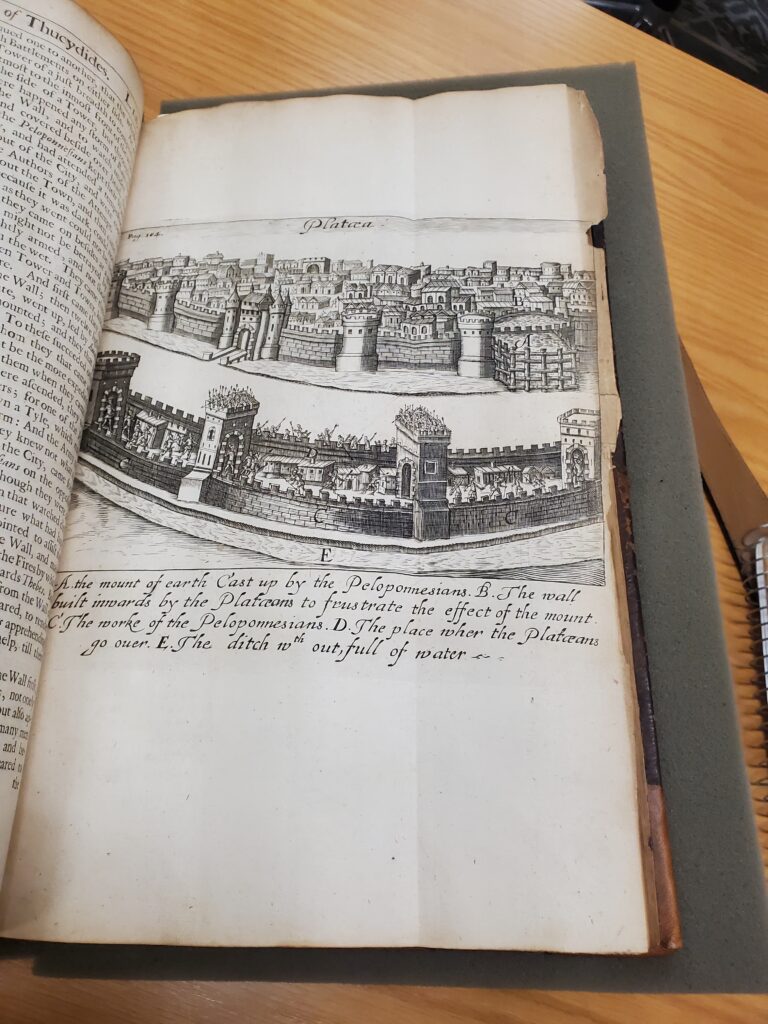
There are also two watermarks in the book, one after the other with one being the Initials M.D.P. and the other looking to be a jester.
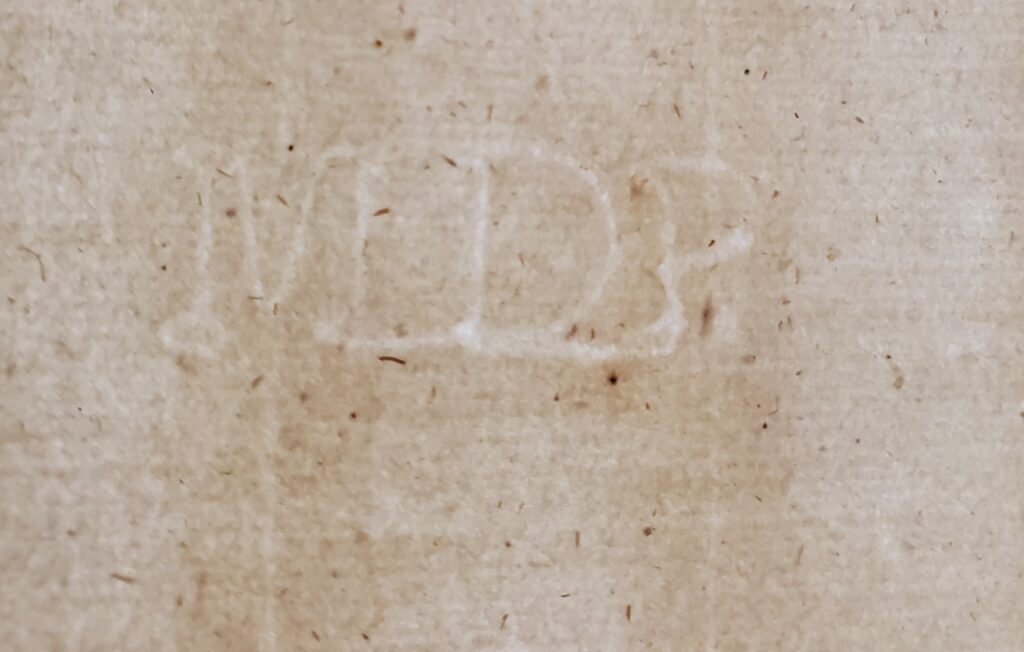
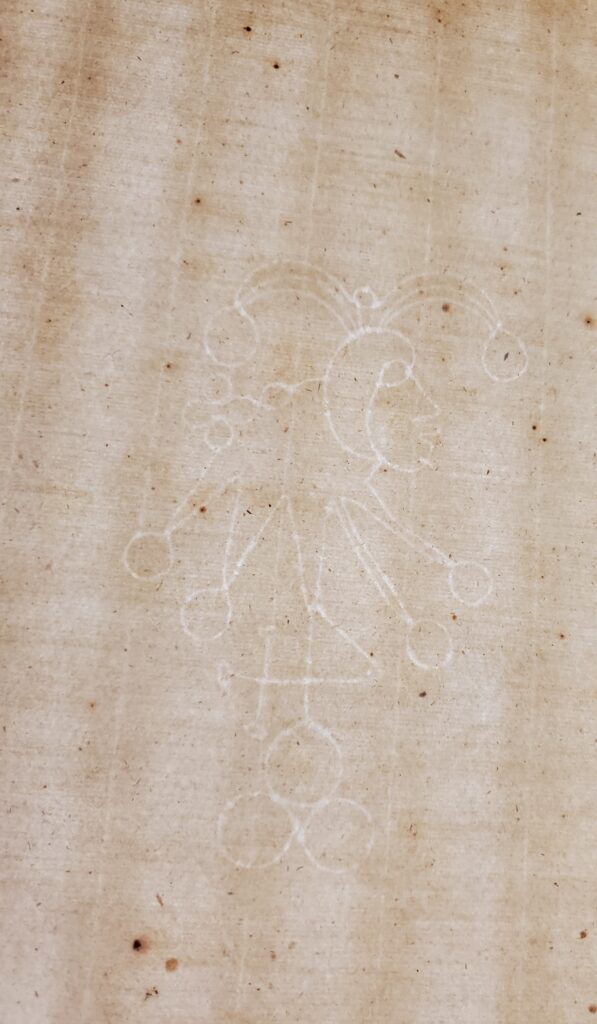
The book is in rather fine condition considering its age but shows sign of a decent amount of usage, with corrections in the text and worn pages especially on the maps. Despite this, the books binding holds together well and indicates no rebinding having taken place.
The Author
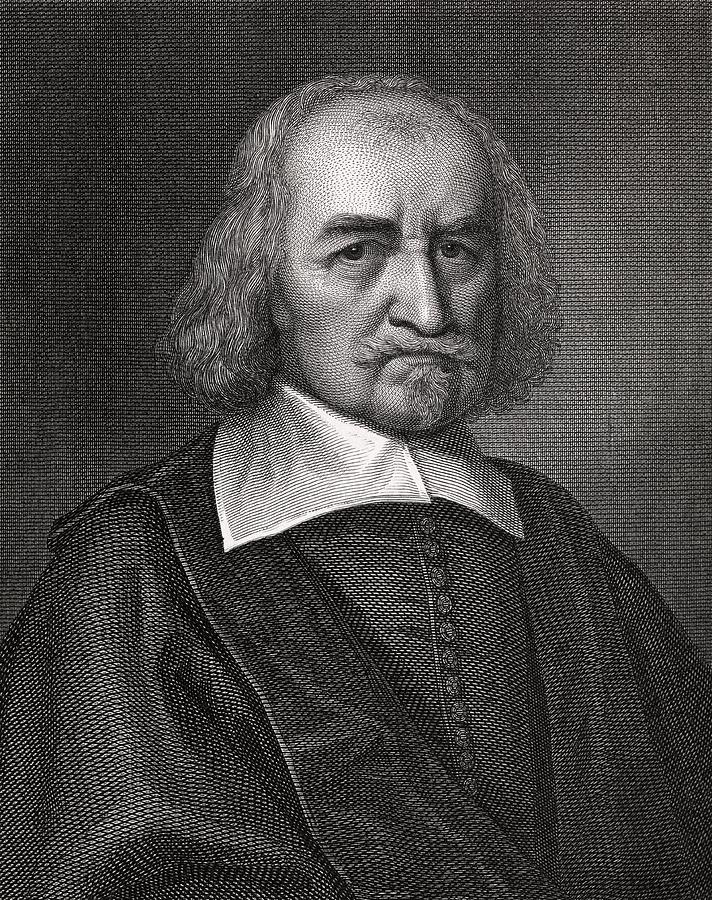
Thomas Hobbes is a historical figure who boasts a wide array of expertise and work. Although his works were broad ranging from physics and mathematics to political philosophy, he is more widely known for the later. Hobbes was born in 1588 in Malmsbury as the son of a local clergyman and would later go off to study at Magdalene Hall in Oxford and eventually worked under the Cavendish family. Hobbes actually includes a dedication to William Cavendish in this book for his patronage:
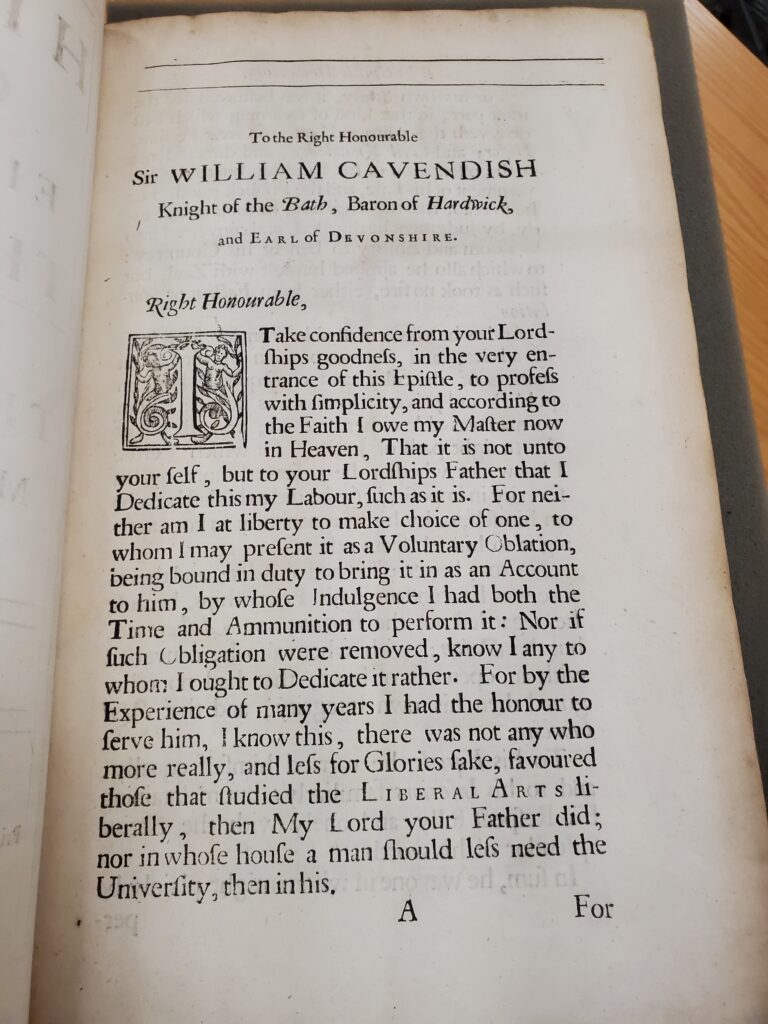
Before Hobbes broke out into his philosophical works however he first translated Thucydides in 1629, which came to be his first published work. The reasoning for this supposed stray from what would soon come to be his field of introspection may attribute to Hobbes’ draw to Thucydides’ character.
Hobbes has said that Thucydides was his favorite historian because “he shows how incompetent democracy is” which is a very clear indicator of where he would take his philosophy of government to in the upcoming years. Hobbes also makes note to call Thucydides a historian in the same degree that Aristotle is a philosopher and Homer a poet in the beginnings of the book, further showing his admiration for this historical figure.
Hobbes would later go on to make this second edition of the translations in 1676, the very year this copy was printed and a full 50 years after the first edition. The Second edition comes with the added phrase of “much Corrected and Amended” which points to a growth in Hobbes’ Greek translating abilities, but as we’ll see later on, it appears that at least some of the readers didn’t view it be corrected enough.
Provenance
This Copy of Thomas Hobbes’ second edition translation of Thucydides’ Grecian War was printed in 1676 for Charles Harper by Andrew Clark to be at the Flower-de-luce over against St. Dunstans Church in Fleet-street. Fleet street being one an extremely famous location for bookselling in this time. How did this book get from London to East Lansing though? We will attempt to track the progress of this book as it passes through many different hands and across the Atlantic.
The First Owners
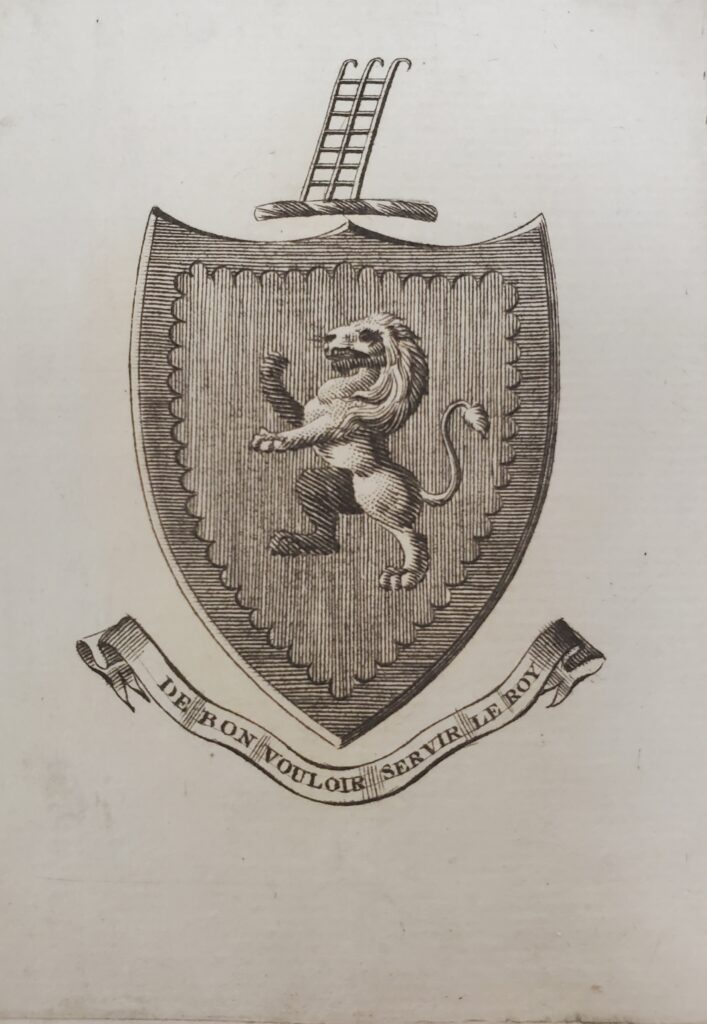
On the endpaper of the front cover of the copy is a coat of arms of a lion on a shield and a double ladder above it with the motto: “De Bon Vouloir Servir Le Roy”. This motto and coat of arms belonged to the Bennett family, a noble family that were the Earls of Tankerville which drew from the name from Tancarville, Normandy. This would explain the French motto which translates to “To Serve the King with Good Will”.
The Earls of Tankerville have a complex history, with the title having been recreated three separate times under two different peerages and two different families. In 1676 when this copy of Thucydides had been printed however the Earldom had not yet been recreated for its third final time, but the Bennett family were under the title of Barons Ossulston with John Bennett the first Baron of Ossulston being alive within the perfect time to come into possession of the book. However his son Charles Bennett who succeed him would be the head of the reconstructed Earl of Tankerville in 1714. The Bennett family/Earl of Tankervill crest is described as “(1) Out of a mural coronet or, a lion’s head gu. charged on the neck with a bezant (for Bennett). (2) a double scallion- ladder or (for Grey).” by Fairbairn’s book of crests.

The scaling ladder and lion check out with the one seen in the picture, but the lack of a bezant and mural cornet aswell as a single ladder instead of double(as seen in the picture to the left) may point to this coat of arms belonging to the Bennet family under the title of Dukes Ossulston rather than Earls of Tankerville.
The Second Owner…Possibly
On the recto side of the second leaf of this copy is a rather large block of writing that takes up nearly half the page. These two paragraphs are actually an excerpt for a published work of writings by Walter Moyle Esquire, a politician and writer of the time who had quite an interest in antiquity.
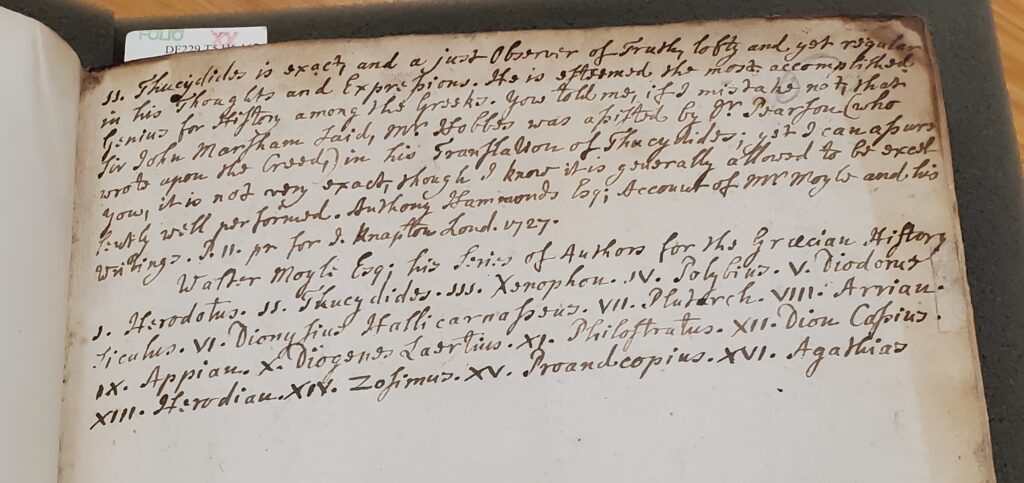
The actual excerpt itself comes from a letter Moyle wrote to Anthony Hammond, a good friend of his, concerning the fact they hadn’t seen each other in awhile as well as praising Hammond on his work in the House of Commons. Moyle later in the letter goes on to recommend some works on Greek history, listing off authors and the order in which to read them. This is what the second paragraph is with the exception of the first sentence which is a lead in to the authors. the text reads:
“Walter Moyle Esq; his lens of Authors for the Grecian History. i Hirodutus ii Thucydides iii Xenophon iv Polybius v Diodotus Siculus vi Dionysius Halicarnasseus vii Plutarch viii Arrain ix Appain x Diogenes Laestius xi Philostratus xii Dion Cassius xiii Herodian xiv Zosimus xv Prandcopius xvi Agathias”
After listing all these writers, Moyle goes on to elaborate the stories and writings about each with praise on their specific qualities and strengths. However, it’s only with Thucydides that Moyle actually writes about the translation made by Hobbes and has a couple critiques. He writes: “Thucydides is exact, and a just observer of truth, lofty and yet regular in his thoughts and expressions. He is esteemed the most accomplished genius for history among the Greeks. You told me, if I mistake not, that sir John Marsham said Mr Hobbes was assisted by Dr. Pearson (who wrte upon the Creed) in his translation of Thucydides; yet I can assure you, it is not very exact, though I know, it is generally allowed to be excellently well performed. Anthony Hammond, Esq; Account of Mr Moyle and his writings, pg. 11 pr for J. Knapton Lond. 1727”
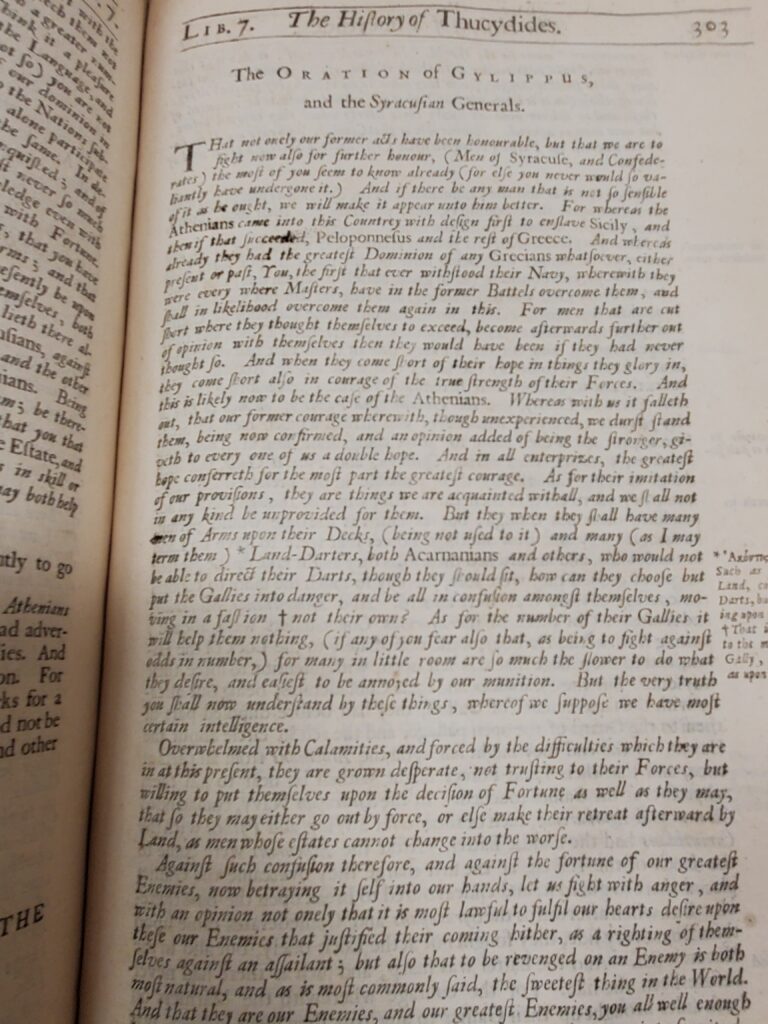
This paragraph has a couple points of interest with the first being the mention of Hobbes being helped by a Dr. Pearson who isn’t mentioned at all in the book. When searching for a Dr. Pearson alongside Thomas Hobbes there are no results which may be because it may have simply been a false rumor as it was a John Marsham (another dead end) who spoke about it or it could simply be that Pearson was a shy man just lost to time. Beyond that point is the critique of what looks to be the translation itself as Moyle mentions the translators and then says that “it is not very exact”. This however could also point to the numerous misspellings and double prints that occur throughout the copy, which one of the owners have gone so far as to have struck out as seen below.
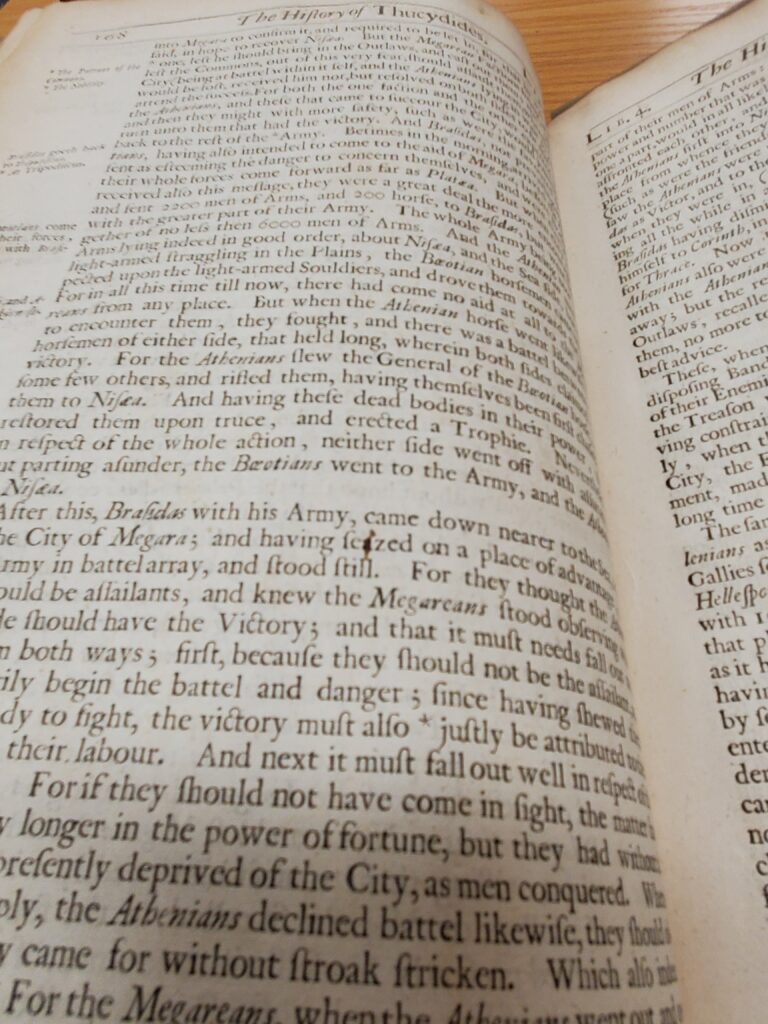
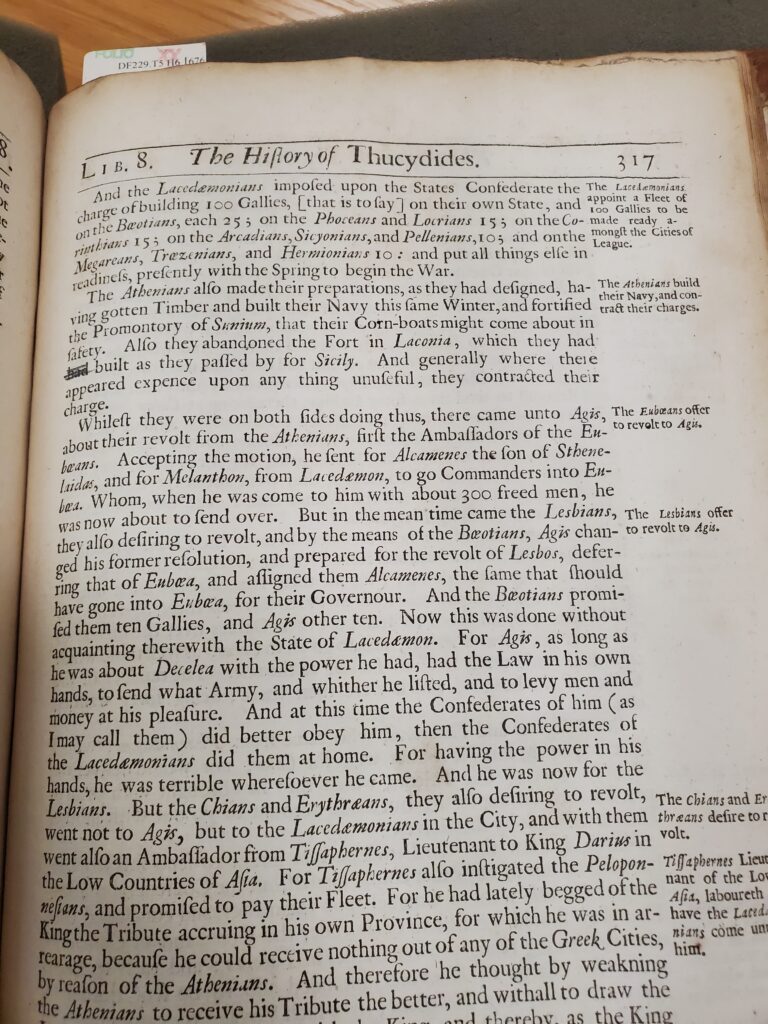
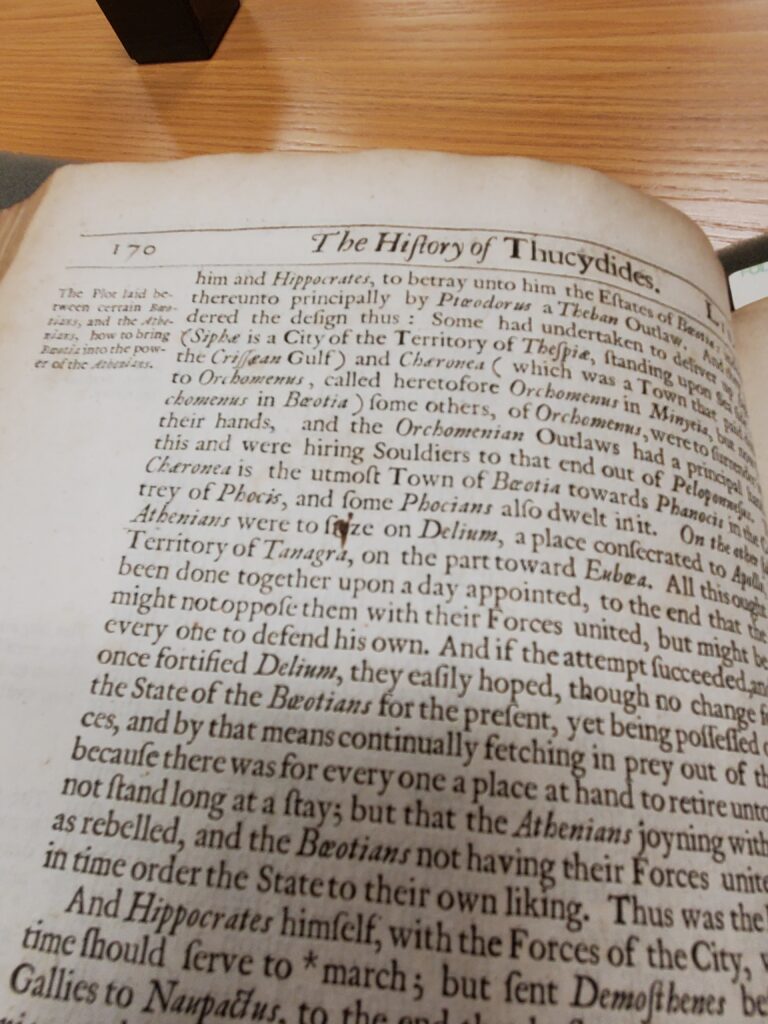
It is unclear however who wrote these excerpts into the book, as they didn’t sign their name or leave any identification as to who it may be. The writer could’ve been any of the owners of this book since 1727 as this was when Moyle’s works was published. So with the writer unknown, and the time it was written unknown, the owner of the book at the time of this writing is also unknown. Despite this dead end however, its inclusion in this copy is both interesting as well as insightful to the time as it is clear that Hobbes’ Thucydides was seen as a good reference for Greek history among upper ranking members of British society.
Third… Or maybe Second Owner?
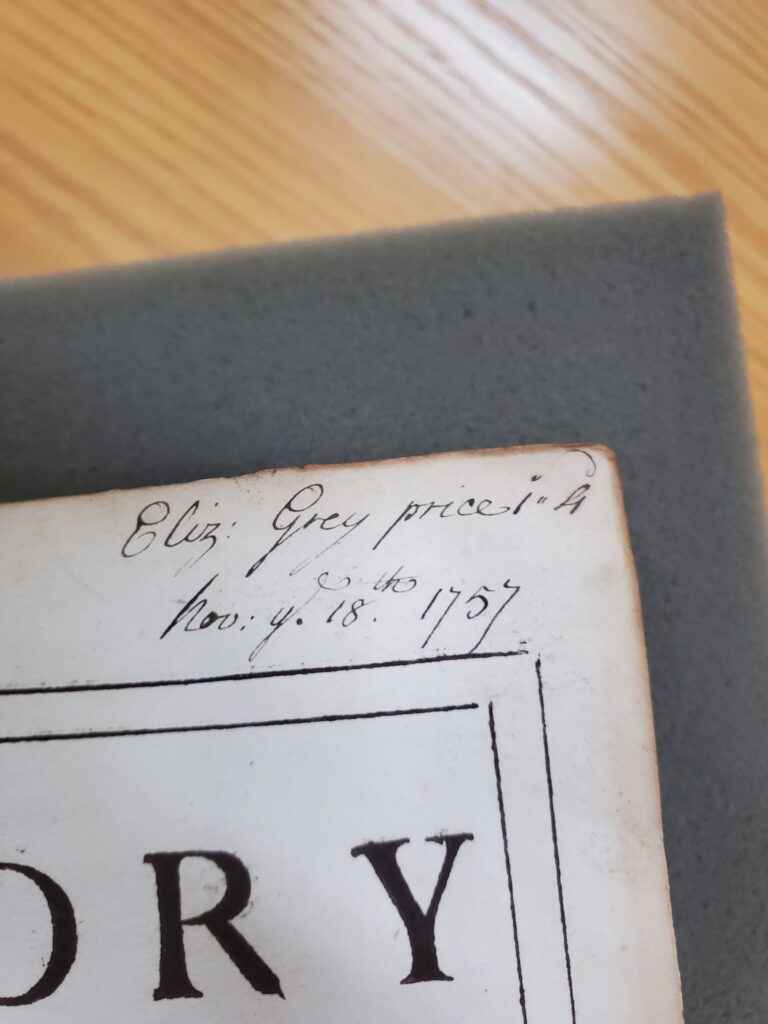
Written in the top right corner of the book plate is a small abbreviated name with a price and a date with it. The name is Elizabeth Grey and the date is November 18th 1757, nearly one hundred years since the book was printed and it is already at its second owner.
The year 1757 would have meant that Charles Bennett III as the Earl of Tankerville. It is unclear how Elizabeth came into possession of the book from the Earl, but nevertheless she acquired it. Besides the simply signing of here name, the date, and the price of the book, there is way to track down exactly which Elizabeth Grey owned this book. There were no direct connections of an Elizabeth Grey to any member of the Tankervilles so the trail runs cold there. Although for speculation’s sake it is possibly that this Elizabeth Grey is Elizabeth Pennyman with Grey having been her maiden name. Elizabeth Pennyman was the aunt of Charles Grey 2nd Earl Grey from which the tea brand is named after. Elizabeth being from a very reputable family may have had some interaction with the Tankervilles that would bring the trading of this particular book. Although if this were the case that would mean that Elizabeth would be 17 at the time of reading and writing in this book, which although not impossible, doesn’t seem too practical. Either way, no matter which Elizabeth Grey read it or who she was connected to, we know that she owned the book in 1757 and that one link in the chain of ownership is completed.
Second to Last Stop
From 1757 a massive leap to the 1900’s is made with the final pieces of information that links this copy to an owner. Both a tag located in the back of the book and a small card located in the front of the book read “William Salloch Pines Bridge Road Ossining, New York”.
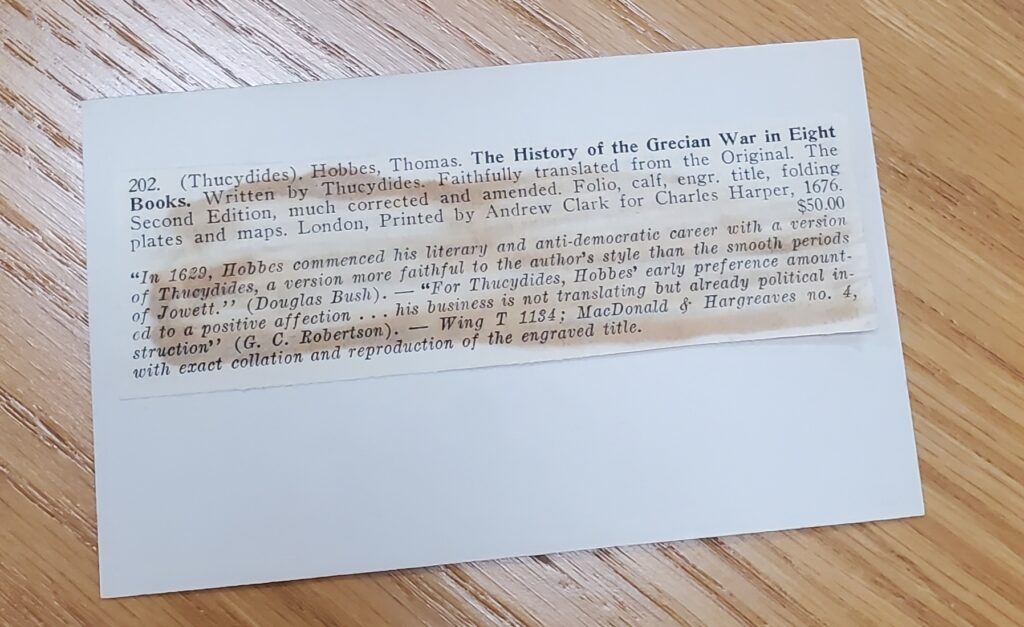
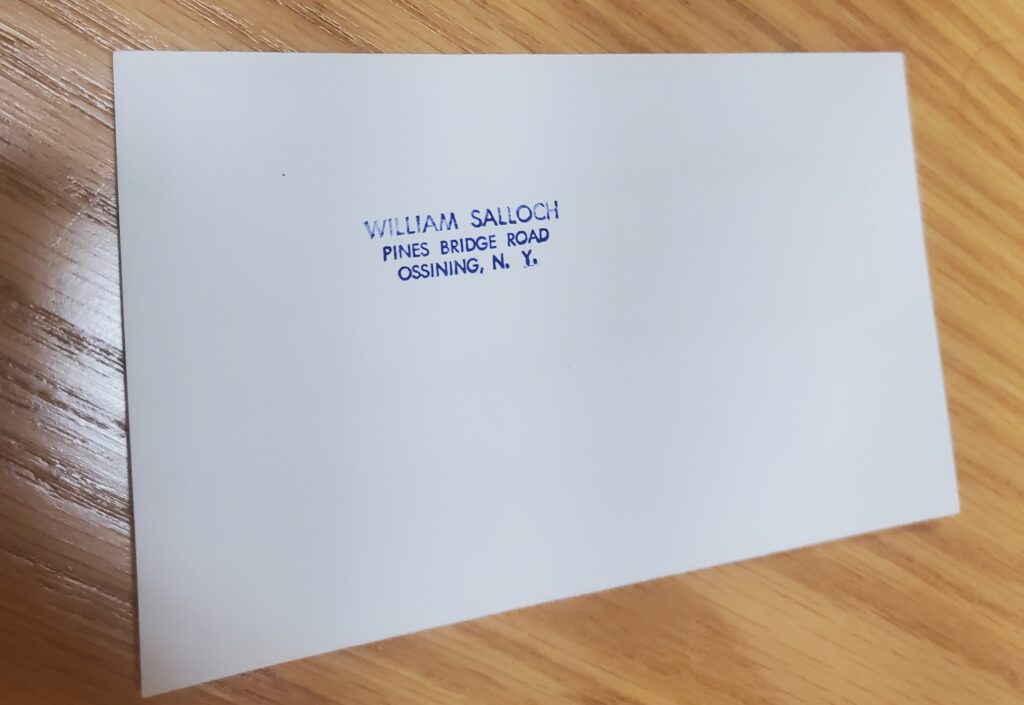
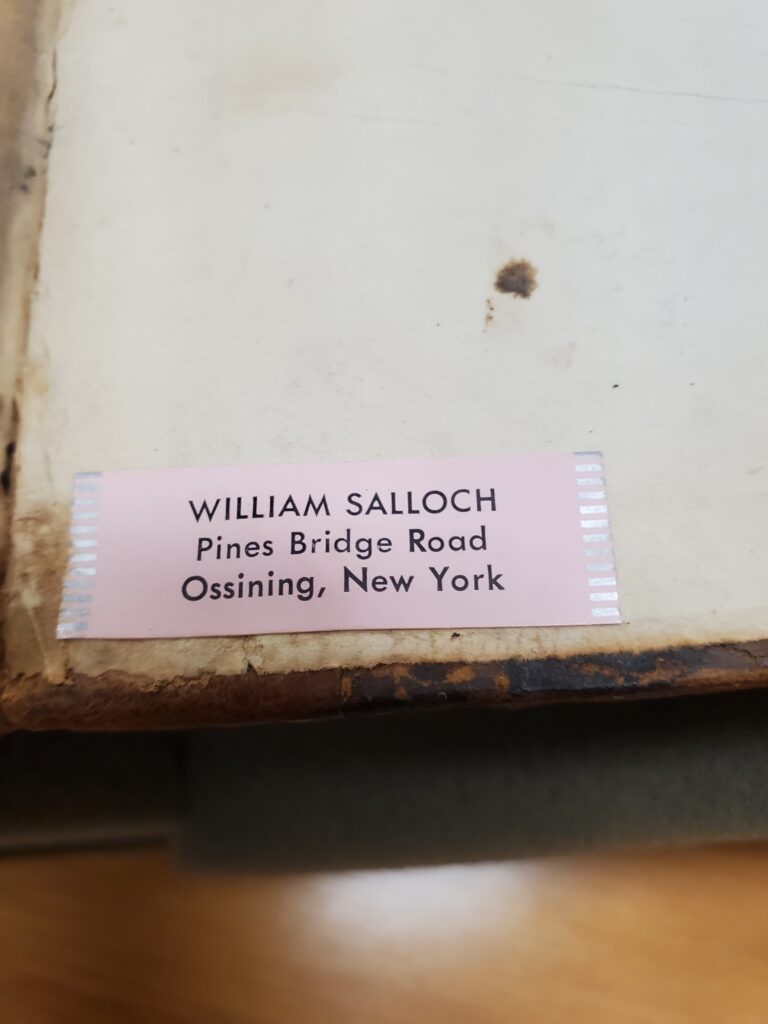
The William Salloch that these pieces reference are not actually a person William Salloch, but the Company William Salloch, which was founded by a man named William Salloch and his wife Marianne Salloch. William Salloch was born in 1906 in Germany who studied literature and language in the hopes of becoming a librarian but ran into conflict with his wife being Jewish and the turmoil that arose in Germany at the time. Instead he worked for publishing houses and bookshops until eventually moving to America with his wife and founding the company: William Salloch. Old Rare, and Scholarly Books. At first they were located on 344th E 17th Street New York but would later move to the address indicated above in Ossining in 1957. William Salloch would go on to be a founding member of the Antiquarian Bookseller’s Association of America (ABAA) and also become President of the association from 1970-1972. William Salloch would later pass in 1990 and more than likely he was last owner before the copy came to East Lansing Michigan, where it resides now on the banks of the Cedar River.
References
Duncan, S. (2021, February 12). Thomas Hobbes. Stanford Encyclopedia of Philosophy. Retrieved November 13, 2021, from https://plato.stanford.edu/entries/hobbes/.
Owners of incunabula. Owners of Incunabula (MEI). (n.d.). Retrieved
November 13, 2021, from https://data.cerl.org/owners/4023? style=csv&format=text&lang=it.
Fairbairn, J. Fairbairn’s Book of Crests of the Families of Great Britain and Ireland. Heraldic Book Co., 1968
Sowerby, Robin. “Thomas Hobbes’s Translation of Thucydides.” Translation and Literature, vol. 7, no. 2, Edinburgh University Press, 1998, pp. 147-69,
http://www.jstor.org/stable/40339788.
OrmsbyLennon, H. (2006, February 19). Hobbes’s nature. Washington Examiner. Retrieved November 13, 2021, from https://www.washingtonexaminer.com/weekly-standard/hobbess-nature.
Exhummation [lan Jackson]. Chamberpot & Motherfuck: The Price-Codes of the Book Trade. Narberth, Pennsylvania: [Bruce McKittrick], 2017
Moyle, W. (1727). The whole works of Walter Moyle, Esq: That were published by himself. to which is prefixed some account of his life and writings. Printed for J. Knapton, A. Bettesworth, E. Curll, J. Pemberton, and J. Batley.
Article by William Altier IV, HST 457 Fall 2021
