
Written by Anna Weigel
Translated to: Boethius on the Philosopher’s Consolation (Fine philosophic consolation)
Michigan State University call number: XX folio B659.C2 1501
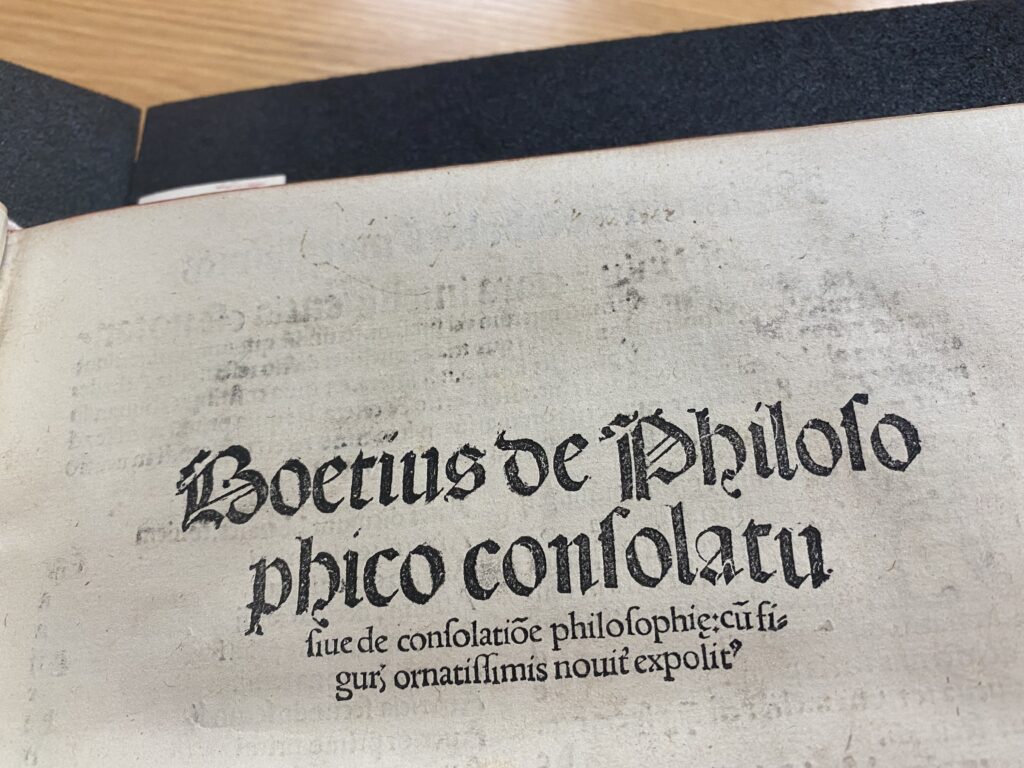
This book consists of a text written by Boethius, a Roman Senator, Consul and philosopher, and a commentary on the work. The commentary was falsely attributed to Saint Thomas Aquinas, but according to the Michigan State University library website was actually written by Sebastian Brant, who was a 15th century Humanist and satirist. This book was published in 1501 by Johann Grüninger in Strasbourg, Germany.
This book is a work of philosophy, and the original text was written by someone who was an influential figure in Roman society. The commentary around the text reflects the sentiment that people started to look to old wisdom to influence the way they lived their lives.
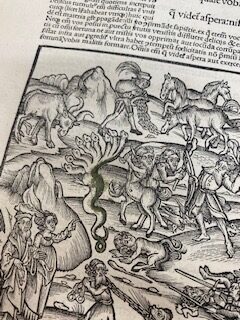
One interesting aspect of the book is the woodcuts that appear throughout the text. These woodcuts are detailed and plentiful throughout the book, adding a level of complexity to the printing process of the book. There is a green substance, which is most likely pain, on a snake in one of the woodcuts located on page 109. This is the only instance of any color being added to the woodcuts in the book.
Condition of MSU’s copy
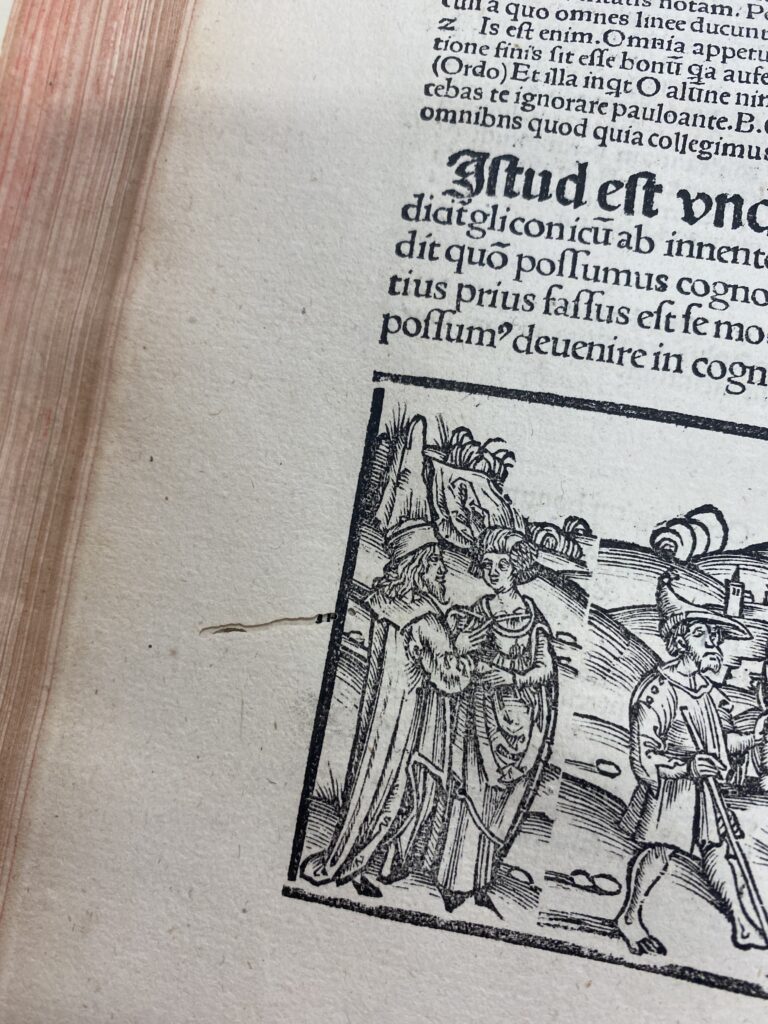
This book is in fairly good condition. There is some worm damage and water damage seen later in the book, but there is very little damage and these things do not detract from the readability of the book.

The book has previously been sent for conservation work to Etherington Conservation Services in September of 2011, where they repaired pages, rebound the book in calf, made new end bands and end pages, added a label and added new spine linings.
Provenance in MSU’s copy
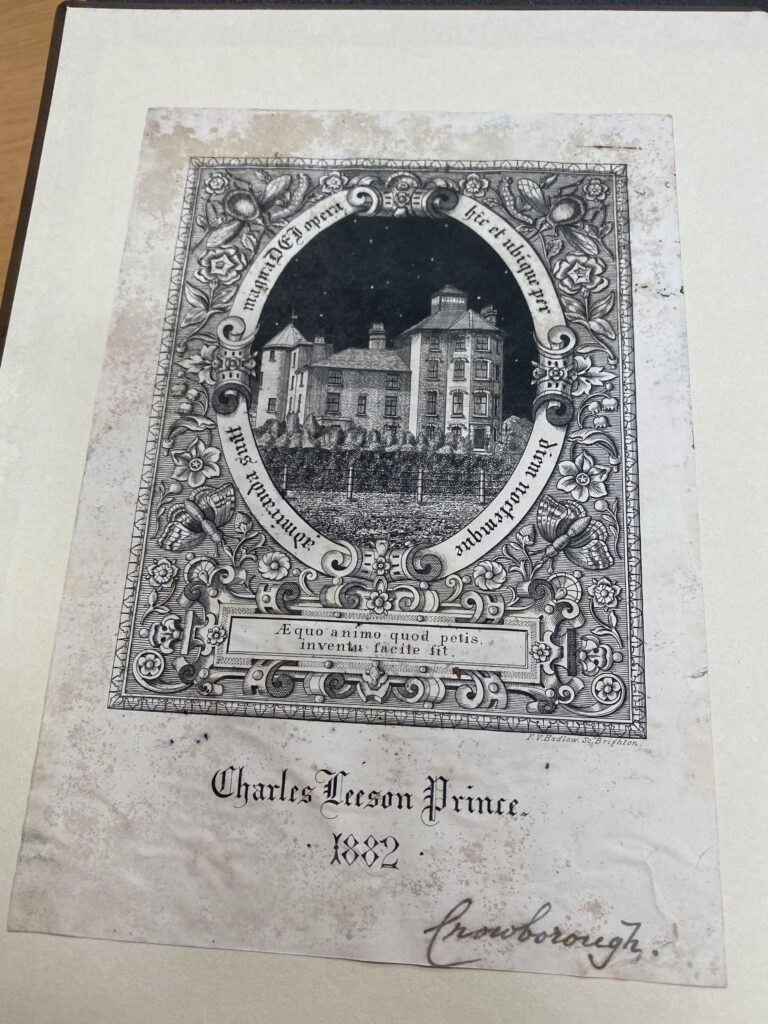
The first and most obvious pieces of provenance found in this book are the two bookplates found at the beginning of the book, both for a man named Charles Leeson Prince, one of which was dated to 1882. Prince (1821-1899) was a doctor in Sussex, England. He purchased Uckfield Grammar school in 1879, where a majority of the books in his collection were from. Above the second bookplate, Prince signed his name with the word Sussex next to it, indicating that he lived there while owning the book.
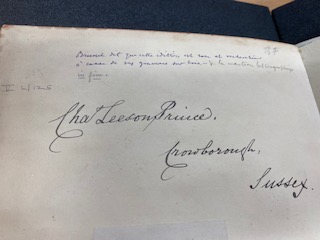
Additionally, located in the flyleaves and end pages of the book are booksellers codes. This indicates the book has been sold at least three times before arriving to Michigan State, once to Prince and twice from additional booksellers. In the flyleaves, there is a note from a bookseller in French that reads, in English, “Brunet says this edition is rare and sought after because of its woodcuts” in one hand, then after in a different hand, also in French, references an index of the pages of the book that’s in the end pages, which appears to be written by the same person.
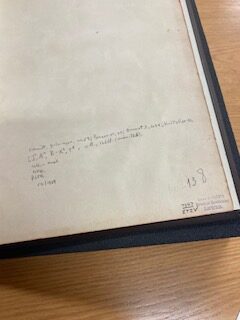
Based on the initials given with the index that appears on an end page, a later bookseller appears to have been HP Kraus, a bookseller who lived from 1907 to 1988. He is also known as HPK, as is written in the book. This index gives the year of sale as 1959, which lines up with when Kraus would have been alive and selling books. This also means this sale of the book took place after Prince owned it, meaning this could have been the last sale of the book before it came into the possession of Michigan State. This sale was also likely after the sale written about on the fly leaf at the located on an end page, thought beginning of the book, as the writing on the end page matches the additional writing at the end of the other booksellers note, which references the note indicating it was written afterwards.
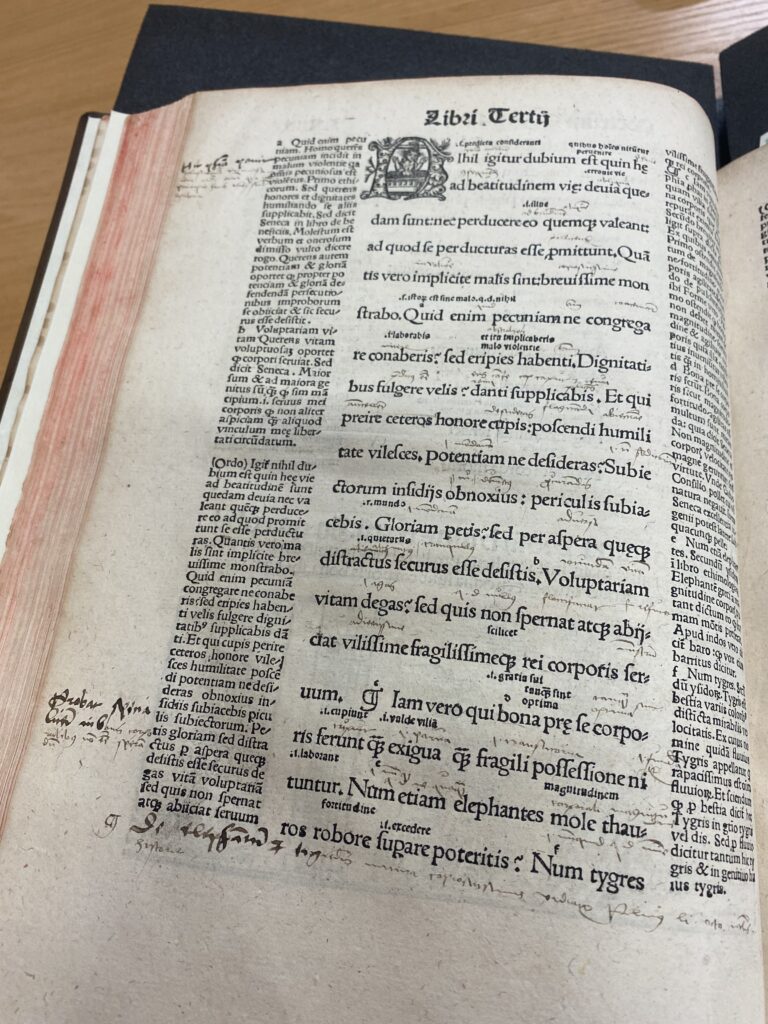
There is marginalia in the book, written by two different hands. There is a lot of writing at the beginning of the book, none in the middle, and towards the end of the book starting back up again on page 65. These do not appear to be the writings of Charles Leeson Prince, as they are written in what seems like 16th century script, and, additionally, a different colored pen from the one Prince used to sign his name above his second bookplate. The writing is in Latin, the language the book is written in, further suggesting that Prince, an Englishman, did not make these notes.
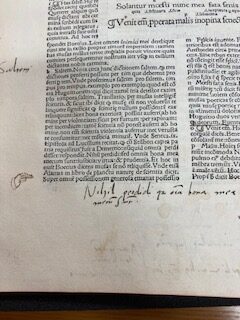
Throughout the book there are three manicules, located on pages 2, 51 and 124. These point to things that the reader thought were important to remember, or wanted to point out to future readers. The manicules in this book are fully-drawn, rather than a more highly stylized version found in other books, making this book an interesting example of the different types of manicules found in books.
Anna Weigel, Fall of 2021, for HST 475
