
Book Link: https://archive.org/details/castleknowledgeooreco/page/n4/mode/zup
USTC: 505372
Smithsonian Call Number: 39088003048154
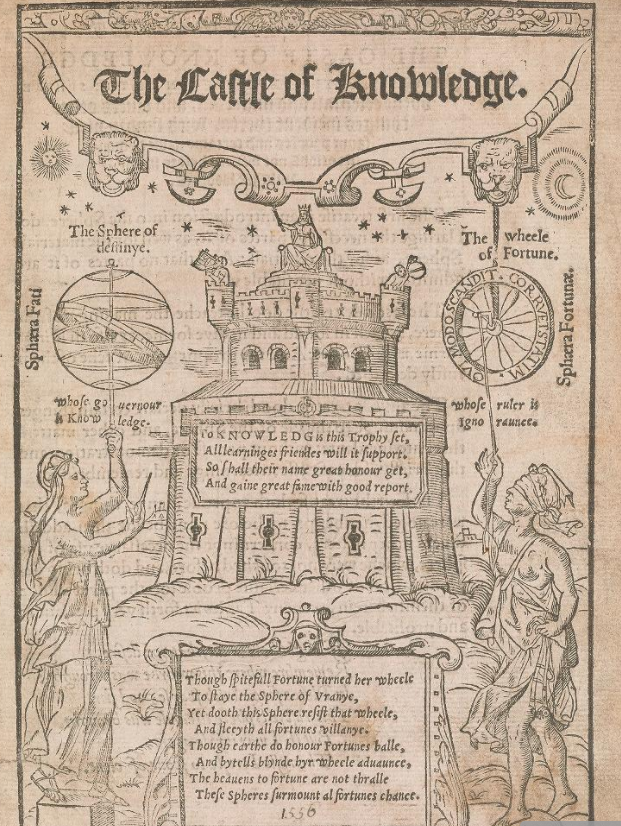
Robert Recorde wrote The Castle of Knowledge in the mid-1500s. Specifically, Reginalde Wolfe published the book in London in 1556. The work explores astronomy as it relates to the Earth by providing commentary on the ideas of scholars and philosophers like Ptolemy, Proclus, and Sacrobosco [1].
Condition of the Text
For having been published in 1556, The Castle of Knowledge is in great condition. The spine is bound in leather, and the front and back covers are marbled in blue and red colors. Despite the coloring, the covers feature no other ornamentation or furniture. The pages themselves are made of a fine paper that bears no rips or holes. The ink is clear and legible, and the text is set in Roman typeface. There are minor dark smudges throughout that do not affect the readability of the text. The most prominent mark of damage is on the top right-hand corner of pg. 257 and the top left-hand corner of pg. 258. On pg. 257, there are marks of severe burn damage since the paper seems singed. However, a previous owner of the book added in a new corner of paper and rewrote the corresponding portion of the table by hand. The two burn mark make the text hard to read but are the only major indications of damage.
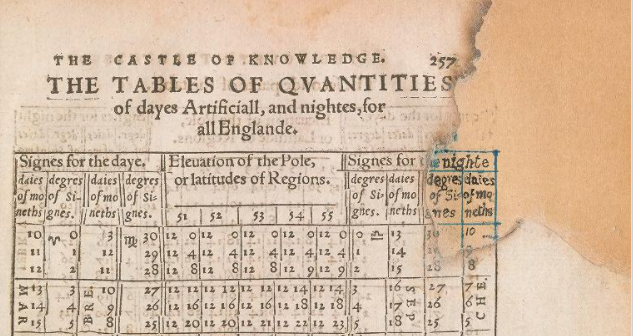
Given that the text is nearly 300 pages long, it features both folio and page numbers to help the reader navigate it. The book additionally features woodcuts and decorative initials toward the beginning and then dozens of mathematical tables and charts throughout. All of the illustrations are in pristine condition.
About the Author and Book
Recorde was a Welsh philosopher born in 1510. He studied at Oxford and Cambridge before becoming a professor of mathematics. Notably, he was a true pioneer in his field for being the first person to use the plus and minus signs in a work published about 11 years before The Castle of Knowledge [2]. Besides holding credit for developing core mathematical symbols, Recorde wrote extensively on topics related to math and astronomy. The Castle of Knowledge in particular acts as a synthesis of the works of early philosophers, as I mentioned earlier. The book even references Copernicus’ theory of heliocentrism.
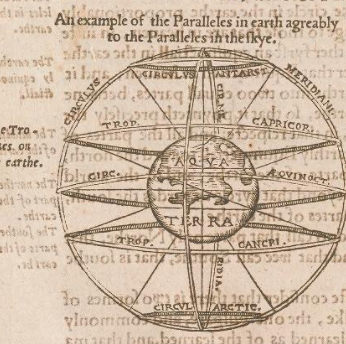
Recorde’s 1556 work takes a broad look at “the sphere,” which is his way of referring to the Earth. It is written in a more vernacular tone and takes on the style of a conversation between teacher and student [3]. Thus, The Castle of Knowledge represents a key astronomy textbook. Recorde wrote it for an academic audience, which is evident in its use of tables, symbols, and circumscribed spheres. Drawing on established astronomic theory, the book would have helped students expand their understanding of the mathematical nature of their world.
Provenance
Here are the main marks of provenance in The Castle of Knowledge. Since the book is nearly 500 years old, I will not be able to discuss every single person who has owned or read this text. However, the individuals and organizations I do reference provide an overview of the life of Recorde’s work.
Lewis Evans
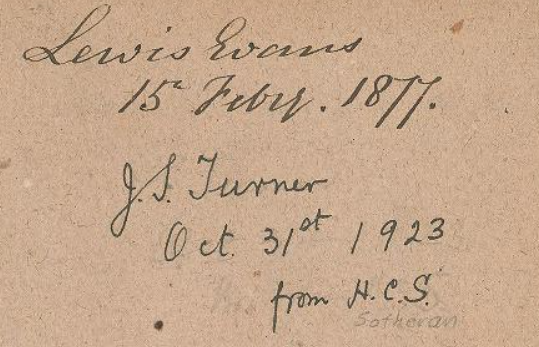
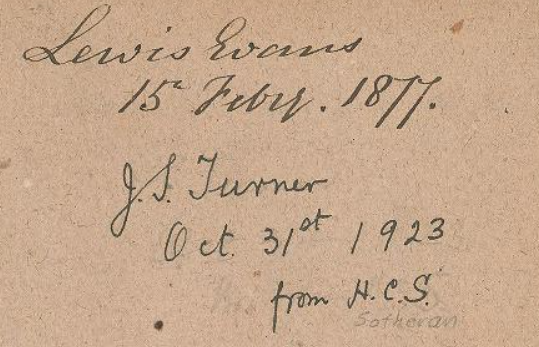
In the front cover page is a handwritten signature for Lewis Evans accompanies by the date “15 Febur.. 1877.” With help from Dr. Brockey, I found that Evans lived from 1853 to 1930 in England. He came from a family of academics and leaders in the paper manufacturing industry. However, Evans is best known for collecting rare books, sundials, and astrolabes. When he donated his collection of astrolabes to Oxford University in 1922, it totaled 63 [4]. There is another inscription referencing Evans’ donation, which I will discuss later.
Bernard Quaritch
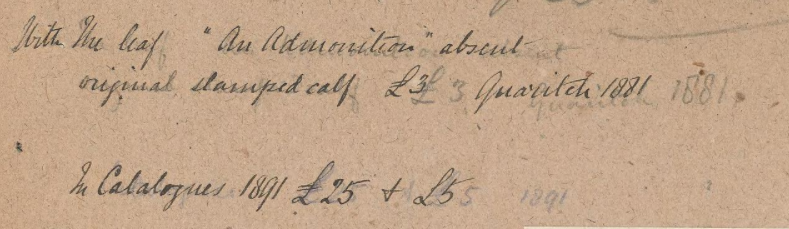
Three lines of ink writing are also on the front cover page. The lines read as follows “(illegible) the lead ‘an Admonition’ absent, original stamped calf, £3 Quaritch 1881” and “In catalogues 1891 £25 +5.” Through research, I found that “Quaritch” referred to Bernard Quaritch, who lent his last name to the rare book store he founded in 1847. The shop is still open in London today. Quaritch was also one of the founders of the Antiquarian Booksellers’ Association and widely dealt with rare books in the natural history and fine arts genres [5]. These lines are likely from a buyer who obtained The Castle of Knowledge from Quaritch’s shop.
J.S. Turner
Under Evans’ signature lies the name of J.S. Turner with the date Oct. 31, 1923 and the message “from H.C.S.” I did find two J.S. Turners who lived in Australia during the 1900s. They were both professors and might have had acquired the book from “H.C.S,” who I discovered to be Henry Sotheran. Sothern founded the Sotheran’s rare book shop in York in 1761 and established a London branch in 1815 [6]. Indeed, under “H.C.S.” lies the name “Sotheran” in pencil. Turner, whether he was an Australian professor or not, got The Castle of Knowledge from Sotheran’s.
Four Catalogue Entries
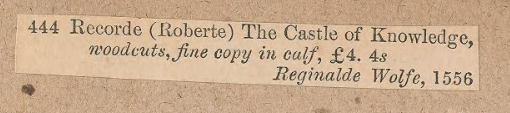
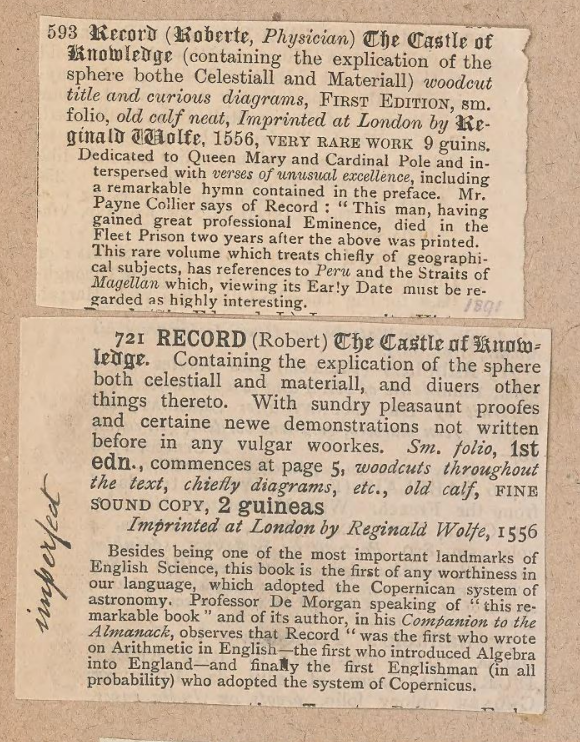
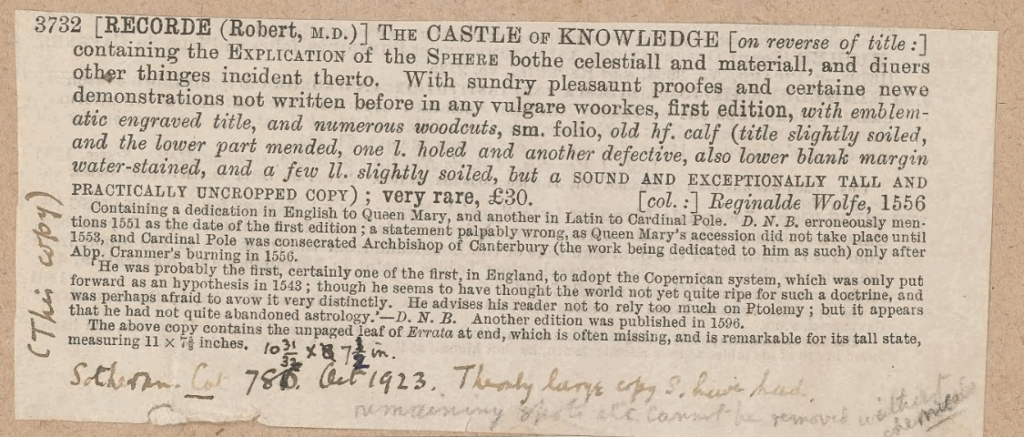
Four catalogue entries are pasted on the front cover page. They seem to have been taken from separate catalogues as they feature index numbers like “444” and “593.” The clippings give short booksellers descriptions of the content and physical condition of the book. They note the folios, woodcuts, and even reviews of the text and Recorde from people like “Payne Collier,” who was an English literature critic and “Professor De Morgan,” who was likely mathematics professor Augustus De Morgan of Cambridge. The inserts also reveal that Recorde dedicated the book to Queen Mary and Cardinal Pole. The entries also offer clues to individual owners of The Castle of Knowledge. The third entry, with the number “721” features the word “imperfect” in ink on the left side. However, it is the fourth entry, which originally appeared in a Sotheran’s catalogue, marked with “3732” that shows how a former owner engaged with the text. The catalogue listing features the inscriptions “(This copy)” and “Sotheran. Col 786 Oct 1923 The only large copy S. have had. (illegible) cannot be removed without chemicals.” The inscription also features the dimensions of the book at “10 31/32 x 7 1/2 in.” The previous two notes could have come from a librarian or person in charge of making a catalogue that included The Castle of Knowledge. I did not that Turner signed the book in 1923, so he could have been the one to make the note on the entry.
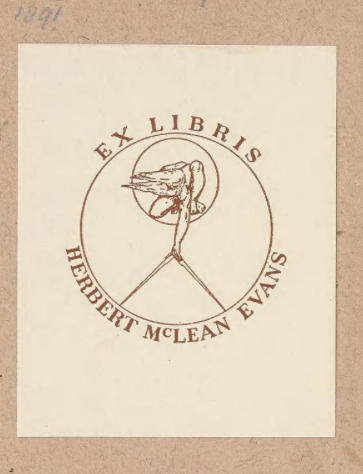
Herbert McLean Evans
Featured in the center of the cover page is a bookplate that reads “Ex Libris Herbert McLean Evans.” Translated, that means “From the library of Herbert McLean Evans.” Evans was born in California in 1882 and earned a medical degree from John Hopkins. He would later join the faculty at Berkeley. His research and training focused on anatomy, specifically reproductive cycles [7]. The bookplate features a symbol that might be Evans’ personal crest. I found no further information on his private library or how he acquired The Castle of Knowledge.
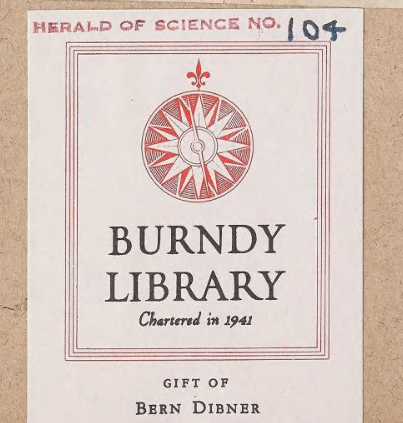
Burndy Library
A bookplate near the bottom of the cover page reveals that the Burndy Library owned The Castle of Knowledge in the 1900s. Bern Dibner founded the library in 1941 and filled it with books related to technology, mathematics, and astronomy. Dibner himself was an electrical engineer, but enjoyed reading the words of Di Vinci. After his death in 1988, all of the books in the Burndy Library were moved to the research section of the Dibner Institute for the History of Science and Technology, which was housed in MIT. In 2006, the Burndy Library closed to the public and the whole collection was moved to the Huntington Library in California [8].
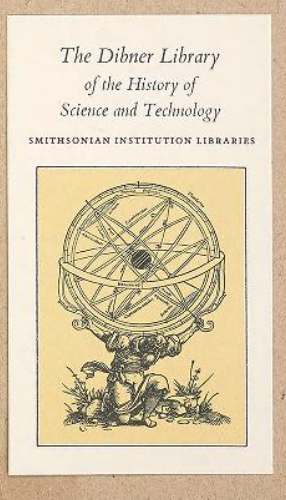
Additionally the back cover page features a bookplate for “The Dibner Library of the History of Science and Technology,” with “Smithsonian Institution Libraries” features as a subtitle. It also has a long, white call strip, which features a call number and the notation “SCDIRB” (Special Collections Dibner Institute). This rear book plate acts as further evidence of The Castle of Knowledge having a place in Dibner’s collection.
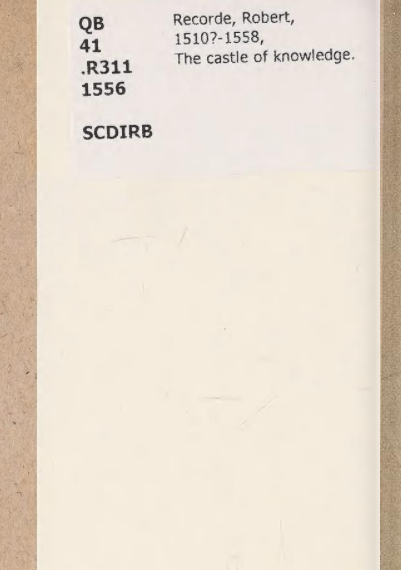
book provides the location of the
text in the Dibner institute
Miscellaneous Markings
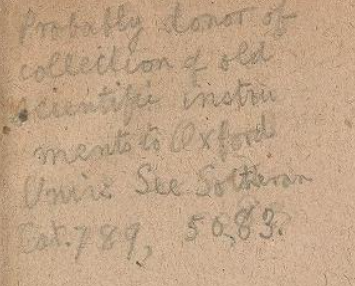
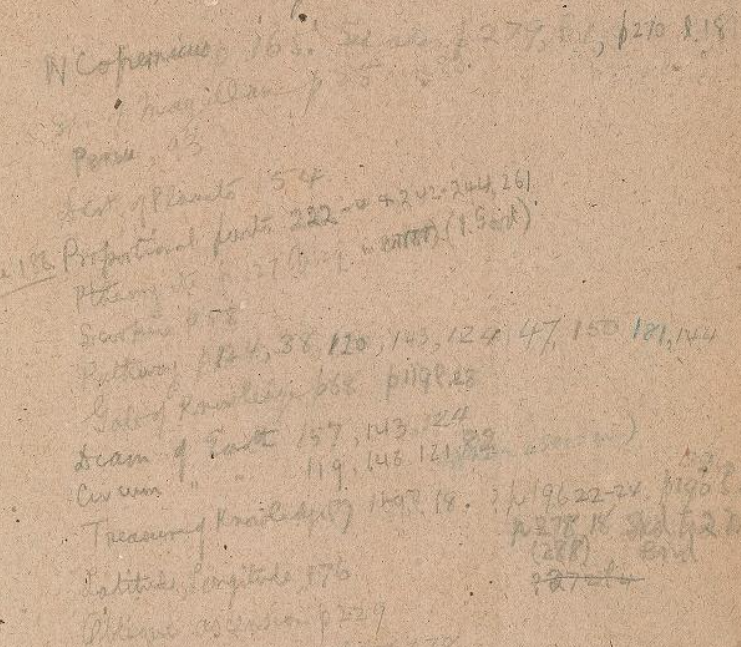
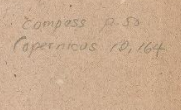
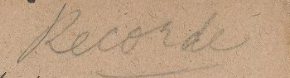
The front and back cover pages also feature unidentified inscriptions. The first details the purpose of the book as being from a “donor of collection of old scientific instruments to Oxford University.” As I mentioned in my section about Evans, he donated 63 astrolabes to Oxford, and this note is in reference to him. The front cover page also features the name “Recorde” in large pencil. Recorde himself could have signed the book, or a subsequent owner could have written it. In addition, there are two personal index entries for “compass p.50” and “Copernicus 10, 164.” Then, on the back cover page, someone hand wrote their own index. The list features names like “Copernicus” and then page numbers like “270.” The index is indicative of a reader making a guide to the book specific to their purposes.
Analysis
The above marks of provenance prove that Recorde’s book was for an academic audience. Since its publication in 1556, it stands to reason that anyone could have owned the book. Though dedicated to Queen Mary, Recorde did not design or write the book for a royal. The woodcuts, while complex are not colored. Also, there is no gold foil or evidence of rubrication. The text was even written in an informal tone. Given that some of the previous owners were academics or founders of libraries, they let the book live its purpose. From Lewis Evans to Herbert McLean Evans to the Burndy Library, The Castle of Knowledge has taught and inspired scholars over the past four centuries. Even the personalized index on the back cover page is a clear sign that a previous reader critically engaged with the text. Given that Recorde wrote the book int he format of a dialogue between professor and student, he would be delighted to see so many people “conversing” with his text.
References
[1] Christie’s. Online auction. Sale 1820, Lot 433. RECORDE, Robert (ca 1510-1558). The Castle of Knowledge. London: Reginald Wolfe, 1556, April 2007, https://www.christies.com/lotfinder/Lot/recorde-robert-ca-1510-1558-the-castle-of-4890533-details.aspx.
[2] Smithhisler, Damian. “Robert Recorde,” http://www.math.wichita.edu/history/Men/recorde.html. Accessed 8 Nov. 2020.
[3] Feingold, Mordechai. “Robert Recorde.” Encyclopaedia Britannica, 28 May 2020, https://www.britannica.com/biography/Robert-Recorde.
[4] Simcock, Tony. “Lewis Evans, founder of the History of Science Museum.” History of Science Museum, https://hsm.ox.ac.uk/lewis-evans- biographical-account. Accessed 19 Nov. 2020.
[5] “About Us: Our History” Bernard Quaritch Ltd, https://www.quaritch.com/about/our-history/. Accessed 18 Nov. 2020.
[6] “About.” Sotherans: Sotheran’s Rare Books and Prints, https://sotherans.co.uk/pages/about. Accessed 18 Nov. 2020.
[7] “People: Herbert McLean Evans (1882-1971): A History of UCSF, https://history.library.ucsf.edu/evans.html. Accessed 8 Nov. 2020.
[8] “History of the Dibner Libraries.” Smithsonian Libraries, https://library.si.edu/libraries/dibner/history. Accessed 8 Nov. 2020.
Created by Mark Ostermeyer for Professor Liam Brockey’s Fall 2020 HST/ENG 475 class on November 8, 2020.
