
The American Chesterfield, or, Way to Wealth, Honour, and Distinction: Being selections from the letters of Lord Chesterfield to his son, and extracts from other eminent authors, on the subject of politeness: with alterations and additions, suited to the youth of the United States
By A Member of the Philadelphia Bar and containing letters from Philip Dormer Stanhope, Earl of Chesterfield, 1694-1773
Library Call MSU: BJ 1855 .A6 1828
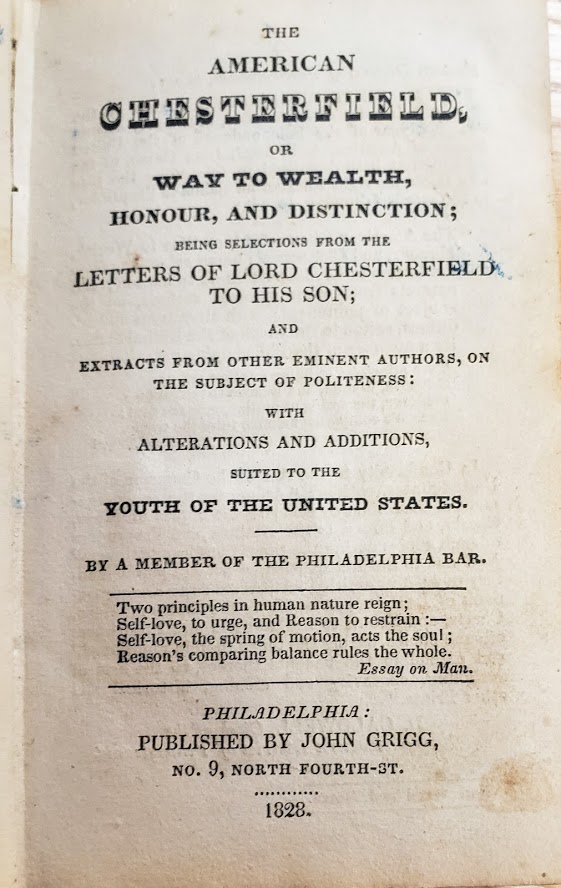
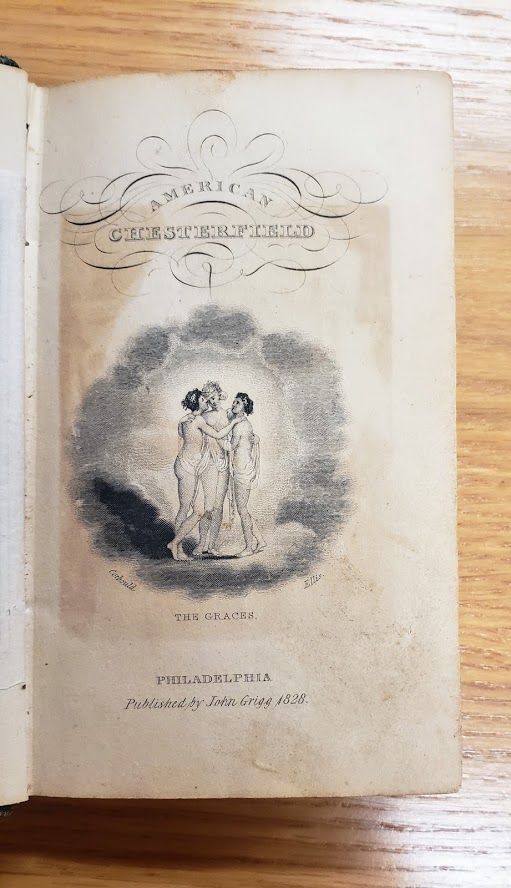
“The American Chesterfield or, Way to Wealth, Honour, and Distinction: Being selections from the letters of Lord Chesterfield to his son, and extracts from other eminent authors, on the subject of politeness: with alterations and additions, suited to the youth of the United States” was originally published in 1827 by John Grigg at no. 9, North Fourth-St. in Philadelphia, Pennsylvania. The printing of this work, which is held in MSU Special Collections was printed in 1828.
The American Chesterfield is a book of American Georgian Era etiquette, which is greatly inspired by the letters of several notable 18th-century aristocrats to their sons. This volume covers topics such as introductions, laughter, and how to cut and serve a partridge. This book was perhaps intended to serve as a how-to guide for young American men of all classes to learn the arts of manners and comportment and raise the reputation of middle-class America’s manners.
The Author

Philip Stanhope, 4th Earl of Chesterfield (September 22nd, 1694 – March 24th, 1773) was known by his contemporaries as a robust statesman, a cunning diplomat, and a witty conversationalist. Chesterfield attended university at Trinity Hall, Cambridge, he left less than a year after arriving, after studying language and oration. He then commenced on his Grand Tour of the Continent, as tradition dictated to complete his education as a nobleman.
During Chesterfield’s tour, he was exposed to the cultural deference to Classical antiquity and the Renaissance held by his fellow Europeans. As well as forming lasting acquaintances among the polite society of Continental Europe.
The Earl of Chesterfield for all his talk of manners sired an illegitimate son named Philip Stanhope, to whom he wrote almost four hundred letters to. The correspondence began in 1737 and ended with his son’s death in 1768, his son’s aggrieved impoverished widow Eugenia published the letters as the book Letters to His Son on the Art of Becoming a Man of the World and a Gentleman in 1774. Chesterfield wrote extensively geography, history, and classical literature, – with later letters focusing on politics and diplomacy to ensure that his son was well-educated. The letters themselves were written in French, English, and Latin, all to confirm fluency and precision in the younger Philip’s communications. Selections from these letters provide a great deal of source material for the American Chesterfield.
A Member of the Philadelphia Bar is also listed as one of the authors of the American Chesterfield. This book is not the only 19th-century volume to list a bar member as one of its authors with no further information. Whether the author meant to remain anonymous as to not attract either good or bad attention that might influence his career as a lawyer, or whether it was a way to denote authority on whatever subject they were writing on (regardless of its relation to the law) in order to sell more books, is unclear from the pages of this iteration of the American Chesterfield.
Physical Aspects
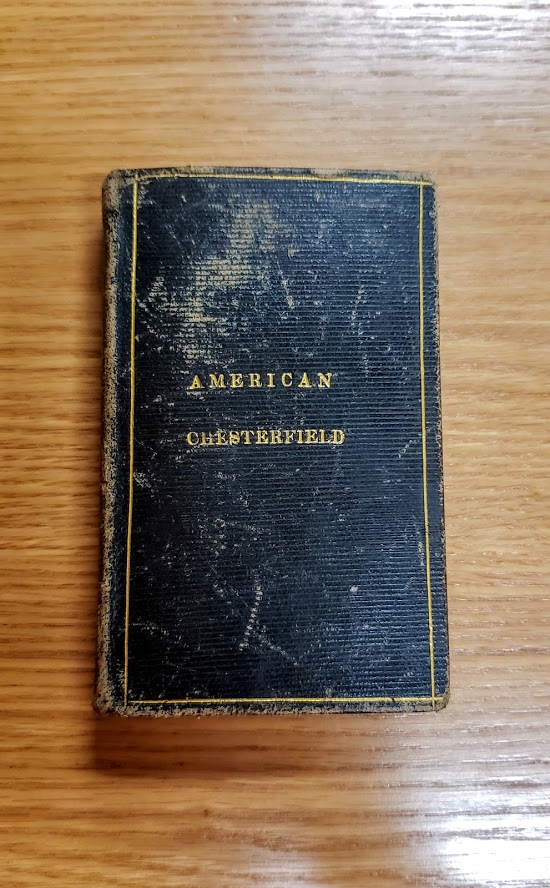
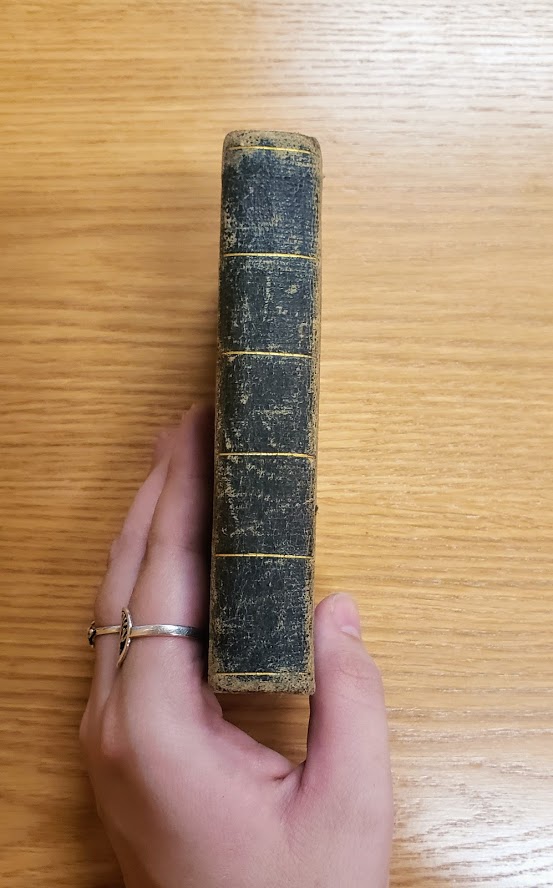
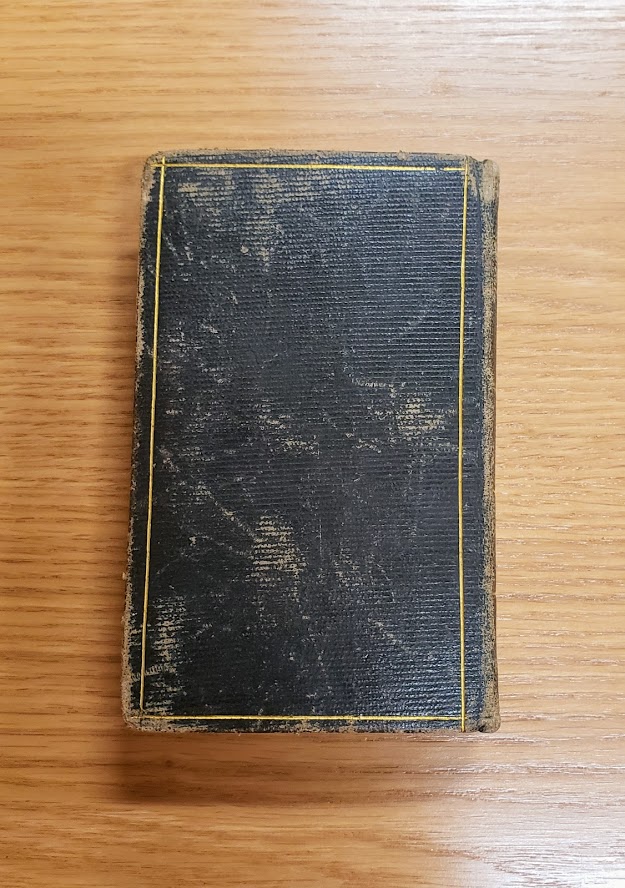
This copy of the American Chesterfield is bound cardboard painted in very dark green. A rectangular border frames the cover and the short title “The American Chesterfield”, both of them are impressed in gold. It shows significant signs of wear and scratches on the painted front cover. There are six bands on the spine. The spine is intact and tight in its binding. There are signs of bumping on the corners and notable wear on the hinges. The back cover shows notable signs of scratching and scuffing at the paint of the cover. The amount of wear on this book indicates that it saw at least a moderate degree of regular use and did not spend the majority of its life sitting on a shelf. The text block and the spine are both intact which indicates that even with regular use, it was not handled casually and was a valued item to an owner.
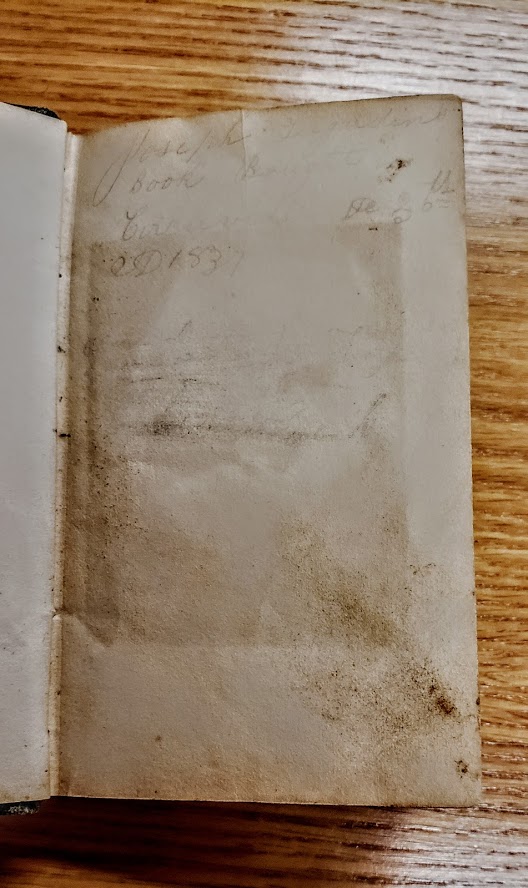
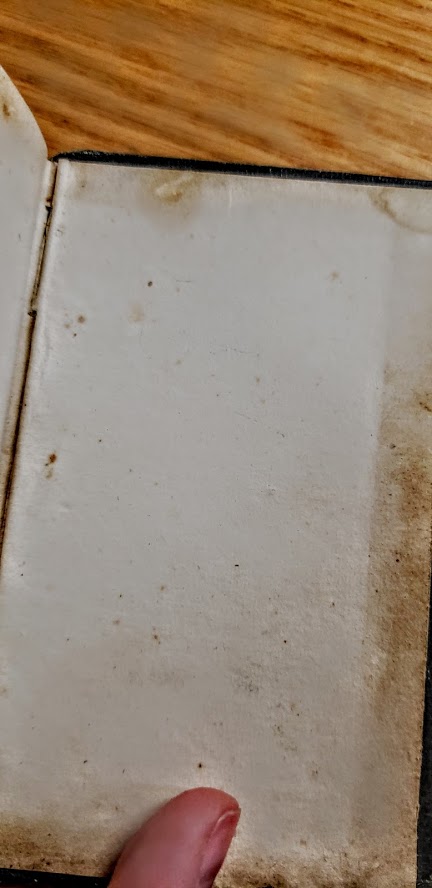
There are vestiges of a possible former ownership inscription that have since been erased on the front leaf of the text. The only legible letter being a capital “E”. In the back pastedown, there are several indistinct impressions of letters possibly reading “A-S-L-“. There does not appear to be signs of lead or ink on the page from these impressions nor any discernible meaning. They may simply be a result of someone using the book as a hard writing surface.
The text itself displays a clearly printed and well-inked type. There is very little foxing or soiling in the text, although there is some browning in the front leaves of the text. There is also no discernable fading to the ink anywhere in the text. The American Chesterfield has five distinct typefaces: the book’s intellectual contents are in a serif there is an italics style subheading font, an all-capitals small subheading font, a larger all-capitals small subheading font, and a larger bold all capitals heading font.
Marks of Ownership
B. & J. Turn(b)- Bookbinders
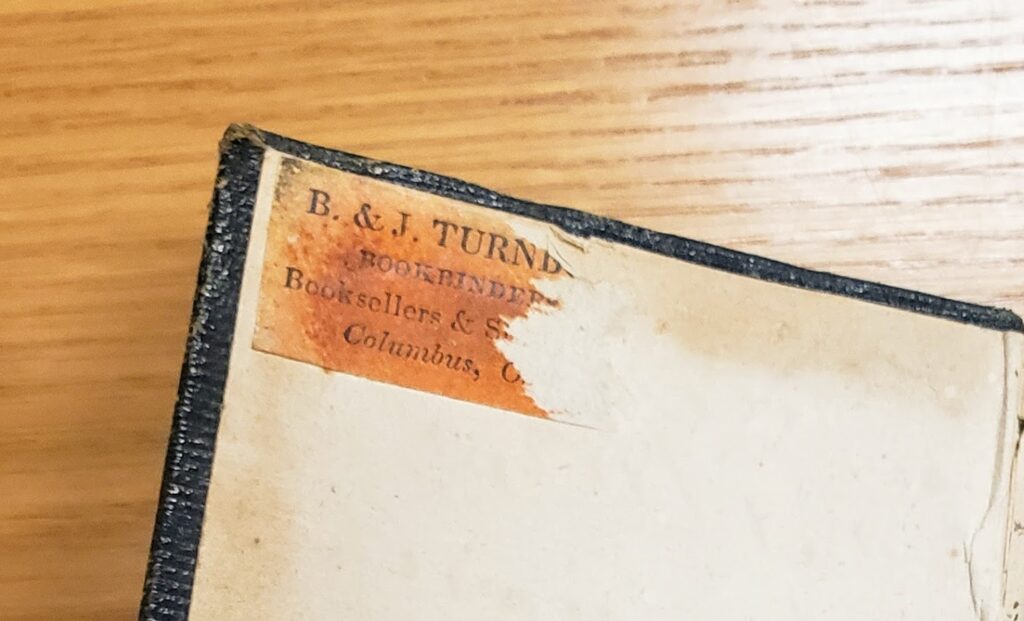
There are five distinct marks of ownership in this copy of the American Chesterfield. The first is a partially removed bookplate on the front cover pastedown from a bookseller’s shop in Columbus, Ohio.
What is left of the faded orange plate reads, “B. & J. Turn(b)- Bookbinders, Booksellers, and S-, Columbus, Ohio)”. B. & J. Turnbull booksellers who first advertised their presence in March of 1832 were in fierce competition with another local bookseller Issac Whiting, this competition remained fierce until 1834. Turnbull also maintained a bookstore in Steubenville, Ohio. There are two probable marriage records linked to a John Turnbull.
Samuel Ritter
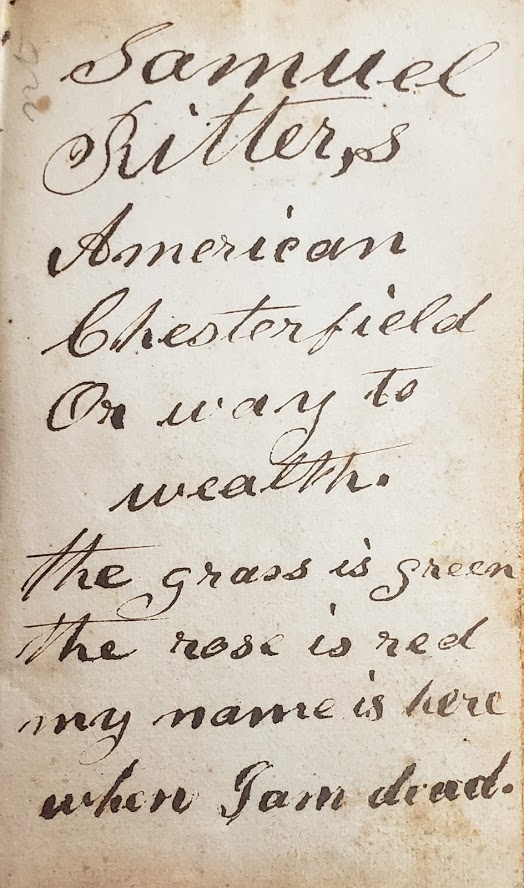
The next mark of ownership comes in the form of a name and a modified children’s rhyme. In flamboyant Spencerian style handwriting, the author of the note writes, “Samuel Ritter’s American Chesterfield on way to wealth. The grass is green the rose is red my name is here when I am dead.” This charming poem most likely has its roots in an Elizabethan period nursery rhyme. There are several candidates for the Samuel Ritter behind this inscription. The inscription takes up the entirety of the first page and the ink is rather faded, which could suggest that Ritter was an earlier owner. But he could have just as easily been an owner later in this book’s life before it came to be housed in MSU Special Collections.
The main lines of evidence that are available to track Ritter are his name and his handwriting, which means looking at marriage records as it is a significant document that occurs during one’s adult life and requires a signature. While many marriage records have been digitized it does not necessarily mean there will be a scan of the primary document itself to compare handwriting. Additionally, based on the other marks of ownership there are several possible locations that Ritter could be linked to, including Columbus, Ohio (the bookshop plate), Circleville, Ohio (listed in a different mark of ownership), Steuben, Indiana ( location of death for a previous owner), and Philadelphia, Pennsylvania or even the whole state of Pennsylvania(location of publishing). Based on this research there are two likely candidates based on handwriting, one in Sandusky, Ohio, and one in Pennsylvania.
However they are hardly exact matches, some of this can be reasoned with through the context of the signature, the penmanship in the American Chesterfield is notably more flamboyant but one can afford to be flamboyant in one’s own belongings especially compared to the solemnity of a marriage certificate. The other component is age, a more mature man might be less likely to engage in decorative flourishes. However, this is all under the assumption that Ritter got married at all.
Joseph Teegardin
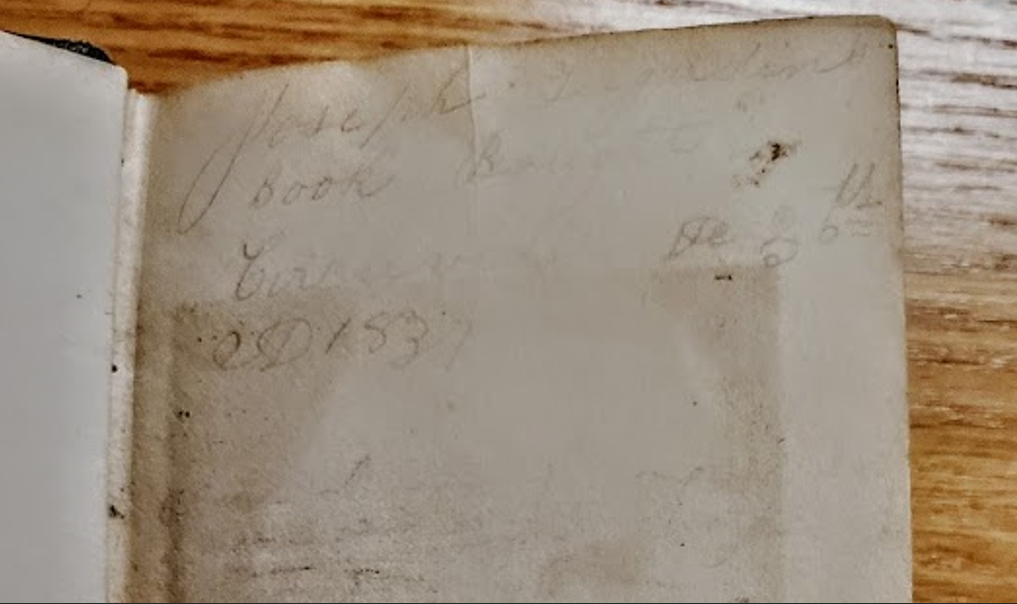
The third mark of ownership belongs to Joseph Teegardin. He writes in pencil,” Joseph Teegardin Book bought Circleville 1837″. The Circleville that Teegardin refers to is most likely Circleville, Ohio, which is approximately thirty miles from Columbus, the location of the bookshop. From this, we can assume that this copy made its way from Columbus to Circleville somewhere between the years 1828 and 1837. The main point of interest about Joseph’s inscription is in fact the inscription that comes after his in blue flowing ink.
Dorilas L. Teegardin
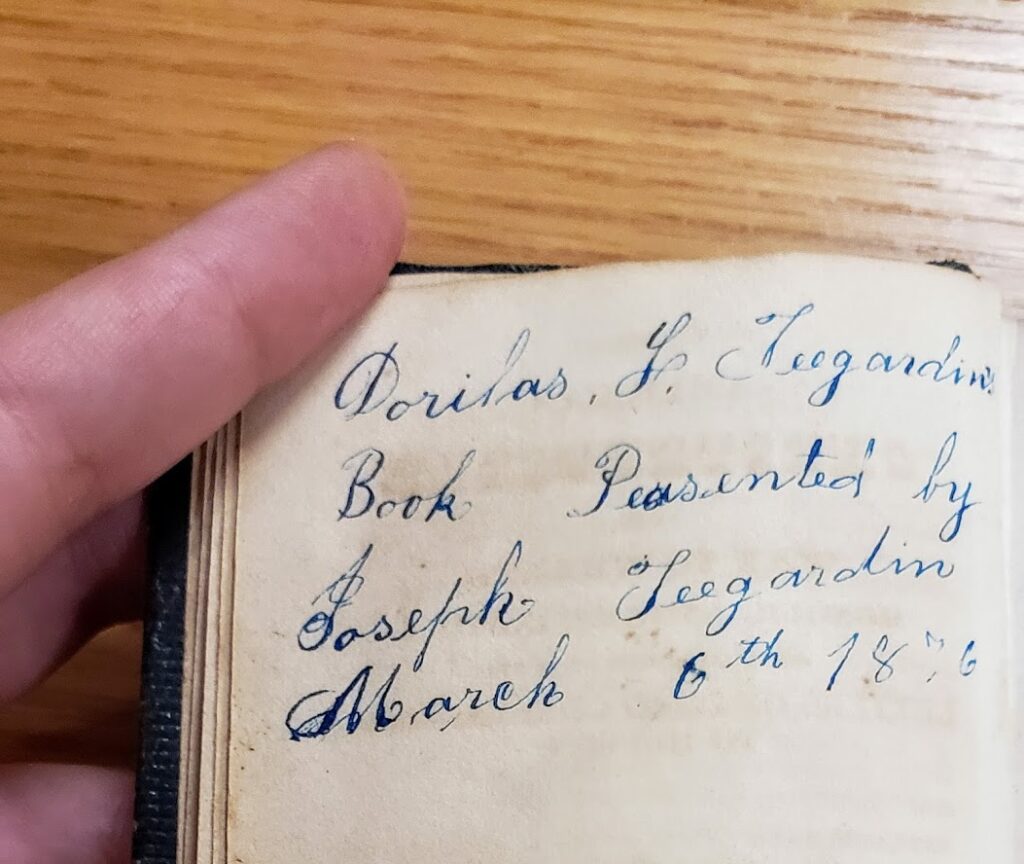
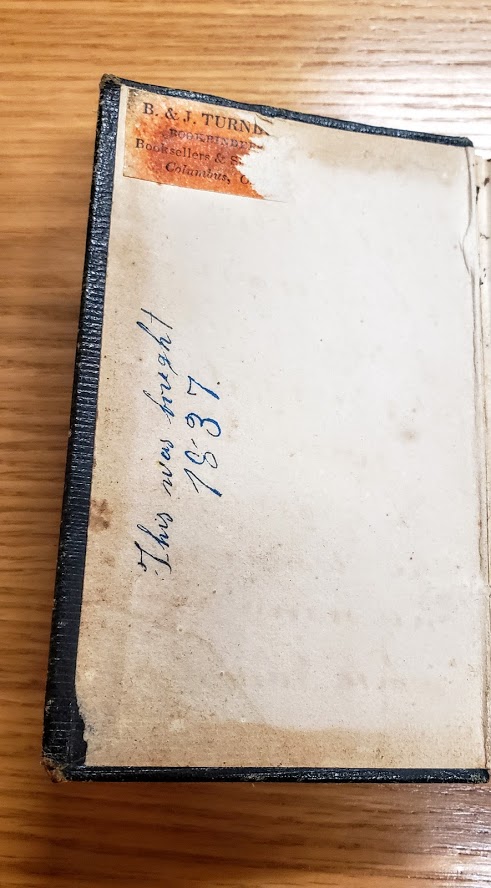
“Dorilas L. Teegardin’s book presented by Joseph Teegardin March 6th, 1876”.The book was Prilos Lugar presented a year before the death of Joseph Teegardin when Dorilas was fourteen. This handwriting also clearly belonged to the inscription on the pastedown of the text reading, According to family genealogies and census records, Joseph Teegardin was the grandfather to Dorilas Lafayette Teegardin. The unusual name of Dorilas allows a great degree of confidence in pronouncing these Teegardin’s to be the owners of this particular volume of the American Chesterfield.
The three generations of Teegardin men were all farmers. There is no evident reason why the American Chesterfield was passed from grandfather to grandson rather than from father to son. Perhaps this book was simply one of many that Dorilas received as a result of his grandfather’s death. It could be imagined that this gift was the result of a certain sense of kinship and closeness between a grandfather and grandson. Or perhaps the disinterest of a midwestern farmer for etiquette books based on the ideas of British aristocracy that could hardly affect his rural life in Otsego, Indiana.
Sources:
The American Chesterfield: Archive
Philip Dormer Stanhope, 4th earl of Chesterfield
American Chesterfield AbeBooks Listing Spencerian Handwriting 1900 United States Federal Census for Dorilas Teegardin
1880 United States Federal Census for Dorias L. Teegardin
1850 United States Federal Census for Joseph Teagarden 1850 United States Federal Census for Joseph Teagarden Ohio, County Marriage Records, 1774-1993 for Samuel Ritter
Michigan, Marriage Records, 1867-1952 for Samuel Ritter
Ohio Tax Records, 1800-1850
Ohio, County Marriage Records, 1774-1993 for John Turnbull
Ohio, County Marriage Records, 1774-1993 for John Turnbull
ISAAC N. WHITING: PIONEER BOOKSELLER AND PUBLISHER OF COLUMBUS, OHIO
The Rose is Red the Grass is Green
Isabella Wikle-Fall 2020- HST 475
