
Part I – Identification
Author: Maier, Michael [Michaele Majero]
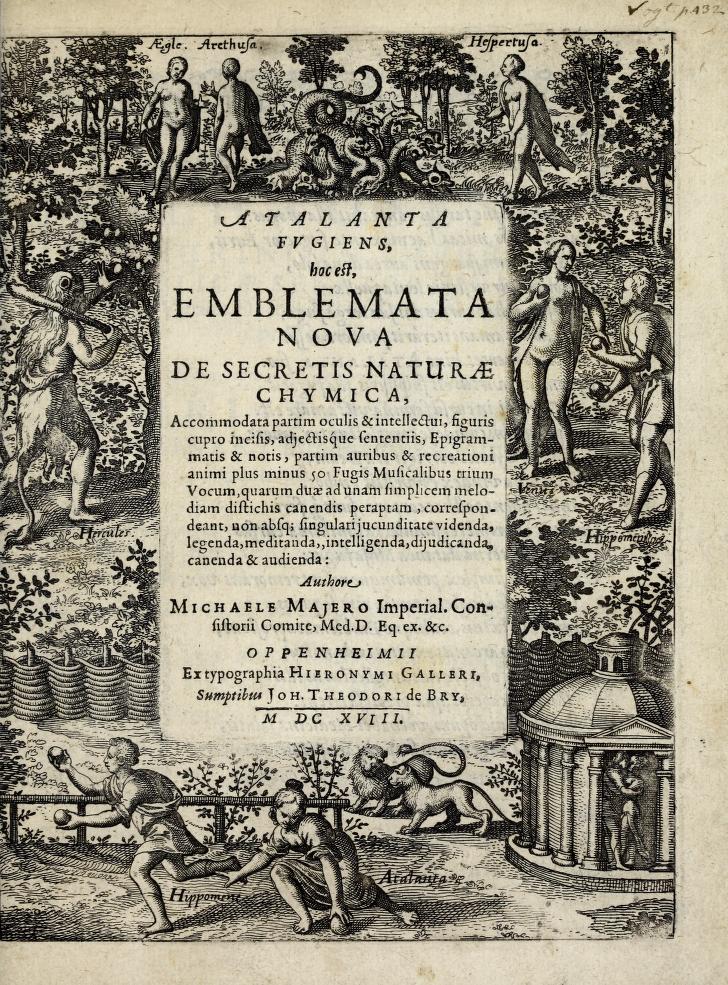
Title: Atalanta Fugiens, hoc est, Emblemata Nova de Secretis Naturae Chymica, Accommodata partim oculis et intellectui, figuris cupro incisis, adjectisquesententiis, Epigrammatis et notis, partim auribus & recreationi animi plus minus 50 Fugis Musicalibus trium Vocum, quarum duae ad unam simplicem melodiam distichis canendis peraptam, correspondeant, non absq; singulari jucunditate videnda, legenda, meditanda, intelligenda, dijudicanda, canenda et audienda.
Short Titles: Atalanta Fugiens, hoc est, Emblemata Nova de Secretis Naturae Chymica : Accommodata partim oculis [et] intellectui, figuris cupro incisis … , Authore Michaele Majero …
Atalanta Fugiens
Imprint: Oppenheim, Ex typographia HYERONYMI GALLERI, sumptibus JOH. THEODORI de BRY, M DC XVIII [1618]
Link: https://archive.org/details/atalantafugiensh00maie/page/n8/mode/2up
Part II – Michael Maier’s Atalanta Fugiens
About the author:
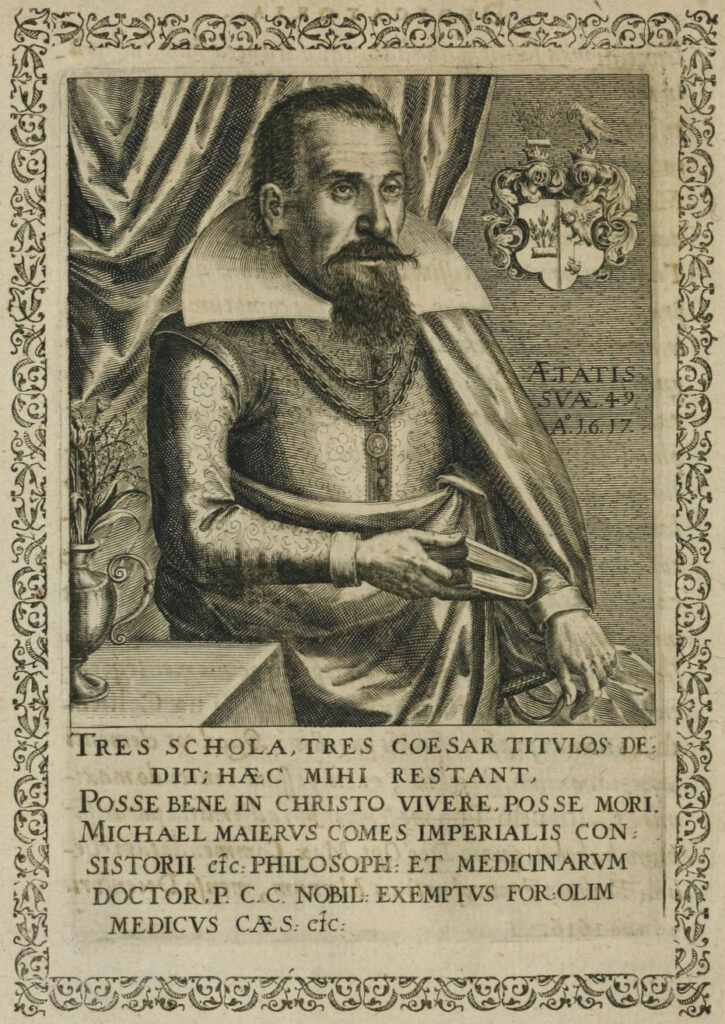
Michael Maier (Latin: Michael Maierus; 1568-1622) was a German alchemist and epigramist who worked as a court physician and counsellor to Rudolf II, a Holy Roman Emperor. The Rudolfine court was notorious for supporting and refuging alchemists such as the author of Atalanta Fugiens.
Besides being a physician and alchemist, Maier (Fig. 1) has also left a rich legacy of writings – many of which were influential to later philosophers, such as Sir Isaac Newton – and musical compositions. He has written around 20 books on hermetic philosophy, Atalanta Fugiens being possibly one of the most prominent examples of the genre ever published.
About Atalanta Fugiens:
Atalanta Fugiens, first published in 1617 in Germany, is an “alchemical emblem book”. Containing 50 engravings with highly detailed emblems, each accompanied by a set of poetic sextets (in Latin and German) and a musical “fugue”, Atalanta Fugiens is definitely an example of early multimedia – more on that later…
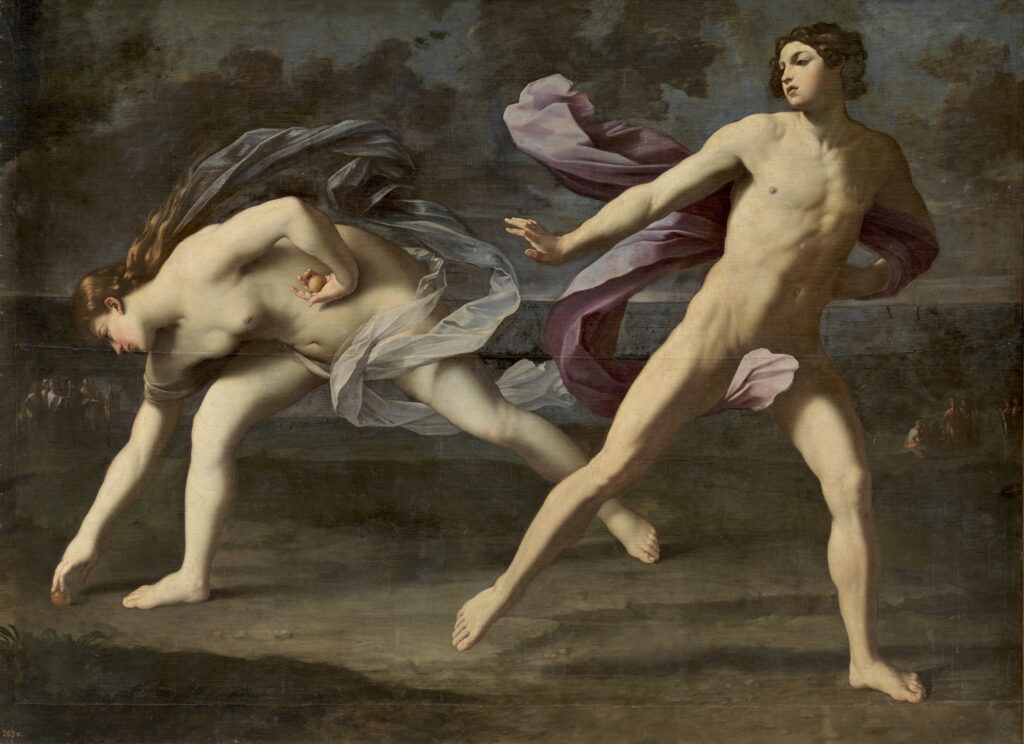
Atalanta Fugiens can be translated to “Atalanta flees” or “Atalanta fleeing”/”seeking refuge”. Greek mythology tells us that Atalanta was the daughter of a hunter and, most importantly, she was the fastest runner among all mythological figures. When Atalanta grew up, her father, lasus, decided that it was time for her to get married. Atalanta, who was not eager to marry anyone, made a deal with her father – if someone could beat her in a foot race, she would marry the winner.
Many tried and failed, as Atalanta was too fast a runner. However, one man named Hippomenes sought help from Aphrodite. The goddess of love, who was feeling deeply affronted by Atalanta’s rejection to love, decided to help Hippomenes. Aphrodite, knowing that Atalanta was always a curious creature, gave Hippomenes three golden apples. The apples were supposed to be tossed out by Hippomenes during the race, thus creating a distraction to Atalanta. One by one, Hippomenes threw the apples on the ground as they raced. Each time an apple was thrown, Atalanta would stop and examine it, but she would always be able to catch up with Hippomenes. After the third apple was thrown, though, Atalanta would not have much more race left to catch up with Hippomenes, who wins the race and therefore marries Atalanta.
The story of Atalanta and Hippomenes creates the perfect metaphor for a book on alchemy – the same way Hippomenes is trying to find ways of achieving the unattainable (that is, winning a foot race against Atalanta), the alchemist is likewise trying to find a way of “dominating” nature and its properties. Moreover, the story of the race between Atalanta and Hippomenes – one in which one is constantly running after the other – creates another metaphor that is also used by the author in a very clever and creative manner: a musical metaphor by means of composing fugues. A musical fugue is, by definition, an imitative compositional technique in which one voice “follows” the other, almost as if trying to “catch up” with the other voice. Incidentally, each voice is labelled in a way that clearly references the legend: Atalanta seu vox fugiens (Atalanta, or the fleeing voice) for the first part/voice, Hippomenes seu vox sequens (Hippomenes or the voice which follows) for the second part/voice, and Pomum objectum seu vox morans (the apple which is tossed, or the voice which lags behind) in the third part/voice. Therefore, by composing fugues to accompany each of the 50 emblems, the author is using a popular compositional technique of the time to create a musical reference to the legend of Atalanta and Hippomenes. What an ingenious rhetorical stunt!
But Maier goes even further with the use of these musical fugues – many of these compositions do not follow strictly the rules of counterpoint of the time, as many of these contains parallel perfect intervals (such as 5ths and 8ves) and incorrect dissonance treatment. Maier, who was a skillful composer, most likely “cheated” the rules on purpose, as did Hippomenes by tossing out the golden apples during the race.
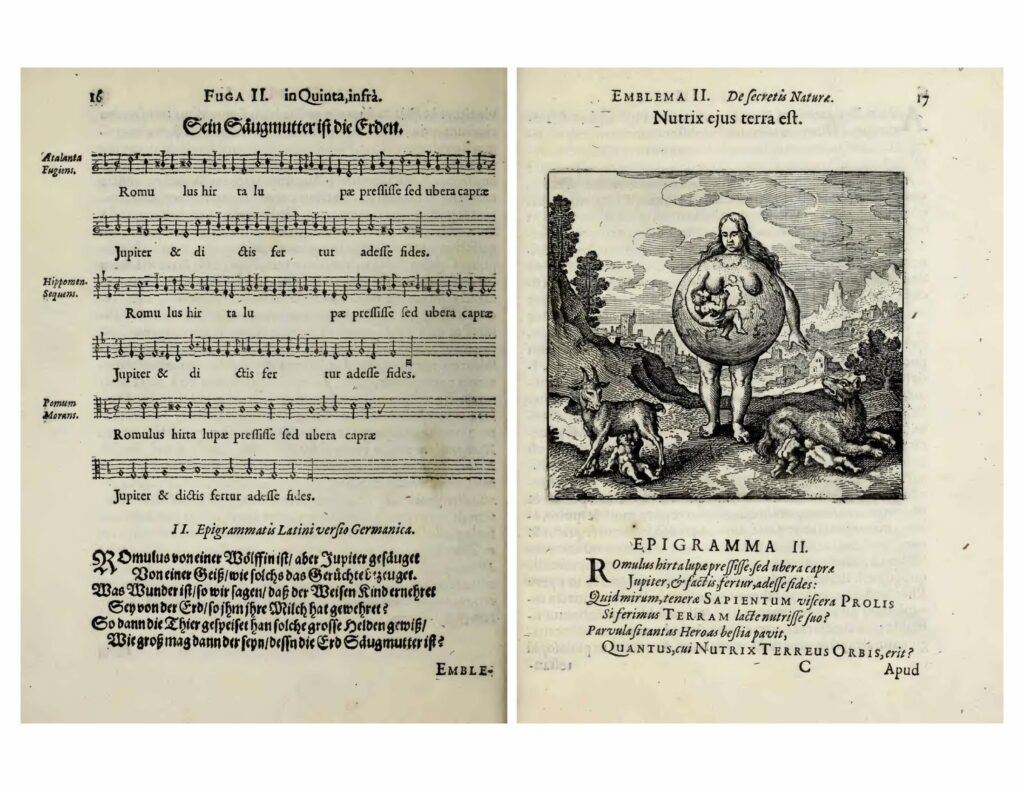
Let us now return to the idea of Atalanta Fugiens being an early example of multimedia. As the title suggests, Atalanta Fugiens is “to be looked at, read, meditated, understood, weighed, sung, and listened to, not without a certain pleasure”. If you take a look at Fig. 2, each emblem comes in a two- page set. Each of these sets contains an engraved emblem that is quite big and detailed on the right side, a poetic sextet in Latin (right side) and its translation in German (left side) and, finally, a musical fugue that uses the Latin sextet as its text on the left side. Therefore, as the reader engages with the text, he or she receives three different inputs: a visual one from the emblem, a linguistic one from the text, and an aural input from the music. Studies have shown that the population who would consume this type of book during the time of its publication were capable of singing or “audiating” (hearing inside of one’s mind) the musical compositions in this book with ease. Atalanta Fugiens is, indeed, an early example of multimedia!
Part III – Provenance of my specific copy
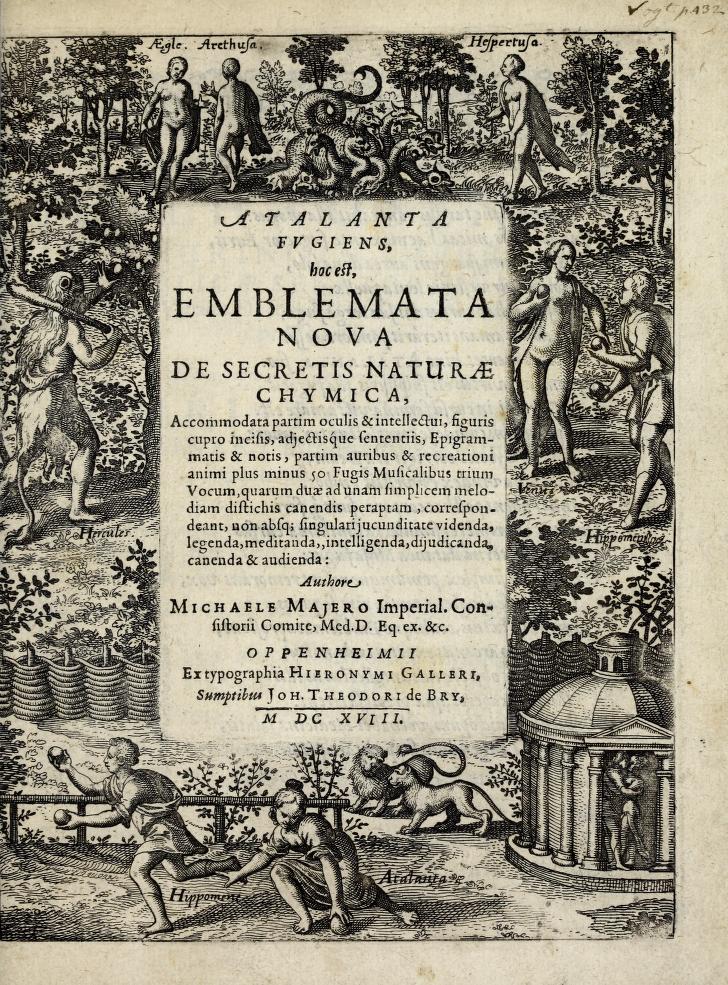
My copy of Atalanta Fugiens is currently held at the Getty Institue Library in Califronia. It was published in 1618 in Oppenheim , Germany. This copy was printed by Hieronymus Galler with engravings by Johann Theodor de Bry (1561-1623), as specified in the title page in Fig. 3. Some scholars attribute the engravings to Matthäus Merian (1593-1650), who was Bry’s son-in-law and who also worked as a publisher. For more technical information about this copy from the Getty Institute Library, please refer to the “technical notes” section below.
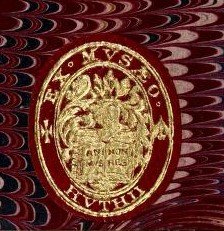
The earliest provenance evidence that I could find comes from England form a bookplate located on the inside part of the cover page (fig. 4). It reads “EX MUSEO HUTHII” and it pertained to Henry Huth (1815-1878), a British bibliophile and banker. It was very likely inherited by his son, Alfred Henry Huth (1850-1910), who was also a bibliophile and possessed an enormous collection of books. The Huth library catalogue, published in 1880, indeed shows that a copy of Atalanta Fugiens was in the family’s collection and, given that the family’s plate is found in this specific copy, I would assume that this is the copy referenced in the catalogue. Upon his death, Alfred Henry Huth bequeathed a large part of his collection to the British Museum which, in turn, published a catalogue such books on on 1912. Atalanta Fugiens is note listed in this catalogue, which means that this copy was likely not donated to the British Museum or, if it was, it was not included in the museum’s collection.
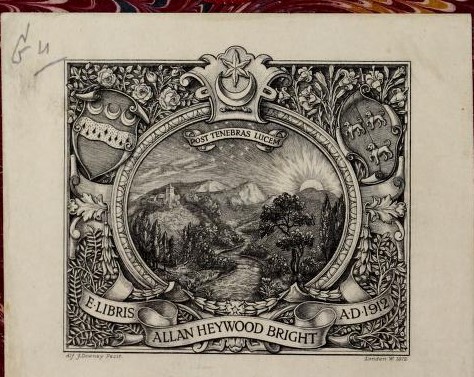
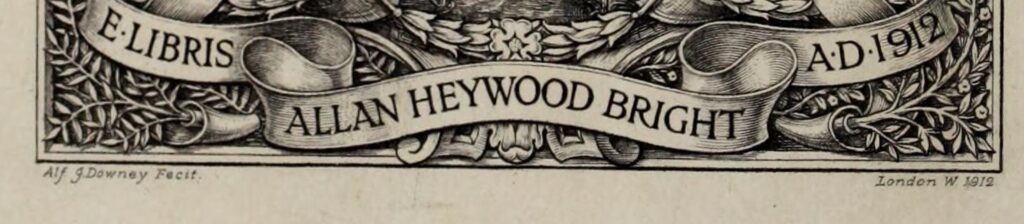
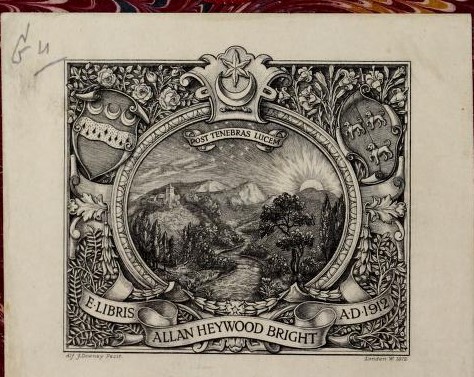
Incidentally, the next provenance evidence that I have found, in the same page as the previous one, is another bookplate. This one is from 1912, the same year that the Hulth family books were donated. It reads “E. LIBRIS; ALLAN HEYWOOD BRIGHT; A.D. 1912” and it belonged to Allan Heywood Bright (1862-1941), a British politician and researcher who also published works on physical sciences (see Fig. 5). I could not find a catalogue of Bright’s book collection online but, given that his bookplate can be found in this specific copy, one can confidently assume that this book was indeed in Bright’s possession in 1912. The bookplate itself was made by Alf. G. Downey, as it reads on the detail “Alf. G. Downey facit” (see Fig. 6).
What happened with this copy between 1912 and 1916 is, to me, unknown. The next provenance markings can be found on the back of the back-cover page. It reads as follows (see Fig. 7):
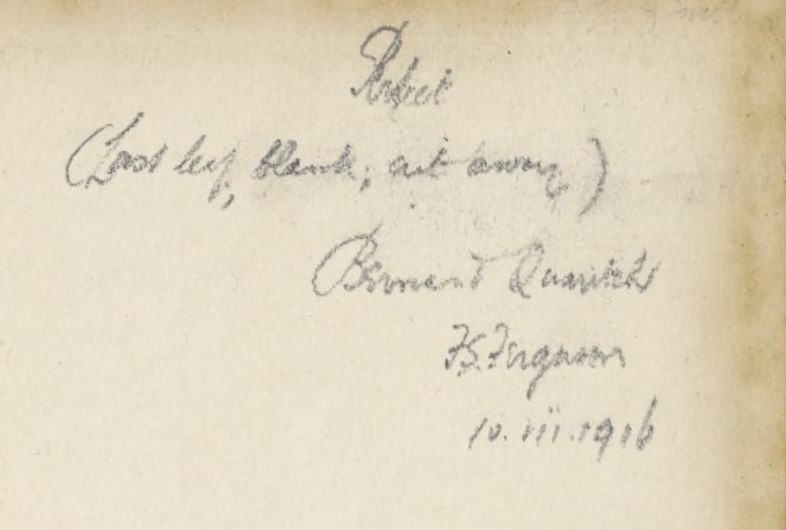
____ [Robert?]
(Last leaf; blank; cut away)
Bernard Quaritch
FS Ferguson
10.III.1916
This marking contains a lot of information that might tell us where this book was and who had it. First, Bernard Quaritch (or Bernard Quaritch Ltd.) is a rare book bookselling company located in London, England. They were established in 1847 and they are still open for business. I was able to contact Bernard Quaritch via email and, as of 11/08/2020, they were able to confirm with me that, based on these provenance markings, they were very likely in possession of this specific copy. They have informed me that F[rederic] S[utherland] Ferguson was a bookseller (and later managing director) of the shop at the time, and that the handwriting on the page is probably his. Because of the 2019/20 COVID-19 pandemic, England has just (as of 11/05/2020) issued restrictions and the shop is currently temporarily closed. Because of this, the person with whom I was in contact could not go to the actual shop to check their catalogues and confirm when and how they came into possession of this copy – and to whom it was sold. I will update this information as soon as I hear back from them with more details.
Frederic Sutherland Ferguson (1878-1967), the aforementioned managing director, was an English bibliographer. Besides being the manager of Bernard Quaritch Ltd., he was also the president of the University of London’s Bibliographical Society between 1948-1950.
The aforementioned Bernard Quaritch provenance note is the last note that I was able to find in this copy that points out to an owner or to a date. Furthermore, I was not able to find a specific catalogue that points out to any copies of Atalanta Fugiens possessed by Bernard Quaritch Ltd. or by Mr. Ferguson. Therefore, I could not find any more information about what happened to this copy before it ended up at the Getty Institute Library, or how it ended up there. I have contacted the Getty Institute Library via email but, sadly, I have not received an answer.
Other provenance markings:
These are markings that do not tell us much about ownership or dates. They are:
- “GU” [?] pencil markings on Allan Heywood Bright’s bookplate. I cannot find out what it means (Fig. 8);
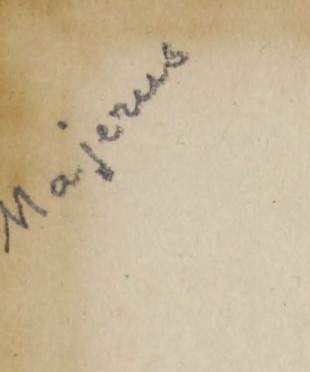
- Pencil marking on back of cover page, top left corner- Majerus (Fig. 9), which is the latinized version of the author’s name;
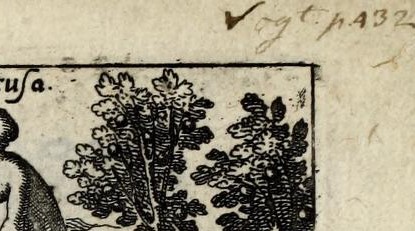
- Pencil marking on the top right corner of title page – “Vogt p. 432” (Fig. 10);
- Maybe referring to Iohannis Vogt’s Catalogvs historico-criticvs libarvm rariorvm? In this book, Maier’s book is listed as a rare book, but not on page 432.
Summary of provenance:
With date implications:
- Plate – EX MUSEO HUTHII
- Henry Huth (1815-1878) – English bibliophile and banker
- Alfred Henry Huth (1850-1910) – Henry’s son, also a bibliophile who inherited most of his father’s books
- Upon his death, Alfred left a large part of his collection to a British Museum. The British Museum published a catalogue of the chosen books on 1912, but Atalanta Fugiens is not listed in this catalogue
- Plate- LIBRIS; ALLAN HEYWOOD BRIGHT; A.D.1912
- Allan Heywood Bright (1862-1941) – British Politician and researcher who published works on physical sciences
- Bookplate made by Alf. G. Downey, 1912
- “GU” [?] pencil marking. I cannot find out what it means
- Pencil marking – annotation by Frederic Sutherland Ferguson, a bookseller working for Bernard Quaritch LTD, which is a rare books seller in England (1916 pencil marking).
Without date implications
- Pencil marking on back cover page, top left corner – Majerus
- Unknown date, probably recent, based on style of handwriting
- Pencil marking on top right corner of title page – “Vogt p. 432″
- Maybe referring to Iohannis Vogt’s Catalogvs Historico-criticvs librobm raiovm? In this book, Maier’s book is listed as a rare book, but not on page 432.
Part IV – Technical Notes
Author: Maier, Michael [Michaele Majero]
Title: Atalanta Fugiens, hoc est, Emblemata Nova de Secretis Naturae Chymica, Accommodata partim oculis et intellectui, figuris cupro incisis, adjectisquesententiis, Epigrammatis et notis, partim auribus & recreationi animi plus minus 50 Fugis Musicalibus trium Vocum, quarum duae ad unam simplicem melodiam distichis canendis peraptam, correspondeant, non absq; singulari jucunditate videnda, legenda, meditanda, intelligenda, dijudicanda, canenda et audienda.
Short Titles: Atalanta Fugiens, hoc est, Emblemata Nova de Secretis Naturae Chymica : Accommodata partim oculis [et] intellectui, figuris cupro incisis … , Authore Michaele Majero …
Atalanta Fugiens
Imprint: Oppenheim, Ex typographia HYERONYMI GALLERI, sumptibus JOH. THEODORI de BRY, M DC XVIII [1618]
MSU holdings: Online resource [no call number] – Publisher: Kassel Bärenreiter-Verlag, 1964
USTC citation: UTSC 2082786, USTC 2082523
Library Call Number: At the Library of Congress LCCN 18003117
Description
211 numbered pages [5 unnumbered pages]
Illustrations and music (engravings)
20cm; format; quarto
Notes:
- Signature: A-Dd’ (Dd4 blank, unlike other copies of this book)
- Page 87 mislabeled as 67; page 118 mislabeled 18; page 146 mislabeled 149; page 164 mislabeled 163; page 171 mislabeled 155; page 200 mislabeled 184; page 207 mislabeled 107. Text is correct in all these pages
- Richly illustrated. Engraved illustrations: illustrated title page, plus one illustration per discourse (50 discourses in total). Engraved header decoration on dedicatory page (A2r) and on preface page (A4r). Decorated initials also found dedicatory (inhabited) and preface pages.
- Contains 50 3-voice musical fugues, one per discourse. Individual types used for each note.
- Index of fugues on Dd2v
- Includes a monitio ad philomusicum (a warning to the “philomusician”) on folio Dd3rv
- Printed in black
- Very little spotting. Exception on folio L1v, on top right hand side of the page where a small strong spot can be found, making one letter illegible.
Useful Links
- Atalanta Fugiens on the Archive website:
- https://archive.org/details/atalantafugiensh00maie/page/n227/mode/2up
- Allan Heywood Bright’s books for sale for whopping 3 million Pounds Sterling:
- https://www.telegraph.co.uk/culture/art/artsales/10946649/For-sale-the-3m-library-that-time-forgot.html
- The Merian family tree, showing the relationship between Johann Theodor de Bry and Matthäus Merian:
- https://www.stroux.org/patriz_f/stMe_f/MeM_f.pdf
- Recordings of Atalanta Fugiens‘ Fugues
- https://www.youtube.com/watch?v=kOxmAdfU15s
- https://www.youtube.com/watch?v=1a6X-JUL2LE&t=155s
Bibliography
British Museum. Catalogue of the Fifty Manuscripts & Printed Books Bequeathed to the British Museum by Alfred H. Huth. Oxford: Oxford University Press, 1912.
Hasler, Johann F.W.”Performative and multimedia aspects of late- renaissance meditative alchemy: the case of Michael Maier’s Atalanta Fugiens (1617).” Revista de Estudios Sociales, no. 39 (2011): 135-144.
Huth, Henry. The Huth library: A catalogue of the printed books, manuscripts, autograph letters, and engravings, collected by Henry Huth, with collations and bibliographical descriptions. Volume 3 (London: Ellis and White, 1880), 892.
Maier, Michael. Atalanta fugiens, hoc est, Emblemata nova de secretis naturae chymica: accomodata partim oculis & intellectui, figuris cupro incisis, adjectisque sententiis, epigrammatis & notis, partim auribus & recreationi animi plus minus 50 fugis musicalibus trium vocum, quarum duae ad unam simplicem melodiam distichis canendis peraptam, correspondeant, non abs(que) singulari jucunditate videnda, legenda, meditanda, intelligenda, dijudicanda, canenda & audienda. Oppenheim: Ex typographia Hyeronymi Galleri, 1618.
Symbola avreae mensae dvodecim nationvm: hoc est, Hermaea sev Mercvrii festa ab heroibus duodenu selectu, artis chymicae usu, sapientia & authoritate paribvs celebrata, ad Pyrgopolynicen seu aduersarium illum tot annis iactabundum… avthore Michaele Maiero. Francofvrti : Typis Antonij Hummij: M.DC.XVII [1617].
Smith, Pamela H. “Alchemy as a Language of Mediation at the Habsburg Court”. Isis, Vol. 85, No. 1 (Mach., 1994): 1-25.
“The Bibliographical Society – Past Presidents”, The Bibliographical Society, accessed November 8, 2020, https://web.archive.org/web/20090804010233/http://www.bibsoc.org.uk/presidents.htm.
Wüthrich, Lucas. “Matthäus Merian”. Dictionnaire historique de la Suisse (DHS), accessed November 07, 2020, https://hls-dhs-
dss.ch/fr/articles/019075/2008-10-30%.
Article by Felipe Villas Boas, D.M.A in Flute Performance at Michigan State University
