
Part I – Identification
Title: Machinæ Cœlestis
Author: Johannes Hevelius
Publisher: S. Reiniger
Place of Publication: Poland
Vol. I Publication Date: 1673
Vol. II Publication Date: 1679
MSU Library Call No.: Online resource only. No MSU Library Call No.
Smithsonian Library Call No.: 39088002601383
Image/Book Sources:
- https://archive.org/details/Machinacoelesti2Heve/page/380/mode/2 up
- https://archive.org/details/Machinacoelesti1Heve/page/336/mode/2up
Part II – Physical Examination
Vol. I
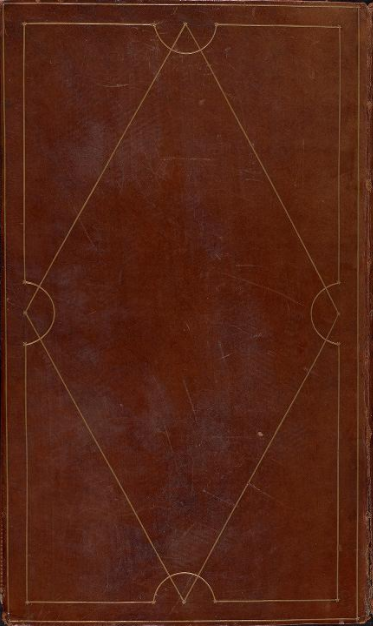
Binding: The book’s binding appears to be in good condition, albeit there are a few blemishes, such as the uplifted corner on the bottom left portion of the binding, found on the backside of the book as well as a few scratches from usage. There also appears to be some fading of the decorative lines located near the spine of the book, which can be found on both the front and back of the book.
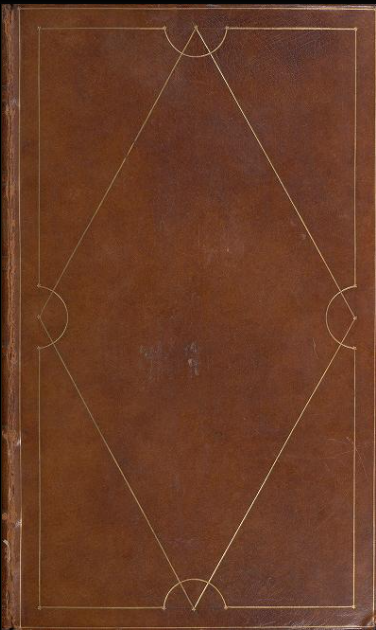
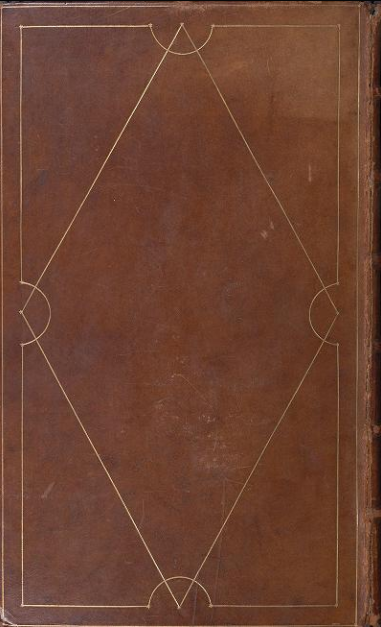
Pages: The pages are also in relatively good condition, although there is some discoloration found on pages 10-14 near the edges. This discoloration pattern is spread across multiple pages, which suggests that those pages were damaged by some element while the book was closed. Crisp page edges suggest that this book was handled carefully throughout its lifetime.
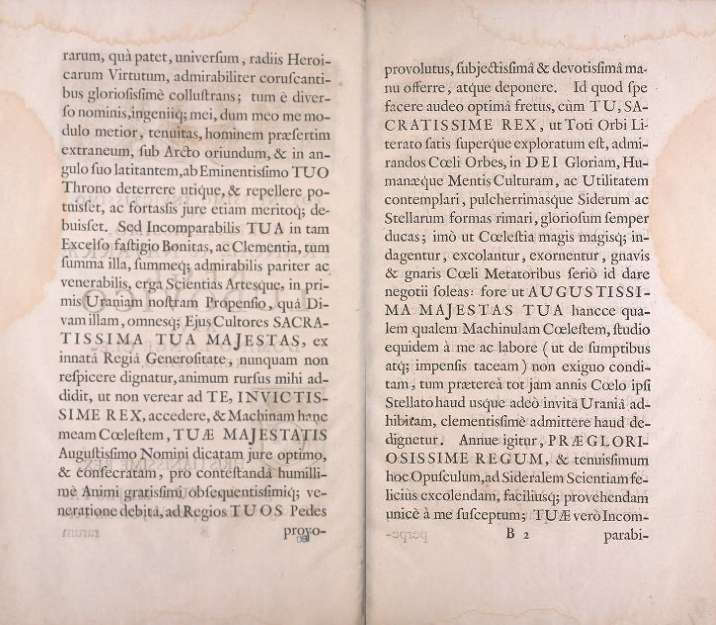
Text: Besides the aforementioned discoloration, the text of the book is in excellent condition. Illustrations are extremely crisp and show a fine attention to detail in the visualization of the various astronomical instruments. Book is written with black ink only, no other colors are present. Includes an index.
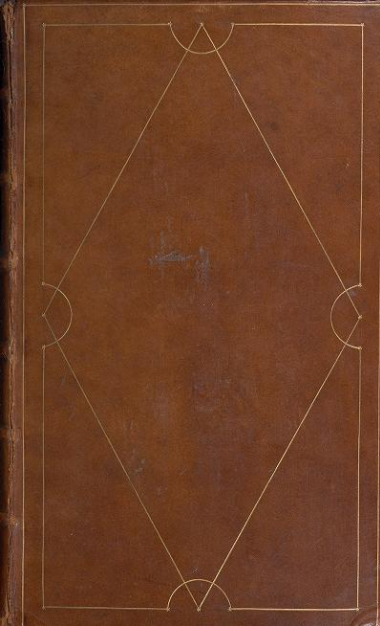
Misc.: An interesting pattern of wear can be seen when observing the front of both books – there are set of deep scratches located roughly in the center portion of the front cover.
Vol. II
Binding: The binding for this book shares similar wear patterns regarding the binding as the Volume I example. Scratches and signs of slight fading are noticeable. The front cover of the book also has some wear near the bottom joint.
Pages: Same general condition as Vol. I. However, there are some heavy discoloration circles located on some of the pages.
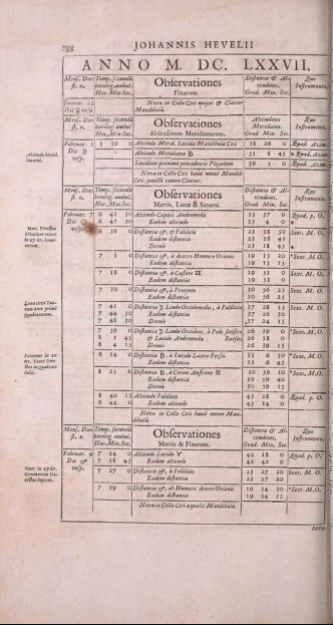
Text: The text in this book is also in very good condition, although some of it can be obscured by the circular marks (such as seen in the image above) illustrations are also crisp. This book also features an index.
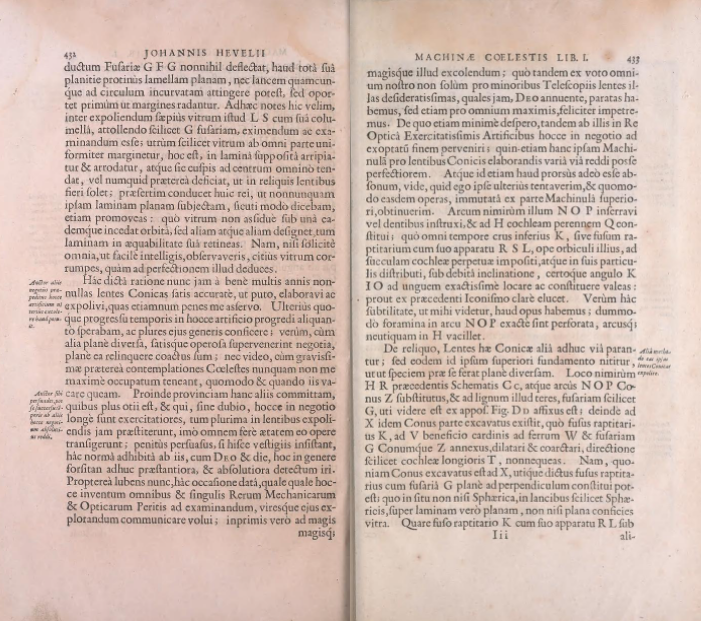
Misc.: It is most interesting to note that page 431-432 of this book appears to be completely discolored, while the neighboring pages do not share this complete discoloration (see below).
Part III – About the Author
Born in Poland in 1611, Johannes Hevelius held a wide variety of positions during his lifetime, and is certainly an extremely well-known individual for his accomplishments in Astronomy. He was also named the town councilor, and his family was in the brewing business.
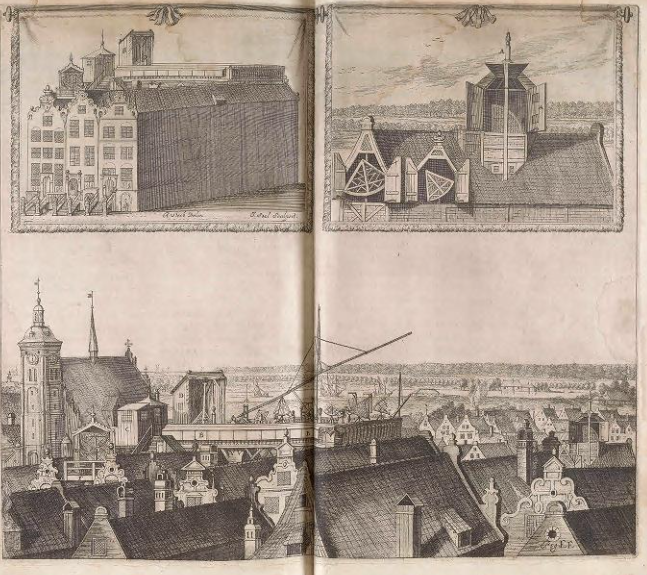
One of his most notable achievements is his construction of Sternenburg, an extremely advanced and well-equipped observatory for its time (see below). It contained a wide variety of instruments used for astronomical measurements. Both volumes of Machinæ Cœlestis provide specific descriptions and illustrations of the various machines Hevelius used in his studies of astronomy.
Another notable work from Hevelius is his work on Selenographia, which provides geographical information regarding the moon. It was published in 1647.
Johannes Hevelius later died in 1687.
Part IV – Contents
Vol. I
This book is written in the Latin language, and primarily focuses on the description and usage of the various instruments in regards to collecting astronomical data. There are also many illustrations of these mechanical devices presented throughout the book which are references by the text (see below).
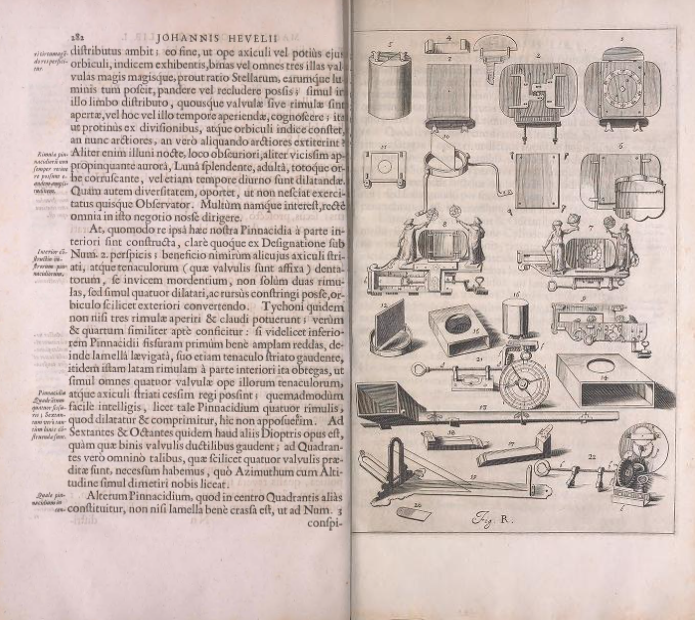
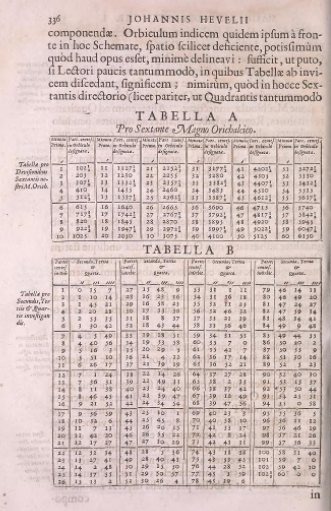
Various mechanical devices are described on other pages in this book – some in more detail than others. A few data tables can be found as well throughout this book, but Volume II contains many more tables and visual representations of the recorded data.
Vol. II
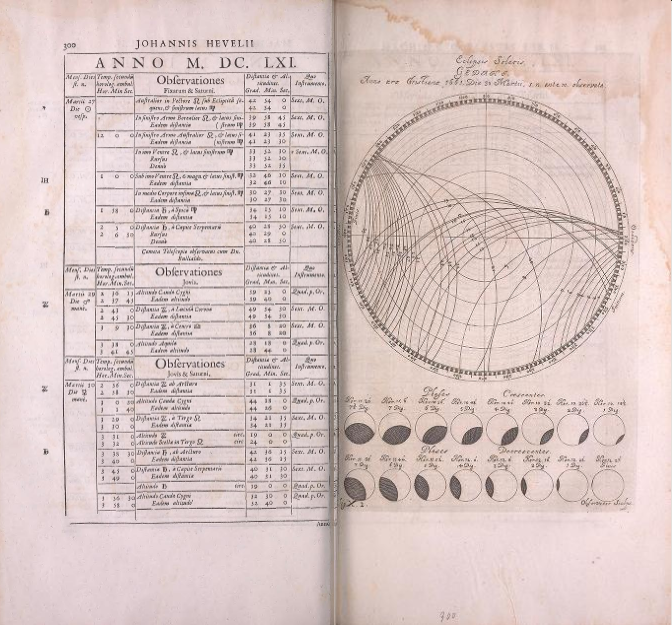
This book is aimed much more at recording the data achieved from the instruments aforementioned in Vol. I. Data is organized by tables, which contain observations and measurements during different days throughout the year. Illustrations are still present, albeit they are more scientific in nature than the illustrations seen in Vol. I. These illustrations serve to be a visual representation of the data recorded (see below).
Part V – Provenance
It can be deduced that both of these books have been kept together for a long period of time, potentially since 1796! This hypothesis is presented from the provenance information presented at the inside cover of both books.
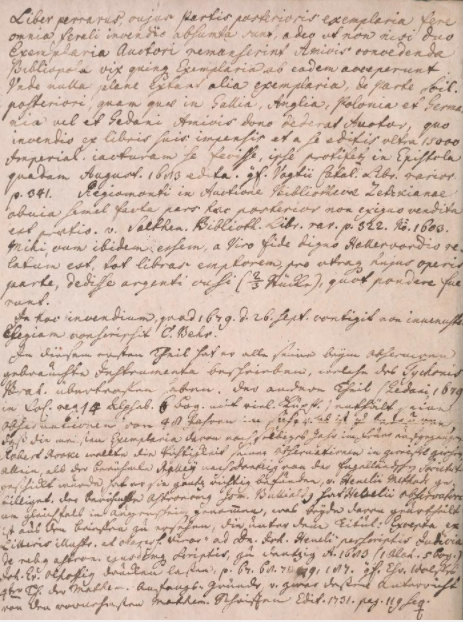
The first data point of provenance for both these books is the publication date, 1673 and 1679. The note found at the beginning of the book written in Latin and German would also be written sometime before these two books were acquired by George Shuckburgh-Evelyn (see below).
The second data point of provenance is the mark of George Shuckburgh- Evelyn, dated 1796. This mark is located at the top of the title pages of both books.
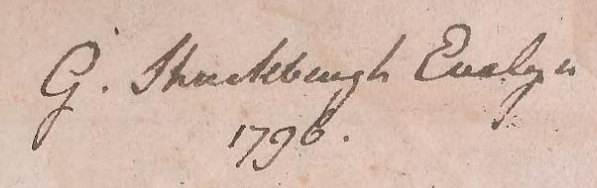
Shuckburgh-Evelyn was an astronomer who contributed the “Shuckburgh scale”, which was used as a yard standard of measurement. He also had his own personal observatory at Shuckburgh hall, located in England. Without a doubt, these books would have been of great interest to Shuckburgh- Evelyn.
The third data point of provenance comes from the name Caroline Herschel, as seen from this snippet below. She wrote the top portion of the note, but not the bottom. It is dated 1799 (supposedly when Herschel translated the German to English), which potentially means that Shuckburgh-Evelyn did not possess these books for a long period of time. Herschel was also in England at the time that she wrote in this book. However, this mark of provenance is only found on the first of these two books.
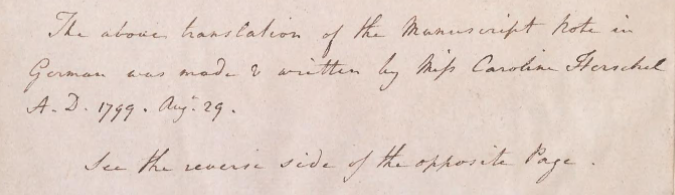
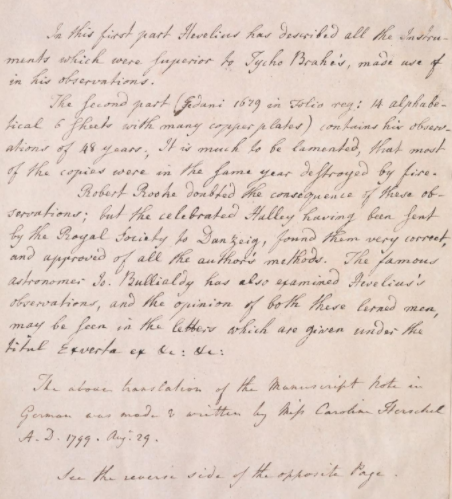
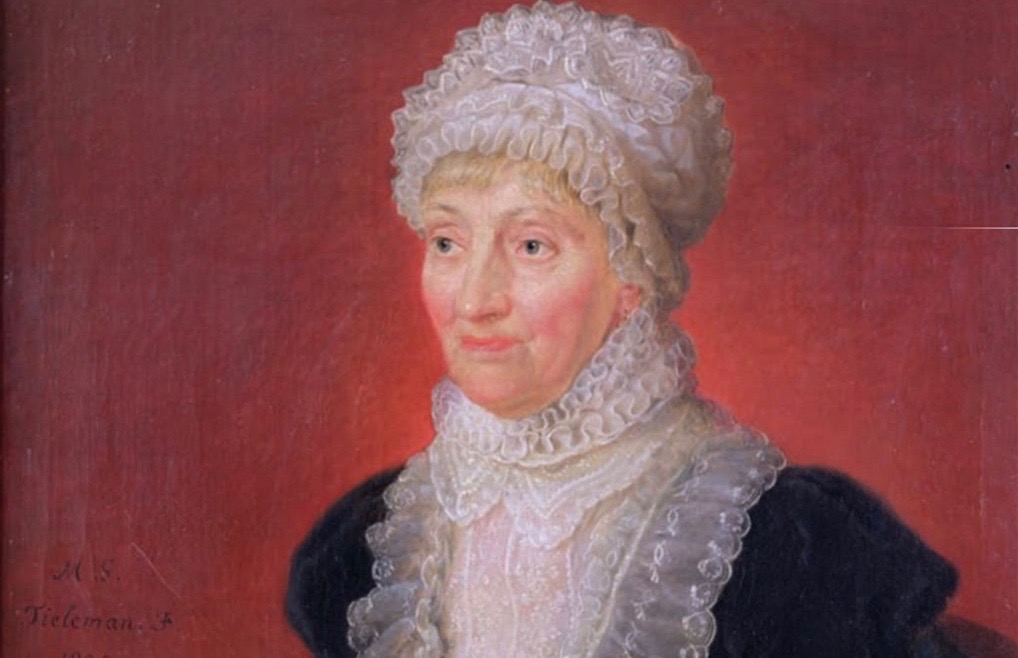
Caroline Herschel is a notable astronomer in the fact that she was the first woman to discover a comet. Trained by her, William, she contributed a great deal towards the advancement of astronomy.
There is also another note attached to this book, which appears to be written in Latin (See below).
The fourth data point of provenance is with the mark of Herbert McLean Evans, whom was born in 1882 and died in 1971. This mark is located on the inside cover of both books.
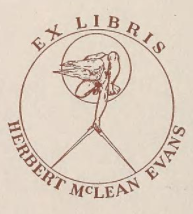
Evans was not noted as being an astronomer, but rather as a respected researcher of anatomy. His use for these books would more likely be for his own personal interests, rather than applying the information from these books towards astronomy.
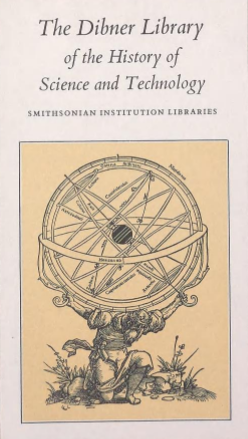
Sometime after 1941, these two books were donated to the Burndy Library, where they then stayed until they were later transferred over to the Dibner Library of the History of Science and Technology in 1974. Since then, these books have remained in the possession of The Smithsonian Institution Libraries.
Another notable aspect regarding the Burndy Library bookplate are the words “Herald of Science NO. 10” – this book was designated among one of the more important scientific books in Bern Dibner’s collection.

Part VI – Significance
Both of these books have major significance in the study of astronomy. The descriptions of the instruments (and the measurements gathered by these instrument) would prove most interesting to other astronomers for reference. As previously mentioned in the provenance data above, these books have passed through the hands of relatively important individuals.
While the books are not heavily decorated in regards to their appearance, they contain valuable information of which would be of considerable significance in regards to the study of astronomy.
Part VII – Article Information
By: Issac Houston
Class: HST 475, Fall Semester
Bibliography
- DeBakcsy, Dale. “Meet Caroline Herschel: History’s First Professional Woman Astronomer.” Women You Should Know®, Women You Should Know, 15 Mar. 2019, womenyoushouldknow.net/caroline-herschel-first-woman-astronomer/.
- Dejoie, Joyce, et al. “Caroline Herschel.” NASA, NASA, starchild.gsfc.nasa.gov/docs/StarChild/whos_who_level2/herschel.html.
- Helden, Albert Van, et al. The Galileo Project, Albert Van Helden, 1995, galileo.rice.edu/Catalog/NewFiles/hevelius.html.
- Landau, Elizabeth. “The 17th-Century Astronomer Who Made the First Atlas of the Moon.” Smithsonian.com, Smithsonian Institution, 27 Dec. 2018, www.smithsonianmag.com/science-nature/17th-century-astronomer-who-made-first-atlas-moon-180971103/
- McConnell, Anita. Jesse Ramsden (1735-1800): London’s Leading Scientific Instrument Maker. Routledge, 2016.
- Parrott-Scheffer, Chelsey. “Johannes Hevelius.” Encyclopædia Britannica, Encyclopædia Britannica, Inc., 20 July 1998, www.britannica.com/biography/Johannes-Hevelius.
- Rockafellar, Nancy, et al. “A History of UCSF.” Herbert McLean Evans – Biography – A History of UCSF, University of California San Francisco, history.library.ucsf.edu/evans.html.
- Zupko, Ronald Edward. Revolution in Measurement: Western European Weights and Measures since the Age of Science. American Philosophical Society, 1990.
