
Written by lewelle5
Adolescens academicus sub institutione Salomonis / authore R.P. Carolo Musart, Belga, e Soc. Iesu doct. theol. et in Viennensi Austriae Academia sacr. literarum interprete.
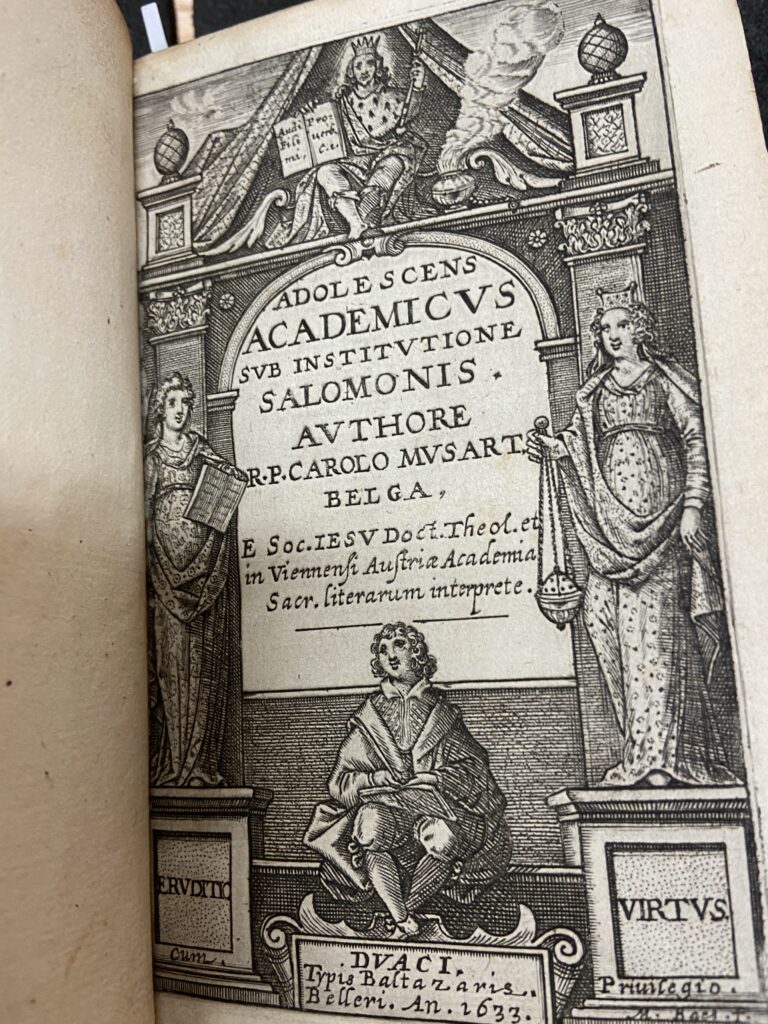
Publisher: Douai: Typis Baltazaris Belleri, 1633
Author
This book was written by Charles Musart. He lived between 1582-1653 and was born in Haspberg, Netherlands. He joined the Jesuits on October 17th, 1602, where he studied and became a professor of philosophy and rhetoric [5]. He is credited as an author on several other Christian books published in Latin in the 1630s.
Engraver
Martin Baes (or Bassius; fl. 1604-1637) was a Flemish printer and engraver. Little information is known about him and what is known is largely based off of his surviving works. According to the information given by the MSU Library, Bassius was most likely born and trained in Antwerp due to the Flemish style of his plates. Throughout his life he worked on many religious texts, usually targeted at English Catholics. He worked in various cities: Saint-Omer in 1614, Tourani in 1617, Arras in 1613, and Douai in 1618- 1623 [5]. Bassius signed serval of the engraving in this book, including the printed title page, figure 1, and engraving #17, figure 6.
Book Contents
This is an emblem book for children, meaning it is a moral education for adolescents that would have already had some theological education. King Solomon was known as the wise king and he is most famous for the building of Solomon’s Temple. It is not surprising that this book, centered around education and morality, is in the name of Solomon.
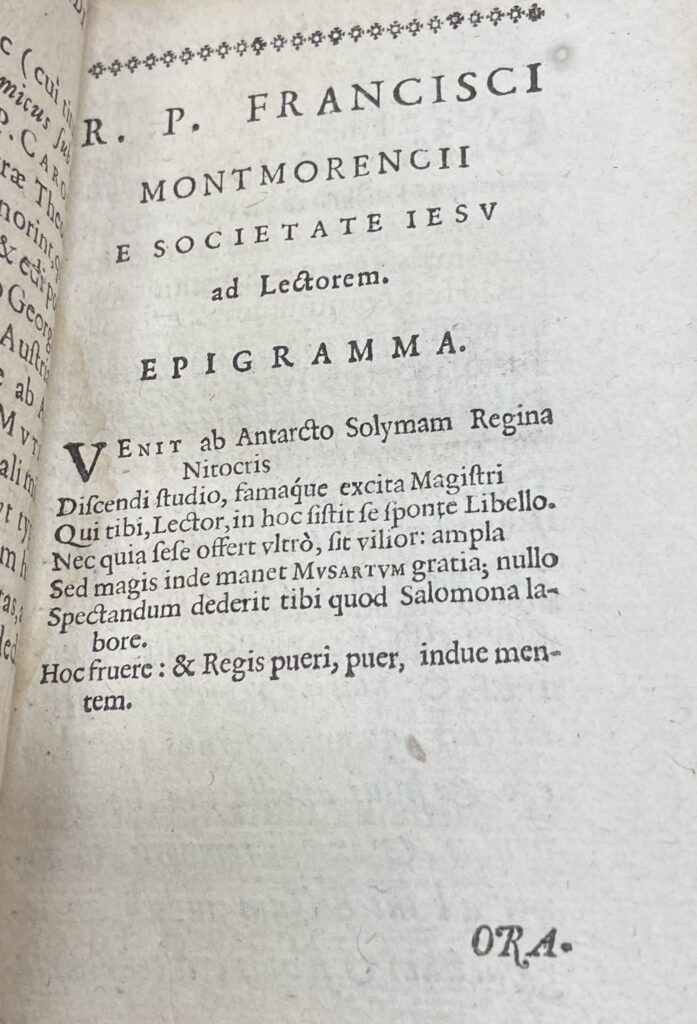
At the beginning of the book there is an epigram from Francisci Montmorencii, who is a French Duke, François de Montmorency (1530-1579). Montmorency was a distinguished French soldier and diplomat. In the Wars of Religion, he sided with the Catholics, but the Virtual Museum of Protestantism states that he was “rather conciliatory towards the Protestants”. [7] From my poor Latin translating skills, I think this short statement may be a word of encouragement for the students, but I’m not sure if there is a moral lesson here.
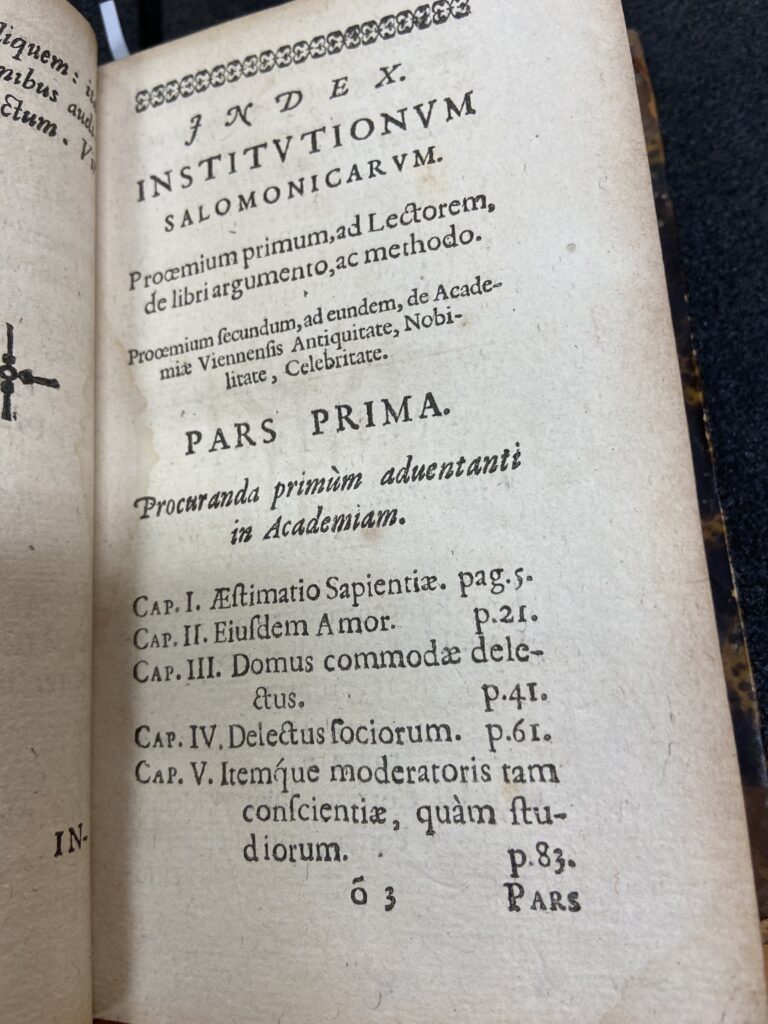
There is a printed index present at the start of the actual book, giving reference to the individual chapters and parts on the book. Every page has a catchword at the bottom, on both the recto and verso sides, to prepare the reader for the next page. There are also octavo markings at the bottom of many pages, noting that the book was printed gathering of eight leaves. Many of the pages throughout the book have printed marginal notes to biblical passages the text is referencing.
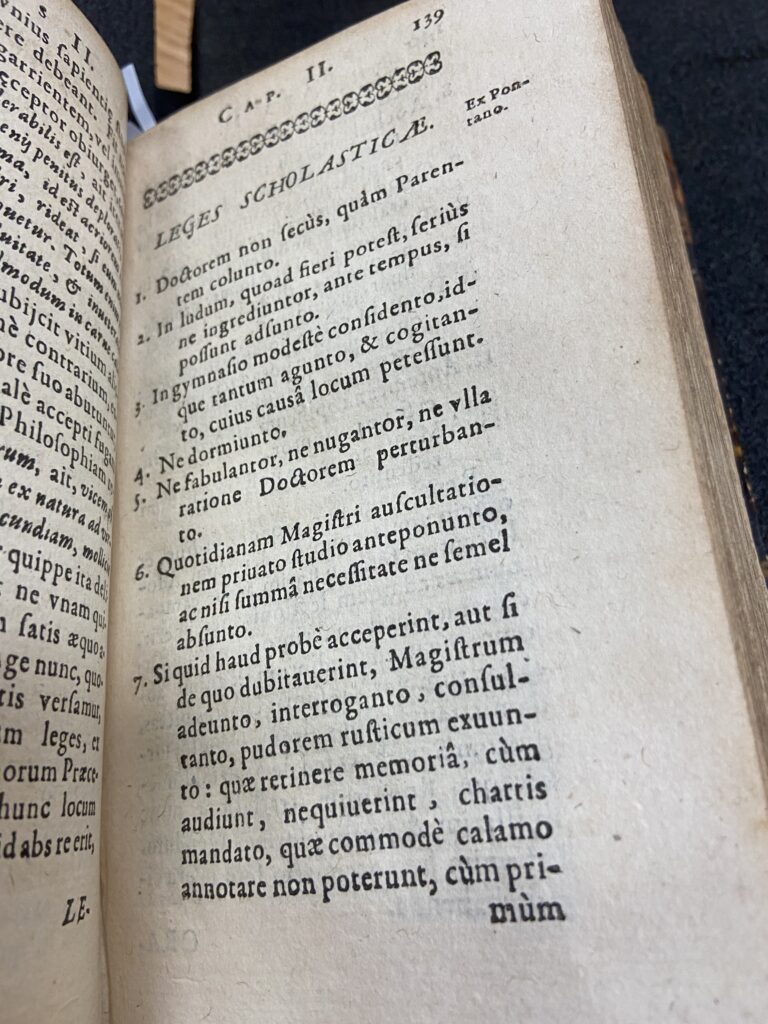
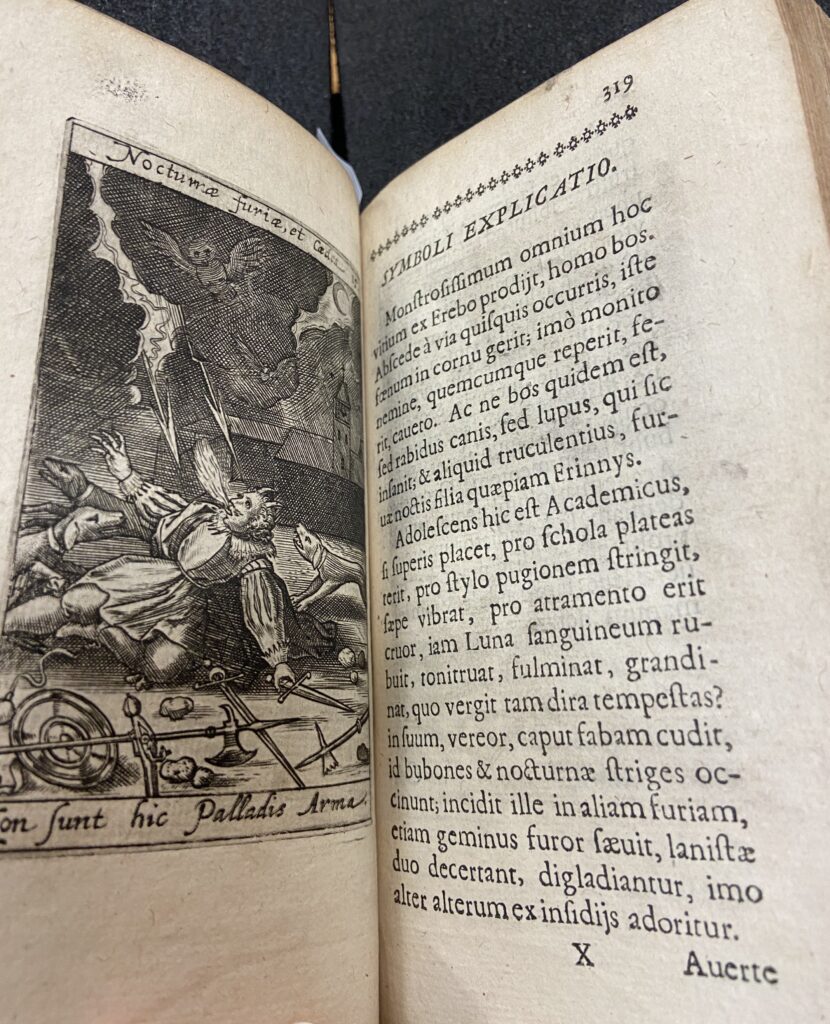
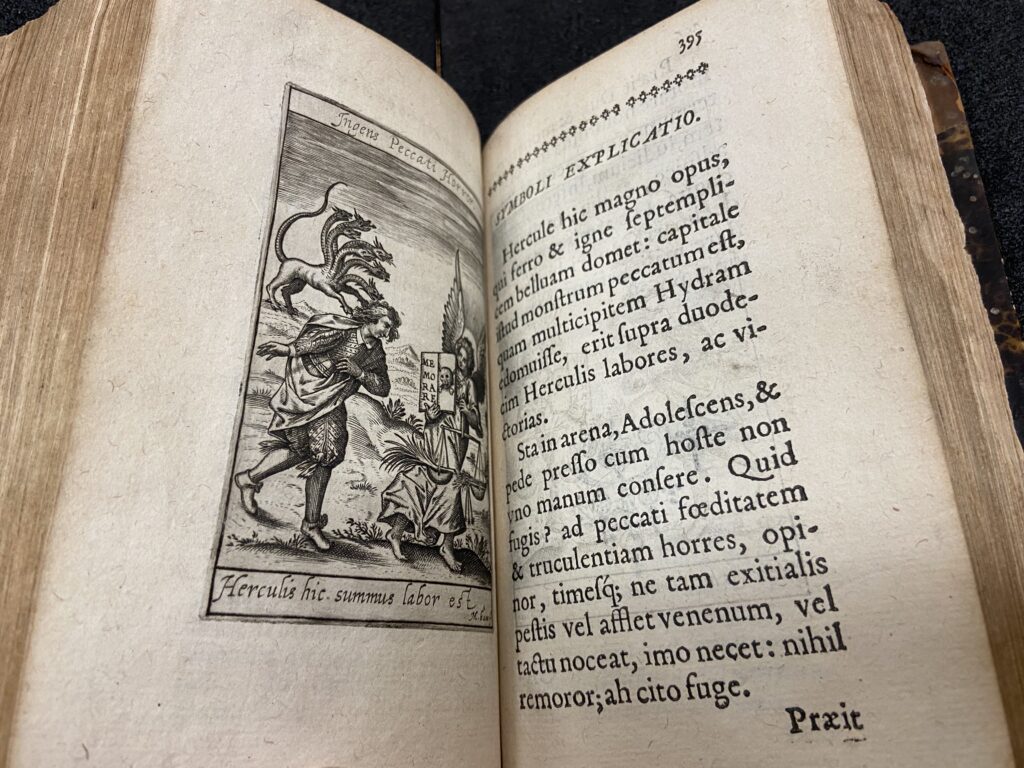
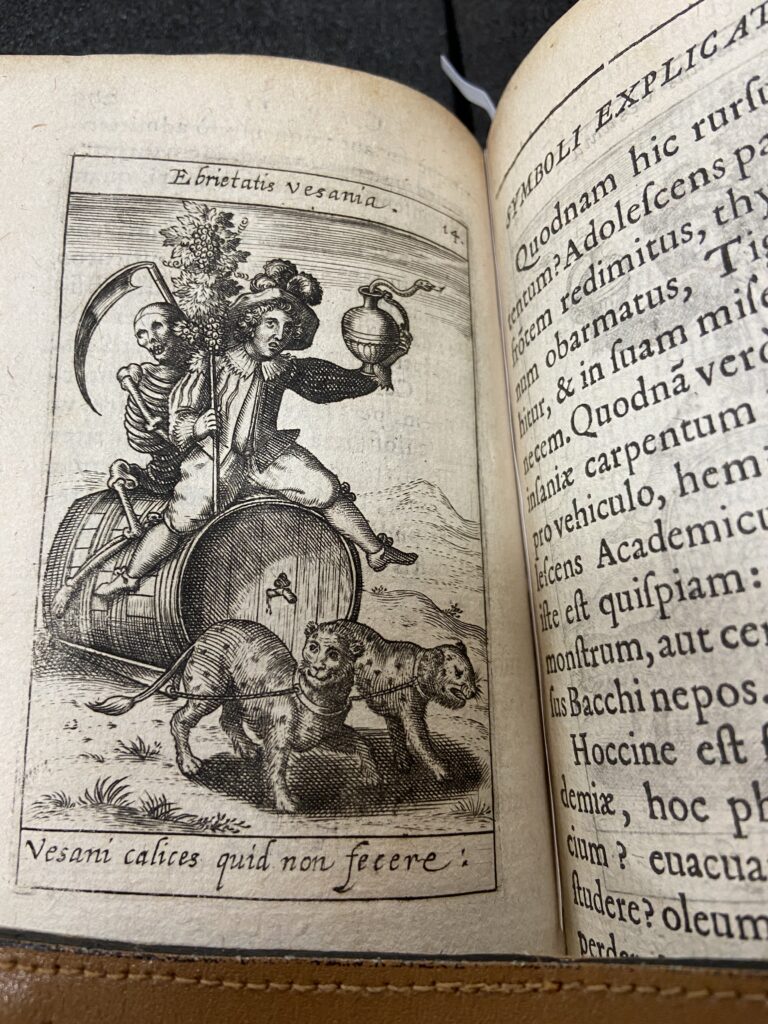
On pages 139-140 there are 13 academic laws the students should follow, showing that this books was an academic manual in addition to a moral one. The most eye catching part of the book is the 20 engraved depictions of allegorical moral lessons, number 2-21. Each image has around a page explanation of the lesson.
Physical State
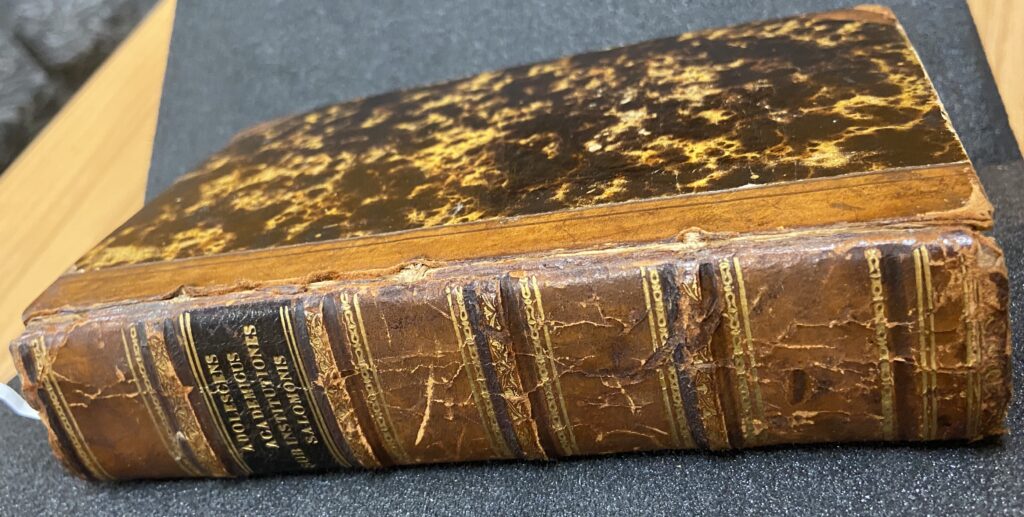
The physical state of the book certainly shows some wear and tear, however it is not completely falling apart. The leather binding is beginning to rip at the spine and front cover. The library noted that the binding has been redone around the 19th century. The leather binding covers the entire spine and an inch or so on the front and back covers. There is also leather on the corners of the cover, laid over the water marbled paper board cover. The back half of the book has more damage, with folded fore- edges, water damage, and a whole at the bottom of the book starting around page 450 until the end. Around page 525, the pages have a darker color and they have several folds, leading me to believe these pages may have been read more, or were a previous owner’s favorite section. There are various stains throughout the book suggesting it was read in different settings or by various people.
Provenance
This copy had very few marks of provenance in it. After an engraved title page, there is another, simpler, title page with a signature reading: “Felix De Pachtere” at the top and two library stamps toward the bottom.
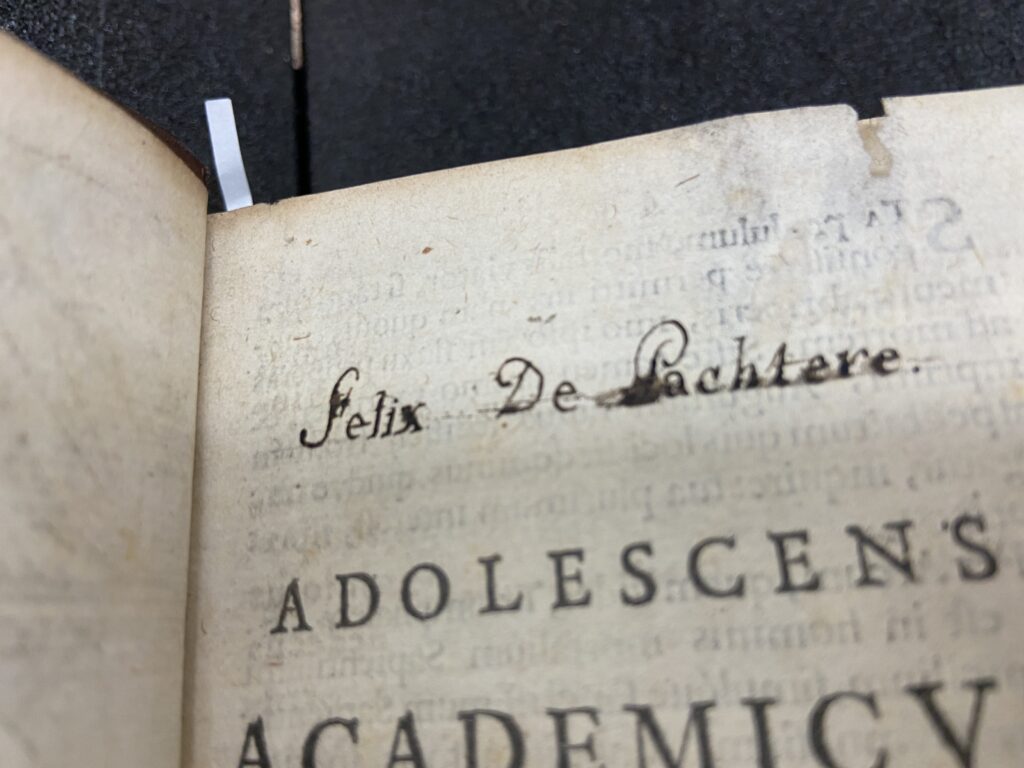
Felix De Pachtere was born on December 6, 1783 and died on June 12, 1849. He was a well educated writer and publisher, who taught in French and Dutch as well as tutored Latin. He became a teacher at the Bogaerde school for poor boys in 1805. By 1824, he stopped teaching and became a bookseller and printer [3]. After his death in 1849, his collection of books was cataloged and sold between November 27-30th, 1849 in Bruges. The catalog shows hundreds of books from medieval manuscripts to books that were published in De Pachtere’s lifetime. The book examined in this paper is cataloged on page 66, as book number 780 [2].
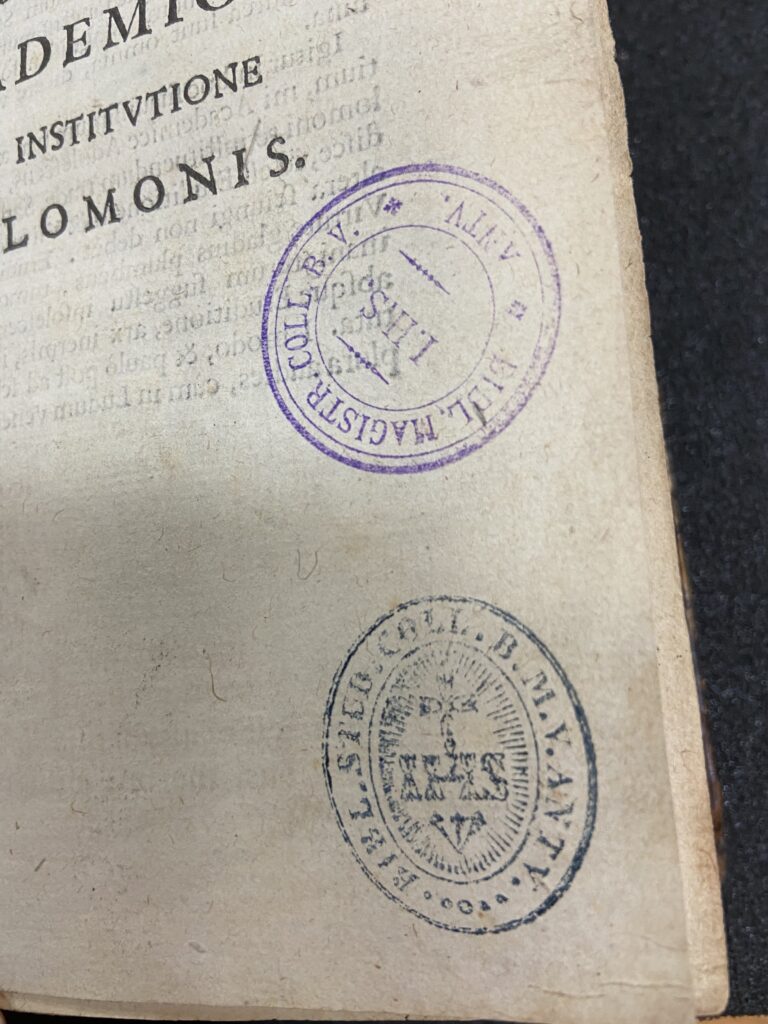
The two library marks are from at least the 19th century, according to Dr. Brockey. However, I could not find other books with these same stamps to find a rough date. The bottom stamp in black ink is older and it is for a Library in Antwerp. The second stamp in purple is a bit newer and clearly states: “BIBL. MAGISTR. COLLO. B.V ANTV” around the outside circle and “I.H.S” written inside. These library marks are most likely from Our Lady College in Antwerp. This is a Jesuit school that first opened in 1575, functioning with both primary and secondary education in various locations around Antwerp, until 1773 when Pope Clement IV stopped all Jesuit education services. In 1840 the Jesuits reopened the college when they returned to Antwerp [6]. It is very likely that Our Lady College bought this copy after De Pachtere died in 1849.
The inside of the back cover has several pencil markings. I believe these are recent additions by our librarians and are not influential in the book’s journey.
Significance of the Book
This copy of “Adolescens academicus sub institutione Salomonis” was the first edition and the only edition to have the engraving done by Martin Baes. This book had an influence on the education and career of Felix De Patchere, as he owned it until he died and signed it. De Pachtere’s life was full of education and Christ, so it can be assumed he was positively influenced by these moral lessons. Finally, being owned by a Jesuit school for adolescences, it can be assumed many 19th century students received this moral education, and went on to educate others.
Bibliography
[1] Académie royale des sciences, des lettres et des beaux-arts de Belgique. “Biographie Nationale.” Google Books. Google, August 10, 2010. https://www.google.com/books/edition/Biographie_nationale/bDwOAQAAMAAJ?hl=en.
[2] De Pachtere. “Catalogue D’une Tr.” Google Books. Google, January 3, 2011. https://www.google.com/books/edition/Catalogue_d_une_tr%C3%A8s_belle_collection_d/3INFAAAACAAJ?hl=en.
[3] “Felix De Pachtere.” Wikipedia. Wikimedia Foundation, January 29, 2019. https://nl.wikipedia.org/wiki/Felix_De_Pachtere.
[4] “François De Montmorency.” Wikipedia. Wikimedia Foundation, August 28, 2020.
https://en.wikipedia.org/wiki/Fran%C3%A7ois_de_Montmorency.
[5] “Jesuit Emblem Book for Children” Library Catalog. Michigan State University. Accessed November 2, 2020. http://catalog.lib.msu.edu/record=b13496038-S23a.
[6] “Our Lady College, Antwerp.” Wikipedia. Wikimedia Foundation, April 27, 2020. https://en.wikipedia.org/wiki/Our_Lady_College, Antwerp.
[7] “The Montmorency.” Musée protestant, November 15, 2017.
https://www.museeprotestant.org/en/notice/les-montmorency/.
Created by Rebecca Lewellen for Professor Brockey’s HST 475, Fall 2020, Michigan State University.
