
The Schoolemaster by Roger Ascham
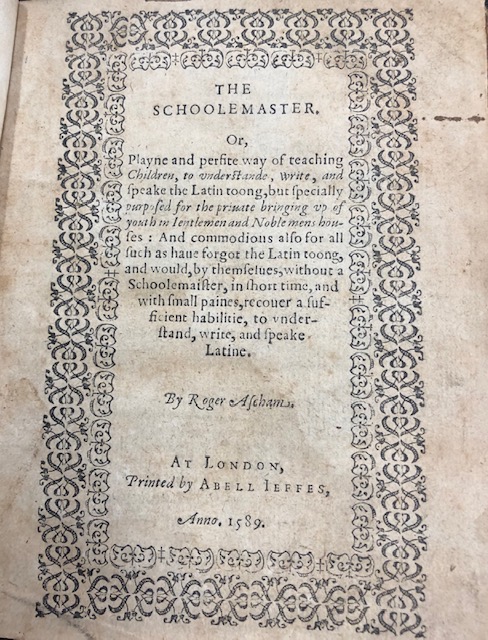
XX PA2061.AB 1589
The Schoolemaster, Roger Ascham’s revolutionary work on the teaching of Latin to young children, was originally published in 1570. Ascham began it at the urgings of his friend Richard Sackville, who recognized Ascham as a proficient teacher and knew that his expertise could advance education in ways never before realized. The Michigan State University edition of The Schoolemaster, published in London in 1589, is a beautiful copy of Ascham’s work and exhibits an extraordinary history of ownership. [25]
About the Author
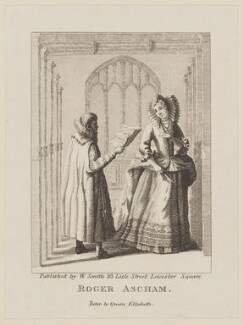
Roger Ascham was born around the year 1515 in the village of Kirby Wiske in North Yorkshire, Great Britain. Education played a large role in Ascham’s life, starting with his being educated at the household of Sir Humphrey Wingfield as a youth. Around the year 1530, Ascham went to St. John’s College in Cambridge to study Greek. He achieved success very quickly, and soon began teaching Greek to fellow students and giving lectures. After earning his degrees, Ascham became Princess Elizabeth I’s tutor in Greek and Latin. After serving as her tutor from 1548-1550, Ascham was secretary to Sir Richard Morrison and then Queen Mary I. He married in 1554 and had seven children with his wife. He became fatally ill on December 23, 1568 and died a week later in London. [10, 25]
Content and Legacy
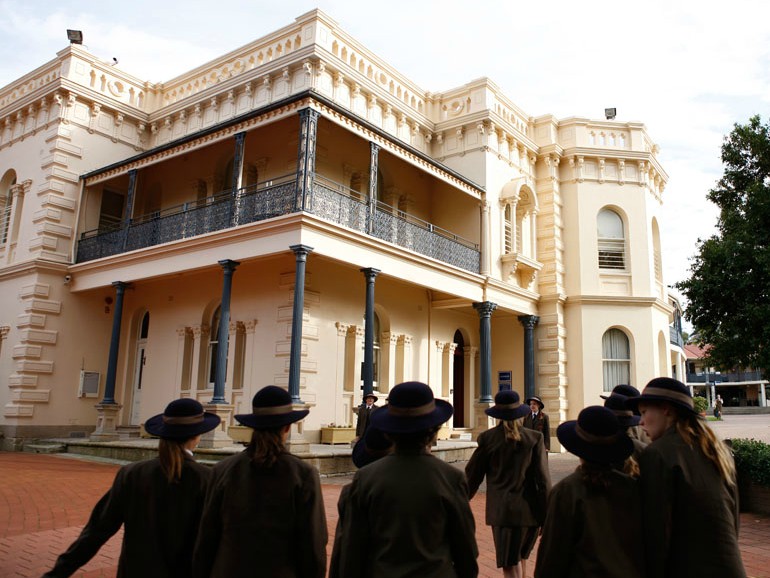
To this day, Ascham is famous for his educational theories presented in The Schoolemaster. The book is about how to best teach Latin, but was not intended to be a textbook in a schoolhouse. Rather, it was meant to be used in the homes of the wealthy so that they could instruct their children in the Latin language. The Schoolemaster is split into two books: Ascham School in Sydney, Australia “The First Booke for Youth,” or “The first Booke teaching the bringing vp of youth,” and “The Second Booke, teaching the ready way to the Latin toong.” Contrary to the current style of education, Ascham’s book focused on compassionate and collaborative teaching methods that would help the student, rather than harsh punishment or scolding. These revolutionary ideas differed sharply from present practice and had a huge influence on teaching practices for years to come. Ascham’s legacy lives on in education today, and there is a school named after him in Sydney, Australia that was established in 1886. [23, 25]
Physical Description
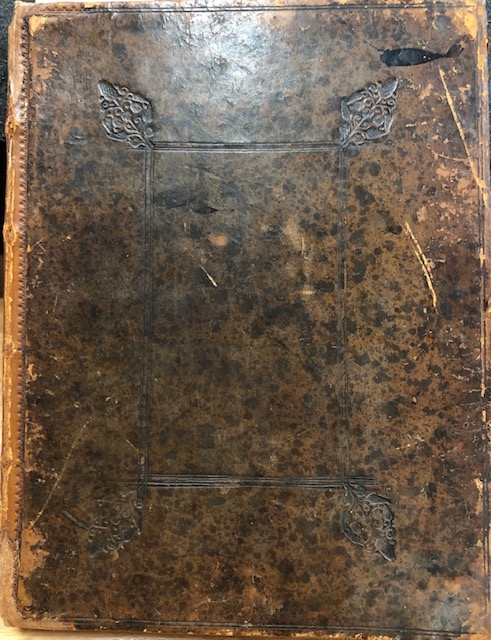
This copy of The Schoolemaster includes some signs of damage, but overall is a well- preserved edition. The book has been rebound, which is indicated by the fact that the text-block has been cut in order to fit the new binding, causing some of catch words present throughout the work to be partially cut off. The binding itself is fairly standard, with brown covers featuring a blind tooled design and a red spine with the title, author, and year of publishing engraved in gold. This spine is different from the style of the covers, indicating that the book has also been rebacked. The pages of the text-block have slight evidence of water damage and large holes from bookworms.

Throughout the work, there is some underlining and bracketing of the text, but no other evidence of interaction with it. This book was probably not read very much, as it is more about the methodology of education and less actual tactics. The book is printed in black letter type.
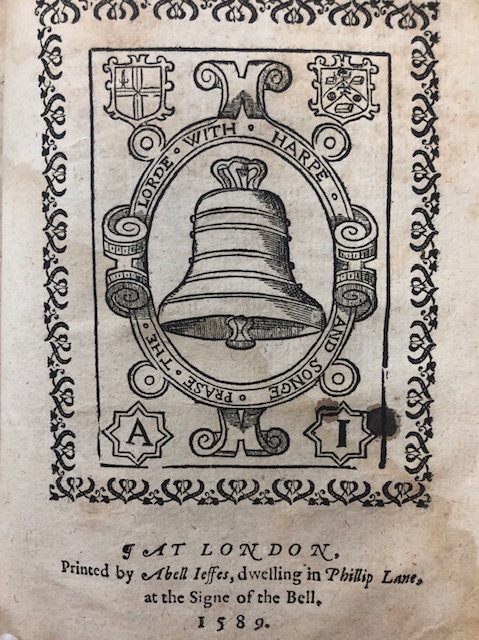
The printer was Abell Jeffes, who was active from 1583-1599. A flyleaf towards the end of the work has his printer’s device on it. It depicts a large bell surrounded by an oval border with the words “Prase The Lorde with Harpe and Songe,” and the inscription at the bottom of the page states that the book was printed at London in 1589 “at the Signe of the Bell.” This feature is extremely rare, and the device is unique due to the pun it plays on the printer’s first name. [17]
Provenance and Ownership
- Immanuel Bourne
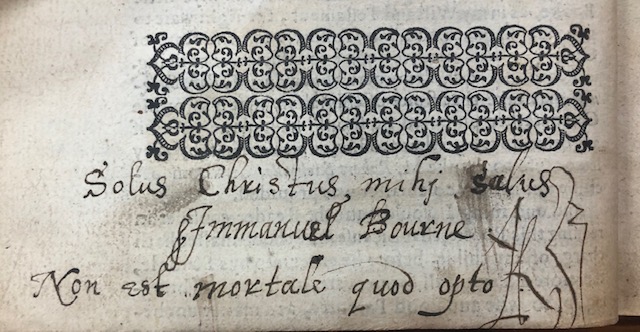
Immanuel Bourne lived from 1590-1672, and was most likely the first owner of this book. Educated at Christ Church in Oxford, Bourne quickly became a prominent English divine. He has several published works, most of which are his sermons. In The Schoolemaster, there is an inscription written by Bourne in Latin on the last page of the preface. It reads “Solus Christus mihi salus, Immanuel Bourne, non est mortale quod opto.” This translates to “Christ alone is my salvation”, his name, and the phrase “nothing I desire is mortal.” This phrase actually originated in Ovid’s Metamorpheses, and is commonly used to indicate a desire for the supernatural. With Bourne’s Christian background, this would be the idea of striving for the gifts of Heaven rather than being distracted by material wealth. There are also large doodles next to the inscription that could be initials, but seem to be by a different owner. Bourne himself clearly knew Latin, and most likely owned this book in order to learn about the new teaching methods proposed by Ascham, and perhaps so that he could educate the youth of his church. [15, 24]
- Reverend Samuel Reynolds
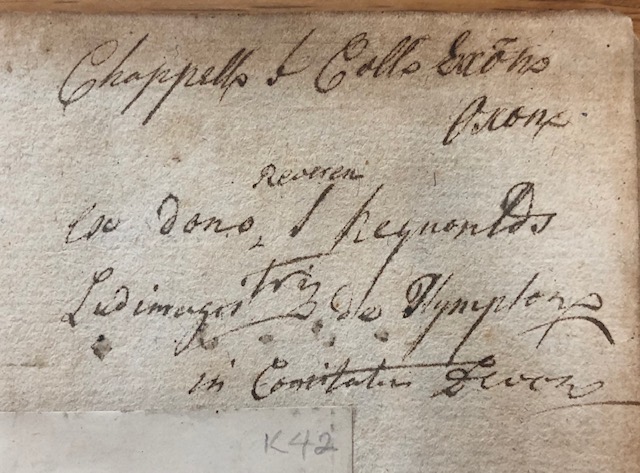
On the inside flyleaf of The Schoolemaster, there is another inscription written in Latin. It states that the book was given as a gift to Reverend Samuel Reynolds, the headmaster of Plympton School in the county of Devon. Plympton Grammar School was founded in 1658, and is today known as Hele’s School. Reynolds was born in 1681 and became headmaster in 1715. His son, Joshua Reynolds, was a well- known English painter who specialized in portraits. He painted a portrait of his father in 1746. It makes logical sense why Samuel Reynolds would have owned this book. As the headmaster of a grammar school in England, he would naturally own and consult a prominent English book on how to teach children. [13, 18, 22, 23]
- George Thomas Robinson
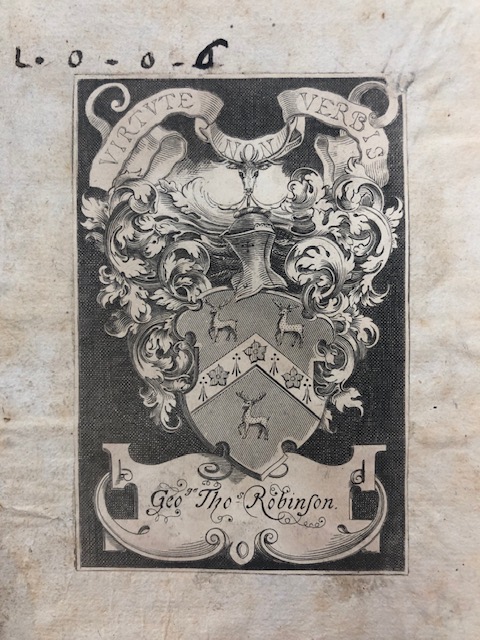
On the inside cover, there is a large paper bookplate bearing a coat of arms and the name “Geoge Thos Robinson” and the motto “Virtute non verbis,” meaning “Deeds, not Words.” The Robinson family’s coat of arms boasts a knight’s helmet and a shield with three flowers and a stag. The bookplate itself has a lot of dark negative space, which is not typical of most coats of arms. George Thomas Robinson lived from 1827-1897 and was a prominent architect and journalist for the Manchester Guardian in England. He was a fellow of the Society of Antiquaries of London; interestingly, the next owner of this book also belonged to this society. This possibly indicates that they were friends, or that Robinson sold it to his fellow. Since Robinson was an architect and thus interested in history and the classics, he would have wanted to know Latin, which is perhaps why he owned this book. [11]
- Ernest Edward Baker
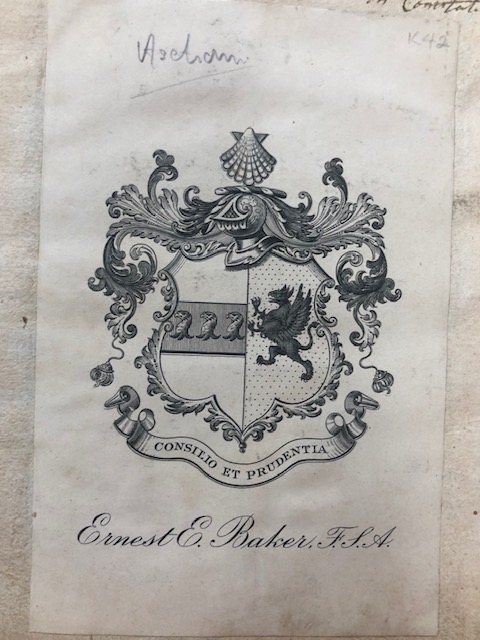
On the inside flyleaf of The Schoolemaster, opposite Robinson’s bookplate, is the bookplate of Ernest E. Baker, FSA. The coat of arms features a shell, a griffin, and the motto “Consilio et Prudentia,” meaning “By Counsel and By Wisdom.” Baker was also a fellow of the Society of Antiquaries of London, which is indicated by FSA next to his name. This is an extremely prestigious group that focuses on history, art, and culture. Baker was elected as a fellow on March 14th, 1889 and admitted to the society on March 28th of the same year. In addition to being a fellow in this society, he edited J.O. Halliwell-Phillipps’ biography of Shakespeare and wrote the forward for it in 1891. In keeping with this topic, Baker is listed as a “Life Trustee” of Shakespeare’s birthplace on a document published in 1910. Due to his fascination with Shakespeare, it can be reasoned that Baker owned this book in the hope that it was used to teach young Shakespeare, who would have been six years old when it was originally published. This possible connection resurfaces later in the provenance chain in an interesting catalog clipping. [5, 6, 7, 12, 16, 19, 26, 27]
- William Lindsell Cuttle
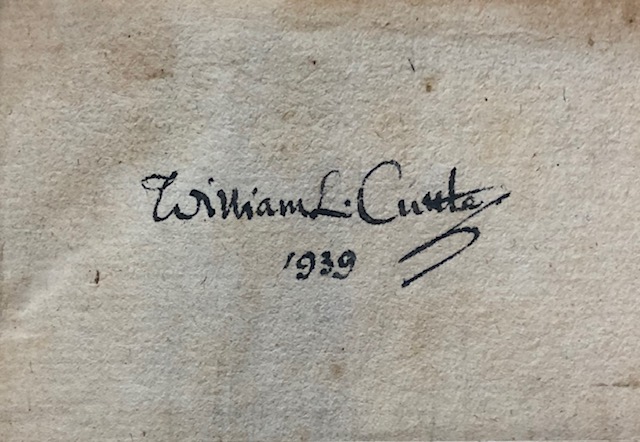
Another signature on the inside flyleaf is that of William L. Cuttle, with the year 1939 written under it. William Cuttle was a prominent figure at Downing College starting in the year 1931. He was a Fellow of the College, a Tutor, Director of Studies in Classics, a Senior Tutor, and a librarian from 1934 to 1956. Cuttle lived from 1856 to 1958. He won a scholarship from Forest School to Emmanuel in Cambridge in 1915, but before attending, he served four years as a Lieutenant in the RASC (Royal Army Service Corp). After this, he went to Greece to study as an archaeologist in Sparta and Macedonia. He picked up malaria there, which affected his health later in life. Upon returning to England, he became a lecturer in Classics at the University of Bristol before ending up at Downing in 1931, where he stayed for the rest of his life. As librarian, Cuttle founded the Lord Guilford Classical Society and created the Doughty Society. In 1954, Cuttle underwent a major operation, and died a few years later. Multiple students praised Cuttle as an extraordinary tutor and companion. One in particular, Colin Hill, wrote an article for the Downing College Alumni Association Newsletter, published in 2003, praising him for his academic prowess and friendship. Cuttle also donated several pieces of Cambridge history to the Downing College library throughout his lifetime. As an expert in the Classics and a lover of education, it makes logical sense that William Lindsell Cuttle would own The Schoolemaster. [3, 8, 14, 21, 28]
- John Lawson
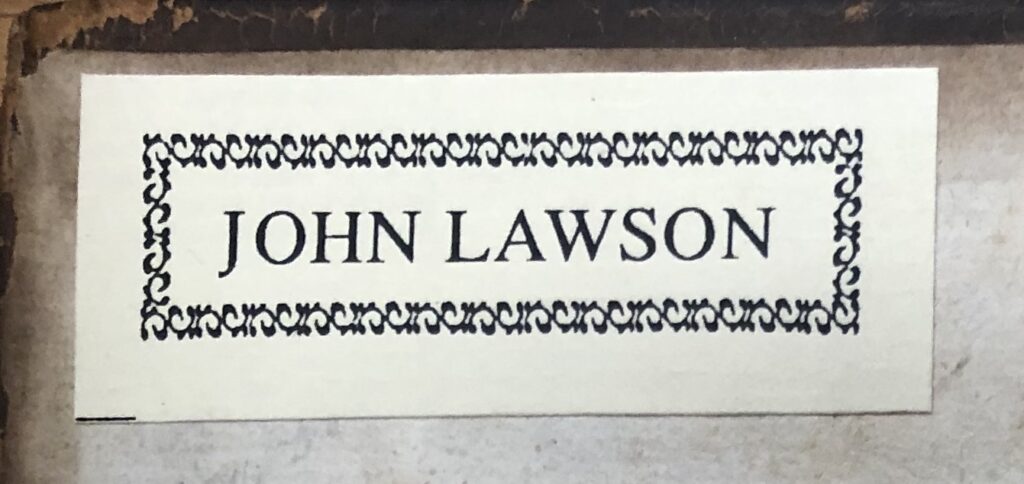
The final label on the front inside cover is that of John Lawson. This is merely a piece of paper with the name “John Lawson” printed clearly on it with a simple border. This indicates that the book belonged to John Lawson, a prominent English bookseller. Lawson’s father founded E.M. Lawson & Co in 1921, which was a large bookselling company. Lawson himself joined in 1952 and created bookselling catalogs. He rose as a bookseller and was known for his deep understanding of a work and all of its features. Lawson eventually became president of the Antiquarian Booksellers Association from 1976-1978, and then vice president and president of the International League of Antiquarian Booksellers from 1979 to 1985. He died in 2019. Due to his bookselling nature and expertise among catalogs, it is likely that Lawson was responsible for the addition of the catalog descriptions discussed below. As they explain, this edition of The Schoolemaster was highly prized, making it an obvious choice for a bookseller such as Lawson. Additionally, Lawson most likely had an interest in language and education from his career as a bookseller, making it understandable that he would own this work. [1, 2]
- Bookseller’s Descriptions
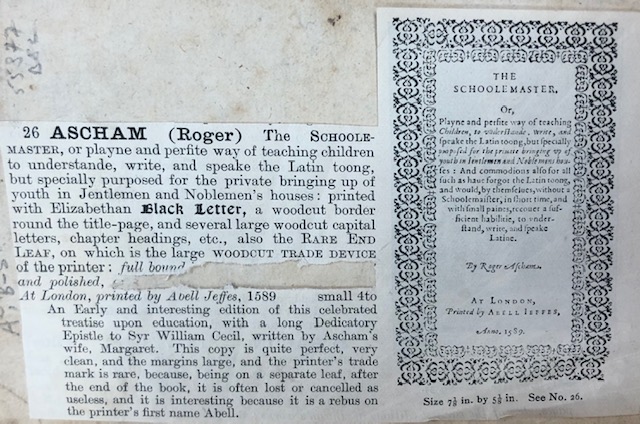
There are two cut-out catalog descriptions of this copy of The Schoolemaster pasted to Second book catalog cutout the inside of both covers in this book. They notably focus on the fact that it is printed in black letter (both emphasize this by those words being typed in the style) and the presence of the rare printer’s mark on its own flyleaf. These were most likely added by John Lawson after he purchased the book. As a master of cataloging, he probably had many catalogs in his home from which to take descriptions from, and he may have added clippings to all of the works he bought. The reasoning behind it is unclear, but given his history, Lawson is most likely responsible for these descriptions.
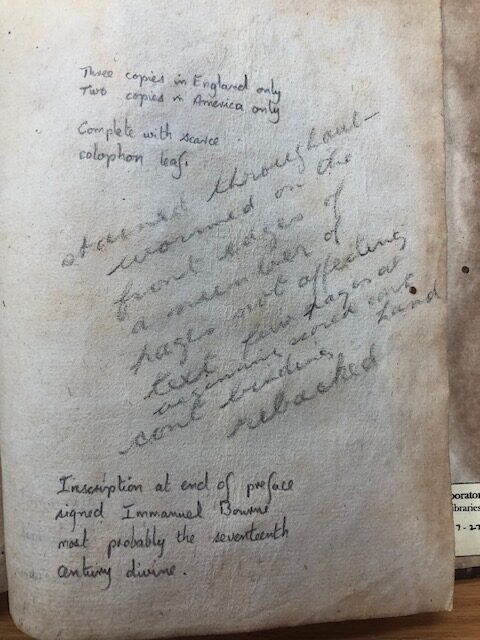
In addition to these paste-ins, there are booksellers’ notes on the recto side of the end flyleaf. One states that there are only three copies of this book in England and two in America, once again mentioning the rare “colophon leaf.” Another note, written in the same handwriting, mentions Immanuel Bourne’s inscription. The last and largest annotation comments on the damage in the book, stating that there are stains and wormholes throughout it and that it has been rebacked.
- Doctor Nathan Drake
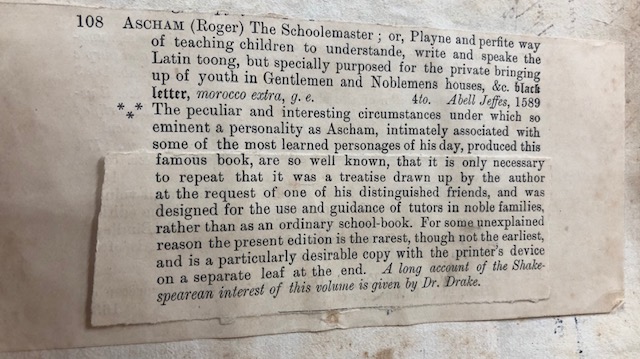
While Nathan Drake does not have any sign of ownership in this edition, he is linked to the work through one of the bookseller’s descriptions. The final line of the first paste-in states that Dr. Drake gives a “long account of the Shakespearean interest of this volume.” Nathan Drake, 1766-1836, was a Shakespearean scholar and writer who is well-known for his book, Shakespeare and His Times, in which he mentions Ascham and his methods. The fact that Drake was interested in Ascham and this copy of The Schoolemaster supports the possible connection to Shakespeare first raised by Baker’s ownership. [9, 20]
- Wallace Conservation Library
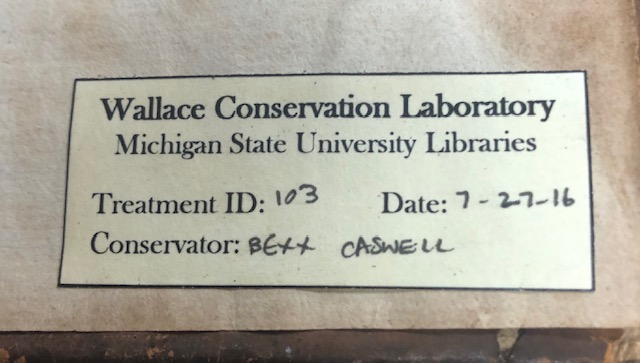
The final stop in the chain of provenance of this work is the Michigan State University library. This small label is pasted on the inside back cover of the book, revealing that it was conserved on July 27th, 2016 by Bexx Caswell. Bexx Caswell was a Special Collections conservator at MSU, and now is the director of book conservation for the Northeast Document Conservation Center. This label indicates that The Schoolemaster went through repairs at the Wallace Conservation Laboratory before reaching its final destination in the MSU Special Collections. [4]
- Other signs of ownership
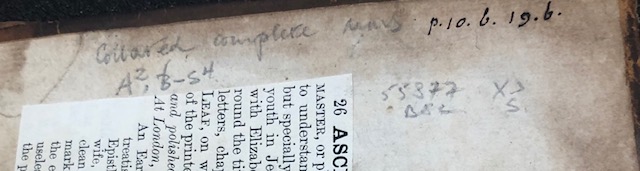
In addition to the bookplates, inscriptions, and paste-ins, there are several unidentifiable pencil markings on the inside covers of the books. Above George Thomas Robinson’s bookplate, there is an inscription that could resemble a year or a shelf number. On the opposite page, someone has written “Ascham” on top of Ernest E. Baker’s bookplate, as if it indicate the author of the book again, with “K42” written in the righthand corner (these are visible on the pictures of their bookplates). The back inside cover includes even more small markings. There seem to be some call numbers and possibly dates.
Conclusion
Roger Ascham’s The Schoolemaster was a revolutionary work in the field of education. Its approach to teaching and criticism of harsh punishment continues to have profound effects on education to this day. This copy in particular also gives key insight into its history of provenance, and includes rare elements that make it truly unique. It was a joy to investigate this book, and Ascham would be proud to see the effect that his work has had on the world today.
Sources
1.”Antiquarian Booksellers’ Association.” Rare Books – ABA The Antiquarian Booksellers Association, www.aba.org.uk/About-the-ABA/More-About-the-ABA/Past-Presidents/ABA-Past-Presidents-1970-1980.
2. Barker, Nicolas. “John Lawson – Obituary by Nicolas Barker.” ILAB, 8 Oct. 2019, ilab.org/articles/john-lawson-obituary-nicolas-barker.
3. “BLACKWELL S RARE BOOKS Antiquarian & Modern.” [PDF] BLACKWELL S RARE BOOKS Antiquarian & Modern – Free Download PDF, slidex.tips/download/blackwell-s-rare-books-antiquarian- modern#.
4. “Book Conservation Laboratory Staff.” Northeast Document Conservation Center, www.nedcc.org/about/staff/book-conservation- laboratory.
5. “Catalog Record: Proceedings of the Society of Antiquaries of London.” Catalog Record: Proceedings of the Society of Antiquaries of… | HathiTrust Digital Library, catalog.hathitrust.org/Record/008567881.
6. “Catalogue of the Books, Manuscripts, Works of Art, Antiquities and Relics.” Google Books, Google, books.google.com/books?id=buJIAAAAIAAJ&pg=PA9&lpg=PA9&dq=ernest%2Bedward%2Bb aker%2Bfsa&source=bl&ots=US3icogH-h&sig=ACfU3U2C-YPdOtBxmV749xhF4h38F8E9GA&hl=en&sa=X&ved=2ahUKEwi4i-nsl8DIAhVDvJ4KHfQ4BloQ6AEwAXoECAkQAg#v=onepage&q=ernest%20edward%20baker%20fsa&f=false.
7. Congress. “LC Linked Data Service: Authorities and Vocabularies (Library of Congress).” – LC Linked Data Service: Authorities and Vocabularies | Library of Congress, id.loc.gov/resources/works/7263705.html.
8. Downing College Association Newsletter and College Record 2004. 2004, www.dow.cam.ac.uk/sites/default/files/downing_record_2004.pdf.
9. Drake, Nathan. “Shakespeare and His Times.” Google Books, Google, books.google.com/books?hl=en&lr=&id=Qp9RAAAACAAJ&oi=fnd&pg=PA1&dq=roger%2Bascham%2Bdrake&ots=9pQi6GHOjs&sig=up9-zgjuf419laauTpHyGTknfj4#v=onepage&q=roger%20ascham%20drake&f=false.
10. The Editors of Encyclopaedia Britannica. “Roger Ascham.” Encyclopædia Britannica, Encyclopædia Britannica, Inc., 26 Dec. 2018,
www.britannica.com/biography/Roger-Ascham.
11.”George Thomas Robinson.” Wikipedia, Wikimedia Foundation, 17 Mar. 2019, en.wikipedia.org/wiki/George_Thomas_Robinson.
12. Halliwell-Phillipps. “A Calendar of the Shakespearean Rarities, Drawings and Engravings Formerly Preserved at Hollingbury Copse, near Brighton.” HathiTrust, babel.hathitrust.org/cgi/pt?id=uc2.ark%3A%2F13960%2Ft9862gz5b&view=1up&seq=7.
13. “Hele’s School.” Wikipedia, Wikimedia Foundation, 22 Sept. 2019, en.wikipedia.org/wiki/Hele%27s_School.
14. Hill, Colin W. “William Lindsell Cuttle.” Downing College Alumni Association Newsletter, 2003.
15. “Immanuel Bourne.” Wikipedia, Wikimedia Foundation, 1 Oct. 2019, en.wikipedia.org/wiki/Immanuel_Bourne.
16. “James Halliwell-Phillipps.” Wikipedia, Wikimedia Foundation, 12 Oct.
2019, en.wikipedia.org/wiki/James_Halliwell-Phillipps.
17. “Jeffes, Abel Active 1583-1599” [WorldCat Identities],
worldcat.org/identities/lccn-n2004074666/.
18.”Joshua Reynolds.” Wikipedia, Wikimedia Foundation, 21 Sept. 2019,
en.wikipedia.org/wiki/Joshua_Reynolds.
19. London., Society of Antiquaries of. “Proceedings of the Society of Antiquaries of London. V.12 1887-1889.” HathiTrust, babel.hathitrust.org/cgi/pt?id=inu.30000116559455&view=2up&seq=12.
20. “Nathan Drake (Essayist).” Wikipedia, Wikimedia Foundation, 8 June 2019, en.wikipedia.org/wiki/Nathan_Drake_(essayist).
21. National Archives. “The Discovery Service.” The National Archives, The National Archives, 12 Aug. 2009, discovery.nationalarchives.gov.uk/details/c/F56193.
22. “Reverend Samuel Reynolds.” Person Page, 2017, thepeerage.com/p4164.htm.
23. Reynolds, Joshua. “Samuel Reynolds Portrait.” National Portrait Gallery, www.npg.org.uk/collections/search/portrait/mw201257/Samuel-Reynolds.
24. Roberts, Paul. “Non Est Mortale Quod Opto.” In the Margins, 2 Dec. 2010, mycommonplaces.org/2010/12/02/non-est-mortale-quod-opto/.
25. “Roger Ascham.” Wikipedia, Wikimedia Foundation, 13 July 2019, en.wikipedia.org/wiki/Roger_Ascham.
26. Society of Antiquaries of London. “Proceedings of the Society of Antiquaries of London.” HathiTrust, babel.hathitrust.org/cgi/pt?id=hvd.hwqwa5&view=1up&seq=65.
27. “Society of Antiquaries of London.” Wikipedia, Wikimedia Foundation, 25 Sept. 2019, en.wikipedia.org/wiki/Society_of_Antiquaries_of_London#Membership.
28. Personal communication with Jenny Ulph, College Archivist, Downing College, November 8, 2019
Created by Mary Claire Zauel for Professor Brockey’s 200H, MSU, Fall 2019
