
RIDER’S (1726) British Merlin: Adorn’d with Many Delightful Varieties and Useful Verities, for the Year of our Lord God, 1726
XX AY751.R54 1726
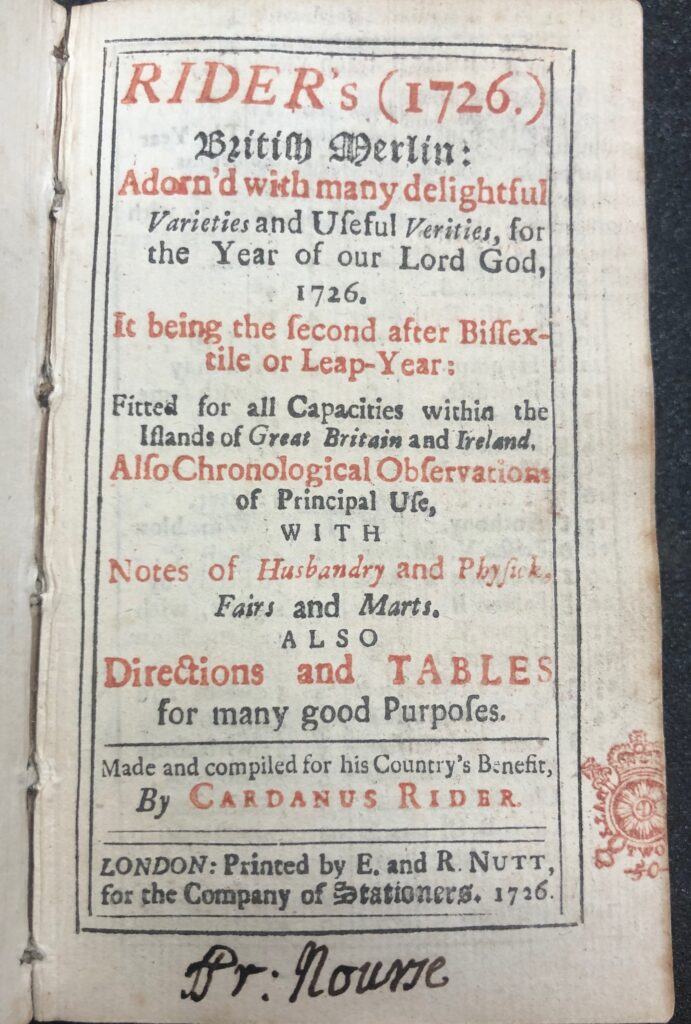
RIDER’s (1726) British Merlin: Adorn’d with Many Delightful Varieties and Useful Verities, for the Year of our Lord God, 1726 by Cardanus Rider was published in 1726 by the Company of Stationers in London. The text is an almanac with advice and extra tips for medicine and agriculture and includes extra blank pages for the owner to keep a diary of sort. The almanac tells the reader about phases of the moon, when it was best to plant certain crops, and predictions for each month.
The Author
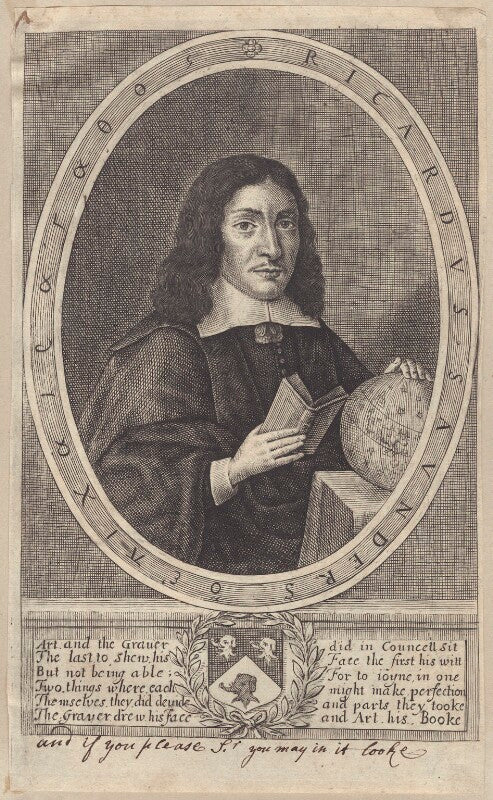
Cardanus Rider is believed to be a pseudonym for Richard Saunders, and if you rearrange the letters have Ric_ard Saunder_. He was an astrologer and doctor born in 1613 in England and died sometime between 1675 and 1692. In 1653, his folio “Physiognomie and Chiromancie, Metoposcopie❞ launched him into the public eye and was a major work.[1] Although he died in the 17th Century, Rider’s British Merlin was published into the 19th Century due to the popularity. While Richard wrote under the pen name of Cardanus Rider, Richard Saunders was the pseudonym used by Benjamin Franklin, another author of almanacs. [2]Not much else is known about Richard besides his profession and the almanacs he produced.
The name Cardanus is a reference to the mathematician and astrologer Gerolamo Cardano. He is well known for his scientific career and the first use of negative numbers. Along with his accomplishments in the mathematics, he spent much of his life as a physician and working on the sciences. It would make sense for an almanac, that has information about science and medicine, to have a reference to a prominent polymath.
Physical Description
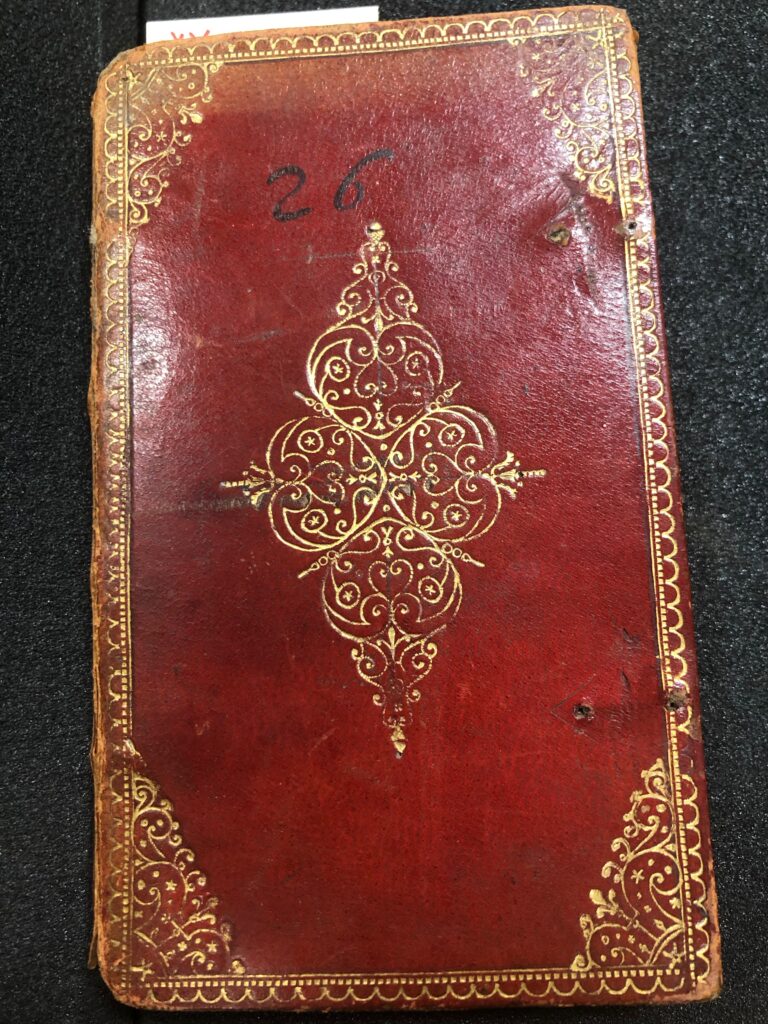
The physical state of this copy is in a very good condition, minus the cover, considering the usually short-lived works from this time. On the front and back covers there are indents and holes from where there used to be latches, but have since then been removed, shown in the picture to the left. The corners of the book are a little worn and the edges of the cover are faded. There is also the number “26”, for the year this almanac was intended, written on the front cover. Gilded tooling is used in the center and around the outline of the cover for decoration. On the inside of the front and back cover the boards have a marble design with colors of blue, red, and gold.
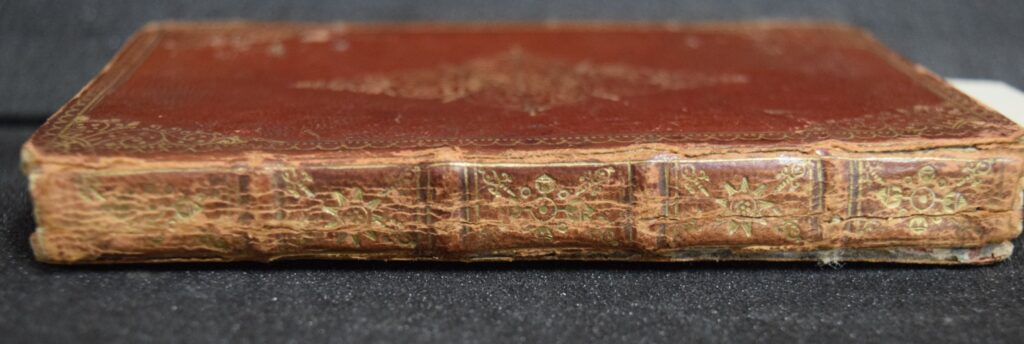
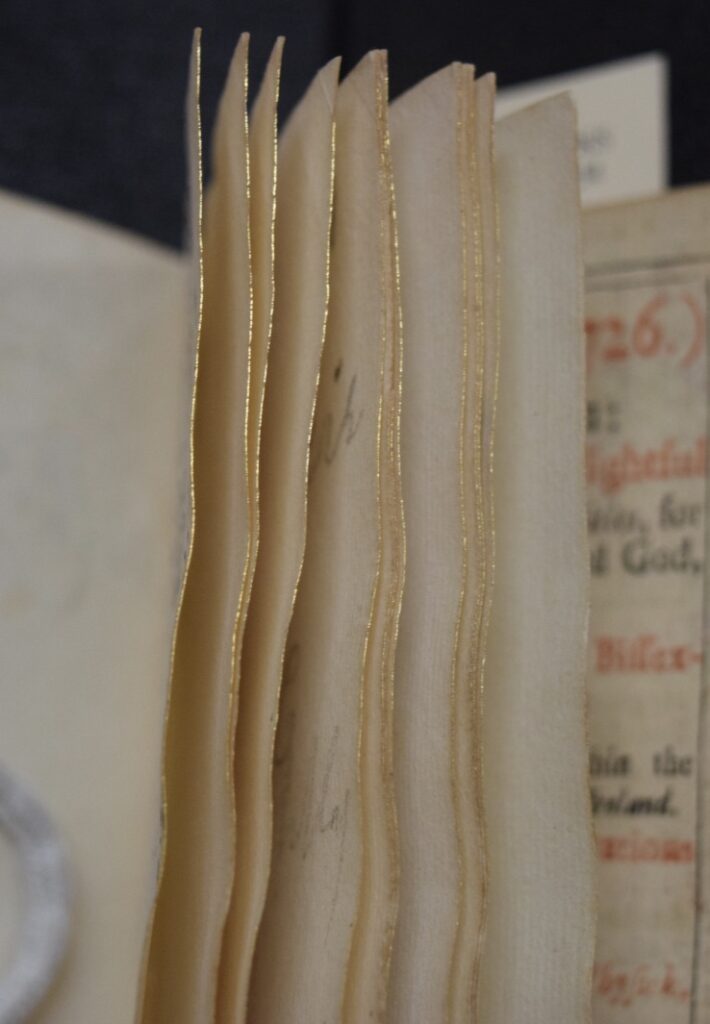
On the binding, there are gilded symbols tooled down the entire side. The pages are also warped from all the years. The front cover is partially torn from the spine of the book, most likely due to years of use.
Edges of pages that were once gilded, now are mostly faded yellow with a slight hint of the gold due to the constant use of this book. Many almanacs would not have this feature due to their fleeting life. These were seen more as economical and multi-purposeful covering many needs in one book.
Significance of the Book
This book would be significant for farmers or any person in the agriculture profession. The reader would be able to gage an idea of when it was or wasn’t best to plant a crop, and conditions in different months. Along with the almanac, there is information on many different subjects that would be helpful to know for the common people. For example, lists of fairs and markets, so the reader knew when and where they were able to trade, sell, and buy products. Another component of significance is the addition of blank pages. These pages were typically used in almanacs as a diary for the owner, where they were able to record important information, trades, and observations.
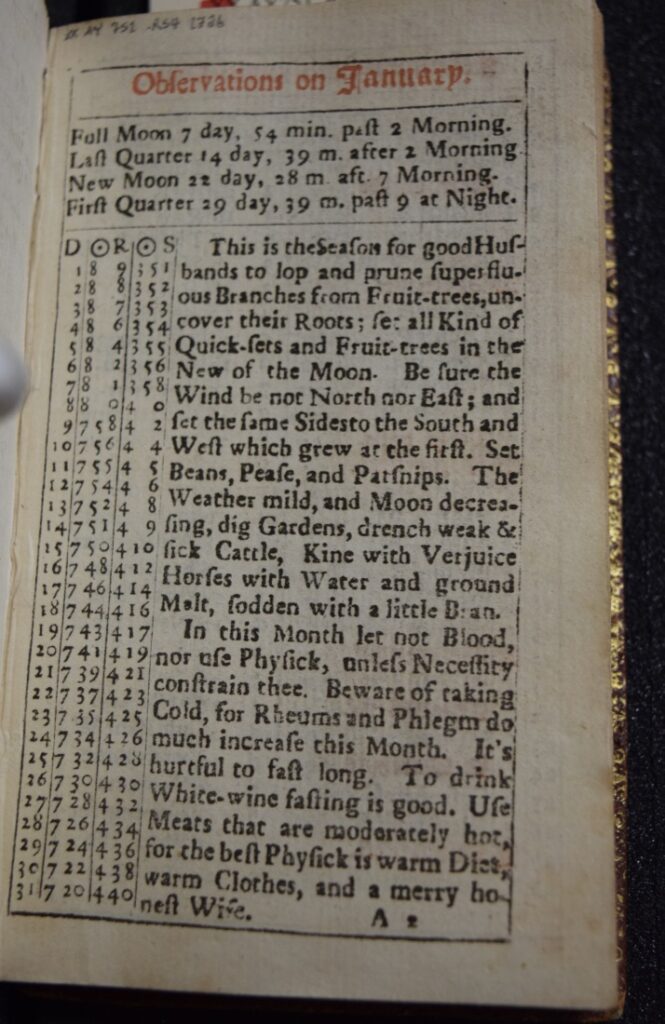
The book also included extra tips for farming and medicine. Along with farmers, many physicians would use these almanacs for their medicinal information. Due to the lack of training for many of these practitioners, they would follow the instructions in an almanac to the t, relying heavily on the information inside. In this almanac, there are observations for January with health-related advice, including that “its hurtful to fast long” and to eat meat that is “moderately warm”. Although many of the “medicinal” advice is generic, at this time many physicians had little practice and referred to anything available, like an accessible almanac.
Ownership and Unique Elements
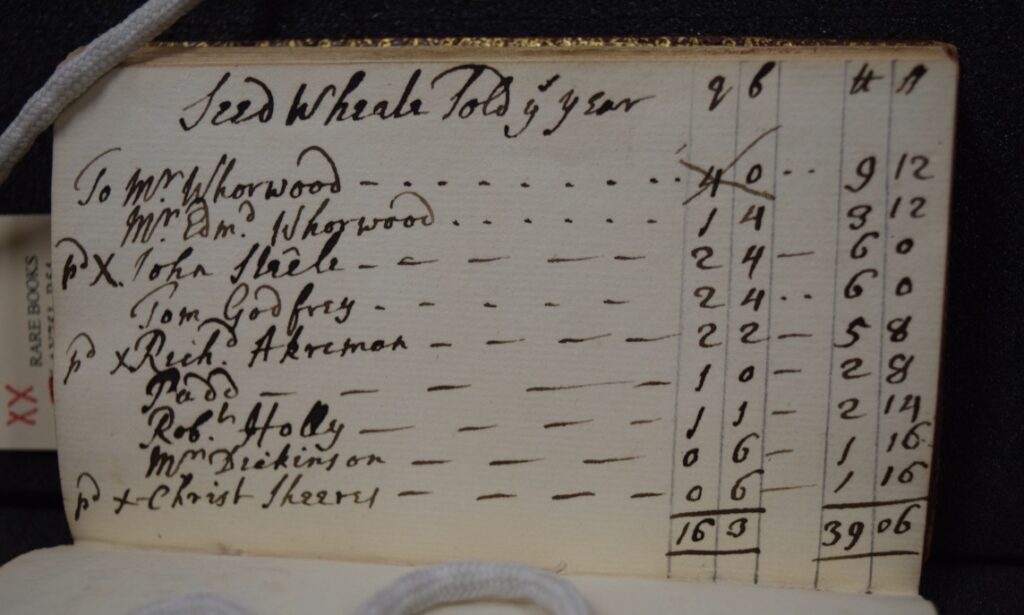
The owner recorded of information throughout this almanac, including the chart shown on the left. This record includes names of farmers that are found throughout the book, showing a relationship between them and the owner. There are notes and records of interactions and trades between the owner and these farmers. The names proceed Mr. Whorwood, Mr. Tom Whorwood, John Steele, Tom Godfrey, Rich Akreman, Padd, Rob h. Holly, Mr.Dickinson, and Christ Sheerey. Some other names found on other pages are Mr Rich Braeir Thorne, John Hyolt, and Baker Kerwood. On one page, in the upper right hand corner is the price “sixty five pounds”, for which the book was most likely sold.
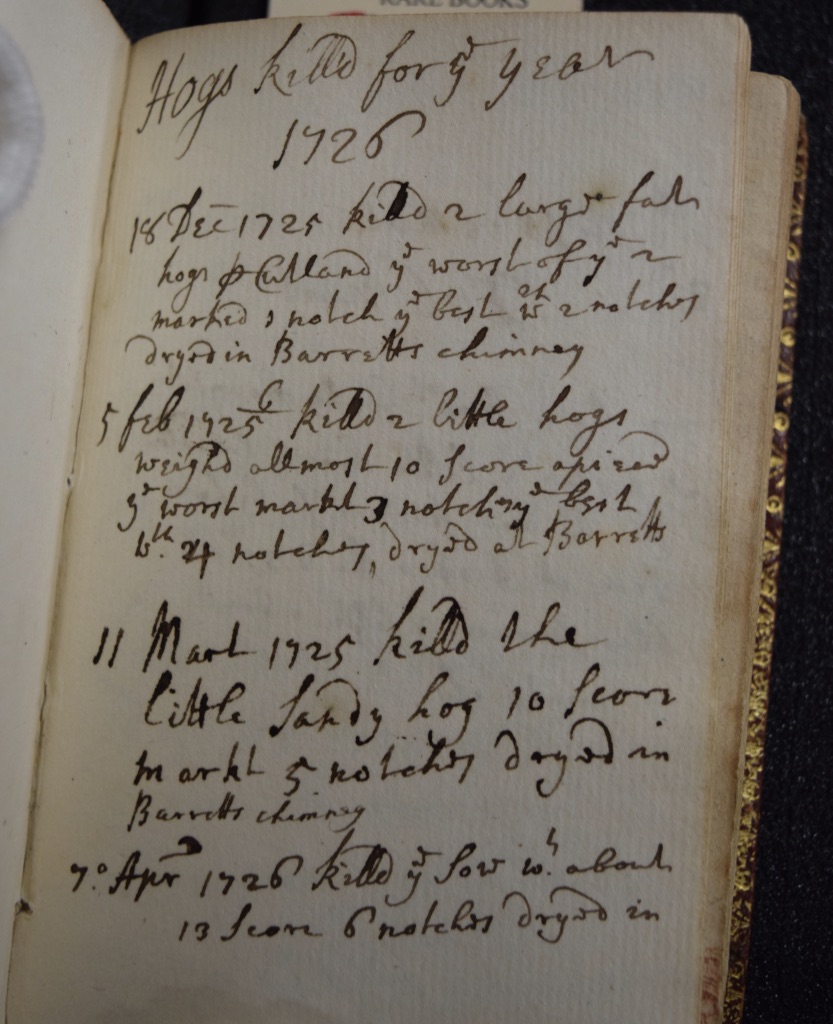
The owner used every blank page available. He would record different techniques for farming, observations of the weather, events going on in his life, and when people would visit him. Writing about “John Clark’s boy” visiting, as well as Baker Kerwood. One of the last pages has “Spurge” at the top with Pad Locks, Cole Harris, Goofe Michday, and Woresho & Garders listed below. The owner, a farmer, used many pages to record stock numbers and kills.
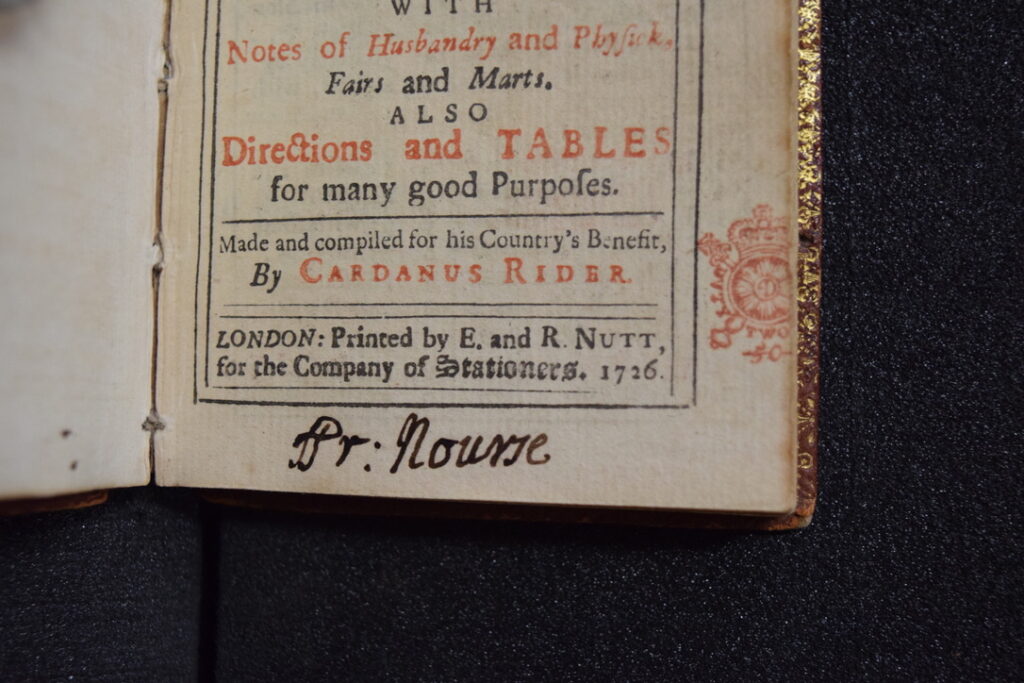
On the title page, there is “Fr:Nourse” inscribed on the bottom. John Nourse was a prominent bookseller, known for scientific books. He was baptized in 1705 and died 75 years later. This puts him in the right time period to be able to sell this book as it was from 1726. The farmer who used this book often and most likely for many years could be the owner after Nourse.
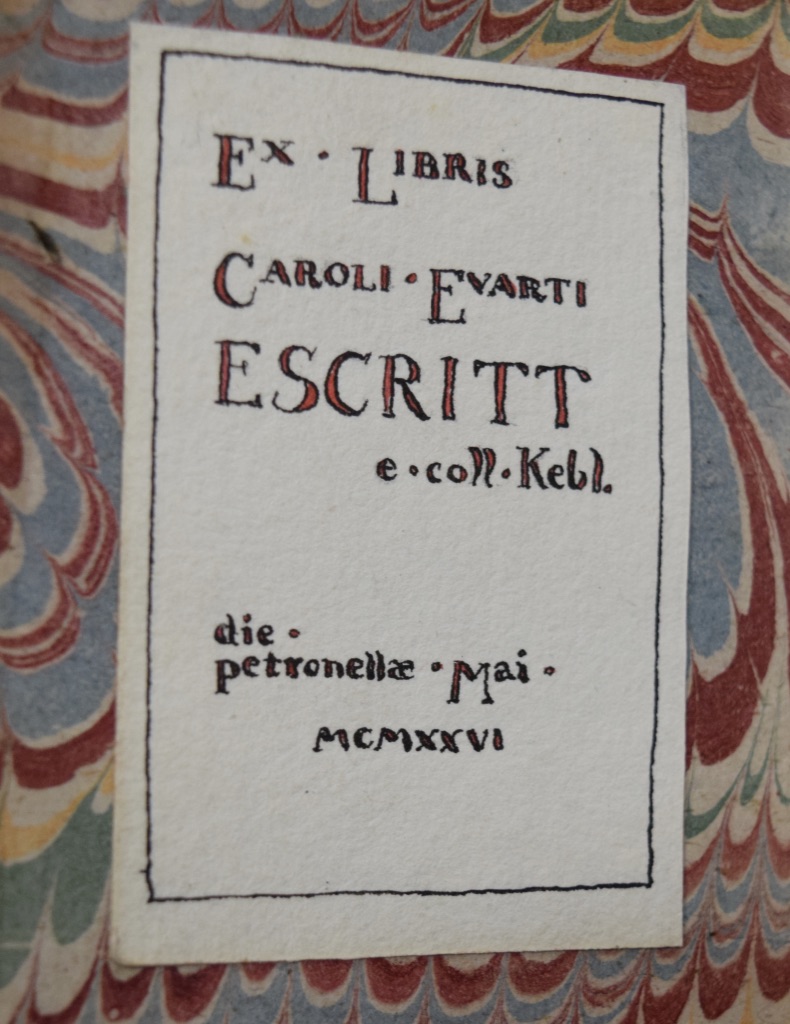
A bookplate inserted into the inner-side of the front cover is evidence of an owner in 1926. This owner is Charles Ewart Escritt who, following a trend at the time, latinized his name to be “Caroli Evarti Escritt”. Captain Charles attended Keble College of Oxford as an undergraduate, and later in life became Secretary of the Oxford University Appointments Board.[3] Also, he was a part of the civil division of the British military and served during WWII.
Sources
[1]Porter, M H. “Saunders, Richard (1613-1675), Medical Practitioner and Astrologer: Oxford Dictionary of National Biography.” (1613-1675), Medical Practitioner and Astrologer | Oxford Dictionary of National Biography, 5 Oct. 2019, https://www.oxforddnb.com/view/10.1093/ref:odnb/9780198614128.00 1.0001/odnb-9780198614128-e-24702?rskey=fZeKye&result=3.
[2]”Poor Richard’s Almanack.” Benjamin Franklin Historical Society, http://www.benjamin-franklin-history.org/poor-richards-almanac/.
[3]Escritt, Tony. “Capt. Charles Ewart Escritt.” COFEPOW, https://www.cofepow.org.uk/armed-forces-stories-list/capt-charles-ewart-escritt.
Created by Riley Puscas in Fall 2019 for Professor Brockey’s 200H, MSU
