
XX BV4500 B87 1691
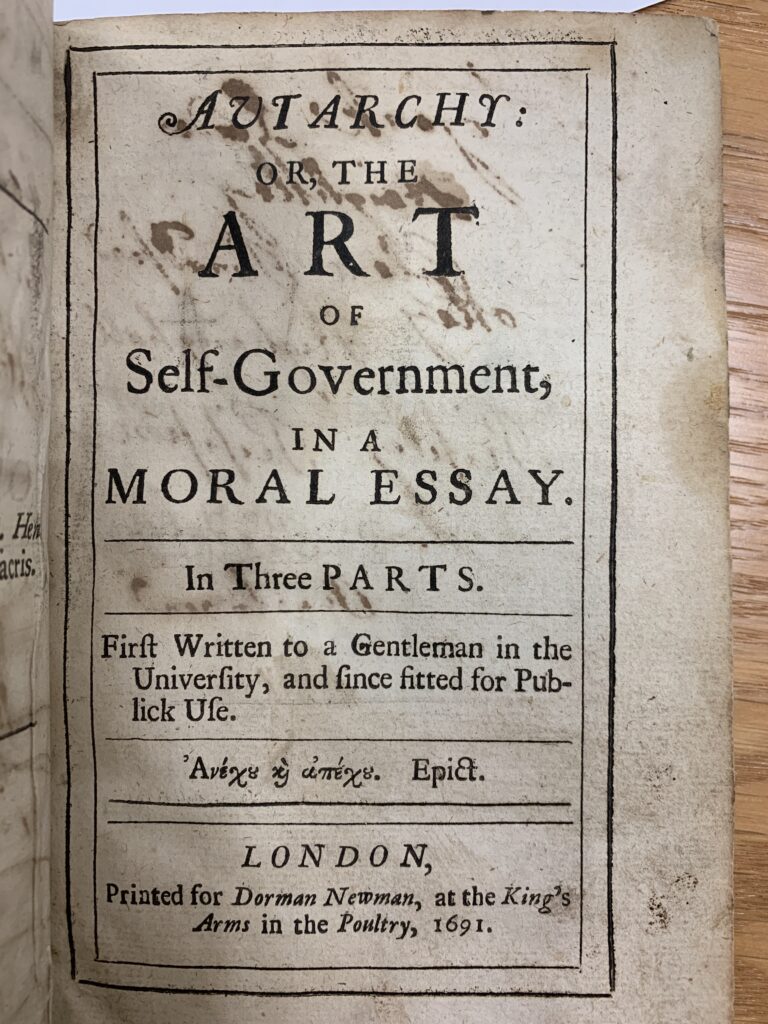
Autarchy: or, The Art of Self- Government, in a moral essay. In three parts. First written to a gentleman in the university, and since fitted for publick use. by George Burghope, was published in 1691 at the King’s Arms in the Poultry. This book was printed for Dorman Newman. This book was printed before 1694 in England which meant each book published until then required an imprimatur to ensure the books being published were free of all doctrinal or moral errors. For religious texts like this one the imprimatur was strictly enforced. The book is stamped with the line Imprimatur. by Z. Isham R. P. D. on February 6th 1691 verifying the legitimacy of the book as truthful.
Dorman Newman was a printer in London that ran multiple successful print and bookstores. Elizabeth Lane Furdell wrote an article in the London journal calling his business a bookshop emporium due to the wonders of printed text coming out of his shop. Newspapers, books, and other limited run distributable materials were all available to be read or purchased in house.
Autarchy is defined as self rule. This book is split into three parts to better explain what autarchy is to the reader. Part one contains “The Nature of Autarchy and the rules of its exercise.” The second part of the book is a Vindication of the pleasures of Autarchy. The third part’s subject is “The Outward Advantages of Autarchy.” This book was written by a well traveled reverend George Burghope who spent many years in small rural communities interacting with the poor and preaching on how men must better govern themselves, their actions and their impulses. For a traveling preacher in the 1690’s this subject would be especially pertinent to those in small towns or holdings who had to be entirely self reliant to make it through their everyday hardships. This book focused on warning the reader of the pleasures of the flesh and all the temptations that besieged an educated man. It preaches on resolving oneself to follow god through the temptations that lead men astray.
About the Author
The author George Burghope was the personal reverend of the third Earl of Bridgewater in Hertfordshire England. He has six published writings three being on the topic of autarchy or self government. He upholds his ideals of ignoring temptations and sticking with the values of the church throughout all of his texts. He is on record in The History of Hertfordshire volume III donating 30 £ to a former parish of his in 1707, with the instructions of investing it in the church and using the interest to feed the poor every year. In a collection of church records from St. Martins church in Burton Agnes, the reverend is mentioned again for having donated a sum of cash with instructions. The passage states that a sermon was preached on preparing for death and the poor in attendance shared the interest of the donation according to the instructions included. Further texts have been found much like the aforementioned ones, they mainly consist of a donation usually with stipulations of a sermon on death and the interest of the donation going to the poor. Burghope preached at and donated to many different churches across england. In 1713 Ralph Eddows was the rector of a sermon on the death of George Burghope with the Earl of Bridgewater in attendance.
Physical Condition
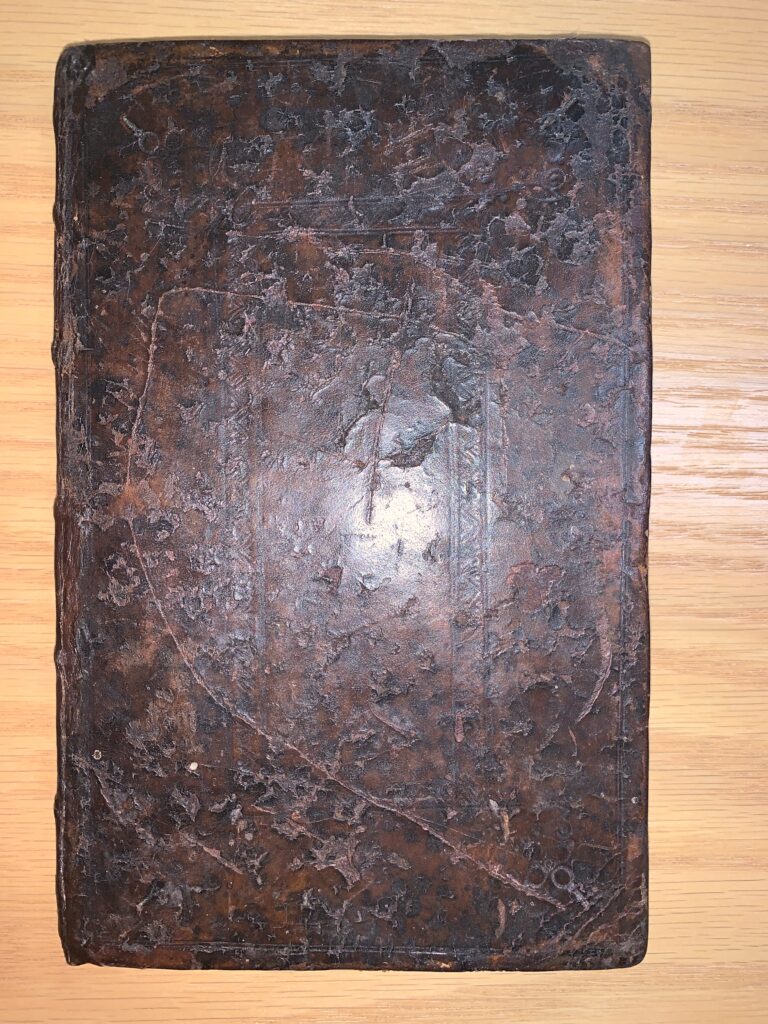
This copy of Autarchy: or, The Art of Self- Government, in a Moral Essay. In Three Parts. Is bound in a compact 17 x 11 cm dark brown original leather binding that is heavily scarred from use. The leather has flaked off randomly across the cover and also features a large curved scar crossed by a smaller vertical scar. There is an original blind decorative tooling featuring bushels extending out towards each corner of the cover. The back cover features the same blind tooling with a similar scar as the front however the scarring on the back cover is one large teardrop shaped slash. The back cover also featured a number of small indents where a chunk leather appears to have been removed most likely from general use. The board within the back cover appears to be slightly bowed out from the leather drying out over time unevenly and curving the board. The spine of the book features 5 raised bands and SELF GOVERMENT written gold on a faded red paint. Farther down the spine there are flecks of blank paint and faint gold decorations along each band on the binding.
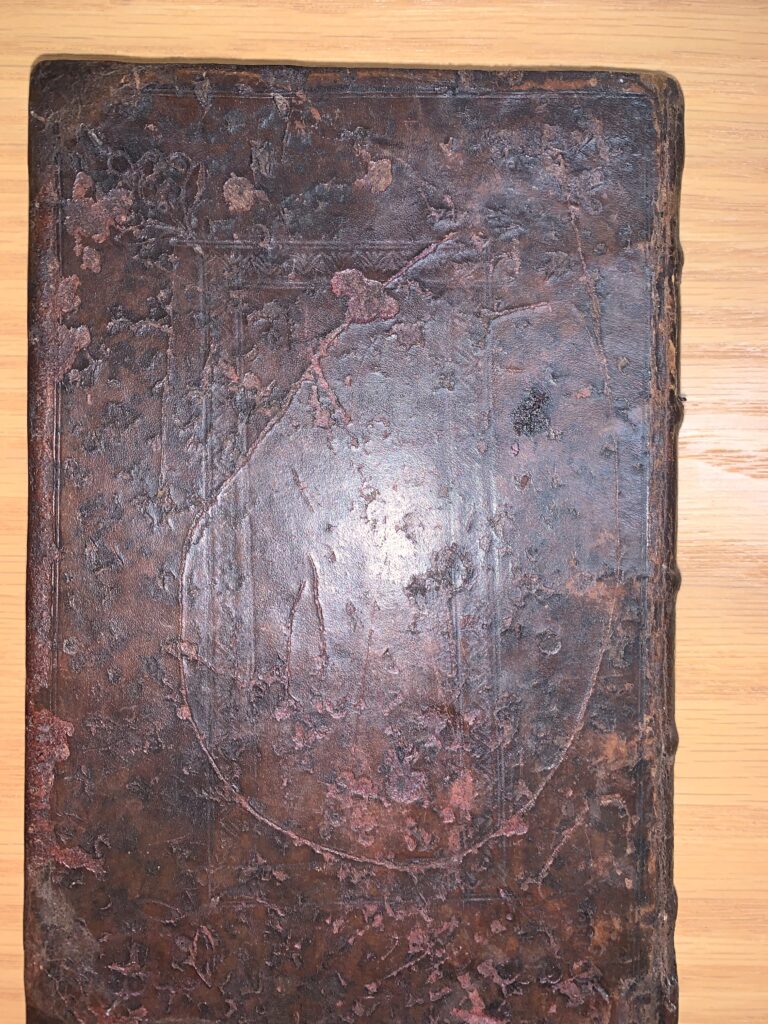
Where the spine meets the covers the leather is heavily cracked and marred from extensive use, inside the covers the paste down page has separated nearly entirely from the rest of the binding due to repeated manipulation of the covers. The pages within the book that have text printed are all unmarked with no annotations or corrections. Many pages bear the stain of residual watermarks but are not harmed otherwise.
Evidence of Ownership and Use
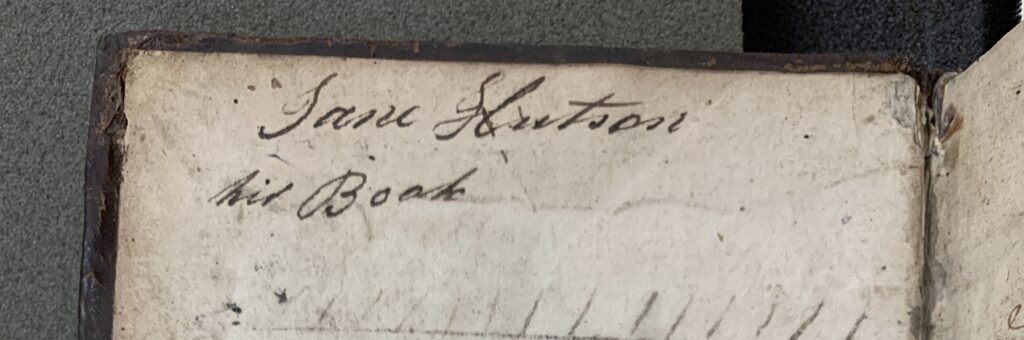
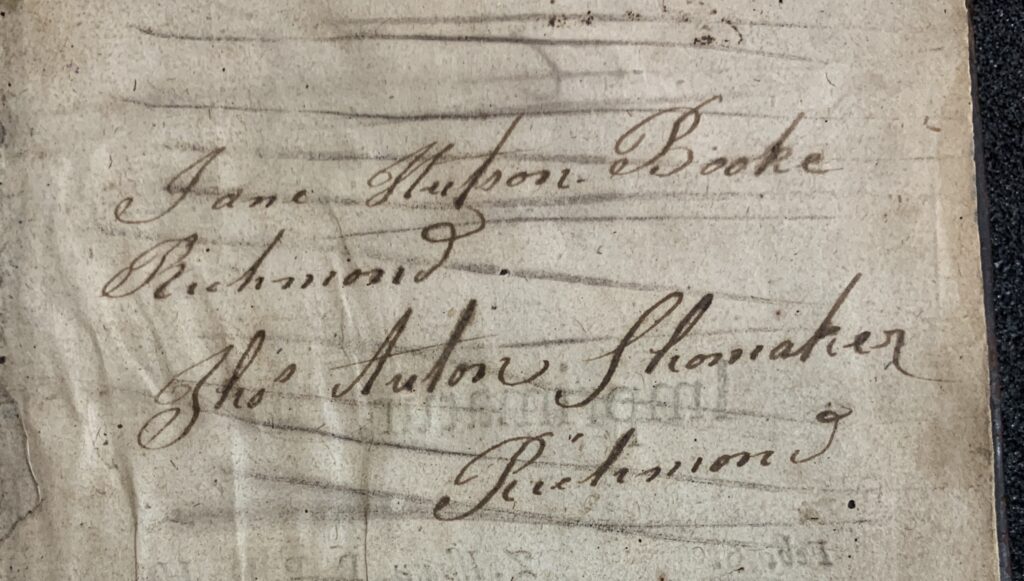
The first piece of evidence of use is on the front pastedown page of the book featuring the name “Jane Hutson hir book” this owner continues to write on the next page with the words “Jane Hutson Booke Richmond” followed by “Tho. Auton Shomaker Richmond” these names are followed by a list of towns and distances.
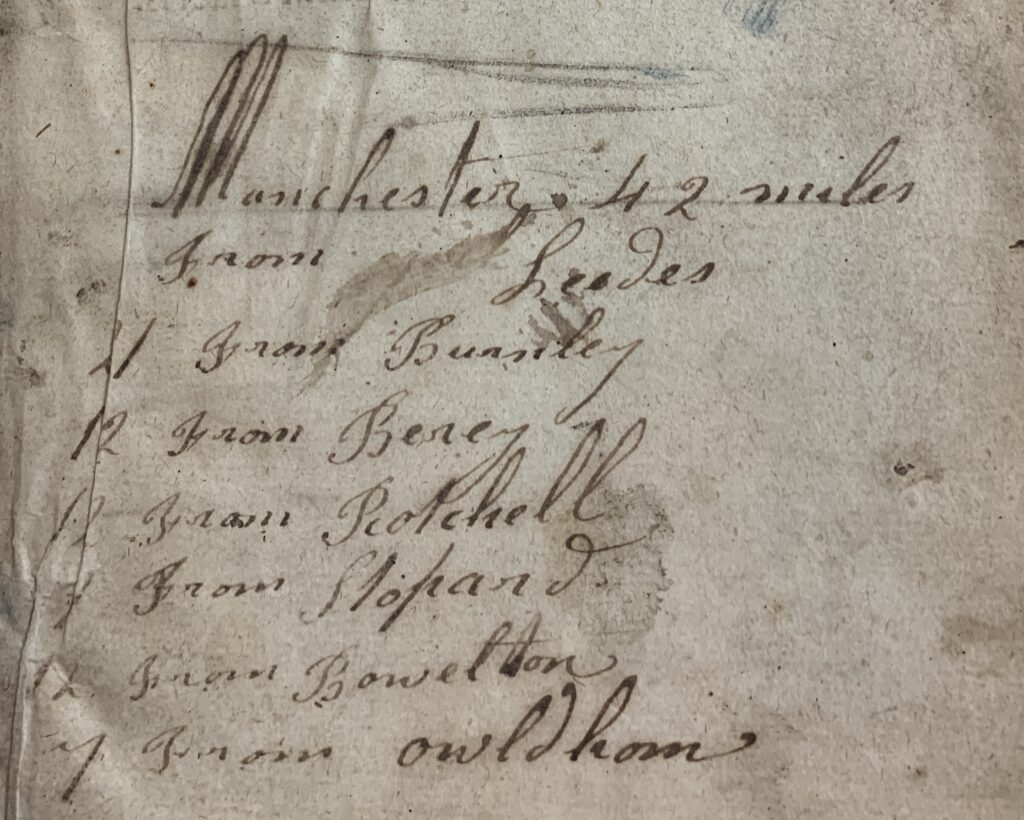
“Manchester 42 miles from Leedes, 21 from Burnsley, 12 from Bury, 12 from Rotchall, 12 from Bowelton, 7 from Owldhom. After further research I was able to match up the two names featured on the first page to a gravesite in St Michael churchyard Hambleton District, North Yorkshire, England. The Auton family has a plot there with Thomas Auton (1780-1857), his wife Margaret Hutchinson Auton (1783-1867) and their two children Jane (1808-1842) and James (1820-1840). The initial name on the book was Jane Hutson which was most likely a shorthanded notation of writing out her mothers maiden name. The Auton families grave location in Richmond North Yorkshire indicates that this was the same family who once owned this book due to the list of locations that follow the two names. All the towns listed were within a small margin of error an accurate distance as the crow flies from Richmond England. On the ventral side of the title page is a further list of towns. It reads as, York, Leedes, Knightley, Colen, Bradford, Ottery, Mighinghall, Ripeley, Rippon, Mashom, Bedale, Richmond. It is possible that the previous owners had used this book to preach to the rural communities surrounding them much like the author had. This list could be a way of documenting their travels.
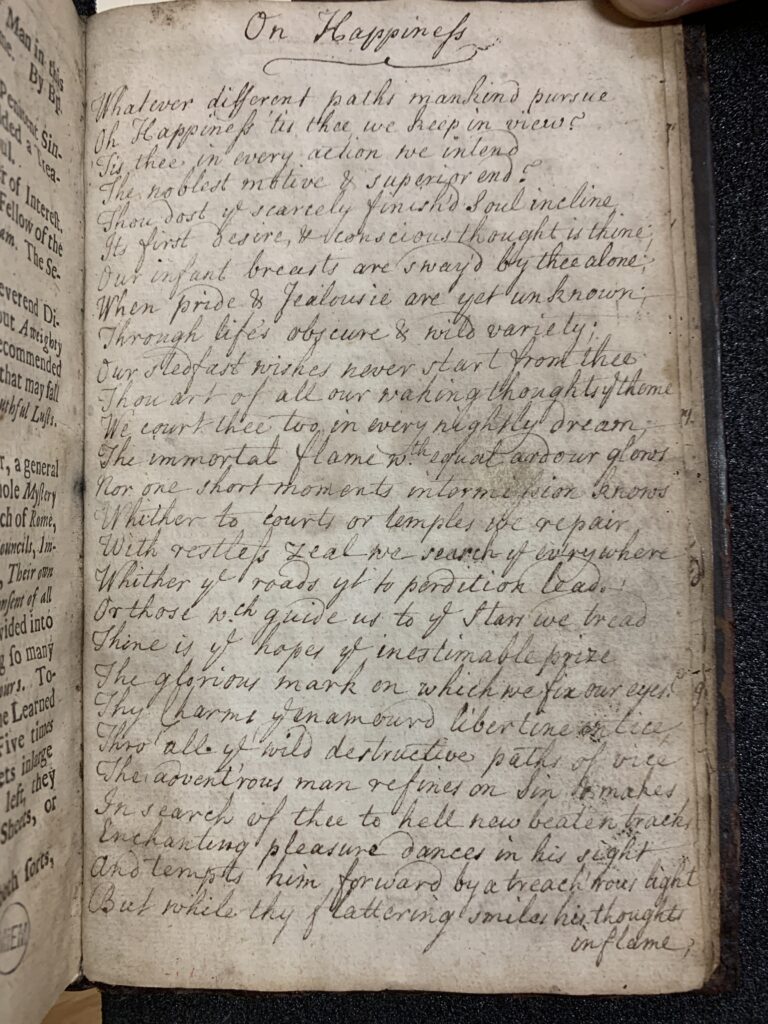
After this initial pages evidencing use the entire book itself goes on without any annotations until the final four pages, initially left blank one previous owner wrote out a three page passage titled “On Happiness”. This happiness letter is followed by another letter titled Extract of a letter.
Following these last pages the back pastedown page may have had more evidence of another previous owner however, the name once written there was rubbed off leaving only an illegible afterimage of the ink that was once there.
Created by Alexander Manning in Fall 2019 for Dr. Brockey’s UGS 200H class at MSU
