
SF 426. C31729
The works of John Caius was printed by Charles Davis on Paternoster Row in London 1729. Included in this volume are; On British Dogs, book one History of Animals and Plants book one, Of His Own Books, book one, The use of Greek and Latin when writing a book, book one. This volume was also edited by a Dr. Samuel Jebb.
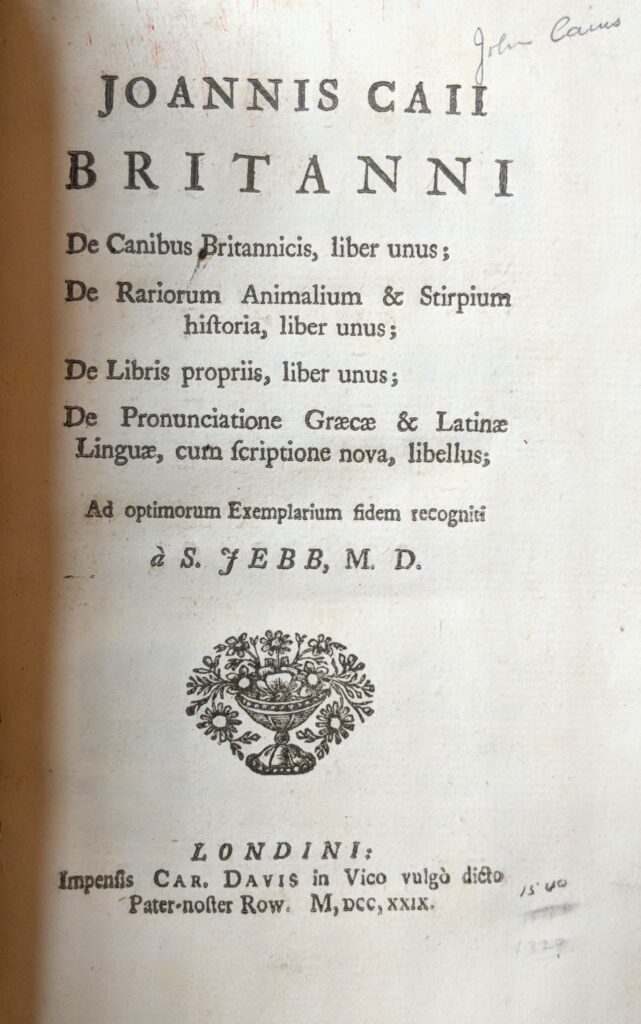
John Caius, or John Kay was an English physician who was born in Norwich in 1510, where he attended Gonville Hall at Cambridge University to study theology [1]. After graduating Caius moved to Italy and attended the University of Padua where he received his degree as a physician [1]. Afterwards, Caius moved to London and was admitted to the College of Physician where he was appointed president nine times [1]. Caius was famously a physician of Queen Mary and Queen Elizabeth but was eventually dismissed due to him being atheist. Caius also returned to Gonville Hall and enlarged it, changing the title to Gonville Hall and Caius College.
It is thought that Dr. Cauis in Shakespeare’s play the Merry Wives of Windsor was inspired by this John Caius [1].
This collection of books is the combination of many John Caius’s best and most important pieces on animals. Before Caius, zoology was not seen as a separate science and as a result, he pioneered its importance [1].
Physical Description

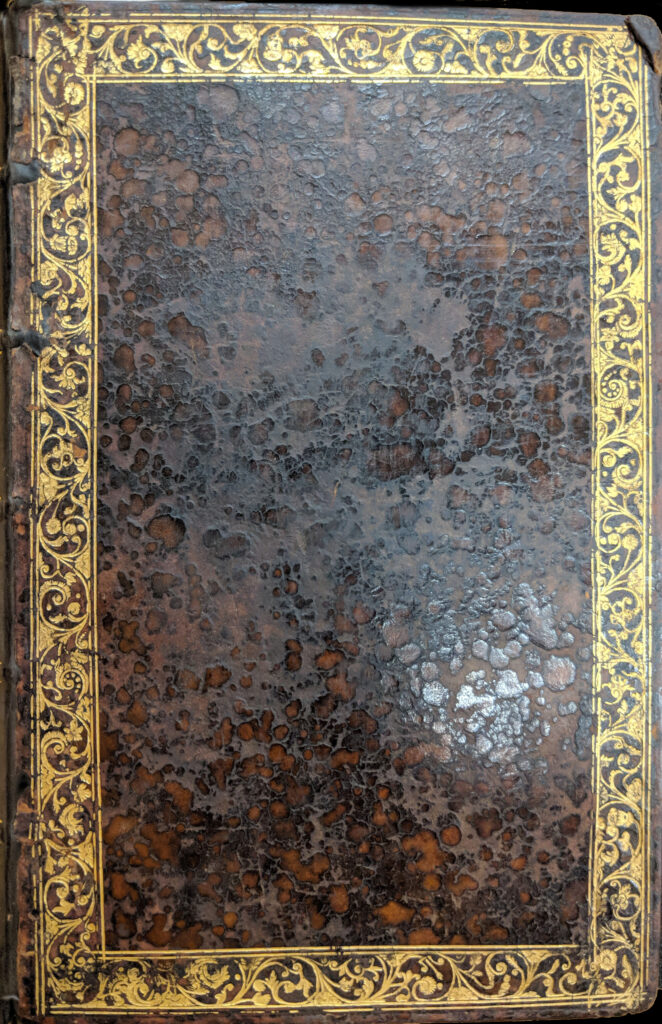
The Works of John Caius is printed in octavo and has a full brown molted calf binding and decorated gold tooling with wide rolls. The spine has five raised bands with gold tooling at the spine bands, titled in the second spine compartment on a red label there is the “Caii Opuscula” which translates to “the small texts of Cauis”. Once open, On British Dogs has a marbled flyleaf and paste down.
The book has minor foxing and tinting with some shelf wear at the board edges, as well as minor cracking on the hinge and bumping on the corners.
Provenance
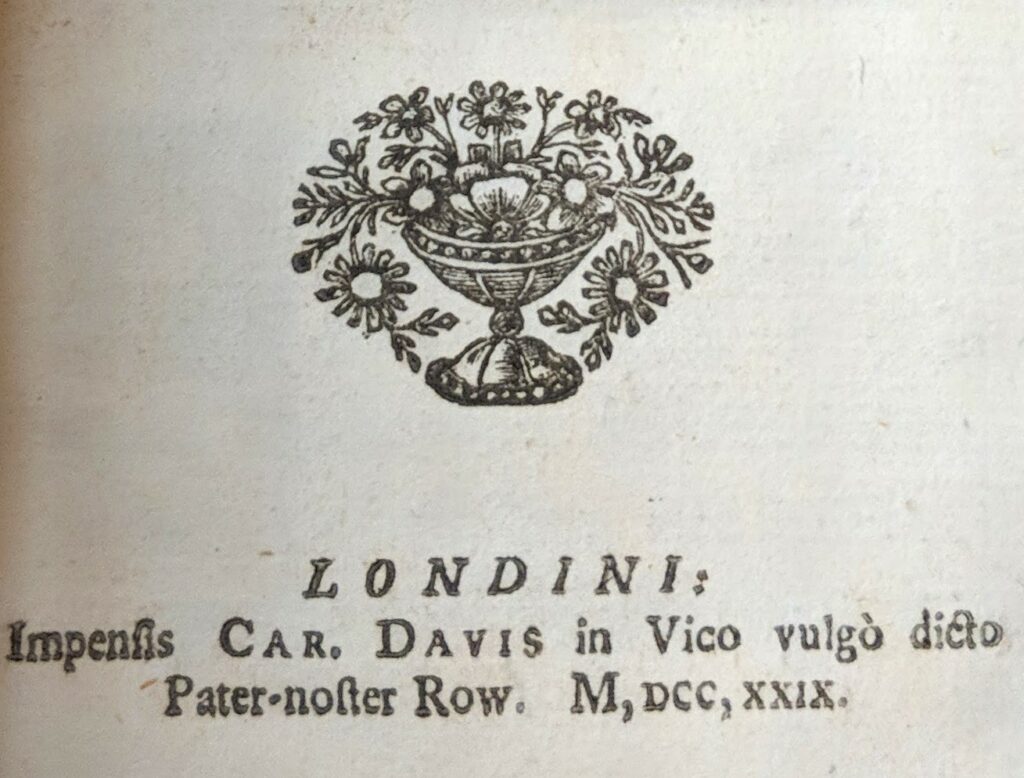
The Printer’s Device is a floral design inside of a vase. According to the title pages, this particular book was printed by a Charles Davis on a Paternoster Row in London, the street Paternoster Row. Paternoster Row was one of the most bustling publishing locations in all of England, as a result, many printers never became well known or reached any sort of fame [6].

The first and second evidence of ownership is on the front three endpaper recto side. Here there are two inscriptions with names. The one on the center of the end paper reads, “T: Holt Whites[?]” After performing extensive research, the only name that I found was of an author named Thomas Holt White from England, wo was an author that published books on the English language around 1762. One particular book that Thomas Holt White published was A Review of Johnson’s Criticism on the Style of Milton’s English Prose, with Strictures on the Introduction of latin Idioms into the English Language. Which loosely related to John Caius’ book the use of Greek and Latin when writing a book. [2] There is another inscription that is nearly illegible that appears to say “J: H: Burns Cab.E 1825 [?]” I was unable to find a J:H Burns from 1825, however, I believe the Cab. E stands for Cambridge, where John Caius began his career. Both of these inscriptions indicate that the books stayed in England and it eventually ended up in Cambridge, where it found its next owner Edward Mansel Sympson.

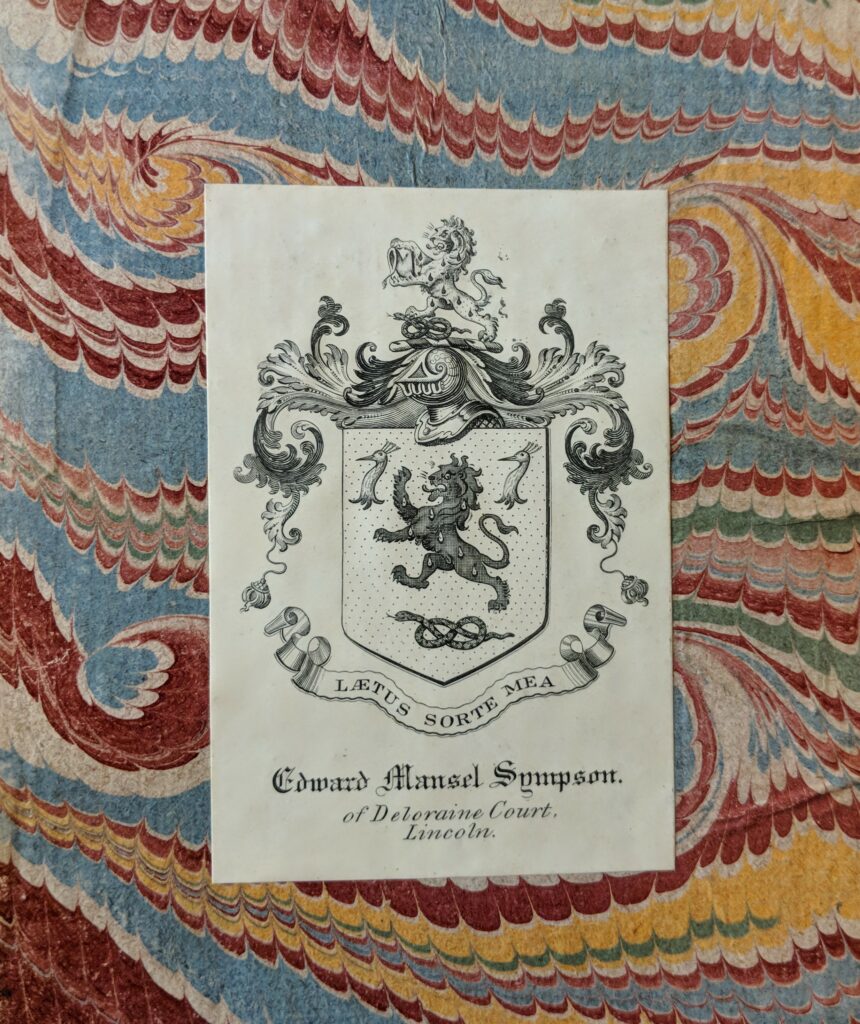
The third evidence of ownership is on the front pastedown endpaper there is an armorial from Edward Mansel Sympson. Lieutenant Colonial Edward Mansel Sympson was a doctor as well as a writer who lived in Lincolnshire, England who attended and graduated from Cambridge University where he likely was when he obtained this book. Sympson lived from 1860 to 1921, during which Sympson wrote a book titled, Memorials of Old Lincolnshire [4]. It can be assumed that Edward Mansel Sympson was the third owner of On British Dogs due to him being alive after 1825. As a result of John Caius being a famous English physician as well as an author, that contributed greatly to Cambridge Sympson would hold a special interest for books that he wrote.
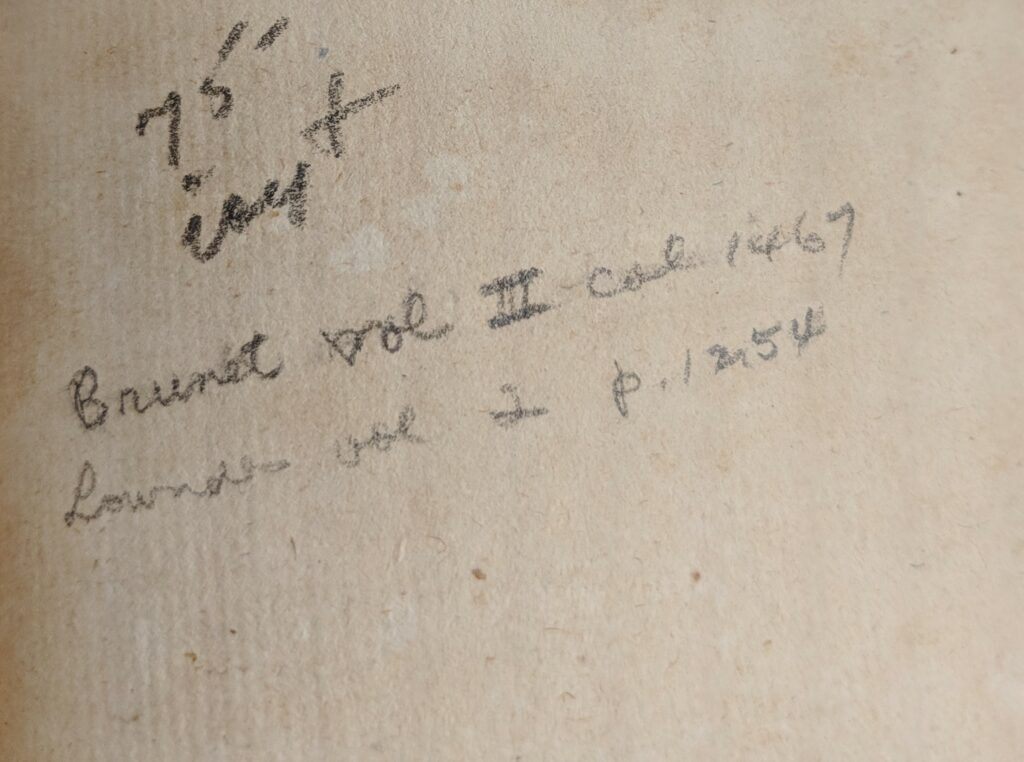
Finally on the rear endpaper verso side, there are three inscriptions. One reads, Brunet, Vol, II, colum 1467, another read Lowndes, Vol. II page. 1254. After researching these two inscriptions, they appear to be pages in two separate bibliographies that lead to works by John Key. [5] The third inscription reads, 75 isu+ [?] which could indicate a bookseller code and a bookseller price after finding the significance of the book through the bibliographies. I believe this is the period where the book was sold from England to the United States.
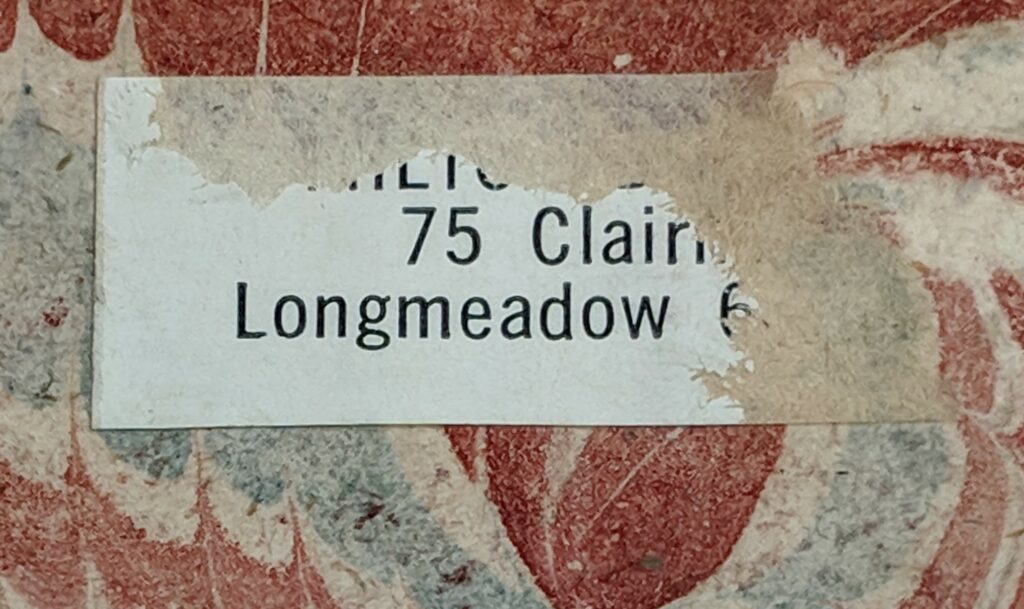
The first American piece of provenance found on the front paste down of The Works of John Caius is a torn book label. This book label only shows a portion of an address. After consulting the catalog shown below made by John Howell, it mentions a Milton Danziger, who happened to live at a 75 Clairmont Place, Longmeadow Massachusetts. Milton Danziger was born in 1897 in California, he eventually moved to Massachusetts and married his wife Agnes and lived here until his death in 1962. [6]
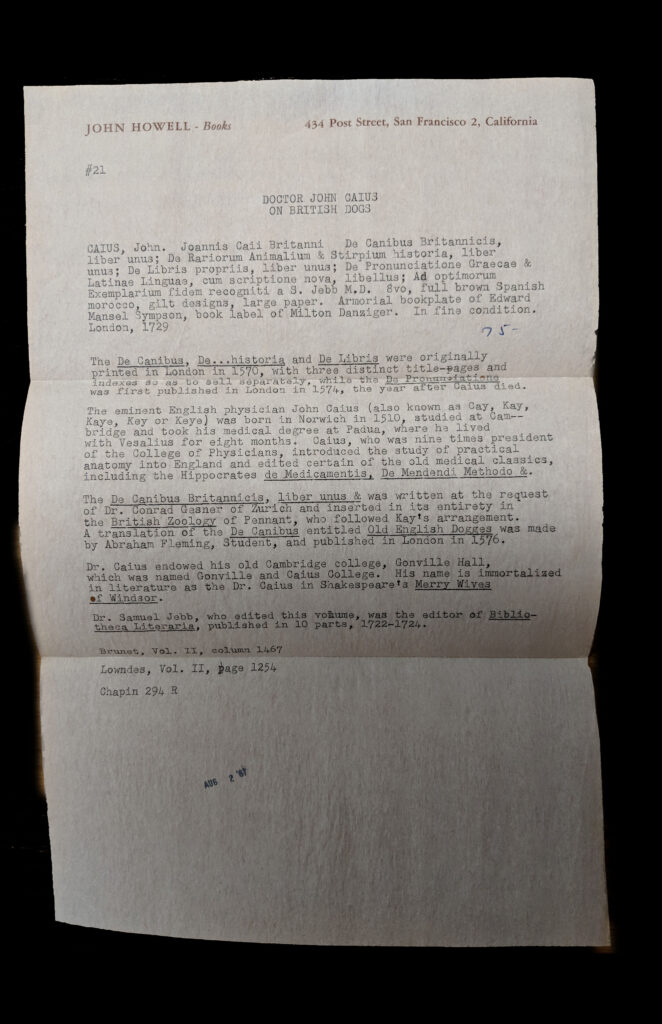
The final and most recent piece of provenance is from a John Howell of San Francisco who was a famous book collector born in 1912, his son Warren Howell worked with him father as a book collector. Their goal was to combine both the American works, with European works, creating an extensive library as most book collectors at the time would only deal with one category at a time [3]. The works of John Caius would have been an excellent piece for John Howell as it was written by a famous English author, and published in one of the most famous printing areas in England. This book was purchased from John Howell books on April 2nd, 1967 by Michigan State University where it continues to reside.
Significance
Through the inscriptions, armorial and book label, it can be observed that this volume of The Works of John Caius has seen at the very least, 5 different owners, however it is most likely more since the dates do not add up perfectly. It does appear that most of the earlier people who owned this book owned not as a means to study but because John Caius was such a famous writer/physician. Including, John Howell who owned The Works of John Caius as a way to add to his collection. I make this observation because of Edward Mansel Sympson who most likely owned the book due to it being written by a famous physician from his country. Furthermore, the two bibliographic entries at the back free endpaper would indicate that this book was purchased for collection purposes and not educational.
References
- Britannica, The Editors of Encyclopaedia. “John Caius.” Encyclopaedia Britannica. October 02, 2018. Accessed October 18, 2018. https://www.britannica.com/biography/John-Caius.
- Catalog Record: An Excursive Memoir, Legal, Historical and Political on the Parliamentary Declaration of the Liberties of England (3 Charles I) Constitutionally Termed the Petition of Right.” Catalog Record: An Excursive Memoir, Legal, Historical And… | Hathi Trust Digital Library. Accessed November 07, 2018.
https://catalog.hathitrust.org/Record/011617808. - “Howell < Rare Book Hub – Rare Books, Book Auctions, Antiquarian Book Collecting.” http://www.rarebookhub.com/book_sources/141.
- Larionov, Denis, and Alexander Zhulin. “Armorial Families: A Directory of Gentlemen of Coat-armour (Volume 2) Online.” Read the EBook Armorial Families: A Directory of Gentlemen of Coat-armour (Volume 2) by Arthur Charles Fox-Davies Online for Free (page 210 of 282). Accessed October 18, 2018. http://www.ebooksread.com/authors-eng/arthur-charles-fox-davies/armorial-families-a-directory-of-gentlemen-of-coat-armour- volume-2-dxo/page-210-armorial-families-a-directory-of-gentlemen-of-coat-armour-volume-2-dxo.shtml.
- Lowndes, W. Thomas. (185764). The bibliographer’s manual of English literature containing an account of rare, curious, and useful books, published in or relating to Great Britain and Ireland, from the invention of printing: with bibliographical and critical notices, collations of the rarer articles, and the prices at which they have been sold… New ed., rev., cor. and enl.; [with an appendix relating to the books of literary and scientific societies.] London: H. G. Bohn.
- “Paternoster Row.” British History Online. Accessed October 18, 2018. https://www.british-history.ac.uk/old-new-london/vol1/pp274-281.
- The Class Of…silver Anniverary Gopher.” Google Books. Accessed November 07, 2018. https://books.google.com/books? id=LnhOAQAAMAAJ&q=milton danziger 75 Clair longmeadow ma&dq=milton danziger 75 Clair longmeadowma&hl=en&sa=X&ved=0ahUKEwj1ktW-Yp_eAhUI64MKHUSrDJYQ6AEIKDAA.
Page by Ryan Lopez for HST 475
