
XX PA6478 .A2 1515
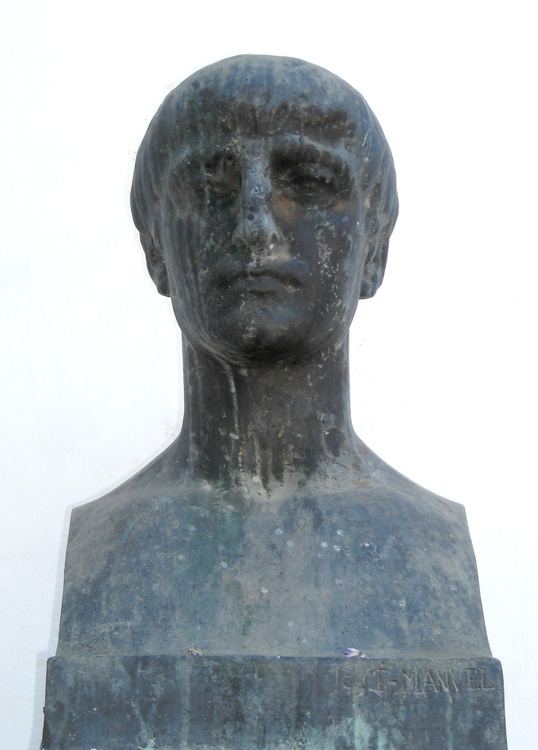
Civilis Belli or “Civil War” is the sixth book of a ten book series by Marcus Lucan and was published in Latin in 1515 by a famous printer, Aldus Manutius, in Venice, Italy; this specific book is a second addition. This book actually has two names, Civilis Belli and Pharsalia, but is more commonly referred to as Pharsalia in reference to Lucan. The author, Marcus Lucan, was a Roman statesmen and Latin poet. He was an important person in Emperor Nero’s inner circle. Lucan’s poetic talents were so revered, that he was honored with a prize at the first Neronian Games in 60 CE, as he had written a poem praising emperor Nero.
This piece is an epic poem that Lucan started writing in 61 CE, it is unfinished because Lucan committed suicide in 65 CE; but this work is his legacy, and what makes him so famous to this day, as it is still being studied by scholars and readers. The poem, even though it is unfinished, is still considered one of the greatest epic poems of the Silver Age of Latin literature. The poem tells the story of the epic war between the forces of the Roman Senate, led by Pompey the Great, and Julius Caesar.
The Print Master
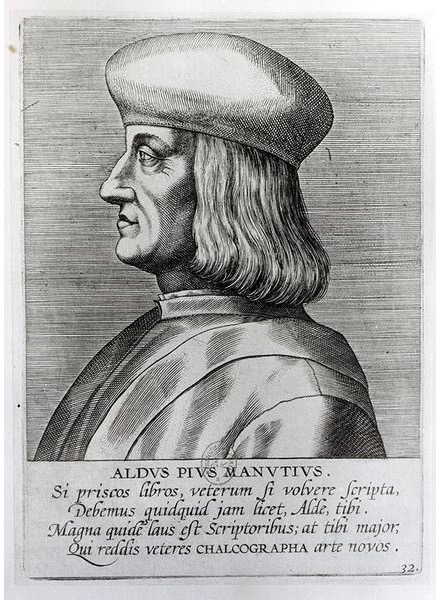
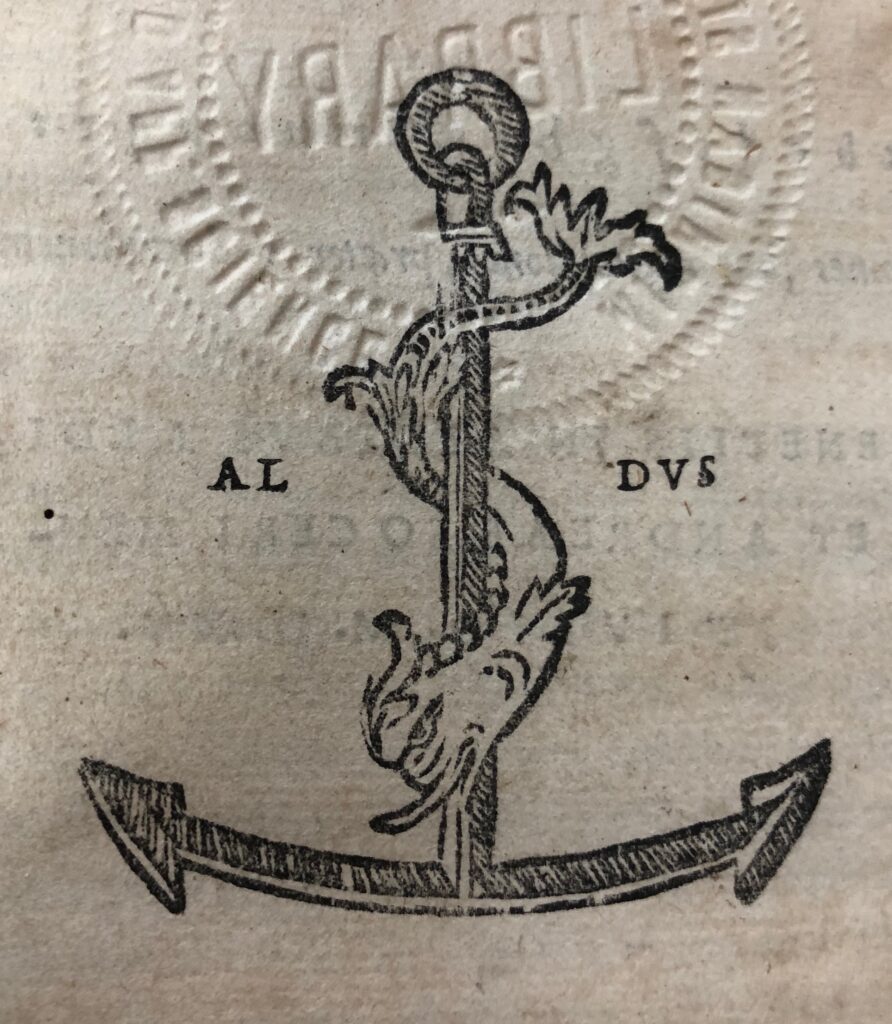
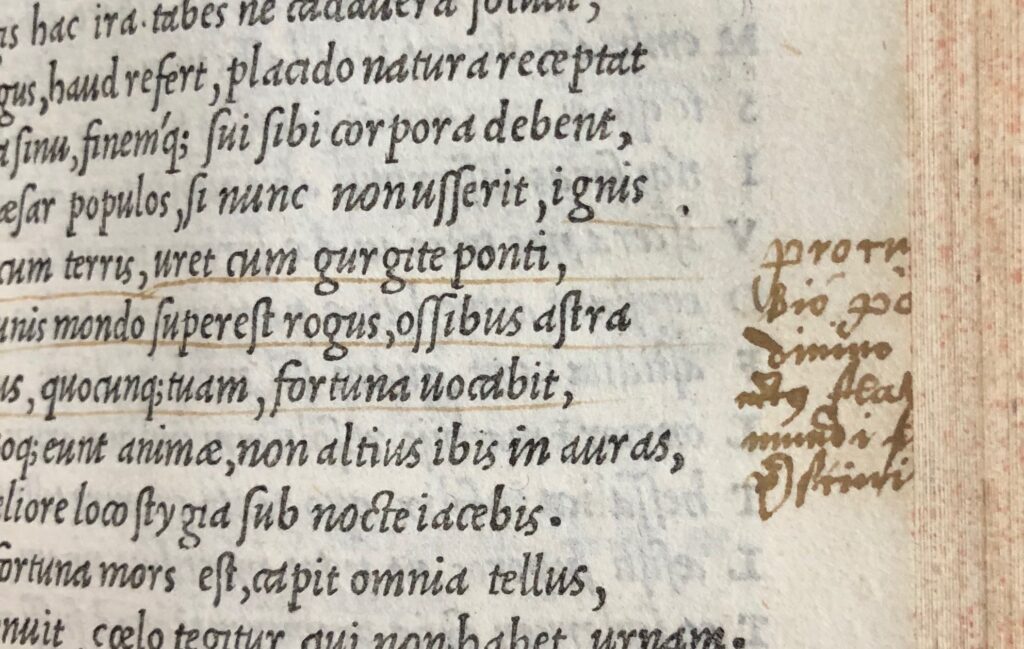
Aldus Manutius is, even to this day, considered one of the greatest printers in history, and is attributed to changing how the world would read, forever. His shop in Venice, Italy was a family f=run business between Manutius and his sons. He was the one who introduced curved italic type, replacing the cumbersome square Gothic print that was used at the time was one of his many world-changing achievements. Before Manutius began printing, books were only held in monasteries or within private collections. Manutius is credited for making the book accessible for those who would otherwise not of had the chance to see one, let alone learn from it. His printer mark is a dolphin wrapper around an anchor, this was inspired by the latin phrase “festina lente” or “hasten slowly.”
Physical Description
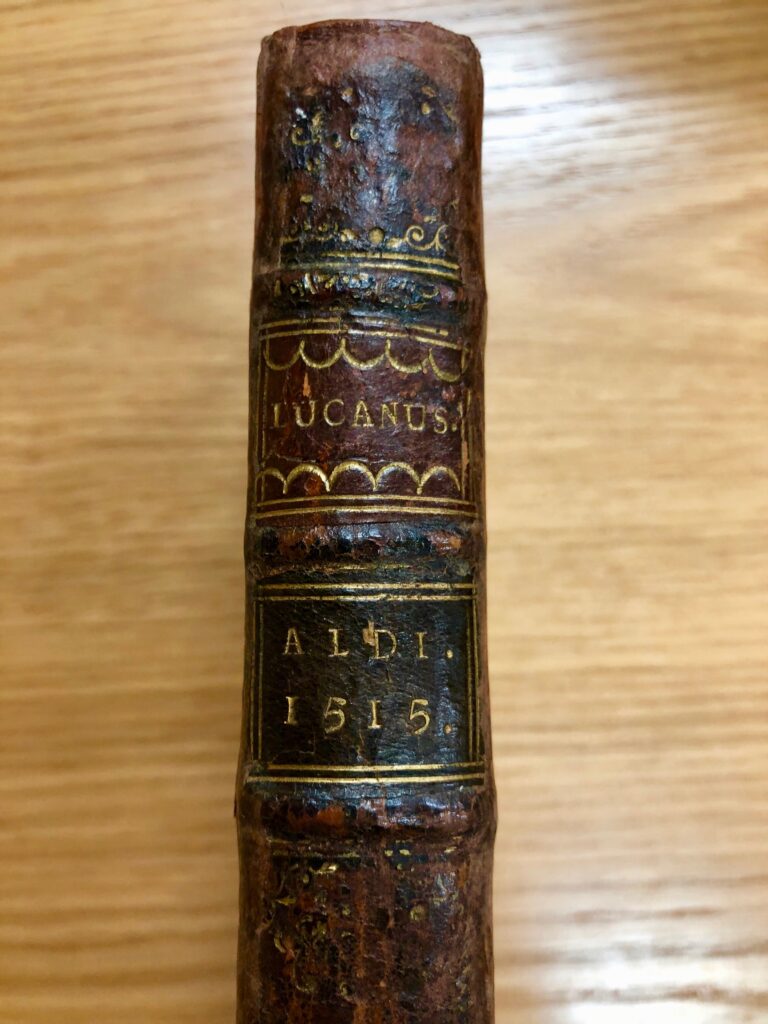
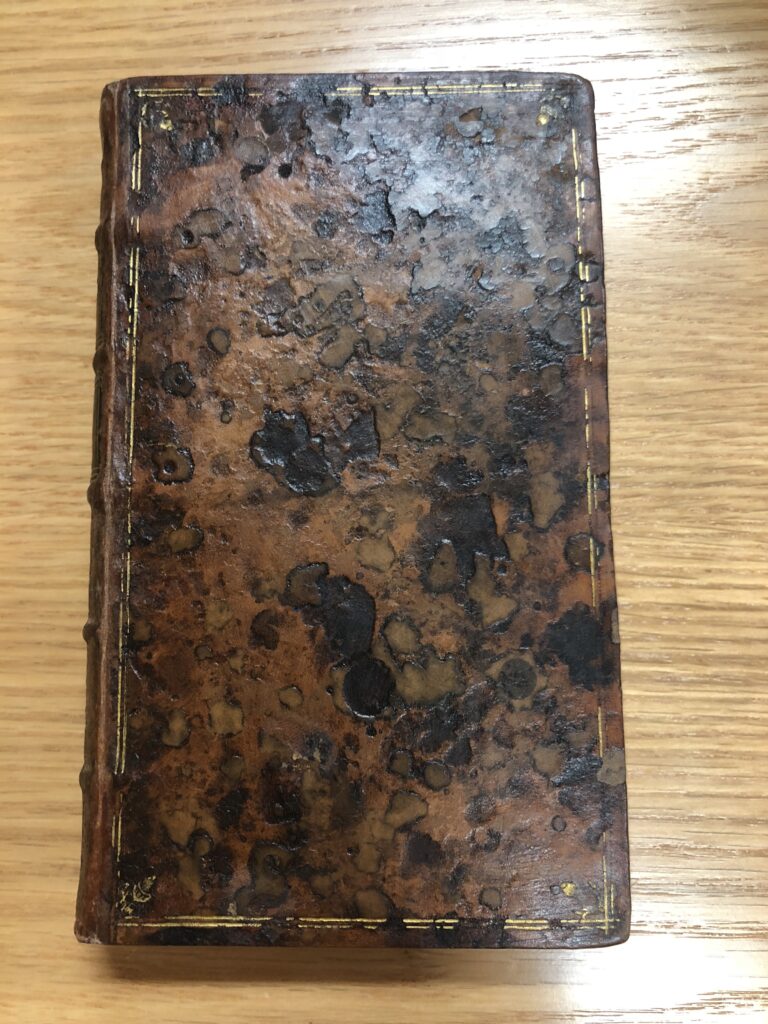
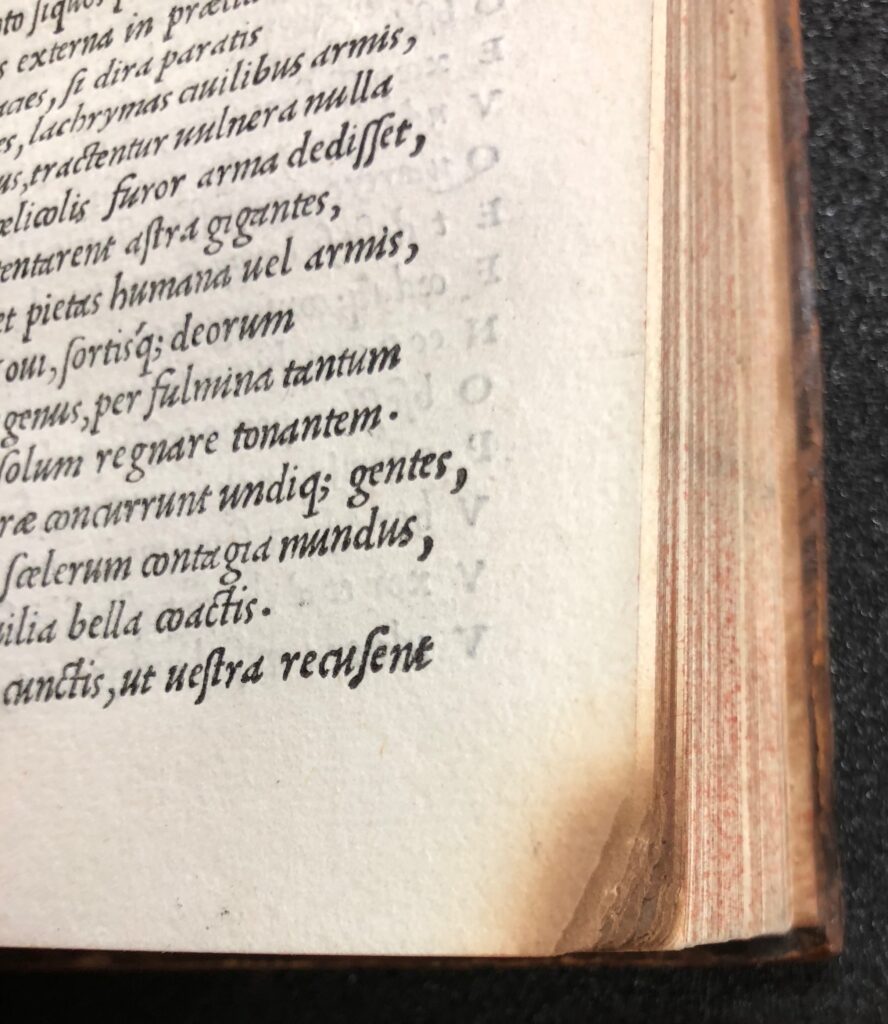
This piece is in excellent condition for being over 500 years old, which is largely due to the outstanding conservation efforts by the MSU Library Conservation Lab [see “Arrival at Michigan State”]. The cover has a crocodile grain likeness and is bordered with a thin gold embellishment. The spine also shares the crocodile grain likeness and gold embellishments; in gold is “LUCANUS” and “ALDI. 1515”. The Latin text itself is still clear and legible on the thin sheets of paper. There is some minor burn damage on a cluster of pages, but none of the text is damaged. There is no significant water damage or pest damage, which is highly impressive from a book from this time period, this is again, largely due to the fantastic efforts by the MSU Conservation Lab.
Significance
This piece is significant due to the fact that Lucan wrote is and Manutius published it. Both were considered revolutionary for their, Lucan was a master poet and Manutius for making books available for the “common person” and being credited with changing how the world would read for centuries to come. Though a book like this would of still be a type of luxury item, this was the first time that everyday people could own a book like this.
Arrival at Michigan State
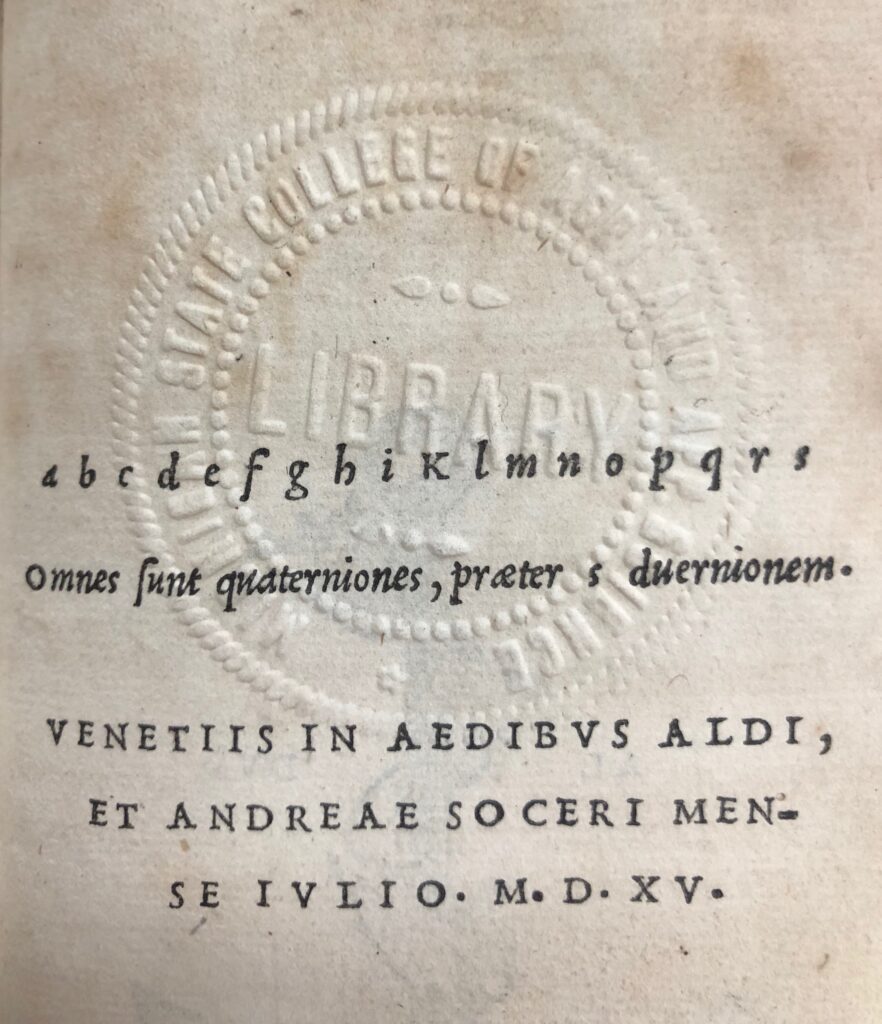
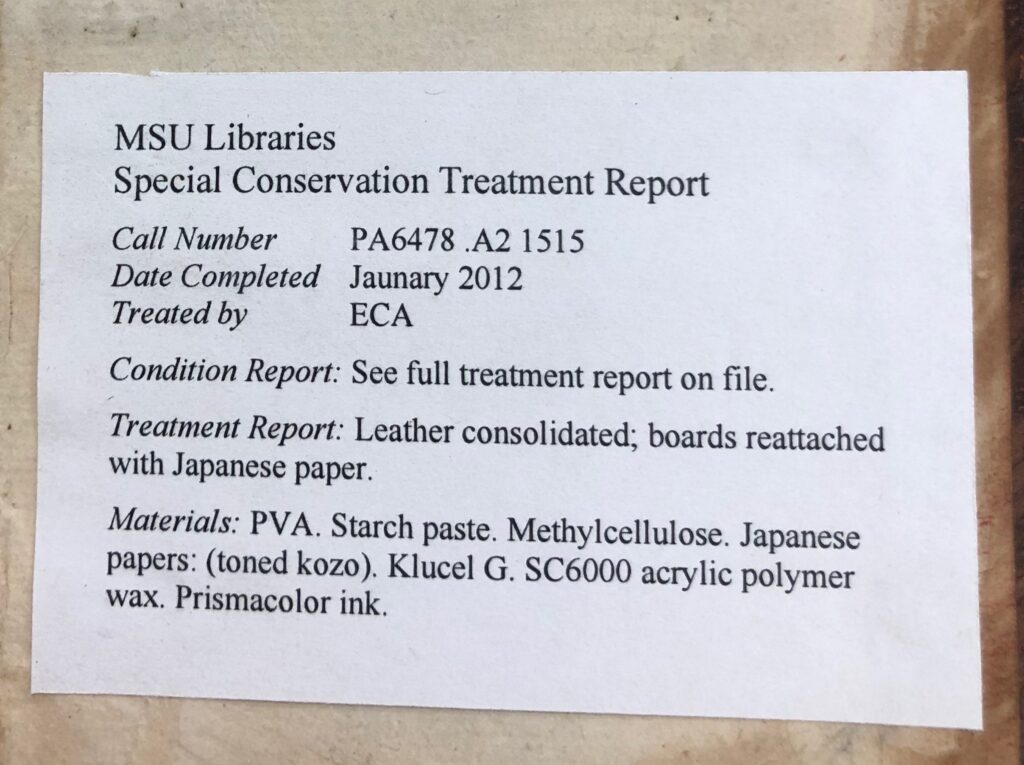
This book arrived at Michigan State between 1925-1955, when it was the Michigan State College of Agriculture and Applied Science. We know this due to the three embossed college stamps on three of the pages. In 2012, this piece went to conservation for treatment. It shows what was done to the book, who treated it, and the materials that were used.
Previous Ownership
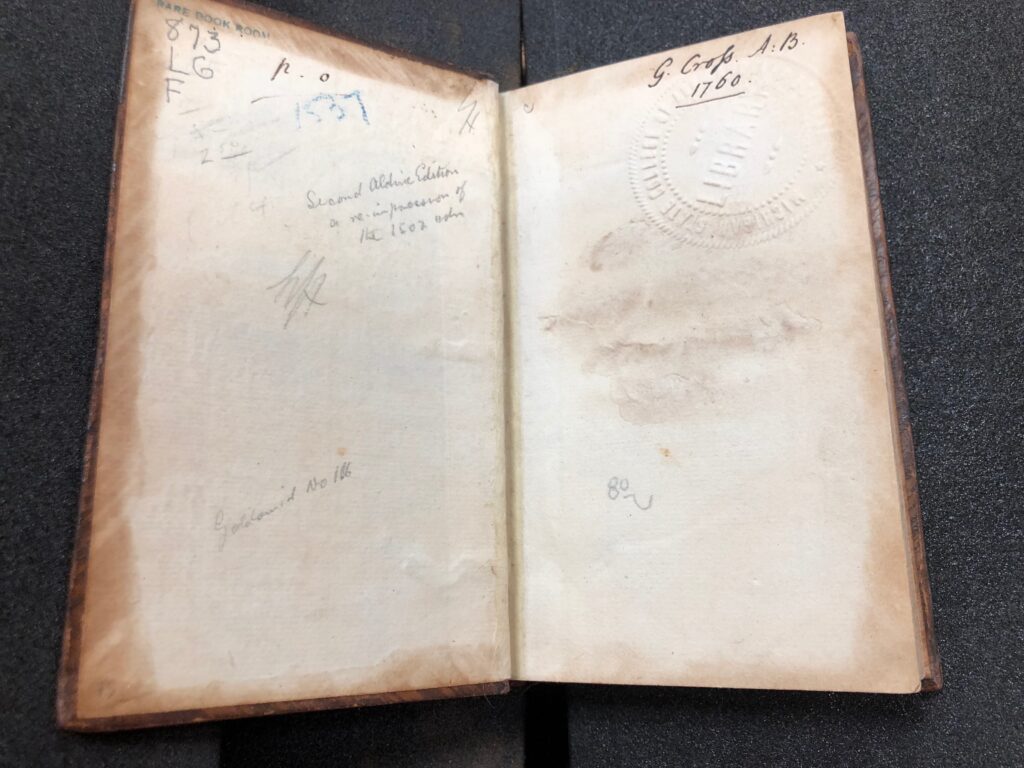
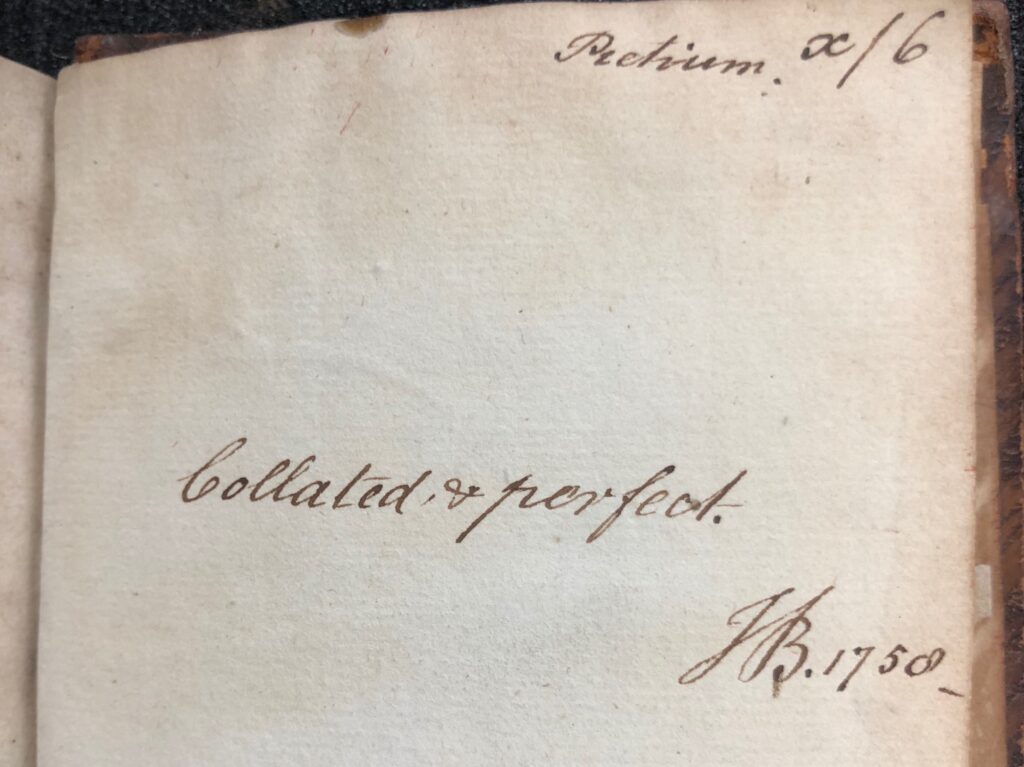
It is clear that this book has gone few a few owners, due to the various types of handwriting found on the inside covers of the book, as well as on the pages inside. There are many notes in margins of the pages, some even being upside down, as well as the first third of the book has consistent underlining of the text. The underlining fades out as we go deeper into the book, then resurfaces for the final few pages. On the back-board has some perfectly preserved evidence of this. It is also clear that this book was, in a way, “appraised”, in the 18th century [1750], in ink and clear handwriting, reading, “Collated & perfect. JB. 1750-“, which is a personal favorite characteristic of this piece.
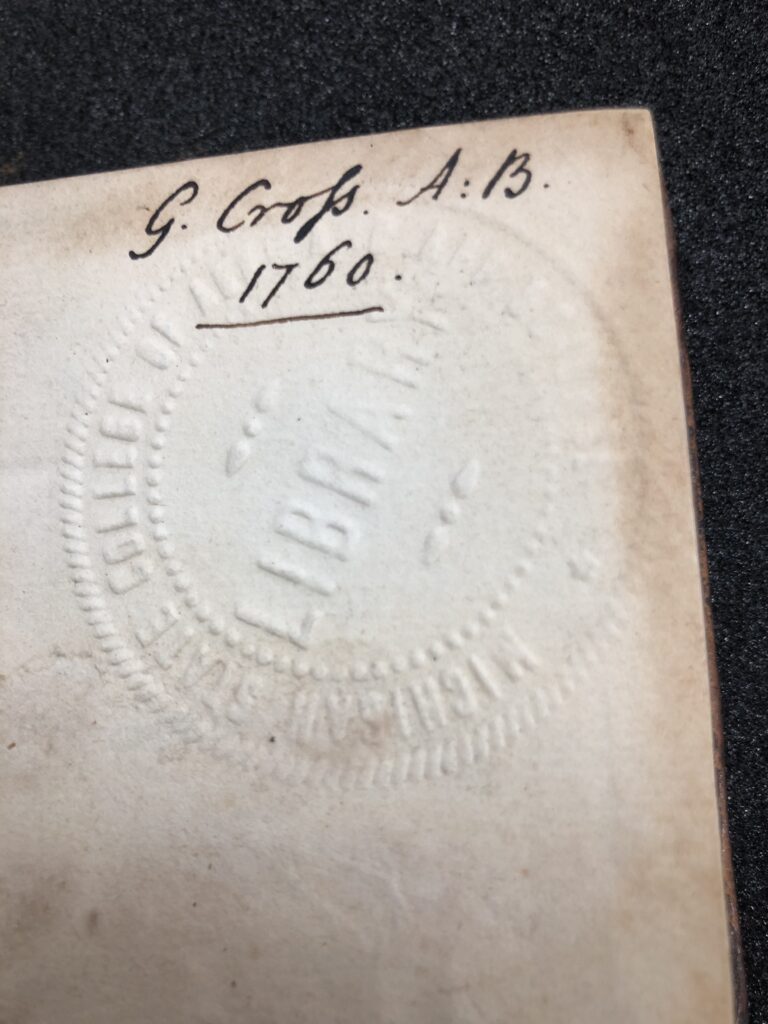
This book was also owned by a “G.Cross” in 1760, who had Bachelors of Arts degree. We know this because of the “A.B.” that he wrote after his name. Bachelor of Arts students are still using Lucan’s work to this day; does draw the question though, was he the one who wrote notes on the margins of the pages and underlined the text?
This piece is filled with writings from various people of different time periods, showing that Lucan’s work can transcend the ages, which would not have been possible without Manutius.
Sources:
BYU Special Collections. Aldine Checklist. Accessed October 14, 2018. http://exhibits.lib.byu.edu/aldine/Checklist.html.
Pharsalia (De Bello Civili) – Lucan – Ancient Rome – Classical Literature. Accessed October 13, 2018. http://www.ancient-
literature.com/rome_lucan_pharsalia.html.
“Books as a Commodity: 17th Century.” The Book: 1450 to the Present. Accessed October 13, 2018.
https://eduscapes.com/bookhistory/commodity/3.htm.
“Catalog.” Library Catalog. Accessed October 17, 2018. https://magic.msu.edu/search-/X?search=XX PA6478.A2 1515.
Congress. “LC Linked Data Service: Authorities and Vocabularies (Library of Congress).” LC Linked Data Service: Authorities and Vocabularies | Library of Congress. Accessed October 17, 2018. http://id.loc.gov/authorities/names/n79089234.html.
Nadeau, Barbie Latza. “The Man Who Changed Reading Forever.” Smithsonian.com. November 06, 2015. Accessed October 15, 2018. https://www.smithsonianmag.com/travel/aldus-manutius-printing-
typeface-typography-italics-venice-180956855/
Sanderson, Elaine. “Marcus Annaeus Lucanus.” Ancient History Encyclopedia. October 17, 2018. Accessed October 17, 2018. https://www.ancient.eu/Marcus_Annaeus_Lucanus/.
Project 2 Assignment by Gabriel R Seck for History of the Book [HST 475], 2018
