
On the Lover’s Confession
by John Gower
Printed by Thomas Berthelette, London, 1554
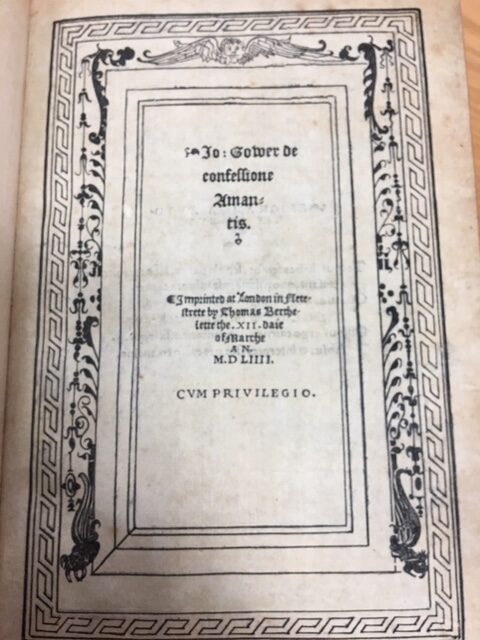
XX PR 1984 .C6 1554
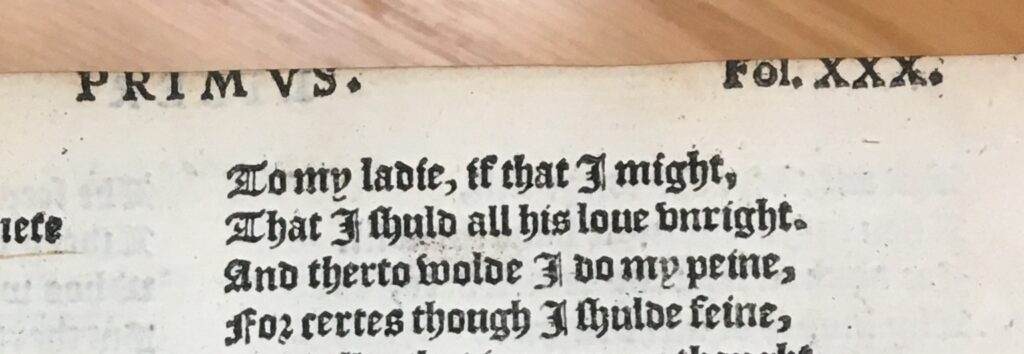
John Gower’s Confessio Amantis, written c. 1390, is a Middle English poem that describes a lover’s confession made to the chaplain of Venus in what the medievalist Russel Peck calls a “poem of consolation,” wherein the plot concerns the “search for repose.”1 It boasts some thirty-three thousand lines and is composed of many short stories, similar in style to Chaucer’s Canterbury Tales
About the Author
Gower (c. 1330 – 1408) was an English poet of several notable works, including Vox Clamantis and Speculum Meditantis, the former of which is a Latin work containing moral essays, and the latter consisting of a French poem, comparable in length to Confessio Amantis.
Friendship with Chaucer
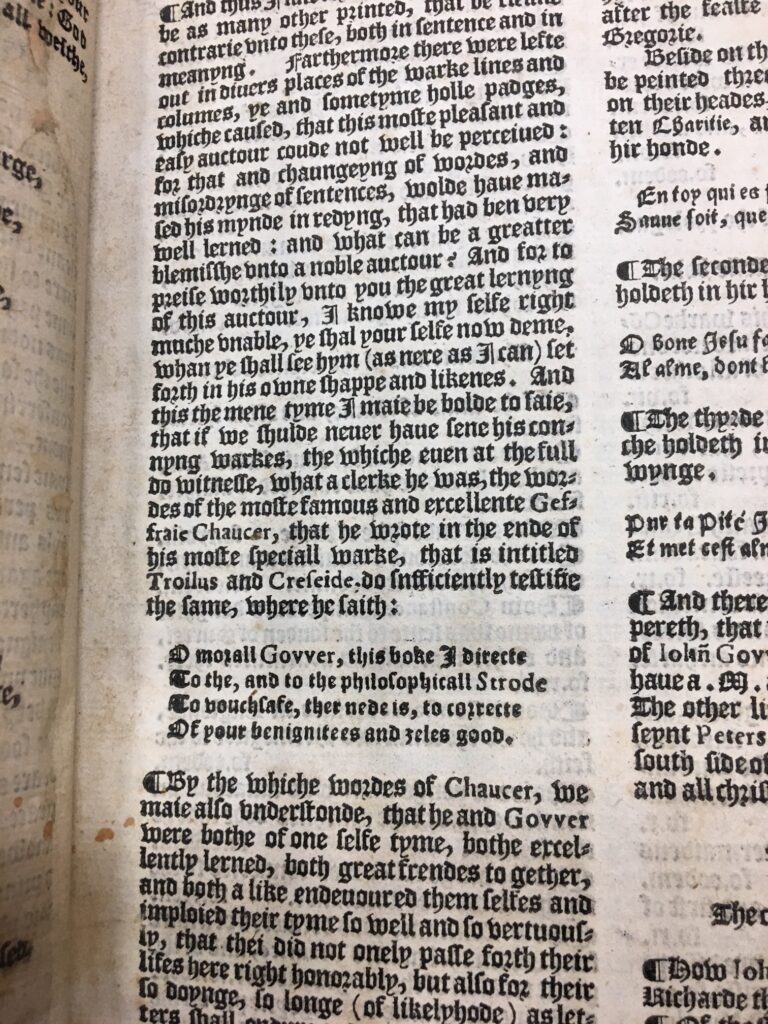
Throughout Gower’s life, he maintained a friendship with Geoffrey Chaucer. Power of attorney would be granted to Gower when Chaucer traveled aboard in 1378, and Chaucer would dedicate Troilus and Criseyde to “moral Gower.”2
Historical and Literary Significance
Confessio Amantis is a significant work in the field of Middle English literature. Written shortly before Chaucer would start his Canterbury Tales, Gower’s lengthy poem would be successful in its own time; forty-nine manuscripts survive, a little more than half of the number of surviving copies of the Canterbury Tales.3
With the age of the printing press, Gower’s Confessio would find itself still being reproduced and read. William Caxton (c. 1422 – 1491), who was a printer of English literature and whose influence on such can be described as immense, would print Confessio Amantis alongside the Canterbury Tales in the late fifteenth century. It is noted that Caxton’s work was “the staple reading of most literate persons.”4
Edition
At the time of the printing of this book, only two prior editions of the text in printed form had existed. The first publication of Confessio was created in 1483 by William Caxton.5 The second would not come until 1532, when Thomas Berthelette would print it. The third edition, also printed by Berthelette, would be produced in 1554 and would include further modernization in English spelling.6 Due to its date of publication, the book discussed here is a third edition of Confessio Amantatis
MSU’s Edition
Physical Description and Overview
The book itself is in good condition, with a lack of any significant tearing or irrecoverable damage to the pages. However, throughout the entirety of the text there is frequent foxing, along with water damage present on many pages. This water damage has clearly stained the paper on the affected pages, but it does not interfere with the legibility of the text. There is significant staining on the outer margin of the majority of pages, probably caused by repeated reading of the text.
Binding and Binder
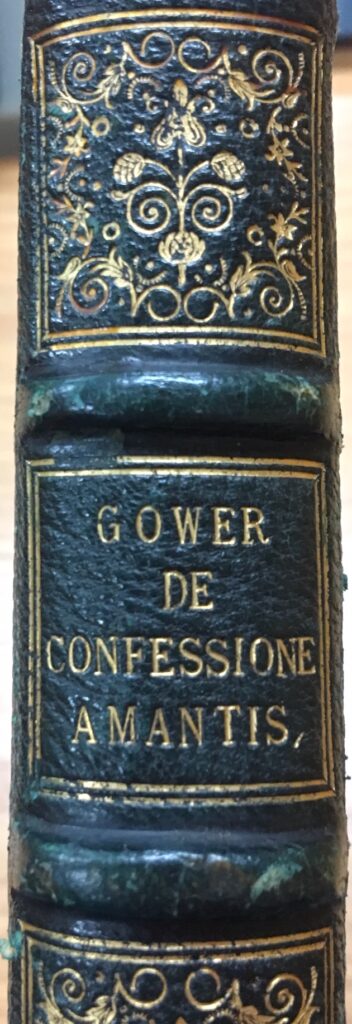
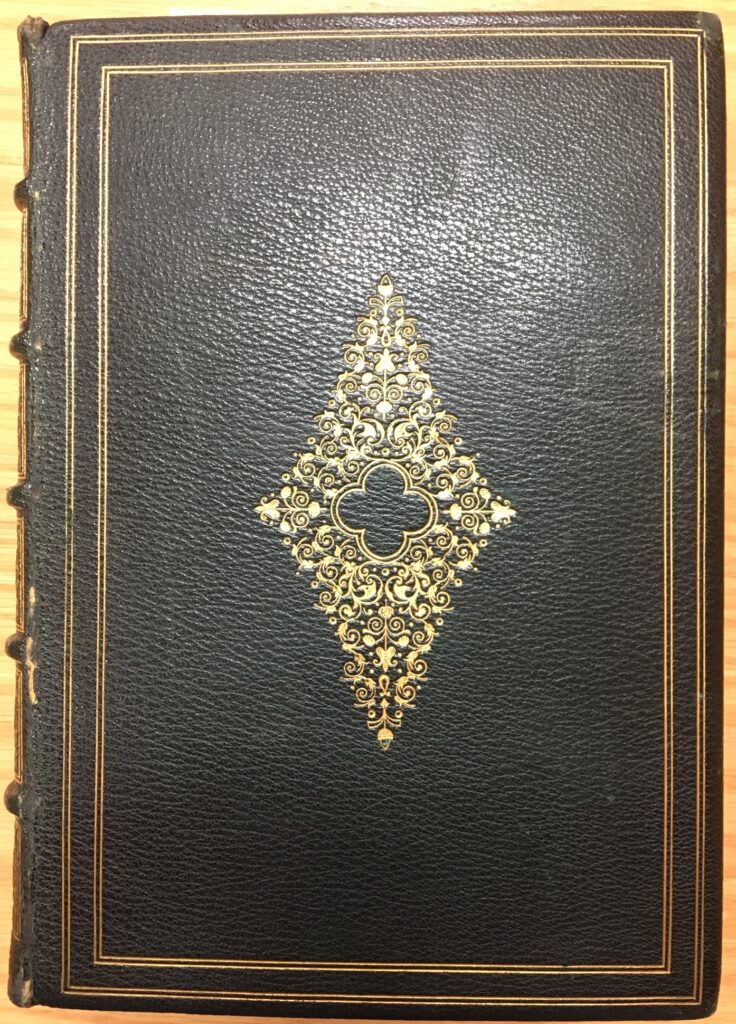
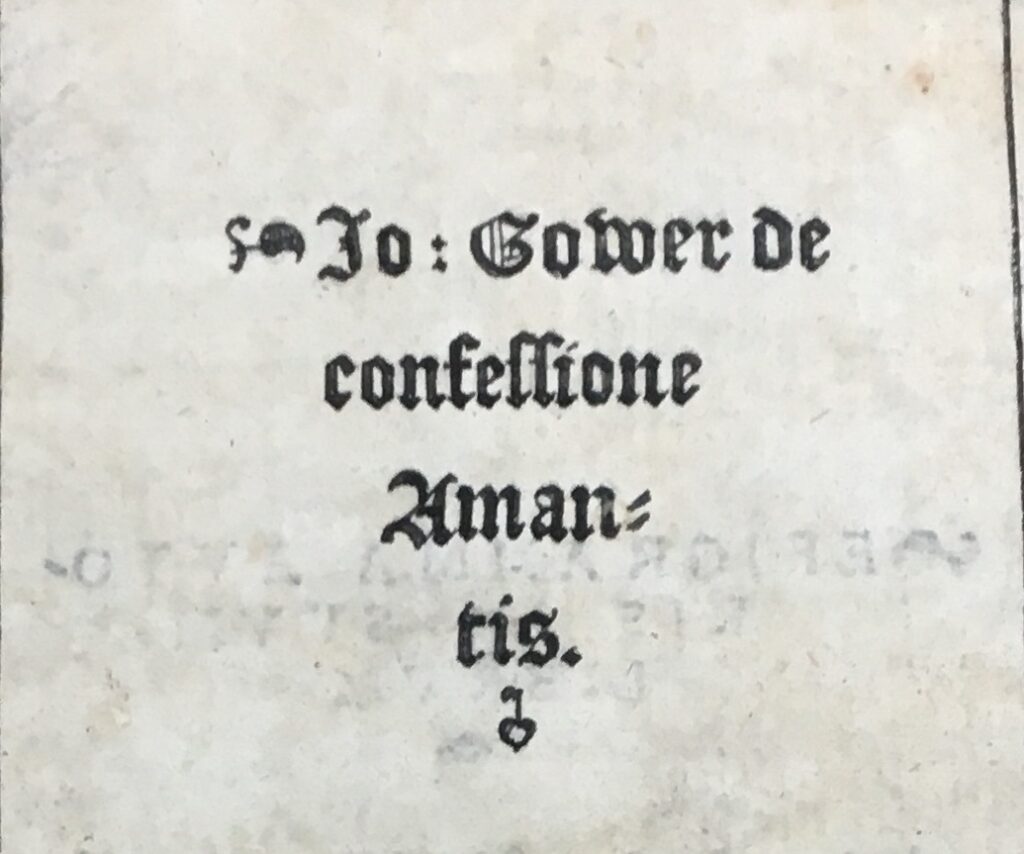
This edition of the text is finely bound in a dark green leather, embossed in gold leaf both on the covers and the spine, and it has marble end-papers. The binding is in excellent condition, and it is therefore no surprise that this book has been rebound. Evidence of this is numerous: many pages have been cut in order to fit the new binding, along with a stamp on the front free end-paper recto which states “Bound by Riviere.” It should be noted that when the book was rebound it seems that the original title page was also removed; the current title page is a pen facsimile.
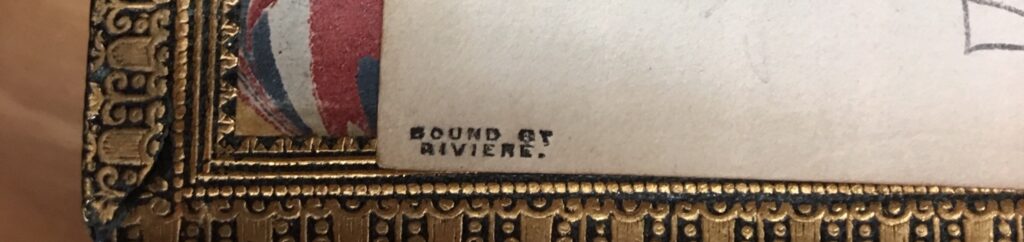
Robert Riviere (1808 – 1882) was a prominent English bookbinder descended from a French family. He is well known for his fine bindings, rebinding the Domesday Book, and his work for both English nobility and the royal family.7 In 1840 Riviere started a bookbinding business in London. Despite the fact that he also bound books prior to 1840, it is likely that the majority of his work took as a bookbinder took place in between 1840 and his death in 1882.8 As such, the binding on this copy of Confessio Amantis can be dated approximately mid-nineteenth century. Riviere’s reputation for fine binding alone makes this book a valuable historical artifact and example of the rich history a book can have.
Confessio or Confessione?
Though the work was originally entitled Confessio, this edition of the text has made a slight modification of the title. Rather than the intended The Lover’s Confession, the title page in this book reads John Gower On the Lover’s Confession. This change conveys the same meaning, and it is not clear why the creator of the facsimile title page decided to write it as such.
Provenance, Inscriptions, and Ownership
Booksellers
According to the MSU library online catalog, this book was purchased by the university from H.M. Fletcher in 2017.9 The exact lineage of ownership before this seller is unknown, though there is a glued clipping from a book catalog on the recto of the rear free end-paper. This clipping indicates that the book was sold G.H. Last in June of 1920 for just over £5.
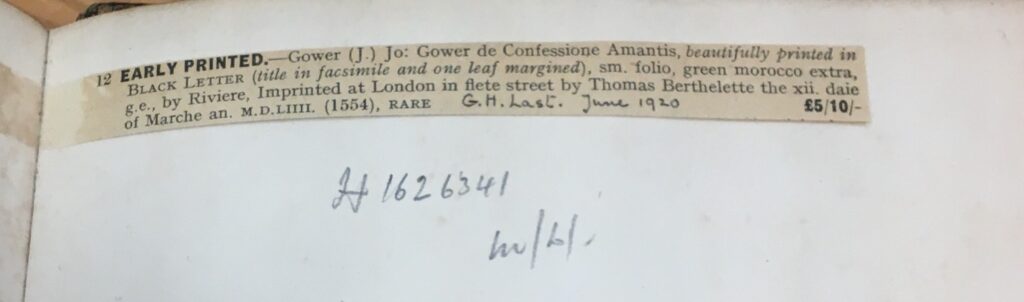
George Herbert Last (1877 – 1949) was an English bookseller who served as the president of the Antiquarian Booksellers’ associations. His catalogs were well known in his day and he is reported to have sold to many institutions.10
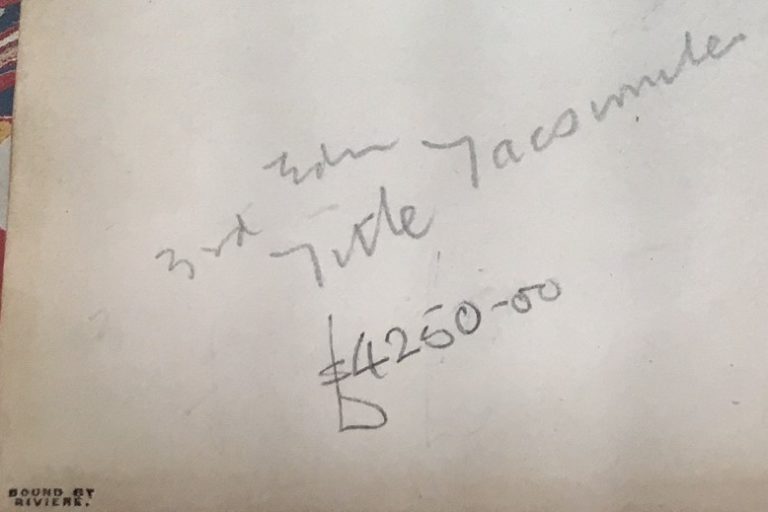
On the front free end-paper recto, there is an inscription that notes the edition of the book, its facsimile title page, and a price that it was presumably sold for (£4250). This is likely the mark of H.M. Fletcher
The Bookplate
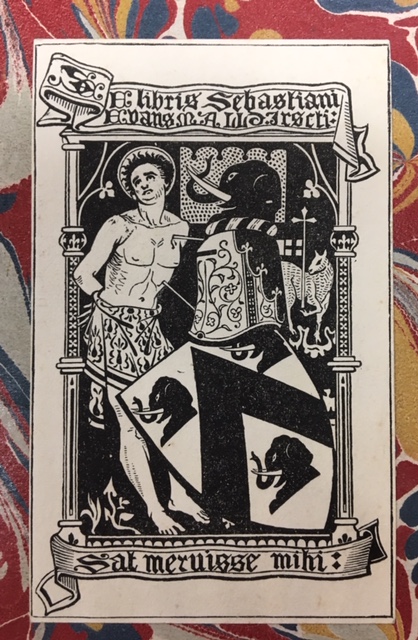
Perhaps the most striking evidence of ownership is a bookplate, located on the front paste-down. It reads: “Ex libris Sebastiani Evans,” and has written below it his motto, “sat meruisse mihi” (“to have been meritorious [worthy] is enough for me”).11 Depicted in the center is a representation of the martyrdom of St. Sebastian, along with a shield adorned with three elephants and an inverted chevron. Also present is a banner with a similar elephant, a helmet with a floral pattern, and a lamb holding a cross of unknown design.12 Due to the nature of this scene, the bookplate cannot be described as purely armorial.
Sebastian Evans (1830 – 1909) was an English journalist, political activist, and bibliophile. Well known within literary circles, among his friends were Newman, Huxley, and Darwin. He composed several artistic works, three of them being separate collections of poems. Evans was also a proficient translator of several languages, including French, Latin, and Greek. He had a keen interest in Medieval literature and a fascination with the Holy Grail, about which he published The High History of the Holy Graal.13 Given that he lived in the nineteenth century and was more or less contemporary to Riviere, it is probable that it was Evans who had Riviere rebind the book, and then after that he marked it with his personal bookplate.
W.W. Greg
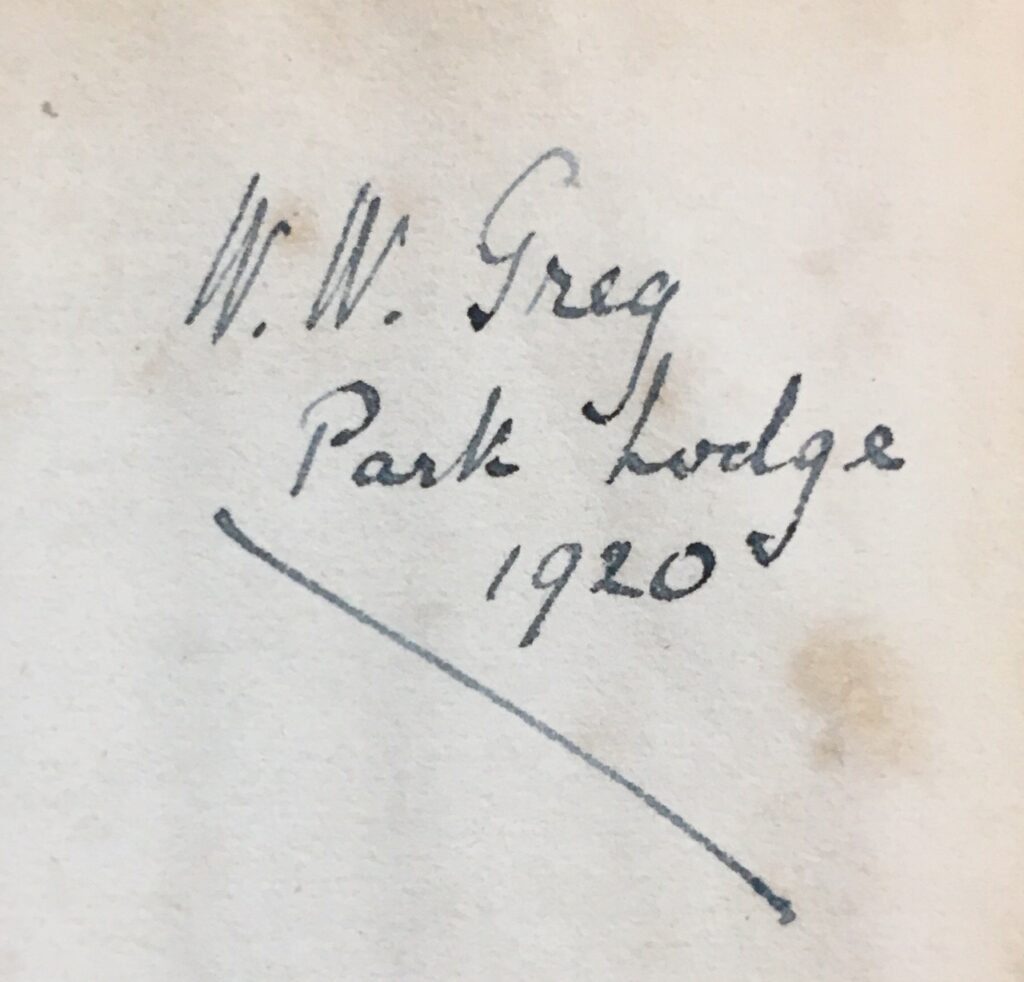
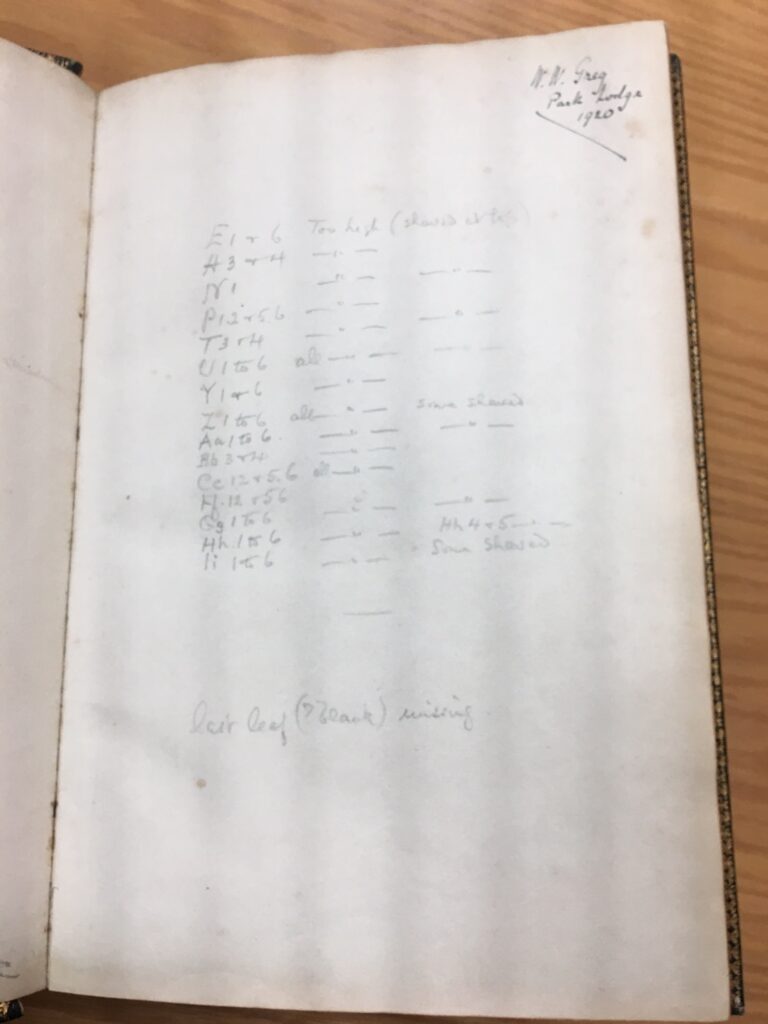
On the front end-paper verso is an inscription by W. W. Greg, written in 1920. This is likely the mark of ownership Sir Walter Wilson Greg (1875 – 1959), an English scholar of Shakespeare and bibliographer, who professionally was known as W. W. Greg.
On the front fly-leaf verso, there are several inscriptions that seem to be bibliographic notes, with one inscription explicitly stating “last leaf missing.” This inscription in pencil is similar Greg’s hand, and given his bibliographic background it is likely that he was author of this inscription.
John, a Good Fellow
There are a few inscriptions in the text that concern a man named John. At first glance one might be tempted to conclude that this was just an owner writing his name in the text; however, a certain inscription tells the reader that John is a good friend. perhaps this John was indeed a good friend of a previous owner. It should be noted that the two inscriptions do not look exactly of the same hand, with the one being written far neater than the other. It is possible that these inscriptions are by two different owners, with no correlation between them.

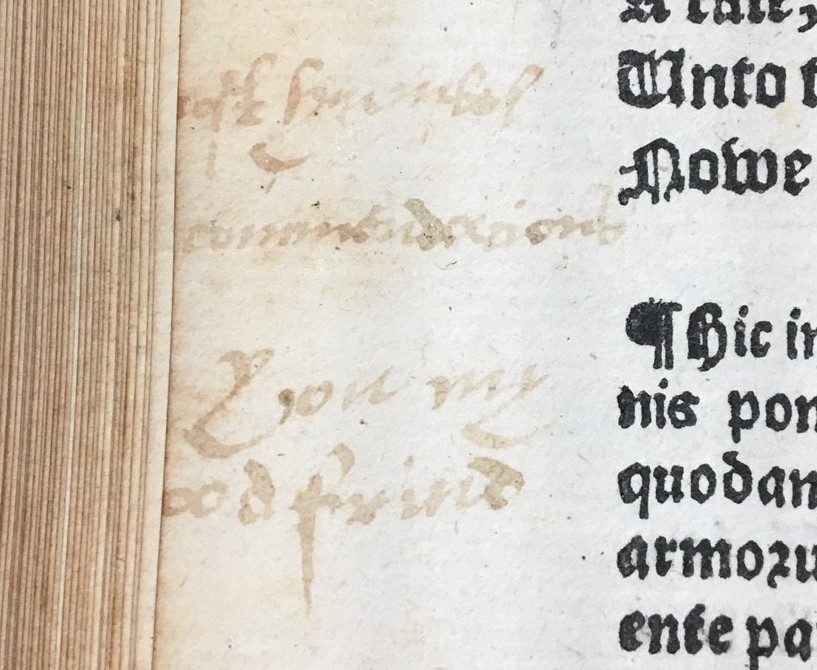
There is also another interpretation of the above picture. According to the Special Collections Providence Handbook reference on handwriting, the letter representing “J” here may be more closely related to “Y” If that is the case, then the “n” in John is more likely a “u,” changing the meaning of the inscription entirely to “You my [g]ood frind.” It is not clear, however, what exactly the writer intended to convey.
Rear Fly-Leaf Recto
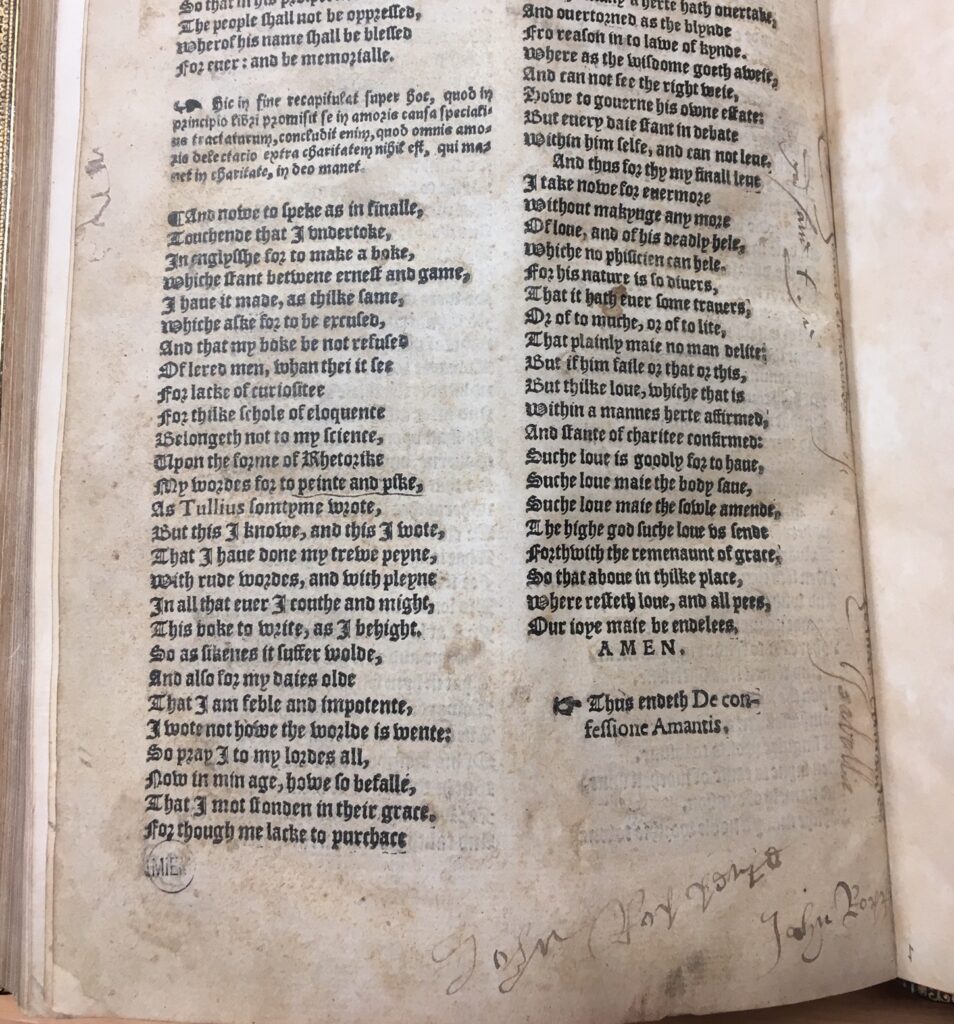
The rear fly-lead recto contains several inscriptions from at least three hands. “Isabella,” Thomas edmundes,” and “John Ropper [?].” These may all indicate ownership, and from this one can deduce that the these three hands may all be different owners of the text. There are other inscriptions on this page, but they are unidentifiable. There is also the possibility that this “John” is the same as the supposed friend of the owner; which would suggest John was an owner who was writing about himself.
Other Inscriptions
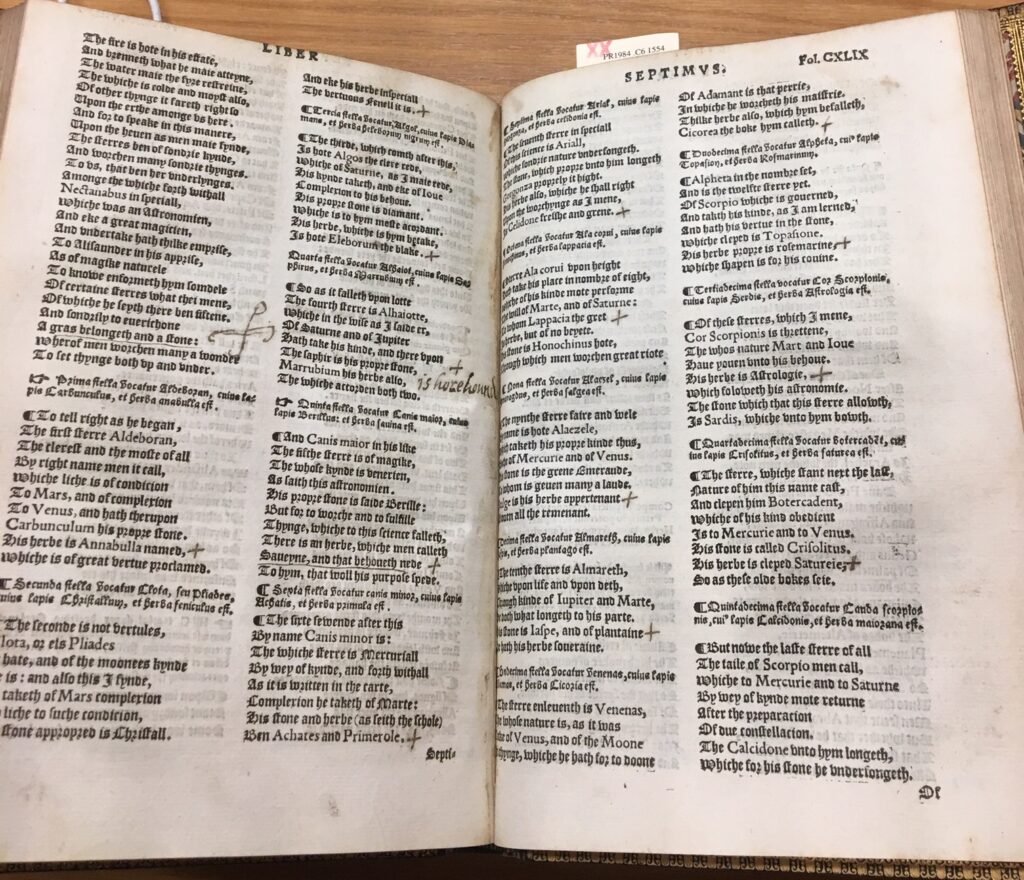
Throughout the text there is frequent underlining and other marginalia, some of which is unidentifiable. One particular case of this on the verso of Fol. CXLIX and the recto of Fol. CXLVIII. On these pages there are various crosses inscribed at certain points throughout the text, though it is not obvious what exactly they are denoting. There is also an inscription that reads “is horehound [sic].”
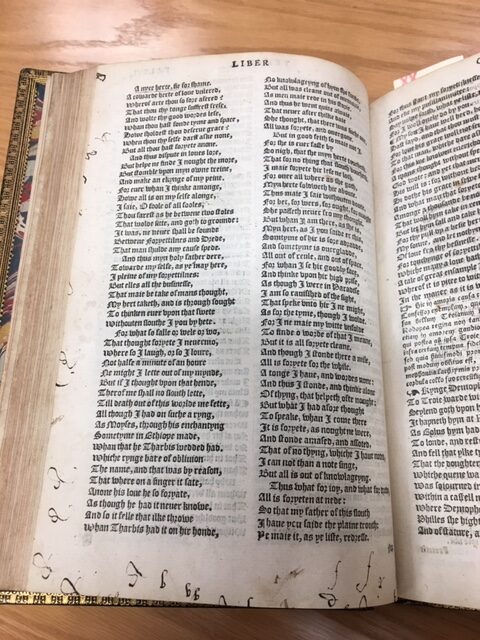
On the recto of Fol. LXVI there are several markings, probably pen trials. In this case the one who wrote them was trying their pen on various letters. Due to the pages being cut when the book was rebound, some of these markings are missing the full inscription.
The front end-paper recto contains an inscription that notes the facsimile title page. This hand, written in pencil, does not seem to be Greg’s.
Repairs
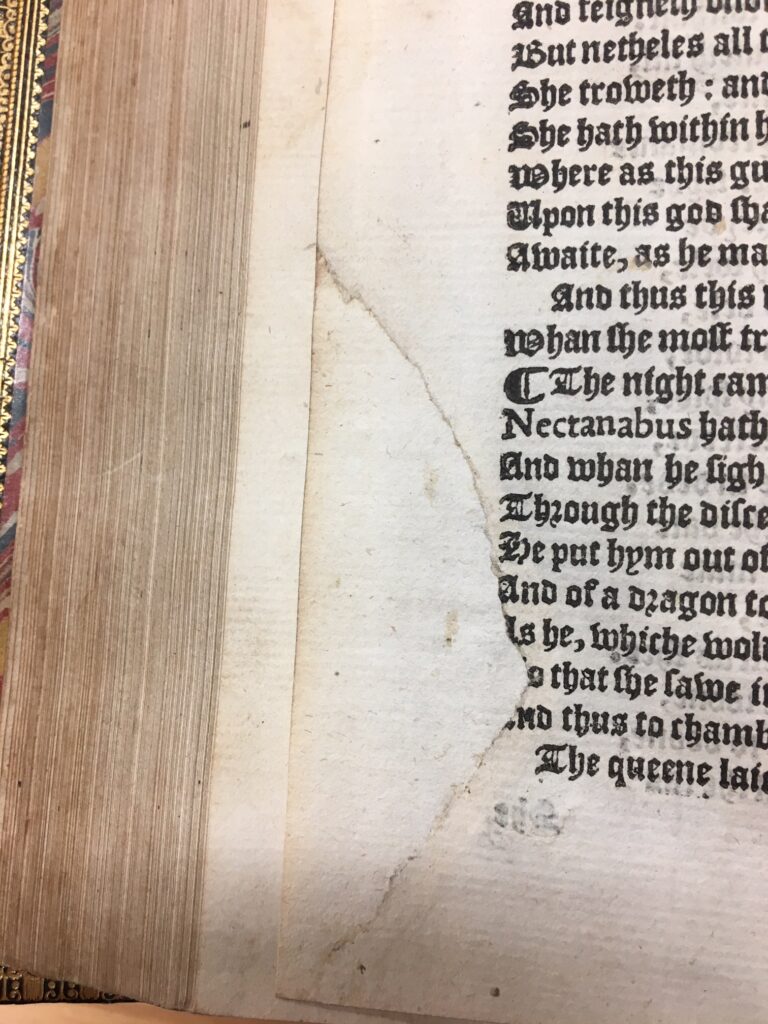
On Fol. CXXXVIII there is a tear in the lower lower outer margin, obscuring part of the original text. This was repaired at some point, though nothing was done to restore the text. This is the most visible repair throughout the book, with there being several minor ones present at various pages.
References
1 John Gower, Confessio Amantis, ed. Russel Peck (Holt, Rinehart, and Winston: 1968), p. xi.
2 Ibid., p. xxxii.
3 G.C Macaulay, The Works of John Gower, (Oxford, Clarendon Press: 1901), p. vii.
4 Encyclopaedia Britannica, “William Caxton,” (Encyclopaedia Britannica).
