
XX PR3412 .D7
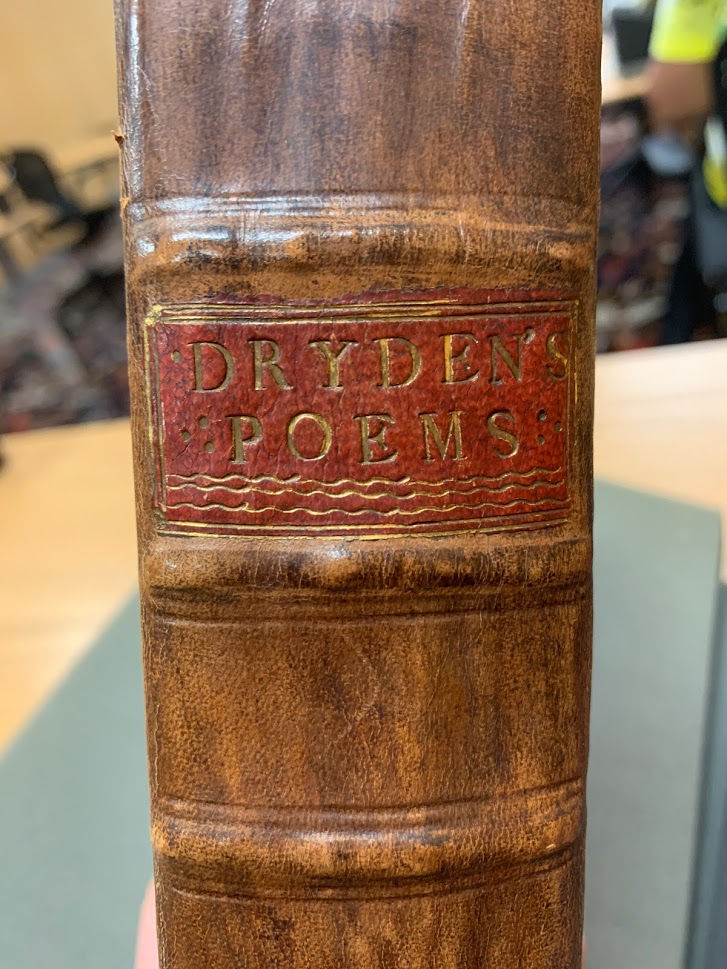
This contemporary calfskin-bound volume of Dryden’s Poems includes eight pamphlets of poems by John Dryden and others. John Dryden was a famous English poet and playwright who in 1668 was named England’s first Poet Laureate.1 Dryden was part of a small literary society which was founded by Wentworth Dillion, 4th Earl of Roscommon2, though this small circle was disbanded after his death. The poems range in date from 1681 to 1688 and were published in London. The poems included in the collection are Annus Mirabilis (1688), Absalom and Achitophel (2nd edition), The Medal (1682), The medal of John Bayes (1682), Religio Laici (1682), The Hind and the Panther (1687), The Revolter; a trage-comedy (1687), and An Essay on the Translated Verse (1687) by Roscommon. Throughout this book are several blank leaves as well as heavy annotation. Full poems and letters are written in manuscript by previous owners, along with notes in the margins of some of the printed poems.
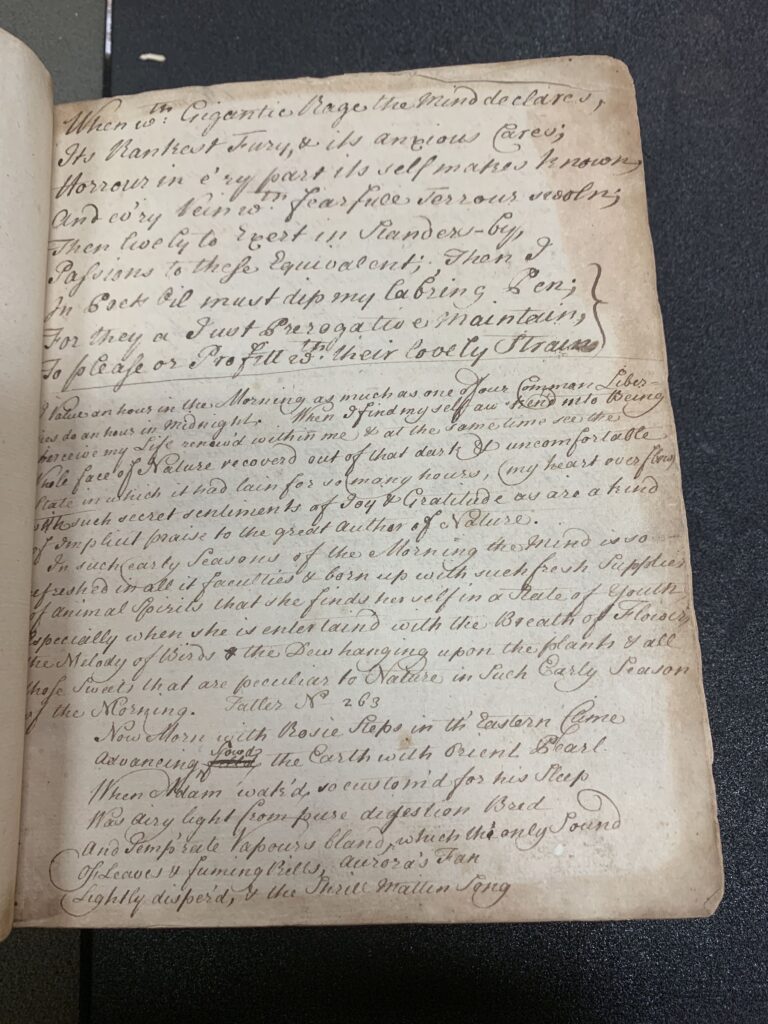
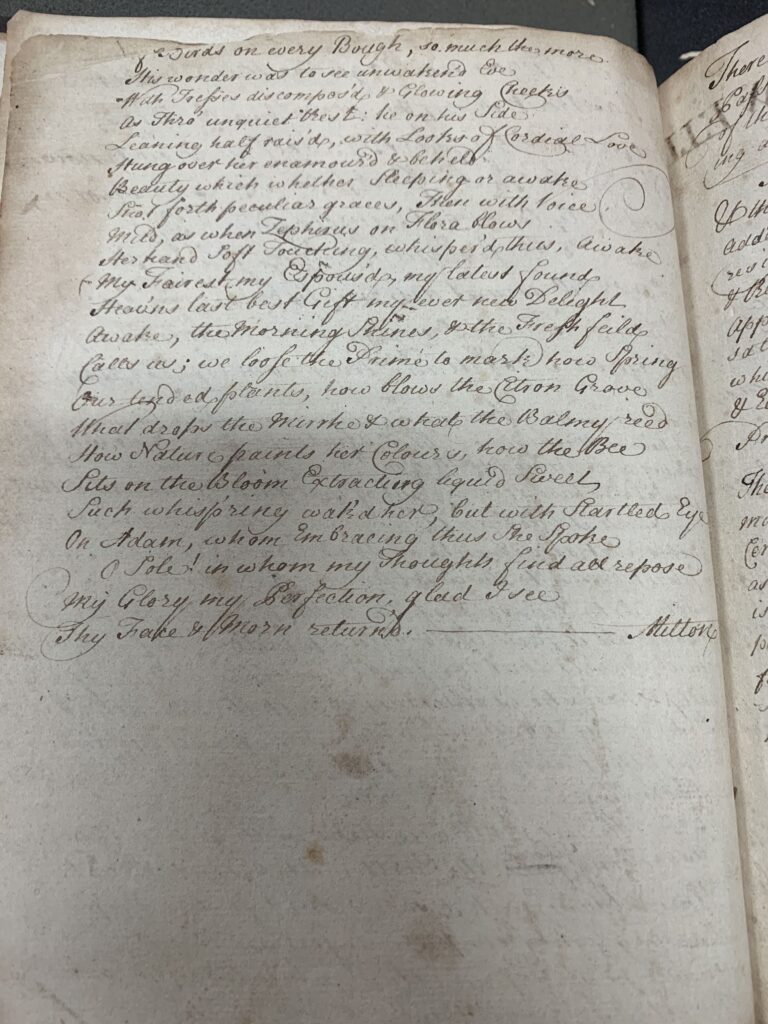
While the first printed poem in this volume is Dryden’s Anus Mirabilis, there are several pages of manuscript on the pages before it, most of which are direct quotations from other publications, including The Tatler no. 263 (a volume from a British literary and society journal founded by Richard Steele in the early 18th century) and John Milton’s Paradise Lost, a personal favorite of the Earl of Roscommon3. Though Milton’s Paradise Lost was published in 1667, that particular volume of The Tatler was published on December 14, 1710 (i.e. after John Dryden’s death in May 1700), meaning that Dryden himself was not responsible for any of the annotations at the beginning of this book. This does, however, indicate that the original owner had this book in their possession in the early 1700s.
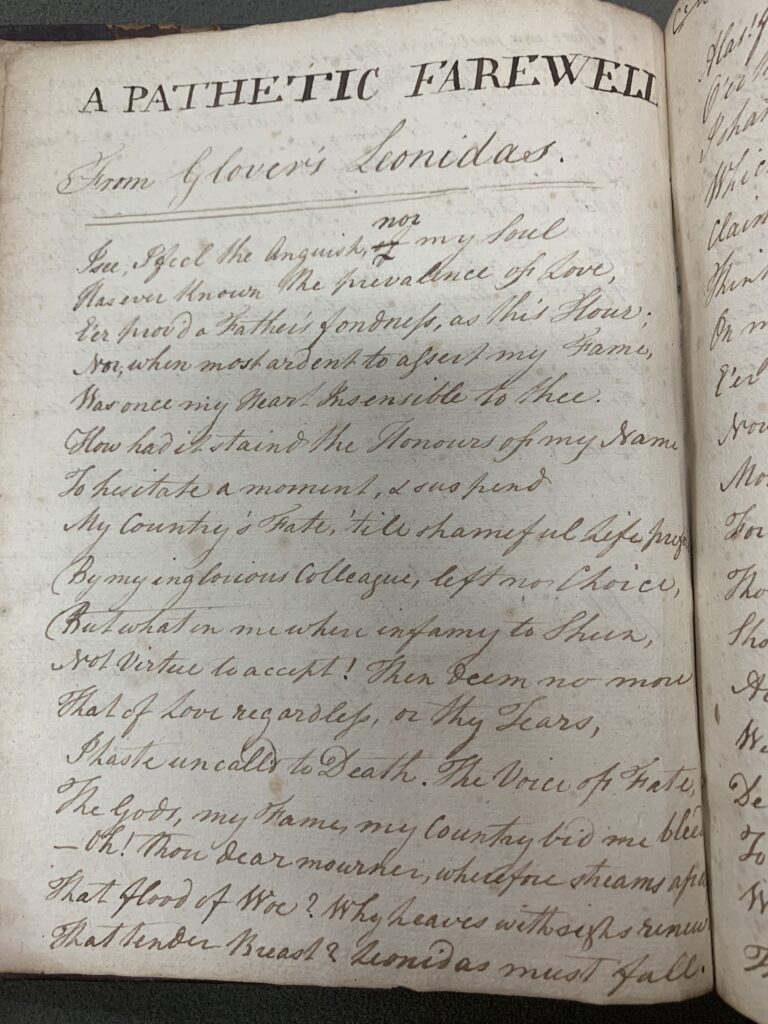
In the pages following the quotations from The Tatler and Paradise Lost is “A Pathetic Farewell” from Glover’s Leonidas. While poem is also written in manuscript, there are subtle differences in the handwriting that indicate a different person (and potentially different owner) wrote this addition. “A Pathetic Farewell” was written in 1737, again telling us that the owner at this point had this book in the late 1730s/onto the 1740s.
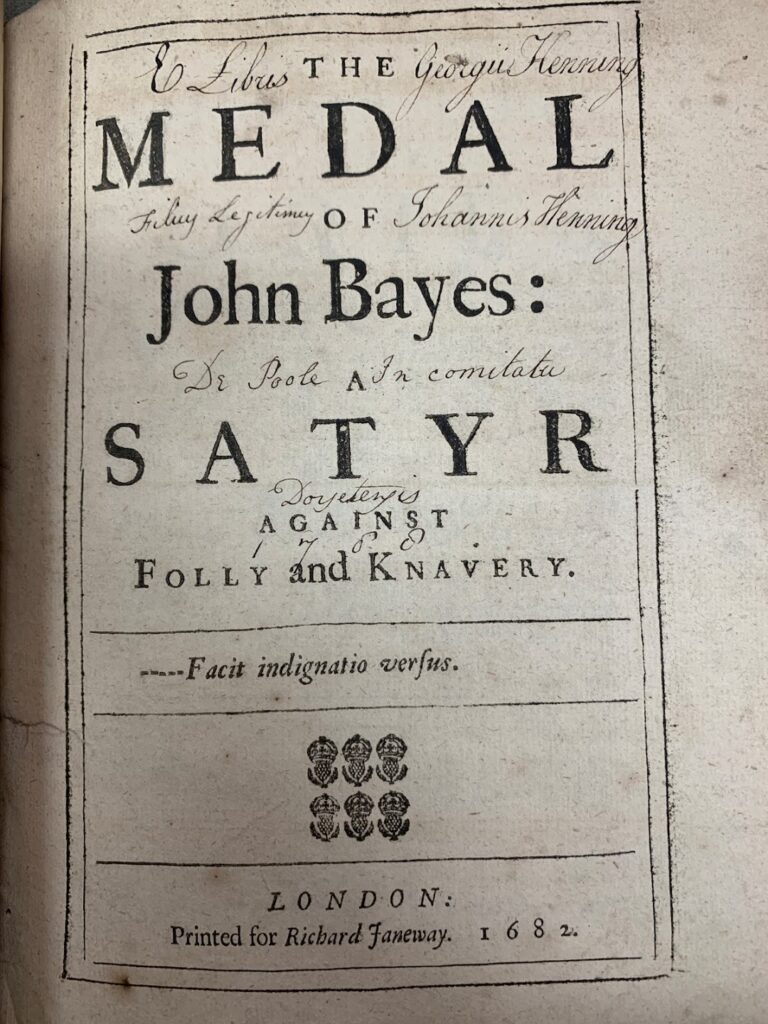
The most telling piece of provenance lies on the title page of The Medal of John Bayes: A Satyr Against Folly and Knavery, the fourth pamphlet in the book. This is the only explicit instance of ownership with “E Libris Georgia Henning… Johannes Henning” handwritten onto the page. The year 1788 is also written towards the bottom of the page, bringing us now to the late 18th century. While no information can be found about these owners, it is exciting to have our biggest clue about the history of this book.
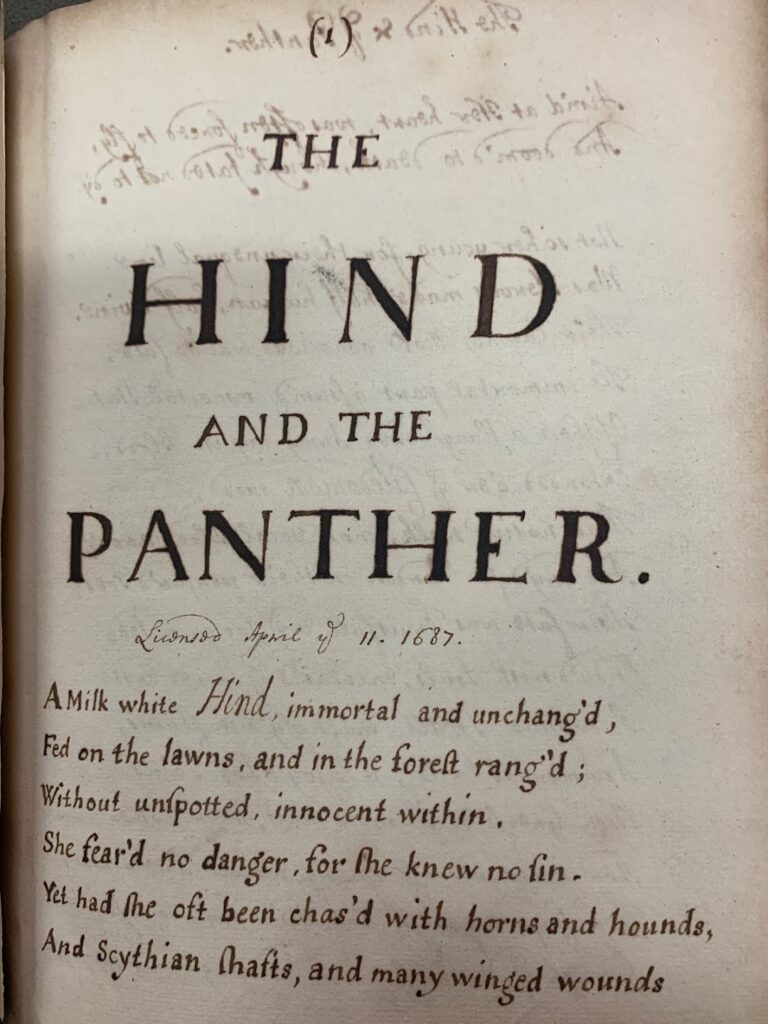
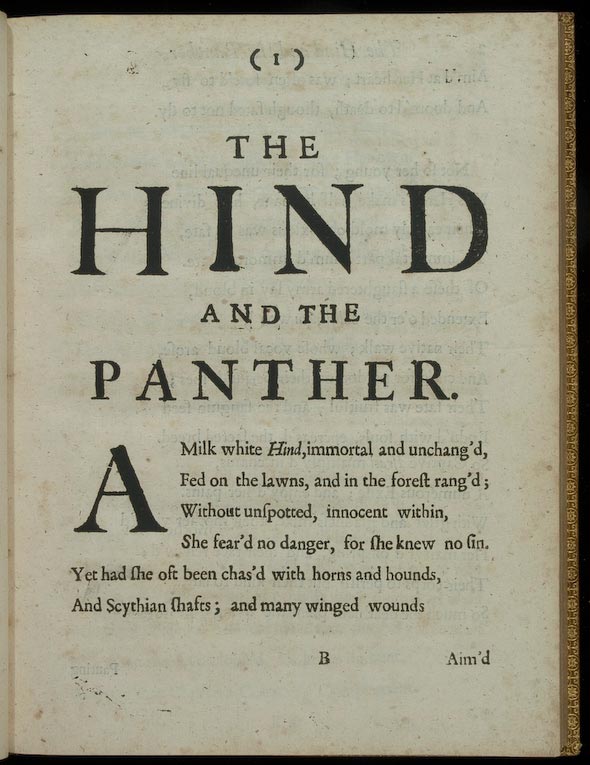
The sixth pamphlet in this book is a version of Dryden’s The Hind and the Panther, one of Dryden’s longest poems. This allegory in heroic couplets was one of the outcomes of Dryden’s conversion to Catholicism during the accession of the Roman Catholic King James II in 1685,4 which sparked controversy amongst many Protestant writers due to beliefs that Dryden converted for political reasons. The contents of The Hind and the Panther, however, presents evidence that Dryden’s switch to Catholicism stemmed from genuine conviction rather than politics.5 Most of the pages from this poem are missing from the book, so a previous owner handwrote the first four pages and the last twelve pages onto inserted leaves to fix this. This owner even went as far as to replicate what the title page would look like, showing the personal importance that this poem had on the owner.
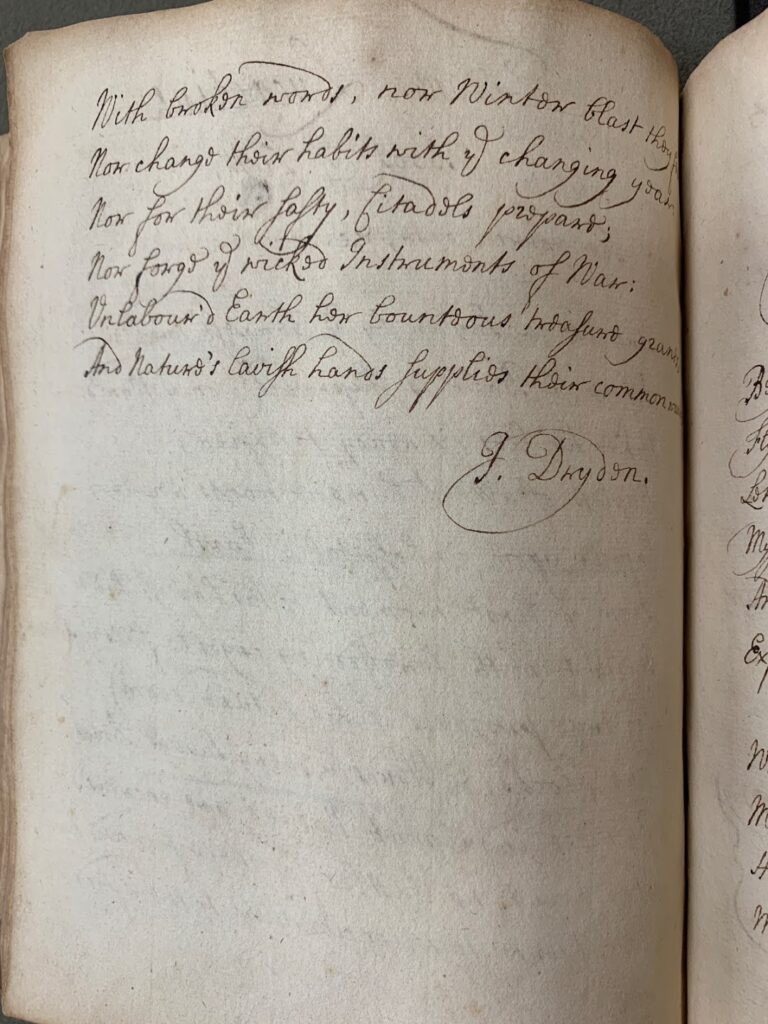
The last hundred pages of the book are exclusively in manuscript, and include a passage from Lucretius, signed J. Dryden, and a copy of “To Mr. Dryden on his ‘Religio Laici”, which is a poem by Dryden included earlier in the book. These two poems are written in the same handwriting, and while the first speculation may be that John Dryden himself transcribed these passages, this is quickly disproven after a quick comparison of his signatures from letters addressed to close friends of Dryden. The comparison of the signature in the book versus the letter to his cousin Elizabeth Steward and the letter to his favorite publisher, Jacob Tonson8 can be seen below.
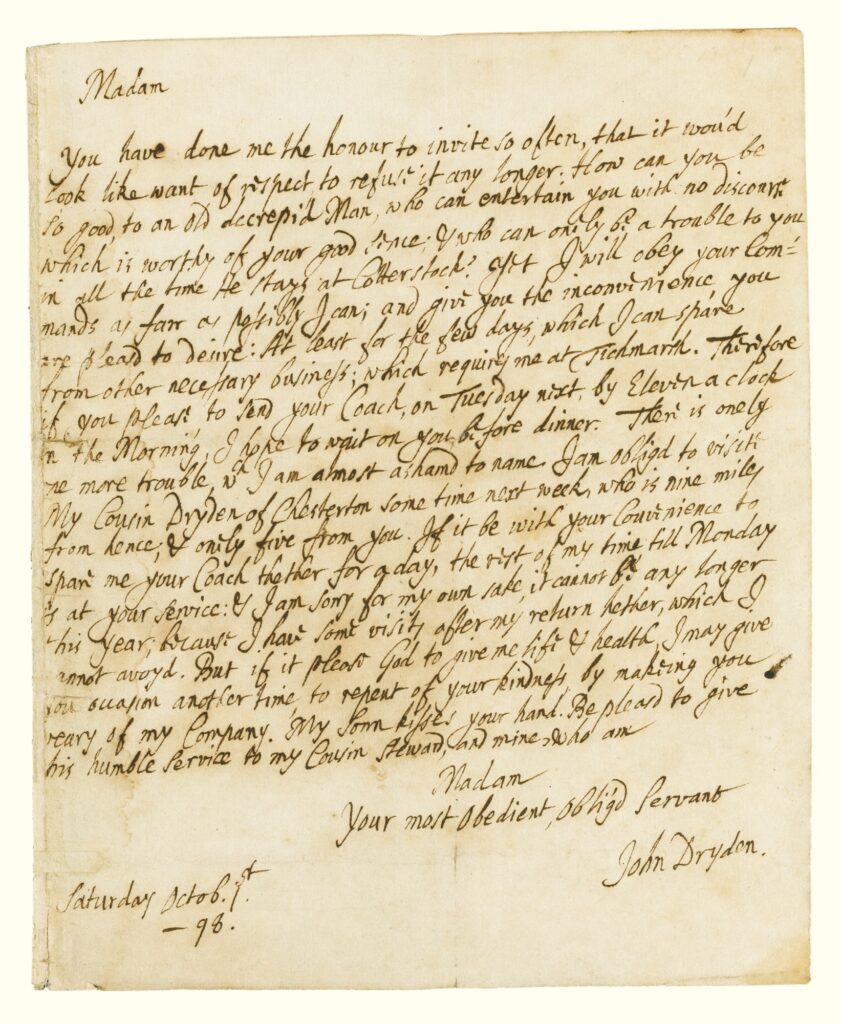
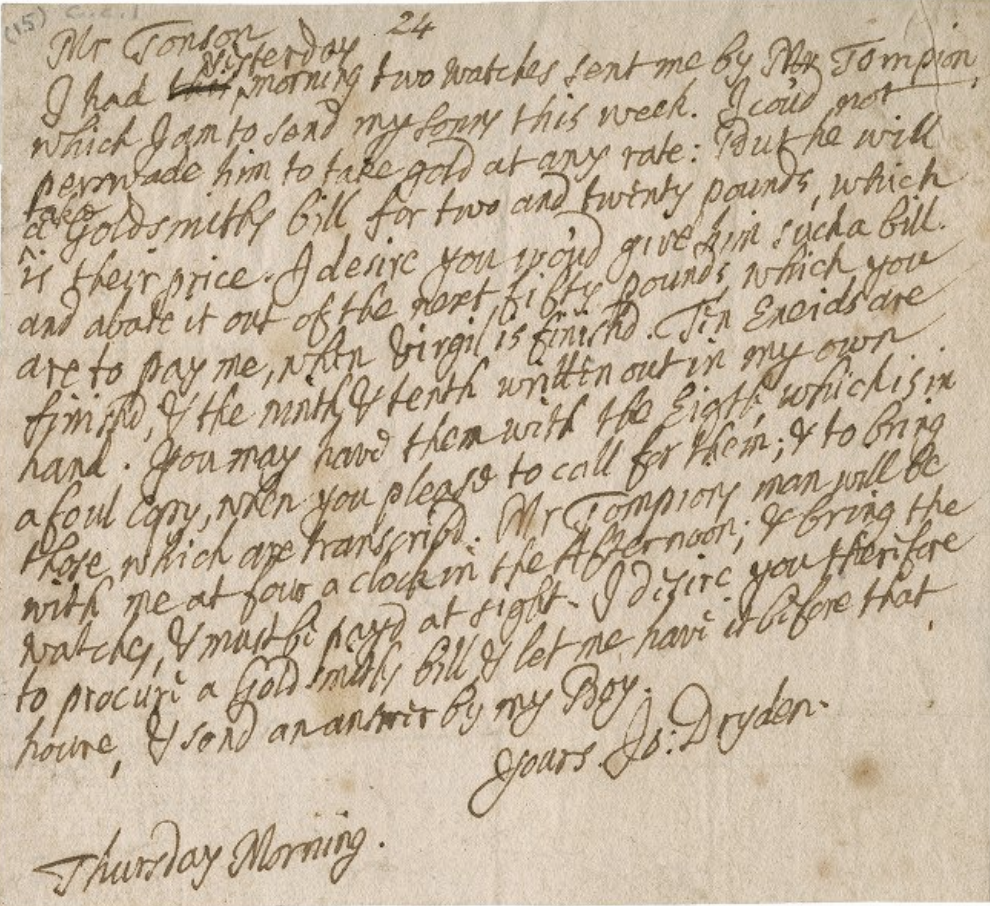
Publisher
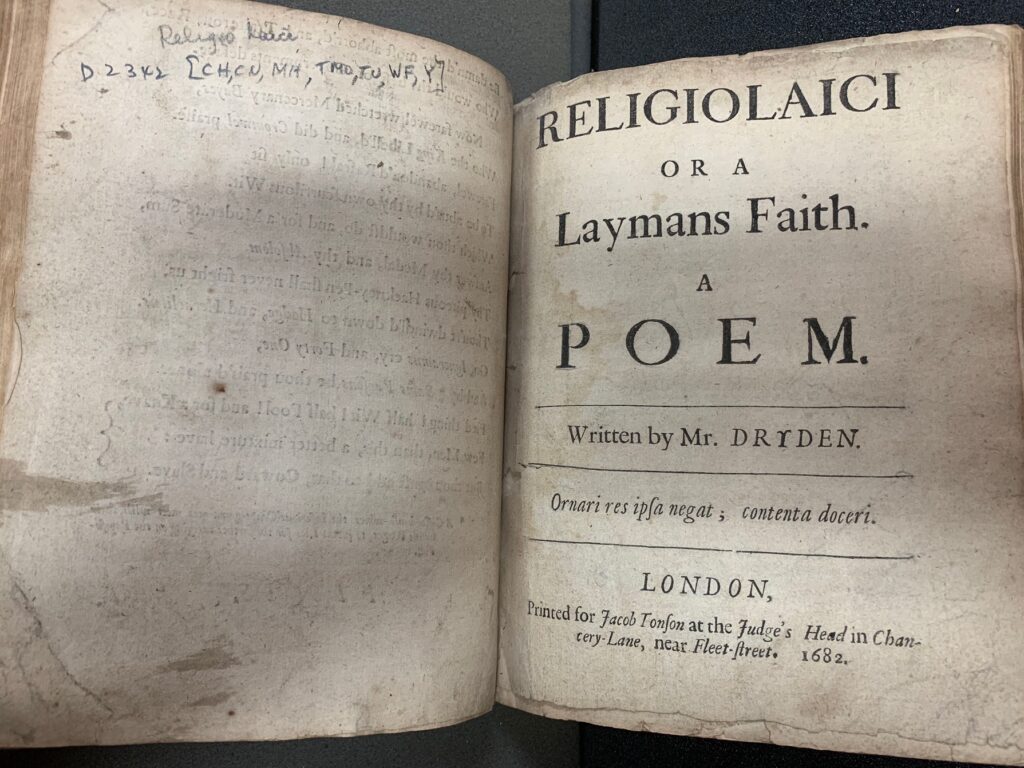
While this book is not one cohesive piece of literature but rather eight separate pamphlets with several manuscript additions, it is difficult to say if they all originate from the same publisher. However, the copy of The Hind and the Panther owned by Rare Books, Special Collections, and Preservation at the University of Rochester was published by Dryden’s favorite publisher Jacob Tonson.6 A total of three copies of The Hind in the Panther were published in 1867 by Jacob Tonson, with another two copies published by Dublin printers James Watson and Andrew Crook, respectively. As the copy of The Hind and the Panther included in this book was published in 1867, it is likely that Tonson published this version. Tonson may have published most, if not all, of the pamphlets in this book. Tonson is explicitly stated as the publisher on the title page of Religio Laici, though not all pamphlets include this same distinction.
Cultural Significance
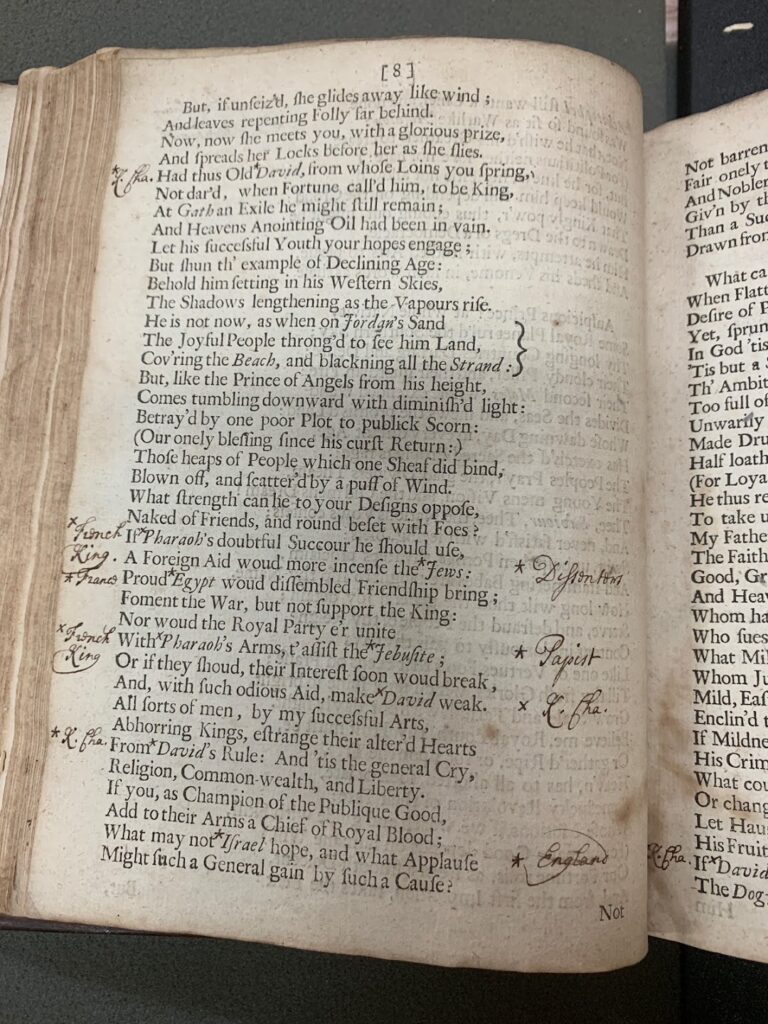
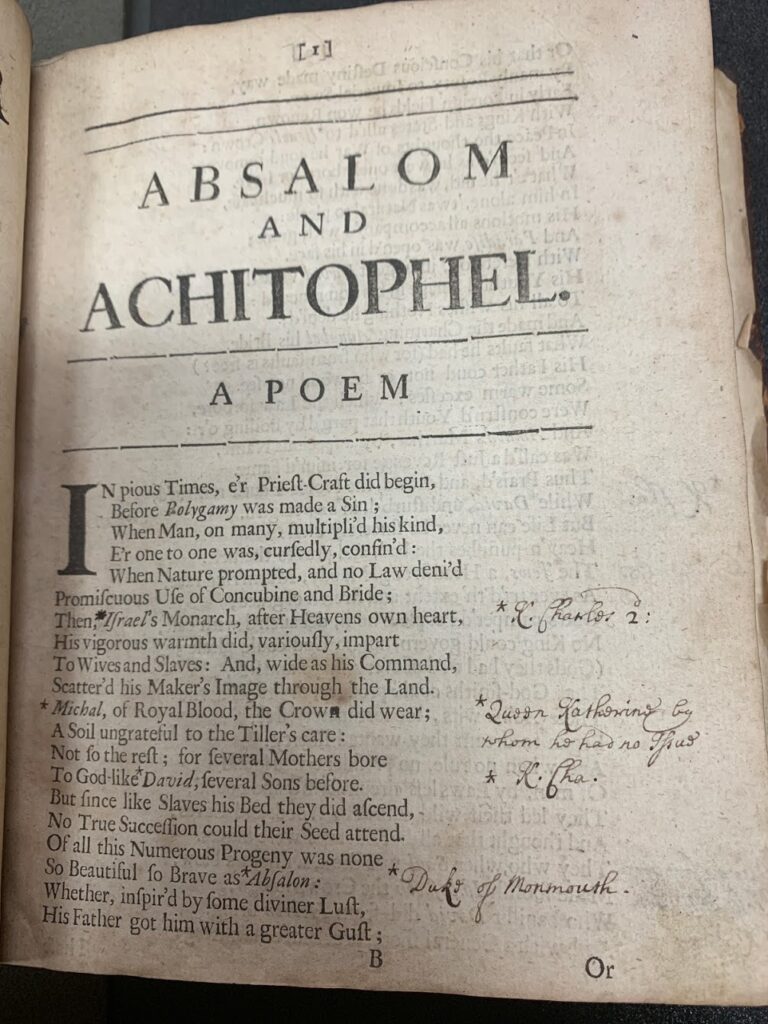
As one of the dominant figures in literature during Restoration England, much of Dryden’s work is an allegory of the social and political climate of the time.9 The hidden meaning behind his poem Absalom and Achitophel is unveiled by one of the annotators, with the true names of the characters written in the margins. Israel’s monarch is revealed to be King Charles, Absalom is James Scott, Duke of Monmouth, Israel is England, Sanhendrin is Parliament, etc.10 Examples of the marginalia are included below. This satirical poem uses Biblical allusions to explain the Monmouth Rebellion, which was an attempt to overthrow James II that led to the eventual execution of the eventual execution of James Scott, Duke of Monmouth, in 1685.11
Additional Provenance
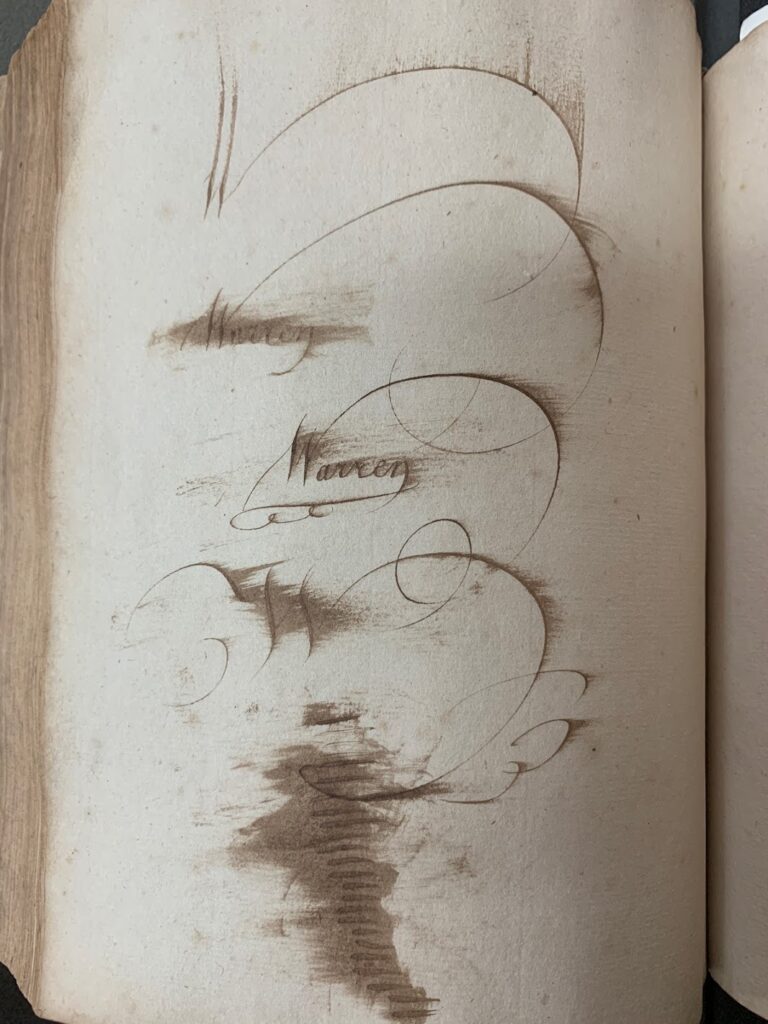
While the inscription on the title page of The Medal of John Bayes: A Satyr Against Folly and Knavery from Georgie and Johannes Henning is perhaps the most exciting piece of provenance in this book, the scribbles on the last eight pages of the book give us a little bit more insight on one of the potential owners. While most of the scribbles are quite literally, scribbles, and are nonsensical, one page shows what appears to be someone practicing their signature. The name “Warren” is written a couple times, with several letter ‘W’s filling the page as well. It is possible that this Warren may be one of the owners of this version of Dryden’s Poems. It is also possible that Warren was the object of the owner’s affection, and that this is the equivalent of a school girl writing her crush’s name in her notebook. It is even possible that Warren is not even a person connected to the ownership of this book at all. This is one of the many mysteries in tracing this book’s provenance.
On the next page, the phrase “nota bene” or “mark well, observe carefully” in Latin is written in a similar fashion as the name “Warren” on the previous page. It appears that this was written by the same person, as the handwriting between the two pages is the same. The first usage of the phrase “nota bene” in English literature was circa 172112, 21 years after Dryden’s death, and this phrase was written into this book anytime after that. This further dispels any thoughts that Dryden himself may have annotated this book.
1Sutherland, James R. “John Dryden.” Encyclopædia Britannica, Encyclopædia Britannica, Inc., 15 Aug. 2018,
www.britannica.com/biography/John-Dryden.
2Clingham, Greg. “Roscommon’s “Academy,” Chetwood’s Manuscript “Life of Roscommon,” and Dryden’s Translation Project.” Restoration: Studies in English Literary Culture, 1660-1700 26, no. 1 (2002): 15-26. http://www.jstor.org/stable/43293717.
3Revolvy, LLC. “”Wentworth Dillon, 4th Earl of Roscommon” Folders on Revolvy.com.” Revolvy. Accessed October 18, 2018.
https://www.revolvy.com/page/Wentworth-Dillon,-4th-Earl-of-
Roscommon.
4“John Dryden.” John Dryden: The Hind and the Panther. Accessed October 18, 2018. http://spenserians.cath.vt.edu/TextRecord.php? textsid=37340.
5Fujimura, Thomas H. “The Personal Drama of Dryden’s the Hind and the Panther.” PMLA 87, no. 3 (1972): 406-16. doi:10.2307/460899.
6Collection Highlight: Dryden, The Hind and the Panther | RBSCP. Accessed October 18, 2018. https://rbscp.lib.rochester.edu/4423.
7“Now Property From The Collection of Robert S Pirie Volumes I & II: Books and Manuscripts.” Dryden, John Autograph Letter Si ||| Letters ||| Sotheby’s N09391lot84qclen. Accessed October 18, 2018. http://www.sothebys.com/en/auctions/ecatalogue/2015/property- collection-robert-s-pirie-books-manuscripts-n09391/lot.332.html.
8” MEDIA INFORMATION.” Letter from John Dryden to Jacob Tonson: Autograph Manuscript Signed – LUNA: Folger Digital Image Collection. Accessed October 18, 2018.
https://luna.folger.edu/luna/servlet/detail/FOLGERCM1~6~6~667735-145696:Letter-from-John-Dryden-to-Jacob-To.
9Shmoop Editorial Team. “John Dryden in Restoration Literature.” Shmoop. November 11, 2008. Accessed October 18, 2018. https://www.shmoop.com/restoration-literature/john-dryden-author.html.
10″ Found in the Vault: Dryden’s Poems with Manuscript Additions.” Adversaria: Special Collections Provenance at MSU. January 23, 2014. Accessed October 18, 2018.
https://msuprovenance.wordpress.com/2014/01/23/found-in-the-vault-
drydens-poems-with-manuscript-additions/.
11Gregory, Jeremy, and John Stevenson. The Routledge Companion to Britain in the Eighteenth Century. New York: Routledge, 2007.
12” Nota Bene.” Merriam-Webster. Accessed October 18, 2018. https://www.merriam-webster.com/dictionary/nota bene.
Created by Alexis McCarroll for Professor Brockey’s HST 475, Michigan State University, Fall 2018.
