
JOHN FORTESCUE
London: For the comapanie of stationers
XX KD600.F613 1616
ABOUT THE BOOK
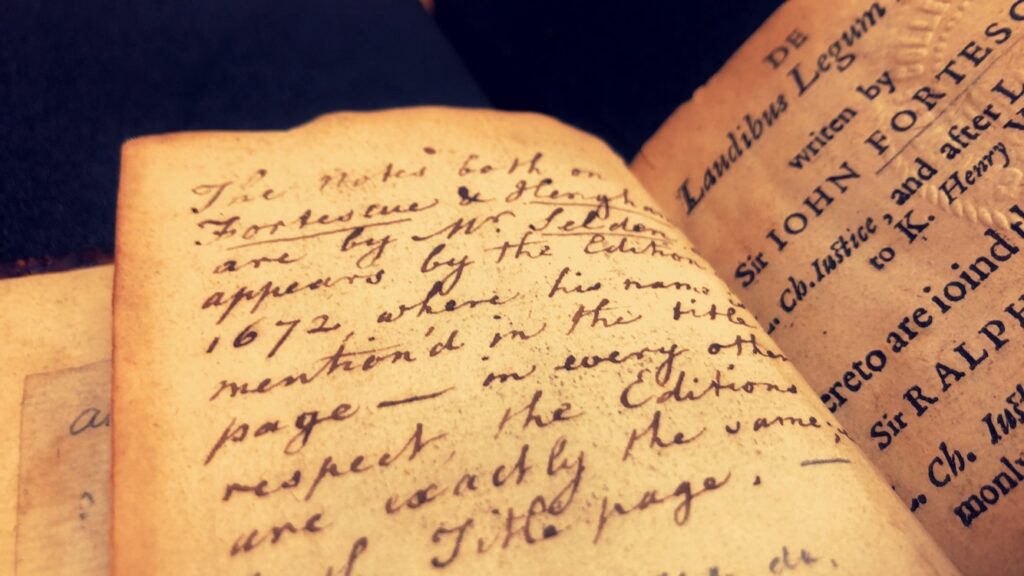
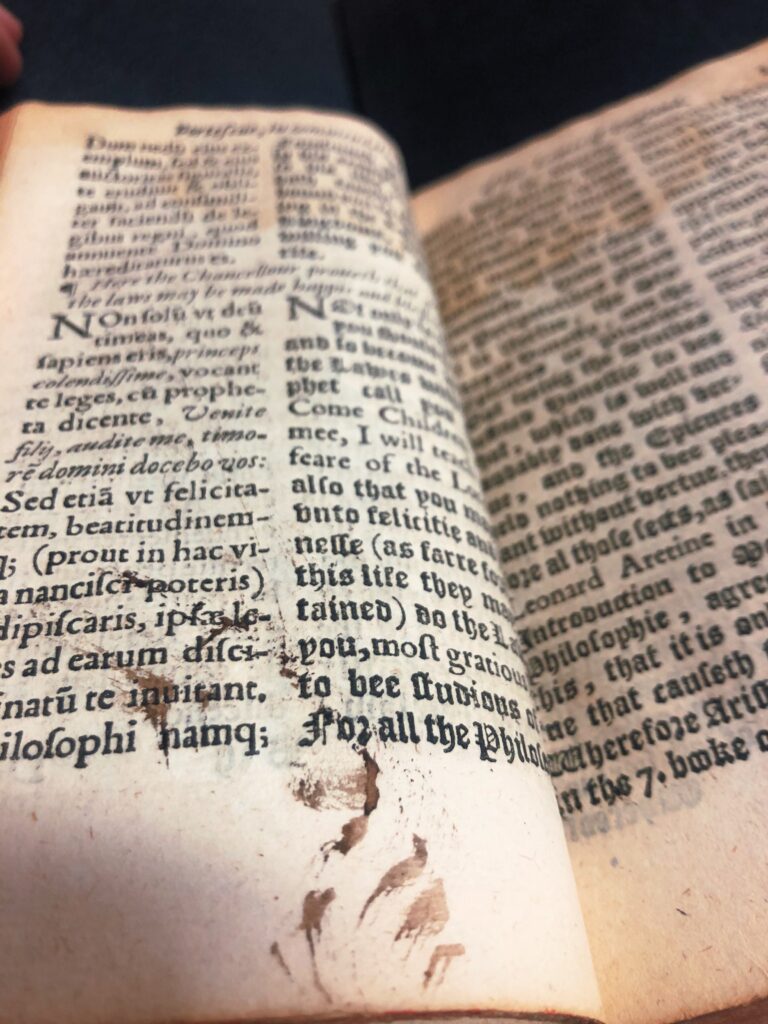
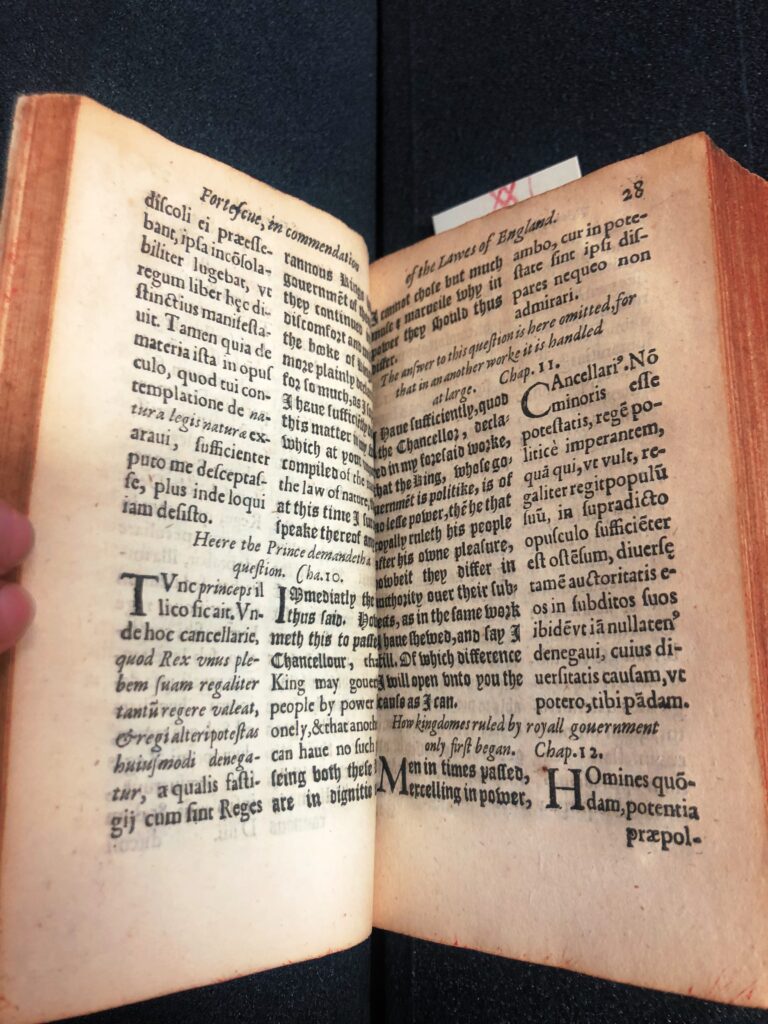
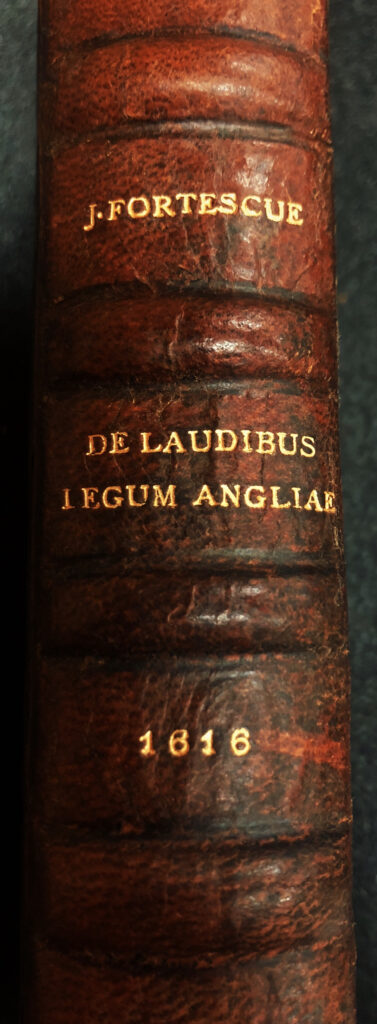
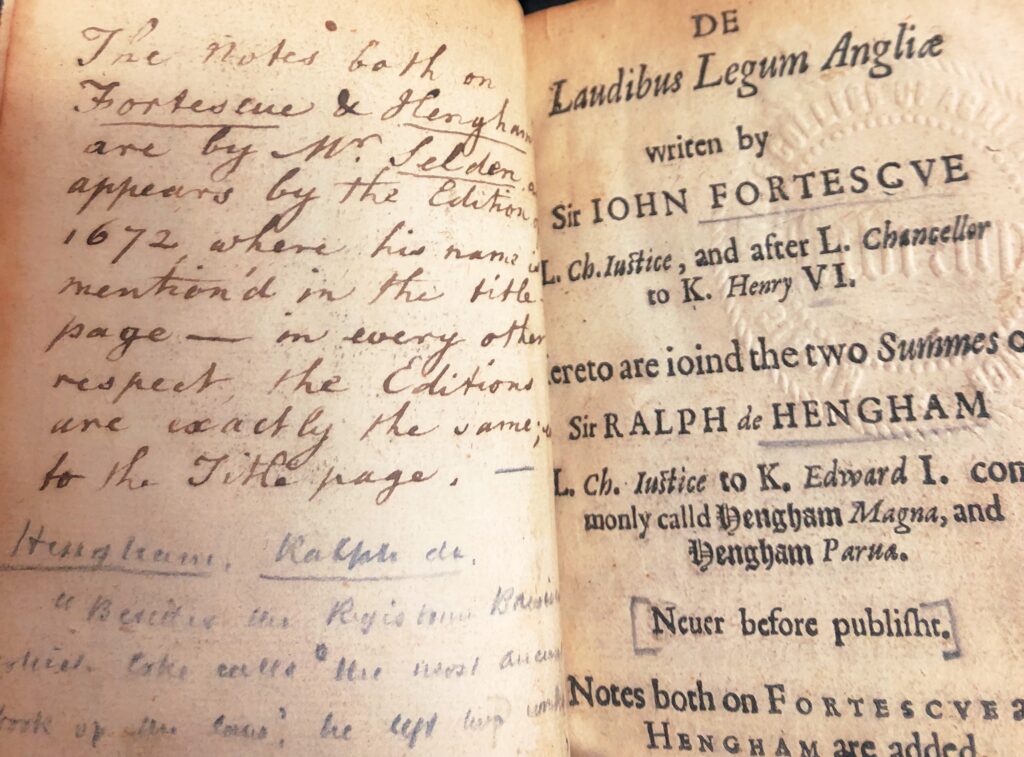
Translated to “In Praise of the Laws on England,” this is a 15cm leather book containing 159 pages total and with pages that are in original condition. It also has a pasted in book plate, previously owned by Sir John Duntze, including numerous markings throughout the text, both in Latin and in English. This copy contains notes both on Fortescve and Hengham that were added, as well as notes by John Selden and translated by Robert Mulcaster. Binding with the title, author, and year embossed in gold leaf and in great condition. As one of John Fortescue’s most notable pieces, De laudibus legum Angilae is a book on English law created in the wake of Lancastrian restoration in order to educate Edward, Price of Wales and son to King Henry VI in concepts of governing [1]. This is likely to be the first book on this topic written in such a lucid yet easily comprehensible form [3]. Presumably created on a larger medium, this copy is small enough for the common man to carry and descriptive enough for the layman to understand. It counters Roman derived civil law, holding highest regards to the English constitution.
During this time period of its print, the Church had once taken a leading role in establishing governance had faced disastrous turmoil during the years of the Reformation, so this publication reinforced the larger pressure for the government to provide the regulations for society. The manufacturing of this book in 1616 provided the public with a traditional English code of ethics in order to govern its people and also encouraged a set of morals to extend to more people for educating them in the political process. Fortescue established a moral in this work that is still practiced by Anglo-Americans, the belief that it is best let someone remain guilty remain free than be prosecuted innocently [1]
MORE ON JOHN FORESCUE
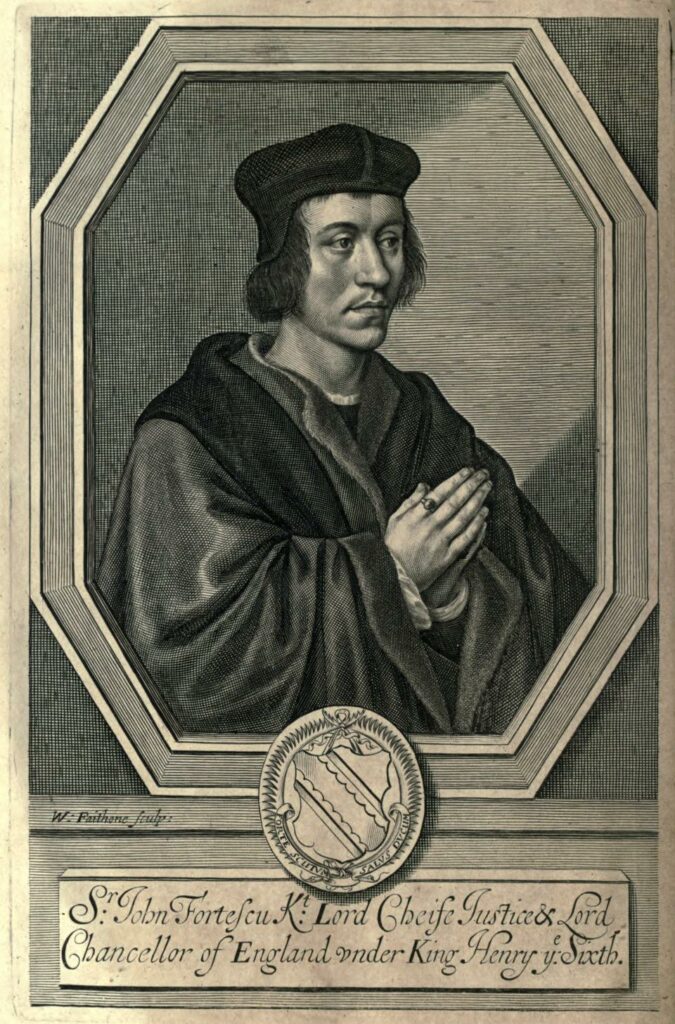
Although many discrepancies have clouded the dates Fortescue was alive for, it was estimated to be around 1385-1479. He began his political career around the 1420s as a lawyer to eventually opening his own practice [2] later, serving in Parliament in 1442 as the Chief Justice of the King’s Bench [3]. Facing many hardships unto his exile, he moved to France and worked in helping Prince Edward prepare to rule England in later years [2] to which he was wholly devoted. Yet, by 1471, the House of Lancaster fell and he was accused of treason and captured in England, eventually being released to retire in his home until his death several years later. He particularly studied the English Constitution and English law throughout his career.
CHAIN OF CUSTODY
The earliest dated sign of ownership is that of Sir John Duntze, consisting of a book plate with a coat of arms with BART as a signifier of his title. Sir John Duntze was born an English merchant who developed a career in politics by serving as a member of Parliament until his death in 1795[5]. His career faltered as he developed gout and absenteeism drove him officially out of politics, ultimately to his passing soon later. [2]
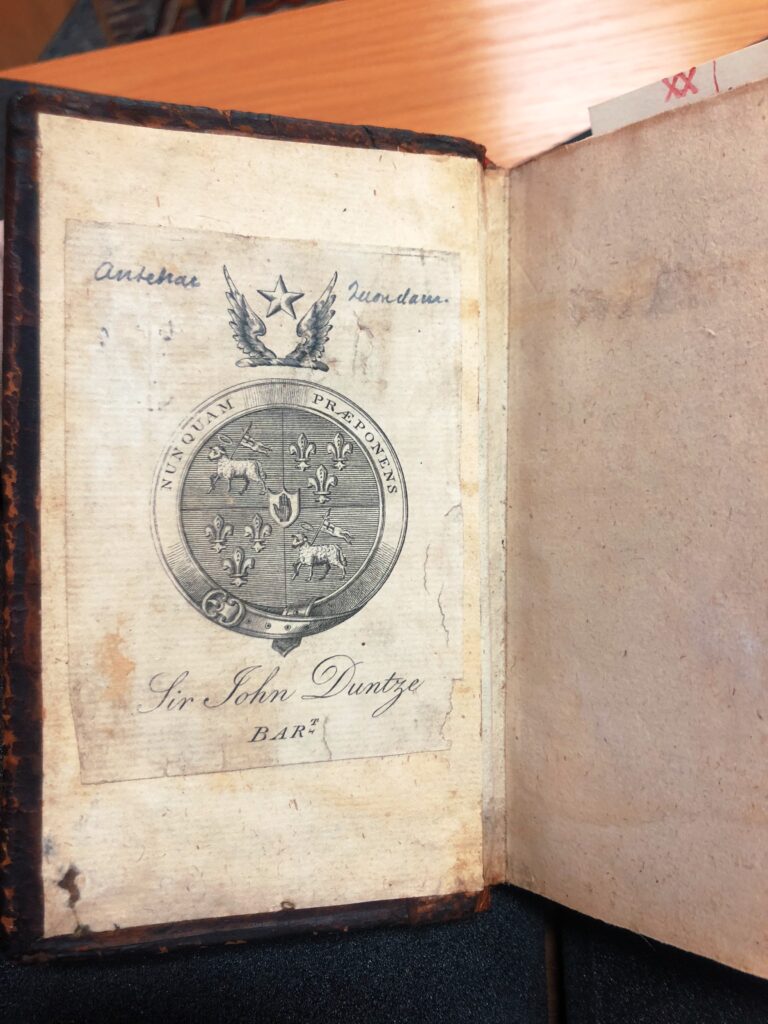
It is possible this could have been placed by either of his sons who also carried the same first and last name who also held titles of baronetage and carried political interests. [4]
The next marking is from an unnamed source in pencil that seemed to post-date John Dunzte because the marking follow or are layered above his writings. It is dated 1741, although this date would incur John Duntze to be only 6 years old at the time of ownership. This could mean the note to the reader was not written by Duntze, but there is not much of an explanation for the pencil inscriptions on the coat of arms.
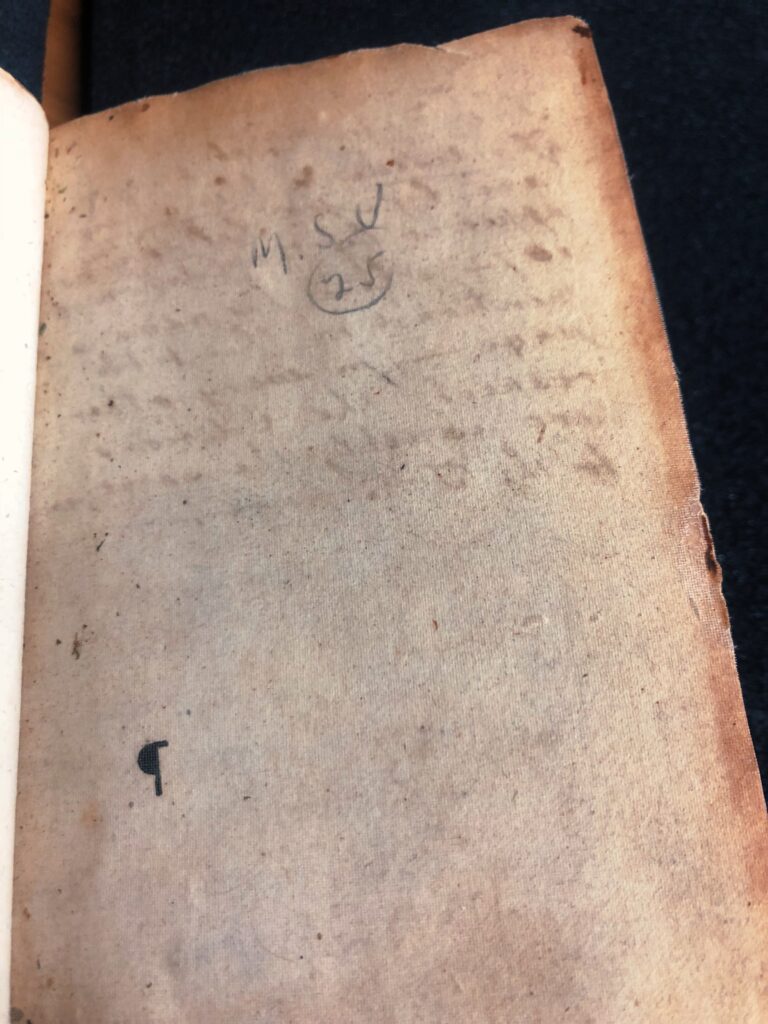
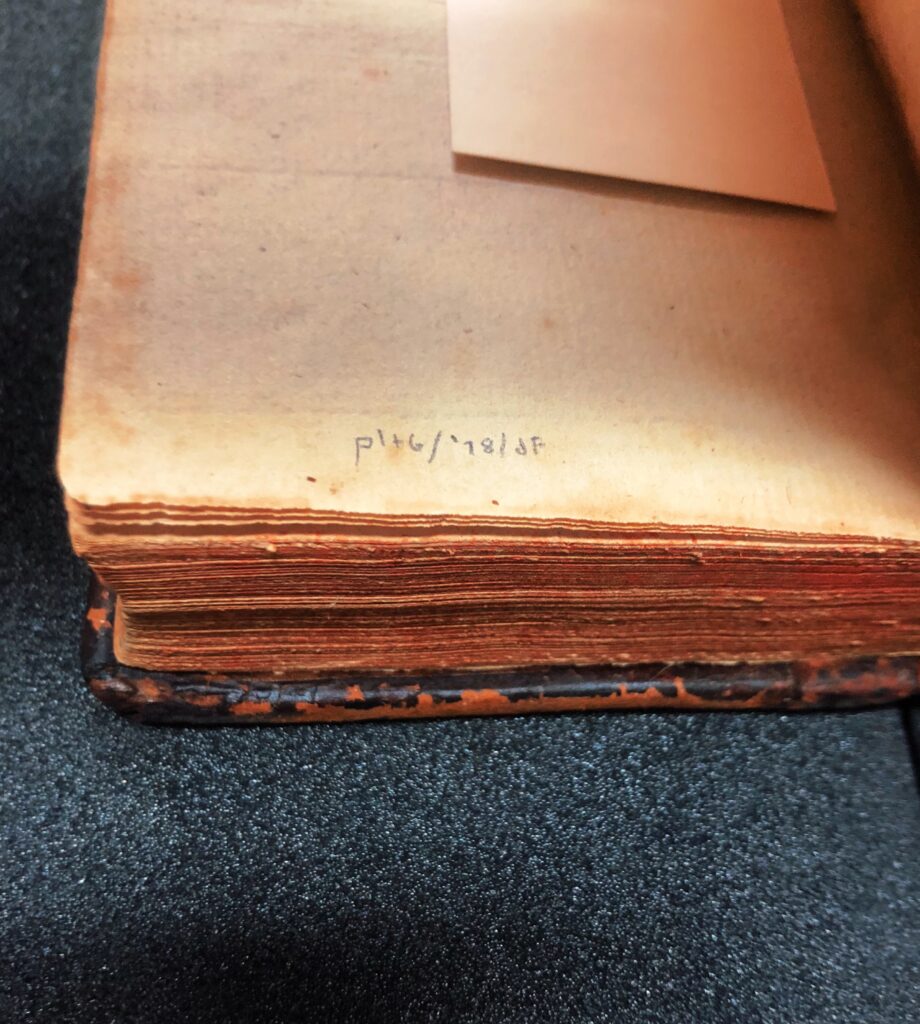
Two more pencil notes indicating what appears to be a type of organizational system, likely used by the MSU library, ‘P’ possibly reflecting it’s topic in politics, as well as the year ’78 and the initials of the author, J.F. The second is unclear what the numbers pertain to, but it is presumable they we classified in a particular set.
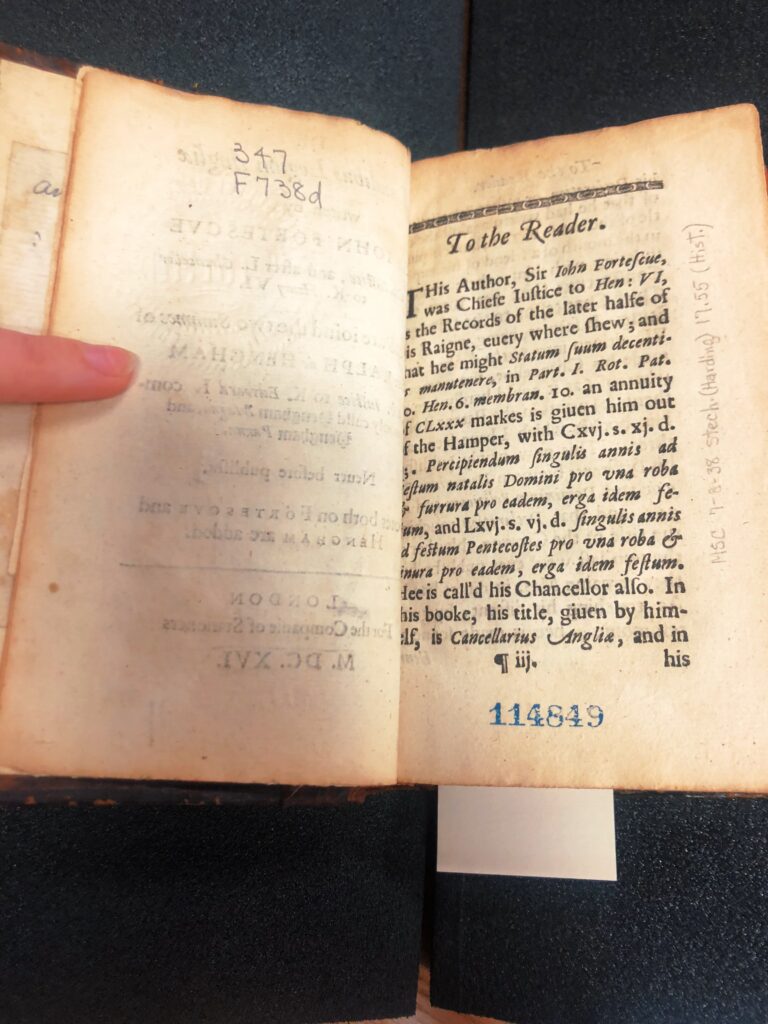
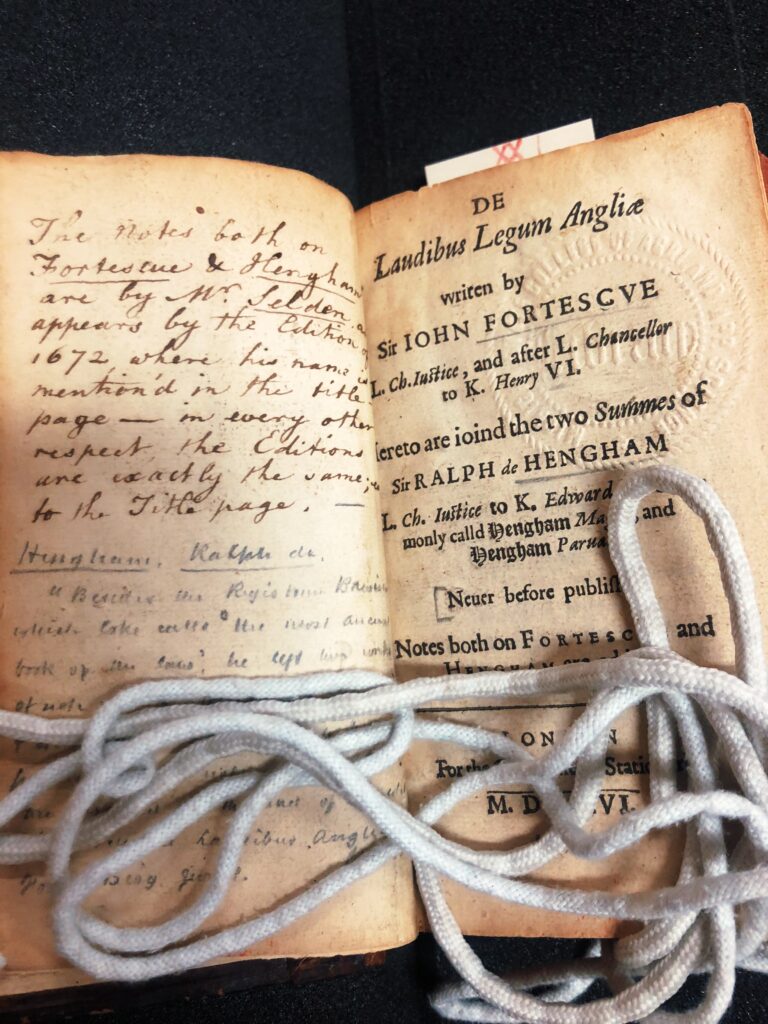
This fell into Michigan State University’s hands between 1935-1955, due to the embossed stamp, when the school was under the name ‘Michigan State College of Agriculture and Applied Science.’ [6]
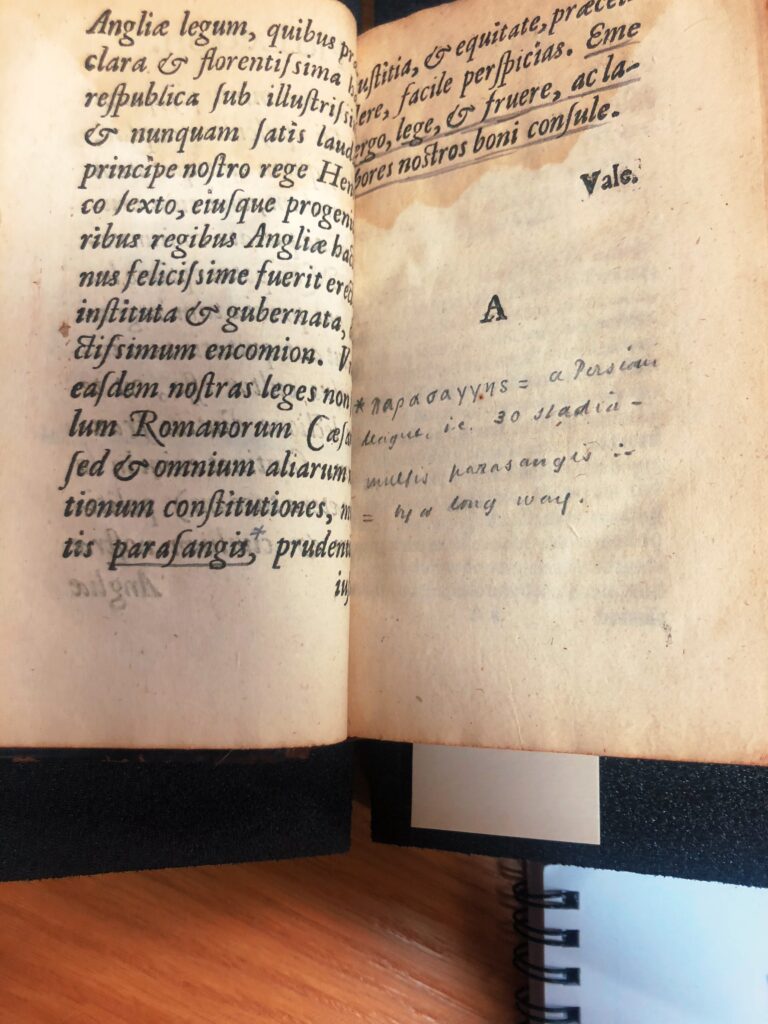
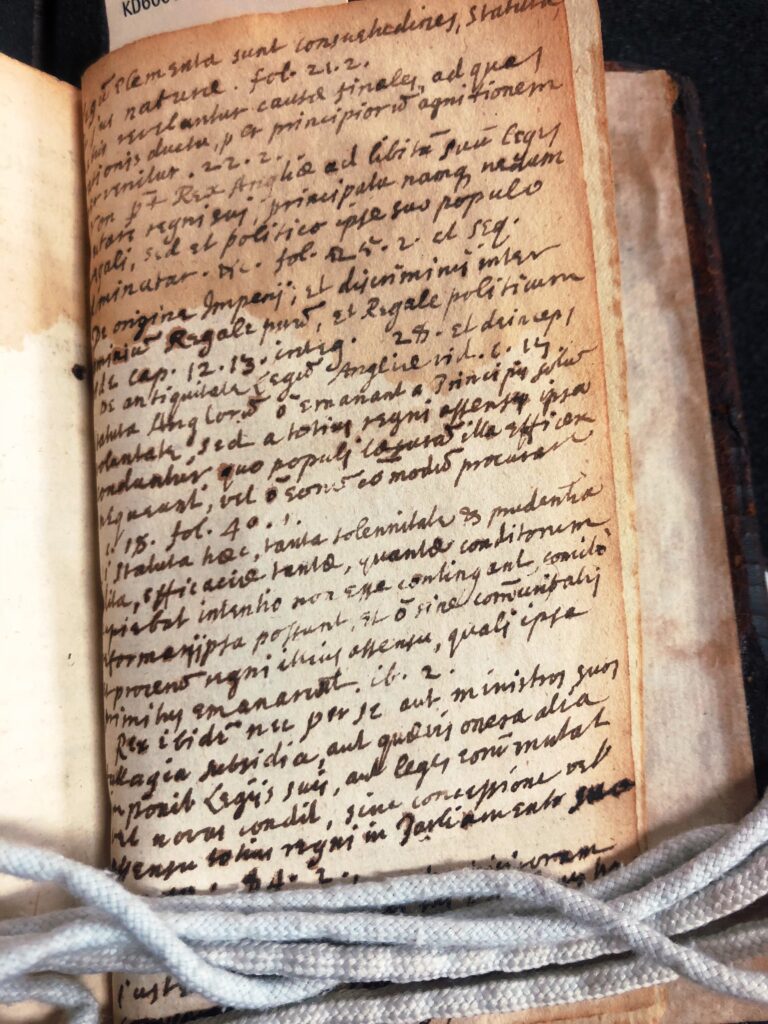
These are some miscellaneous entries, one denoting Persian writing and some notes following, as well as page long note, mostly in Latin, with ink that is similar to our first owner, but the handwriting doesn’t hold much resemblance.
REFERENCES
- The Editors of Encyclopedia Britannica, “Sir John Fortescue, English Jurist” Encyclopedia Britannica, (February 2012). https://www.britannica.com/biography/John-Fortescue
- L.S. Woodger, “FORTESCUE, John (d.1479), of Devon” History of Parliament https://www.historyofparliamentonline.org/volume/1386-1421/member/fortescue-john-1479
- The Editors of Encyclopedia Britannica, “Sir John Fortescue, English Jurist” Encyclopedia Britannica, (Feb 2012). https://www.britannica.com/biography/John-Fortescue
- J. and W. T. Clarke, “Debrett’s Baronetage,” London (1555) https://books.google.com/books?id=DUcRAQAAIAAJ&pg=RA1-PA205&lpg=RA1-PA205&dq=%22arms%22+sir+john+duntze&source=bl&ots=mXbl- HD_Q2&sig=tQN9lcDKTsKnLueveTSitpOXRDI&hl=en&sa=X&ved=2 ahUKEwjCoffEzJPeAhUszoMKHfpJB4wQ6AEwCXoECAgQAQ#v=o nepage&q=%22arms%22%20sir%20john%20duntze&f=false
- W.H.K. Wright, “Journal of the Ex Libris Society” Volume 5 https://books.google.com/books?id=AFFRAQAAMAAJ&pg=PA135&lpg=PA135&dq=sir+john+duntze+books&source=bl&ots=21RY9pYI9J&sig=GpXtw5s-9yqBN290XaZzPqmp8yc&hl=en&sa=X&ved=2ahUKEwi_qfnbyJPeA hUI8YMKHUp4ALOQ6AEwD30ECAkQAQ#v=onepage&q=sir%20john%20duntze%20books&f=false
- University Archives and Historical Collections, “Timeline” http://onthebanks.msu.edu/Timeline/1-7-A/michigan-state- university-has-had-six-different-names-in-its-history/
Created by Emily C. Smith for Professor Brockey’s HST 475, MSU, Fall 2018.
